Report based on story by Ashley Brugnone, CMP Writer/Editor
Would you like to learn AR marksmanship under the tutelage of world-class USAMU team members? Then consider attending the Civilian Marksmanship Program’s Rifle Small Arms Firing School (SAFS), held Wednesday, July 16-17, during the National Rifle and Pistol Matches at historic Camp Perry. SAFS courses have been conducted at the National Matches since 1918. Hundreds of rifle participants are expected this year.
The school is structured toward teaching new shooters, so no past firearm experience is required. Intermediate shooters are also welcome to participate. Students will learn basic firing practices and competition skills. In addition to the live fire practice, students will compete in an EIC Match. All participants will be instructed by members of the U.S. Army Marksmanship Unit (USAMU) and coached by Military Rifle Team Members or CMP Rifle Master Instructors.
For those already familiar with rifle shooting, an Advanced Rifle Course will also be held to provide additional class instruction and the chance to fire in a special Excellence-In-Competition (EIC) Match. Whether an experience shooter or picking up a firearm for the first time, come enjoy a day of fellowship and fun in one of America’s oldest pastimes with the security and knowledge of some of the best marksmen in the country!
Shooting Industry Magazine has released a helpful blog article concerning airline travel and firearms. Written by well-known shooting instructor, gun writer (and part-time police officer) Massad Ayoob, the article covers key points travelers must understand before carrying firearms into an airport zone. In his article Flying with Firearms, Ayoob warns travelers that “State gun laws change frequently” and that “our country is a 50-piece patchwork quilt of gun laws”.
Here are some of the recommended resources gun-toting travelers should consult before they head to any airport in the United States:
Flying with Firearms — Familiarize Yourself With The Laws by Massad Ayoob
State gun laws change frequently, including reciprocity on concealed-carry permits even in the gun-friendly “red states.” Here are a few sources I recommend for you and your customers.
Online, the best and most up-to-date source of gun laws I’ve found is www.Handgunlaws.us. For smart phones, the best app I can recommend is Legal Heat (www.mylegalheat.com).
The Transportation Security Administration (TSA) and the Federal Aviation Administration (FAA) are the authoritative sources on flying with firearms.
The controlling TSA regulation can be found at www.tsa.gov, search “Firearms.” The FAA’s controlling regulation is 108.11. To view the FAA’s controlling regulation, visit the U.S. Government Printing Office: www.gpo.gov/fdsys, click “Advanced Search” and enter “14 CFR 108.11” — the first result contains the report.
Here’s a special promotion that could save you $10 – $20 or more when purchasing products from Brownells.com. To celebrate its 75th Anniversary, Brownells is offer a seventy-five cent shipping special. Now through Friday, June 6th, orders over $75.00 ship for just $0.75 (seventy-five cents). To get this special price on standard shipping, use code FB6 during the online check-out process.
This 75/75 shipping promotion ends at 11:59 pm CDT on June 6, 2014. This is valid for standard domestic shipping only, and does NOT include hazmat fees or other special handling charges.
Looking for an up-to-date, comprehensive resource on “tactical” bolt guns, AR-platform rifles, and defensive-style shotguns? Then check out this 500+ page book by “Blue Book” author S.P. Fjestad. The new 5th Edition of the Blue Book of Tactical Firearms Values is the most complete reference book for tactical rifles, handguns, and shotguns. The 5th Edition, published in April 2014, features both new and older tactical guns with detailed model descriptions and current MSRP. All values have been updated to reflect current market conditions.
Book Has Glossary and Manufacturers Index
This unique resource includes an updated tactical glossary defining tactical terms with helpful links and illustrations. The book also includes updated directories of firearms, gear, optics, and accessory manufacturers with complete contact information. Almost 200 AR-15 manufacturers and trademarks are covered. Most of the information contained in this 5th Edition of the Blue Book of Tactical Firearms Values is not available anywhere else. Author/publisher S.P. Fjestad is an expert on collectible antique and modern firearms. His best selling Blue Book of Gun Values, the industry standard reference source, has over 1 million copies in circulation worldwide.
Imagine you’re out in the field and your scope fails or you have a malfunction with your iron sights (maybe the front blade snaps off). You’d think that means you can’t shoot anymore. Well think again. In fact, as Kirsten Joy Weiss demonstrates in this video, it IS possible to shoot a rifle without a scope or conventional sights — and one can do so with surprising accuracy. Trick shot artist Kirsten shows how you can align a corner of your action with a spot at the end of the barrel to aim at your target. With no sights, Kirsten manages to shoot a very respectable group — drilling 4 of 7 shots in one ragged hole.
Watch Kirsten Put 4 of 7 Shots in One Ragged Hole with No Sights
Kirsten created another video earlier this year, where she also did some precision shooting without sights, hitting a pair of bottle-caps at 25 yards. CLICK HERE for Kirsten Bottle Cap Video.
J.G. Anschütz GmbH & Co. KG (Anschütz), elite German manufacturer of airguns and rimfire arms, recently announced the launch of Anschütz North America (Anschütz NA), a subsidiary enterprise based in the USA. Anschütz NA will distribute and market rifles and shooting accessories for the US market. Importantly, Anschütz NA will provide after-sales service and Warranty work for Anschütz products. Anschütz NA will commence business activities in the USA on July 1, 2014.
Jochen Anschütz, president of J.G. Anschütz GmbH & Co. KG in Ulm, Germany noted, “The USA is a powerful market with a huge demand for Anschütz premium quality rifles. Over the years, the continued interest from the American hunters and target shooters in our fine hunting and high-precision target rifles has given us the confidence to further grow and support this important market.”
“While attending the 2014 SHOT Show in Las Vegas … both I and my father, Dieter Anschütz, [realized] that not only do we need to continue to provide our excellent rifles, but [we need] also to expand our legendary Anschütz service here in America,” he said. “We feel that the best way to support this new growth is to take the distribution and sales service into our own hands.”
Anschütz NA will offer Anschütz after-sales service for all company products, as well as warranty support, repairs, spare parts, and tech info. The established Anschütz distribution chain and main dealer network in the US will continue to operate as before. To learn about Anschütz NA services, contact Customer Relations Manager Steven Boelter at: steven.boelter [at] @anschuetz-sport.com.
Model 1727F (17 HMR) Rifle with Fortner Straight-Pull Action
Lyman’s popular E-Zee Case Length Gauge is now bigger and better. The new version II of Lyman’s Case Gauge is much larger than the original version. The Case Gauge II now measures more than 70 cartridge types — way more than before. This tool is a metal template with SAAMI-max-length slots for various cartridge types, including relatively new cartridges such as the .204 Ruger and Winchester Short Magnums. This tool allows you to quickly sort brass or check the dimensions. If you have a bucketful of mixed pistol brass this can save you hours of tedious work with calipers. You can also quickly check case lengths to see if it’s time to trim your fired brass.
If you load a wide variety of calibers, or do a lot of pistol shooting, we think you should pick up one of these Lyman Case Gauge templates. They are available for under twenty bucks at Sinclair Int’l and Amazon.com. The folks at Sinclair say the E-Zee Case Gauge II has a been a hot seller.
Case Gauge Should Last a Lifetime
Easily measure the case length of over 70 popular rifle and pistol cases with Lyman’s new E-Zee Case Length Gauge II.
This rugged, precisely-made metal gauge makes sorting or identifying cases fast and accurate. The template is machined with SAAMI max recommended case lengths. Made from metal, with no moving parts, the E-Zee Case Gauge II should last a lifetime.
When we first ran this story a while back, it generated great interest among readers. By popular request, we’re reprinting this story, in case you missed it the first time around. — Editor
Precision shooters favor premium brass from Lapua, Norma, or RWS. (Lake City also makes quality brass in military calibers.) Premium brass delivers better accuracy, more consistent velocities, and longer life. Shooters understand the importance of good brass, but many of us have no idea how cartridge cases are actually made. Here’s how it’s done.
The process starts with a brass disk stamped from strips of metal. Then, through a series of stages, the brass is extruded or drawn into a cylindrical shape. In the extrusion process the brass is squeezed through a die under tremendous pressure. This is repeated two or three times typically. In the more traditional “draw” process, the case is progressively stretched longer, in 3 to 5 stages, using a series of high-pressure rams forcing the brass into a form die. While extrusion may be more common today, RWS, which makes some of the most uniform brass in the world, still uses the draw process: “It starts with cup drawing after the bands have been punched out. RWS cases are drawn in three ‘stages’ and after each draw they are annealed, pickled, rinsed and subjected to further quality improvement measures. This achieves specific hardening of the brass cases and increases their resistance to extraordinary stresses.” FYI, Lapua also uses a traditional draw process to manufacture most of its cartridge brass (although Lapua employs some proprietary steps that are different from RWS’s methods).
After the cases are extruded or drawn to max length, the cases are trimmed and the neck/shoulder are formed. Then the extractor groove (on rimless cases) is formed or machined, and the primer pocket is created in the base. One way to form the primer pocket is to use a hardened steel plug called a “bunter”. In the photos below you see the stages for forming a 20mm cannon case (courtesy OldAmmo.com), along with bunters used for Lake City rifle brass. This illustrates the draw process (as opposed to extrusion). The process of draw-forming rifle brass is that same as for this 20mm shell, just on a smaller scale.
River Valley Ordnance explains: “When a case is being made, it is drawn to its final draw length, with the diameter being slightly smaller than needed. At this point in its life, the head of the draw is slightly rounded, and there are no provisions for a primer. So the final drawn cases are trimmed to length, then run into the head bunter. A punch, ground to the intended contours for the inside of the case, pushes the draw into a cylindrical die and holds it in place while another punch rams into the case from the other end, mashing the bottom flat. That secondary ram holds the headstamp bunter punch.
The headstamp bunter punch has a protrusion on the end to make the primer pocket, and has raised lettering around the face to form the headstamp writing. This is, of course, all a mirror image of the finished case head. Small cases, such as 5.56×45, can be headed with a single strike. Larger cases, like 7.62×51 and 50 BMG, need to be struck once to form a dent for the primer pocket, then a second strike to finish the pocket, flatten the head, and imprint the writing. This second strike works the brass to harden it so it will support the pressure of firing.”
Thanks to Guy Hildebrand, of the Cartridge Collectors’ Exchange, OldAmmo.com, for providing this 20mm Draw Set photo. Bunter photo from River Valley Ordnance.
What anti-corrosion products really fight rust effectively? You’ll hear many opinions, but what do actual field tests reveal? One rifle shooter, who posts on YouTube as BlueonGoldZ, wanted to separate myth (and marketing claims) from reality, so he completed his own long-term rust test using metal samples. First he used ordinary tap water spray, and then he did a second, longer-duration test with a salt-spray solution. Nine different products were tested: Break Free CLP, Corrosion-X, Frog Lube, M-Pro 7, Outers, Pro-Shot Zero Friction, Rem Oil, Slip 2000, and Tetra Gun Triple Action CLP.
BlueonGoldZ initially examined each product for its “beading” properties with a normal tap water spray. But the main test involved many multiple weeks of exposure after a “dense” salt-water spray. (No rust formed after two weeks tap water exposure, so the test was accelerated with salt-water exposure).
The clear winners in the test, as shown by the screen shot above, were Corrosion-X (Best), and Frog-Lube (Second Best). The photo shows the test samples two weeks after being sprayed with salt water. The results are pretty dramatic — you can see with your own eyes what happened. We think this is a very useful bit of real-world research.
Results from Similar Long-Term Salt Exposure Test
Unfortunately, BlueonGoldZ’s test did NOT include Eezox, which we have found to be extremely effective (on a par with Corrosion-X). In another long-term test of corrosion preventatives, the two best rust fighters were Eezox and Corrosion-X in that order. Since that test was completed, Corrosion-X, already an excellent product, has been enhanced. CLICK HERE for Long-Term Salt Exposure Test Report.
Our friend Dennis Santiago recently recreated the “Mad Minute”, a marksmanship drill practiced by the British Army in the decades preceding World War I. Dennis, an active high power rifle competitor and instructor, enjoyed his “Mad Minute” exercise, though he assures us that this takes practice to perfect. Dennis tells us: “Here is a ‘Mad Minute’ drill, done using a period correct Lee-Enfield (SMLE) No.1 Mk III rifle and Mk VII ammo. I got to the Queen’s Regulations (15 hits in one minute) on the second run and put a good group on the target at 200 yards. This is ‘jolly good fun’ to do every once in a while. This is ‘living history’ — experiencing a skill from a time when the sun never set on the British Empire.”
“Mad Minute” was a pre-World War I term used by British Army riflemen during training at the Hythe School of Musketry to describe scoring a minimum of 15 hits onto a 12″ round target at 300 yards within one minute using a bolt-action rifle (usually a Lee-Enfield or Lee-Metford rifle). It was not uncommon during the First World War for riflemen to greatly exceed this score. The record, set in 1914 by Sergeant Instructor Alfred Snoxall, was 38 hits. (From WikiPedia.)
Want to See More “Mad Minute” Action with a Modern Tubegun?
In 2012, Gary Eliseo ran a “Mad Minute” exercise using a modern, .308 Win Eliseo RTM Tubegun of his own making. Gary ended up with 24 hits on a bull target set at 300 yards. (Gary actually had 25 hits in 25 rounds fired, but the last round hit just after the 60-second time period expired.) Note how Gary pulls the trigger with the middle finger of his right hand. This allows him to work the bolt faster, using his thumb and index finger. CLICK HERE for Eliseo Tubegun Mad Minute story.
Watch Gary Elesio Shoot the ‘Mad Minute’ (Starts at 4:47 on Video)
NOTE: In an interesting coincidence, Dennis Santiago was actually in the pits pulling targets for Gary during Eliseo’s 2012 “Mad Minute” exercise.
History of the Mad Minute Commentary by Laurie Holland
The original military requirement of the “Mad Minute” saw the soldier ready to fire with a round in the chamber, nine in the magazine, safety on. This course of fire is still followed by the GB Historic Breechloading Arms Association and other bodies in their recreated “Mad Minute” competitions.
The first 10 would go quickly, but reloads were critical, this not done by a magazine change as Gary did with the RTM or in a modern tactical or semi-auto rifle, but through slick use of ‘chargers’. It is this aspect which fouls so many of my colleagues up as it is very easy to cause a jam and a large part of 60 seconds can go in sorting it out!
Charger clips were selected for those that just held the rounds firmly enough to stop then falling out, were sand-papered and polished with a stove / fireplace polish called ‘Zebrite’ so that the rimmed rounds would slip through the clips like corn through a goose.
If you’re unfamiliar with the cock-on-closing Enfield action, it seems clumsy. With intensive practice it is very smooth and can be operated incredibly quickly. The trick is to whip the bolt back onto its stop and initiate a rebound movement that takes it and the cartridge well into the chamber thereby reducing the effort required to close the bolt and chamber the round.


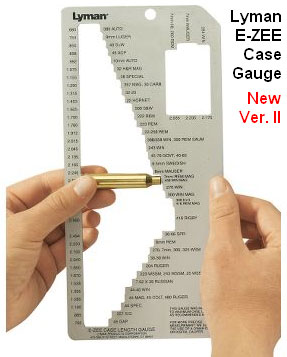 Lyman’s popular E-Zee Case Length Gauge is now bigger and better. The new version II of Lyman’s Case Gauge is much larger than the original version. The Case Gauge II now measures more than 70 cartridge types — way more than before. This tool is a metal template with SAAMI-max-length slots for various cartridge types, including relatively new cartridges such as the .204 Ruger and Winchester Short Magnums. This tool allows you to quickly sort brass or check the dimensions. If you have a bucketful of mixed pistol brass this can save you hours of tedious work with calipers. You can also quickly check case lengths to see if it’s time to trim your fired brass.

 Precision shooters favor premium brass from


 Lee-Enfield No. 4 Rifle (1943), courtesy


