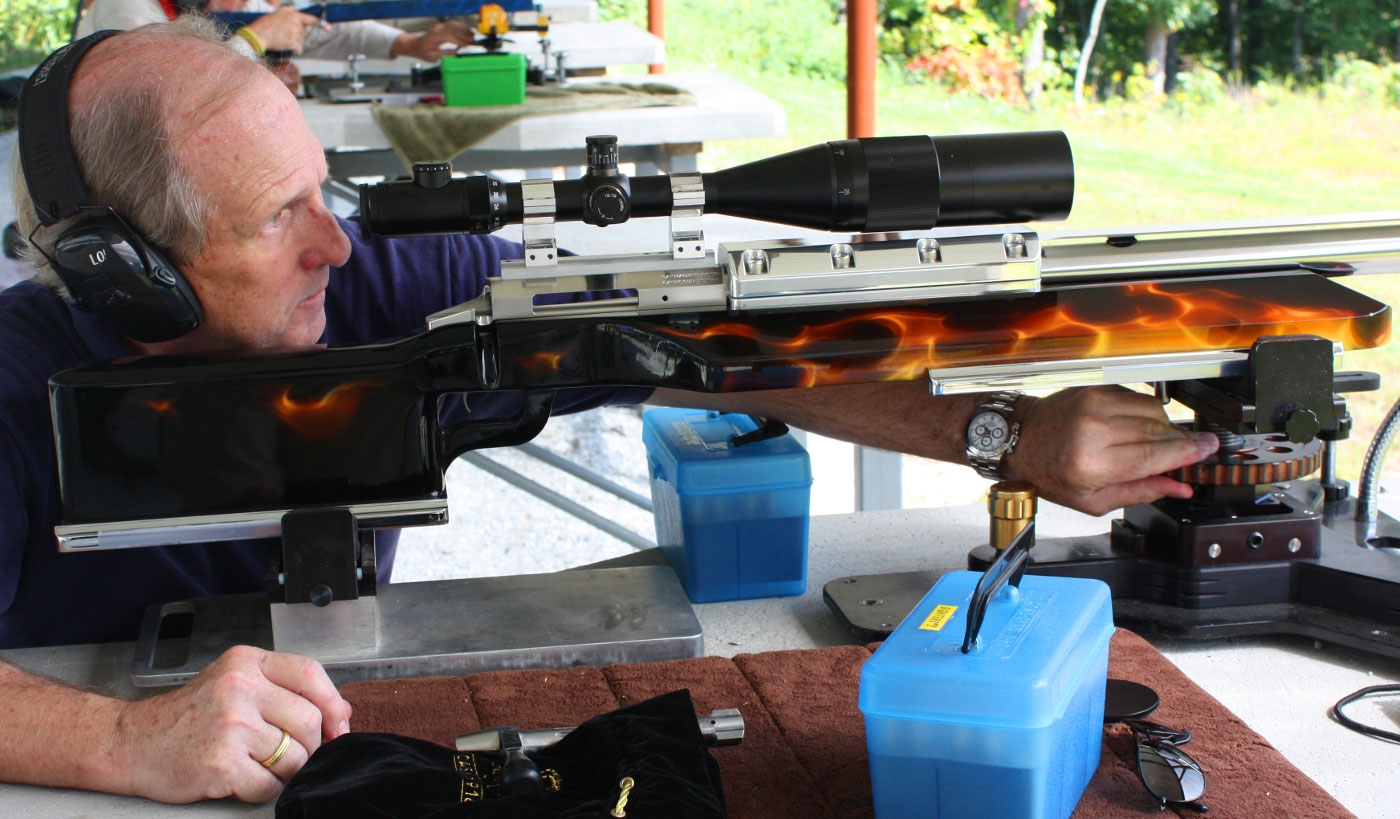
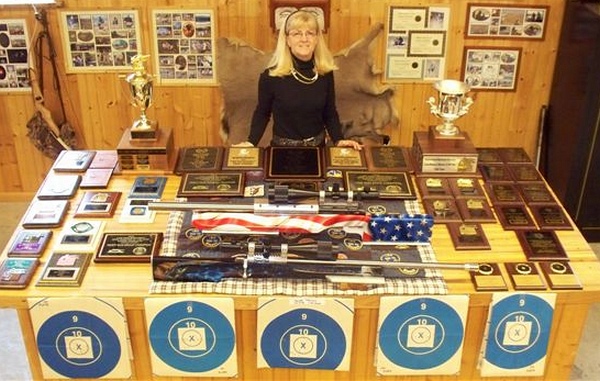
Retired Army Special Forces Sgt. Maj. Walter Wilkinson won two of the four individual 1,000-yard Score titles — for Light Gun and Hunter Classes — at the recent Fifty Caliber Shooters’ Association (FCSA) 2018 World Championships. In addition to his two individual score titles*, Wilkinson was also a member of the winning 4-shooter team.
The FCSA World Championships were held July 5-7, 2018 at the NRA Whittington Center near Raton, New Mexico. There were shooters from Australia, Great Britain, Spain and the USA in attendance. The FCSA 1000-yard matches have four classes: Light Gun, Heavy Gun, Unlimited, and Hunter. In the first three classes, the rifles are normally shot from a machine rest off the bench. Hunter Class requires the shooter to fire from the ground with a bipod. And that’s how Wilkinson shot all his relays…
Remarkably, Wilkinson, who shot his near-“box stock” Steyr HS .50 equipped with factory bipod from the ground in the prone position, posted the FCSA Championships’ highest score, beating out shooters in the Light Gun, Heavy Gun, and even Unlimited Classes.
Beating the Benchresters — While Shooting Prone from Bipod
Wilkinson, a Gunsite instructor from Edgewood, NM, shot a two-day total of 290-10X for the Hunter Score, and his Light Gun Score total of 291-7X was the highest of any shooter in any class — most of whom were firing custom-built rifles from mechanical rests atop concrete benches. Wilkinson also placed fourth overall in the 2-Gun Aggregate, which factors both scores and average group sizes from both classes. Wilksonson’s score wins marks his third FCSA victory in the Hunter Class with his Steyr HS .50 since his first win in 2012, and this year he notched his first Light Gun Score World Title.
The Wicked Whittington Range at Raton
Nestled at the base of the Sangre de Cristo Mountains, the Whittington Center’s 1,000-yard range has notoriously tricky winds, especially in the afternoons. On the first day, Wilkinson shot on the afternoon relays. As usual, switching and swirling winds proved to be a formidable foe for all shooters. Wind coming from behind the shooters was switching from 4 O’clock to 8 O’clock and back again, often changing within seconds. Wilkinson was able to very quickly make wind judgments and adjust his hold accordingly. “I couldn’t do anything wrong,” Wilkinson said. “It was like every time the wind changed, I knew exactly where to hold, and the bullets just kept going where I wanted them to.
Photo courtesy Brett Berger.
Holding Off Right and Left for the Cycling Wind
“The highlights of the day were the last two strings of fire in Hunter Class during Relay 4″, Wilkinson explained. “I shot a 50-2X with a 9.8-inch group and a 49-2X with a 7.9-inch group. The Ten-Ring is right at 1.15 MOA, and when you keep them all in that, it says something about your rifle and your load. During both of those two strings, I changed from holding on the right side of the target to the left side during the string.”
Wilkinson’s .50 Delivered Quarter-MOA Groups During Load Testing
Wilkonson’ Steyr .50-Cal has always been an accurate rig. Back in 2012, when Wilkinson developing loads, the big rig showed outstanding accuracy: “As I was working up a load for the HS.50, I shot groups that amazed me. I was getting groups of 0.214 MOA at 220 yards, and I didn’t know what to think. All the bullets were going in the same hole, and it was like ‘Wow, I’ve really got a rifle that can shoot here’. That stunned Wilkinson: “With my [military] experience with the performance of the same .50 BMG cartridge overseas, I didn’t expect that kind of accuracy out of it.”
Cost of Big-Bore Shooting
Is owning and shooting a 50 BMG caliber rifle expensive? Relatively speaking yes, but one must put it into perspective. Rifles may run from $2500 to $6000, maybe even more for a top of the line custom rifle. (Current MSRP for the Steyr H2 .50 is $5910.00). A premium long-range scope will set you back $1500 to $3000. And while excellent commercial ammo is available, it runs $3 to $5 per round! Most serious shooters start reloading for the rifle as soon as practical, not only for the economics of reloading but also for the ability to fine tune custom ammo for their specific rifle. It’s a very rare match that is won shooting commercial ammo.
*Wilkinson’s FCSA trophies state “Hunter Class Score World Champion” and “Light Class Score World Champion”. NOTE the FCSA also recognizes, for each class, a World Champion for Group size, AND a World Champion for combined Group and Score (Aggregate). Plus there are Championship Trophies for Two-Gun. This gets a little confusing. With other Disciplines there is only ONE World Champion per class, generally the competitor who has the best combination of Group Size and Score.
Today was the final day of the Berger Southwest Nationals (SWN). Two 1000-yard individual matches were scheduled. But the weather gods did not cooperate. Sunday matches were cancelled due to high, gusty winds from the North-Northeast that made it very difficult to handle the large, wood target frames. With concern for the safety of pit workers, match organizers waited until 10:00 am, then canceled the matches. It was a disappointment for some, but all the competitors still enjoyed a great week at Ben Avery.
With the cancellation of Sunday matches, the three individual champions — Sling Division, F-TR, and F-Open have been decided based on the Friday and Saturday results. We congratulate the three new Champions: Bob Sebold (F-Open), Phillip Kelley Jr. (F-TR), and Allen Thomas (Sling).
Top Five Overall – F-Open
Bob Sebold, 843-49X
Keith Glasscock, 843-38X
Jay Christopherson, 841-45X
Stephen Potter, 841-37X
James Crofts, 841-34X
Top Five Overall – F-TR
Phillip Kelley Jr., 838-35X
Ellis Berry, 837-42X
Niklas Montin, 836-35X
Peter Johns, 835-36X
Edward Shelley, 832-33X
Top Five Overall – Sling
Allen Thomas, 844-37X
Oliver Milanovic, 843-45X
Trudie Fay, 842-32X
Nancy Tompkins, 840-43X
Angus McLeod, 840-43X
Team matches concluded yesterday, Saturday. In team competition, Team Lapua/Brux/Borden won the F-Open Division, while Team McMillan finished first in F-TR Division. In the Sling Division, Team USA National Hayes topped the field. Congratulations to the winning teams.
Wicked Winds on Saturday Challenged Competitors
Saturday’s weather was not kind to shooters. Along with cloudy skies came wind — lots of it. The wind was veering, and gusty — with significant changes in velocity. It was hard to predict the cycles — if they could be called that. Erratic was more like it. Many shots were out in the 7 and 8 rings. One champion-level shooter told us: “That was ugly — I got my clock cleaned”. Another shooter said “I ran out of paper to hold off”. At one point, Team Lapua/Brux/Borden (LBB) waited over 30 minutes to take a shot, hoping to get into a steady condition. The patience paid off. Team LBB shooter Jay Christopherson’s final shot (after the long wait) was a 10.
Above is a view from a spotting scope during the 1000-Yard Team Match on Saturday. During the course of the day, there were many 7s and 8s showing on the targets. One competitor said “the wind was so bad, I was holding off the frame”.
Team Lapua/Brux/Berger shot great in tough conditions on Saturday to win the F-Open Team competition. Second from left is Jay Chistopherson, AccurateShooter.com’s System Administrator. When he’s not shooting, Jay works hard to keep our Shooter’s Forum and content sites running smoothly.
The team announced: “Team Lapua-Brux-Borden pulled off a major win today at Berger SW Natinols. Conditions were very challenging but our wind coach was able to keep up with the conditions. Our rifles shot very flat which allowed us to rack up points and Xs. We have a great team and amazing sponsors: Lapua, Brux Barrels, Borden Actions, Cerus Rifleworks. Team members: Jay Christopherson, Eric Cortina, Steve Harp, Tod Hendricks, Pat Scully, and Bob Sebold. Notably, Bob Sebold also won the 2018 Berger SWN Individual F-Open title, making him a double champion.
Eliseo Tubegun with Nightforce Competition scope. These versatile rifle chassis systems are produced by Competition Machine in Cottonwood, Arizona.
Photo by Sherri Jo Gallagher.
There couldn’t be a match without the dedication of the folks who work the pits. At the Berger SWN, competitors did pit duty, ferried by trailers, and there were also some volunteers.
Photo by Sherri Jo Gallagher.
They say behind every successful man is a good woman. Derek Rodgers, current F-TR World Champion, is no exception. His wife Hope Rodgers was on hand throughout the SWN to cheer on her husband.
For many sling shooters, the Berger SWN is the second most important event of the year, right after the NRA Championships, held at Camp Perry (OH) and (now) Camp Atterbury (IN). Check out those patches.
Industry Report — Berger, Lapua and Capstone Precision Group
Last year Berger Bullets was acquired by the Nammo Lapua Group. Berger Bullets, along with Lapua Products, SK Ammo, and Vihtavuori Powder, are now distributed in the USA by the Capstone Precision Group. Berger will continue to offer its full line of bullets, plus Berger-branded Ammunition (formerly ABM Ammo). Likewise Lapua will continue to offer its superb caftridge brass, plus Lapua’s full line of bullets and loaded Ammunition. In this video, Capstone’s Director Bill Gravatt explains how Capstone is working to expand the availability of Lapua and Berger products. In addition, Eric Stecker explains how Berger Bullets can increase production significantly, now that Berger is operating in the large Nammo/Lapua facility in Mesa, Arizona.
Today is the last day of the Berger Southwest Nationals. After the cancellation of Sunday’s 1000-yard matches due to high winds, this year’s 2018 SWN concluded with the Award Presentations. We watched as scores of medals — along with heaps of cash and Berger bullets — were handed out. AccurateShooter.com also awarded prestigious Corinthian awards to Nancy Tompkins (Sling) and Rick Jensen (F-Class).
Photo by Sherri Jo Gallagher.
Team McMillan was the top-performing F-TR squad at the Berger SW Nationals. The team includes many former members of the all-conquering Team Sinclair.
Want to learn long-range benchrest skills from the best in the business? Then head to Williamsport, PA this June. The registration period for the 2018 PA 1000 Yard Benchrest School is now open. This year’s session will be held Saturday and Sunday, June 16-17, 2018, with a “Meet and Greet” on Friday Night. Classes, taught by top 1K shooters, are held at the Original Pennsylvania 1000-Yard Benchrest Club Range, one of the best 1000-yard ranges in the country. The school will be limited to 25-30 students with one instructor for every two students.
Praise from a 1K Benchrest School Grad
Here’s a testimonial from a recent graduate: “I can attest to the knowledge that you gain. I went last year and loved it. Have renewed my membership in the Club and would love to go this year. I would love to take the course again. In the photo above I am in the back row, fourth from the right — sunglasses and blue shirt.” — Bob, Class of 2016
Participants will learn all aspects of long-range benchrest shooting from some of the most skilled marksmen in the country. Much time is spent at the loading bench and on the firing line. Classes cover load development, precision reloading, bench skills, and target analysis. You don’t even need guns and ammo — all equipment and ammunition will be provided.
School instructors tell us: “This year’s benchrest school will be a 2-day weekend event. (There is also an optional ‘Meet and Greet’ gathering Friday evening). The school is a beginner class designed to teach the fundamental skills needed to be competitive at at 600 and 1000 yards. Saturday will be spent in class covering a range of topics including reloading ‘dos and don’ts’, load development and equipment handling. Sunday we will shoot an actual match to see what you’ve learned.”
Cost for the class is $425.00 including lunches on Sat/Sun and dinner on Saturday. Act soon if you want to attend the 2018 school — the school fills quickly. NOTE: To secure your placement, payment must be made in full prior to May 25th, 2018.
Watch Williamsport Benchrest School Slideshow: Please enable Javascript and Flash to view this VideoPress video.
This slideshow was produced by Sebastian Reist an alumnus of the 2009 Williamsport 1000-yard BR school. SEE: www.sreistphotography.com.
Report by David and Donna Matthews
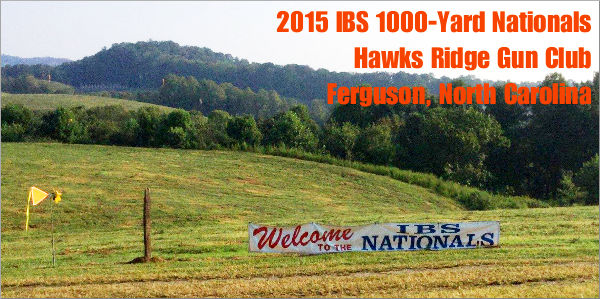
The 2015 IBS 1000-Yard National Championships were held September 4-5 at the Hawks Ridge Gun Club in Ferguson, North Carolina. Attendance was great, with 103 Registered Light Gun shooters and 89 Heavy Gun competitors. After a practice day, the competitors tried on Friday and Saturday to master the unpredictable conditions at Hawks Ridge. The 1000-Yard National Match for 2015 featured a three-target Aggregate for each Division (i.e. six targets total for both classes).
The Hawks Ridge range is quite unique — it’s a very wide-open, over-the-hills range. Conditions constantly change (and change very quickly according to several competitors). The management and membership of this range put on a great event this year. Several shooters said this was one of the best-run National-level matches they had ever attended.
Jim Bauer Won the IBS 2015 Nationals shooting a 6mm Dasher in both Light Gun and Heavy Gun Classes. Here’s his match-winning Heavy Gun. Smithed by Gordy Gritters, Bauer’s Heavy Gun featured a BAT action, Kreiger barrel (in barrel block), Shehane stock, and Nightforce scope.
Bauer Drives Dashers to Victory The Two-Gun Champion and Overall winner was Jim Bauer with 24 rank points. In second place was Robert McMichael with 36 rank points. Bauer shot great in both Light Gun (LG) and Heavy Gun (HG) matches, posting Top 10 finishes in both classes. Bauer ran 6mm Dashers in both Divisions (LG and HG) with Vapor Trail bullets. By contrast, McMichael shot big cartridges — a .284 Shehane in LG and a .300 WSM in HG, using Berger Bullets for both calibers. Top lady shooter was Donna Matthews while Amber Brewer won the Junior Division. John Stecik won a BenchSource Annealing machine for shooting the Best Light Gun Target (50 score with a 3.758″ group). Steve Knight shot the Best Heavy Gun Target (100 with 4.407″ group), to win a Douglas barrel.
PDF File — scroll to bottom of document for EQUIPMENT LIST.
The Hawks Ridge Gun Club Range and Facility
The 1000-yard shooting facility is a covered pavilion that has 15 shooting benches located in the rolling hills of Wilkes County North Carolina. The Club has a great Barbeque grill on site, which the McNeil family employed to perfection, delivering an outstanding Barbeque chicken meal on Friday night.
One veteran shooter commented that when you can take 103 of the best shooters in the country and hold a event that had very little to any issues you have accomplished something. Range officials were quick to point out that it took a lot of hard work from Hawks Ridge Club members as well as support from the IBS, the sponsors, and the competitors.
Outstanding Prize Table
Over $20,000 worth of prizes were awarded at this year’s IBS 1000-Yard Nationals. Prizes included: Nightforce scopes, Sightron Scopes, BAT Action, Defiance Action, Baity Action, Shehane stocks, rests, reloading tools, Sierra and Berger bullets, and more. Many thanks should go to Stanley Taylor from Douglas Barrels for his time and energy in acquiring prizes for the match.
Here’s a true “Blast from the Past”, a video featuring our friend Stuart Elliott of Brisbane, Australia. This 2011 video has now racked up nearly 680,000 views, making it probably the most-watched long-range benchrest video ever uploaded to YouTube. The video shows Stuart shooting a 10-shot Heavy Gun string at the Brisbane range, Queensland, Australia, in July 2011. In this example, Stuart elected to “run a condition” with his big, .300 WM Heavy Gun, shooting fast with slight hold-off adjustments as the wind increased during the string. The cartridge is a .300 Winchester Magnum, loaded with moly-coated 190gr Berger VLDs. Stuart has an unusual bolt configuration. After each shot, Stuart removes the bolt completely with his right hand, and then uses the bolt to “shuck” the fired cartridge while loading the new cartridge with his left hand. That sounds awkward, but Stuart makes it all look easy. Stuart runs BRT Shooters Supply, a leading vendor of precision shooting equipment (including March scopes), in Australia and nearby regions.
1000-yard Benchrest competitor James O’Hara set four (4) new IBS Records in 2013. These multi-match Light Gun Agg records were secured with O’Hara’s solid performance at the 2013 Virginia 1000-yard Benchrest State Championship. Here are the new records set by O’Hara in 2013:
During the VA state championships, O’Hara was on fire. All four groups were centered for 50s, with three groups under 3″ and the fourth a 3.715″. That’s consistency.
Target 1- Group 2.996” Score 50.2
Target 2- Group 2.433″, Score 50.1
Target 3- Group 3.715″, Score 50.4
Target 4- Group 2.188″, Score 50.1
Group Average 2.833″, Score Average 50.2
On 1000-yard benchrest targets, the 10-ring is just seven inches in diameter, while the X-Ring is a mere 3 inches in diameter. At the Virginia 1K Championships, James managed to keep all his shots within the seven-inch 10 Ring with eight of the shots inside the 3 inch X-Ring. That is amazing accuracy and consistency. David Goodridge says: “This is truly a remarkable example of superb marksmanship, rifle design, assembly, load development and equipment maintenance.” (O’Hara had previously set a 10-match Aggregate Light Gun World record of 4.5389″ in 2012).
Click image for Full-screen view
James O’Hara Talks About Record-Setting Rifles and Ultra-Accurate Long-Range Loads
James generously agreed to share his knowledge and experiences on the many facets of IBS 1000-yard benchrest preparation, reloading and shooting techniques in an intereview with Australian David Goodridge. This feature originally appeared in Australian Target Rifle Magazine. A few of O’Hara’s responses have been updated, based on a conversation with James on April 8, 2014.
Goodridge: James on behalf of the Australian LRBR community I would like to congratulate you on your achievements in 1000-yard Benchrest and thank you for [doing this] interview. To begin, could you provide an outline on your background and the reasons or factors that led you to becoming involved in 1000-yard BR at the Virginia Club.
O’Hara: I started short-range Benchrest in 1996 for a brief time and won my first 100-yard IBS match and I was hooked. Loss of eye-sight in one eye put a damper on it and I quit shooting for while, and I started shooting trap to try to switch over to left-handed. It worked and I started to pick up a gun left-handed so I went back to the rifle and built a tube gun.
I tried the local groundhog matches but the rules changed every match. I then found the Reade Range and 1000-yard matches. I restocked my gun with a long-range stock and started 1000-yard Benchrest. Finding I enjoyed the challenges associated with long range benchrest, I began 1000-yard Benchrest competition at Harry Jones Range and White Horse Range, two IBS ranges in West Virginia. I basically started after the year was under way in 2011 and I must say it was a very humbling experience. I soon learned that my previous short range [techniques] were not working.
New scales, a K&M arbor press with a force indicator, led to improvements. Then designing and obtaining reamers to my own specifications led to further substantial improvements, with the end result being that the same loads now seem to work from barrel to barrel.
James O’Hara Equipment Details
Gunsmithing: I do all the work myself, except barrel chambering/fitting is done by Dave Bruno.
Favored Caliber: I use a 6mm Dasher with a .266 neck and a .135 free bore. My load is a 103gr Spencer bullet trimmed and pointed with Hoover tools. Load is Alliant Reloder 15, 33.0+ grains weighed on a GD503 scale, with a CCI 450 primer. Right now I’m jumping the bullet about .006″. Previously, I shot them about .010” into the rifling but it was pulling the bullets or pushing them back.
Actions: For the IBS record groups I used a Bat 1.350” Bat B action in a Roy Hunter Stock. Other actions in use include a 1.530” Bat B and a Kelby F-Class Panda. Barrels: The record barrel was a Brux Heavy Varmint, 1:7.83″ twist, finished at 28″, and fitted with a Harrell’s brake. Stocks: I have two Roy hunter stocks and a PR&T and all track very well. They are balanced at two inches ahead of the receiver. All three stocks are glued with liquid Devcon and are pillared, so they are “glued and screwed”. I think this is the best system. Scopes: The PR&T-stocked rifle has a March 10-60X and the two Hunter-stocked guns have Nightforce 12-42x56mm NXS scopes. Rests: My front rest is a Sinclair Competition model that I modified with a cartridge holder that holds cartridges up by the port. I use the new super slick bag by Protektor and a rear Doctor Bag with leather ears. Scope Mounts: Rings are Burris Signature Extra High (the ones with inserts).
Case Preparation and Reloading Techniques:
My cases are three years old, with close to 100 firings. They are all from the same lot. I anneal the cases dirty to save some work and I anneal every time to have consistent neck tension. I punch the primers out and clean the pockets and run the flash hole uniformer in to make sure there is no carbon build-up. You can use the same tool as you use to prep the new cases. Flash holes are uniformed to .0625″. (Flash holes, “out of the box”, are less consistent than you may think.)
I turn necks to .0102″ with a K&M tool. Some competitors don’t turn necks, but without uniform neck tension you will have vertical. I use a K&M VLD chamfering tool and a Wilson case trimmer for new cases and when I trim fired cases. I use a nylon brush for inside the necks and clean the cases outside with 0000 steel wool using a small power station or a drill to spin them. The cases are sized on a Forster Coax press with a Harrell’s full length bushing die. Priming is done by hand using a K&M priming tool. I throw a “close” charge with Harrell’s bench rest powder measure. That charge goes in the pan of my Sartorius GD503 scale and then I trickle up to weight with an Omega powder trickler.
For bullet seating, I now use the 21st Century Hydraulic arbor press with seating force indiciation. I previously used the K&M arbor press with force indicator — it was good, but the 21st Century unit is more sophisticated, more precise, and easier to read. I have a loading block that is color-coded in the pounds of force needed to seat the bullet. I try to keep rounds in sets of 3-lb seating force settings. Each loaded round is put in the appropriate column (based on measured seating force). All loaded rounds are color-coded to avoid mixing. Leftovers from matches are used at a later date.
Click image for Full-screen view
I have now made a tool from an old bearing surface comparator. It will contact the ogive of the loaded round and it will check the seating depth while it is sitting on a granite block. Relying completely on the force and feel of the dial indicator allows seating depths to be held to .0005″ (i.e. one-half-thousandth). Compared to others means, this seems a more accurate way to check seating depth.
Bullets are spun on a Juenke machine after they are trimmed on a Hoover trimmer and pointed on the Hoover tool. For the next step, a Tubb Bearing Surface Comparator is used to sort bullets to plus/minus .0005″. I don’t discard any bullets — if I have some small lots of bullets that have a shorter or longer measurement they are used for testing. With the Spencer and BIB bullets there are not many that are not within plus/minus .001”. I quit weighing cases because of the outside variations. I only do what makes a difference [on target] and I only test and do load development at 100 yards, where I can control the conditions.
Barrel Freezing (Cryogenic treatment)
For the 2013 season, I cut barrels back to 28″ and had them “frozen” (cryo-treated) at Cryo Plus. I think that both barrels are average in the wind, but the first shot from a clean barrel is in the group. I shot around seven 100s with my other Light Gun. In Heavy Gun, I even won the group Aggregate at the Virginia State shoot. I have cryo-treated all of my barrels and I believe I have proof that it does produce benefits. I talked to George Kelbly about this before I did it. My results agreed with what George had indicated: fire cracking was less, chambering was easier and the major benefit was that the groups did not ‘walk’ as the barrels became heated.
Bench Set-up and Shooting Procedures
I use a spotting scope to help see the flags and the mirage. The mount is a Sinclair for the bench. This really helps because I can’t see the flags far out. I think the most important part of the set up is getting the gun to track, it has to come back in the box every time and shooting under the same condition every shot. I know everybody likes to run them — I do if the condition holds — but if it doesn’t you must pick them one at a time. This is where the direction and the speed of the wind come into play; you must shoot in the same condition you zero in.
When I set up to shoot, I line up the gun on my target and I move it back and forth till I can get it coming back in the ten ring and then I set my scope. I load my record rounds in my holder and I use my sighters out of the box. I now am watching and timing the conditions and I now make the decision of the one I will use and this is the only one I sight-in with. If I have some big guns beside me with brakes, I will wait till they are done or try to get in between their shots (this doesn’t always work).
Trigger control is a must and you have to be consistent. I will give up a perfect sight picture for a perfect trigger pull. I use free recoil and only my finger is on the trigger. After the rifle recoils back, I hold the fore-arm and open the bolt — you have to be careful not to upset the gun in the bags. After loading the next round, I close the bolt and push the gun forward with my right hand on the fore-arm. I am guiding [the stock] forward in between the bags. This gives me less chance to make a mistake, and maybe half of the shots need no or very little adjustment. I know it’s hard to get accustomed to, but try not to take your eye out of the scope so you are watching the mirage and not to get caught in a change. For the best part, I shoot free recoil and do all my testing at 100 yards in my backyard range. I zero dead on at 100 and come up 24 minutes for 1000 yards.
Bore Cleaning Procedures
I never try to get the gun super clean at a match, I like to see a little gray on a clean patch. I don’t want the barrel to be squeaky clean — I like to see a little haze on a patch. When it’s like that, after one fouling shot, the next shot usually goes right where it’s supposed to. When it’s squeaky clean, it may take five shots to foul in.
I used a product called WartHog 1134, and it has served me well for a long time but now that the Hazmat stopped the shipment of it, so I went to over-the-counter products and all are equally bad compared to what I had used but they do the job, it just takes longer. I never pull a patch or brush back through (across the crown), I go one way only (outward) out and then unscrew the brush or take the patch off at the muzzle. I use a 50/50 mix of Hoppies and Kroil after I clean. Just before I shoot I run a smaller patch down the bore to leave a very thing film of oil in the bore. I never want to shoot over a dry bore. If you shoot over a squeaky clean, dry bore, you’ll get copper every time.
What the Future Holds for O’Hara
My goal last season was to set the Agg records. Now I only have one more goal — that is the single target group, so I will back off shooting the Heavy Gun. I have three excellent Light Guns and a bunch of barrels to do it… so maybe! I think the greatest enjoyment is the people you shoot with, the common interest is the bond I guess but I wouldn’t change it for anything. — James O’Hara
Goodridge: James, on behalf of all Australian IBS 1000-yard BR competitors, I would like to thank you for your great patience and cooperation in preparation of this article, and for the valuable and interesting insight that you have provided into what is required to achieve success at the highest levels of 1000-yard BR competition. Not that you need it, but good luck for the 2014 shooting season.
Yes old dogs can learn new tricks. Just five years ago Forum member Henry Pasquet (aka “HenryP”) got started in 1000-yard benchrest shooting. He was 66 at the time. Henry worked hard, learned fast, and pursued accuracy with a vengence. That all paid off when Henry won the 2013 IBS 1000-yard Nationals this summer, finishing as the Two-Gun Overall National Champion. Henry was kind enough to talk about his rifle, his reloading methods, and his strategy for success. In fact, Henry was eager to share “everything he knows, so that other guys can fast-track their learning process”. Henry told us: “I want to share every lesson I’ve learned, so that other guys can improve their game and enjoy the sport more.” Henry also wants to encourage other senior shooters: “If you pay attention to details (when reloading), and get a good rifle with a good barrel, age is not a handicap. With a good set-up, older guys can compete with anyone out there. This is one sport where you can be a champion in later life.”
Click on Rifle Photos to View Full-screen Versions
Q&A with Henry Pasquet, IBS 1000-Yard National Champion
Q: First, do you have any advice for older shooters getting started in their golden years?
Henry: You’re never too old. In this sport, you can excel even in your 60s, 70s and beyond. At this stage in life, we now have the time and money to get good equipment and rifles. Plus, our years of work experience help us to think, analyze, and thereby make progress. In this game, we older guys can definitely compete on a par with younger shooters.
HARDWARE
Q: Tell us about your Nationals-winning rifle and bench gear. Is there anything unique about your hardware that gave you an edge?
Henry: At the Nationals, I used my 17-lb Light Gun for both Light and Heavy Class. This rifle has a 1.55″, round BAT LP/RE action, fitted with a Bartlein barrel chambered for the .284 Shehane (an improved version of the .284 Winchester). The barrel was near-new; this was the first time I had used it this year. A great barrel and great batch of Berger 180gr VLDs all made a difference. Jay Cutright chambers my barrels. Jay’s metal-work is so precise that I can screw any barrel he’s chambered to any BAT action I own. The laminated stock was modified by Tommy Shurley from a standard 3″-wide fore-end to a 5″-wide True-Trac with an adjustable 3″-wide rear plate. It’s not pretty but it tracks like a Heavy Gun stock. Tommy made my other stocks as well.
On top is a Nightforce 12-42x52mm Benchrest scope with CH-3 reticle. I used a Fulghum (Randolph Machine) front rest with an Edgewood bag made with the low-friction 3M material. In the rear I use a special-order Protekor rear “Doctor” bag with ears spaced 3 inches apart. The rear bag also has the new 3M material on contact surfaces (photo at right).
Q: During the Nationals, at the last minute you switched guns. Why did you go from a 6mm Dasher to a 7mm Shehane?
Henry: I had planned to use my Light and Heavy Dashers, but after placing the Dasher on the ready line, decided to switch to the .284 Shehane. It was still early in the morning and I felt that the heavier bullets would be easier to see against the berm. The Dasher had actually been giving tighter groups under perfect conditions, but seeing the impact is important.
Q: Tell us about the combined tuner/muzzle brake on some of your barrels. How does this improve rifle performance and how do you set the “tune”? Do you tune the barrel to the load?
Henry: I use a tuner or tuner/brake on every barrel. I started with Time Precision tuners. Art Cocchia advised getting a load with a good known accuracy node with minimum extreme spread, which controls vertical. Do not go for the hottest loads, which just reduces brass life. Then use the tuner and tune the barrel to the load. The .284 Light Gun needed a muzzle brake and tuner. I had a local gunsmith cut a thread on the muzzle brake for a tuner I got from Sid Goodling. (Eric Bostrom developed an almost identical unit at the same time. I use Eric’s tuner/brakes on all my new barrels.) Just before Nationals, I tried going up and down one marker. Down one mark cut the group in half! Think how much range time (and barrel life) that saved me. Using a tuner is easier than messing around changing loads and tweaking seating depths. Tuners definitely can work. Last year I shot a 3.348″ 10-shot group at 1000 with my .284 Win Heavy Gun fitted with a Time Precision Tuner.
Q: What are the advantages of your stock’s 5″-wide fore-end and 3″-wide rear plate? Is there a big difference in tracking and/or stability? Does the extra width make the rifle easier to shoot?
Henry: I had true Heavy Guns with 5-inch fronts and 3-inch rears. They tracked well. I felt the same result could be had with a Light Gun. I talked two stock makers into making them. I initially had the standard rear stock until Tommy Shurley and Mike Hearn came out with an adjustable rear plate. The stocks track perfectly. You can see your scope’s crosshairs stay on the target the whole time and push the rifle back for the next shot. There is no torquing (gun wobbling) when cycling the bolt. Us old guys need all the help we can get. I am getting rid of my 45-pound Heavy Guns and replacing them with Light Guns with heavy barrels.
Q: Some people say the .284 Shehane is not as accurate as the straight .284 Winchester. You’ve proved them wrong. Why do you like the .284 Shehane? More speed, less pressure?
Henry: The reason I rechambered my 7mm barrels to .284 Shehane was not velocity, pressure, or brass life. It was all about bolt lift. My straight .284 almost required me to stand up to eject brass. I damaged an extractor and had to send the bolt back to BAT. With the .284 Shehane, my bolt cycles like there is no case to eject.
Reloading Methods
Q: People want to know about your load and your loading methods. What can you reveal?
Henry: For my .284 Shehane at the Nationals, I loaded 52.5 grains of Hodgdon H4350 and Federal BR-2 primers behind Berger 180gr VLDs. I usually anneal the brass each winter. I have used the same brass for years. I use Redding bushing dies, apply Imperial sizing wax, resize, wipe off wax, clean and uniform the primers pockets using the RCBS Trim Mate Case prep center, then apply Imperial dry neck lube with a bore mop.
To dispense powder, I use a RCBS ChargeMaster set 0.1 grain below my desired load and then weigh them on a Sartorius GD-503 magnetic force restoration scale to get identical charges. I use a K&M Arbor Press with seating force gauge when seating the bullets with a Wilson inline die. My “target” seating force on the K&M dial is 20-23 units for Dashers and 35-40 units for the .284 Shehane. I put any variables aside for sighters. I do not weigh brass, bullets, or primers. My bullets were so consistent that I did not sort by bearing surface. I did trim the Berger VLDs to the shortest bullet length with a Hoover Trimmer, and then pointed the meplats just enough to close them with a Whidden pointer. I sort my bullets to 0.005″ overall length, rejecting about five percent.
Q: What kind of precision are you looking for in your reloads? Do you trickle to the kernel? Does this really help reduce extreme spread?
Henry: I try to keep my charge weights consistent to one kernel of powder. I use the Omega powder trickler with a Sartorius GD-503 lab-grade balance to achieve that. For accurate dispensing, put very little powder into the Omega so you can drop one kernel at a time. Single digit ES (Extreme Spread) is the goal. This does make a difference at 1000 yards. If you get the same push on the same bullet with the same neck tension, good things are going to happen.
Q: You believe consistent neck tension (i.e. grip on the bullet) is really important. What methods are you using to ensure consistent bullet release?
Henry: I apply Imperial dry neck lube to the inside of my case-necks with a bore mop. The K&M arbor with seating force gauge shows the need to do this. If you put a bullet into a clean case, it will be jerky when seating the bullet. You may see 40 units (on the K&M dial) dropping to 20, then slowly increasing pressure. I explained to a friend that not lubing the neck is like overhauling an engine without lubing the cylinders. Smooth entry gives the bullets a smooth release.
Barrel Cleaning
Q: You go 60-80 rounds between cleaning and the results speak for themselves. What is your barrel cleaning procedure? Do you think some guys clean too often or too aggressively?
Henry: I cringe when I see people wearing out their barrels with bronze brushes between relays. I clean my barrels at the end of each day when I get home. I shot my best-ever 1K Heavy Gun group (3.348″) at day’s end after 60 to 80 rounds. After trying other solvents, I have gone back to Wipe-out’s Carb-Out and Patch-Out products. I use about four patches of Carb-Out, let it sit a few minutes, then use one stroke of a nylon brush followed by Patch-Out until the barrel is clean. I use a bore mop to clean inside the chamber, then some Break Free LP on the bolt followed by bolt grease on the lugs and cocking part. I use a bore guide when anything goes down the barrel.
Shooting Skills and the Learning Process
Q: Henry, you can shoot long-distance on your own property in Missouri. How important is practice, and what do you do during a typical practice session?
Henry: I can shoot 1000 yards on my farm. I have a concrete bench using a slab from a yard furniture place on concrete blocks. Two 4 x 8 sheets of plywood hold four IBS targets. I never practice. I only test, keeping a notebook with all the info. I do most of my testing at 300 to 500 yards, shooting off my deck so I can see my shots immediately.
Q: How much of your success do you credit to really accurate rifles, versus superior shooting skills?
Henry: I do not consider myself another Carlos Hathcock or some master marksman. I am an average 1000-yard shooter, but I do work hard getting the most out of my rifles. Four other people have shot their first 1000-yard matches with my rifles, including my wife, and all of them won relays! I loaned my Dasher to another shooter two years ago and he got second at the 600-yard Nationals. Others will tell you that the rifle must be “on” to win. If your barrel or bullets are average, don’t expect to perform above average in competition.
Q: What you do enjoy most about long-range benchrest shooting? What are the attractions of this sport?
Henry: The sport offers good people and a real challenge. 1000-yard shooting keeps us all humble, but we still keep trying to see how good we can do. I am thankful for Robert Ross providing the only match location that I can shoot regularly.
Q: Henry, you have been a Forum member for many years. Have you learned important techniques from other Forum members and other shooters?
Henry: I have followed the AccurateShooter Forum since 2008. At my age I am not good at computers. I copied and analyzed many articles, especially on the .284 and the Dashers. Without AccurateShooter.com, I would probably still be shooting double-digit (10″+) groups at 1000 yards, and I sure wouldn’t have my name on a National Championship trophy.
Q: You are in your 70s now and have only been shooting competitively for a few years. How did you get so good so fast? How did you manage to beat shooters who are decades younger?
Henry: I had 20/10 vision when I was young, but am down to only 20/20. I have been interested in long range shooting for a long time including ground hog hunting. I went to some VHA jamborees also. In 2008, I went to the Williamsport Benchrest School with a friend from Pennsylvania, John Haas. We would compare notes frequently. I bought a BAT three lug from Tom Mousel in Montana. We also compared notes and made each other better. At IBS matches I studied other shooters’ equipment and techniques. I tried some, accepting some and rejecting some.
Here’s my advice:
Always be ready to learn something new. If it makes sense, try it. I would also encourage other older shooters not to quit. Stick to it. You can make enormous progress in a few seasons.
Report for International Benchrest Shooters (IBS) On August 30-31, 2013, Robert and Chrissy Ross hosted this year’s 2013 IBS 1000-Yard National Championships at their Midwest Benchrest range in Yukon, Missouri.
This year’s format was run with all the Light Gun (LG) relays shot on Friday, followed by all the Heavy Gun (HG) relays on Saturday. The competition was very tight as the Two Gun Overall Champion, Henry Pasquet from Elsinore, Missouri, didn’t even realize he had won until his name was called out at the award ceremony. Henry, an active AccurateShooter Forum member, secured a well-deserved National Championship with strong performances in both classes. Henry registered a fifth place in LG Group along with tenth place in LG Score. Henry then finished first in HG Score along with eleventh in HG Group to earn the 2013 Two-Gun Overall Title.
Matthew Kline traveled from Pennsylvania to take second place in the Two Gun competition. He garnered that honor with an eighth Place in LG Group and a fourth place in LG Score. Matthew followed up these with a ninth place in HG Group and eleventh place in HG Score.
Kansas’ Jim Bauer came in a close third in the Two Gun rankings, by finishing first in LG Score and 21st in HG Group, then adding a second place in HG Group and 16th place in HG Score. Jim’s wife Sally, last year’s IBS long-range Shooter of the Year winner, was the Top Female Shooter. Rory Jacobs, from Vapor Trail Valley Shooting Club in Spickard, MO was the Top Junior Shooter.
Hot Temperatures and Fickle Winds Challenge Shooters
The Midwest Benchrest range is literally in the Ross’ back yard and is cut right out of the middle of a Missouri forest, which gave the shooters new to the range a false sense of confidence, thinking the trees would block the winds. The shooters had to deal with temperatures in the upper 90s (and the shade trees offered little relief). With the incredible humidity present, it felt it was even hotter. Although the winds weren’t very high, they weren’t very cooperative either, as they were never consistent throughout both days. One minute it was directly behind the shooters and the next it was quartering to the right. A moment later it was to the left.
The early relay winners seemed to favor the end benches, while later in the day, they seemed to favor the middle benches. There was was nothing but bright sunshine for the two-day event. Cloud cover and cooler temps, which were earlier forecast for the shoot, finally showed up the day after the tournament. Needless to say, the “heat monkeys” were making small groups difficult at this year’s shoot. Most small groups that were shot, were followed up with larger groups, in both the LG and HG events.
All in all, everyone still had a great time competing, seeing friends and fellow shooters from other parts of the country, and enjoying the Ross’ hospitality. It wasn’t long after the shoot was over before everyone started talking about where the 2014 Nationals would be. Perhaps, Robert Ross said it best: “Ultimately, the competition yields to the resulting friendships, which are fostered as part of a common goal: Raising the bar in long range precision shooting.”
The two-day competition was run as smoothly as any monthly shoot is run. The weekend’s shoot really started off on Thursday night though. Jim and Sally Bauer, Hornady, and Midwest Benchrest, sponsored a fantastic fish fry for all the competitors and their spouses. This provided some neutral ground to meet up and catch up with both new and old friends alike before the actual shooting began. If possible we will add equipment lists and individual relay results to this story on Accurate Shooter.com.
Featured Hardware at the 1K Nationals (Click Photos to Zoom)
If you want to learn how to shoot accurately at very long range, one of the very best places to learn is the Williamsport 1000-Yard Benchrest School. The 6th Annual Benchrest School will be held Saturday June 8 and Sunday June 9, 2013. There are still a few slots available for this year’s session. Classes, taught by top 1K shooters, are held at the Original Pennsylvania 1000-Yard Benchrest Club Range, one of the best 1K ranges in the country. View the range on the Williamsport website, PA1000yard.com
Prospective students will be taught all aspects of long-range benchrest shooting from some of the most skilled marksmen in the country. All areas are covered: load development, precision reloading, bench skills, and target analysis. Much time is spent at the loading bench and on the firing line. And you don’t even need guns and ammo — all equipment and ammunition will be provided.
School instructors tell us: “This year’s benchrest school will be a 2-day weekend event. (There is also a ‘Meet and Greet’ gathering Friday evening). The school is a beginner class designed to teach the fundamental skills needed to be competitive at at 600 and 1000 yards. Saturday will be spent in class covering a range of topics including reloading dos and don’ts, load development and equipment handling. Sunday we will shoot an actual match to see what you’ve learned.”
Don’t hesitate if you want to grab one of the remaining slots for the 2013 school. Contact the school directors right away. For more info, visit contact Dave Gardner (Public Relations) at pa1000br@yahoo.com or 570-916-9095. To get an application, please contact Nancy Miller (Club Secretary) at nancymiller@htva.net or 607-426-1535. Cost for the class is $300.00 including lunch and dinner on Saturday.
To see what the 1K Benchrest school is like, watch the slide show/video below, produced by Sebastian Reist, an alumnus of the 2009 Williamsport 1000-yard BR school. Sebastian, a talented professional photographer, captured the highlights of his Williamsport 1K training weekend:
As we commence the 2013 IBS benchrest season, it’s time to give credit to the 2012 IBS long-range Shooters of the Year. Bill Shehane of D&B Supply sent us photos and profiles of three winners, who all used his Tracker stocks. Bill writes: “I would like to thank all the many 600-yard and 1000-yard shooters for once again making Tracker Stocks the number one choice in long range shooting for 2012.” Bill notes that: “I’ve always said we get beat by women and children more than we own up to and 2012 was a perfect example of this.”
Photo Credit: Gordy Mitchell
Sally Bauer, 2012 IBS 1000-Yard Shooter of the Year
In 2012, Sally Bauer became the first lady to win the title of IBS 1000-yard Shooter of the Year. Sally earned that honor through hard work, dedication, and a burning desire to “be all she can be”. While helping her husband Jim rise to the top of the 1000-yard benchrest game, Sally was taking notes and working toward her turn at the top. Well friends, Sally took no prisoners in 2012. At the Nationals, Sally fought a very tight battle with several extremely good shooters. But then she “put the hammer down” and pull away in a very convincing manner to clinch the top title.
Mason Hildrith, 2012 IBS 1000-Yard Junior Shooter of the Year
Mason Hildrith not only had a great performance at the 1000-yard National Championship in his home State of West Virginia, but was once again the top Junior Shooter in the IBS 1000-yard Shooter of the Year program. Bill Shehane writes: “I know just how proud your Grandmother and Grandpa are of you and Diane and I are just as proud of not only how good you are with the rifles but the way you conduct yourself. You are a fine young man and a great example of an humble shooter willing to help others enjoy the sport too.”
Mike Hanes, 2012 IBS 600-Yard Shooter of the Year
Mike Hanes is a reformed .22LR rimfire shooter who took a liking to 600-yard benchrest competition. At last year’s 600-yard Nationals in St. Louis, Mike put on quite a show against a steller group of the Nation’s best 600-yard shooters. After this performance, Mike never let up and captured the 2012 IBS 600-yard Shooter of the Year title
Congrats to Sally, Mason, and Mike for a fine season of great shooting. Bill Shehane adds: “Diane and I both thank all of you for choosing Tracker Stocks. Keep up the good shooting and have fun in 2013.”


 Want to learn long-range benchrest skills from the best in the business? Then head to Williamsport, PA this June. The registration period for the 2018 PA 1000 Yard Benchrest School is now open. This year’s session will be held Saturday and Sunday, June 16-17, 2018, with a “Meet and Greet” on Friday Night. Classes, taught by top 1K shooters, are held at the Original Pennsylvania 1000-Yard Benchrest Club Range, one of the best 1000-yard ranges in the country. The school will be limited to 25-30 students with one instructor for every two students.


 The Two-Gun Champion and Overall winner was Jim Bauer with 24 rank points. In second place was Robert McMichael with 36 rank points. Bauer shot great in both Light Gun (LG) and Heavy Gun (HG) matches, posting Top 10 finishes in both classes. Bauer ran 6mm Dashers in both Divisions (LG and HG) with Vapor Trail bullets. By contrast, McMichael shot big cartridges — a .284 Shehane in LG and a .300 WSM in HG, using Berger Bullets for both calibers. Top lady shooter was Donna Matthews while Amber Brewer won the Junior Division. John Stecik won a BenchSource Annealing machine for shooting the Best Light Gun Target (50 score with a 3.758″ group). Steve Knight shot the Best Heavy Gun Target (100 with 4.407″ group), to win a Douglas barrel.


 1000-yard Benchrest competitor James O’Hara set four (4) new IBS Records in 2013. These multi-match Light Gun Agg records were secured with O’Hara’s solid performance at the 2013 Virginia 1000-yard Benchrest State Championship. Here are the new records set by O’Hara in 2013:


 Barrel Freezing (Cryogenic treatment)
 Yes old dogs can learn new tricks. Just five years ago Forum member Henry Pasquet (aka “HenryP”) got started in 1000-yard benchrest shooting. He was 66 at the time. Henry worked hard, learned fast, and pursued accuracy with a vengence. That all paid off when Henry won the 2013 IBS 1000-yard Nationals this summer, finishing as the Two-Gun Overall National Champion. Henry was kind enough to talk about his rifle, his reloading methods, and his strategy for success. In fact, Henry was eager to share “everything he knows, so that other guys can fast-track their learning process”. Henry told us: “I want to share every lesson I’ve learned, so that other guys can improve their game and enjoy the sport more.” Henry also wants to encourage other senior shooters: “If you pay attention to details (when reloading), and get a good rifle with a good barrel, age is not a handicap. With a good set-up, older guys can compete with anyone out there. This is one sport where you can be a champion in later life.”

 On top is a Nightforce 12-42x52mm Benchrest scope with CH-3 reticle. I used a Fulghum (
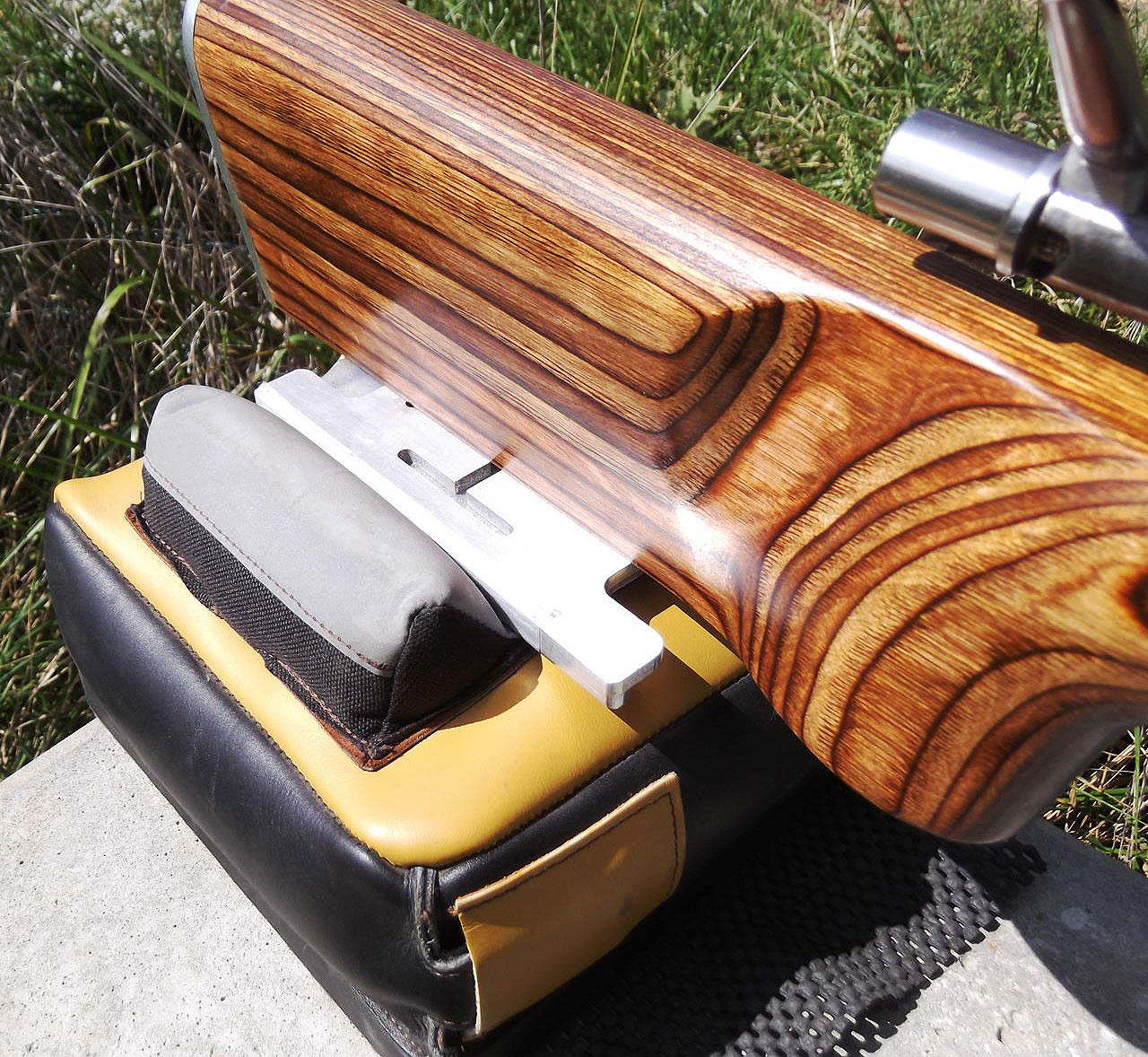
 To dispense powder, I use a RCBS ChargeMaster set 0.1 grain below my desired load and then weigh them on a Sartorius GD-503 magnetic force restoration scale to get identical charges. I use a K&M Arbor Press with seating force gauge when seating the bullets with a Wilson inline die. My “target” seating force on the K&M dial is 20-23 units for Dashers and 35-40 units for the .284 Shehane. I put any variables aside for sighters. I do not weigh brass, bullets, or primers. My bullets were so consistent that I did not sort by bearing surface. I did trim the Berger VLDs to the shortest bullet length with a Hoover Trimmer, and then pointed the meplats just enough to close them with a Whidden pointer. I sort my bullets to 0.005″ overall length, rejecting about five percent.
 Q: You go 60-80 rounds between cleaning and the results speak for themselves. What is your barrel cleaning procedure? Do you think some guys clean too often or too aggressively?


 On August 30-31, 2013, Robert and Chrissy Ross hosted this year’s 2013 IBS 1000-Yard National Championships at their