|
|
March 1st, 2016

Report by Johnny Fisher
Here’s something you don’t see very often — a fullbore shooter with a .223 Remington topped a field of talented .308 Win shooters. Not only that, he scored more points than any F-Class competitor (however, F-Classers shot a smaller target). Bob Gill’s performance proves that, even in an era of high-BC .308 bullets, the little .223 Rem cartridge can still hold its own in the hands of a great shooter.
At last weekend’s California State Fullbore Championships, Bob Gill bested over 30 competitors for the championship with a .223 Palma rifle, only dropping 7 points over the weekend for a 993-56X. The event was sponsored by the California Rifle & Pistol Association and hosted by the Coalinga Rifle Club.

Bob Gill Talks about the ‘Mental Game’
Conventional wisdom when shooting any match is to just stay focused on each and every shot and let the scores work themselves out after all firing is complete. “Two To The Mound” shooting changes all of that, as each competitor is not only aware of their own standings throughout the course of the match – but also of their closest competitor during these pair-fire strings. With this championship never further out than a 2-point lead throughout the weekend, stress was high and every once of mental focus needed to be tapped.
Bob recalls, “The entire match was neck and neck. After a few mental mistakes and a few wind mistakes, with three shots remaining the thought is three shots and a 1X lead. I need to shoot three 10s. Everything else goes away. Shoot three 10s and he can’t catch me.”
Three 10s later, Bob won the CA State Fullbore Championship by one point and one X. Well done!
Gun Specifications
Bob was shooting a 1970s-era .223 Remington B-40X action inside a Competition Machine R1 chassis. The barrel is a 30.5″ Heavy Palma taper, 1:7″-twist Brux with a Wylde chamber and .220 freebore done up by Randy Gregory at Accuracy Unlimited. The Tubb 7T7 two-stage trigger was set at 1 + 1 pounds.
.223 Remington Accuracy Load — Berger 90gr VLDS, Varget and BR4s
Gill loaded 90gr Berger VLDs in front of 25.0 grains of Hodgdon Varget powder, jumping 15 to 20 thousandths for a 2.708 COL with a BR4 primer inside Lapua brass. Bob uses a Redding Full-Length S-Die to push the shoulders back .004 to match that of new Lapua brass and a bushing chosen to achieve .004 neck tension. He sorts his brass by weight into 0.5 grain lots and each piece is trimmed on a Giraud trimmer after sizing because he says “it grows like crazy”.

Fullbore Course of Fire — Pair Firing on Day 2 at Coalinga
The Fullbore Course-Of-Fire for this match was squadded on the first day by classification for 15-shots string-fire at each yard-line: 300 / 600 / 900 / 1000 yards. These scores were then used to determine “two to the mound” squadding for the second day, when each competitor pair-fired with his closest competitor, and also kept score in between his own shots. In this “pair fire” arrangement, only 45 seconds are allowed between shots after a shooter accepts his shot score. This forces competitors to shoot through condition changes as opposed to waiting for a more favorable pattern.
CLICK HERE for CA Championship Individual Results | CLICK HERE for Team Results
February 29th, 2016

At the request of our readers, we have launched a “Deals of the Week” feature. Every Monday morning we offer our Bargain selections. Here are some of the best deals on hardware, reloading components, and shooting accessories. Be aware that sale prices are subject to change, and once clearance inventory is sold, it’s gone for good. You snooze you lose.
1. RCBS — Buy Green, Get Green Rebate

RCBS is running a very attractive Rebate Program currently. If you spend $300.00 on qualifying products you get a $75.00 rebate. Spend $50 and get a $10.00 Rebate. This program is limited to one (1) rebate redemption per calendar year, with a maximum of $75.00. CLICK HERE for more information. NOTE: To qualify, you must supply completed RCBS rebate coupon, original UPC barcodes from package, and original cash register receipt and/or dated, itemized sales invoice.
2. Monmouth Reloading — 1000 Lake City 5.56 Cases, $68.95
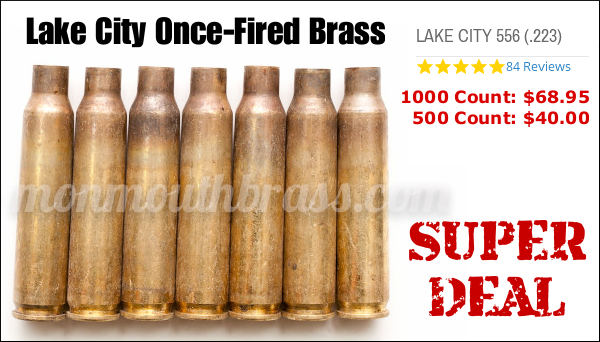
1000 pieces of Lake City brass for under seventy bucks? Yep, that’s a deal and a half. Monmouth Reloading is selling genuine, once-fired Lake City 5.56x45mm brass, thick-walled and sourced direct from the U.S. Military. Monmouth reports: “Our current stock of Lake City 5.56 looks to be all newer year Lake City head stamp but may contain a small percentage of other NATO headstamps. Lake City is a popular, reliable brass, normally capable of many reloads.” Monmouth includes 1% overage to account for any damaged brass. NOTE: Brass has crimped primers, so the pockets will need to be reamed or swaged prior to reloading.
3. Grab A Gun — Remington PSS with 20″ Heavy BBL, $589.00

Remington’s Heavy Barrel PSS model established a reputation for excellent accuracy. This .308 Winchester version features a 20″ heavy barrel threaded for a suppressor. The action is secured in a strong, pillar-bedded Hogue Overmolded ghillie green stock. The trigger is the X-Mark Pro externally-adjustable model set at 3.5 pounds. Weight, without rail or optic, is 7.3 pounds. NOTE: This PSS Rifle may also qualify for a $50.00 rebate from Remington. Inquire before you order.
4. Optics Planet — Leupold Mark AR MOD 1 1.5-4x20mm

Scopes for Service Rifles. Starting next year, under proposed new NRA Competition Rules, Service Rifle shooters will be able to use optical sights with a max magnification of 4.5X (fixed power or variable). At one-third the cost of a 4X ACOG, the Leupold 1.5-4X Mark AR is a good scope choice for the new optics-legal Service Rifle Class. Optics Planet currently has this on Sale for $299.99. With a Duplex reticle, this is also a fine hunting scope.
5. Amazon — Yes4All 36″x16″ Gun Cleaning Mat, $9.99
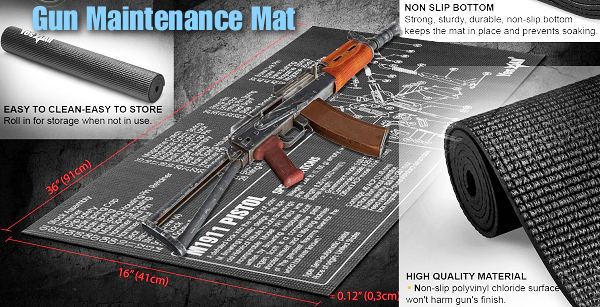
Every gun owner should have a work mat to protect valuable firearms during cleaning and maintenance operations. Right now you can get a quality 36″x16″ mat for under ten bucks. The non-slip polyvinyl chloride (PVC) surface won’t harm gun’s finish, and its absorbent features keep the fluids from going through your work surface. This week Amazon is offering the Printed Version (shown above) for $9.99 and a Plain Black Version for just $8.09. That’s an excellent value either way.
6. AmmoMen — Federal .22LR Target Ammo, $3.25/50 Rounds
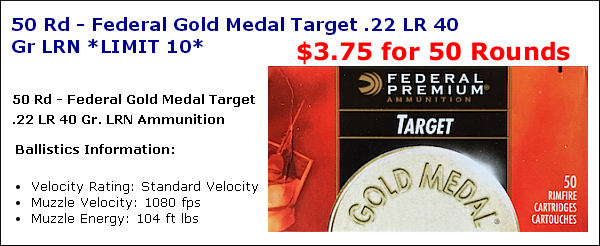
This Federal Gold Medal Target ammo is MUCH better than common bulk rimfire ammo, yet with this deal, it is only 7.5 cents per round — that’s cheaper than pretty much anything else you can buy according to Ammoseek.com. Right now you can get up to ten (10) boxes of this .22 LRrimfire ammo for just $3.75 a box from AmmoMenLLC.com. If you need rimfire ammo, don’t delay — we expect this ammo to sell out very quickly at this price.
7. Walmart — Multi-Purpose Work Bench with Light, $69.95

This 4 foot-wide bench can serve many functions in your work room. We don’t recommend mounting reloading presses to it, but it can hold your tools on the backboard, along with dies and small parts in the drawers. Place bulky items (such as media separators) on the lower shelf. This bench features built-in lighting on the underside of the upper shelf.
Weight Capacity: Bench Top 220 lb, Bottom shelf 200 lb, Top Shelf 44 lb.
Dimensions: 47.4″ (L) x 23.8″ (W) x 61.6″ (H)
8. Bullets.com — Handgun Safe $49.95

This pistol safe keeps your handguns secure while still permitting instant “push-button” access. The three-button lock can be personalized with 3- to 8-digit codes, and there is a key override. This safe will hold two (2) full-sized pistols and can also store passports, cash, or other valuables. The spring-loaded door gives you near-instant response. The all-steel case also includes mounting holes for fixing the safe to floor or shelf.
November 25th, 2015

Here’s something you don’t see very often — Lapua cartridge brass on sale. As part of its Back-to-Black promotion, Brownells has deeply discounted its inventories of Lapua Brass. For most cartridges/calibers, the price has been reduced at least $10.00 per 100-count box. Here are the sale prices, good through the end of the week:
|
.222 Rem – $53.99 (reg. $61.99)
.223 Rem – $53.99 (reg. $61.99)
220 Russian – $89.99 (reg. $99.99)
.22-250 – $89.99 (reg. $99.99)
6mmBR – $81.99 (reg. $91.99)
.243 Winchester – $89.99 (reg. $99.99)
6.5 Grendel – $89.99 (reg. $99.99)
6.5×47 Lapua – $99.99 (reg. $109.99) |
260 Remington – $89.99 (reg. $99.99)
6.5×55 Swedish – $71.99 (reg. $81.99)
6.5-284 – $109.99 (reg. $124.99)
7.62×39 – $54.99 (reg. $59.99)
.308 Winchester – $69.99 (reg. $79.99)
.308 Win Palma – $76.99 (reg. $86.99)
.30-06 Springfield – $99.99 (reg. $109.99)
.338 Lapua Magnum – $239.99 (reg. $269.99) |
August 25th, 2015

Note, this is a limited-time offer with Free Solution (August 2015).
So, what do you do with wet cartridge brass after ultrasonic cleaning or wet-tumbling with stainless media? Most of us just dump the brass into a plastic strainer or a colander, shake the casings a little to get the water out, then let the brass air-dry on a tray. We don’t recommend drying brass in a hot oven. If, by mistake, you leave your brass in the oven too long (or set the temp too high), you may slow-anneal your brass, which can end up weakening the brass.
If you can’t wait for your brass to air-dry naturally, there is another solution. Frankford Arsenel now offers a brass dryer that can dry up to 1000 pieces of .223 Rem brass or 2000 pieces of 9mm pistol brass. Yes, here’s yet another gadget for your man cave/reloading center. This unit employs forced air convection heating to dry brass quickly without water spots. This “Platinum Series” Brass Dryer features five (5) removable drying trays so you can dry different types of brass (without mixing) at the same time. Frankford says the max air temperature in the machine is about 160° F — that won’t over-cook your brass. And the “forced air flow” system distributes heat evenly.
Frankford Arsenal Brass Dryer Features
- Specifically designed to dry brass after Rotary Wet-Tumbling or Ultrasonic cleaning.
- Vented trays provide optimal airflow to minimize drying time.
- Top-mounted fan, circulates up to 160°F air to quickly dry the brass inside and out.
- Five (5) removable trays easily dry up to 1,000 pieces of .223 brass in less than 1 hour.
Free Cleaning Solution with Frankford Arsenal Brass Dryer
Currently, Grafs.com is offering a FREE 30-oz. bottle of Ultrasonic Brass Solution with every Brass Dryer unit sold. A $15.99 value, the solution goes a long way — you mix it at a 40:1 ratio with water. And, Frankford Arsenal claims: “Our Cleaning Solutions are so strong that they can be used for multiple cleaning cycles before having to mix new solution”.
July 1st, 2015

If you shoot an AR-platform rifle, you could probably use one of these gadgets. A brass-catcher keeps your brass in good shape and saves you the hassle of picking up fired cases. Moreover, nearby shooters no longer have to fear being pelted with your hot brass.

February 24th, 2015
 The Bureau of Alcohol, Tobacco, Firearms and Explosives (ATF) is seeking to ban commonly-used 5.56 M855 “green tip” ball ammunition as “armor piercing ammunition” and is seeking public comment on the proposal. The National Shooting Sports Foundation (NSSF) urges target shooters and gun owners to contact ATF to oppose this proposed ban. The Bureau of Alcohol, Tobacco, Firearms and Explosives (ATF) is seeking to ban commonly-used 5.56 M855 “green tip” ball ammunition as “armor piercing ammunition” and is seeking public comment on the proposal. The National Shooting Sports Foundation (NSSF) urges target shooters and gun owners to contact ATF to oppose this proposed ban.
For decades, under the “sporting purposes” doctrine, commonly-available “green tip” M855 and SS109 rifle ammunition has been exempt from federal law banning armor-piercing ammunition. There is no question that this 5.56 ball ammo has been widely used by law-abiding American citizens for sporting purposes.
Winchester-brand 5.56X45 62gr NATO M855 FMJ Ammunition

 The NSSF has an online form that makes it easy to voice your opinion on the proposed ban on 5.56 ball ammo. This form will direct your comments to Congress and/or the ATF. Click the button at right to navigate to the NSSF online form. The NSSF has an online form that makes it easy to voice your opinion on the proposed ban on 5.56 ball ammo. This form will direct your comments to Congress and/or the ATF. Click the button at right to navigate to the NSSF online form.
Commentary by Jim Shepherd, The Shooting Wire
Should the ATF reclassify surplus (and widely used) M855 and SS109 ammunition as armor-piercing, it would then be illegal for consumer consumption. This weekend, we received word that apparently many gun owners didn’t find this to be a compelling reason to record their objections with the federal government. With only a few days remaining in the ATF’s solicitation of comments, fewer than 6,000 shooters have registered their displeasure with the proposal.That, as one of my least-favorite instructors used to say, is simply unacceptable.”
January 29th, 2015
Each Wednesday, the U.S. Army Marksmanship Unit publishes a reloading “how-to” article on the USAMU Facebook page. Yesterday’s “Handloading Hump Day” post covered preparation of once-fired 5.56x45mm brass. This article, the first in a 3-part series, has many useful tips. If you shoot a rifle chambered in .223 Rem or 5.56x45mm, this article is worth reading. And visit the USAMU Facebook page next Wednesday for the next installment.

This week, Handloading Hump-Day will answer a special request from several competitive shooters in Alaska. They asked about procedures for morphing once-fired GI 5.56mm brass into accurate match brass for NRA High Power Rifle use. The USAMU has used virgin Lake City (LC) 5.56 brass to win National Championships and set National Records for many years. In this 3-part series, we’ll share techniques proven to wring match-winning accuracy from combat-grade brass.
 Preparing Once-Fired GI 5.56 Brass for Reloading (Part 1 of 3) Preparing Once-Fired GI 5.56 Brass for Reloading (Part 1 of 3)
Assuming our readers will be getting brass once-fired as received from surplus dealers, the following steps can help process the low-cost raw material into reliably accurate components.
1. Clean the Brass
First, clean the brass of any dirt/mud/debris, if applicable. Depending on the brass’s condition, washing it in a soap solution followed by a thorough rinsing may help. [This step also extends the life of the tumbling media.] Approaches range from low-tech, using gallon jugs 1/2 full of water/dish soap plus brass and shaking vigorously, to more high-tech, expensive and time-consuming methods.
2. Wet-Tumbling Options (Be Sure to Dry the Brass)
When applying the final cleaning/polish, some use tumblers with liquid cleaning media and stainless steel pins for a brilliant shine inside and out, while others take the traditional vibratory tumbler/ground media approach. Degree of case shine is purely personal preference, but the key issue is simple cleanliness to avoid scratching ones’ dies.
If a liquid cleaner is used, be SURE to dry the cases thoroughly to preclude corrosion inside. One method is to dump the wet brass into an old pillow case, then tilt it left/right so the cases re-orient themselves while shifting from corner to corner. Several repetitions, pausing at each corner until water stops draining, will remove most water. They can then be left to air-dry on a towel, or can be dried in a warm (150° F-200° F max) oven for a few minutes to speed evaporation.
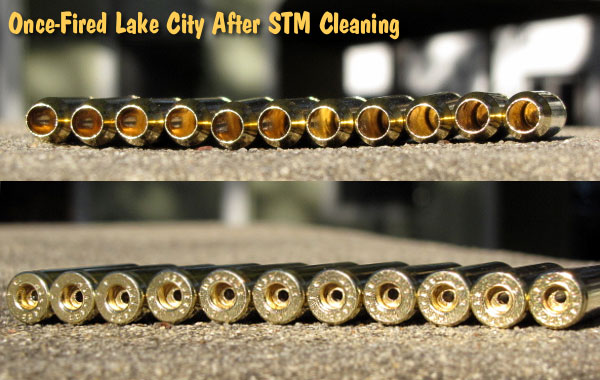
Shown below are Lake City cases after cleaning with Stainless Media (STM). Note: STM Case cleaning was done by a third party, not the USAMU, which does not endorse any particular cleaning method.
3. Inspect Every Case
Once dry, inspect each case for significant deformation (i.e., someone stepped on it), damaged mouths/necks and case head/rim damage. Some rifles’ ejectors actually dig small chunks of brass out of the case head — obviously, not ideal for precision shooting. Similarly, some extractors can bend the case rims so badly that distortion is visible when spinning them in one’s fingers. These can be used for plinking, but our match brass should have straight, undamaged rims.
Dented case mouths are common, and these can easily be rounded using a conical, tapered tool, [such as a .223 expander mandrel. A dummy 7.62 or .30-06 cartridge with a FMJ spitzer can also work.] If most of your brass is of one headstamp, this is a good time to cull out any odd cases.
4. Check the Primers Before Decapping
Your clean, dry and inspected brass is now ready for full-length sizing, decapping and re-priming. Historically, primer crimps on GI brass have caused some head-scratching (and vile language) among handloaders. Our next installment will detail efficient, easy and practical methods to remove primer crimp, plus other useful handloading tips. Until next week, Good Shooting!
NOTE: The USAMU Handloading (HL) Shop does not RE-load fired 5.56 brass. We use virgin LC brass with our chosen primer already staked in place. However, our staff has extensive personal experience reloading GI brass for competition, which will supplement the Shop’s customary steps. In handloading, as in life, there are many ways to accomplish any given task. Our suggestions are note presented as the “only way,” by any means. Time for loading/practicing is always at a premium. Readers who have more efficient, alternative methods that maintain top accuracy are invited to share them here.
December 17th, 2014

Can a human being, hand-holding a rifle, out-shoot a mechanical test rest? Who would win in this battle between man and machine? You might just be surprised. At 600 yards, with an AR-platform rifle, the results can be remarkably close, based on targets provided by the USAMU. When clamped in a test rig, a USAMU M16A2 produced a 200-18X group with handloads. The USAMU says this was “one of our better 20-shot groups at 600 yards, testing ammo from a machine rest”. Can a human do better?

Remarkably, a human soldier came very close to matching the group shot from the machine rest. The photo below shows a 20-shot group shot by a USAMU marksman with sling and iron sights, using USAMU-loaded ammunition. The score, 200-16X, was nearly the same. As you can see, the USAMU rifleman didn’t give up much to the machine rest, even at 600 yards!

In fairness, this was no ordinary human performance. The 200-16X score was a new National Record set in December, 1994. This was fired by PFC Coleman in an Interservice Match at Okeechobee, Florida. Nice shootin’ soldier!
September 29th, 2014
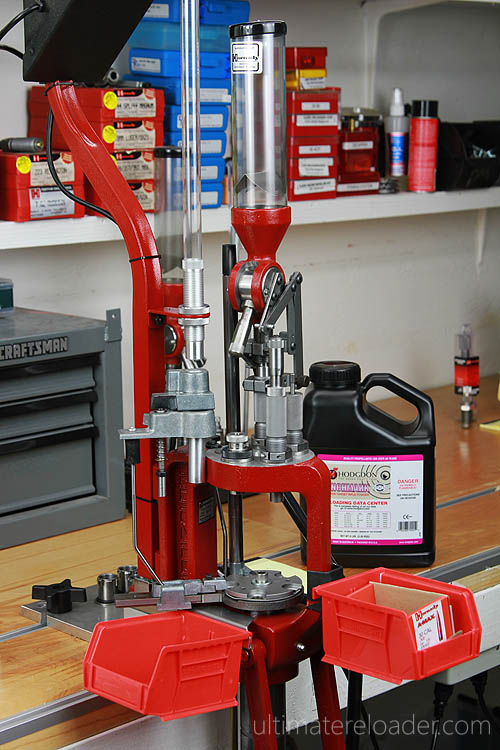
When you need ammo fast — lots of ammo, it’s hard to beat a progressive reloading press for output. We use progressive presses to load handgun ammo and .223 Rem cartridges for varmint safaris. With good dies, and proper press set-up, today’s progressive presses can produce surprisingly uniform and accurate ammo. No, you won’t see Benchrest Hall-of-Famers loading PPC cartridges on progressives. However, if you need 1000 rounds for your next prairie dog adventure, you should consider getting a progressive. Below you can see a Hornady Lock-N-Load AP configured to load .308 Winchester in bulk.
CLICK HERE to Read Full Article

UltimateReloader.com has published helpful Tips to Optimize Progressive Rifle Loading. No matter whether you have a Red (Hornady), Green (RCBS), or Blue (Dillon) progressive, this article can help you load more efficiently and produce better results. Here are some highlights:
Proper Brass Prep
Just like a good paint job requires good prep work, great rifle ammo requires good brass prep. In order to make sure your rifle loading goes smoothly, make sure to perform the following brass prep steps:
- Clean the brass (tumble, ultrasonic, etc.)
- Inspect brass for cracks, deep dents, etc.
- For military brass: de-prime, ream/swage primer pockets, size with small-base sizer die (small base usually optional).
- Measure brass length — if too long, size and then trim.
- Final inspection before loading.
- Cleaning primer pockets may be something you’ll consider (I don’t clean primer pockets except for rare cases or match ammo).
Smooth and Steady Pace
Since you’re loading rifle ammunition on a progressive, you’re already saving a load of time, so there’s no need to rush things! Attention to detail is super-important for safety and for good results. Always keep an eye on powder level (goes down FAST) and what’s happening at each station.
The Right Press and Press Setup
Look for a heavy-duty, well-built press that will stand up to rifle loading. You’ll also want to make sure your powder measure will have the proper capacity (~25 grains for .223, ~50 grains for 308). If you are bulk reloading, ensure you have enough stations for sizing, charging, powder check, bullet feed, bullet seating, and (optional) bullet crimp.
More Ultimate Reloader Resources for Users of Progressive Presses:
September 9th, 2014
One of our favorite Ruger bolt-action rifles is now available in a caliber better suited for varmint hunting. The versatile Ruger Gunsite Scout Rifle, previously offered in .308 Winchester only, is now chambered in .223 Rem / 5.56 NATO. This newest version of the Gunsite Scout Rifle features a hybrid chamber that shoots both 5.56x45mm NATO and .223 Remington. This rifle is light and compact. With a 16.1″ barrel, it weighs just 7.1 pounds without optics.

The .223 Scout Rifle is offered in both right- and left-hand versions, both with a 10-round detachable box magazine. You can choose either an all-stainless version ($1099.00 MSRP), with SS receiver and SS barrel, or a dark version ($1039.00 MSRP) with matte black alloy steel action and barrel. The bolt offers Mauser-style controlled round feed, with a lever-style safety on the rear of the bolt shroud. The rifle features a 16.1″, 1:8″-twist rate, barrel fitted with flash hider which can be removed to attach other 1/2-28 threaded barrel accessories. Interestingly, the magazine for .223/5.56 Scout Rifle is dimensionally the same as the mag for the .308 Scout Rifle. The .223/5.56 mag employs a plastic insert to feed the smaller cartridge properly.
American Rifleman Field Test of .223 Rem Scout Rifle

Adjustable Length of Pull Through Buttpad Spacers
The black laminate stock is fitted with sling swivel studs and features checkered grip and forearm. A soft rubber recoil pad with three 1/2″ spacers allows the length of pull (LOP) to be adjusted.


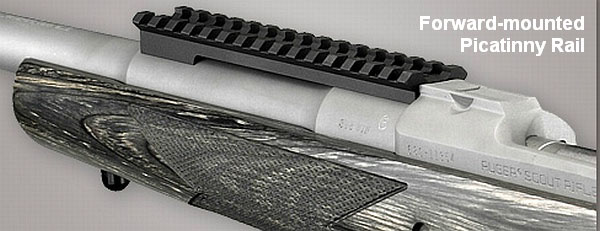
Ruger Scout Rifles feature a Mini-14-style protected, non-glare, post front sight and receiver-mounted, adjustable, ghost ring rear sight. The forward-mounted Picatinny rail lets you use a variety of optics including LER scout scopes that allow “both eyes open” target acquisition. Ruger provides scope rings for mounting conventional scopes on the integral M77-style mounts built into the Scout Rifle receivers.
|


