|
|
July 1st, 2015

If you shoot an AR-platform rifle, you could probably use one of these gadgets. A brass-catcher keeps your brass in good shape and saves you the hassle of picking up fired cases. Moreover, nearby shooters no longer have to fear being pelted with your hot brass.

February 24th, 2015
 The Bureau of Alcohol, Tobacco, Firearms and Explosives (ATF) is seeking to ban commonly-used 5.56 M855 “green tip” ball ammunition as “armor piercing ammunition” and is seeking public comment on the proposal. The National Shooting Sports Foundation (NSSF) urges target shooters and gun owners to contact ATF to oppose this proposed ban. The Bureau of Alcohol, Tobacco, Firearms and Explosives (ATF) is seeking to ban commonly-used 5.56 M855 “green tip” ball ammunition as “armor piercing ammunition” and is seeking public comment on the proposal. The National Shooting Sports Foundation (NSSF) urges target shooters and gun owners to contact ATF to oppose this proposed ban.
For decades, under the “sporting purposes” doctrine, commonly-available “green tip” M855 and SS109 rifle ammunition has been exempt from federal law banning armor-piercing ammunition. There is no question that this 5.56 ball ammo has been widely used by law-abiding American citizens for sporting purposes.
Winchester-brand 5.56X45 62gr NATO M855 FMJ Ammunition

 The NSSF has an online form that makes it easy to voice your opinion on the proposed ban on 5.56 ball ammo. This form will direct your comments to Congress and/or the ATF. Click the button at right to navigate to the NSSF online form. The NSSF has an online form that makes it easy to voice your opinion on the proposed ban on 5.56 ball ammo. This form will direct your comments to Congress and/or the ATF. Click the button at right to navigate to the NSSF online form.
Commentary by Jim Shepherd, The Shooting Wire
Should the ATF reclassify surplus (and widely used) M855 and SS109 ammunition as armor-piercing, it would then be illegal for consumer consumption. This weekend, we received word that apparently many gun owners didn’t find this to be a compelling reason to record their objections with the federal government. With only a few days remaining in the ATF’s solicitation of comments, fewer than 6,000 shooters have registered their displeasure with the proposal.That, as one of my least-favorite instructors used to say, is simply unacceptable.”
January 29th, 2015
Each Wednesday, the U.S. Army Marksmanship Unit publishes a reloading “how-to” article on the USAMU Facebook page. Yesterday’s “Handloading Hump Day” post covered preparation of once-fired 5.56x45mm brass. This article, the first in a 3-part series, has many useful tips. If you shoot a rifle chambered in .223 Rem or 5.56x45mm, this article is worth reading. And visit the USAMU Facebook page next Wednesday for the next installment.

This week, Handloading Hump-Day will answer a special request from several competitive shooters in Alaska. They asked about procedures for morphing once-fired GI 5.56mm brass into accurate match brass for NRA High Power Rifle use. The USAMU has used virgin Lake City (LC) 5.56 brass to win National Championships and set National Records for many years. In this 3-part series, we’ll share techniques proven to wring match-winning accuracy from combat-grade brass.
 Preparing Once-Fired GI 5.56 Brass for Reloading (Part 1 of 3) Preparing Once-Fired GI 5.56 Brass for Reloading (Part 1 of 3)
Assuming our readers will be getting brass once-fired as received from surplus dealers, the following steps can help process the low-cost raw material into reliably accurate components.
1. Clean the Brass
First, clean the brass of any dirt/mud/debris, if applicable. Depending on the brass’s condition, washing it in a soap solution followed by a thorough rinsing may help. [This step also extends the life of the tumbling media.] Approaches range from low-tech, using gallon jugs 1/2 full of water/dish soap plus brass and shaking vigorously, to more high-tech, expensive and time-consuming methods.
2. Wet-Tumbling Options (Be Sure to Dry the Brass)
When applying the final cleaning/polish, some use tumblers with liquid cleaning media and stainless steel pins for a brilliant shine inside and out, while others take the traditional vibratory tumbler/ground media approach. Degree of case shine is purely personal preference, but the key issue is simple cleanliness to avoid scratching ones’ dies.
If a liquid cleaner is used, be SURE to dry the cases thoroughly to preclude corrosion inside. One method is to dump the wet brass into an old pillow case, then tilt it left/right so the cases re-orient themselves while shifting from corner to corner. Several repetitions, pausing at each corner until water stops draining, will remove most water. They can then be left to air-dry on a towel, or can be dried in a warm (150° F-200° F max) oven for a few minutes to speed evaporation.
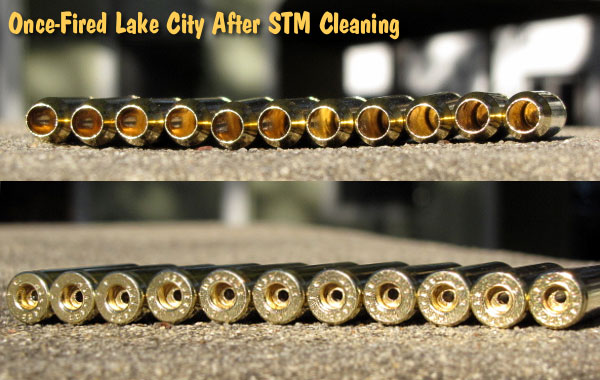
Shown below are Lake City cases after cleaning with Stainless Media (STM). Note: STM Case cleaning was done by a third party, not the USAMU, which does not endorse any particular cleaning method.
3. Inspect Every Case
Once dry, inspect each case for significant deformation (i.e., someone stepped on it), damaged mouths/necks and case head/rim damage. Some rifles’ ejectors actually dig small chunks of brass out of the case head — obviously, not ideal for precision shooting. Similarly, some extractors can bend the case rims so badly that distortion is visible when spinning them in one’s fingers. These can be used for plinking, but our match brass should have straight, undamaged rims.
Dented case mouths are common, and these can easily be rounded using a conical, tapered tool, [such as a .223 expander mandrel. A dummy 7.62 or .30-06 cartridge with a FMJ spitzer can also work.] If most of your brass is of one headstamp, this is a good time to cull out any odd cases.
4. Check the Primers Before Decapping
Your clean, dry and inspected brass is now ready for full-length sizing, decapping and re-priming. Historically, primer crimps on GI brass have caused some head-scratching (and vile language) among handloaders. Our next installment will detail efficient, easy and practical methods to remove primer crimp, plus other useful handloading tips. Until next week, Good Shooting!
NOTE: The USAMU Handloading (HL) Shop does not RE-load fired 5.56 brass. We use virgin LC brass with our chosen primer already staked in place. However, our staff has extensive personal experience reloading GI brass for competition, which will supplement the Shop’s customary steps. In handloading, as in life, there are many ways to accomplish any given task. Our suggestions are note presented as the “only way,” by any means. Time for loading/practicing is always at a premium. Readers who have more efficient, alternative methods that maintain top accuracy are invited to share them here.
December 17th, 2014

Can a human being, hand-holding a rifle, out-shoot a mechanical test rest? Who would win in this battle between man and machine? You might just be surprised. At 600 yards, with an AR-platform rifle, the results can be remarkably close, based on targets provided by the USAMU. When clamped in a test rig, a USAMU M16A2 produced a 200-18X group with handloads. The USAMU says this was “one of our better 20-shot groups at 600 yards, testing ammo from a machine rest”. Can a human do better?

Remarkably, a human soldier came very close to matching the group shot from the machine rest. The photo below shows a 20-shot group shot by a USAMU marksman with sling and iron sights, using USAMU-loaded ammunition. The score, 200-16X, was nearly the same. As you can see, the USAMU rifleman didn’t give up much to the machine rest, even at 600 yards!

In fairness, this was no ordinary human performance. The 200-16X score was a new National Record set in December, 1994. This was fired by PFC Coleman in an Interservice Match at Okeechobee, Florida. Nice shootin’ soldier!
September 29th, 2014
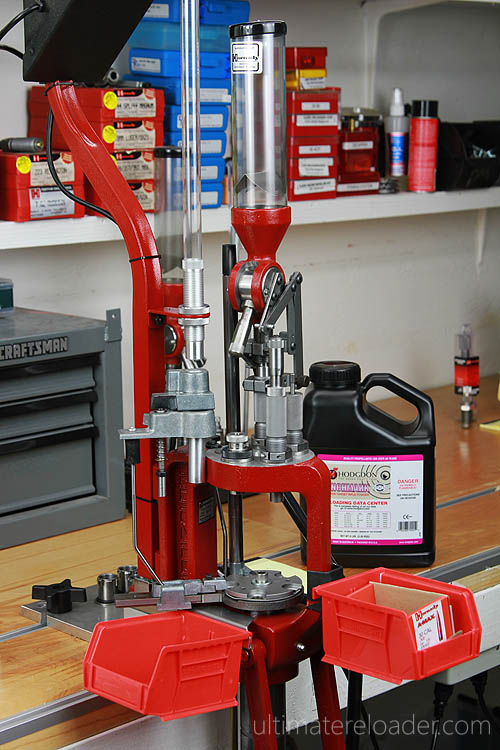
When you need ammo fast — lots of ammo, it’s hard to beat a progressive reloading press for output. We use progressive presses to load handgun ammo and .223 Rem cartridges for varmint safaris. With good dies, and proper press set-up, today’s progressive presses can produce surprisingly uniform and accurate ammo. No, you won’t see Benchrest Hall-of-Famers loading PPC cartridges on progressives. However, if you need 1000 rounds for your next prairie dog adventure, you should consider getting a progressive. Below you can see a Hornady Lock-N-Load AP configured to load .308 Winchester in bulk.
CLICK HERE to Read Full Article

UltimateReloader.com has published helpful Tips to Optimize Progressive Rifle Loading. No matter whether you have a Red (Hornady), Green (RCBS), or Blue (Dillon) progressive, this article can help you load more efficiently and produce better results. Here are some highlights:
Proper Brass Prep
Just like a good paint job requires good prep work, great rifle ammo requires good brass prep. In order to make sure your rifle loading goes smoothly, make sure to perform the following brass prep steps:
- Clean the brass (tumble, ultrasonic, etc.)
- Inspect brass for cracks, deep dents, etc.
- For military brass: de-prime, ream/swage primer pockets, size with small-base sizer die (small base usually optional).
- Measure brass length — if too long, size and then trim.
- Final inspection before loading.
- Cleaning primer pockets may be something you’ll consider (I don’t clean primer pockets except for rare cases or match ammo).
Smooth and Steady Pace
Since you’re loading rifle ammunition on a progressive, you’re already saving a load of time, so there’s no need to rush things! Attention to detail is super-important for safety and for good results. Always keep an eye on powder level (goes down FAST) and what’s happening at each station.
The Right Press and Press Setup
Look for a heavy-duty, well-built press that will stand up to rifle loading. You’ll also want to make sure your powder measure will have the proper capacity (~25 grains for .223, ~50 grains for 308). If you are bulk reloading, ensure you have enough stations for sizing, charging, powder check, bullet feed, bullet seating, and (optional) bullet crimp.
More Ultimate Reloader Resources for Users of Progressive Presses:
September 9th, 2014
One of our favorite Ruger bolt-action rifles is now available in a caliber better suited for varmint hunting. The versatile Ruger Gunsite Scout Rifle, previously offered in .308 Winchester only, is now chambered in .223 Rem / 5.56 NATO. This newest version of the Gunsite Scout Rifle features a hybrid chamber that shoots both 5.56x45mm NATO and .223 Remington. This rifle is light and compact. With a 16.1″ barrel, it weighs just 7.1 pounds without optics.

The .223 Scout Rifle is offered in both right- and left-hand versions, both with a 10-round detachable box magazine. You can choose either an all-stainless version ($1099.00 MSRP), with SS receiver and SS barrel, or a dark version ($1039.00 MSRP) with matte black alloy steel action and barrel. The bolt offers Mauser-style controlled round feed, with a lever-style safety on the rear of the bolt shroud. The rifle features a 16.1″, 1:8″-twist rate, barrel fitted with flash hider which can be removed to attach other 1/2-28 threaded barrel accessories. Interestingly, the magazine for .223/5.56 Scout Rifle is dimensionally the same as the mag for the .308 Scout Rifle. The .223/5.56 mag employs a plastic insert to feed the smaller cartridge properly.
American Rifleman Field Test of .223 Rem Scout Rifle

Adjustable Length of Pull Through Buttpad Spacers
The black laminate stock is fitted with sling swivel studs and features checkered grip and forearm. A soft rubber recoil pad with three 1/2″ spacers allows the length of pull (LOP) to be adjusted.


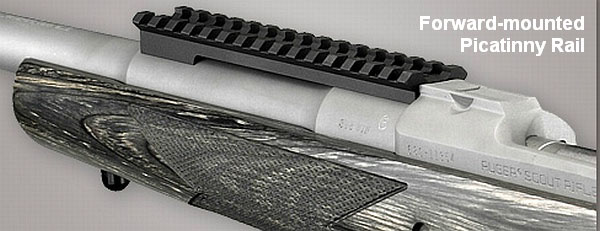
Ruger Scout Rifles feature a Mini-14-style protected, non-glare, post front sight and receiver-mounted, adjustable, ghost ring rear sight. The forward-mounted Picatinny rail lets you use a variety of optics including LER scout scopes that allow “both eyes open” target acquisition. Ruger provides scope rings for mounting conventional scopes on the integral M77-style mounts built into the Scout Rifle receivers.
August 13th, 2014
Giraud Tool has a new case trimmer/chamferer that works with a power drill (or other power source). Giraud’s patent-pending Tri Way Case Trimmer is a self-contained unit powered by your drill or motor. Using a sharp carbide blade it will trim your cases to length, deburr, and cut both inside and outside chamfers — all in one pass. That’s pretty impressive for a $90 tool that fits in the palm of your hand.
Close-up of the Tri Way cutter with clear plastic chip guard removed.

Product Features
1. Fully adjustable for cartridge length (and depth of chamfer).
2. Tool includes carbide blade that cuts a 15° inside case mouth chamfer and 45° outside chamfer.
3. Case holder supported by sealed ball bearing raceway.
4. Tool includes removable, transparent plastic chip guard.
5. Tool can work in any orientation (vertical, horizontal, or any angle).
The Giraud Tri Way Trimmer is designed to be powered by a portable hand drill, drill press, or other dedicated rotating power source. The tool indexes off the shoulder of your cases, but the blade adjusts so that cartridge overall length (COAL) can be controlled with precision. Constructed out of 6061-T6 aluminum and 303 stainless steel, the Tri Way tool should last a lifetime. Note: This tool is not universal. The Tri Way is dedicated to a single cartridge and “related” cartridges with similar body dimensions. Thus you need a specific tool for each cartridge family. For example, the .308 Win tool will also trim .243 Win, .260 Rem, and 7mm-08.
Cartridge Sizes Available for Giraud Tri Way Trimmer:
.223 Remington (Also trims .17 Remington, .204 Ruger, .222 Remington, .222 Remington Magnum)
7.62 x 39mm (Russian)
.300 Blackout (Also trims .17 Rem Fireball, .221 Fireball)
.308 Winchester (Also trims .243 Winchester, .260 Remington, 7mm-08)
.30-06 Springfield (Also trims .25-06, .270 Winchester, .280 Remington)
.300 Winchester Mag (Also trims .264 Winchester Magnum, 7mm Remington Magnum)

Product Tip from EdLongrange. We welcome reader submissions.
June 13th, 2014
This month Ruger is introducing a new varmint version of its popular Ruger American Rifle (RAR). The RAR “Predator” model is offered in six (6) different chamberings: .204 Ruger, .223 Remington, .22-250 Remington, .243 Winchester, 6.5 Creedmoor, and .308 Winchester. All have 22″ free-floated, medium-contour barrels except the .308 Win, which has an 18″ tube, making it a very handy truck gun.

Gun writer Ed Head got his hands on one of the new RAR Predator rifles, chambered in .223 Remington. He reviewed the Predator for the DownRange.TV blog. The reviewer liked the compact 6.62-pound rifle, which features a molded polymer stock and hammer-forged 1:8″ twist barrel. Ed Head liked the short-throw bolt, and he praised the crisp trigger. Accuracy, as tested, was not that impressive — 1.224″ on average at 100 yards. But the tester noted that some types of ammo shot much better than others. So, conceivably, with handloads, this gun could shoot well under 1 MOA. Shooting at steel targets, the tester “managed to shoot 1.5-inch groups at 100 yards, 2.5-inch groups at 200 yards, and 7-inch groups at 300 yards, all with the Lake City ammunition.”
 CLICK HERE To Read Full Review of Ruger American Rifle Predator
Overall, reviewer Ed Head liked the Predator enough that he decided to purchase his test rifle: “I like this rifle and I’m going to buy it from Ruger. It will shoot ‘minute of squirrel’ at reasonable ranges and should do well on bigger critters — predators — out to 400 yards or more.”
Rifle Features
- One-piece, 3-Lug 70° bolt with full-diameter bolt body and dual cocking cams.
- Integral bedding block system that positively locates the receiver.
- Action comes with factory-installed aluminum Weaver-style scope rail.
- Two-position safety can lock trigger (but not bolt) to allow safe unloading.
- Adjustable 3.5-lb Ruger Marksman trigger with Savage-style inner safety blade.
- Barrel factory-threaded at muzzle for muzzle brakes, flash hiders, and/or suppressors.
- Rotary magazines with 4- or 5-round capacity (depending on caliber). These magazines are a little tough to load correctly.

May 9th, 2014
Lake City vs. Lapua — which brass is harder? And how about Remington vs. Winchester? Is the widely-held belief that Win brass is harder than Rem brass really true? To help settle these burning questions (raised in a Forum thread), Forum member Catshooter recently sampled the base hardness of four brands of .223/5.56 brass. He employed a very impressive tool for the task — a $2,500 Ames Hardness Gauge. Catshooter explained that his Ames Guage “is FAA certified and approved for testing aircraft engine parts — it does NOT get any better than that!”
Catshooter measured four cases picked at random from batches of Lake City (LC) 2008 (5.56x45mm), Lapua .223 Rem Match, Winchester .223 Rem, and Remington R-P .223 Rem.
 |
 |
 |
 |
| Lake City |
Lapua Match |
Winchester |
Remington |
Photo Shows Ames Gauge Base Hardness Measurement on Lake City Brass

Photo Show Ames Gauge Base Hardness Measurement on Winchester Brass

 TEST RESULTS TEST RESULTS
Using Rockwell hardness standards (.062″x100kg, Rockwell “B”), the brass measured as follows:
LC 2008 = 96
Lapua 223 Match = 86
Winchester 223 = 69
Remington “R-P” = 49
Summary of Test Results
Catshooter writes: “For all you guys that have believed that Winchester cases were tougher than Remington — you are vindicated, they are a lot tougher! However, Lake City and Lapua are ‘the pick of the litter'”. Catshooter notes that both Lake City and Lapua are significantly harder than either Winchester and Remington .223 brass. That’s something that we’ve observed empirically (Lapua and LC stand up better to stout loads), but now we have some hard numbers to back that up. Hats off to Catshooter for settling the hardness debate with his Ames Hardness Gauge.
May 7th, 2014
Need .223 Rem ammo for your early summer varmint safari? Grafs.com has you covered. Over the past few months, Graf & Sons has acquired a large supply of .223 Rem ammo from a variety of manufacturers. Now Grafs.com has a great selection of .223 Rem ammo, with many items marked down on sale. You’ll find name-brand ammo for as little as $9.99 per 20-ct box (American Eagle 50gr JHP). If you prefer heavier bullets for longer-range shooting, check out the PRVI Partizan ammo loaded with 75gr HPBT match bullets — this is just $10.99 per per 20-ct box.
Here is just a sample of the .223 Rem ammo available at Grafs.com right now:


|


