|
|
January 31st, 2014
Looking to start a new enterprise? How about entering a field where consumer demand greatly exceeds supply right now — the ammunition business. If you have $38,000 or so you can get your own automated ammo-making machine from Ammo Load Worldwide, Inc., an American-run business located in Lewiston, Idaho. There’s also an 11-station, computer-controlled “Mark L” rifle ammo machine that’s a bit pricier — $77,000 with accessories. Sure that’s a tad more expensive than a Dillon XL650, but with a Mark L you can produce three thousand .223 Rem rounds per hour with the push of a button.

Watch Ammo-Loading Machines in Action:
Mark X Pistol Cartridge Loading Machine (about $38,000)
For over 30 years Ammo Load machines have served ammunition manufacturers, commercial loaders, private shooting ranges, and numerous law enforcement agencies. The Mark X Ammo Load machine (for pistol cartridges) has a maximum production rate of just over 5,000 cycles per hour. Many users produce between 3,000 and 5,000 rounds per hour. The primary factors governing the quality and quantity of ammunition produced are the components (particularly the cases), the caliber, and the capabilities of the operator.


The Mark X Ammo Load machine for pistol cartridges has nine (9) stations: Case Check, Size and Deprime, Primer and Primer Disk Check, Belling, Powder Feed, Powder Check, Bullet Seating, Bullet Crimp, Final Sizing. There are checks (with shut-offs) for case feed, primer feed, bullet feed, and powder load. The Mark X comes complete with shell case feeder, primer feed tube, powder flask, and bullet feed tube.
Mark L – Automatic Rifle Ammunition Loader (About $77,000)
In 2009 Ammo Load Worldwide introduced the Mark L automatic rifle ammunition loader in .223 and .308. Many proven features from the Mark X pistol machine have been incorporated into the Mark L to provide precise and consistent rifle cartridge loading at approximately 3,000 to 3,600 rounds per hour. All of the sensors and switches use fiber optic technology to increase precision and reduce maintenance. The Mark L utilizes a 3-station powder drop; the manufacturer claims this maintains charge weights to within 1/10th of a grain.


| Mark L Rifle Cartridge Loading Machine has 11 stations: |
1. Sizing/Checking*
2. Mouth Flare
3. Priming
4. Primer Check / 1st Powder Drop
5. 2nd Powder Drop
6. 3rd Powder Drop
| 7. Powder Check
8. Initial Bullet Seating
9. Final Bullet Seating
10. Crimp & Bullet-in-Case Check
11. Eject |
*Along with sizing, this first stage performs Flash-Hole Check, Ringer Check, and Case Check.
January 12th, 2014
 Redding is now offering Micro-Adjusting Taper Crimp Dies for the .223 Remington (5.56×45) and .308 Winchester (7.62×51), the two most popular cartridges used in competitive rifle shooting. New for 2014, these top-adjusting, micrometer-style dies, you can adjust crimp precisely without having to back-out the die and reposition the lock ring. Redding is now offering Micro-Adjusting Taper Crimp Dies for the .223 Remington (5.56×45) and .308 Winchester (7.62×51), the two most popular cartridges used in competitive rifle shooting. New for 2014, these top-adjusting, micrometer-style dies, you can adjust crimp precisely without having to back-out the die and reposition the lock ring.
The process of traditional taper crimp die adjustment is generally both time consuming and imprecise due to the 1:14″ thread pitch coupled with the need to reposition the lock ring after each adjustment. The new Redding Micro-Adjusting Taper Crimp Dies for .223 Rem and .308 Win use a knurled, micrometer-type head situated to provide approximately +/- 0.100″ of adjustment after initial die set-up. The actual crimp is applied with a hardened steel “free floating” internal sleeve.
To Taper Crimp or Not to Crimp?
That Depends…
Do you actually need a taper crimp on .223 Rem or .308 Win cartridges? If you are shooting a precision bolt gun, the answer is “probably not”. However, if you are hand-loading ammo for a semi-automatic rifle, there are reasons you may want to apply a taper crimp on the cartridge. And high-volume .223 Rem shooters may want to apply a taper crimp, particularly when loading mixed headstamp brass using a progressive press. The new Redding dies allow you to control the amount of crimp easily and more efficiently. Redding claims that: “Down time and loss of production due to adjustment of the crimp are virtually eliminated, dramatically increasing the rounds per hour rates of all progressive and turret-style presses.”
High-volume hand-loaders often struggle with the realities of case variation and the resulting difficulties in obtaining a uniform crimp. Redding notes: “Case length is not the only variable, as case neck-wall thickness also impacts where the case intersects the die’s tapered crimping surface.”
December 11th, 2013
 We know many readers have been searching high and low for components and high-quality ammunition, particularly for popular chamberings such as the .308 Winchester. Well Santa delivered something nice for you .308 shooters. Bullets.com received a large shipment of Norma-brand Tac .308 ammo. This is good stuff — Norma brass loaded with a quality 150gr Norma FMJ bullet. This Tac-308 ammo is now in stock and On Sale for $53.50 for fifty (50) rounds at Bullets.com. If you can find this elsewhere, you’ll pay $65.00 or more per box. And remember, you’ve got quality Norma brass that will last for many reloadings after the ammo is fired. When you consider the value of the brass for reloading, this deal is even more attractive. We know many readers have been searching high and low for components and high-quality ammunition, particularly for popular chamberings such as the .308 Winchester. Well Santa delivered something nice for you .308 shooters. Bullets.com received a large shipment of Norma-brand Tac .308 ammo. This is good stuff — Norma brass loaded with a quality 150gr Norma FMJ bullet. This Tac-308 ammo is now in stock and On Sale for $53.50 for fifty (50) rounds at Bullets.com. If you can find this elsewhere, you’ll pay $65.00 or more per box. And remember, you’ve got quality Norma brass that will last for many reloadings after the ammo is fired. When you consider the value of the brass for reloading, this deal is even more attractive.

December 2nd, 2013
Forum member Jonathan L. (aka ‘Quest-QC’) was a member of the Canadian F-TR team at the F-Class World Championships in Raton, NM this fall. His handsome .308 Winchester rifle features some interesting hardware and a stunning African Padauk-wood stock stiffened with carbon fiber layers. We were impressed by the innovative, adjustable bag-rider assembly Jonathan fitted to the rear of his stock (scroll down for photo). With an Allen wrench, the vertical height and the slope (i.e. fore/aft angle) of the V-shaped bag-rider can be changed easily. This has many advantages. First, Jonathan can set his rifle to the most comfortable height (for his prone position) without using “lifters” under the rear bag. The system also gives him some gross elevation adjustment separate from the bipod. In addition, the angle adjustment allows the bag-rider to better match the geometry of the rear bag. Last but not least, by setting up the bag-rider with some drop (higher in front, lower in back), Jonathan can fine-tune his elevation (while aiming the gun) by simply sliding the rifle fore and aft.

Jonathan says: “This year was my second year shooting at 1000 yards and I managed to find a spot on Team Canada for the FCWC at Raton. Here is the rifle that brought me there…”

The rifle features a Kelbly Panda F-Class RB-LP action, 34″ Bartlein 1:11″-twist, Heavy Palma contour barrel. Fitted to the red-toned Padauk-wood stock is a 23.2 oz., StarShooter CF-SS light weight bipod with custom bench feet. On top is a March 8-80x56mm scope in Kelbly rings. Total weight of the rifle is 18 pounds, 1 oz., complete with the 24 oz. adjustable brass bag-rider at the back. The bag-rider block was modeled in 3D, then machined afterwards to use up the remaining weight available after all the other components. CLICK for StarShooter CF-SS Bipod Video.
African Padauk Wood is Very Stiff
Jonathan chose the red-toned African Padauk Wood because it is stiff for its weight: “The reason for choosing African Padauk is that the weight of the wood is the same as Maple but 45% more rigid.” The downside of Padauk, as Forum member Gstaylorg notes, is that it is a “very oily wood, which can make it somewhat difficult to finish with something like polyurethane. [Padauk] can generate a lot of bubbles and cause cracking problems around joints and/or seams.” Jonathan did note that he has observed a few bubbles in the auto clear coat on his stock. He plans to refinish the stock in the off-season.

Gun Is Extremely Accurate with Berger 200gr Hybrids
Jonathan says this rig was very accurate, at least until his barrel gave up the ghost. He says he has put 15 successive shots in about 1/4 MOA: “I managed to make it twice (1/4 MOA for 15) by taking my time between shots. You don’t want to overheat this barrel. I needed to provide a very strong effort (mentally) to be able to achieve such precision as the rifle is way better than me.” Jonathan shoots Berger 200gr Hybrid bullets (in the lands) with Hodgdon Varget powder, and Federal 205M primers, loaded into neck-turned Lapua .308 Win brass. He has also had good luck with Vihtavuori N150 powder in the past.

In compliance with F-Class rules, the adjustable bag-rider system would not be adjusted “on the fly” during record fire. The bag-rider’s vertical rise and fore/aft slope would be optimized before shooting, then locked in place. The bottom photo offers a good view of the V-shaped profile of the metal bag-rider. We have found that this kind of V-profile, closely matching the triangular profile of the rear ears, makes a rifle more secure in the rear bag and often allows the gun to track better.


September 10th, 2013
While attending the 2013 F-Class World Championships at Raton, we had a chance to talk with Derek Rodgers, who had just been named the 2013 U.S. F-TR National Champion. Derek’s F-TR Win at Raton makes him the only shooter to have won U.S. F-Class National titles in both F-Open and F-TR divisions. Derek was excited about his performance at Raton: “F-TR was my first love in competitive shooting and [winning the F-TR title] has always been a personal goal to achieve”. In this Q&A session, Derek tells us about his rifles and his Nationals-winning .308 Winchester load. Derek also provides some advice for new shooters in the F-TR game.

Q: Readers want to know about your rifle. How did your select your stock, action, and bipod? And tell us about working with your gunsmith Doan Trevor and the quality of his work.
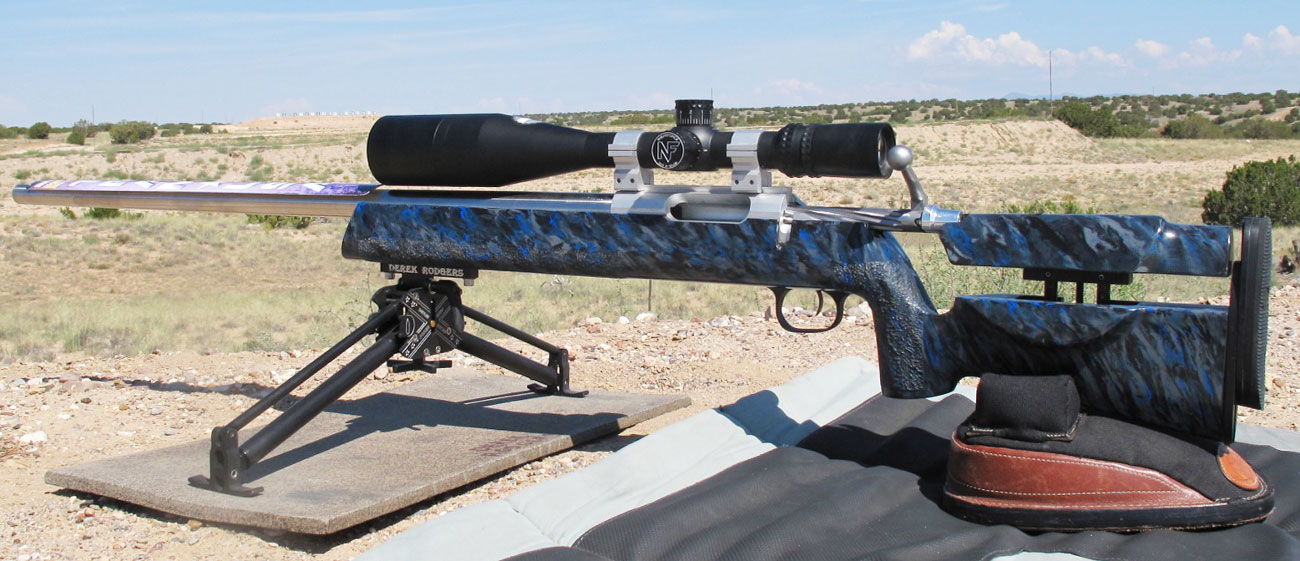
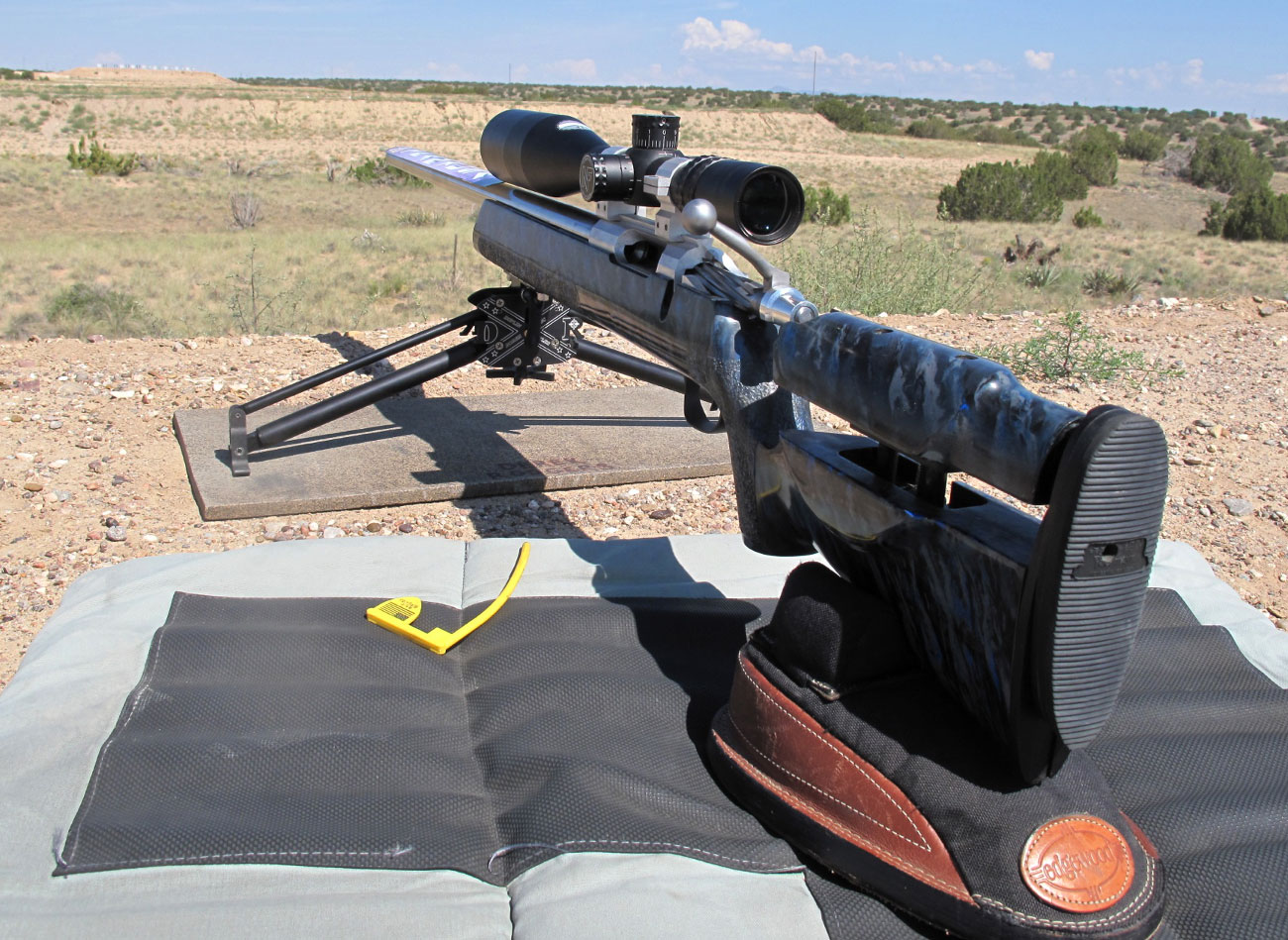
Derek: For my F-TR project, I carefully chose as many lightweight components as possible, without compromising performance. I wanted to put the weight savings (from light components) into a heaver, stiffer barrel. The rifle features a left port, left bolt Kelbly F-Class Panda action fitted with a Kelbly trigger. The stock was acquired as an uncut blank. It’s a McMillan Prone stock and is very comfortable in design. It also has a nice vertical pistol grip and gentle palm swell. This makes getting behind the gun feel very natural. [Editor’s Note: Though Derek is a right-hander, he shoots with a Left bolt-Left port action. This allows him to stay in the shooting position, right hand on grip, while manipulating the bolt (and feeding rounds) with his non-trigger-pulling hand.]
CLICK on Rifle Photos for Full-Screen Versions

Rifle photos by Dennis Welker.

 Doan Trevor built the entire rifle. Doan even made all of the hardware on the gun. Doan was able to drop pounds vs. ounces as a result. Doan’s 3-way butt-plate hardware alone weighs just half a pound! Doan was highly attentive in helping me build the gun the way I wanted. His bedding and fitment is clean and he has creative ideas for the competitive shooter. While my stock is fiberglass, Doan really shines when it comes to building stocks from wood blanks. In fact, Doan built the stock used by second-place finisher Lige Harris, and also fourth-place Trudie Fay. I feel fortunate to have Doan so close. He’s truly a master craftsman who can quickly turn a project into reality. Doan Trevor built the entire rifle. Doan even made all of the hardware on the gun. Doan was able to drop pounds vs. ounces as a result. Doan’s 3-way butt-plate hardware alone weighs just half a pound! Doan was highly attentive in helping me build the gun the way I wanted. His bedding and fitment is clean and he has creative ideas for the competitive shooter. While my stock is fiberglass, Doan really shines when it comes to building stocks from wood blanks. In fact, Doan built the stock used by second-place finisher Lige Harris, and also fourth-place Trudie Fay. I feel fortunate to have Doan so close. He’s truly a master craftsman who can quickly turn a project into reality.
I chose a Bartlein barrel on this rifle. It is an 1:11″ twist, 32″ long, heavy-contour barrel to stabilize heavy bullets. This barrel was a real hummer from the start. I shot six shells over the chronograph to determine initial chamber behavior and all six loads shot into 1 hole at 100 yards. Each cartridge had 0.5 grains increase in powder. That’s never happened to me before.

Up front, I used a Duplin Bipod. It weighs just 17.2 ounces and is made in North Carolina by Clint Cooper and supplied through Brownells/Sinclair. It is a new product for them and it has already proved to be an extremely lightweight, solid platform. Kelbly rings and an NXS 8-32X scope top the rifle off.
Q: Could you talk about your experience shooting at Raton — dealing with the challenging winds. Did you have any strategy going into the Nationals? Did that change?
Derek: The Raton winds can be intimidating to a person that has never shot there before. In fact, one of the first comments I heard was that it was ugly and nasty out there as the flags ripped straight out to the NW. I glanced downrange and thought it looked like another beautiful New Mexico day (being from NM does have its perks). There is usually no shortage of big wind out here. I’m fortunate to shoot 1K matches locally at a Del Norte Gun Range located outside of Albuquerque. It prepared me to shoot when I can see the mirage and proceed with caution when I can’t. It is the same elevation as the Whittington Center and gives me true testing with actual come-ups that will work dead on at both ranges. My strategy going in to the match was to shoot heavy 200 grain Berger hybrid bullets. I felt like it was the best compromise between BC and velocity. My load held an incredibly flat water-line and that gave me the confidence to either shoot through the entire string in tough wind or stop and wait until the switching winds returned to what I like to see. I was fortunate to pick the correct wind-sets and jump in when I needed to — or wait when the mirage didn’t look right. It paid off as I saw competitors’ targets raised with wide ring spotters. A few times I watched my clock and let a couple relays tick down to the last several minutes before finishing. The winds are quite challenging here and wind pickups and let-offs are huge! The wind calls are definitely magnified in Raton.

Q: You are the only shooter to have won both the F-Open and F-TR U.S. National Championships. How would you compare and contrast F-Open vs. F-TR?
Derek: Now that I’ve won both F-TR and F-Open National titles, I have finally captured the elusive F-TR national victory. F-TR was my first love in competitive shooting and [winning the F-TR title] has always been a personal goal to achieve. I could not be happier to win in my home state with a spectacular level of expertise in attendance. You really need to remain 100% focused in F-TR and try not to miss any condition change. If you do, you will pay dearly as the .308 Win just doesn’t have the extra horsepower to plow through the minor wind changes like Open guns can. Needless to say, F-Open shooters have their hands full in Raton as well; high BCs and fast, booming magnums aren’t the only way to get good scores. Open shooters need to be just as in-tune with the wind. Most of the Open Class shooters use sophisticated rests and cartridges superior to the .308 Win. However, I saw rough conditions disrupt many top shooters as they handed over their score cards to line officers. Although not in a front rest, I have learned to manage my F-TR gun to keep it tracking straight back under recoil. I had two main concerns in Raton this year with my F-TR rifle: 1) Keep all my shots on paper even if the winds blow 25+ mph; and 2) do NOT shoot another target! It’s very easy to do if your bipod slides over during recoil. That was less of a concern for me when I shot Open. Open Class rifles have a more stable foundation that stays in place better. However, just one crossfire at this level will take you out of contention to win anything in Open or F-TR. Both classes are very tough these days on the upper level and you can’t afford to give away points.

Q. What was your load for Raton and did you have to make any adjustments for the altitude or temperature?
Derek: My load for the upcoming Nationals was something I used earlier in the year to win the 2013 East Coast Sinclair Nationals: Berger 200gr Hybrids, Lapua brass, Varget powder, Wolf LR primers. I felt it was very consistent against some of the best F-TR shooters around. However, my biggest concern was my load being over-pressured in late summer. It was a hot year in New Mexico. In June, I made a couple trips to Raton and discovered my loads that I felt were safe were actually on the hot side. I tested locally in the heat of the day vs. calm cool mornings. I also spent quite a bit of time studying past load data / temperatures and came up with a game plan to work with what I had. I kept my fingers crossed that the ambient temperature would stay in the low 80s. I knew my load shot well from 50-80 degrees, but above that and I thought I may have problems with the groups coming apart late in a string. I saw this happen to me in the past with temp-stable powders in a .308 Win. In fact, .308 Win loads become much more critical when pushing the cartridge to its full capacity. Had the temps been in the mid to upper 90s, I’m sure the rifle would have shot differently.

Q: What advice would you offer to someone getting started in F-TR competition?
Derek: I think shooting F-TR has allowed me to really get an idea of what the wind is doing. If a new shooter is interested in trying it, the best tips I can offer is to partner up with a few experienced shooters that know how to hand-load carefully and compare shooting notes. This helps someone get traction with proven methods. Another tip would be to get matches under your belt–at different ranges. It may seem trivial, but each range is different. The shooter may benefit by seeing something that he hasn’t encountered before. The other thing I’d suggest to new shooters is not to worry about your score when starting. Keep shooting. More trigger time is key. I’d recommend working on eliminating your lowest ring value first. For example, if you’re lowest score was a 6, next match try to only shoot better than 7s. Once that is eliminated work on your 8s. When you consistently shoot 9s and 10s then you can be assured that your technique is solid and manageable. Higher scores and Xs will come….
July 6th, 2013
 Need quality bullets at affordable prices? Powder Valley Inc. (PVI) has made a huge purchase of FOUR MILLION factory second bullets from a major manufacturer. These come in lots of 500 bullets at great prices. How about $73.95/500 for .224 caliber bullets? That’s just $14.79 per hundred! If you shoot a .30-caliber rifle, PVI also has 168gr and 175gr factory second bullets at great prices. The 168s are $109.95/500 while the 175s are $115.95/500. These factory-second bullets are found on Powder Valley’s Specials Page (Go to PowderValleyInc.com and click on the blue “Specials” Link in the top left.) Need quality bullets at affordable prices? Powder Valley Inc. (PVI) has made a huge purchase of FOUR MILLION factory second bullets from a major manufacturer. These come in lots of 500 bullets at great prices. How about $73.95/500 for .224 caliber bullets? That’s just $14.79 per hundred! If you shoot a .30-caliber rifle, PVI also has 168gr and 175gr factory second bullets at great prices. The 168s are $109.95/500 while the 175s are $115.95/500. These factory-second bullets are found on Powder Valley’s Specials Page (Go to PowderValleyInc.com and click on the blue “Specials” Link in the top left.)
NOTE: All these bullets are in stock right now, but we expect these to sell out fast. Note, you can not purchase small quantities. These are only offered in lots of 500.
| PVI Special Purchase Major Brand Bullets |
| Item # |
Description |
Price |
| PVI22477 |
.224 77 GR HPBT (500) (Major mfg factory seconds) |
$73.95 |
| PVI308168 |
.308 168 GR HPBT (500) (Major mfg factory seconds) |
$109.95 |
| PVI308175 |
.308 175 GR HPBT (500) (Major mfg factory seconds) |
$115.95 |
June 12th, 2013
 We all know that reloading components have been in short supply in recent months. If you’ve been searching for quality brass, your wait may be over. We all know that reloading components have been in short supply in recent months. If you’ve been searching for quality brass, your wait may be over.
A boatload of Lapua cartridge brass has crossed the Atlantic, cleared customs, and is now in warehouses. Many large vendors report that they have ample supplies of Lapua brass in stock now. So if you need some cartridge cases, place your orders today.
Here is a summary of the cartridge types in stock, vendor by vendor. Sorry, no 6mmBR brass on hand at these outfits, but you’ll find most other types of Lapua rifle brass:
| Lapua Rifle Cartridge Brass in Stock as of 6/12/2013 |
| Creedmoor Sports |
Grafs.com |
Powder Valley Inc. |
.220 Russian
.223 Rem
22-250 Rem
6.5×47
6.5×284 Norma
.260 REM
.308 WIN
.308 WIN Palma
.30-06 Spr |
.220 Russian
6.5×47
.260 Rem
6.5×55 SE
6.5×284 Norma
.338 Lapua Mag |
.220 Russian
.222 Rem
.223 Rem
22-250 Rem
.243 Win
6.5×47
.260 Rem
6.5×55 SE
6.5×284 Norma
7.62×39
.308 Win
.308 Win Palma
.30-06 Spr
.338 Lapua Mag |
May 10th, 2013
Conventional .308 Winchester brass has a large primer pocket with a large, 0.080″-diameter flash hole. In 2010, Lapua began producing special edition .308 Win “Palma” brass that has a small primer pocket and a small flash hole, sized 1.5mm (.059″) in diameter. Tests by U.S. Palma Team members showed that the small-flash-hole .308 brass possibly delivers lower Extreme Spread (ES) and Standard Deviation (SD) with some bullet/powder/primer combinations. All things being equal, a lower ES should reduce vertical dispersion at long range.
Why Might a Small Flash Hole Work Better?
The performance of the small-flash-hole .308 brass caused some folks to speculate why ES/SD might be improved with a smaller flash hole. One theory (and it’s just a theory) is that the small flash hole creates more of a “jet” effect when the primer fires. German Salazar (Rifleman’s Journal Editor) sought to find out, experimentally, whether this theory is correct. German explained: “During one of the many internet forum discussions of these cases, Al Matson (AlinWA) opined that the small flash hole might cause the primer flash to be propagated forward more vigorously. In his words, it should be like shooting a volume of water through a smaller nozzle, resulting in a flash that reaches further up the case. Now that kind of comment really sparked my curiosity, so I decided to see what I could see.”
More Primer Testing by Salazar
You can read more about this test and other primer experiments on RiflemansJournal.com.
Salazar Primer Tests: Small Rifle Primer Study | Large Rifle Primer Study
Large and Small Flash Hole .308 Cases — But Both with Small Primer Pockets
To isolate the effect of flash hole diameter alone, German set up a test with the two types of .308 case that have a small primer pocket: Remington BR brass with a 0.080″ flash hole and Lapua Palma brass with a 0.062″ flash hole. NOTE: German reamed the Lapua brass to 0.062″ with a Sinclair uniforming tool, so it was slightly larger than the 0.059″ factory spec. The Remington brass has a .22 BR headstamp as this brass was actually meant to be re-formed into .22 BR or 6 BR before there was factory brass available for those cartridges.

German set up his primer testing fixture, and took photos in low light so you can see the propagation of the primer “blast” easily. He first tested the Remington 7 1/2 primer, a primer known for giving a large flame front. German notes: “I thought that if there was a ‘nozzle effect’ from the small flash hole, this primer would show it best. As you can see from the photos, there might be a little bit of a flash reduction effect with this primer and the small flash hole, the opposite of what we expected, but it doesn’t appear to be of a significant order of magnitude.”
Remington BR case, 0.080″ Flash Hole, Remington 7.5 Primer.

Lapua Palma case, 0.062″ Flash Hole, Remington 7.5 Primer.

Next German tested the Wolf .223 primer, an unplated version of the Small Rifle Magnum that so many shooters use. German notes: “This is a reduced flame-front (low flash) primer which has proven itself to be very accurate and will likely see a lot of use in the Lapua cases. With this primer, I couldn’t detect any difference in the flash produced by the small flash hole versus the large flash hole”.
Remington BR case, 0.080″ Flash Hole, Wolf .223 Primer.

Palma case, 0.062″ Flash Hole, Wolf 223 Primer.

German tells us: “I fired five or six of each primer to get these images, and while there is always a bit of variance, these are an accurate representation of each primer type and case type. You can draw your own conclusions from all this, I’m just presenting the data for you. I don’t necessarily draw any conclusions as to how any combination will shoot based on the pictures.”
Results of Testing
Overall, looking at German’s results, one might say that the smaller diameter of the small flash hole does not seem to have significantly changed the length or size of the primer flame front. There is no discernible increased “jet effect”.
April 11th, 2013
Report by Richard King (King’s Armory, Texas; ‘Kings X’ on our Forum)
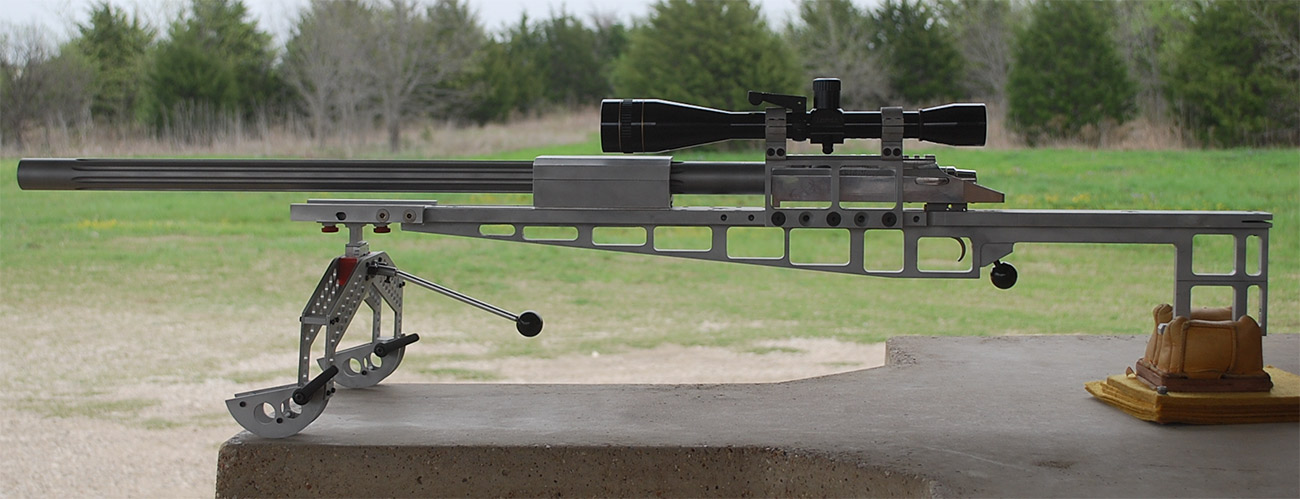
With all the talk from Vince Bottomley in the April issue of Target Shooter about aluminum stocks, I thought you might like to see my latest project. This is my personal gun, built the way I wanted it. I know it’s radical and some may not care for it. But it works.

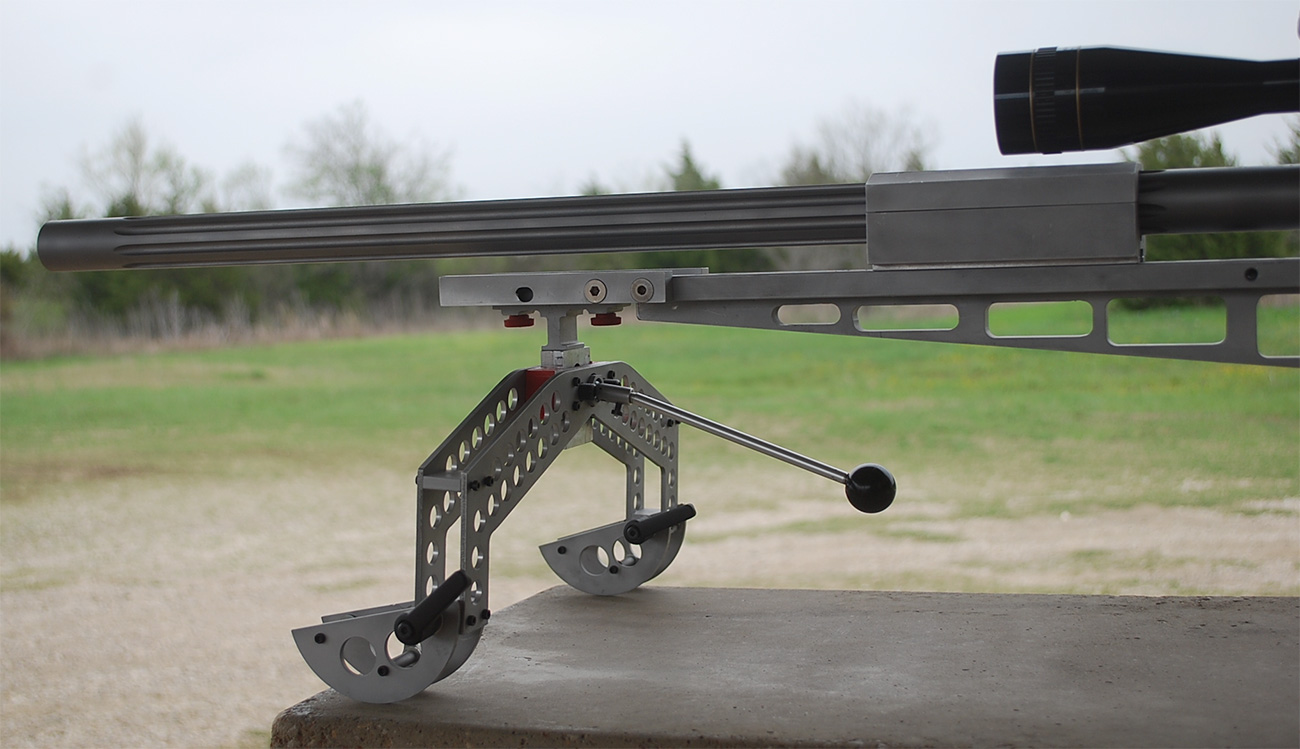
This is pretty much an all-aluminum rifle. The action is a Kelbly F-Class with a Shilen stainless steel competition trigger. The scope is a 1″-tube Leupold 36X with a Tucker Conversion set in Jewell spherical bearing rings. The .223 barrel is Pac-Nor 3-groove, 1:6.5″-twist mounted in a “V”-type barrel block. The bipod has vertical adjustment only via a dovetail slide activated by a stick handle. It works like a joy-stick, but for vertical only. I adjust for windage by moving the rear sandbag.
The 30″ barrel is 1.250″ in diameter. With the barrel block forward, the vibrations should be at a low frequency. Instead of one long rod whipping, I now have two short rods (barrel haves) being dampened. This is my fourth barrel block gun. They work, but so does a good pillar-bedded action. I just do stuff a little different.

The vertical “keel” down the bottom of the stock stops the “spring” of a flat-bar stock. There is little, if any, noticeable flex before or during recoil. The long length of the stock, the fat barrel, and the forward-mounted barrel block work together to keep the gun from rising off the ground. BUT, remember this is a .223 Rem rifle. A .308 Win version might act very differently. I may try a .308-barreled action soon, just to see what happens. But I will stick with the .223 Rem as my choice for match shooting.
 The offset scope idea came from a benchrest “rail” gun. In truth, the whole concept came from a rail gun — just adapted to being shot off a bipod. Sure it isn’t directly over the bore. It is about 1.5″ over to the left. So if you want the scope to be zeroed on the center of the target, you have to adjust for the offset. At 100 yards that is 1.5 MOA. But at 300 it is only 0.5 MOA, at 600 only a ¼-MOA, and at 1000 about 1 click on my scope. The offset scope idea came from a benchrest “rail” gun. In truth, the whole concept came from a rail gun — just adapted to being shot off a bipod. Sure it isn’t directly over the bore. It is about 1.5″ over to the left. So if you want the scope to be zeroed on the center of the target, you have to adjust for the offset. At 100 yards that is 1.5 MOA. But at 300 it is only 0.5 MOA, at 600 only a ¼-MOA, and at 1000 about 1 click on my scope.
What the offset DOES do for me is eliminate any cheek pressure. My cheek never touches the stock. Since this is only a .223 Rem, I don’t put and shoulder pressure behind it. And I don’t have a pistol grip to hang on to, but I do put my thumb behind the trigger guard and “pinch” the two-ounce trigger.
The offset scope placement could interfere with loading a dual-port action from the left. That’s not a problem for me as I set my spotting scope up on the left side very close to the rifle. I have plenty of time to reload from the right side while the target is in the pits being scored.
Again — this is my rifle. It is designed for my style of shooting. It is not meant to be a universal “fit all” for the general public. However, I will say the design is adaptable. I can easily convert the system to run in F-Open Class. I would drop a big-bore barreled action into the “V” block, slide on a heavier pre-zeroed scope and rings, add plates on the sides up front to bring the width to 3”, and maybe a recoil pad. It might be interesting to offset the wings up from to counter torque of the big bullets. But I would also have to offset the rear bag rider to get the gun to recoil straight back.
How the Gun Performs
I have had “T” to the range only twice for load development. It groups like my present barrel-blocked 223 F-TR gun. But it’s much easier to shoot and it only moves about 3/4” — straight back. I tried to build am omni-directional joy-stick bipod but I could not get all the side-to-side wiggle out of it. So I have set it up so it only moves up and down (horizontal movement is locked-out). As it works now, the joystick on the bipod lets me set elevation on the target quickly (with up/down adjustment). Then, to adjust for windage, I slide my rear bag side-to-side as needed. Once set, I just tickle the trigger and smile.
Gun Handling — Shoot It Like a Bench-Gun
I basically shoot the gun with no cheek or body contact. I don’t grip it, other than maybe a pinch on the trigger guard. The scope was offset to the left to help the shooter move off the gun and avoid the possibility of head/cheek contact with the stock.
Listen to Richard King Explain How He Shoots his ‘Texas-T’ Rifle:
[haiku url=”http://accurateshooter.net/Video/RichKingTalks.mp3″ Title=”Richard King Talks”]
CLICK PHOTOS to See Big Size
January 13th, 2013
Following shoulder surgery, our Contributing Editor German Salazar moved to F-TR shooting, replacing his sling and iron sights with bipod and scope. German has done remarkably well for an F-TR newbie, winning his first two 500-yard matches (in F-TR class) at Phoenix-area ranges. German has been shooting his “old Palma rifle with a scope and bipod attached”. This rig features a Gilkes-Ross action in a Robertson/Sitman Highpower Prone stock with an Anschütz 5020 trigger and 30″ 1:11″-twist Krieger barrel. The rifle is fitted with a Canadian-made Rempel “Ski” bipod and a Leupold BR 24X scope.
On his Riflemans’ Journal website, German has crafted a helpful article with advice for “sling shooters contemplating a busman’s holiday into F-Class.” Even seasoned F-Class shooters can learn something from German’s observations in his F-TR: Scoping it Out article. Here are some highlights from the article:
Carpet Under the Bipod
“I quickly learned that a piece of carpet was an essential component under the bipod. Without the carpet, [on dirt surfaces] the bipod tends to dig into the dirt with every shot, resulting in odd elevation shots. On the concrete it isn’t quite as essential, but it smooths the recoil movement appreciably and is worthwhile. [I used] a short-nap carpet remnant for this, but my car floor mat also worked well.”

Clicking vs. Holding Off
“I’ve been shooting iron sights and clicking sight knobs for most of my life; trying to hold off made me very uncomfortable and the reflex pull of the trigger just wasn’t there. Once I returned to holding center and clicking, I was more comfortable and was able to execute my shots more quickly and cleanly. By zeroing the windage knob I can also easily return to a previous setting when conditions warrant.”
Reading Mirage with Spotting Scope
“In conversations with other F-Class shooters in our club, I found that few were using a spotting scope to see mirage; they were largely relying on the rifle scope. However, the rifle scope is focused on the target, as it must be to eliminate parallax, and thus cannot show mirage with the same clarity as a spotting scope that is focused roughly halfway down the range.”

Positioning Your Spotting Scope
“I position the spotting scope in the same manner as I did when shooting from the sling. It is very close to me and can be used without moving the head from the cheekpiece. The object, as always, is to minimize movement in order to maintain a consistent position and to minimize the time lost between the last glance at the mirage and breaking the shot.”
CLICK HERE to Read Full F-TR Article by German Salazar
German’s F-TR article first appeared in 2011. Since then German has had another shoulder surgery, but he is progressing well.
|