Remington will introduce a new bolt-action rifle at SHOT Show, the Model 783. Remington positions the new model 783 as a mid-level offering between the Model 770 and Model 700 SPS, according to John Fink, Freedom Group Rifle Product Manager. This new rifle was first revealed in an American Rifleman article by Richard Mann, who tested an early production version in September 2012. Mann reports: “The ‘7’ in the model designation comes from the 700 line of rifles, the ‘8’ is kind of a throwback to the affordable but reliable model 788, which was discontinued 20 years ago, and the ‘3’ is for the three in 2013. The suggested retail price is $451, but you can expect street prices to be closer to $400.”
Remington is claiming sub-MOA accuracy for the Model 783, as demonstrated by the “teaser” photo sent out to Remington customers earlier this week:
Adjustable Trigger with Insert
The rifle features a polymer stock, cylindrical action, and an adjustable trigger with a control insert (as used on the Savage AccuTrigger and Marlin Pro-Fire trigger). Remington’s “CrossFire Trigger System” is pre-set at 3.5 lbs pull weight. According to the reviewer, Remington’s CrossFire Trigger is “similar in appearance to the Savage AccuTrigger and the Marlin Pro-Fire Trigger; it has a center lever that locks the trigger until it is fully depressed.” (We think selecting “CrossFire” as a product title was a dumb move by Rem’s marketing guys.)
Model 783 Has Barrel Nut System
Remington has borrowed a trick from Savage, employing a barrel nut system for fitting barrels to model 783 actions. The model 783’s two-lug bolt features a Sako-style sliding-plate extractor — this is a departure from the system on a Rem 700. Scopes can be mounted with two Model 700-spec front scope bases. However, Remington plans to offer integral scope mounts in the near future.
Designed for game hunters, the model 783 will initially be offered in four chamberings: .308 Winchester (short action), .270 Winchester, .30-06 Springfield, and 7mm Rem. Magnum. Remington says it will roll out more chamberings by the middle of 2013. In addition a compact-stock version with a shorter length of pull will be offered. Barrels are 22″ or 24″ with a “magnum contour”. Model 783 rifles will be produced in the Freedom Group’s Mayfield, Kentucky manufacturing plant.
We recently reported on the new Jennings F-TR stock with integrated bipod. When we first saw this rig we thought, “OK, it looks cool, but how does it shoot?” Well, we had a chance to test a .308 Win F-TR rifle built by Chesebro Rifles using the Jennings stock, Barnard action, and 32″ Bartlein barrel. With the gun on the bench, we first shot a few rounds to confirm zero and test for function.
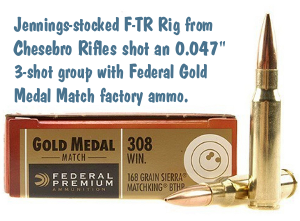
Then gun-builder Mark Chesebro set the rifle on the shooting mat, opened up a box of Federal 168gr Gold Medal Match (GMM) .308 Win ammo, and got down to business — from the ground. What happened next can only be described as “shock and awe”. Mark nailed three successive groups that left us shaking our heads in amazement. The Jennings stock works. Does it ever. This gun hammers.
All groups were shot from the ground, bipod-supported, with Federal factory GMM ammo.
Mark’s first three-shot group had two shots in one hole, then the third leaked a bit high for a 0.184″ group. Then Mark dialed down 2 MOA elevation, and drilled an astonishing 3-shot .047″ group. (For reference, the black diamond in the orange paster is 1/4″ from point to point.)
I was watching through a Swarovski spotting scope and I saw all three shots track into one hole that just got a little whiter in the middle with each successive round. I yelled out “Stop shooting!” because I wanted to measure the group. It was an easy mid-zero — and honestly it looked like just one bullet hole from a pistol. That is amazing with factory .308 Win ammo, particularly in a barrel throated for 185s, not the 168gr SMKs Federal uses in its Gold Medal Match .308 ammunition.
After measuring Mark’s 3-shot bughole, we walked back to the firing line and Mark shot a full 5-shot group. This would have been a two-flat, but he flinched a bit and his third shot went a little high to open the group to a 0.233″. Still darn impressive with factory ammo…
Editor’s Comment: This Gun is Ultra-Stable and Tracks Straight Back
I had a chance to shoot the gun from the ground. I can tell you this — the stock design really works. With the wide-track bipod, the gun is incredibly stable. As you’re aiming there is virtually zero horizontal movement in the crosshairs. All you need to do is squeeze the ears to set your vertical Point of Aim and pull the trigger. This thing is one of the easiest guns to shoot accurately (from the ground) that I’ve ever tried. You don’t have to struggle for stability at all — the gun wants to stay dead calm.
With the large, cylindrical Delrin feet placed on a mat, the gun tracks straight back. And there is no hop, no bounce, no roll. In fact, the gun tracked so well that I could see my bullets impact on the paper target. That’s surprising for a .308 Win with no muzzle brake. After a shot I could slide the gun forward and the crosshairs were right where they should be — the only thing I had to do is squeeze the ears to re-set my vertical. All I can tell you is the thing is very easy to shoot well.
I don’t know whether it is because of the forward-angle geometry of the legs, or the Delrin feet, or the properties of the carbon fiber tube that supports the front end, but the gun seems to have more damping than other metal-chassis stocks I’ve tried. Some metal-stocked guns seem to “ring” and transmit a sharp pulse to the shooter. This Jennings stock doesn’t do that — it seems to soak up vibration somehow. And the recoil is very mild, I think because the Delrin feet slow the gun down as they slide back smoothly.
Bottom Line:We came away very, very impressed with this rifle and the Jennings stock. I have never experienced a bipod-equipped rifle (in any caliber) that is easier to aim and hold steady, or which is easier to return to precise point of aim after each shot. And, without question, this is one of the most accurate .308 Win rifles we have ever shot from the ground. And that was with factory ammo, not tuned handloads!
Making a Great Design Even Better
Could the rifle be improved? Yes. While there is some rear elevation adjustment (via an eccentric bag-rider that rotates) we would like to see more rear-end elevation adjustment, so the gun could better adapt to uphill and downhill target placements. Also we’d like to see a higher mounting point for the bag-rider so you could use a taller, beefier rear bag. We discussed these points with Mark Chesebro, and he’s agreed to start prototyping some upgrades. This may include a thumbwheel-adjustable bag-rider (sort of like an upside-down adjustable cheekpiece). At our suggestion, the vertically adjustable bag-rider may be offered in two versions — straight and angled. With an angled bag-rider (i.e. with a slight amount of drop front to rear), you could adjust your vertical point of aim by sliding the gun forward or aft in the rear bag.
We will supplement this test report with more photos and video in a few days. We know you want to see how well it tracks. The video tells the story better than words can…
Colt Manufacturing Company (“Colt”) has finally released T&E versions of the long-promised Colt 901 “Modular Carbine” first revealed in 2011. This rifle shoots both .223 Rem and .308 Win cartridges using the SAME LOWER with different uppers. The Colt accomplishes this task by using a unique magwell insert, along with different mags and buffer assemblies. The 901 is very different than other AR variants which squeeze a short .30-caliber cartridge, such as the .300 AAC BLK, into a .223-length AR magazine. The Colt 901 shoots regular .308 Winchester cartridges, from .308-Win sized magazines. The key is the proprietary magwell insert, which allows standard 5.56×45 (.223 Rem) AR mags to fit inside the lower. To move from .308 to .223, once the insert is in place, you simply switch the buffer spring and buffer, and then attach your .223 Rem upper.
GunsAmerica Review
You’ll find a detailed review and field test of the Colt 901 in the latest GunsAmerica Blog. The testers say the Colt 901 caliber-changing system works as advertised: “It can be adapted from .308/7.62, using standard P-Mags, to .223/5.56, using standard AR mags, and back again, in literally seconds. The design uses one proprietary part, and you have to swap out the recoil system. It is that simple, and it works fantastic…. What [Colt] did was to design a very simple part that adapts both the lug and the magazine size from one size upper to the other. The part itself is made from aluminum, and weighs exactly 3 ounces, including the captured steel push pin. It is simply an adapter, and its genius is in its simplicity.”
The GunsAmerica Review of the Colt 901 is worth reading if you’re interested in a dual-caliber AR. The review offers plenty of photos (zoomable to large size), with close-ups of the magwell insert and the buffer systems. In addition, the reviewers field-tested the Colt 901 with both .223 Rem and .308 Win uppers. Accuracy at 100 yards was not impressive (1.5″ group with the .308, about 2″ for the .223 version), but the reviewers believe the rifle could have shot better with a trigger upgrade.
The Top Shot TV show recently featured the “Mad Minute”, a high-speed drill requiring shooters to place as many hits as possible on a steel plate set at 200 yards. The time limit was one minute, and shooters were using historic Lee-Enfield bolt-action rifles. Top Shot’s “Mad Minute” was based on a British Army training drill. Soldiers were expected to get at least 15 hits on an bullseye target at THREE hundred yards. Top Shot cheated a bit, placing the target at 200 yards (instead of 300 in the real British Army “Mad Minute” drill). Still the two Top Shot shooters managed only six (6) shots each in one minute. Consider that a “passing score” for a Brit soldier was 15 hits, you have to give credit to those WWI-era Tommies.
Watch Gary Elesio Shoot the ‘Mad Minute’ (Starts at 4:47 on Video)
Elesio Gets 24 hits on 300-yard Target in One Minute
Using an Eliseo RTM Tubegun chambered in .308 Winchester, Gary Elesio attempted the “Mad Minute” last weekend. Gary ended up with 24 hits on a bull target set at 300 yards. That’s four times as many hits as the Top Shot competitors. Gary actually had 25 hits in 25 rounds fired, but the last round hit just after the 60-second time period expired. Note how Gary pulls the trigger with the middle finger of his right hand. This allows him to work the bolt faster, using his thumb and index finger. The straight-through (inline stock) design of the Tubegun allowed Gary to maintain his cheekweld and head position throughout the minute-long drill.
Gary told us: “This isn’t easy. I came away very impressed with the training of the Tommy soldiers if they could make 15 hits in one minute. We had some skilled shooters who brought their own Lee-Enfields and they only did as well as the guys on Top Shot — making six or seven hits in a minute. The problem is that, with the cock-on-close operation of the Lee-Enfield, the gun would push away when the shooter closed the bolt, so the shooter would lose his sight picture, and have to re-center the rifle. I am truly astounded that the record for the ‘Mad Minute’ is 38 shots. That is hard to do with an AR, much less any bolt gun.”
Gary Hopes to Beat the ‘Mad Minute’ Record in the Future
The record for the “Mad Minute” — 38 shots on target at 300 yards — was set in 1914 by Sergeant Instructor Alfred Snoxall*. In the subsequent 98 years, that record has never been broken by any shooter with a conventional bolt-action rifle. Gary told us: “As long as that record still stands, I’m going to keep working at it. I know I lost a few seconds with mag changes. I think with some additional training, I can increase my score. Still, 38 hits is phenomenal. I am very, very impressed at what that guy did — it’s really mind-boggling to do that with an Enfield. Contrary to what has been written, those old Enfields are not that easy to shoot fast. Our club shooters found that out.”
* There is some uncertainty concerning the size of the target used by Snoxall. Some internet reports say the target was 12″ x 12″. Other posts, from England, suggest the target was 36″ by 36″. If the target was a 12″-diameter bull, Snoxall’s achievement is even more amazing.
‘Mad Minute’ and British Marksmanship with the SMLE (Lee-Enfield) Commentary by Laurie Holland
The original military requirement of the ‘Mad Minute’ saw the soldier ready to fire with a round in the chamber, 9 in the magazine, safety on. This course of fire is still followed by the GB Historic Breechloading Arms Association and other bodies in their recreated ‘Mad Minute’ competitions.
The first 10 would go quickly, but reloads were critical, this not done by a magazine change as Gary did with the RTM or in a modern tactical or semi-auto rifle, but through slick use of ‘chargers’. It is this aspect which fouls so many of my colleagues up as it’s very easy to cause a jam and a large part of 60 seconds can go in sorting it out!
As well as the training Gary mentions and commends, there were pay incentives / penalties for certification or failure, and there were valuable monetary and kudos benefits in achieving very high hit counts in the 20 + range. Tommies could draw their rifles from the armoury any time when off duty and spent hours in barracks practising using inert rounds and dry firing. For instance, a common practice was to balance a halfpenny coin on the foresight blade between the sight protecting ears and take shot after shot prone on the barracks floor until the trigger was pressed and the ‘shot taken’ without the coin falling off its perch.
Charger clips were selected for those that just held the rounds firmly enough to stop then falling out, were sand-papered and polished with a stove / fireplace polish called ‘Zebrite’ so that the rimmed rounds would slip through the clips like corn through a goose.
If you’re unfamiliar with the cock-on-closing Enfield action, it seems clumsy. With intensive practice it is very smooth and can be operated incredibly quickly. The trick is to whip the bolt back onto its stop and initiate a rebound movement that takes it and the cartridge well into the chamber thereby reducing the effort required to close the bolt and chamber the round.
None of this is to detract from the skill many of these guys had and the fantastic results they got both in rate of fire and accuracy out to 500/600 yards. That came from long days of live firing at full distances — far more practice than I’ll warrant US doughboys got at that time. The result was when the small British Expeditionary Force acted a blocking force against two advancing German infantry corps in Belgium in the autumn of 1914. Kaiser Wilhelm predicted confidently that his highly trained ‘Landsers’ would sweep this ‘contemptible little army’ aside. Instead, the Germans advancing in the open at ranges they felt was safe from rifle fire ran into a wall of lead of such a rate and accuracy that regimental commanders explained their failure to advance and massive casualties through the British having far more automatic weapons than their intellignce had briefed. The British survivors of that period adopted the self-styled title of ‘Old Contemptibles’ as an ironic rebuke to Wilhelm, one still used today. By Christmas 1914 that small and highly professional British army had been destroyed through attrition and army rifle competitions aside never achieved those riflecraft standards again — but of course that’s what a machinegun is for and it was criminal that BEF battalions (600-1,000 men) went to war with an establishment of only two Vickers-Armstrong machine-guns — a fraction of that in the opposing German units.
This Report was submitted by Darrell Buell, F-T/R Team USA Captain
The F-Class World Championships are just over a year and a half away. In the past four years, much has changed in the F-T/R game. Most noticeably, participation has increased greatly. We had 60 shooters at the 2011 Nationals in Lodi compared to 19 shooters in 2007. The level of competition has risen as well. There was a mere 3% spread in scores for the top 30 places this year. That’s tighter than it has ever been since I started keeping statistics. The top 15 spots had only a 2% score spread!
F-T/R Team USA Selection Process
With many more shooters and a higher level of competition, selecting the 2013 American F-T/R team was especially difficult. There were many qualified applicants to choose from. The selection criteria have not changed over the years. All of the 40+ applicants’ qualifications were dumped into a matrix to get sorted. The initial sort was done by examining the best data I have that compares all of the shooters side by side, i.e. Nationals scores. More weight was given to those times when I could compare shooter vs. shooter on the same relay, when they were facing the exact same conditions. From there, we used modifiers for International Team experience, and other factors. 50 million calculations later, a ranking was developed. This ranking was used to set the Roster List below.
USA F-T/R Team Roster:
Team Staff:
Captain: Darrell Buell
Vice Captain: Mike Miller
Head Coach: Mid Tompkins
Coach: Steve Cunico
Adjutant: Kathy Buell
Team Members:
Jeff Rorer
John Hayhurst
John Chilton
Chris Ozolins
John Weil
Dale Carpenter
Derek Rodgers
Team Members (cont’d):
Philip Kelley
Warren Dean
Brad Sauve
Paul Phillips
Monte Milanuk
Lane Buxton
Sierra Scott
As with past Teams, this roster will be used for the next four (4) years for International Competitions of every description. These events include (but are not limited to): 2013 F-Class World Championships in Raton, NM; 2013 South African International Matches in Bloemfontein; 2013 Stars & Stripes Challenge 2013; Creedmoor Cup; USA vs. Europe, and others.
Reserve Team Spots
The sharp-eyed will notice that I may seem to be a couple of shooters short. I am reserving a couple of spots to be named after the 2012 Nationals in Raton, in case other shooters are absolutely on fire this year, and would be good additions to the Team.
F-T/R Team USA Sponsors
As with past Team campaigns, the financial challenges (especially for the travel) will be considerable. I am absolutely committed to taking the very best Team I can field, regardless of finances. To this end, some outstanding sponsors are helping take some of the burden off the individuals: Berger Bullets, Nightforce Optics, Surgeon Rifles, Hodgdon Powder, Lapua, Kowa, and Redding Reloading. Many thanks to these and other sponsors for their continuing support.
Ruger is introducing a new USA-made bolt action rifle, the Ruger American Rifle (“RAR”). By external appearances, it looks like a Tikka T3 with a Savage Accutrigger. It even has a barrel nut just like a Savage! With a polymer-type synthetic stock, the RAR is light-weight — just 6.25 lbs. with a free-floated, hammer-forged 22-inch barrel (no optics). The RAR will be very affordable — MSRP is just $449.00. Obviously, Ruger hopes to compete with the Savage and Stevens lines of hunting rifles.
Three-Lug bolt, Barrel Nut, and Rotary Magazine
The RAR has some interesting design features. The bolt has three lugs (like a SAKO) with a 70° bolt lift. The action features a full-diameter bolt body and dual cocking cams for easy cycling (watch video below). And yes the RAR uses a barrel nut (like Savage) to secure the barrel to the action (and set headspace). Notably, the RAR comes standard with a rotary 4-round detachable magazine. The receiver comes drilled and tapped from the factory, and scope bases are supplied (but not pre-installed).
Built-in V-Blocks and Adjustable “Lawyer Trigger”
One notable feature of the RAR is a built-in bedding system with twin V-blocks. Ruger’s new patent-pending Power Bedding™ system employs stainless-steel bedding blocks fitted into the stock to positively locate the receiver. You’ll also notice that Ruger has adopted a new Savage-style trigger with a blocking tab on the trigger shoe. This new “Marksman Adjustable Trigger” is user-adjustable between three and five pounds. A tang safety, which can be placed “on safe” while the bolt is cycled, is complemented by a passive, trigger-mounted safety (similar to Savage’s Accutrigger).
It appears that, like the Tikka T3, the RAR has a single action length, designed to handle both medium- and long-length cartridges. Chamberings available initially are: .243 Win (1:9″ tw); .308 Win (1:10″ tw); .270 Win (1:10″ tw); 30-06 Springfield (1:10″ tw). Capacity is four rounds for all chamberings.
In this video, Ruger President/CEO Mike Fifer previews the new Ruger American Rifle…
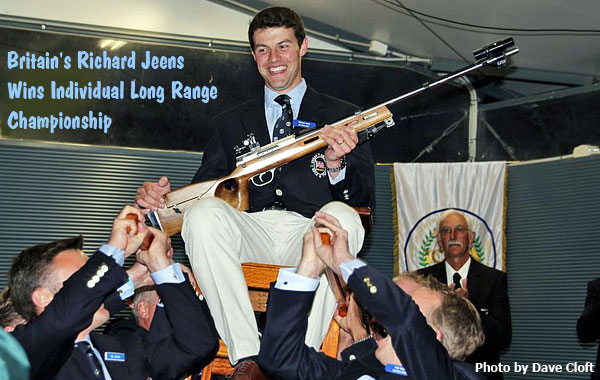
Great Britain’s Richard Jeens won the Individual World Long Range Full-Bore Rifle Championship in Brisbane, Australia with a final score of 725-49V. (A “V” is a center-ring hit, equivalent to an “X” in American matches). Ceremonially hoisted in the air by his fellow competitors at the awards ceremony, Jeens was all smiles, having earned a title he’ll retain until the next World Championships in 2015. Jeens topped a field of 374 shooters from seven countries. Andre Du Toit of South Africa took the Silver Medal after a shoot-off for 2nd/3rd position against bronze-medal winner David Luckman of Great Britain. CLICK HERE for complete results.
Finishing 5th overall in the Three-Day Aggregate, Jeens had to rely on his shooting skills (plus a little bit of luck) to win the shoot-off (the top ten competitors after three days of competition advance to a final shoot-off.) The little bit of luck came by way of the winds during the 1,000-yard phase of the competition. Long Range shooters usually deal with all sorts of conditions, but the day’s wind was enough to knock a few of the favorites (such as SGT Sherri Gallagher) out of the Top Ten. Nonetheless, it was a well-deserved win, and we congratulate Richard on his achievement. Looking at Richard’s winning rifle, we surmise his victory settles the question whether a thumb-hole stock will work for long-range prone shooting — it seemed to suit Jeens just fine.
Jeens wasn’t the only hot-shooting marksman from Great Britain in the competition. Fellow Brit David Luckman shot a 723-68V, matching South African Andre Du Toit for the second highest score (Du Toit then prevailed in a shoot-off for second place). Only 4 Vs behind her team-mate Luckman, Great Britain’s Jane Messer finished fourth with 723-62V. Notably, three women finished in the Top 10, led by Messer, with Americans Trudie Fay and Nancy Tompkins in sixth and tenth, respectively. Heading into the final day of the Individual Championships, Nancy’s daughter SGT Sherri Gallagher was in the lead, but she dropped points in the very windy conditions on the last day.
With the individual side of the competition complete, all that remains is the Palma Match. Here are the final individual scores:
Photo Credit: US Palma Team member Dave Cloft. Report by Lars Dalseide for The NRA Blog.
Tikka has started to import its new T3 Sporter, which features an ergonomic, laminated stock, detachable magazine, adjustable cheekpiece and a nice, stiff action with integral dovetail and side bolt-release. The trigger adjusts from 2 to 4 pounds. The T3 Sporter will be produced with 20″ or 24″ barrels in a variety of popular chamberings: .222 Rem*, .223 Rem, 6.5×55 SE, .260 Rem, .308 WIN. We expect this rifle to be popular with tactical shooters and club-level match shooters who want a versatile rifle that can be used for hunting as well as target shooting. The stock is similar to the ISU “standard rifle” design used for 300m position shooting. As you’d expect, it works in all positions: prone, sitting/kneeling, and standing.
T3 Is Accurate With Smooth-Working Action
We first saw the new Tikka T3 Sporter in January, at the SHOT Show Media Day. The gun we sampled had a nice trigger, smooth bolt, and shot quite accurately with factory ammo. Watch the video below for an overview of the T3 Sporter. The Tikka T3 Sporter was developed in co-operation With Finnish hunting and sport shooting organizations. The design goal was to create a rifle that performs in competition, but can also be used for hunting. The ergonomic stock features an adjustable cheekpiece and adjustable buttplate (length of pull can be changed with spacers). An integral rail allows placement of hand-stops, bipod mounts, and attachments so the rifle can be carried with a double-sling, biathlon style. T3 Sporter weight (without scope) is 9 lbs. with 20″ barrel, or 9.7 lbs. with 24″ barrel.
EuroOptic.com Has T3 Sporters in Stock EuroOptic.com has T3 Sporter inventory in stock now, priced at $1695.00. Not all variants have arrived yet*, but we’ve been told that the following models are available: .308 Win 24″ barrel, .308 Win 20″ barrel, 6.5×55 24″ barrel, 6.5×55 20″ barrel, .260 Rem 20″ barrel. 20″ barrels are threaded with a cap (18×1 metric) while the 24″ barrels are unthreaded. View details on EuroOptic’s T3 Sporter Page (NOTE: EuroOptic’s web site may not show the latest inventory, so call (507) 220-3159 for availability.)
*Beretta, Tikka’s parent company, controls T3 Sporter imports. EuroOptic.com informed us that it “ordered all the versions we could from Beretta, but no .222 Rem was available in the USA at this time.” So, for the near term at least, it appears that the .222 Rem will be limited to the European market.
USA v Scotland F-TR at Blair Atholl Match Report by Laurie Holland
After their success in Ireland (Bulletin June 27th) a third of the American shooters, Tony Robertson in F Class and a complete F-TR team captained by Darrell Buell, travelled to Scotland to shoot over Perthshire’s famous Jubilee Range above Blair Atholl. As well as competing in six individual 900 and 1,000-yard matches in the Scottish Long-Range Meeting, the USA challenged Scotland to a 900-, 1,000-, and 1,100-yard yd F-TR team competition, to be held on the American Independence Day, July 4th.
After practice on Friday, July 1st, US competitors did well in the six individual matches over the weekend taking four out of the top six places overall with Stan Pate and Michelle Gallagher leading the way. However, Scottish home team captain Paul Crosbie took all three 900-yard matches and one 1,000-yard yard match. Winners of the other two 1000-yard events were Michelle Gallagher, and Scotland’s Laurie Holland, shooting his .223 Rem (That’s right — Laurie beat all the .308s with a .223). The weekend’s overall F-TR winner was Paul Crosbie on 405.23v (ex 450.90v) narrowly leading Stan Pate and Michelle Gallagher. After tying on Saturday, Scottish Shooter Les Bacon slowly pulled ahead of Tony Robertson in F Class and took this section by five points on an aggregate of 420.25v.
Scottish team captain Paul Crosbie and coach Tim Kidner pause during a wind change.
Independence Day Challenge — Team Scotland Beats Team USA
The 4th of July started cooler and cloudy with a near calm disturbed by intermittent light fish-tailing breezes from behind. The 900-yard scores benefitted from this, the six strong teams averaging 70 or more points per shooter out of the possible 75. After the 900-yard stages, Team USA was ahead with 427-24V against Scotland’s 420-20V.
By the time the teams relocated to 1,000 yards, the overcast had gone, sunshine alternated with moving shadows from big white puffy clouds to produce heat-induced, variable winds and intermittent mirage. Scores tumbled and there were many gaps between shots as the wind coaches stayed their hand waiting for a previous condition to return or trying to read a new one. Different wind doping approaches were apparent with Scotland’s Tom Kidner and Hamish Hunter relying mostly on the wind flags and plots while Nancy and Michelle spent considerable amounts of time glued to a pair of massive spotting scopes trying to read the mirage.
Nancy calls 1K wind for daughter Michelle Gallagher. USA captain Darrel Buell is just behind them.
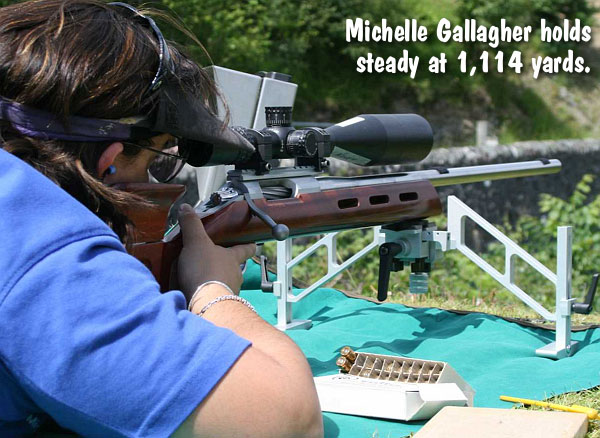
At 1000 yards, the Scots produced 357-8V against the visitors’ 346-8V, putting them into a four-point lead overall. Remarkably, however, the youngest American shooter, Sierra Scott nailed the best individual 1,000-yard score, a 65-2V. With everything hanging on the 1,100-yard stage, conditions were as for 1,000 yards only more so — warmer, still more variable winds and intermittent aiming difficulties from a boiling mirage downrange. The Scottish coaches’ experience really paid off now, their shooters scoring 295-2V, 23 points ahead of the visitors. Three out of the top four individual results (with scores of 50 or better) were by Scots, and top scorer Paul Crosbie posted a 59 shooting the big 210gr Bergers. Michelle Gallagher (shooting Berger 155.5s) nailed an excellent 57 to edge Scotland’s Peter Burbridge (55 points shooting 208gr Hornady A-Max). Laurie Holland posted an impressive. His .223 Rem ‘mouse gun’ was obviously still in the groove at 1,114 yards!
So, the home team kept its honor and Blair Atholl’s reputation intact. While disappointed, the visitors knew they had done really well given their inexperience with the quirks of this most difficult of venues. Everybody had a great time, some old friendships were renewed, new ones made. This was F-TR at its most enjoyable with four days shooting that no participant will ever forget. There was even an informal 1,233-yard competition on the Saturday afternoon won by US team captain Darrell Buell.
The Creedmoor Cup F-Class events in Ireland have come to a close. The Irish hosts ran a great match and the American shooters proved their prowess — winning both team and individual titles. Here’s how the events were scheduled so you can keep things in order: after several practice days, the two-day NRA-Ireland F-Class Individual Championships was held Wednesday and Thursday last week. Then, on Friday, competitors divided into F-Open and F-T/R squads to shoot the USA vs. Europe matches. On Saturday and Sunday, the main event, the two-day Creedmoor Cup Match was held. All of these matches were conducted on the brand new 1200-yard range in Tullamore. The Irish are to be commended for constructing such a great range in a relatively short time.
American Shooters Dominate Team and Individual Events
We don’t have all the scores yet, but we do have key results. We’re proud to announce that the USA won the main Creedmoor Cup event! Prior to that, on Friday, the Yanks prevailed in the Europe vs. USA Challenge match (sort of like the Ryder Cup). Forum Member Erik Cortina reports: “I’m not 100% on the numbers but I know we beat them by about 110 points shooting in the rain! We have a very strong team and excellent wind coaches!”
In the individual competitions held during the week, American shooters also topped the podium. In F-T/R individual competition, Darrell Buell won the championship with a solid performance. Larry Bartholome shot superbly in windy conditions to win the F-Open match. (Larry was using a Precision Rifle & Tool Low Boy stock, Nightforce scope and a SEB Neo Rest.) Larry’s compatriots also shot well — there were nine Americans among the top 11 F-Open shooters. That is definitely a dominant performance by our talented F-Open squad.
Here are some reports from Ireland that came in from Forum members Erik Cortina and TonyR over the last few days:
Sunday, 6/26: “The second day of the Creedmoor Match was completed today and the USA has won the Gold Medal. I haven’t seen the score but I’m sure it will show up at some point. Shooting conditions were again tough with high speed fishtail tail winds that switched rapidly but our wind coaches, Bob Mead, Nancy Tompkins, Michelle Gallagher, Dale Carpenter, Jim Murphy, and Ricky Hunt were up to the challenge. The Irish Team were great hosts and we all had a wonderful time. They put together a new range with this event in mind in just a few months and it is something to be proud of.” — TonyR
Saturday, 6/25: “Shot the first day of the Creedmoor Cup today. Winds were tough! We had a fishtailing wind from 5-7 o’clock and we were being pushed into the 3 ring with ease, the F-T/R guys were going into the 1’s! We didn’t have a good day, we dropped 434 out of 4,000, but they had a worst day than we did, they dropped 648 points! So to say winds were tough is an understatement! We are having tons of fun regardless.” — Erik
Friday, 6/24: “We just finished shooting the Europe vs. USA Challenge. I’m not 100% on the numbers but I know we beat them by about 110 points shooting in the rain! We have a very strong team and excellent wind coaches!” — Erik
Thursday, 6/23: “Larry shot great today [to win the F-Open Championship]! In F-Open, there were 9 of us in the top 11. This is an awesome range! We have been shooting in 25 +- winds for two days and it’s fun when you can stay ahead of the wind, but if you get behind it, it’s not fun at all…” — Erik
Want to see more photos from Ireland, and read more reports from the competitors? You’ll find more info about the Creedmoor events, match results, plus linked photo galleries on the USA F-T/R Team’s new Facebook Page. Log on to: http://www.facebook.com/us.rifle.team.


 Adjustable Trigger with Insert


 Mark’s first three-shot group had two shots in one hole, then the third leaked a bit high for a 0.184″ group. Then Mark dialed down 2 MOA elevation, and drilled an astonishing 3-shot .047″ group. (For reference, the black diamond in the orange paster is 1/4″ from point to point.)

 I don’t know whether it is because of the forward-angle geometry of the legs, or the Delrin feet, or the properties of the carbon fiber tube that supports the front end, but the gun seems to have more damping than other metal-chassis stocks I’ve tried. Some metal-stocked guns seem to “ring” and transmit a sharp pulse to the shooter. This Jennings stock doesn’t do that — it seems to soak up vibration somehow. And the recoil is very mild, I think because the Delrin feet slow the gun down as they slide back smoothly.
 The
The 



 Tikka has started to import its new

 T3 Is Accurate With Smooth-Working Action