|
|
February 9th, 2012
Forum member Skeeter has a 6mm Dasher falling block varmint rifle. The Dasher case is based on the 6mm BR Norma cartridge with the shoulder blown forward about 0.100″ and out to 40°. This gives the Dasher roughly 3.5 grains added capacity compared to the standard 6BR.
Last year, Skeeter needed to form 300 cases for varmint holiday. Skeeter decided to fire-form his brass without bullets. This method avoids barrel wear* and saves on components. There are various ways to do this, but Skeeter chose a method using pistol/shotgun powder, some tissue to hold the powder in place, Cream of Wheat filled to within an 1/8″ of top of the neck, and a “plug” of tissue paper to hold it all in place. Shown below are cases filled with a pistol/shotgun powder charge topped with Cream of Wheat and then a tissue paper plug.


To ensure the case headspaced firmly in his Dasher chamber, Skeeter created a “false shoulder” where the new neck-shoulder junction would be after fire-forming. After chamfering his case mouths, Skeeter necked up all his cases with a 0.257″ mandrel (one caliber oversized). Then he used a bushing neck-sizing die to bring the top half of the neck back down to 0.267″ to fit his 0.269″ chamber. The photo below shows how the false shoulder is created.

After creating the false shoulder, Skeeter chambered the cases in his rifle to ensure he could close the bolt and that he had a good “crush fit” on the false shoulder, ensuring proper headspace. All went well.

The next step was determining the optimal load of pistol powder. Among a variety of powders available, Skeeter chose Hodgdon Titewad as it is relatively inexpensive and burns clean. The goal was to find just the right amount of Titewad that would blow the shoulder forward sufficiently. Skeeter wanted to minimize the amount of powder used and work at a pressure that was safe for his falling block action.
Working incrementally, Skeeter started at 5.0 grains of Titewad, working up in 0.5 grain increments. As you can see, the 5.0 grain charge blew the shoulder forward, but left it a hemispherical shape. At about 7.0 grains of Titewad, the edge of the shoulder and case body was shaping up. Skeeter decided that 8.5 grains of Titewad was the “sweet spot”. He tried higher charges, but the shoulder didn’t really form up any better. It will take another firing or two, with a normal match load of rifle powder and a bullet seated, to really sharpen up the shoulders. Be sure to click on the “View Larger Image” link to get a good view of the cases.


The process proved to be a success. Skeeter now has hundreds of fire-formed Dasher cases and he hasn’t had to put one bullet through his nice, new match-grade barrel. The “bulletless” Cream of Wheat method allowed him to fire-form in a tight-necked barrel without neck-turning the brass first. The only step now remaining is to turn the newly Dasher-length necks down about .0025″ to fit his 0.269″ chamber. (To have no-turn necks he would need an 0.271″ or 0.272″ chamber).
Skeeter didn’t lose a single case: “As for the fire-forming loads, I had zero split cases and no signs of pressure in 325 cases fire-formed. Nor did I have any misfires or any that disbursed COW into the action of the firearm. So the COW method really worked out great for me and saved me a lot of money in powder and bullets.” To learn more about Skeeter’s fire-forming process, read this Dasher Fire-Forming Forum Thread.
*Skeeter did have a fire-forming barrel, but it was reamed with a .269 chamber like his 10-twist Krieger “good” barrel. If he fire-formed with bullets, he would have to turn all 300 necks to .267″ BEFORE fire-forming so that loaded rounds would fit in the chamber. Judging just how far to turn is problematic. There’s no need to turn the lower part of the neck that will eventually become shoulder–but how far down the neck to turn is the issue. By fire-forming without bullets now he only has to turn about half the original neck length, and he knows exactly how far to go.
January 3rd, 2012
 Target Shooter Magazine has released its web-based January 2012 Issue. The FREE January Issue features handy reloading guides (written by Laurie Holland) for two very popular cartridges: 6mmBR Norma, and .308 Winchester. If you shoot either of these chamberings, you should read these latest installments of Laurie Holland’s Handloading Bench series. For the January issue, Laurie also authored Sorting a Savage Part 1 which covers the Savage-actioned .223 Rem that Laurie shot in the European F-Class Championship. Savage shooters will find useful tuning tips. Target Shooter Magazine has released its web-based January 2012 Issue. The FREE January Issue features handy reloading guides (written by Laurie Holland) for two very popular cartridges: 6mmBR Norma, and .308 Winchester. If you shoot either of these chamberings, you should read these latest installments of Laurie Holland’s Handloading Bench series. For the January issue, Laurie also authored Sorting a Savage Part 1 which covers the Savage-actioned .223 Rem that Laurie shot in the European F-Class Championship. Savage shooters will find useful tuning tips.
Gear and Optics Reviews
Other good articles in January’s Target Shooter Magazine include a comprehensive review of the Lyman DPS 1200 III powder dispenser, and an excellent article about riflescopes by Gwyn Roberts. Gwyn explains the many choices in reticle design, and he discusses the pros and cons of adjustable front objectives vs. side-focus scopes.

If you haven’t sampled Target Shooter Magazine yet, you should. The hardware photography is high quality and there is something for everyone — from Benchresters to Tactical shooters. You can view the 92-page December issue for FREE at www.targetshooter.co.uk. Target shooter also has an iPad/iPhone friendly version that can be downloaded.
December 9th, 2011
Eric Stecker of Berger Bullets was kind enough to supply some of Berger’s 80gr 6mm Varmint bullets for testing. These were formerly called the Berger MEF, but now the box says “Varmint — Match Grade” (part #24321). Our initial testing, in a standard 6BR with 1:8″-twist, 3-groove PacNor barrel demonstrated that “Match-grade” was no boast. These things shoot! At 100 yards, the first two shots went into the same hole. A nice 5-shot group formed up under 0.2″. And to keep things interesting, this was with a varmint-style stock and only one wind-flag about 30 yards out. By comparison, the best we could do with Hornady 75gr V-Maxs in this gun were groups in the mid-fives (half-MOA+).
Reader ShCal of San Luis Obispo has also tested the 6mm Berger 80s and also got great results, shooting under 0.5″ at 200 yards.

June 7th, 2011
 Dispelling Some 6mm BRX Myths, by Robert Whitley Dispelling Some 6mm BRX Myths, by Robert Whitley
I recently had an interesting and fact-filled conversation with Bob Crone (the inventor of the 6mm BRX) about his BRX. Bob actually called me because he was concerned that there are a lot of myths and about his 6mm BRX and he wanted to “set the record straight” on a few things. Here’s my summary of some topics we discussed:
Myth One: Bob made his 6mm BRX chamber by running a 6mm BR reamer in too deep.
Truth: There is no truth to Myth One. Bob said he specifically designed the BRX reamer and had it made with the head space he specified and a neck length appropriate for his newly designed 6mm BRX wildcat cartridge.
Myth Two: In the course of making up his 6mm BRX, Bob had a version with a .120″ longer head space than a 6mm BR Norma.
 Truth: Bob was clear that his original design for the 6mm BRX always had a .100″ longer head space than a 6mm BR and that he never deviated from that. Right after Bob started working with his 6mm BRX, Bill Shehane came forward with a 6mm BRX version he made up that had a .120″ longer head space, and thus the confusion started. In truth, the original 6mm BRX always was (and still is) a chambering with a head space .100″ longer than a 6mm BR Norma. Truth: Bob was clear that his original design for the 6mm BRX always had a .100″ longer head space than a 6mm BR and that he never deviated from that. Right after Bob started working with his 6mm BRX, Bill Shehane came forward with a 6mm BRX version he made up that had a .120″ longer head space, and thus the confusion started. In truth, the original 6mm BRX always was (and still is) a chambering with a head space .100″ longer than a 6mm BR Norma.
Myth Three: The BRX was originally set up for 105-107gr bullets.
Truth: Bob said he set up his original reamer with a zero freebore and he has his gunsmith use a throater to throat whatever chamber was being made to where he wanted a particular bullet to touch the lands. Bob said he originally started with a 1:10″ twist barrel and shot a bunch of the 95gr VLDs and also 87gr bullets. Later he used an 8.5″ twist barrel for the heavier bullets.
Myth Four: The original BRX was set up also for use with Remington BR Brass.
Truth: Bob said he always used Lapua brass. He originally was an avid reader of Precision Shooting magazine and saw that the .262″ neck-turn neck was working real well with the 6 PPC and 6mm BR bench rest shooters and he decided to try to go with something that was already working well for 6mm shooters. He says his original reamer had a .262″ neck, but he also has a .272″ “no-neck-turn” version that he used on some of his rifles. He said the Lapua brass was so good and consistent, that for some rifles he just “didn’t want to mess with it” so he went with the “no-neck-turn” .272″ neck too.
 Myth Five: The “false shoulder” method was used to make brass. Myth Five: The “false shoulder” method was used to make brass.
Truth: Bob said he never used the “false shoulder” method to make 6mm BRX brass, he just loaded 6mm BR brass with a bullet well into the lands of the BRX chamber and fire-formed brass that way. He noted that the accuracy with some of the fire-forming rounds was “outrageous” (i.e. outrageously good that is), so much so, they were shot in matches sometimes.
Myth Six: The 6mm BRX has a blown-out or straightened out body.
Truth: Bob said he kept the basic body taper of the 6mm BR cartridge. He wanted the cartridge to be an easy and inexpensive (but high performance) 6mm wildcat, and the original design was (and still is) set up to use readily available 6mm BR dies (up off the shell holder about .100″ from the normal position).
Author’s note: It was a most enjoyable experience to talk to Bob Crone. He is not only still passionate about his 6mm BRX, but he has a commanding knowledge of it as well.

Reamer Print provided by AR-X Enterprises LLC, www.6mmAR.com.
April 13th, 2011
The 2011 Hickory Groundhog and Egg Shoot at Vale, NC was a big success. Some 177 shooters vied for over $7,000 worth of prizes. The main course of fire was challenging, with three sets of paper groundhog targets at 100, 300, and 500 yards, and NO Sighters. Shooters can also compete in an Egg Shoot for cash and other prizes. For the primary three-yardage Groundhog match, there are two rifle classes: Custom Division and Factory Division. The match, one of the most popular varmint competitions in the country, is sponsored by Bulls-Eye Sporting Goods (Larry Willis, owner). The event is held every year on the first Saturday in April.
This year’s “Top Shot” at the Hickory was Randy Chappell. Shooting a 6 BRDX (we were told), Randy scored 90 points to win the Custom Division. Randy took home a new Nightforce NXS scope plus $300.00. Runner-up Robbie Roberts steered his 6BR to second place in Custom, earning him a Sightron Scope and $150.00 in cash. Finishing third in Custom Division was past Hickory winner Chris Brady, Terry Brady’s son. Chris, who also shot a 6BR, took home a Shehane Tracker stock and $50.00.

| CUSTOM Division |
1st Place, 90 points
Randy Chappell |
2nd Place, 82 points
Robby Roberts |
3rd Place, 80 points
Chris Brady |
| FACTORY Division |
1st Place, 72 points
Greg Davis |
2nd Place, 59 points
Jeff Godfrey |
3rd Place, 59 points
Jason Elmosre |
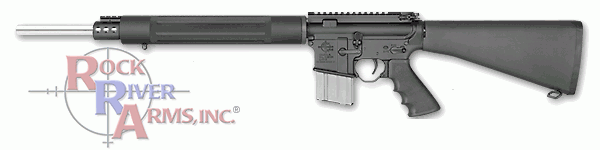
Rock River AR Wins Factory Division
There were some surprises this year in the Factory Division. While many folks expected a Savage 6BR or 6.5-284 to win, that wasn’t in the cards. This year a semi-auto ‘Black Rifle’ outshot all the factory bolt guns. Greg Davis scored 72 points with his .223 Rem Rock River AR15 to win the Factory division by a comfortable margin. The next best Factory shooters, Jeff Godfrey and Jason Elmore, both had identical 59-point totals. Godfrey was awarded second place over Elmore on a tie-breaker.
 Challenging Conditions on the Range Challenging Conditions on the Range
Conditions at the Hickory were pretty tough this year. Sam Hall, a past Hickory winner and IBS Shooter of the year explained: “It was difficult this year, with 20+ mph, gusty winds in the afternoon. This is a ‘no sighters’ match and I was having trouble with my cold bore zero. I wasn’t the only one.”
The 6 BRDX — The Best BR Improved Yet?
Shooting his new 6 BRDX, Sam finished eighth in Custom Division, with 73 points. Sam likes the 6 BRDX chambering, which is a 6BR Improved with a 40° shoulder, but with a longer neck than a BRX or Dasher. “I’m real happy with the BRDX… I think it is as accurate as a BRX or Dasher, but the brass is much easier to form. Randy Chappell told me the same thing. I think it has enough case capacity to hit the velocities we want. The BRDX was shooting ‘lights out’ earlier this year, but I think maybe my tune wasn’t right for the conditions at the Hickory.”
November 13th, 2010
Jonathan Ocab, a High Power shooter from California, had gunsmith Doan Trevor install a Sako-style extractor in the Rem 700 bolt in Ocab’s 6mmBR Eliseo R5 tubegun. Jonathan produced an excellent video showing how the Sako extractor improves the ejection of the short, fat 6mmBR cartridges in his rifle. Jonathan’s video demonstrates 6mmBR case ejection with an unmodified Rem 700 factory bolt versus a factory bolt fitted with a Sako-style extractor.
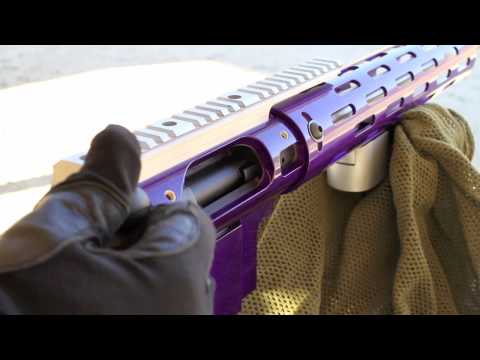
Johnathan explains: “Note how even when slowly operating the bolt, the bolt with the Sako extractor easily ‘kicks’ out the brass on ejection with minimal chance of operator error resulting in a failure to extract. While the unmodified bolt has issues ejecting brass on slow operation, it will eject if the operator pulls the bolt back quickly (fast and with some force).
While a Sako-style extractor isn’t an absolute necessity, this video shows the definite improvement this modification provides. For short cartridges like the 6mmBR, this is very useful. This modification is highly recommended for competition shooters, especially High Power competitors who seek improved function in rapid-fire stages. This modification is fairly inexpensive and any competent gunsmith should be able to perform the work (usually under $100 with parts and labor).”

EDITOR’s NOTE: In his video, Jonathan deliberately worked the unmodified Remington bolt slowly to show how the standard Rem extractor can struggle with short fat cases like the 6mmBR. In fact, when you work a standard, unmodified bolt more quickly, the extraction can be much more positive. Cycling the bolt with more “snap” provides more energy to eject the cases. We have run an R5 Tubegun chambered in 6mmBR with an unmodified Rem 700 bolt (no SAKO extractor), and the extraction was reliable, provided the bolt was worked quickly.
August 28th, 2010
 What kind of accuracy do you think a tubegun can deliver with factory ammo — during barrel break-in? Perhaps 0.6″ at 100 yards, half-MOA if the conditions are perfect? Well you may want to change your preconceptions about tubeguns — and factory ammo. This Eliseo R5 repeater, smithed by John Pierce with a Pierce CM action and Broughton 5C barrel, shot the Lapua 90gr factory ammo into flat ONEs during the break-in session. A day later, in tricky 8-14 mph winds, the gun nailed a witnessed and computer-measured 0.174″ 5-shot group using the 105gr factory ammo. That would be impressive for a “full-race” benchgun with precision handloads. For an across-the-course rifle shooting factory ammo, it’s pretty amazing. What kind of accuracy do you think a tubegun can deliver with factory ammo — during barrel break-in? Perhaps 0.6″ at 100 yards, half-MOA if the conditions are perfect? Well you may want to change your preconceptions about tubeguns — and factory ammo. This Eliseo R5 repeater, smithed by John Pierce with a Pierce CM action and Broughton 5C barrel, shot the Lapua 90gr factory ammo into flat ONEs during the break-in session. A day later, in tricky 8-14 mph winds, the gun nailed a witnessed and computer-measured 0.174″ 5-shot group using the 105gr factory ammo. That would be impressive for a “full-race” benchgun with precision handloads. For an across-the-course rifle shooting factory ammo, it’s pretty amazing.
Eliseo Tubegun Shoots in the Ones
This accurate rifle belongs to our friend (and designated expert trigger-puller) Joe Friedrich. During the initial break-in session, since his reloading dies had not yet arrived, Joe decided to start with some Lapua factory-loaded 6BR ammo he had on hand. After doing a few two-shot-and-clean cycles (with patches and nylon brush), Joe decided to try a 3-round group just to see if the Broughton barrel had some potential. To his astonishment, the Eliseo R5 put three rounds in 0.100″ (photo below left). Joe then cleaned the barrel again, shot a couple foulers and tried a 4-shot group. The results were just as stunning — 4 shots in a mere 0.104″ but three in virtually one hole (photo below right).

 
 |
Joe’s Halloween 6BR Tubegun SPECS
Chassis: Eliseo R5 Repeater, fitted with Eliseo Front Sled and Rear Bag-Rider.
Gunsmithing: Pierce Engineering Ltd..
Chambering: 6mmBR Norma, .272″ No-turn Neck, approx. 0.090″ freebore.
Action: Pierce Engineering, Rem 700 footprint, Chrome-Moly, fluted bolt.
Barrel: Broughton 5C (Canted Land), 27.5″, 1:8″ twist, Medium Palma contour.
Trigger: CG X-Treme Two-Stage.
Optics: March (Kelbly’s) 10-60x52mm.
Ammunition: Lapua 6mmbr 90gr Scenar BT (#4316045, non-moly), 105gr Scenar BT (#4316046, non-moly ). |
 You Can’t Believe How This Gun Shoots You Can’t Believe How This Gun Shoots
Joe called your Editor and said “You can’t believe how this gun shoots with factory ammo!”. So we arranged a photo session for the next afternoon, where I could verify the rifle’s accuracy. Well it turned out the conditions were way more challenging than when Joe broke in the barrel the day before. Winds were running 8-14 mph and were swinging through 180 degrees half-way down the range. Joe fired a few 90s through the Oehler chronograph at my request, then opened a box of Lapua 105gr factory ammo. It took about four rounds for the barrel to settle in after being cleaned the night before. Then Joe got serious, and with your Editor looking over his shoulder, he drilled a 0.174″ five-shot group in switching winds, doping every shot. Joe felt the gun could have shot tighter but he missed one wind call.
Serious Accuracy with a Multi-Purpose Rifle
So there you have it — a tubegun that shoots in the ones with factory ammo. Joe says that, at least with the 90s, the Elesio R5 shoots as well as his 6 PPC. Joe stressed that “steering the tubegun is hard work. You really have to concentrate compared to a purpose-built bench gun like my PPC. With the tubegun, everything has to be perfect on every shot — hand position, cheek position, stock position in the bag. If you’re off just a little bit, it’s easy to steer the gun the wrong way and send a shot out of the group.”
Accuracy Great but Fouling Heavy and ES Could Be Better
Have there been any negatives to Joe’s 6BR tubegun experiment so far? Well, the Broughton 5C barrel, while phenomenally accurate, shows signs of being a bad fouler. Copper built up pretty quickly over the first 25 rounds or so. We saw best accuracy with a recently-cleaned barrel. Hopefully the fouling will lessen as the barrel polishes in with use. And the canted land barrel is slower than average with the factory ammo. Lapua rates its 90gr naked-bullet ammo at 2950 fps with a 26″ tube. In Joe’s 27.5″ barrel we only averaged 2901 fps. With the 105gr factory ammo, which is rated at 2790 fps, we averaged just 2694 fps. That’s quite disappointing. Also the ES on the factory ammo, slightly over 50 fps for both bullet types, wasn’t particularly good. Still, the overall results were stunning. This gun shoots better than many long-range benchrest rifles running carefully-developed handloads — and it does that with factory ammo, right out of the box.

August 11th, 2010
 In international 300m competition the top shooters use high-tech rifles shooting some of our favorite cartridges: 6mmBR, 6XC, and 6.5×47 Lapua. These chamberings all possess superb inherent accuracy, allowing great scores even when shooting with iron sights. This week, both men and women have been competing in prone and three-position 300m events. The level of competition has been high — Bettina Bucher of Switzerland tied the womens’ 599 score record in winning the women’s 300m prone event, and the 600-point mens’ record score has been tied twice in prone matches, once by France’s Josselin Henry, shooting factory 6.5×47 Lapua ammo. To see Bettina Bucher and Josselin Henry in action, visit the ISSF-Sports.org website. There you’ll find complete match results, as well as photos and videos of the action. In international 300m competition the top shooters use high-tech rifles shooting some of our favorite cartridges: 6mmBR, 6XC, and 6.5×47 Lapua. These chamberings all possess superb inherent accuracy, allowing great scores even when shooting with iron sights. This week, both men and women have been competing in prone and three-position 300m events. The level of competition has been high — Bettina Bucher of Switzerland tied the womens’ 599 score record in winning the women’s 300m prone event, and the 600-point mens’ record score has been tied twice in prone matches, once by France’s Josselin Henry, shooting factory 6.5×47 Lapua ammo. To see Bettina Bucher and Josselin Henry in action, visit the ISSF-Sports.org website. There you’ll find complete match results, as well as photos and videos of the action.

Right now there are three short videos covering 300m competition. CLICK HERE to access the videos. When the page displays, go to the scrolling menu (on right) and select: “300m Rifle Prone Women”, or “300m Standard Rifle Men”, or “300m Rifle Prone Men”. The video on the 300m prone womens’ competition features Switzerland’s Bettina Bucher who tied a World Record in the event. Note, in the 300m mens Standard Rifle highlights video, the American announcer incorrectly names the winner of the 300m Standard Rifle event as “Henry Josselin”. She got it backwards.
Josselin Henry Wins 300m Standard Rifle Event, But Three Shooters DQ’d
Marco Dalla Dea of the ISSF Media team reports that France’s Josselin Henry won today’s 300m Standard Rifle event, becoming the new world champion with a total score of 587 points. The French shooter, who had equaled the 300m Rifle Prone Men world record of 600 points two days ago, had never won an ISSF medal in this event before. Tomorrow, the 28-year old shooter from Paris will compete in the 300m rifle Three-Position event.
Three competitors were disqualified in the 300m mens’ Standard Rifle Finals. There are strict rules on the geometry and features of a “Standard Rifle”, in contrast to “Free Rifle” class which is pretty much “anything goes”. One shooter was DQ’d for an illegal front sight extension, another was tossed for having an “anatomical” grip, and a third shooter was sent packing because his buttplate had too much curve. In the standing position, a hook-style buttplate extension can provide a significant advantage. This hook configuration is allowed on Free Rifles only.
August 6th, 2010
At the 50th ISSF World Championship, most of the media attention has focused on air rifle, smallbore rifle, and trap (shotgun). However, the world’s top 300m centerfire shooters are also competing in Munich this week. In conjunction with the 2010 ISSF Worlds, the 300m World Championship is taking place in Munich this week, with mens’ and womens’ prone, 3-position, and team events.
Thus far, the 300m prone mens individual and team competition have been concluded, with Mens’ 3-position yet to be held. The womens’ 300m prone event takes place Monday August 9th, while both men and women will shoot the 3-position event on Tuesday, August 10th.

300m Results So Far
In Mens’ Individual 300m prone, Great Britain won the team event, with a 1792-89X combined three-man score. Team Austria finished just one point behind, 1791-104X, but with a much higher X-Count. The French team finished third with 1790-104X, lead by a superb performance by Josselin Henry, who shot a 600-36X, not dropping a point. Though his 4th-place finishing Team Norway did not make the podium, Norway’s Vebjörn Berg shot a brilliant 600-43X, one of the best match scores in 300m history.
In individual mens’ 300m prone competition, the top three shooters were Austria’s Stefan Raser (599-36X), Norway’s Vebjörn Berg (598-44X), and Marcel Zobrist of Switzerland (5989-39X). Top American was Michael McPhail, who finished 7th with 597-36X.
Click these links for ISSF World Championships 300m Schedules and Results:
 Frenchman Ties Perfect 600 Record Score Frenchman Ties Perfect 600 Record Score
with 6.5×47 Lapua Factory Ammo
No equipment lists have been published for the 300m World Championships, so there is very little information on the hardware and ammo used by the top competitors. However, we did learn that France’s Josselin Henry shot his 600-36X using factory-loaded Lapua 6.5×47 ammo. Henry’s perfect 600/600 score was shot in the 300m Prone Relay 2 Elimination match yesterday, August 5th. A perfect 600 was first shot by Norway’s Harald Stenvaag, NOR in 1990, then matched by Germany’s
Bernd Rücker in 1994, and by Norway’s Vebjörn Berg in 2010. Notably, Berg also shot a 600-43X in his own prone elimination match in Munich on August 5th. According to Lapua factory representatives, Josselin Henry shot his 600-36X with factory-loaded 6.5×47 Lapua (123gr HPBT Scenar) rounds, right out of the box, without any test shooting or lot selection.
July 23rd, 2010
Robert Whitley sampled a recent lot of Lapua 6mmBR brass and found that the neck-walls are marginally thinner, resulting in a very slightly smaller loaded neck diameter. Here is Robert’s report….
For the last few years the different boxes of Lapua 6mmBR Norma brass I have purchased (four different lots) have yielded brass with necks that measured around .269″ – .2695″ loaded. While this worked out very well in a variety of applications, sometimes I had to neck-turn that brass because it was a little too tight for an application or chamber I had. I recently received some of the latest “blue box” Lapua 6mm BR Norma brass (Lot # P00487801) and this latest lot of 6BR brass measures right around .268″ loaded (with popular 6mm bullet types). While some may bemoan the smaller neck diameter of this latest brass lot, for others, this can be a buying an opportunity to resolve an existing clearance issue with a “no neck turn” chamber. For example, if you have a .271″ “no neck-turn” type chamber, this may help resolve clearance issues that arose with other batches of brass. Or, for those who need to turn their necks to fit a tighter chamber, this new lot of 6mmBR brass has about .001″ – .0015″ less metal to remove, making the turning process that much easier.

 This lot of brass (Lot # P00487801) was obtained from Graf & Sons. Since the batches of Lapua 6mmBR Norma brass that come into this country typically sell out quickly, if this .268″-loaded-neck brass is of interest to you, get some soon as it may go fast. While in years past I tried to keep my neck clearance very close to the chamber neck diameter, as time passes, I am now finding that in some situations a little more neck clearance can help remedy an accuracy or consistency issue. A certain amount of clearance is clearly needed for the proper accuracy and consistency of ammunition, but in some situations a tight neck clearance is not optimum and may be more detrimental then beneficial. We tinker with everything else with our loads and rifles, why not neck clearance? — Robert Whitley This lot of brass (Lot # P00487801) was obtained from Graf & Sons. Since the batches of Lapua 6mmBR Norma brass that come into this country typically sell out quickly, if this .268″-loaded-neck brass is of interest to you, get some soon as it may go fast. While in years past I tried to keep my neck clearance very close to the chamber neck diameter, as time passes, I am now finding that in some situations a little more neck clearance can help remedy an accuracy or consistency issue. A certain amount of clearance is clearly needed for the proper accuracy and consistency of ammunition, but in some situations a tight neck clearance is not optimum and may be more detrimental then beneficial. We tinker with everything else with our loads and rifles, why not neck clearance? — Robert Whitley

Editor’s NOTE: If you need some new 6BR brass, but your existing cases have no-turn necks which are .269″+ loaded, you may want to segregate the newer .268-necked brass. Segregating the new brass will allow you to use a a slightly smaller diameter bushing to maintain the same amount of grip on the bullet (as before). Other than this minor change in neck diameter with this lot of brass, this Lapua 6mm BR Norma brass is essentially the identical product as it has been all along.
Visit Robert Whitley’s 6mmAR.com website for more information on Grendel-based cartridges, and his 6mmHOT.com site for info on the 6mmBR Improved Dasher, 6-6.5×47, and 6.5×47.
|


