The 6mm Dasher is based on the 6mm BR cartridge with the shoulder blown forward about 0.100″ and “improved” to 40°. Case capacity is raised to about 41.0 grains. This allows the Dasher to drive 105-108gr bullets comfortably at 2970-3000 fps without over-stressing the brass. A popular load used by many successful Dasher shooters is 33.3 grains of Reloder 15, CCI 450 primers, with 105gr Berger VLDs, .010″ in the lands. This is a “warm load” and should only be used with fire-formed brass. As with any load, start 10% low and work up. You may also have good luck jumping the bullets .020″ or more.
Robert Hoppe, one of the top 600-yard shooters in the country, was the 2009 NBRSA 600-yard champion. In 2007, shooting a 6 Dasher, Robert nailed a 0.5823″, 5-shot group. At the time it was the smallest group ever shot in 600-yard registered benchrest competition. In 2008, John Lewis shot even smaller with an IBS Heavy Gun, but Robert’s 0.5823″ still remains the NBRSA 600-yard record, and we believe it is the smallest group ever shot at 600 (in registered BR competition) by a 17-lb class rifle. Robert has been very successful in the 600-yard game, and is one of the best 600-yard shooters in the West. He knows how to wring the best accuracy out of the 6mm Dasher cartridge. Here Robert offers some tips on load development and tuning for the 6mm Dasher.
North Carolina-based gunsmith Nat Lambeth is one of the gurus of the Savage world. He has built many highly competitive match rifles using Savage actions, employing his special accurizing methods. Nat recently built up a 6 BRX prone rifle using Gary Eliseo’s new S1 Savage Chassis. The 6 BRX, a 6BR improved with 30° shoulder, can be a very accurate cartridge, as demonstrated by Nat’s new rifle. Right out of the gate, this gun shot an 0.290 five-shot group during barrel break-in.
The rifle features a Savage Target action, factory Accutrigger, and a very accurate 32.5″, 8-twist Broughton 5C™ barrel. The load was Lapua 6BR brass hydraulically formed to 6 BRX, 32.5 grains of Hodgdon Varget, Wolf (Russian) SRM primers, and a Berger 105gr VLD bullet.
Nat really likes the 6 BRX chambering in a long-range prone rifle: “The 6mm BRX is like a 6mmBR on steroids. The whole purpose of the 6mm BRX and 6mm Dasher is to make the 6mmBR a better round for 600-1000 yard shooting. The have the advantages of the 6mmBR with a little more velocity. Most folks who shoot a 6mm BRX fire-form their 6mmBR brass by seating the bullets in the rifling and loading the 6mmBR case with a 90% load. The case expands into the larger chamber making a 6mmBR case now a 6mm BRX. [For this gun] I used my new Hornady Hydraulic Forming Die. [Editor: the hydraulic die will form the cases to about 95% of final shape using just the die, a water-filled case, and a mallet.] As you can see, the hydraulic die allowed me to start off with a standard 6mm BRX load from the get go. For optimum accuracy, barrel life, and case life the 6mm BRX seems to have an accuracy node between 3000 fps and 3080 fps.
Another factor is that the Broughton barrels seem to give about 100-150 fps more velocity. Almost every Broughton barrel that I have chambered seem to gain a little velocity after the first 200 rounds. I have chambered the 6mm BRX with most other barrel manufacturers and they all have shot well. This is a very sweet round.”
If you want to check out this rifle, head to the 2009 F-Class Nationals at Camp Butner, Sept. 30 – October 4. Nat explains: “This rifle will be at Butner for the F-Class Nationals and future matches and practices. I will have it and ammo available for those who would like to shoot it during the practice sessions both as a 6mm BRX and .308 Win.” For more info, call Nat Lambeth at (919) 556-0554 (Home/shop — evenings and weekends), (919) 662-6848 (cell), or email NLambeth [at] embarqmail.com.
After scanning the equipment list for the recent 600-yard IBS Nationals, one of our readers noted how the 6mm Dasher dominated the Top 10 list in both Light Gun and Heavy Gun Classes. But Sam Hall won the Grand Agg with a straight 6BR, Mike Davis won the Heavy Gun Agg with a 6BRX, and Richard Schatz won the Light Gun Agg with a 6mm Dasher. So which cartridge should you pick? What’s the best for the 600-yard game — 6BR or Dasher or BRX?
Sam Hall, 2008 IBS 600-yard Shooter of the Year and back-to-back 2009/2008 IBS 600-yard National Champion, offers this advice:
“I shot a Dasher most of this year at IBS 600-yard matches and shot a no-turn BRX in a couple of shoots. I even tried a BRDX (40° improved with a longer neck than Dasher) in a practice barrel. By looking at the results on my target, I would never have been able to tell the difference between any of them if I did not already know what cartridge I was shooting. The 6BR or an improved version are just downright inherently accurate. They are all easy to load for and tune. I do believe the 6-6.5×47 Lapua is harder to get tuned than the 6BR. There are always the exceptions though. I have been beaten a few times this year by one exceptionally good shooting 6-6.5×47.
My next step is to try a no-neck-turn 6BR. I have been beaten by some a few times. I am now wondering if neck-turning is worth the time. A lot of the top BRX and Dasher shooters are not turning their necks and doing extremely well.
In my opinion pick your favoite BR or improved version, learn it well, practice, and don’t deviate. If someone you know shoots a BRX (or Dasher) and has a lot of experience with it — that is a good head start for loads. You can then compare what shoots good and what does not. I sure did not learn everthing on my own. I got some good load info here on this website (AccurateShooter.com) and I used to hound Terry Brady to death for loads to find out what he was winning with. Don’t be afraid to ask questions! I still do! Good luck and have fun.”
Many Forum members are putting together their first custom or semi-custom precision rifle this season. These folks often ask us, “What kind of accuracy can I expect from my first 6mmBR?” Of course there are no guarantees, but a 6BR with a good custom barrel, good chambering job, and a nice bag-riding stock should be able to shoot well under half-MOA (1/2″ at 100 yards), maybe even approach quarter-MOA. Forum member Eric (aka Exercion) provided this interesting report on his new 6BR:
Love at First Groupby Eric
Well, I took my new stick to the range for the first time today. It features a Savage single shot target action in RBLP configuration, 28″ Broughton 5C barrel, Sharp Shooter Supply Dogtracker stock with adjustable buttplate, and Nightforce scope.
Now, I have never owned a 6mmBR before, but from reading here and seeing them in action I decided to build one. Its main purpose in life is mid-range F-Class shooting, mainly at 600 yards, and if the winds are favorable, at 1,000. (I already have a 6.5 for “normal” conditions.) I am most grateful for all the info here, and especially the load data. I picked Reloder 15 under the 107gr SMKs for my first loads, starting at 29.0 grains, and proceeding in half grain increments to 30.0 grains. Jumped the bullets 0.015″. Ran the Lapua brass through the neck-sizer bushing die, and was concerned at the force needed to pull the expander button through the virgin brass necks but figured this was a once per case deal to round them out for initial loading. When I measured the runout on the loaded rounds, I was appalled as they had more wobble than anything I personally loaded before, but I kept reminding myself that this was the fireform/chronograph/scope and gun trial stage.
Three Shots in 0.335″ Edge to Edge
So off to the range this morning. No wind here at the house, so life was good … until I got to the range and the wind started to blow. So I set up everything, leveled the gun in the bags, leveled the scope to the gun, made sure the bore was in the center of the chronograph and bore-sighted. First couple of rounds were off to the right, so I moved the scope over 5 MOA and fired another shot, hit paper with it, so I shot 2 more and stopped because I couldn’t tell what was happening. A walk down to the hundred yard berm revealed a nice hole that measures 0.335″ at its absolute widest edge to edge! That’s the smallest 3-shot group I’ve ever fired with anything. I am so in love!
SDs Improve with Heavier Charge and Run-out Disappears
I kept going ’til I worked my way through my first 100 rounds.Given the conditions, I was more interested in the chrony numbers than group, (though 20-shot strings yielded nice quarter-sized holes) and found that as my charges got heavier the SD was coming down (the 30 grain load gave me an SD of 9). I can’t wait to see what will happen with some load tinkering, as well as bullet trials (have Bergers, Hornady A-Maxs, and Lapua Scenars waiting for the next trip). Also, as I had hoped, fire-forming “cured” the run-out problem. I ran the fired but un-sized cases over my concentricity tool and saw less than 0.001 runout on the necks now.
Given the many matches won and records set by 6BR Improved cases, both 6 BRX and 6 Dasher varieties, product planners at Nammo Lapua have shown some tentative interest in manufacturing an official 6BR Improved case. This would be something very similar to a 6BRX, with about 41-42 grains of capacity, compared to about 38 grains for the 6BR. The case would be bigger than a 6BR, but smaller than a 6-6.5×47 or 6XC. The case would retain the small primer pocket and small flash hole of the 6BR case. A “bigger BR” would easily drive the 105-108gr 6mm bullets at 2950-3000 fps, where they often seem to shoot the best.
Before you jump out of the chair shouting “Oh Boy!”, keep in mind that Lapua’s interest is very preliminary — the engineers are merely fact-finding. This is just in the “idea stage”. Lapua’s cartridge designers are, however, intrigued by the accuracy and efficiency of the 6BR Improved case. Anything that regularly sets world records is worth considering. And Lapua would like to have a cartridge that will prove superior to the 6XC in international 300m competition.
AccurateShooter.com’s Editors have advocated the production of an “official” 6BR Improved. This wildcat deserves to become standardized. We suggest that it be similar to the 30-degree-shoulder 6BRX, but with a longer neck than a BRX (which loses neck length as the shoulder is moved forward). Existing BRX shooters could simply trim the necks shorter as needed to fit existing chambers. Dasher fans could proceed to “improve” the shoulder to 40 degrees, for their preferred configuration.
Obviously, as with any potential product, the question remains “is there sufficient market demand to justify production set-up and tooling costs?” We think the answer is yes. Not only would a factory 6BR Improved case be popular with Benchrest and across-the-course shooters, but this case would be great for varminters looking for something with more velocity than a 6BR but better barrel life than a 22-250. So, would you be interested in a factory 6BR Improved? Express your views in our Product Poll.
6mmBR, 220 Russian, .308 IN STOCK MidwayUSA just received supplies of Lapua brass for the hard-to-find cartridges: 220 Russian, 6mmBR, .243, 6.5 Grendel, and .308. If you need Lapua brass in a hurry, you might want to jump on this, as Midway’s inventory will probably sell out quickly.
220 Russian, item 1270320316, $94.99 per 100-ct box 6mmBR, item 1270323515, $80.89 per 100-ct box .243 Win, item 1270235456, $82.34 per 100-ct box 6.5 Gredel, item 1270213283, $104.99 per 100-ct box .308 Win, item 1270187523, $70.99 per 100-ct box
Other Sources Bruno Shooters Supply expects to have more Lapua brass within two weeks. Grafs.com expects another large shipment to arrive fairly soon as well.
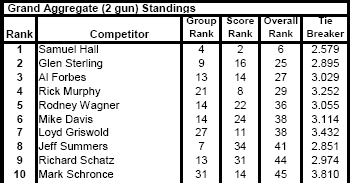
The 2008 IBS 600-yard Nationals concluded Saturday at Oak Ridge, TN. Many of the nation’s top shooters were there, including multiple world record-holders. Sam Hall was the big winner at the match. He took the Two-Gun Grand Agg, while winning Heavy Gun (HG) group Agg., HG score Agg., and Light Gun (LG) Score Agg. As Greg Seigmund said, Sam “tore the place down.” Glen Sterling shot well to finish second in the Two-Gun Grand. Richard Schatz compiled an impressive 2.242″ average to win Light Gun Group Aggregate. Richard’s Dasher really performed — three of his eight LG targets were mid-inch: 1.395″, 1.473″, and 1.736″. Joel Kendrick shot the small LG group of the match, an 0.984″, but Sam Hall wasn’t far behind, with a 1.089″ on his third target.
Hammerin’ Hall Talks About the Nationals
After the match, Sam gave us the details of his impressive win: “First off, I would like to thank Larry Sparks, Dave Tooley, Greg Seigmund, Larry Isenhour, Steve Shelp and everyone else that helped out to put on the match. They all did a great job. It was run very well and smoothly. Everyone I talked to said they had a really great time. I really enjoyed meeting all the guys from other states I had heard about and read about. Everyone I talked to was humble and top-notch.”
Q: How did it feel to win the Championship?
Sam: It is just starting to sink in that I won after I have got home. But, I still can’t believe I won. As they say, I was floating around on cloud nine after the win. It really meant the most to me when I got home and got to show and tell my two young boys and my wife what I had done.
Q: What were the conditions like?
Sam: We started with Light Gun each day. Every morning was pretty calm, but by mid-morning the mirage and breezes started. They were very switchy at times. We also had some pretty severe thunderstorms on the first two afternoons that “ate some peoples’ lunch”.
Q: Tell us about your equipment.
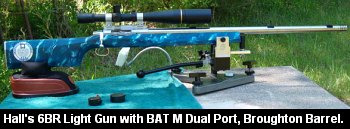
Sam: Both my Light Gun (LG) and Heavy Gun (HG) are straight 6BRs, with .268 necks. In LG I shot my Blue/White Shehane-stocked ST-1000 with 103 Spencer VLDs. The blue gun, smithed by BAT’s Tom Dixon, features a BAT M dual port, Broughton Barrel (1800 rounds), and Leupold 45X Competition scope. (Note: the equipment list is incorrect, I did not shot my Leonard-stocked gun in LG). In HG I shot another Shehane ST-1000 (orange/ white) but with Berger 105 VLDs. The orange rifle (smithed by Leonard Baity) weighs 28 lbs. (lots of lead in the stock). It has a Lilja 31″ straight-fluted barrel (800 rounds), BAT MB dual port, March 50x scope.
Q: What loads were you running?
Sam: I have been shooting the same loads in these two rifles for two years: Alliant Reloder 15, CCI BR-4 primers, Lapua brass, with 103 Spencers in my LG and 105 Berger VLDs in my HG. Both are barely in the rifling so my bolt is easy to close and I won’t pull a bullet out if I have to eject a live round (which I did have to do). My LG brass is the original 100 with about 18 reloadings. My bolt lift was getting a little sticky at the top in the middle of the day, so I put ice packs around my ammo in the heat of the day to keep pressure down. I certainly don’t recommend this to anyone! I just know this load and its limits.
Q: What was the key to victory for you?
Sam: I had the mindset when I went into the match that I was going to actually take more time shooting, remember my fundamentals, follow through each shot, and be as careful I could shooting. I figured if I did not get in a hurry, and thought through each shot, I was more likely not to have a big group that would kill me. Richard Schatz said the same thing at the end of the match. Richard tells people you don’t have to shoot little bitty groups at the Nationals to win, you just can’t shoot any really big ones.
Q: What are your plans for the rest of the season?
Sam: As far as anything new, I am actually thinking of an improved BR next year for the wind. Hoping I can get the velocity at a lower pressure. I might put these two barrels in semi-retirement and try to get another couple of barrels going. If I can’t get anything shooting better than my old barrels, I will put them back on when the stakes get high again. These two rifles and loads are like old gloves, I am used to them and trust them. They can sit unused for weeks, but when I pull them out, they perform as well as before.
The DQ Problem
Many top shooters experienced DQs during the match. In some cases the DQs were wind-related. However, a number of shooters DQ’d by shooting a record round on the sighter target which remained in place during record fire. After the match many shooters asked “Why don’t they just take down the sighter targets when record fire commences?” That would eliminate this potential problem. Alternatively, a large orange sticker could be placed over the sighter center, warning shooters not to fire at that target. In short-range benchrest, in the case of certain errant shots, there is a rule providing a 1-MOA penalty rather than a DQ. That’s worth considering for the 600-yard game.
In November, Savage’s Marketing Director told us to look for new rifles that were “right up your alley” in 2008. We’ve now received confirmation that Savage will offer the 6mmBR Norma chambering in at least two rifles in the Savage 2008 product line.
First, Savage will add a 6BR-chambered F-Class rifle, similar to the very popular 6.5-284 F-Class rifle. The 6BR F-Class gun will be in the same heavy laminated stock with 3″ fore-arm and wide flat in the rear. The barrel will be a 30-incher, presumably in 1:8″ twist. The trigger is the 6-oz. target version of Savage’s AccuTrigger. MSRP hasn’t yet been set, but we expect the 6BR F-Classer to sell for about $950.00 (street price), the same as the 6.5-284 version.
While designed for F-Class matches out to 1000 yards, the 6BR F-classer should also prove to be an excellent bench gun for varmint matches (200 to 500m), 300-yard matches, and 600-yard benchrest matches, and it should make an excellent long-range varminting platform.
But for Varminters and hunters looking for a lighter, more conventional stock, Savage will offer a 6BR Chambering in two versions of its Long-Range Precision Varminter (LRPV) Series–RBLP with blind mag, or RBRP with box magazine. This rifle features a stainless action in either Right Bolt, Left Port, or Right Bolt, Right Port configuration with a Detachable Box Magazine–something new for Savage. The LRPV comes with a high-quality H.S. Precision stock with an aluminum bedding block chassis. Like the F-Class rifle, the LRPV will have a target AccuTrigger adjstable from about 6 ounces to 2.5 pounds. The LRPV will have a 26″ barrel, and it is rumored the 6BR will have a 1:12″ twist rate, but that is not certain. The LRPV is also available in .204 Ruger, .223 Rem, and 22-250, along with 6mmBR Norma.





 After scanning the
 Now, I have never owned a 6mmBR before, but from reading here and seeing them in action I decided to build one. Its main purpose in life is mid-range F-Class shooting, mainly at 600 yards, and if the winds are favorable, at 1,000. (I already have a 6.5 for “normal” conditions.) I am most grateful for all the info here, and especially the load data. I picked Reloder 15 under the 107gr SMKs for my first loads, starting at 29.0 grains, and proceeding in half grain increments to 30.0 grains. Jumped the bullets 0.015″. Ran the Lapua brass through the neck-sizer bushing die, and was concerned at the force needed to pull the expander button through the virgin brass necks but figured this was a once per case deal to round them out for initial loading. When I measured the runout on the loaded rounds, I was appalled as they had more wobble than anything I personally loaded before, but I kept reminding myself that this was the fireform/chronograph/scope and gun trial stage.
 Given the many matches won and records set by 6BR Improved cases, both 6 BRX and 6 Dasher varieties, product planners at
 220 Russian, item 1270320316, $94.99 per 100-ct box