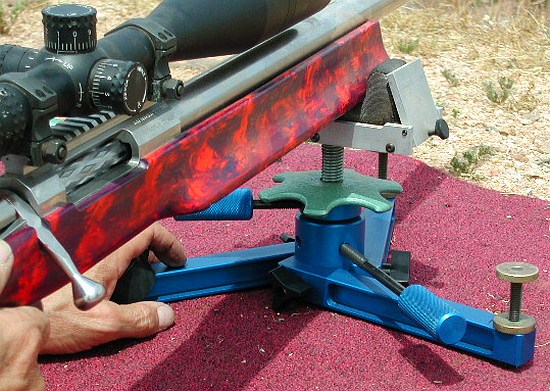
Texas stock-maker Wayne Young has created an innovative modular stock. The fore-end side-plates bolt on to an aluminum sub-chassis so you can alter the width, or run an offset on either side of center. You can transform the stock from 3″ wide to 5″ wide in a couple minutes. Or, if you want to experiment with offset (i.e. having more fore-end width on one side of the barrel than the other side), you can simply remove a few bolts, and stack up the sideplates on one side.
The ability to quickly (and inexpensively) transform a stock from 3″ wide to 5″ wide is a definite plus for shooters who want to use the same rig in both F-Class and benchrest. You can run your rifle at max-legal 3″ width for F-Class, then bolt on additional fore-end “wings” to run at 5″ for bench competition. The 5″-wide stocks are now legal for 600-yard and 1000-yard benchrest, at both IBS and NBRSA registered matches. Those folks who have tried out 5″-wide stocks on Light Guns have been impressed with the results. The extra width stabilizes the rifle on the bags, reducing perceived twist (torquing) and hop. There is less “Rocking and Rolling”. With the gun torquing less, the tracking during recoil normally shows an improvement as well. (But we should say that, even with the standard 3″ width, these stocks track great.)
Video Demonstrates Superior Tracking
How does a Wayne Young stock track? Straight and true — with virtually no hop. You can see for yourself. In the video below, Wayne shoots a test rifle chambered in .284 Winchester, a popular F-Class cartridge. The load is a 175gr Berger XLD bullet pushed at 3010 fps by Reloder 17 powder. That’s a stout, fast load — the recoil force easily meets or exceeds a typical F-Open match load. To better demonstrate the gun’s handling characteristics, Wayne deliberately shoots the gun free-recoil style — without gripping hard or shouldering the stock*. As you can see, the gun recoils straight back. The forearm and buttstock also slide perfectly in the bags, without “grabbing”. (Note: In the video, the rifle’s front bag-rider section is aluminum without polymer “wings”. This particular gun was built with a wider aluminum channel to fit a large-diameter, straight-contour barrel).
Stock Specifications and Design Features
Finished stocks weigh approximately 7 pounds, 4 ounces. If needed, stocks can be lightened to just under 7 pounds. Overall length is 36″. Length of pull is adjustable from 13 to 13.75 inches with standard two-way adjustable butt pad. The main chassis is machined from billet 6061-T6 (Tee Six) aluminum, while the fore-end chassis section is 6063-T5 (Tee Five). The black side sections, fore-end plates, and buttstock lowers are CNC-machined from high-grade HDPE, a rugged, chemically-resistant polymer.
The chassis for round actions features a “V-Block” seating area. There is a flat configuration for Panda and Stiller flat-bottom actions. With either the round- or flat-bottom configuration, actions can be mounted directly on the 1.25″-square aluminum chassis, using supplied action bolts. (Skim bedding is optional.) No inletting, pillar-installation, or stock finishing (painting) is required. Just bolt your barreled action into the chassis and head to the range.
Wayne’s stocks come with two-way adjustable butt-plate, adjustable cheekpiece, trigger guard, and all fasteners. If you consider all that standard equipment and the fact that Wayne’s gunstocks require no inletting and no finishing, these stocks are attractively priced. Wayne’s F-Open/Benchrest Stock, with 3″ fore-end, costs $499.00 plus $25.00 S/H. There is also a $499.00 F-TR version with a fore-end set up for bipod attachment. (Wayne produces an integral, adjustable and removable F-TR bipod for $75.00.) Add $100.00 extra if you want the aluminum components hard-anodized. With long actions or Savage actions, there is an extra charge to configure the central chassis to fit. For more information visit WaynesGunstocks.com or call (210) 288-3063 from 8:00 am to 4:30 pm Monday through Friday.
* If Wayne was shooting a .284 Win in an F-Class match, he would grip the gun and put some shoulder into it. But for demonstration purposes in the video, Wayne free-recoiled the rig so you can see how well it tracks with no holding or steering by the shooter.
We’re excited when major barrel-makers offer new technologies that promise worthwhile performance benefits for hunters or match shooters. Lothar Walther (LW) has developed a new bi-metal barrel system that cuts weight dramatically while promising significantly-enhanced heat dissipation.
Walther’s new Ultra-Lightweight Barrels combine steel with lightweight alloys. This results in a significant weight reduction without the use of carbon fiber, epoxy binders, or other heat-retaining materials. Beginning as an LW50 stainless blank, the barrel is precision-machined to remove excess weight. An outer casing of light-weight alloys is machined and the two are fitted together without adhesives. Basically you end up with the steel inner barrel inside a larger-diameter fluted aluminum outer barrel (see diagram). This gives you the ‘best of both worlds’ — light weight for ease of carry, and thick diameter for rigidity and enhanced heat dissipation. Near the action, the barrel remains all-steel.
We haven’t tested one of these bi-metal composite barrels, but the potential for significant weight savings is obvious — aluminum is a lot lighter than steel. What’s more, a metals expert we contacted said that a bi-metal system employing fluted aluminum over steel, if assembled properly, could dissipate heat much better than steel alone (given the same diameter). Stainless steel has a thermal conductivity factor of 16. Aluminum has a thermal conductivity factor of 250.*
Our expert also pointed out that some other composite barrel systems on the market actually increase heat retention because they place insulating materials next to the inner steel barrel. (Carbon, Fiberglass, and Epoxy are all considered “insulating substances” as they have very low thermal conductivity*.) The LW system of aluminum over metal should avoid this mistake, our expert said. Lothar Walther says: “Unlike solid steel barrels, this barrel sheds heat fast. VERY FAST!”
Half the Weight of Conventional Barrels
How much weight can you save? With a 1.200″ shank diameter (except Savage) and a muzzle diameter of 0.850″, the LW Ultra-Lightweight Barrel is less than half the weight of a standard varmint barrel of the same size. Walther claims its UltraLight Barrel can be “carried for long distances and stand up to heavy firing.” This, LW says, makes these barrels “perfect… for varmint and tactical uses”.
Pre-Chambered Ultra-Lightweight Barrels Available in .22 to .338 Calibers
Lothar Walther offers Ultra-Lightweight barrels in a full range of calibers from .22LR to .338. Each Ultra-Lightweight Barrel comes complete with chamber, crown, and breech threads. These barrels are fluted by the factory. If you order a LW Ultra-Lightweight barrel, Lothar Walter provides the services of a specialist trained in building guns with these barrels. To order one of Lothar Walther’s bi-metal barrels, CLICK HERE or contact Lothar Walthar at the address below:
*Thermal conductivity is the quantity of heat transmitted through a unit thickness in a direction normal to a surface of unit area, due to a unit temperature gradient under steady state conditions. The factor values are based on this formula: W/(m.K) = 0.85984 kcal/(hr.m. °C). Here are thermal conductivty values for common materials: Aluminum, 250; Brass, 109; Steel (Carbon 1%), 45; Stainless Steel, 16; Carbon, 1.7; Brick dense, 1.3; Concrete (medium) 0.7; Epoxy, 0.35; Fiberglass, .04.
Story tip from EdLongRange. We welcome reader submissions.
The Xmas holiday buying season is right around the corner. If you’re looking for an unusual gift for a firearms enthusiast or military veteran, check out the 40mm Grenade Salt & Pepper shakers from GG&G. Available with either silver or gold anodized top sections, these measure 4″ tall by 1 5/8″ in diameter. GG&G’s matched salt and pepper shakers are milled from solid billet 6061 T-6 aluminum, and closely replicate the dimensions of the original 40mm grenade. The tip of the projectiles are engraved with “S” or “P” to easily identify the contents. The top halves (gold or silver sections) unscrew for easy filling. Cost for either gold (GGG-1315) or silver (GGG-1316) versions is $45.00. These would also be a great “conversation pieces” for your Thanksgiving family get-together.
Sinclair Int’l is now selling a new line of O-ring-equipped aluminum jags made by The Custom Shop (TCS). These unique TCS O-Ring Jags are crafted from aluminum so they won’t react to solvents. The O-rings hold the patch firmly against the bore surface to efficiently clean powder, lead, copper, and plastic fouling. There are shapes and sizes for pistols, rifles and shotguns. Rifle jags come in sizes .22 (J22), .243 (J2436mm), .257 (J25725Cal), .270-6.8mm (J27068mm), .284 (J2847mm), .308 (J30RP), .338 (J338RP), and .50 Cal (J50). The “RP” models do double-duty for large-caliber rifles and pistols.
We haven’t tried these jags yet, but we think the O-rings may be a good idea. As with any aluminum-bodied jag, be sure to keep the jags clean, as hard particles and debris can become embedded in the aluminum surface. You don’t want to drag embedded debris across your delicate rifling. The TCS jags range in price from $9.95 to $10.95.
Forum Member Tom Sziler(aka Tomekeuro85) produces very nice CNC-milled aluminum loading and sorting blocks that can be customized with your name or catridge designation. These start at just $15 for a 50-bullet sorting tray or 25-round range block. The original 50-round loading blocks cost $25 for most cartridges (smaller than .338 Lapua), $28 for .338 Lapua, and $30 for big stuff like the 50 BMG.
This bullet sorting tray is useful if you sort by base to ogive length or bullet weight.
Trays Are Made to Precise Tolerances and Fitted with Rubber Pads
All trays and blocks have rubber pads on the bottom for grip. Holes are all milled deep, to precise tolerances to prevent rattling, but rounds still fit with sufficient clearance. Clearance is provided on the bottom of each hole to avoid potential primer contact and to make room for debris. You want something customized? No problem. Tom says: “Custom variations of any of these items are available. Just let me know what you’re looking for.”
These blocks are definitely high-quality. Forum member PGG reports: “You can count on top notch work and materials guys. I bought a boat load of them for Christmas gifts [and] they were a huge hit. Super items, super service, great value.” Forum member WoolenMammoth agrees: “[I] ordered a few blocks recently and they far exceeded my expectation. Really nice work at an absurdly competitive price.” For more info, or to place an order, view this Shooters’ Forum Thread, or email Tom.Sziler[at]gmail.com.
Last month, we ran a story explaining how surplus aluminum Stinger missile transport boxes can be modified to hold two long-barreled match rifles side-by-side. We have received many emails concerning the Stinger missile box conversions. People wanted to know where they could purchase the Stinger boxes commercially. Folks also asked about shipping costs and weights.
On the outside, the Stinger missile transport boxes measure roughly 66″ x 12″ x 13″. Usable inside length is just under 62″. That’s nearly a foot longer than a typical long-range benchrest rifle with 30″ barrel — so you have plenty of clearance. As received from Uncle Sam, with hard foam internal cradles, the boxes weigh about 53 pounds. The boxes are watertight and are fitted with air relief valves, but they do not have key-locks. However, it is pretty easy to retrofit a hasp lock for security.
Stinger Missile Boxes $199.97 at SportsmansGuide.com The Sportsman’s Guide is now selling the Stinger boxes for $199.97 plus shipping. These durable containers weigh a hefty 53 pounds shipped so there is a $5.00 “heavy product” surcharge in addition to regular shipping and handling fees. If you are a member of Sportsmans’ Guide’s “Buyers Club”, you can save money. Buyer’s Club price is listed at $179.97 plus shipping. If you’re doing a search on the Sportsman’s Guide website, these boxes are listed as “U.S. Military Aluminum Container”, item number WX2-157199.
Forum Member Stinger Box Offer
Paul Scott, one of our Shooters’ Forum members, acquired many of these Stinger cases a while back. He still has a half-dozen or so for sale at $175.00 plus shipping. These are the same type U.S. Army surplus missile boxes that Sportsman’s Guide is selling. The dimensions and features are identical, they’re just a bit cheaper. Paul charges actual UPS shipping, which should run from $30-$50 depending on far you are from Paul’s Texas home. To order, email pscott [at] pegasustexas.com.
It is very easy to add wheels to a Stinger Box. Start by sliding a solid axle through the horizontal “bumper” on one end. Add spacers, wheels, cotter pins and … Voilà, you have a wheeled double-gun transporter. Shown below is Paul Scott’s wheeled Stinger box: “The wife found a old hand truck dolly with 10″ no-flat wheels. Put the axle through the aft bottom bumper and secured it with 1/2″ pipe clamps. The spacer is 1/2″ irrigation pipe cut to fit and adapted for cotter pins. The 10″ wheels are perfect to fit in the box.”
Having a quality funnel helps you get carefully-measured powder charges in your cases, with no spillage, every time. If you’ve tried cheap, plastic funnels you know that they can rock on the case mouth. Also, if the fit isn’t good, some kernels end up on your bench, instead of inside the case.
Thankfully, precision, caliber-specific metal funnels are available to reloaders for about $10-$12.00. Satern Custom Machining funnels feature an aluminum top with a caliber-specific, machined brass base/neck. The Satern funnel’s aluminum body is completely static-free so powder flows into the case without bridging. Dick Saunders makes a similar, turned-aluminum funnel sized for particular calibers. Both these metal funnels make reloading easier (and they are ideal for blackpowder loading because they do not give off static electricity). As Forum member Wes notes, with a fitted metal funnel: “the possibility of the funnel sliding to the side, and spilling powder all over the place is drastically reduced.”
Satern Aluminum/Brass Funnels
Steve Satern crafts rugged aluminum funnels with brass ends. The caliber-specific sizes offer a snug fit that keeps the funnel tight on the case neck while the powder is flowing. Forum member Danny Reever reports: “If you are tired of the generic ‘fits all’ funnels falling over and powder spraying every where, try one of the Satern funnels. Sinclair Int’l sells them and they are top notch.” SMike308 adds: “I have retired my plastic funnels after buying my first Satern funnel. I now have one for each different caliber that I load for. I especially like that the Satern has the brass weight at the bottom, which adds stability to the funnel.”
Satern funnels are sold by MidwayUSA (6mm $11.29), Satern Machining (6mm $11.25), and Sinclair International (Item 11-9XX, 6mm $11.95). Satern Machining also offers two types of universal funnels, 22-30 caliber and 30-50 caliber. Satern’s universal funnels, along with the larger .338 to .50 caliber funnels, cost $18.45.
Saunders Aluminum Funnels
Some of our Forum members prefer the turned aluminum funnels made by Dick Saunders. You’ll need to order these direct from Saunders. Specify .17, .20, .22, 6mm, 6.5mm, .30 caliber or “all-purpose”. The Saunders funnels start at about $10.00. Contact Dick Saunders at the address below:
Dick Saunders
145 Delphi Rd.
Manchester, IA 52057
563-927-4026
There has been a trend to ever-lighter handgun frame construction, in an effort to make pistols lighter and more convenient to carry. Ruger just introduced the LCR 357, a .357 Magnum carry revolver with a frame made, in part, from plastic. Well, perhaps weight reduction efforts have gone too far, at least when it comes to magnum chamberings in handguns.
A Smith & Wesson .44 Magnum model 329 PD revolver recently broke in half while shooting Winchester factory ammo. The whole front end of the gun sheared off forward of the cylinder. Cause of the failure is unknown, but it does not appear that the barrel was obstructed, as there was no visible damage to the barrel assembly forward of the frame. We really don’t know why this revolver broke in half, though some observers speculated there may have been hairline fractures in the frame. That’s just a guess. It’s also possible that the factory ammo was over-charged. The pictures below were posted by the gun owner on Photobucket and first linked on AR15.com.
Scandium Alloy Frames
The model 329 PD has a “Scandium AirLite” frame, which is in fact an alloy of aluminum and scandium. When combined with aluminum, scandium (which costs ten times as much as gold by weight), forms an alloy that is lighter than titanium and as much as three times stronger than ordinary aluminum. Apparently however, there can be problems with scandium construction… as the photos reveal. Last year, Smith & Wesson recalled 270 limited-edition Performance Center m329 revolvers because barrel assembly may have caused frame damage. The model 329 PD shown in this article was NOT one of the recalled Performance Center guns.
Make My Magnum from Steel… The Smith & Wesson model 329 PD weighs only 25.1 ounces total, unloaded. Why one would want to shoot “full-house”, high-pressure loads through such a light gun puzzles this Editor. For a carry gun, lower-pressure .44 Special loads seem more appropriate. Smith & Wesson makes a variety of heavier, all-steel handguns chambered in .44 Magnum. If I was to shoot a steady diet of full-power .44 Magnum loads through a revolver, give me a gun with a solid steel frame, such as the classic S&W model 29. After seeing these shocking kaboom photos, when shooting true Magnum loads through a Scandium-framed revolver I would nervously ask myself the question famously posed by Clint Eastwood’s Dirty Harry: “Do I feel lucky?”.
Having a quality funnel can help you get a carefully-measured powder charge in your cases, with no spillage, every time. If you’ve messed around with cheap plastic funnels you know that they can rock on the case mouth. Also, if the fit isn’t good, some kernels can end up on your bench, instead of inside the case.
Thankfully, precision, caliber-specific metal funnels are available to reloaders for about $10-11. Satern Custom Machining funnels feature an aluminum top with a caliber-specific, machined brass base/neck. Dick Saunders makes a simliar, turned-aluminum funnel sized for particular calibers. Both these metal funnels make reloading easier (and they are ideal for blackpowder loading because they do not give off static electricity). As Forum member Wes notes, with a fitted metal funnel: “the possibility of the funnel sliding to the side, and spilling powder all over the place is drastically reduced.”
Satern Aluminum/Brass Funnels
Steve Satern crafts rugged aluminum funnels with brass ends. The caliber-specific sizes offer a snug fit that keeps the funnel tight on the case neck while the powder is flowing. Forum member Danny Reever reports: “If you are tired of the generic ‘fits all’ funnels falling over and powder spraying every where, try one of the Satern funnels. Sinclair Int’l sells them and they are top notch.” SMike308 adds: “I have retired my plastic funnels after buying my first Satern funnel. I now have one for each different caliber that I load for. I especially like that the Satern has the brass weight at the bottom, which adds stability to the funnel.”
Satern funnels are sold by MidwayUSA (6mm $11.29), Satern Machining (6mm $10.49), and Sinclair International (Item 11-9XX, 6mm $11.95). Satern Machining also offers two types of universal funnels, 22-30 caliber and 30-50 caliber.
Saunders Aluminum Funnels
Some of our Forum members prefer the turned aluminum funnels made by Dick Saunders.
These are sold by Russ Haydon’s Shooters Supply for $9.95 each. Specify .17, .20, .22, 6mm, 6.5mm, .30 caliber or “all-purpose”. If you have questions, you can contact contact Saunders directly:
Dick Saunders
145 Delphi Rd.
Manchester, IA 52057
563-927-4026
Butch Lambert sent his new ShadeTree Engineering F-Class rest base to German Salazar in Phoenix for testing and evaluation. The Daily Bulletin previewed a prototype rest base last month. (CLICK HERE for previous report.)
ShadeTree Rest is Lightweight and Easily Assembled
Designed to be light for air travel and easy carrying at the range, the anodized aluminum rest base weighs just 3 pounds without the top or feet. Once fully assembled, this rest base is lighter than anything else on the market, but provides all the stability needed on the range. The legs attach with thumbscrews and the center section slides right in. Assembly was a matter of a minute or two and can be done at the range without any tools. The legs have an I-beam section for light weight and rigidity, the anodizing is well-executed. Almost any currently-made top assembly will fit the base as will the leg screws. We found the rest to be well designed and manufactured.
Bruno Wins Match Using ShadeTree Rest Base
Well-known benchrester Lester Bruno of Bruno Shooters’ Supply also shoots F-Class in matches at the Ben Avery Shooting Facility. Lester volunteered to give the rest a workout. Lester used the rest in a local 600-yard match May 2nd. Lester’s first comment was that the ShadeTree rest was a lot easer to carry on and off the firing line than a heavy cast iron rest. After shooting the match, Lester confirmed the rest’s ease of use and stability. Given that Lester won the match, we can surmise that the rest was an effective tool for the job and a worthwhile product for any F-Class shooter, particularly one who travels by air. To learn more about price and availability of the F-Class rest base, call Butch Lambert at (972) 524-2247 or email papawlambert [at] starband.net.


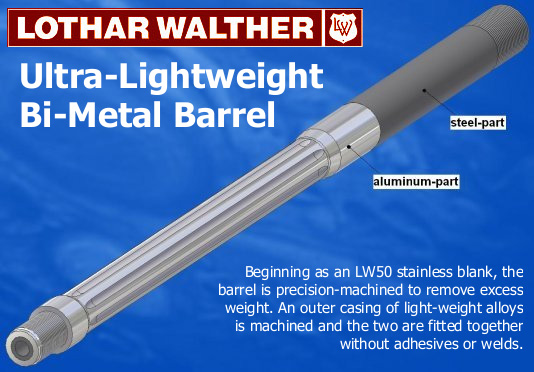
 We haven’t tested one of these bi-metal composite barrels, but the potential for significant weight savings is obvious — aluminum is a lot lighter than steel. What’s more, a metals expert we contacted said that a bi-metal system employing fluted aluminum over steel, if assembled properly, could dissipate heat much better than steel alone (given the same diameter). Stainless steel has a


 These blocks are definitely high-quality. Forum member PGG reports: “You can count on top notch work and materials guys. I bought a boat load of them for Christmas gifts [and] they were a huge hit. Super items, super service, great value.” Forum member WoolenMammoth agrees: “[I] ordered a few blocks recently and they far exceeded my expectation. Really nice work at an absurdly competitive price.” For more info, or to place an order, view this
  Last month, we ran a story explaining how surplus aluminum

 Having a quality funnel helps you get carefully-measured powder charges in your cases, with no spillage, every time. If you’ve tried cheap, plastic funnels you know that they can rock on the case mouth. Also, if the fit isn’t good, some kernels end up on your bench, instead of inside the case.

 The Smith & Wesson