In our Shooters’ Forum, one member posed the question: “What makes an AR accurate? What parts on an AR can really affect accuracy — such as free-floating handguards, barrels, bolts, bolt carriers?” He wanted an honest, well-informed answer, not just sales pitches. Robert Whitley posted a very comprehensive answer to this question, based on his experience building and testing dozens of AR-platform rifles. Robert runs AR-X Enterprises, which produces match-grade uppers for High Power competitors, tactical shooters, and varminters.
Building an Accurate AR — What is Most Important
by Robert Whitley
There are a lot of things that can be done to an AR to enhance consistent accuracy, and I use the words “consistent accuracy” because consistency is a part of it (i.e. plenty of guns will give a couple great 5-shot groups, but won’t do a very good 10- or 20-shot groups, and some guns will shoot great one day and not so good on others).
Here are things we think are important to accuracy.
1. Great Barrel: You’ll want a premium match-grade barrel, well-machined with a good crown and a match-type chambering, true to the bore and well cut. The extension threads must also be cut true to the bore, with everything true and in proper alignment.
2. Rigid Upper: A rigid, heavy-walled upper receiver aids accuracy. The typical AR upper receiver was made for a lightweight carry rifle and they stripped all the metal they could off it to make it light to carry (which is advantageous for the military). The net result are upper receivers that are so thin you can flex them with your bare hands. These flexible uppers are “strong enough” for general use, but they are not ideal for accuracy. Accuracy improves with a more rigid upper receiver.
3. True Receiver Face: We’ve found that truing the receiver face is valuable. Some may argue this point but it is always best to keep everything related to the barrel and the bore in complete alignment with the bore (i.e. barrel extension, bolt, upper receiver, carrier, etc.).
4. Barrel Extension: You should Loctite or glue the barrel extension into the upper receiver. This holds it in place all the way front to back in the upper receiver. Otherwise if there is any play (and there typically is) it just hangs on the face of the upper receiver completely dependent on the face of the upper receiver as the sole source of support for the barrel as opposed to being made more an integral part of the upper receiver by being glued-in.
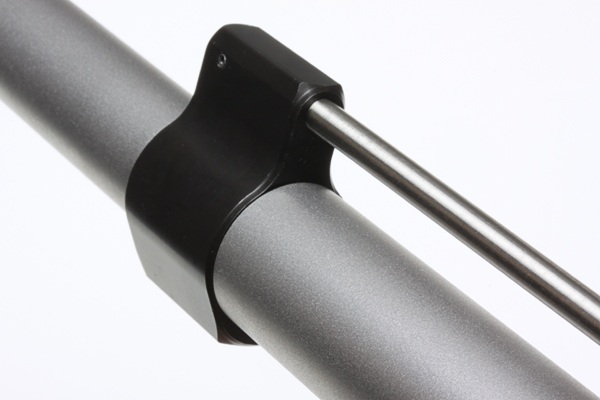
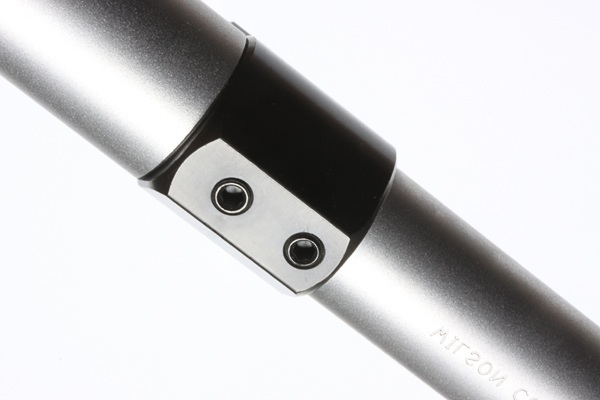
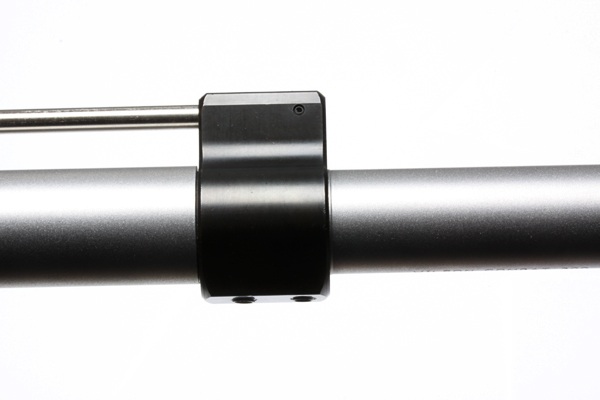
5. Gas Block: You want a gas block that does not impose pointed stress on the barrel. Clamp-on types that grab all the way around the barrel are excellent. The blocks that are pinned on with tapered pins that wedge against the barrel or the slip on type of block with set screws that push up from underneath (or directly on the barrel) can deform the bore inside of the barrel and can wreck the accuracy of an otherwise great barrel.
6. Free-Float Handguard: A rigid, free-float handguard (and I emphasize the word rigid) really makes a difference. There are many types of free-float handguards and a free-float handguard is, in and of itself, a huge improvement over a non-free-float set up, but best is a rigid set-up. Some of the ones on the market are small diameter, thin and/or flexible and if you are shooting off any type of rest, bipod, front bag, etc., a rigid fore-end is best since ARs want to jump, bounce and twist when you let a shot go, as the carrier starts to begin its cycle before the bullet exits the bore.
7. Barrel Contour: You want some meat on the barrel. Between the upper receiver and the gas block don’t go real thin with a barrel (we like 1″ diameter if it’s workable weight-wise). When you touch off a round and the bullet passes the gas port, the gas system immediately starts pressuring up with a gas impulse that provides vibrations and stress on the barrel, especially between the gas block back to the receiver. A heavier barrel here dampens that. Staying a little heavier with barrel contour through the gas block area and out to the muzzle is good for the same reasons. ARs have a lot going on when you touch off a round and the gas system pressures up and the carrier starts moving (all before the bullet exits the bore) so the more things are made heavier and rigid to counteract that the better — within reason (I’m not advocating a 12-lb barrel).
8. Gas Tube Routing Clearance: You want a gas tube that runs freely through the barrel nut, through the front of the upper receiver, and through the gas key in the carrier. Ensure the gas tube is not impinged by any of them, so that it does not load the carrier in a stressed orientation. You don’t want the gas tube bound up so that when the gas tube pressures up it immediately wants to transmit more force and impulse to the barrel than would normally occur. We sometimes spend a lot of time moving the gas block with gas tube on and off new build uppers and tweaking gas tubes to get proper clearance and alignment. Most gas tubes do need a little “tweaking” to get them right — factory tubes may work OK but they typically do not function optimally without hand-fitting.
9. Gas Port Tuning: You want to avoid over-porting the gas port. Being over-gassed makes the gas system pressure up earlier and more aggressively. This causes more impulse, and increases forces and vibration affecting the top end and the barrel. Tune the gas port to give the amount of pressure needed to function properly and adequately but no more.
10. Front/Back Bolt Play: If accuracy is the game, don’t leave a lot of front/back bolt play (keep it .003″ but no more than .005″). We’ve seen factory rifles run .012″ to .015″ play, which is OK if you need to leave room for dirt and grime in a military application. However, that amount of play is not ideal for a high-accuracy AR build. A lot of front/back bolt play allows rounds to be hammered into the chamber and actually re-formed in a non-consistent way, as they are loaded into the chamber.
11. Component Quality: Use good parts from a reputable source and be wary of “gun show specials”. All parts are NOT the same. Some are good, some are not so good, and some aftermarket parts are simply bad. Don’t be afraid to use mil-spec-type carriers; by and large they are excellent for an accuracy build. Also, remember that just because a carrier says “National Match” or something else on it does not necessarily mean it’s any better. Be wary of chrome-plated parts as the chrome plating can change the parts dimensionally and can also make it hard to do hand-fitting for fit and function.
12. Upper to Lower Fit: A good upper/lower fit is helpful. For quick and dirty fit enhancement, an Accu-Wedge in the rear helps a lot. The ultimate solution is to bed the upper to a specific lower so that the upper and lower, when together, are more like one integral unit. For the upper receivers we produce, we try to get the specs as close as we can, but still fit the various lowers in the market place.
13. Muzzle Attachments: Don’t screw up the muzzle (literally). Leave as much metal on the barrel at the muzzle as you can. People like to thread the muzzle for a flash hider, suppressor, muzzle brake, or some other attachment, but if you really want accuracy, leave as much metal as you can there. And, if you have something that screws on, set it up so that it can be put on and have it stay there without putting a lot of torque and stress on it right where the bullet exits the bore. If you are going to thread the end of the barrel, make it concentric with the bore and make sure what you screw on there is as well. For all muzzle attachments, also ensure that the holes through which the bullet passes through are dead true to the bore. Many aftermarket screw-on things are not so good that way. Anything that vents gas should vent symmetrically (i.e. if it vents left, it should vent equally right, and likewise, if it vents up, it should vent down equally). Uneven venting of gas can wreck accuracy.
14. Quality Ammunition: Ammo is a whole story by itself, but loads that are too hot typically shoot poorly in an AR-15. If you want accuracy out of an AR-15, avoid overly hot loads. Shown below are test groups shot with four (4) different uppers, all with moderate loads. These four uppers all pretty much had the same features and things done to them as explained in this article, and they all shot great.
Magpul is now offering 40-round capacity PMAG GEN M3 magazines for AR-platform rifles chambered for .223 Rem/5.56×45. Just 2 1/8″ longer than a 30-round Magpul magazine, the new 40-rounder will fit and function in standard AR mag wells. Magpul claims that: “The new PMAG 40 is just as reliable, durable, and compatible as the PMAG 30.”
Magpul’s new 40-round magazines should prove popular with 3-Gun competitors. The extra 10 rounds can reduce the number of mag changes, which should allow 3-gunners to shave seconds off stage times. As with other latest-generation PMAGs, the new PMAG 40s feature an over-insertion stop catch that prevents the magazine from being slammed too far into the gun during fast changes. This stop catch prevents mag damage and lessens the chance of a malfunction. For LEO and Military personnel using select fire ARs, Magpul notes that: “The optimized magazine spring can handle feeding at cyclic rates over 1150 rounds per minute.”
Major vendors, such as Brownells, will be selling the PMAG 40s very soon. Brownells is charging $19.95 for the PMAG 40, product #100-012-633WB. We expect these things to sell like hotcakes. The editors of Guns.com note: “These magazines are going to be incredibly popular. Everyone likes extra ammo, even when it’s hard to find. And when most magazines with capacities greater than 30 run $40-$50, at these prices Magpul is going to tear through their competition.”
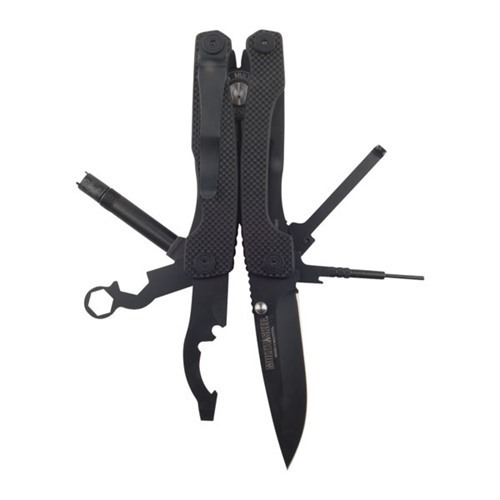
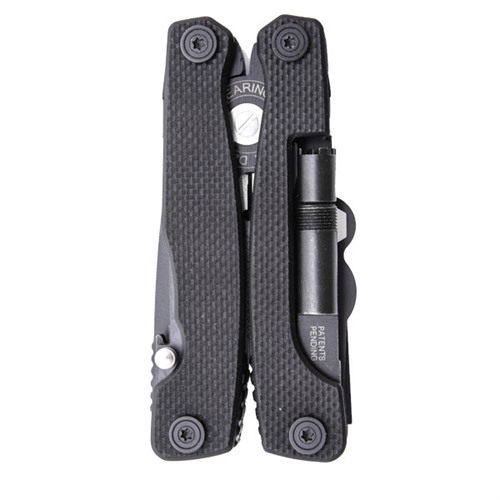
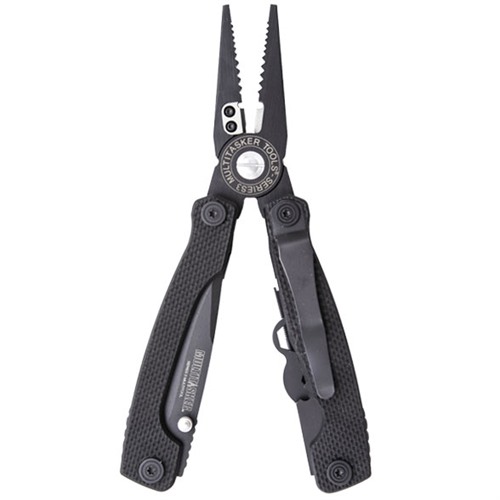
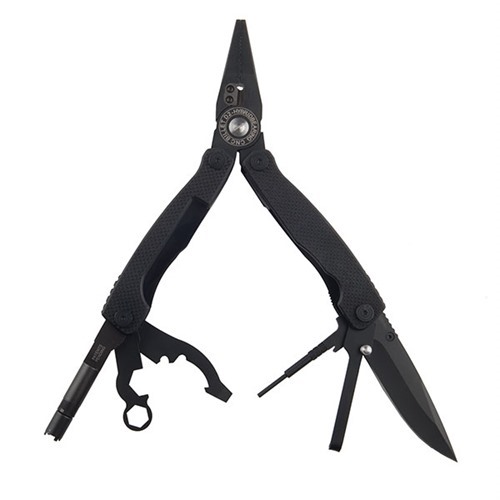
Do you own one or more AR-platform rifles? Need to fix and service critical components in the field? Then you should check out the new AR Platform Multitasker Tool sold by Brownells. This handy gadget has enough functions to keep MacGyver happy. It has hex wrenches for scope rings and LaRue mounts, front sight tool, a Castle Nut spanner wrench, a pin punch, and even a carbon scraper — something every AR owner can definitely use.
In addition to these gun-specific tools, the Multitasker includes a knife blade, pliers, and a magnetic bit driver with ten bits. The cleverly-designed tool folds up to fit in your pocket. For a further explanation of all the tool elements, and an explanation of how they work (with many good photos), see the Multitasker Review on Ar15news.com.
Brownells AR Platform Multitasker Tool Features:
Non-slip G10 Scaled Grips (either matte black or tan)
Billet Pliers (D2 tool steel — CNC milled)
Carbon Scraper with Radiused Tip
3/8″ Hex for LaRue Mounts
1/2″ Hex for Scope Rings
Magnetic Bit Driver (1/4″) with M16A2 FSP Adjuster
Dual-Lug M4 Castle Nut Spanner Wrench
Pin Punch (3/32″) with 8-32 male thread for Otis cleaning kit
D2 3″-long Tool-Steel Knife Blade
Combo Flat Screwdriver and Bottle Opener
Pocket clip (removable)
Kit with 10 Hex Bits for commonly used AR accessories
The state of New York has activated its online registration service for owners of semi-automatic firearms that have been re-classified as “Assault Weapons” under New York’s SAFE Act. We put that term in quotes because the same firearms, such as AR-platform rifles, are legal to own, with few restrictions, in most other U.S. states. New York owners of newly-restricted semi-automatic rifles, pistols, and shotguns have one year from today to register their firearms. Failure to register a newly-defined “assault weapon” by April 15th, 2014 is punishable as a Class A Misdemeanor, with forfeiture of the firearm(s).
If you are a New York gun owner with firearm(s) that may be covered by the SAFE Act, you should read the statute carefully and possibly consult with an attorney if you have questions about your legal obligations. There are many confusing provisions in the new law, but primarily the law requires registration of any auto-loading firearm (pistol, shotgun or rifle) that takes a detachable magazine and has any one or more “evil” features, which are separately enumerated for pistols, rifles, and shotguns. Click these links to read the exact list of banned features.
New York has issued a non-exhaustive list of rifles classified as “assault weapons”. However, even if you don’t see your rifle on this list, it may still be restricted. Under the SAFE Act, ANY semi-automatic rifle “capable of receiving a detachable magazine” is considered an “assault rifle” if it has any ONE or more of these “military characteristics”:
Grenade Launcher
Folding Stock
Thumbhole Stock
Protruding Pistol Grip
Second handgrip or “protruding grip that can be held by the non-shooting hand”.
Bayonet Mount
Flash Suppressor
Muzzle Brake
Muzzle Compensator
Threaded barrel “designed to accommodate” Brake, Suppressor, or Compensator.
In addition to the new registration requirement, the sale and/or transfer of newly-defined “assault weapons” is banned within the state, although sales out of state are permitted. Possession of the newly-defined “assault weapons” is allowed only if they were possessed at the time that the law was passed, and they must be registered with the state within one year (of today) by the owner. The SAFE Act grandfathers the prior ownership of “assault weapons”, but requires that they be registered with the NY State Police by April 15, 2014 — plus they must be recertified every five years. More information can be found at www.Renzullilaw.com.
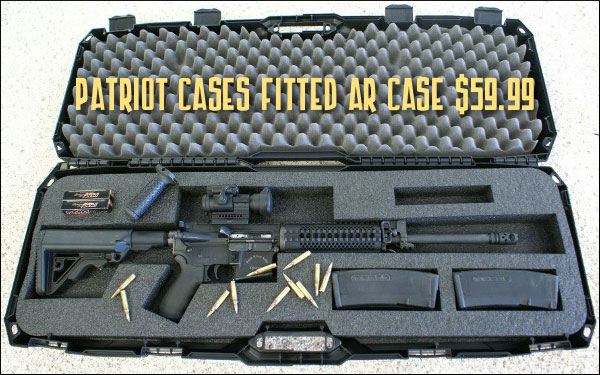
Our buddy Dennis Santiago found a great deal on a good gun case for AR-platform rifles. Now, as a special promo offer, you can get the Patriot AR case, for just $59.99. This case will fit ARs with barrels up to 20″ in length. NOTE: The photo shows Patriot’s AR case with custom-profiled foam. This case will accommodate virtually any AR with barrels up to 20″ long (some foam cutting required for A2-style stocks). Exterior length of the case is 41.5 inches, and internal length is 40.0 inches. Along with the main, pre-cut rifle cavity, there are cut-outs for four (4) magazines, a suppressor, and boxed ammo. The foam is high-density, 2.2-lb Mil-spec polyethylene. Patriot claims this dense foam is “impervious to cleaning oils/solvents, and will not hold moisture”. The case features six (6) molded holes for padlocks, and there are guards protecting the latches. This case carries an ATA Specification 300 II rating.
Brack Wilson of Patriot Cases explains: “FINALLY, after hundreds of requests, our new AR case is available for purchase online at PatriotCases.net This is an incredible deal at only $59.99, and we are offering a special discount for purchases through end of day Monday (April 8, 2013). Enter discount code Facebook at checkout.”
Dennis Santiago tells us: “If you have one of these genetically modified AR-15s set up in 21st Century shooting configuration, this is the case for you. This is perfect for your 3-gun machine…. Friend Brack Wilson just started making them and they went up on his company’s shopping cart today. It’s a solid, lockable design that uses mil-spec heavy foam. They’re on introductory special this weekend so now’s the time to grab one. Enter discount code “Facebook” at checkout and it will deduct $10 from the total cost (so your net cost is $49.99). I think this is the deal of the weekend.”
Dennis hopes that Patriot will produce another version for High Power Shooters: “For you high power guys, I’ve asked Brack to consider making a version with cutouts for the Service Rifle AR-15 with magazine cut outs for one of those Creedmoor mag pouches, a couple of more 20-rd mags (sled + sighter mags), an ECI, a sling, a scorebook. Our kind of stuff. It’d be nice to have a proper hard case with the right cutouts for these guns. It’ll make them safer for transport going to matches.”
It’s time for the NRA National Matches, which means that hundreds of Service Rifle shooters will be converging on Camp Perry, Ohio. It also means that AR shooters may need some expert help to tune up their rifles, and maybe fit a new barrel or trigger to improve accuracy. AccurateShooter.com has a list of Recommended Gunsmiths. Most of the smiths listed on our Gunsmith Page specialize in bolt-action rifles, for Benchrest, varminting, and long-range. While some do work on AR15s and “space-guns”, this is not their primary focus.
If you need a first-rate gunsmith for a service rifle, Sinclair International has compiled its own list of smiths including highly respected names. For service rifles (including AR types), Sinclair recommends the following:
Phil Arrington (Service Rifle) Arrington Accuracy Works
1408 West Ross Ave.
Phoenix, AZ 85027
Phone: (623) 582-5066
Compass Lake Eng. (Service Rifle)
719 White Dr
Alford, FL 32420
Phone: (850) 579-1208
Derrick Martin (Service Rifle) Accuracy Speaks, Inc.
3960 N. Usery Pass Rd.
Mesa, AZ 85207
Phone: (480) 373-9499
E-mail: ask-derrick@accuracyspeaks.com
Medesha Firearms (Service Rifle)
10321 E Adobe Rd
Mesa, AZ 85207
Phone: (480) 986-5876
E-mail: medeshafirearms@aol.com
Website: www.medeshafirearms.com
Albert Turner Enterprises (Service Rifle)
38327 W. Mountain View Road
Tonopah, AZ 85354
(623) 696-5843
ajturner@juno.com
Bill Wylde (Service Rifle)
Wylde & Co.
PO Box 261
Greenup, IL 62428
Phone: (217) 923-3266
To Sinclair’s list we would definitely add John Holliger of White Oak Precision. John built the upper for the Smith & Wesson M&P AR with which Carl Bernosky won the Camp Perry High Power Championship in 2007. This marked the first time an AR-style semi-auto has won that event. John also builds many outstanding components for AR-style rifles, including windage-adjustable front sight bases, and the White Oak Precision Adjustable Buttstock (right).
John Holliger White Oak Precision
101 South Perry
Carlock, IL 61725
Phone: (309) 376-2288
If you are looking for ultra-accurate, high-quality 6mm uppers for ARs and Spaceguns chambered for the 6mmAR and 6mmAR Turbo (based on the 6.5 Grendel case), contact Robert Whitley at AR-X Enterprises, (215) 348-8789. Robert’s uppers are built from the highest grade components and he uses premium barrels. Robert’s uppers shoot extremely well.
In a video filmed during an “online town hall”, Vice President Joseph Biden told a questioner that a modern, semi-automatic firearm is not needed for self-protection or home defense. Biden told the questioner to buy a double-barreled shotgun instead.
V.P. Biden: “Katy, if you want to protect yourself, get a double-barrel shotgun, have the shells of a 12-gauge shotgun, and I promise you, as I told my wife, we live in an area that’s wooded and somewhat secluded. I said, Jill, if there’s ever a problem, just walk out on the balcony here, walk out, put that double-barrelled shotgun and fire two blasts outside the house. I promise you who’s ever coming in is not [going to] — you don’t need an AR15. It’s harder to aim. It’s harder to use. And, in fact, you don’t need 30 rounds to protect yourself. Buy a shotgun. Buy a shotgun.”
The Vice President went on to say the government has to make some limits on the weapons people can buy. Otherwise, he said, the wrong people would have flamethrowers and rocket launchers and billionaires could buy “fully-loaded” fighter jets.
Wilson Combat now offers an Adjustable Lo-Profile AR Gas Block for direct gas impingement AR-type rifles. Wilson Combat’s new adjustable gas block replaces a standard AR gas block and allows you to tune your AR’s gas system for smoother cycling and enhanced reliability. Wilson Combat explains: “Adjusting your rifle’s gas port will lower or increase your bolt’s cyclic rate. This tailors your rifle’s performance to your unique needs.”
A simple adjustment of the hex screw at the front of the block modulates the gas volume allowing you to tune your rifle’s function to your favorite loads. This is very handy when shooting non-standard AR calibers, unusual hand-loads, or suppressed rifles. Adjustable Gas Block systems are sold as complete kits starting at $74.95. Wilson Combat offers two diameters (.750″, .937″) and three lengths (Carbine Length, Mid-Length, & Rifle Length), so you can select the right dimensions for your rifle configuration and barrel diameter. The blocks are Chromoly steel with a Melonited finish.
Package Includes:
Adjustable Gas Block (Melonite Finish)
Adjustment Set Screw (Installed)
Straight Gas Tube (Installed, Gas Tube Pin Installed)
Remington Arms Company, LLC (Remington), part of the Freedom Group Family of Companies, has acquired The American Parts Company Inc. (TAPCO). In business for more than 25 years, Georgia-based TAPCO is a designer and marketer of American-made aftermarket accessories and replacement parts for handguns, rifles, shotguns, and tactical firearms. It is best known as the supplier of accessory products for AR15s, AK and SKS rifles and Remington 870 and Mossberg 500 shotguns. In recent years, TAPCO has modernized its production through computer-aided design, and rapid prototyping technologies.
“This acquisition will enhance our positioning in the accessories market and allow us to further our research and development capabilities” said George Kollitides, Chairman and CEO of Freedom Group. TAPCO will continue day-to-day operations at its Kennesaw, Georgia, facility.
“With the acquisition of TAPCO, Remington continues to demonstrate its commitment to the firearm parts and accessories business,” said Scott Blackwell, President of Freedom Group. “TAPCO is well-known as a leader in delivering innovative and dependable products[.] We are excited about the breadth of the products they bring to our portfolio, and we look forward to utilizing our resources to ensure our consumers and OEM partners benefit from this important acquisition. We welcome TAPCO and its employees into our family of companies.”
Gun Digest offers a users’ guide for tactical rifles. Authored by Patrick Sweeney (Guns & Ammo Handguns Editor), the 224-page Gun Digest Book of the Tactical Rifle covers tactical rifle types, ammo, reloading, and tactical accessories. Most of the book’s sixteen chapters are gun-specific — detailed discussions of particular rifles such as the M15/M1A, the FN-FAL, and the Sig 556. There are also dedicated chapters on Bullpups, Rimfires, and “Sniper Rifles” (both bolt-action and semi-auto).
While the book sports an AR15 on its cover, AR-platform rifles are NOT the major focus of the book. If you are only interested in ARs, this is not the book for you. However, if you want to learn more about a variety of modern arms, you should find the book a valuable resource. Gun Digest claims: “No other book covers as many different styles of tactical rifles, and is written by a more qualified author.”
About the Author
The handguns editor for Guns & Ammo magazine, Patrick Sweeney is a also a credentialed gunsmith and police firearms instructor. He has written many of Gun Digest Books’ best-selling titles including: Gun Digest Book of the 1911, Vols. I and II; Gun Digest Big Fat Book of the .45 ACP, Gun Digest Book of the AR-15, Gun Digest Book of the AK and SKS, among other titles.


 5. Gas Block: You want a gas block that does not impose pointed stress on the barrel. Clamp-on types that grab all the way around the barrel are excellent. The blocks that are pinned on with tapered pins that wedge against the barrel or the slip on type of block with set screws that push up from underneath (or directly on the barrel) can deform the bore inside of the barrel and can wreck the accuracy of an otherwise great barrel.

 Magpul is now offering 40-round capacity PMAG GEN M3 magazines for AR-platform rifles chambered for .223 Rem/5.56×45. Just 2 1/8″ longer than a 30-round Magpul magazine, the new 40-rounder will fit and function in standard AR mag wells. Magpul claims that: “The new PMAG 40 is just as reliable, durable, and compatible as the PMAG 30.”




 To Sinclair’s list we would definitely add John Holliger of


 Remington Arms Company, LLC (


