We congratulate Rebecca Richards of Australia for her incredible shooting in the recent RBA Benchrest Grand Prix at the Sydney International Shooting Centre. Consider this, out of the five (5) benchrest classes competing (two air rifle, and three rimfire) Rebecca won four classes outright while placing third in the fifth class. Wow — that represents complete and total domination. Remarkably, Rebecca dropped only 10 points in four days of shooting.
Rebecca’s amazing 4-day performance was near perfection. Overall, she scored 2740 out of a total of 2750 possible points. She shot four of 11 targets with perfect 250/250 scores, and six more with 249/250. Over the course of the event she hit 152 “dots” (center bulls) out of a total possible 275. That’s pretty amazing if you understand how small those center bulls really are. Take a look at the target photo below — the center dot is tiny.
All in all, this was a performance for the ages — one of the best combined airgun/rimfire benchrest performances in Southern Hemisphere history. Kudos to Rebecca for her brilliant performance.
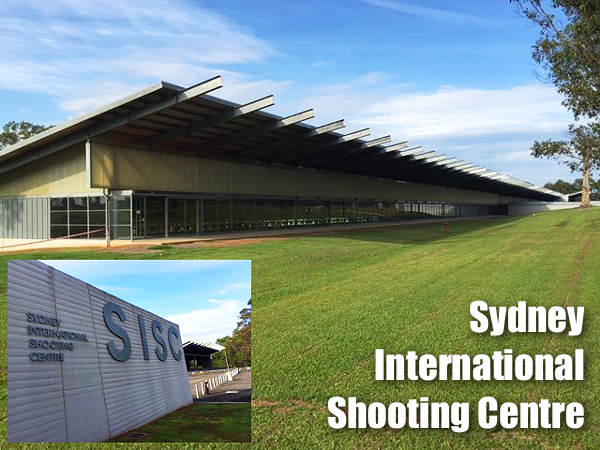
Here’s the modern Sydney International Shooting Centre…
Benchrest legend Tony Boyer finished fifth overall in the individual standings.
Congratulations to USA Team 2, which won the “battle of the nations” at the World Benchrest Championship. Team 2 members are: Lester Bruno, Wayne Campbell, Larry Costa, and Billy Stevens. Wayne Campbell also won the individual Championship, earning him the title of 2015 World Benchrest Champion. Wayne is now officially the best point-blank benchrester on the planet! We wish to acknowledge all the many competitors, from 24 nations, who attended this prestigious event.
Penalties and DQs
Other USA Teams might have finished in the top five, but there were some major mishaps at this event. USA Team 1 suffered a big penalty because of a 5-shot cross-fire at 200 yards. USA Team 3 was disqualified from the event due to a late shot after the “Cease Fire” command (DQ details below).
Here’s how the Teams Match ended up. USA Team 2 finished first, followed by three Australian squads, with Canada Team 1 finishing fifth:
1. USA Team 2 – 0.2230 MOA
2. Australia Team 1 – 0.2441
3. Australia Team 3 – 0.2463
4. Australia Team 2 – 0.2635
5. Canada Team 1 – 0.2678
Wayne Campbell Wins WBC with 0.1866 Agg
But who is the individual World Benchrest Champion? That would be American Team member Wayne Campbell — a very popular result. Wayne shot a remarkable 0.1866 MOA Agg over the four-day event, combining 100- and 200-yard LV and HV matches. That shows you how accurate today’s Benchrest rifles can be (and the skill of the top shooters). Here are the top five individuals, all of whom Agg’d under 0.2100:
1. Wayne Campbell (USA) – 0.1866 MOA
2. Gene Bukys (USA) – 0.1973
3. Murray Hicks (Australia) – 0.2062
4. Larry Costa (USA) – 0.2087
5. Tony Boyer (USA) – 0.2095
The USA took four out of the Top Five individual spots. Living legend Tony Boyer proved he’s still got his stuff. Tony finished just .0033 off the podium, which saw Boyer protege Wayne Campbell in 1st place, Gene Bukys in second, and Australian Murray Hicks in third. The best of the two Great Britain Teams finished in 13th spot (out of 24 teams) with a 0.2998 MOA Agg. Top individual Brit was Bruce Lenton in 31st place with a very creditable 0.2666 MOA Agg.
Shooters from 24 nations competed at the 2015 World Benchrest Championship. Here Alexander Skuratov from Russia prepares ammo for a match.
DAY Four (Friday) Match Report
The fabulous St Louis weather was with us again for the last day and this is the first World Championship I can remember that didn’t have rain! Facilities at this fabulous Benchrest range are second to none and the event has run like the proverbial clockwork. That is a credit to the Club and its helpers and officials who have worked tirelessly for two weeks, as of course the NBRSA Nationals preceded the 2015 WBC.
Today, on the final day, Heavy Varmint rifles shot at 200 yards. Winds were again light, except for the odd relay but the top shooters again banged in those itty-bitty groups that the rest of us can only dream about. Just one non-American managed to sneak into the top five:
Friday Results, 200-Yard Heavy Varmint
1. Wayne Campbell (USA) – 0.1866 MOA
2. Gene Bukys (USA) – 0.1973
3. Murray Hicks (Australia) 0.2062
4. Larry Costa (USA) – 0.2087
5. Tony Boyer (USA) – 0.2095
Thursday DQ Drama — Disqualification and Penalty for American Teams
On Thursday, we had drama when one of the three USA Teams suffered a ten-inch penalty but such is the strength of American Benchrest that USA Team 1 members fought themselves back into contention. The ten-inch penalty was given when a USA Team 1 shooter fired all five shots on the wrong target at 200 yards. But, just as things were looking possible for an American 1, 2, 3 sweep, yet more drama occurred with the disqualification of USA Team 3! That’s right, the entire team was DQ’d as the result of a safety breach. Apparently, a USA Team 3 shooter fired AFTER the “Cease fire” command. That serious rule violation caused the disqualification.
Our Aussie friend Stuart Elliot of BRT Shooters Supply recently filmed some interesting videos at the QTS range in Brisbane, Australia. Stuart told us: “I was shooting in an Air Gun Benchrest match here in Brisbane, Australia. I finished my target early and was awaiting the cease fire and took a short, slow-motion video of windflag behavior.” You may be surprised by the velocity changes and angle swings that occur, even over a relatively short distance (just 25 meters from bench to target).
Here are windflags in slow motion:
The flags show in the videos are “Aussie Wind Flags”, developed by Stuart Elliot. These are sold in the USA by Butch Lambert, through Shadetree Engineering.
Here’s a true “Blast from the Past”, a video featuring our friend Stuart Elliott of Brisbane, Australia. This 2011 video has now racked up nearly 680,000 views, making it probably the most-watched long-range benchrest video ever uploaded to YouTube. The video shows Stuart shooting a 10-shot Heavy Gun string at the Brisbane range, Queensland, Australia, in July 2011. In this example, Stuart elected to “run a condition” with his big, .300 WM Heavy Gun, shooting fast with slight hold-off adjustments as the wind increased during the string. The cartridge is a .300 Winchester Magnum, loaded with moly-coated 190gr Berger VLDs. Stuart has an unusual bolt configuration. After each shot, Stuart removes the bolt completely with his right hand, and then uses the bolt to “shuck” the fired cartridge while loading the new cartridge with his left hand. That sounds awkward, but Stuart makes it all look easy. Stuart runs BRT Shooters Supply, a leading vendor of precision shooting equipment (including March scopes), in Australia and nearby regions.
Ben Emms of Australia won the U.S. Fullbore Championship with an 891-114V score. One point back, Nancy Tompkins finished second, earning the Silver Medal with 890-105V. Michigander Charles Hayes won the F-TR division with 807-34V.
For the “slings and irons” Target Rifle competitors, the individual championship came down to a ten-person Shoot-Off. Americans fared well. Along with Tompkins’ second-place finish, Kelly Bachand placed fifth, Trudie Fay was eighth, Steven Powell finished ninth, and SSG Shane Barnhardt was tenth. Overall, that was a great showing by Americans. This bodes well for the 2015 Fullbore World Championship at Camp Perry.
Today the Fullbore Championships conclude with Palma Team matches. The top shooters are on the firing line, doing their best for their teams and respective countries.
Annette Wachter, aka “30 Cal Gal” offers this report from yesterday: “Here is my Award for most awesome team shirt. Saturday was a crazy morning. I got into position to shoot and there was zero wind. But by the time I took a shot it went to 11 minutes! I Got blown off the target twice. Had to laugh. Nothing I could do. I held great elevation though.”
Competitor’s Report from Kelly Bachand, Kelly’s Gun Sales
Well it all turned out pretty darn well. I was in 7th place in the grand aggregate at the beginning of the day. After the first match of the day I dropped to 10th, and after shooting one of the best strings I’ve ever shot in my life I moved up to 3rd! I then shot in the Top 10 Shoot-Off to determine the final standing and I ended up 5th overall. I’m really quite pleased with this result and I feel very blessed.
Click No Bang — You Have to Load the Rifle!
Going into the final string at 1000 yards I felt myself starting to get a little worked up. I stopped and prayed and really worked at calming myself down. I got in position and got ready to shoot, loaded my first round, made my wind call and took the shot. “Click”. It didn’t go off and worse still I jerked the heck out of the trigger. It’s odd that it didn’t go off, but it happens once in a while, I usually just cock the rifle again and the round goes off on the second try. I line up the sights again, “Click”. Yikes! I jerked the trigger again and there must be something wrong with my rifle! I pull the bolt back and check the end cap, it’s not loose, so I go to eject the round to inspect it and I discover that I never loaded the rifle to begin with! That really calmed me down, quite a lot. I was almost laughing at myself on the line.
Reading the Wind
After the embarassing “click no bang” sequence, I picked an indicator — there was a flag almost pointing at me, and I used it to judge the angle changes. I watched other flags and the mirage for velocity changes and I tried my best to break good shots, and it worked. It was as if God helped me break the right shots at the right time. On a number of occasions I took a shot I called on one side or the other and the wind had either picked up or let off in such a way that if I hadn’t shot it exactly where I did then I would have lost points (calling a shot is just guessing where the shot will be based on how it felt and what it looked like when the gun went off). It was awesome. I ended up with a 75-8V, one of only five 75s that were shot on that string. This means that in 10-15 mph crosswinds, from 1000 yards away, with iron sights, and supported by a sling, I kept 15 consecutive shots inside an area less than two feet across with more than half of them in an area less than one foot across.
The Top 10 Shoot-Off
Since this match is a dress rehearsal for the World Long Range Championships next year there is then a shoot off among the top 10 scoring competitors. Fifteen more shots at 1000 yards and the score from that additional string is added to each shooter’s running total. The overall winner is the one with the most points.
During the Shoot-Off, the wind had picked up a little more, but not much. The biggest challenge I had was that the wind had such a speed that even from prone and with a sling the rifle was no longer steady. Instead the rifle sights were bouncing around as if I was shooting standing. So it was no longer good enough to simply have a good handle on the wind, we now also needed to squeeze the shot off at precisely the right moment. Needless to say some shooters excelled and some did not. Nancy Tompkins impressed everyone present by shooting a 75-7V in these conditions. I had a 70-4V which moved me from 3rd place to 5th place overall.
So I just got 5th place in the U.S. Fullbore Nationals and I’m honestly quite blown away by that result. There were some of the best shooters in the world present. Some of the other countries brought the same shooters who will compete next year in the World Long Range Championships — they were here. This also served as a try-out session for the U.S. Palma Team so many of the best shooters from the USA were present and competing. And then there is me. I’ve shot just two matches this year: a local 1000 yard match back home, and these Nationals. I practiced about half a dozen times and usually at less than 200 yards before coming to Nationals. Yet, despite the many reasons I shouldn’t have done well here, God saw fit to bless me and helped me to shoot very well.
Australian long-range shooter Meichelle K. has customized her gear in a distinctive way. Meichelle hails from a small town called Jimboomba which means “place of loud thunder” in the aboriginal language. Yes indeed, that sounds appropriate for a rifle shooter. We smiled at the “feminine touches” Meichelle applied to her new SEB Bigfoot rear bag. This displays real creativity — and now no one will ever mistake Meichelle’s bag for one belonging to another shooter.
Meichelle regularly shoots F-Class in Australia. She has traveled extensively to compete in major matches. Here is a photo from one of her favorite ranges in Australia. Looks like a beautiful place to shoot. And we love the printed fabric on the range cart! Kisses from Down Under.
Jimboomba — Place of Loud Thunder and Little Rain
Meichelle resides in Jimboomba, a small township located south of Brisbane in Queensland. Jimboomba is named after a sheep and livestock station based where the township is today. The word Jimboomba (originally Gimboomba) is a Gugingin word meaning “place of loud thunder and little rain”. The Gugingin were the first native Australian peoples of this Yugambeh region, now part of Queensland.
We recently wrote about a spectacular 2.6872″ ten-shot group shot at 1000 yards in Montana. Well Australian Peter Varley recently turned in another amazing group at 1000 yards — this time 2.010″ for FIVE shots. And he did it with a borrowed gun! That’s not the smallest 1K group ever shot on the planet*, but it’s still an Australian and (we believe) a Southern Hemisphere record. Varley shot the 2.010″ group with a borrowed 17-lb Light Gun at a Canberra Rifle Club match in March of this year. Congrats to Peter for his outstanding shooting. And “hats off” to fellow Queenslander John McQuire, who loaned Peter the rifle.
Shown below is Peter Varley with his target, plus a close-up. You’ll note that two of the five (5) shots go through a paster. You’ll find pasters all over these targets because the Canberra Club “recycles” these large 1K targets many times.
Peter reports: This was shot at a 1000-yard match on the Canberra Rifle Range on Sunday, March 9, 2014. I traveled 1300 kilometers (807 miles) from Nambour (Sunshine Coast) Queensland to Canberra in the Australian Capital Territory.
I had left my rifle case keys at the motel and resigned myself to target butts duty or a lazy day. A friend, John McQuire from Mackay (Central Queensland Coast) said: “Get my 6.5 x 47 out, clean up, and you’re in the first detail (relay)”. So it was a borrowed gun for the shoot. The match commenced around 9:00 am. Conditions were very good — winds were very light with no mirage to speak of. Everything fell into place.”
Gun Specifications: Lawton 7500 action with Jewell trigger, PacNor barrel chambered for 6.5×47 Lapua, home-made custom stock, March 10-60x scope
6.5x47L Load: Lapua 123gr Scenars, with CCI 450 primers and Varget (ADI 2208) powder.
*The current NBRSA Light Gun 1000 Yard 5-shot group record is 1.473″ by Bill Schrader in 2002. Tom Sarver is credited with an even smaller 5-shot IBS Light Gun record.
There was “Thunder Down-Under” last week at the 2013 World Benchrest Championships (WBC 2013) in Australia. The event was held at the Silverdale Range, a 1.5 hour-drive west of Sydney, NSW. This event drew roughly 80 of the world’s best 100/200 yard Benchrest group shooters who competed both individually and on national teams. Squads from Australia, Canada, Finland, Italy, New Zealand, Russia, South Africa, the United Kingdom, and the USA vied for WBC team honors. Both Australia and the United States fielded three teams, while New Zealand and South Africa each fielded two squads.
Conditions were vicious at times, with extremely high winds in a few relays. To show you how tough things were, legendary shooter Tony Boyer had a 1.560″ group during the LV 200-yard match, while Tom Libby shot a shocking 2.280″ group in the same relay. We can’t remember when we’ve ever seen groups like that posted by shooters of this skill level.
In team competition, the strong USA ‘A-Team’ finished first followed by South Africa A (second place) and Australia A (third place). Ed Adams, Tony Boyer, Gene Bukys, and Bob Scarbrough Jr. were the members of the winning USA A-Team.
In individual competition, Americans finished 1-2-3 in the Two-Gun. Texan Charles Huckeba topped the field, winning the Two-Gun Overall with a 0.2804 Grand Agg. Gene Bukys (0.2863) was second, and Bob Scarbrough Jr. (0.2881) finished third. In fourth place overall was South African Roland Thomsen (0.2919), while New Zealander Peter Haxell (0.2940) finished fifth. The top five for each of the LV and HV yardages are listed below.
Complete WBC 2013 Results have been posted on the Australian Benchrest Bulletin website. Scroll down and look for the blue “Latest Stuff” tab on the lower left. There you’ll find links for WBC 2013 events under the “Latest Results” header.
Light Varmint Grand Agg
1. Gene Bukys (USA-A) .2796
2. Todd Tyler (USA-C) .2817
3. Roland Thomsen (SA-A) .2952
4. Peter Haxell (NZ-A) .2971
5. Jan Hemmes (SA-A) .3024
Light Varmint 200 Yards
1. Jan Hemmes (SA-A) .2939
2. Gert Le Roes (SA-B) .2962
3. Roland Thomsen (SA-A) .2978
4. Gene Bukys (USA-A) .3106
5. Todd Tyler (USA-C) .3375
Heavy Varmint Grand Agg
1. Ivan Piani (ITA-A) .2389
2. Bob Scarbrough (USA-A) .2399
3. Ch. Huckeba (USA-C) .2424
4. Tony Boyer (USA-A) .2520
5. Ed Adams (USA-A) .2781
Heavy Varmint 100 Yards
1. Tony Boyer (USA-A) .1574
2. Ch. Huckeba (USA-C) .1722
3. C. Whittleton (AUS-B) .1872
4. Wyn. Campbell (USA-B) .1874
5. Bob Scarbrough (USA-A) .1900
Heavy Varmint 200 Yards
1. Ivan Piani (ITA-A) .2786
2. Ed Adams (USA-A) .2869
3. Bob Scarbrough (USA-A) .2897
4. Ch. Huckeba (USA-C) .3126
5. Jari Laulumaa (FIN-A) .3168
Photos by Todd Tyler, Tom Libby, and Scott Pieper, provided courtesy Aaron French.
The F-Class World Championships wrapped up yesterday at Raton. This was the biggest F-Class Worlds ever, and the level of competition was higher than ever before. But the World Championships were not just about wind calls and V-Counts. The event was also about camaraderie. All those who participated made new friends from around the globe. In the end, this event was about fellowship, and the bond of shared challenges with fellow shooters. No matter what the tally on the team score-card, everyone who participated in the World Championships came home a winner — a winner in the game of life.
Two Aussies Share the Joy of Victory…
Team F-TR USA Members Ham it Up After Winning F-TR World Championship.
The U.S. F-Open National Team on its Way to the Silver Medal.
Tough Guys Jim Crofts, Paul Phillips, and Brad Sauve Helped Carry Team USA to Victory.
Team Canada at the 1000-yard Line. Canada Hosts the next F-Class Worlds in Ottawa, 2017.
2013 World Individual F-Class Champion Kenny Adams Shooting in Team Mode.
Past NRA President John Sigler with his Wife. John is an Avid F-Class Shooter Himself.
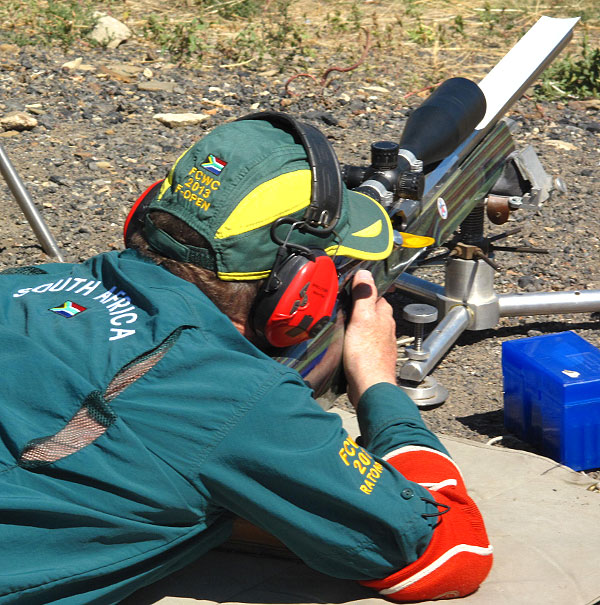
South African F-Open Shooter Hard at Work.
Our British Friends Russell Simmonds and Laurie Holland — both Forum Members.
Spanish Team Genius at work — Farley Rest Bolted to a Truck Brake Rotor. Rock Solid.
Team F-TR USA Captain Darrell Buell with the Superb New Nightforce Spotting Scope.
Two Young Ladies on the Junior F-TR Team Enjoyed the Event.
Team Ireland Proudly Shows the Colors. Erin Go Bragh!
Forum Boss and Raton Range Boss Watch the Action on Day 2.
Editor’s Note: If I learned one unforgettable lesson from this match, it is that we shooters have a common bond that spans oceans and crosses national borders. We truly are a brotherhood of riflemen who share a passion for a challenging and rewarding sport.
I want to thank all the many people who came up to me and said “Thanks for the website — keep doing what you’re doing — it’s important”. I heard that message from Brits, Aussies, Spaniards, South Africans, Germans, Kiwis, Italians, Brazilians, Ukrainians, Irelanders, and of course my fellow Americans. Thank you all for your kind words. Rest assured, we’ll do our best to “keep the faith” in the years ahead.
Top marksmen from around the world battled for national honors today during Day 1 of the F-Class Team World Championships. F-Open and F-TR teams from many countries were decked out in their national colors. We saw squads from Australia, Brazil, Canada, Great Britain, Ireland, Italy, New Zealand, South Africa, Ukraine, and the USA. Other nations were represented as well.
Along with the basic two divisions, F-Open and F-TR, there are separate classifications for 4-man squads and the big 8-member National Teams. One Junior team from the USA is also competing. Right now the 8-man USA F-TR squad has a commanding lead. The talent-laden USA 8-man F-Open squad sits in second place, just three points behind the surprisingly strong Australian squad. But there are hundreds of record rounds left to fire tomorrow, and USA F-Open team members hope to move into the top slot on Day 2. Scroll down the page for a video interview with USA F-Open Team Captain Shiraz Balolia.
More than once in today’s matches dust devils appeared on the range. During the 1000-yard match a large swirling dust cloud formed dead center on the range. We heard coach Mid Tompkins call to his shooters: “Whoa – Whoa, stop firing, stop everything”. Mid told us: “When you have dust devils like that, you have to stop — you can’t out-guess it and you may not even be able to see the target.”
Interview with USA F-Open Team Captain Shiraz Balolia
Many of the top teams are using “comm packages” with microphones and headsets. This allows the coaches to communicate with each other, conferring on observations and wind calls. Wireless communicators are not allowed, so cords are strung between the coaching stations.



 1. USA Team 2 – 0.2230 MOA


 Ben Emms of Australia won the U.S. Fullbore Championship with an 891-114V score. One point back, Nancy Tompkins finished second, earning the Silver Medal with 890-105V. Michigander Charles Hayes won the F-TR division with 807-34V.




 Top marksmen from around the world battled for national honors today during Day 1 of the F-Class Team World Championships. F-Open and F-TR teams from many countries were decked out in their national colors. We saw squads from Australia, Brazil, Canada, Great Britain, Ireland, Italy, New Zealand, South Africa, Ukraine, and the USA. Other nations were represented as well.


