At SHOT Show, we had the chance to meet with German software engineer Hartmut Broemel, creator of QuickLOAD software. This software program, while not a substitute for conventional load manuals, allows shooters to evaluate a wide range of powders and bullets, comparing potential loads on the basis of predicted pressures, velocities, load density and projectile in-barrel time.
We took the opportunity, in the video below, to explain some of the fine points of QuickLOAD for our members. QuickLOAD, sold by Neconos.com, helps reloaders understand how changing variables can affect pressures and velocities. It can predict the effect of changes in ambient temperature, bullet seating depth, and barrel length.
In the video below we explain how to adjust the program for true case capacity, bullet seating into the lands, and other important factors. If you are a new QuickLOAD user, or are contemplating buying the $152.95 program, you should watch the video. The program isn’t perfect, but it can accelerate the load development process, and it can save you money by narrowing down the list of appropriate powders for your cartridge.
No other product currently available to serious reloaders offers as much predictive power as QuickLOAD, and you’ll find your money well spent just for the vast collection of data on bullets and cartridges. With a couple mouse-clicks you can instantly get the specifications of hundreds of bullets and cartridges. Likewise, in a matter of seconds, you can compare load density for a half-dozen powders, or compare the projected velocities of one cartridge versus another.
Here’s something that can save you lots of time and aggravation on a varminting trip. This little $110 gizmo is great for varmint hunters and any one who needs to make a quick shot in shifty wind conditions. Instead of the traditional 1/4-MOA hash marks, the Kenton windage turret features markers corresponding to the wind drift your ammo will encounter at various distances (with 10 mph full value winds). You just dial the distance.
Custom-Calibrated Windage Knobs
Kenton Industries’ Tuned Windage Compensator (TWC) has built-in windage marks for 10 mph cross-winds at 100-1000 yards. How do they do that? Well the knobs are calibrated either for specific calibers/loads, or they can make custom knobs using your observed field data. The knobs can compensate for various wind speeds (2-20 mph) and angles (15°- 90°), by applying some simple conversion ratios. As a general rule, with a “full-value”, i.e. 90°, crosswind, the wind drift will go up or down in direct proportion to the change in windspeed. That means, for example, a 10 mph crosswind will push the bullet twice as much sideways as a 5 mph crosswind.
Two versions of Kenton’s TWC knobs are offered. The $109.95 TWC #1 features calculated ballistics for standardized factory ammo for the caliber and barrel length you specify. The $109.95 TWC #2 feature customized windage settings based on bullet BC, environmental conditions, elevation, and ballistic information you provide.
Custom Elevation Knobs
Kenton also makes a $109.95 elevation-compensating TTC knob, that can be customized to your rifle. With this elevation turret, yardages are marked in 50-yard increments, and you can literally just “dial in your distance”. However, to work effectively the TTC knob must be tailored to a particular load (velocity and bullet). Moreover, actual bullet drop will differ with changes in altitude, temperature, and shooting angle — so it’s not as simple as it sounds, and you may need multiple knobs if you shoot a variety of loads. Kenton offers it TTC #1 model calibrated for standardized factory ammo. The TTC #2 is calibrated out to the maximum effective range of your cartridge based on bullet type, muzzle velocity, altitude, and temperature. Select the type of yardage format to be used. The #2 is recommended for wildcatters or for those who want to adjust to specific conditions. Lastly, a TTC #3 elevation knob is offered that relies on the purchaser’s actual recorded drop data from the field. The TTC #3 elevation knob will be calibrated based on the click-value or MOA you provide for each 50-yard increment.
Here’s a little known fact that may startle most readers, even experienced gunsmiths: your barrel wears out in a matter of seconds. The useful life of a typical match barrel, in terms of actual bullet-in-barrel time, is only a few seconds. How can that be, you ask? Well you need to look at the actual time that bullets spend traveling through the bore during the barrel’s useful life. (Hint: it’s not very long).
Bullet-Time-in-Barrel Calculations
If a bullet flies at 3000 fps, it will pass through a 24″ (two-foot) barrel in 1/1500th of a second. If you have a useful barrel life of 3000 rounds, that would translate to just two seconds of actual bullet-in-barrel operating time.
Ah, but it’s not that simple. Your bullet starts at zero velocity and then accelerates as it passes through the bore, so the projectile’s average velocity is not the same as the 3000 fps muzzle velocity. So how long does a centerfire bullet (with 3000 fps MV) typically stay in the bore? The answer is about .002 seconds. This number was calculated by Varmint Al, who is a really smart engineer dude who worked at the Lawrence Livermore Laboratory, a government think tank that develops neutron bombs, fusion reactors and other simple stuff.
On his Barrel Tuner page, Varmint Al figured out that the amount of time a bullet spends in a barrel during firing is under .002 seconds. Al writes: “The approximate time that it takes a 3300 fps muzzle velocity bullet to exit the barrel, assuming a constant acceleration, is 0.0011 seconds. Actual exit times would be longer since the bullet is not under constant acceleration.”
We’ll use the .002 number for our calculations here, knowing that the exact number depends on barrel length and muzzle velocity. But .002 is a good average that errs, if anything, on the side of more barrel operating life rather than less.
So, if a bullet spends .002 seconds in the barrel during each shot, and you get 3000 rounds of accurate barrel life, how much actual firing time does the barrel deliver before it loses accuracy? That’s simple math: 3000 x .002 seconds = 6 seconds.
Gone in Six Seconds. Want to Cry Now?
Six seconds. That’s how long your barrel actually functions (in terms of bullet-in-barrel shot time) before it “goes south.” Yes, we know some barrels last longer than 3000 rounds. On the other hand, plenty of .243 Win and 6.5-284 barrels lose accuracy in 1500 rounds or less. If your barrel loses accuracy at the 1500-round mark, then it only worked for three seconds! Of course, if you are shooting a “long-lived” .308 Win that goes 5000 rounds before losing accuracy, then you get a whopping TEN seconds of barrel life. Anyway you look at it, a rifle barrel has very little longevity, when you consider actual firing time.
People already lament the high cost of replacing barrels. Now that you know how short-lived barrels really are, you can complain even louder. Of course our analysis does give you even more of an excuse to buy a nice new Bartlein, Krieger, Shilen etc. barrel for that fine rifle of yours.
The popular BulletFlight Ballistics Program, is now available for Android OS smart phones and mobile devices. BulletFlight (from Knights Armament) has emerged over the past couple of years as one of the very best balllistics programs for iPhones and iPods. And now Android device users can enjoy the same functionality and features.
BulletFlight Android OS software comes in three different versions, all available through the Android Market. BulletFlight L1 (Level 1, $3.99) is a fast-running ballistics App with a host of features, including: user-selectable BC models (G1, G7, G8 etc.); output in inches, cm, MOA, Mils, and scope clicks; 360° wind drift calculation. BulletFlight includes a large database of bullet types (with weights, BCs etc.)
BulletFlight L2 (Level-2, $11.99) adds a full calculation screen where you may enter exact range and atmospheric details. The Level-2 version can also generate range-cards, perform cosine-angle calculations, handle mil-dot range estimations, and calculate impact energy, velocity, and flight time. What’s more, Level-2 offers GPS functionality so you can geo-locate your position, and/or download local weather information. The $11.99 L2 software package is what we recommend for most users.
BulletFlight L2 Screen Shots
Level M is Ideal for Ultra-Long-Range Shooting
Priced at $29.99, BulletFlight Level-M (Military) version further adds the ability to calculate an actual BC based on bullet drop, two velocities, or flight time. This can be useful if you make your own bullets, do extensive experimental work, or shoot at extreme long range. If you do regularly shoot beyond 1000 yards, BulletFlight Level-M is probably the best choice. The Level-M software factors bullet spin drift and Coriolis effect into the ballistics solution — making this a super-sophisticated tool. In addition, the Level-M software can calculate bullet stability based on MV, barrel twist rate, and bullet specs.
With all versions of BulletFlight, you can also create your own custom ammo profiles (with velocity, BC, bullet type), allowing you to easily output ballistic plots for multiple firearms, without having to enter the rifle/bullet profile each session.
Eric Stecker of Berger Bullets just revealed some details on Berger’s new 6mm 105gr Hybrid bullet. This projectile is now in the final stage of testing. Here are comparative ballistics for the new 6mm Hybrid vs. Berger’s popular 105gr VLD bullet:
6mm 105 gr Hybrid Target
Original 6mm 105 gr VLD (Now is Berger’s hunting version)
Averaged G1 BC = 0.547 G7 BC = 0.278
Averaged G1 BC = 0.532 G7 BC = 0.272
Longer Bullet Requires 1:8″ Twist
The new 105gr Hybrid Target is slightly longer than the original 105-grainer so a true 1:8″ is strongly recommended. The new bullet is made with the thicker Target jacket to withstand match shooting conditions. The Hybrid ogive is designed to be less sensitive to seating depth and has been working well in other calibers and sizes. This bullet can take all the 6mm cases can dish out and it has a BC equal to our own 6mm 115 gr VLD.
Eric Stecker tells us: “The moment we knew that we had to modify the 6mm 105gr VLD Target with a larger meplat, the need for this bullet was born. We’ve been working on it ever since. Bryan Litz has done an exceptional job with this design. I am very eager to see how they do in many rifles since I regard the 105gr class of bullets as key in Berger’s line. Between the 68gr, the 80gr and the 105gr (among other weights) we have been especially blessed with our 6mm offerings.” Eric is quite right — all those bullets shoot exceptionally well and the 105gr VLD holds many records. If the new 105gr Hybrid can come close to the accuracy of the 105gr VLD, it should be very successful.
One cannot discuss one of the most useful tools for long range shooters, The Slope Doper, without saying something about its inventor, David Rolls. David was a bold man, bigger than life, who dedicated his life to the service of others. Yet, he was full of fun and a little mischief. He had little tolerance of fools (a man after my own heart), but had great respect for those who deserved respect. It was a loss to all when he passed away in August 2008 at the young age of 61. That being said let me tell you of how he lived and what he accomplished with The Slope Doper.
David Rolls’ Background
David worked for years with the Baltimore City Fire Department as a firefighter and paramedic, retiring at 45. Not being content to sit around, he applied for a job with the Sheriff’s Department of Mineral County, West Virginia and graduated from the state police academy. No small feat for a man of any age, let alone one in his forties. David rose to the rank of Sergeant and held that rank until his passing. As a firefighter, paramedic and police officer, he was the kind of man you would want if you were in a tight spot. He never backed down when it came to helping others. Throughout his life he was active in the Boy Scouts and community activities. He was a lifetime member of the NRA holding the status of Golden Eagle and Certified Firearms Instructor.
As a shooter, David was intensely interested in tactical competitions and was a member of the American Sniper Association. Long distance tactical shooters are frequently faced with the problem of making adjustments when shooting uphill or downhill, as well as windage and normal bullet drop. Chucks Hawks provided a superb discussion of the effects of uphill/downhill shooting for the hunter. I strongly urge every reader to look up Chuck’s article to better understand the problem.
Even knowing that we will be shooting over our target (or at best higher than our aiming point), most hunters do not know how to make the required adjustments in the field. Something had to be devised that could be used quickly in the field by the average hunter. Enter David P. Rolls!
Slope Doper Debuts in 1998 at Storm Mountain
After a great deal of thought, David showed up at the Carlos N. Hathcock II Charity Sniper Competition at the Storm Mountain Training Center in 1998 with a prototype of his Slope Doper. It was somewhat crude by comparison to the current day production model, consisting of a laminated paper protractor with a weight and string, but it worked. It allowed a shooter to determine the impact point of his bullet when shooting at any angle. David had succeeded in combining the science of mathematics with the practicality required for field use. It should be noted that military shooters have used protractors for years, but they had to subtract numbers to arrive at the correct angle. Dave’s invention placed the zero degree point at the top of the arc, virtually eliminating the possibility of error. Ever the perfectionist, with an eye to the future, he asked his best friend, Fred Fischer to design a “professional” version with AutoCad, which Fred gladly did. Fred also had contacts with a manufacturer who happened to be a shooter and they were off. Fred still chuckles when he remembers all of the last minute changes that Dave came up with, but at least they had the basic artwork locked into the AutoCad program to go into production. The rest is history.
The Quantico marine sniper instructor who was the first military member to see a production version of the Slope Doper (and incidentally a member of the two-man team who won the Carlos Hathcock Sniper Competition) was impressed enough by it to remove his personal protractor from his data book and replace it with the Slope Doper David gave him. The Slope Doper is now standard issue with the Marine Corp sniper weapon system; The Slope Doper is packed with each rifle and its accessories. The pointer is easily replaceable with string and a weight if it is lost and the printing on both sides is actually fire resistant. It is mil spec and made to withstand combat conditions. It is aluminum rather than plastic, so that it will not break in cold conditions.
To understand how the Slope Doper works, it is best for me to let David tell you in his own words:
To begin with, you must understand that when you shoot up or downhill, gravity has a diminished effect on your projectile such that if you do not make any adjustment for angle, you will likely shoot over your target. This applies at long distances (greater than 300 yards) at slight angles and at severe angles (greater than 30 degrees) at lesser distances. With slight angles at short distances the adjustment may not be enough to worry about. The Slope Doper is a photo etched, anodized, aluminum plate that has two scales inscribed along an arc. The first scale tells you the angle in degrees, the inner scale gives you the cosine of the angle (what I call the “Slope Angle Factor”) at 10 degree intervals.
To use the Slope Doper, you must first know the range to your target. Next you have your partner (guide) hold the Slope Doper along side the bore centerline of your rifle while you take aim and read the Slope Angle Factor. If you are alone, you can sight your target along the top edge of the Slope Doper and capture the pointer with your thumb and then read the Slope Angle Factor. If you are not at an exact Slope Angle Factor, it is easy to interpolate. Now take the known distance and multiply that by the Slope Angle Factor. The answer you get is the effective range. You should now shoot as if the actual distance is the lesser distance (at 30 degrees, a Slope Angle Factor of 0.87, 500 yards becomes 435 yards). All other environmental factors, like wind, are still in effect at the actual distance (500 yards of wind is still 500 yards of wind).
To make my life easier, I attached some Velcro to the back of my Slope Doper and on the forend of my rifle. After using my rangefinder for distance, I simply point my rifle at the target, capture the pointer with my thumb, read the Slope Angle Factor, make a quick mental calculation and shoot. If you are an experienced shooter with a scope that has a mil dot reticule, the back of the slope doper has your ranging formulas. The Slope Doper is a must-have for every person who hunts in mountainous country, from the Appalachians to the Rockies. It will help prevent you from missing your quarry. It is a bargain when compared to the $300 – $500 we pay for our rangefinders and binoculars. You can purchase the Slope Doper directly from the Slope Doper Website for $24.95 plus $5.00 shipping (PayPal or mail-order). U.S. Tactical Supply also sells the Slope Doper for $24.95.
A final note: I was watching the Outdoor Channel last week and watched a hunter on a ridge shoot over a 6×6 bull elk in the valley below. The elk disappeared, and the show ended with the hunter and guide talking about the thrill of the chase, even though they missed the elk. Good for public relations, but not so good for the freezer. They should have had The Slope Doper!
Ultra-Long-Range Shooting by Bryan Litz
We recently did some extended long range shooting with several rifles at a “secret range” where we could shoot out to one mile. I teamed up with Paul Philips, a highly successful National and International F-TR shooter with several National records. We started out shooting a Sako TRG-42 at 1200 yards. This is the same rifle I shot in Wyoming last year at distances out to 2400 yards. This rifle shoots the new Berger 300gr Hybrids, at 2700 fps. We were pleased to find that the Nightforce NXS 5.5-22x56mm scope has plenty of elevation to get to 1200 yards with this bullet, especially when mounted on a Near Mfg. +45 MOA rail. The drop from a 100-yard zero to 1200 yards was predicted to be 34.75 MOA. The size of that 5-shot group was nothing to brag about (1.5 MOA), but what I found satisfying is that the group center was exactly centered for vertical on the target. That means the calculated .418 G7 BC and all of the other variables that went into this trajectory prediction were spot on.
New .30-Cal Tactical Bullets
Next, we shot the LaRue 7.62 OBR rifle at 1200 yards. This rifle produced a 5-shot group of 9.7″ (.85 MOA) with off-the-shelf Applied Ballistics Tactical ammo loaded with .30-cal 175gr Berger Tactical bullets. These bullets only have a muzzle velocity of 2572 fps from this short barrel, which means that in our conditions they were subsonic past 1000 yards, running 1080 fps at 1200 yard. Going subsonic didn’t prevent the 175gr bullets from shooting a sub-MOA group.
However, I was a little disappointed that the group center was 9″ high (0.8 MOA) compared to the predicted trajectory (657″ drop from a 100-yard zero). Note this 9″ error in predicted drop could be produced by small variances. The 9″ shift could be explained by a 14 fps error in muzzle velocity, or a 2% error in bullet BC, or a 5-yard error in range measurement.
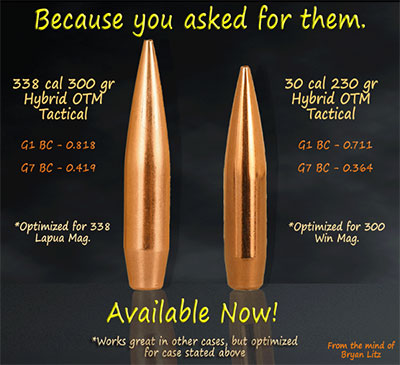
For our final test, I shot Berger’s newest Tactical bullet; the .30-caliber 230gr OTM projectile. This bullet has a tested G7 BC of .368, and a G1 BC of .719. Now this isn’t my most accurate rifle and I haven’t had an opportunity to really work up a good load. As a result, I shot an unimpressive 20″ group (1.8 MOA). But the predicted drop was only off by 2″ (less than 1 click) based on the BC’s listed above.
Shooting .338 Lapua Magnums at One Mile
After shooting at 1200, we lobbed some bullets on an 8’x8′ target at 1760 yards (1 mile). At this range, the TRG-42 put the 300gr Bergers on target with four of five shots in 1/2 MOA with a flyer to make the total group 21″. At this range my group center was 18.5″ (1.1 MOA) higher than predicted. Paul Philips* shot his custom .338 Lapua Magnum rifle. This is a Dave Tooley-built Tac-338 with 30″ Brux barrel, Stiller action, McMillan A-5 stock, and Nightforce NXS 12-42×56. Paul shot at the same target and was able to hold between 1/2 and 1 MOA groups with the same 300gr Berger Hybrid bullets. Paul’s group centers were also about 1 MOA higher than predicted. This small error in prediction isn’t very troubling though, as we’re not entirely confident in the range measurement. As 1760 yards (one mile) is too far for a direct laser rangefinder measurement, the distance was determined with a combination of GPS and Google maps. At that distance, a range error of just 15 yards (out of 1760) could cause the percieved 1 MOA error in predicted drop. So, if the target were really at 1745 yards, instead of 1760 yards, it would explain why we were hitting 1 MOA high. Alternatively, if BC error were the reason for hitting high, it would suggest the G7 BC for the .338-cal 300gr Berger Hybrid is .427, as opposed to the currently advertised .418; a 2% difference.
The Joy of Ultra-Long-Range Shooting
For me, the thrill of shooting these extreme long ranges isn’t just about the group sizes, but the accuracy with which the trajectory can be predicted. The shooter who understands ballistics and inputs the right variables should be able to center a 1.5 MOA group well past 1000 yards. He can be more effective, on targets at extreme ranges, than someone who can shoot an 0.5 MOA group but can’t keep it centered. Of course the most impressive of all is the shooter who can combine precision with accuracy and center the 0.5 MOA group at extreme distances!
Bryan Litz, Ballistician for Berger Bullets and author of Applied Ballistics for Long Range Shooting, has tested the latest version of the Shooter Ballistics Calculator for Android™ OS Smartphones and portable devices. This is a very sophisticated, full featured App that incorporates the latest bullet databases with Litz G7 BCs as well as a wealth of other information. It provides extremely reliable ballistics solutions at all ranges, and in all atmospheric conditions.
Bryan tells us: “The Shooter App has been improving steadily since it was first released and there are many new capabilities now. One of the cool new features is a wireless Bluetooth link to Kestrel Weather Trackers. This can automatically provide the exact atmospherics at your location.”
Bryan used the Shooter App on a trip to Wyoming: “I shot a Sako TRG42 in .338 Lapua Mag to 2400 yards with Berger’s new 300gr hybrids. The dope from the Shooter App was spot on up to 103 MOA of drop using the G7 BC of .419 for that bullet! At 2400 yards, even at 6,000 ft+ elevation, the bullet is subsonic but remained stable and tracked perfectly with the predicted trajectory from Shooter. I don’t know if the same bullet would be stable at sea level when fired at that range or not but it worked well at 6,500 feet.”
Litz Says Shooter App Offers Very Sophisticated Ballistics Solutions
Bryan thinks the Shooter App is extremely accurate: “I consulted on the solver development for Shooter so I can personally vouch for the accuracy of this program. You can set up profiles for rifles and ammo types including calibration factors for scope adjustments, temperature affects on powder burn rate / muzzle velocity, and of course G1 and G7 referenced BCs (you can define a ‘stepped’ BC for both as well). You can set preferences for units, atmospherics, station pressure or altitude, and more. It can calculate spin drift and Coriolis effect, or those features can be disabled. If your smartphone has GPS, the program can automatically populate the latitude for Coriolis calculations.”
Shooter App is just $9.99 — A Bargain Given Its Capabilities
The full-featured Shooter App sells for $9.99 in the Android Apps Marketplace. Visit the Shooter App Website to preview the program’s functions and see how the entry screens work. The App is easy to install and run. There is a also a ‘Lite’ version of SHOOTER that you can download for free.
In this article, Bryan analyzes the design of long-range bullets, from .22 to .30 caliber. He notes that while 30-caliber bullets can have very high ballistic coefficients, 30-caliber bullets must be very heavy to match the BCs of the 6.5mm and 7mm projectiles. As the chart below shows, it takes a 240gr 30-caliber bullet to match the G7 BC of a 180gr 7mm VLD. But most 30-caliber shooters don’t use those ultra-heavy projectiles because the recoil is excessive and because it takes a monster cartridge burning lots of powder to drive 240-grainers to optimal velocities. Litz notes: “Heavy recoiling rifles are harder to shoot accurately. Even if a shooter overcomes the mental aspect of heavy recoil, the ‘system’ is more sensitive to minor imperfections in shot execution. This may be another reason that drives .30 cal shooters down to the ‘middleweight’ 190-grain class bullets instead of the proportionally heavy 220-240 grain bullets.”
Litz concludes that the heavy 7mm bullets are a better choice than the biggest 30-calibers (except in unlimited weight “heavy guns” where recoil is not a factor.) Bryan writes: “Even a moderate 7mm chambering is capable of delivering 2800 to 3000 fps with the heavy 7mm bullets, much faster with magnums. The heaviest .30 cal bullet requires a big magnum just to get to 2800 fps. So the first problem is: you can’t get the heavy .30 cal bullets going as fast as the heavy 7mm bullets! Even if you could get the same muzzle velocities from the heavy .30 cal bullets, it would take much more powder to do it, barrel life would suffer, and you’ve only achieved parity with the 7mm. The various negative effects of the incredible recoil are really just the ‘nail in the coffin’ for the heavy .30 caliber bullets.”
Bryan’s Updated Second Edition Ballistics Book
If you are interested in learning more about bullet design and ballistics, check out Bryan’s book, Applied Ballistics for Long Range Shooting. This highly-respected resource, now in its second edition, includes experimentally-measured Ballistic Coefficient (BC) data for over 236 long range bullets of various makes. The new edition of Applied Ballistics was upsized to 7″x10″ and Bryan added two new chapters, while updating the existing chapters. Bryan’s book comes complete with a CD containing Version 2.0 of the Point Mass Ballistics Solver. CLICK HERE to order Litz’s book and CD for $49.95.
Norma has updated and enhanced its website at www.norma.cc/en/ (the ‘en’ is for English version). Among the many new site features is Norma’s “Ammo Academy”, a technical resource that provides information on: Ballistics, Powder Storage, Barrel Wear, and Bullet Expansion. In addition, the Ammo Academy now links to Norma’s Reloading Data Center, where you’ll find loads for nearly 70 cartridge types including: .223 Rem, .22-250, 6mmBR Norma, 6XC, 260 Rem, 6.5-284, 6.5×55, 7mm-08, .270 Win, .284 Win, .308 Win, .30-06, 300 Win Mag, .338 Lapua Mag and dozens more.
The Ammo Academy’s Ballistics section contains some fascinating technical facts:
After the trigger is pulled, it takes around 0.005 seconds before the firing pin reaches the primer.
From the firing of the primer it takes 0.0015-0.002 seconds until the bullet exits the muzzle.
When the bullet leaves the muzzle, the hot gases surround and overtake the bullet, continuing the acceleration for a few centimeters.
Because the barrel is always angled slightly upwards, the bullet’s flight starts about 3-5 cm below the line of sight.
Norma also offers some good advice about Powder and Cartridge Storage:
To maintain the product quality for as long as possible, you have to keep the powder in a suitable place under suitable conditions. Where possible, store the powder at a constant temperature, ideally between 12 and 15°C (54°F to 59°F), and a relative humidity of 40–50%. If the air is too dry, it will dry out the powder, which will cause the pressure to be higher, thus affecting performance. Also make sure that you close the powder container properly afterwards. Cartridges should be stored under the same ambient conditions to maintain their quality.


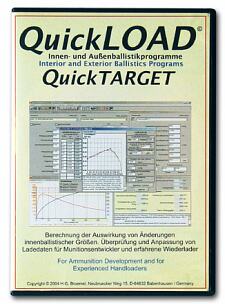 At SHOT Show, we had the chance to meet with German software engineer Hartmut Broemel, creator of QuickLOAD software. This software program, while not a substitute for conventional load manuals, allows shooters to evaluate a wide range of powders and bullets, comparing potential loads on the basis of predicted pressures, velocities, load density and projectile in-barrel time.
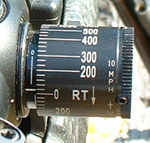 Here’s something that can save you lots of time and aggravation on a varminting trip. This little $110 gizmo is great for varmint hunters and any one who needs to make a quick shot in shifty wind conditions. Instead of the traditional 1/4-MOA hash marks, the Kenton windage turret features markers corresponding to the wind drift your ammo will encounter at various distances (with 10 mph full value winds). You just dial the distance.
 Gone in Six Seconds. Want to Cry Now?

 Longer Bullet Requires 1:8″ Twist
 One cannot discuss one of the most useful tools for long range shooters,

 New .30-Cal Tactical Bullets

 Bryan tells us: “The


 Litz concludes that the heavy 7mm bullets are a better choice than the biggest 30-calibers (except in unlimited weight “heavy guns” where recoil is not a factor.) Bryan writes: “Even a moderate 7mm chambering is capable of delivering 2800 to 3000 fps with the heavy 7mm bullets, much faster with magnums. The heaviest .30 cal bullet requires a big magnum just to get to 2800 fps. So the first problem is: you can’t get the heavy .30 cal bullets going as fast as the heavy 7mm bullets! Even if you could get the same muzzle velocities from the heavy .30 cal bullets, it would take much more powder to do it, barrel life would suffer, and you’ve only achieved parity with the 7mm. The various negative effects of the incredible recoil are really just the ‘nail in the coffin’ for the heavy .30 caliber bullets.”


