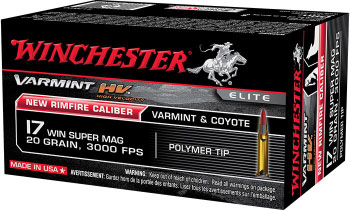
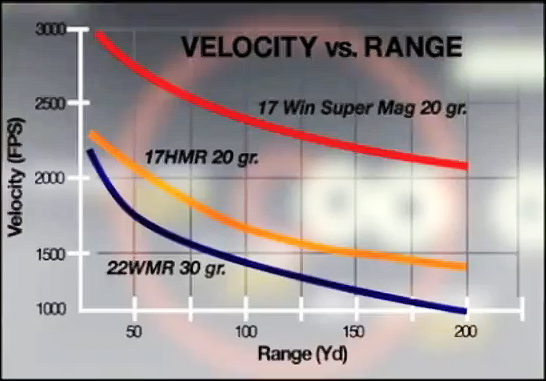
New 3000 FPS Rimfire Round Winchester has announced a new, high-velocity 17-caliber rimfire cartridge, the .17 Winchester Super Magnum (aka .17 Win Super Mag). The .17 Win Super Mag will initially be offered in three bullet types: 20gr plastic tip (Varmint HV), 25gr plastic tip (Varmint HE), and a 20gr JHP (Super-X). The 20-grain varieties boast a 3000 FPS muzzle velocity, earning honors as the fastest Rimfire ammo ever made.
.17 Winchester Super Mag Specifications
Symbol
Sub Brand
Bullet Weight
Muzzle Velocity
S17W20
Varmint HV
20-gr Plastic Tip
3,000 fps
S17W25
Varmint HE
25-gr Plastic Tip
2,600 fps
X17W20
Super-X
20-gr JHP
3,000 fps
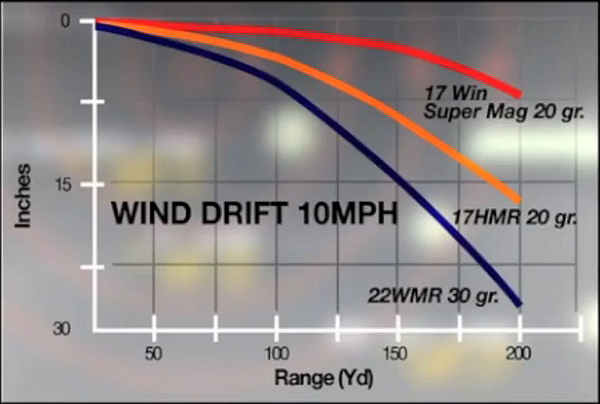
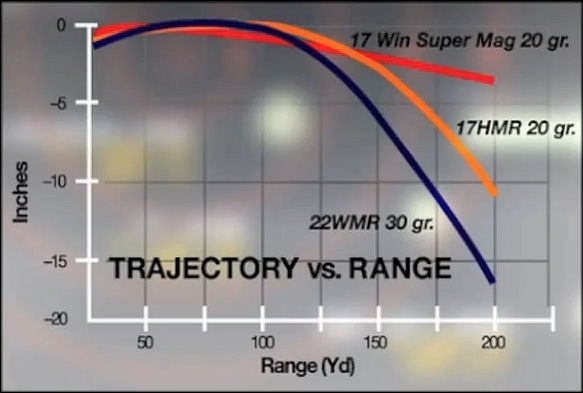
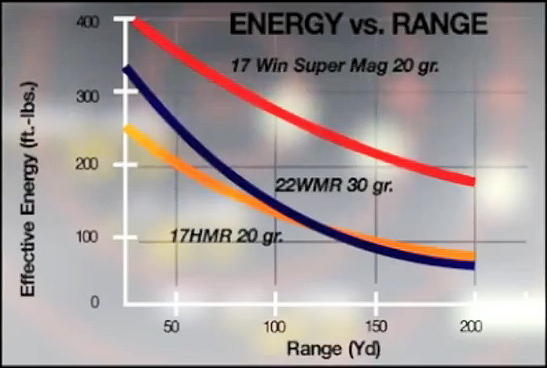
Winchester claims that all .17 Win Super Mag ammo types shoot much flatter than the .22 Win Mag and .17 HMR, while delivering more than 150 percent more energy than both. In addition, the .17 Win Super Mag “bucks the wind” better than any other rimfire ammo — exhibiting significant less horizontal drift at extended ranges. The ammunition should be available at Winchester dealers by April 2013.
Savage Will Release a .17 Win Super Mag Rifle
According to Outdoor Life’s John Snow, Savage will be the first gun-maker to produce rifles chambered in .17 Win Super Mag. Snow says Savage “hopes to have rifles shipping by mid-April”. Winchester states that, later in 2013, two other manufacturers will introduce .17 Win Super Mag rifles.
Ron Spooner writes: “For perspective, contrast the 17 Win Super Mag (no relation to the WSM centerfire cartridges) against the former rimfire velocity champ, the popular .17 Hornady Magnum Rimfire. While the 17 HMR shoots delightfully flat, the 17 Win Super Mag shoots two times flatter and drifts only half as far in the wind. Its 20-grain bullets retain more than twice as much downrange energy, and its 25-grain projectiles nearly triple the energy of the 17-grain V-Max in the HMR load”. Read Ron Spooner Review.
Watch Video Trailer for .17 Win Super Mag Rimfire Ammo
The .17 Win Super Mag offers higher velocities and more downrange energy than ever before. “Our engineers have been developing the top-secret .17 Win Super Mag [cartridge] for more than three years,” said Brett Flaugher, Winchester Ammunition vice president of sales, marketing and strategy. “At 3,000 feet per second it’s the fastest modern rimfire cartridge on the planet. The downrange energy deposited by the .17 Win Super Mag will be a game-changer for varmint and predator hunters everywhere. Now hunters will get the downrange performance of a centerfire cartridge at the more affordable price point of traditional rimfire ammunition. It’s the best of both worlds[.]”
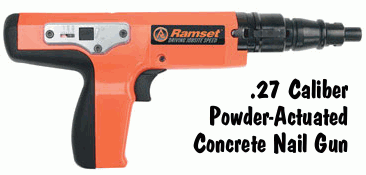
Spawn of a .27-Caliber Nail-Gun
Believe it or not, Winchester’s new .17 Win Super Mag evolved from a “parent case” originally developed for .27-caliber powder-actuated concrete nail guns. Winchester has produced millions of nail gun blanks in .22, .25, and .27 calibers. This new .17 Win Super Mag is derived from Winchester’s .27-cal nail gun blank, necked down to .17-caliber and strengthened with a thicker head and stronger case-walls. With case-walls that are 50% thicker than those on 17 HMR cartridges, the .17 Win Super Mag can operate at 33,000 psi. By contrast, the 17 HMR maxes out at 26,000 psi.
Comment: Will the .17 Win Super Mag Rimfire Round Be a Hit or a Miss?
Initial tests of the .17 Win Super Mag show good ballistic performance compared to the 17 HMR. On the other hand, early accuracy reports have been mediocre, but keep in mind that the gun magazine tests were performed with prototype rifles, on make-shift, wobbly rests (that’s typical). It will be interesting to see how the round can really perform in a good barrel when shot from a stable rest by a skilled trigger-puller.
Economics may dictate whether the .17 Win Super Mag catches on. We’re told this new cartridge will sell for $17.99 per 50-round box. That works out to $0.36 per round, making it about 40-50% more costly than the popular 17 HMR which now sells for $11.50 to $14.00 per 50-round box. At $0.36 per round, the .17 Win Super Mag may exceed the cost of 17-cal centerfire reloads, but then you have the convenience of pre-made ammo. We think that, if the cartridge proves accurate, varmint hunters will pay the extra money (over the 17 HMR) for the added performance, which is pretty significant at 150 yards and beyond. For a squirrel shooter or prairie dog hunter, the .17 Win Super Mag is still much less expensive than the cheapest US-made .223 Rem ammo, which sold for about $10 – $12 per 20-round box (i.e. $0.50 – $0.60 per round) before the current buying frenzy.
Story tip by EdLongRange. We welcome reader submissions.
Christmas Day is just one week away. Books have always been popular Xmas gifts. If you haven’t completed your holiday shopping, here are some recommended titles that should please the serious shooters and firearms enthusiasts on your shopping list. For Shooting Clubs, books also make great end-of-season member awards. Most of us would rather have a useful book than one more piece of wood to toss in a box in the closet.
Here are six recommended titles, in alphabetical order:
If you’re a serious long-range shooter you NEED this book. Since its initial release Bryan Litz’s treatise has become the definitive resource on long-range ballistics and bullet design. While Bryan covers some very advanced topics, Bryan does a very good job of making the text comprehensible to the layman. You don’t need a degree from MIT to read this work. Bryan’s book comes compete with a CD packed with ballistics software and additional reference materials. AND, Bryan includes Ballistic Coefficient data for over 236 long range bullets.
Frederick Selous was a legendary African hunter. It was for him that Tanzania’s famous Selous Game reserve was named. If you have an interest in big game hunting in Africa, you should get this book. As readers have noted, this is “Classic Africana”… “one of the very best exploration/hunting history books about Africa”. It is an excellent book, well-written and “all about hunting”. Selous’ life was full of adventure, and his book lets readers experience, vicariously, the danger and excitement of African hunting in a bygone era.
This handy reference guide contains scores of useful tips from many top shooters. However, this is NOT a load manual. Rather, it explains the techniques for precision reloading, and offers advice on how to get the “Nth” degree of accuracy from your handloads. Each topical chapter is authored by a different expert. Chapters include: Reloading for Extreme Accuracy, High Power (Bolt Guns), High Power (Gas Guns), Benchrest, Magnums, Wildcats, Cast Bullets, and working up an accuracy load. Readers have praised this compact (5.5″ x 8.5″) reference: “I’ve been reloading for many many years, and [this] book still managed to contain pearls of wisdom I’d never heard before.” –T. Pratt.
Tompkins’ treatise is a must-read for serious Palma,
F-Class, and High Power shooters. The revised and updated edition is set for release in 2013. Topics include Mental & Physical training, Reading Wind & Mirage Shooting Fundamentals, International Competition, and Loading for Long Range. Nancy Tompkins is a 4-time winner of the National Long Range Championships, and has won countless other major events. Nancy has been on six Palma Teams (as both a shooter and a coach).
Decades after it was written, Vaughn’s work remains a seminal treatise on accuracy. Vaughn was a serious scientist, working for the Sandia National Laboratories. Many “gun writers” toss out hunches about rifle accuracy. Vaughn, by contrast, did serious empirical testing and statistical analysis. Vaughn wondered why some guns shot well while seemingly identical rifles did not. Rifle Accuracy Facts covers a wide variety of topics, including internal ballistics, chamber design, barrel vibration, bullet imbalance, external ballistics, scope design and more. Writer Boyd Allen notes: “If you are serious about precision shooting, Vaughn’s book belongs in your library.”
Steven Boelter’s 352-page book is a comprehensive study of all types of rimfire ammunition (including 17s and 22 mags), with over 600 photos. In a remarkable undertaking, Steven Boelter fired every brand and sample of rimfire ammo he could acquire (including 22LR, 17 Mach 2, 17HMR and 22 WMR), and recorded all the results. In all, Steven tested 11 brands and 137 different rimfire rounds, firing over 32,000 test rounds.
Bryan Litz, Ballistican for Berger Bullets, is actually a trained rocket scientist, not to mention a skilled long-range shooter. Bryan’s books on Ballistics and Precision Long Range Shooting have been recognized as the leading resources of their kind in print. Now you can save money on Bryan’s highly-regarded books through a special holiday promotion.
Bryan tells us: “For a limited time, we are taking an additional $5 off the retail price of our titles Applied Ballistics for Long Range Shooting 2nd Ed. (regularly $49.95, $44.95 on sale) and Accuracy and Precision for Long Range Shooting (regularly $34.95, $29.95 on sale). And, by purchasing direct from Applied Ballistics you can get your copy autographed by the author”.
Here are what others are saying about these books.
“Got my copy of Accuracy and Precision for Long Range Shooting and can’t put it down! Exceptionally well done! Both this and Applied Ballistics for Long-Range Shooting” are definite requirements for all long range shooters!” — Eric K.
“Thanks, Brian. You have opened up a whole new ‘world’ in shooting, for those of us who love shooting and hunting, but don’t have the academic background to really appreciate the intricacies of science.” — Terje N.
A unique, comprehensive Cartridge Comparison Guide is now available as both a spiral-bound book and as an online database. The Cartridge Comparision Guide is the product of many years of labor by Andrew Chamberlain, a Utah-based hunter. Andrew says his Guide “compares every factory available cartridge from the 17 calibers up to the 50 caliber cartridges”. (Sorry, most wildcat cartridges are not covered.) Chamberlain’s Guide also compiles cartridge data from major ammunition manufacturers such as Barnes, Federal, Hornady, Norma, Nosler, Remington, Sierra, Swift, Weatherby, and Winchester. It shows the optimal velocity achieved for each bullet weight and calculates bullet energy, recoil, and powder efficiency.
Both print and web versions of the Cartridge Comparison Guide provide data for thousands of cartridge/bullet/velocity combos. Charts provide cartridge ballistics including downrange energy. The Cartridge Comparison Guide offers a firearms lexicon, plus Appendices covering Cartridge Selection for Game Animals, Bullet Selection/Design, Bullet Expansion, Wound Channel Characteristics and more.
Book Costs $24.99 — Online Access is $10.00 with FREE Trial
The Cartridge Comparison Guide book version costs $23.99 plus shipping and tax. Accessing the web-based version requires a $10.00 subscription, but Chamberlain offers a 2-Day free online trial membership. A portion of the proceeds of book purchases go to support Paralyzed Veterans of America. CLICK HERE to order the book, subscribe to the online service, or sign up for the free trial.
Great Resource for Hunters
One of Chamberlain’s main goals in creating the Cartridge Comparison Guide was to help hunters select the “right cartridge for the job.” According to Chamberlain: “This started as a personal project to gather information on the more popular cartridges commonly used for hunting. I began comparing cartridge performance, versatility, bullet selection, powder efficiency, recoil generation vs. energy produced, standing ballistic data for different environments, etc.” Chamberlain adds: “I wanted to find the best all-around performing cartridge and rifle that a guy on a budget could shoot.”
Giant Cartridge Poster for Computer Wallpaper (1665×1080 pixels)
Here’s a great illustration of hundreds of cartridges and shotshell types. For dedicated reloaders, this would work great as desktop “wallpaper” for your computer. CLICK HERE for full-size image.
In a masterful piece of Madison Avenue magic, BMW portrays its M5 “super-sedan” as the four-wheeled equivalent of a speeding bullet. In this clever, CGI-enhanced marketing video, an M5 is “shot” from a giant barrel. It then speeds across the Bonneville Salt Flats towards a giant bullseye — just like a bullet heading toward a target. Along its path, the M5 shatters a giant apple, and then slices through three giant water balloons. Far-fetched? Yes. But the illusion is superbly-crafted, making for two very compelling minutes of movie-making.
Watch BMW Video
Measuring the BMW M5 in Bullet Terms
How does the M5 measure up compared to real bullets shot from real rifles? With a 66.9″ body width, the BMW M5 is a 1700mm projectile. When we convert the M5’s rather porky 4350-pound curb weight* to grains, we find the M5 weighs an astonishing 30,450,000 grains. (Yes that’s 30.45 MILLION). The M5’s electronically-governed top speed is 155 mph. That equates to 277.33 fps — pretty slow by ballistics standards. A typical hunting projectile flies ten times as fast. And even a 9mm handgun bullet travels four times as fast.
M5 ‘Knock-Down’ Power More Than Adequate for Big Game
When it comes to knock-down power, a speeding M5 beats even a 50 BMG bullet hands down. At 500 yards, a 750gr A-Max fired from a 50 BMG has about 8625 foot/lbs of retained energy (this assumes 2700 fps MV).
By contrast, with a terminal velocity of 277.33 fps, the 4350-lb BMW delivers 5.199 Million foot/lbs of retained energy. We think that’s more that enough “hitting power” to cope with any size North American game. But there are certainly some “Zombie” Hunters who might still wish for more power.
How about trajectory? Well we can’t answer that one for you. Last time we checked, Bryan Litz had not calculated the G1 or G7 BC for a BMW M5, so we can’t figure the car’s come-ups using JBM Ballistics. Still, we’re sure that, if BMW gave Bryan an M5 to play with, he’d be happy to spend a few months gathering “data”. But we do suspect it might be a bit challenging to get a 4350-lb sport sedan to fly through the sky-screens of Bryan’s chronographs.
*BMW M5 curb weight based on Car & Driver Report and 7000 grains per pound conversion.
Scientists at the Oak Ridge National Laboratory (ORNL) have developed a system that uses lasers and fiber optics to measure very small changes (deflections) in a rifle barrel. These deflections are recorded with laser sensors, and then algorithms are used to compute the resultant changes in bullet trajectory. Using computer-calculated trajectories, the digital sighting system’s “virtual” reticle automatically adjusts to compensate for barrel deflection, as well as changing environmental conditions. The microprocessor-controlled digital reticle can adjust to 1/1000th of a Minute of Angle (MOA). That makes it far more precise than any conventional riflescope reticle.
ORNL Barrel Sensor with Compensating Reticle
Shown below is a laboratory prototype of Oak Ridge National Laboratory’s Reticle Compensating Rifle Barrel Reference Sensor. This system precisely measures the deflection of the barrel relative to the sight and then electronically makes the necessary corrections. The system was developed by a team led by Oak Ridge National Laboratory’s Slobodan Rajic, shown in the photo.
The Reticle Compensating Rifle Barrel Reference Sensor takes the guesswork out of shooting by shifting the burden of knowing the relative position between the barrel and the weapon sight axes from the shooter to an electronic sensor. The system precisely measures the deflection of the barrel relative to the sight and then electronically realigns the moving reticle, or crosshairs, with the true position of the barrel, or bore axis.
“When a weapon is sighted in, the aim point and bullet point of impact coincide,” Rajic said. “However, in the field, anything that comes into contact with the barrel can cause perturbation of the barrel and induce errors.”
With modern high-caliber rifles boasting ranges of up to two miles, even very small barrel disruptions can cause a shooter to miss by a wide margin. That makes this technology indispensable from a marksman’s perspective, Rajic said.
From a technological standpoint, the approach is straightforward. ORNL starts with fluted barrels (the flutes play a key role). With the ORNL technology, glass optical fibers are placed into the flutes. The sensor system contains a laser diode that sends a signal beam into the optical fibers parallel to the bore axis of the barrel.
“The optical fibers are designed to split the laser beam twice, sending one beam along the top of the rifle barrel and another light beam along the side of the barrel,” Rajic said. “Thus, we can measure both the vertical and horizontal barrel deflection.”
Through a combination of algorithms, optics and additional sensor inputs, the system can take into account distance and other factors affecting the bullet trajectory. Ultimately, the whole optical/laser/digital system provides the shooter with crosshairs that automatically adjust for conditions in real time.
A Compensating Reticle with 1/1000 MOA Precision
Skeptics of electronic sighting systems have complained that the resolution of a digital rifle-sight is too crude to allow precise aiming. There simply aren’t enough pixels on a viewscreen to allow ultra-precise aiming at long-range targets, shooters have said. In fairness, the existing commercially-available digital rifle sighting systems HAVE been crude — with a lo-rez screens like you might find in a portable GPS.
Well you can forget all that. ORCL has achieved a break-through in digital sighting. The bar has been raised — by an order of magnitude. The resolution of ORNL’s digital, sensor-informed Compensating Reticle is 125 times better than that of traditional target reticles, which can normally be adjusted by one-eighth Minute of Angle (MOA) (at best). Now get this — the ORNL sensor can sense angular displacement and shift the reticle by 1/1,000th of a minute of angle. While this system is expensive, and designed (at this point) for the military, this technology could eventually benefit sport shooters. A decade from now, we would not be surprised if long-range civilian shooters commonly use electronically-enhanced optics, with digital reticles that automatically compensate for bullet drop (and maybe even windage).
ORNL scientists are also working on technology that could yield much more precise and accurate plots of bullet trajectories. We will no longer have to rely on “guesstimated” data inputs, and certain assumptions about bullet drag factors. Rajic and colleagues are developing a laser-based, bullet tracking system that would record plot the bullet’s actual flight path while the bullet is in the air. In other words, this tracking system would be able to plot the bullet’s true trajectory from muzzle to target. That is much differerent than current ballistic “solvers” which merely draw a predicted arc based on muzzle velocity, wind and temp inputs, and a reference BC value.
Oak Ridge National Laboratory is a multi-program science and technology laboratory managed for the U.S. Department of Energy by UT-Battelle, LLC. Over 3000 scientists and engineers at ORNL conduct basic and applied research and development to create scientific knowledge and new technology in key areas of science, energy, the environment, and national security.
Three-gun match competitor Zak Smith employs a simple, handy means to store his elevation and wind dift data — a laminated data card. To make one, first generate a come-up table, using one of the free online ballistics programs such as JBM Ballistics. You can also put the information in an Excel spreadsheet or MS Word table and print it out. You want to keep it pretty small.
Below is a sample of a data card. For each distance, the card includes drop in inches, drop in MOA, drop in mils. It also shows drift for a 10-mph cross wind, expressed three ways–inches, MOA, and mils. Zak explained that “to save space… I printed data every 50 yards. For an actual data-card, I recommend printing data every 20 or 25 yards.” But Zak also advised that you’ll want to customize the card format to keep things simple: “The sample card has multiple sets of data to be more universal. But if you make your own data card, you can reduce the chance of a mistake by keeping it simple. Because I use scopes with MILS, my own card (photo below left) just has three items: range, wind, drop in MILS only.”
Once you have the card you can fold it in half and then have it laminated at a local office store or Kinko’s. You can keep this in your pocket, tape it to your stock, or tie the laminated card to your rifle. If you regularly shoot at both low and high elevations, you may want to create multiple cards (since your ballistics change with altitude). To learn more about ballistic tables and data cards, check out the excellent “Practical Long-Range Rifle Shooting–Part 1″ article on Zak’s website. This article offers many other insights as well–including valuable tips on caliber and rifle selection.
Scope-Cover Mounted Ballistics Table Another option is to place your ballistics card on the back of the front flip-up scope cover. This set-up is used by Forum member Greg C. (aka “Rem40X”). With your ‘come-up’ table on the flip-up cover you can check your windage and elevation drops easily without having to move out of shooting position. Greg tells us: “Placing my trajectory table on the front scope cover has worked well for me for a couple of years and thought I’d share. It’s in plain view and not under my armpit. And the table is far enough away that my aging eyes can read it easily. To apply, just use clear tape on the front objective cover.”
Updated Links for JBM Ballistics Program
With the release of version 5.1 of the JBM program, some URLs for the calculations pages have changed. You may want to update your bookmarks with the following web addresses:
Leica just introduced its latest pocket-sized laser rangefinder, the CRF 1600-B Rangemaster. This unit features built-in angle compensation plus a ballistics solver that can give you either hold-over (in inches or cm) or clicks (from your zero) to put the shot on target at the ranged distance. At the heart of the CRF 1600-B is Leica’s Advanced Ballistic Compensation(ABC™) system, a precision integrated ballistics calculator that combines stored data with analysis of current ballistics parameters. To calculate projectile trajectory, the ABC™ system processes multiple ballistics variables, including measured distance, angle of incline, temperature, and absolute air pressure. The new 1600-B should be available in June, 2012. The “street price” should be the same as the current CRF 1600, $799.00.
There’s a lot of marketing mumbo-jumbo in the product release info, but what you need to know is that the new CRF 1600-B offers three important functions, in addition to ranging distance to target. These functions are: Angle Compensation, Display of Hold-Over, and Click-Value Display.
1. Built-in Angle Compensation
If you are taking an angled shot (whether up-hill or downhill), the 1600-B tells you the true horizontal component distance to the target. Use this number (as opposed to the line-of-sight distance to the target) to set your elevation. The 1600-B figures out the angle through a built-in inclinometer. This is a handy feature for hunters and tactical shooters, but it’s not really that innovative — other rangefinders have have offered angle compensation for quite some time. Still this is a nice feature that allows hunters to dispense with an angle indicator on their rifles, and you won’t have to work out math equations in the field.
2. Hold-Over Values (Inches or CM)
When you range a target, the 1600-B can display the actual hold-over you need (at the ranged distance), either in inches or centimeters. Then you simply place your cross-hairs higher on the target, according to the hold-over value displayed in cm or inches. This works well — so long as you have some idea of the actual size of the target. If you don’t know if your prey is 4-feet tall or 6-feet tall then you can make mistakes. The hold-over display can read in either inches or cm. Holdover values, based on 12 pre-programmed ballistics curves, are given from 100 yards to 880 yards (compared to only 500 yards on the CRF 1600).
3. Elevation Click Values to Correct POI
One very handy feature of the new Leica 1600-B is that it automatically calculates the elevation clicks you need to correct your point of impact (POI) for the target range. First, you must select a matching ballistics curve (based on your muzzle velocity, bullet BC etc.). Then the 1600-B uses its built-in ballistics solver to calculate drop at the target distance, figuring in temperature and barometric pressure automatically. With a click of a button the 1600-B will displays the number of up-clicks you need to have the correct POI at the ranged distance. Available click values are: 1 MOA, 1/3 MOA, 1/4 MOA, 10 mm/100 m, 5 mm/100 m.
CRF 1600-B Rangemaster Specs (and Real-World Ranging Performance)
The new Leica 1600-B features a 7X monocular optic with 24mm objective and 3.4mm exit pupil. The external lenses have AquaDura® coatings. Though it’s packed with computing power, the 1600-B weighs just 8.1 ounces and, measuring 3″ x 1.63″ x 1.25″, it really does fit in a shirt pocket. Along with target distance, hold-over, and calculated clicks, the auto-adjusting red LED display can show Angle of Incline, Temperature, and Air Pressure.
Leica claims the 1600-B will range out to “approximately 1,600 yards”. Yes, in ideal conditions, the unit can nail a large, reflective object (such as a barn) at that distance, but you’ll find real-world performance on deer-sized targets to be quite different.
It is hard to hand-hold the tiny CRF 1600-B with sufficient stability to range small objects at extreme long distance. When testing the current CRF 1600 model we’ve found the practical max range for hand-holding on a deer to be about 800 yards, and even to do that you need very steady hands and a bit of practice. For long-distance ranging, we actually prefer a larger, flat-body design, such as the Zeiss Victory PRF, which can be rested more easily on a pack or sandbag. For the new 1600-B model, Leica claims measuring accuracy of +/- 1.1 yards to 400 yards, +/- 2.2 yards to 800 yards, and +/- 0.5% over 800 yards.
Leupold is now offering Custom Dial System (CDS®) elevation turrets in more models of VX-3 and VX-3L riflescopes. These CDS turrets have a dial calibrated for load ballistics supplied by the scope owner, with markings that correspond to range yardages. So, instead of dialing-in a specified number of clicks from a ballistics table, you simply dial to the indicated yardage (see demo at right). For example, to hit a target at 500 yards, you simply spin the dial to the “5” mark on the turret. You can order multiple dials, set up for different loads.
New VX-3 CDS models include the 4.5-14x40mm AO, 4.5-14x40mm Side Focus, and 4.5-14x50mm Side Focus. The new VX-3L CDS model is the 4.5-14x56mm Side Focus.
How the CDS™ System Works The CDS System works by laser-inscribing your scope’s elevation dial to match your load, velocity and conditions. Each CDS dial is custom-calibrated based on key ballistic factors: Caliber, Bullet Weight, Bullet Type, Ballistic Coefficient, Muzzle Velocity, Average Elevation, and Average Temperature.
With CDS turrets mounted on a VX-3/VX-3L scope, you can quickly get on target by dialing the elevation to different ranges with a custom adjustment matched to your rifle- and load-specific ballistics. Leupold CDS riflescopes comes with standard ¼-MOA click adjustment dials. VX-3 CDS models include a coupon redeemable for one FREE custom-engraved CDS dial. Additional dials may be purchased for $59.99 each. All you need to swap between dials is a small screw-driver to work a simple set-screw. One-Revolution stops are available for custom dials.
Pat Mundy, communications manager for Leupold & Stevens, Inc., explained, “When you purchase a CDS riflescope, contact us with your ballistic data and shipping information, then we’ll send you a dial custom built to match the caliber and load you are using. It’s as simple as that. There are no adjustment covers to lose and the CDS makes your VX-3 even more accurate and rugged.”
Excellent ballistics apps have been available for iPhones and Android phones for quite some time. Well, Windows-phone users can now join the party. Ballistica, a $5.99 software App for WP7-OS smartphones (ver. 7.5+), is now on the market. Ballistica has all the features you’d expect from a modern ballistics solver. To get a solution, first enter your bullet info, MV, and BC (either G1 or G7). Then input the target distance, up/down angle, temp, altitude, barometric pressure, wind speed and wind angle. The program will create a drop chart with values of your choosing (MOA clicks or Mils). Conveniently, you can save Ballistic Profiles for particular loads (bullet/velocity combinations). CLICK HERE for Ballistica USER MANUAL (PDF file).
The user interface for Ballistica is simple and straightforward, with five primary screens:
Projectile Page: Enter data on bullet of choice: Caliber, Weight, Sight Height, BC (G1 or G7). Conditions Page: Set ambient conditions such as altitude, humidity, and wind direction/velocity. Target Page: Set target distance, target speed, and up/down line of sight angle. Chart Page: Shows POI drop chart with distance intervals you select. Mil- or MOA-segmented clicks. Quick Shot Page: This provides a fast firing solution at one distance. You can change variables as conditions change.
Video Review of Ballistics for Windows Phones
If you have a Windows-OS smart phone, Ballistica is definitely worth checking out. A FREE trial version is available. The trial version lets you access most of the features, however, you won’t be able to save profiles. You can download Ballistica from the Windows Phone Marketplace. You’ll find a “Try for Free” link for the free version right below the purchase link. You can also download a FREE USER Manual for Ballistica. NOTE: Ballistica requires Windows Phone ver. 7.5 or higher.


 New 3000 FPS Rimfire Round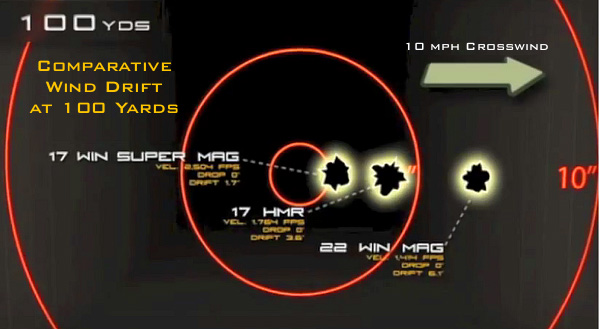

 Spawn of a .27-Caliber Nail-Gun
 Christmas Day is just one week away. Books have always been popular Xmas gifts. If you haven’t completed your holiday shopping, here are some recommended titles that should please the serious shooters and firearms enthusiasts on your shopping list. For Shooting Clubs, books also make great end-of-season member awards. Most of us would rather have a useful book than one more piece of wood to toss in a box in the closet.


 A unique, comprehensive
 Great Resource for Hunters

 M5 ‘Knock-Down’ Power More Than Adequate for Big Game
 The Reticle Compensating Rifle Barrel Reference Sensor takes the guesswork out of shooting by shifting the burden of knowing the relative position between the barrel and the weapon sight axes from the shooter to an electronic sensor. The system precisely measures the deflection of the barrel relative to the sight and then electronically realigns the moving reticle, or crosshairs, with the true position of the barrel, or bore axis.

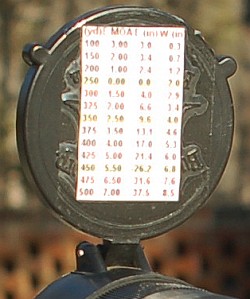 Another option is to place your ballistics card on the back of the front flip-up scope cover. This set-up is used by Forum member Greg C. (aka “Rem40X”). With your ‘come-up’ table on the flip-up cover you can check your windage and elevation drops easily without having to move out of shooting position. Greg tells us: “Placing my trajectory table on the front scope cover has worked well for me for a couple of years and thought I’d share. It’s in plain view and not under my armpit. And the table is far enough away that my aging eyes can read it easily. To apply, just use clear tape on the front objective cover.”
 1. Built-in Angle Compensation
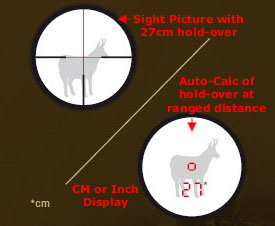 2. Hold-Over Values (Inches or CM)
 3. Elevation Click Values to Correct POI
 With CDS turrets mounted on a VX-3/VX-3L scope, you can quickly get on target by dialing the elevation to different ranges with a custom adjustment matched to your rifle- and load-specific ballistics. Leupold CDS riflescopes comes with standard ¼-MOA click adjustment dials. VX-3 CDS models include a coupon redeemable for one FREE custom-engraved CDS dial. Additional dials may be purchased for $59.99 each. All you need to swap between dials is a small screw-driver to work a simple set-screw. One-Revolution stops are available for custom dials.
 Excellent ballistics apps have been available for iPhones and Android phones for quite some time. Well, Windows-phone users can now join the party.


