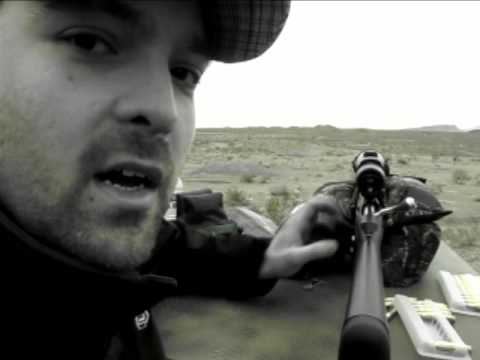
Elcan ushers in the age of digitally-enhanced scopes with its amazing Digital Hunter. It’s about time digital features were added to consumer rifle scopes. In many respects a $150.00 point and shoot camera is much more sophisticated than a $2600.00 Schmidt & Bender. Adding a digital image sensor and digital “crosshairs” to a telescopic lens system unlocks an amazing realm of possibilities. First, you can eliminate moving parts, including the reticle itself, avoiding the possibility of reticle movement that could alter your zero. With digital crosshairs “informed” by a ballistics calculator, the reticle’s aimpoint can automatically display the correct hold-over at any target distance. For low-light shooting, you can boost the brightness and contrast of the image. You can even hook up the scope to a remote monitor so an instructor or spotter can see exactly what the shooter is seeing. Last but not least, everything viewed through the scope can be digitally recorded for later playback and analysis. This way a hunter can record, for posterity, the moment he bagged a trophy buck. Or, a military sniper can record a complete target engagement, for later review by his commander and fellow marksmen.
The $1199.00 Elcan Digital Hunter offers a 2.5-16.5X digital zoom, four field-selectable reticles, and built-in video capture. Reticles can be changed ‘on the fly’ and you can output the video to an external monitor, or simply pop out the SD flash memory card to play back video files on your computer.
Electronic Zoom with No Moving Parts
There are no moving parts in the Digital Hunter except for the diopter adjustment. Magnification is accomplished electronically, and the aiming point does not change at all during magnification. The electronic magnification is parallax-free and the exit pupil remains constant, allowing easy target acquisition, even at high power. Elcan claims that resolution does not change significantly from wide field of view to narrow field of view.
Electronic Ballistic Compensation
One of the most useful features of the Digital Hunter is electronic ballistic compensation. Here’s how that works. The scope has a USB port to connect with a computer. Using Elcan-provided PC ballistics software, you input Bullet BC, Muzzle Velocity, and even wind speed and angle. The scope’s processor automatically calculates drift and drop for various distances and then positions the digital aim point for the correct holdover, based on the target distance you select. All the critical calculations are handled automatically. Watch the video below to see how this all works.
Day-Night Digital Hunter In addition to the standard Elcan Digital Hunter, Elcan offers a version for low-light shooting. The Day/Night Digital Hunter, priced at $1399.00, can be combined with IR (infrared) “flash-lights” to provide full night-hunting capability. Low Light mode displays all the available visible light and the near infrared light (that can be “seen” by the scope’s image sensor, but not by the human eye). Utilizing the near infrared means more light energy is available to the scope for better, brighter imaging. After dark, active night vision enables covert surveillance and varmint hunting (where legal). The effective range of the active night vision depends on the power of the IR Flashlight(s).
Remote Viewing Capability Helps Disabled Shooters
When the Elcan Digital Hunter was first introduced a couple years ago, Outdoors writer Ray Sasser of the Dallas Morning News field-tested it with Ray Mauldin, Elcan Products Manager. Sasser wrote: “There’s a new rifle scope technology on the horizon, a spin-off from military developments made by the Raytheon Company [parent company of Elcan]. The software calculated bullet drop… and the information was stored in a computer chip inside the scope. The only two drawbacks I could find were price and weight. The digital scope weighs 26 ounces, nearly seven ounces heavier than Leupold’s LPS 3.5-14x50mm, my personal favorite traditional scope. Mauldin said physically challenged hunters are particularly excited about the Digital Hunter. It can be used with a video monitoring screen so the rifle can be sighted without your eye to the scope. That’s a huge advantage for a quadriplegic, one-armed or no-armed shooter.”
Digital Enhancements for Target Scopes?
Traditionalists may scoff at digital scope technology, thinking that something like the digital Elcan could never be used in a match because it is too big and heavy. But consider this — all you really need on top of the rifle is the lens system with light sensor. All the other controls and the display could be moved off the rifle and built into a benchtop display/control/processing unit (which could be wireless). In fact, the control functions and display could even performed by an iPod or smartphone. With the iPod you could select the reticle, input ballistics data (Velocity, Bullet BC, Wind direction), and select the magnification level. (Fitting longer focal-length lenses would allow higher magnification than the Digital Hunters’ 2.5-16.5X.) And with a finger-tap on the screen you can record the entire match you are shooting. When mass-produced, such a unit could be sold for considerably less than the $1199.00 price of the Elcan Digital Hunter, as the iPod does the processing and replaces most of the hardware.
Many shooters using the 6mmBR case or a 6BR Improved (6 BRX, Dasher), automatically assume they should be shooting the heavier 105-108gr bullet designs because these offer the “best” ballistic coefficient attainable with a bullet that can work in an 8-twist barrel.
However, if you are shooting a 6BR at medium ranges, say 250 to 400 yards, you should seriously consider trying the 90-95 grain class of bullets, which includes the Berger 90gr Match Target BT, the Lapua 90gr Scenar, the Berger 95gr Match Target VLD, and the Sierra 95gr MatchKing.
First, you may find that, in your barrel, the 90-95 grainers are easier to tune in terms of seating depth, and they may offer somewhat better raw accuracy — yielding smaller groups than the heavier bullets. But remember — each gun/barrel is different.
Second, another advantage of the 90-95s is that you can fill the case fuller with the Varget/RL-15 class of powders (with appropriate throats). You can use more powder and therefore get closer to an optimal 100% case fill. With a 95gr VLD seated long we were able to get virtually 100% fill with a slow lot of Varget. Don’t try that with your 105s!
Lighter Bullets Offer More Speed in a 6BR
You’ll find that, in a standard 6mmBR rifle, you can drive the 90-95 grainers considerably faster than the 105-108 grain bullets at equivalent pressures. In an Eliseo R5 Tubegun, with Broughton 27.5″ 5C barrel, we were able to push the 95gr VLDs a full 160 fps faster than the 108s. This means that the true ballistics of the 90-95s rival that of the heavy bullets — at medium ranges.
We were able to drive the 90-grainers and the 95gr VLDs comfortably and very accurately at 3050 fps, whereas we maxed out at about 2890 fps with the 105gr and 108gr Bergers. At 300 yards, the 95gr bullet’s speed advantage compensates, in large part, for any BC shortfall compared to heavier bullets. In fact, in our rifle, the 95gr VLD actually shows less wind drift at 300 yards than either the Berger 105 Match Target BT or the Berger 108 Match Target BT. See chart.
Here’s data from JBM Ballistics, using G7 Coefficients (500′ alt, 70° temp):
LESSON: Don’t always assume that the heavier bullet has superior ballistics. You have to test, find the accuracy nodes for each bullet in your gun, and run the ballistics for the velocities you can actually achieve with good accuracy. As above, you may be surprised. In our Eliseo Tubegun, the 90-grainers shot tighter than 105s and we gave up little, if anything, in wind drift at 300 yards.
Great Accuracy from 90s and 95s in 6mmBR Tubeguns
In our Broughton-barreled Tubegun, the most accurate bullet so far has been the 90gr Lapua Scenar. In a Savage 6BR with 3-groove PacNor Barrel the Berger 95gr VLD has been ultra-accurate. But we really want to try the 95gr Sierra MK as well. Forum member Randy (aka “InfantryTrophy”) has been shooting the 95gr SMK with great success, and impressive accuracy. Here is his report: “The 95 SMK shoots great. I have not had the opportunity to shoot the 95s at 200 or 300 yards, but I can’t think of anything better to use. This is my first 5-round group fired after about 15 break-in rounds. The load is 29.5 grains of Reloder 15 with SMK 95. The gun is an Eliseo R5 with Pierce action and Broughton 27″ barrel. Shown below is a 5-shot, 100-yard group shot at 100 yards on MR31 target with iron sights, from rest.” Randy measured his group at 0.214″. It looks a bit bigger than that to us, but it is still impressive:
Werner Mehl, the engineering genius behind Kurzzeitmesstechnik (Kurzzeit), a German technology company, has come up with another spectacular ultra-slow-motion video. Werner has developed some of the most advanced video equipment in the world, allowing him to film bullets in flight with frame rates up to 1,000,000 frames per second. That’s not a misprint — some of the Kurzzeit video cameras can record at ONE MILLION frames per second, though typical Kurzzeit “high-speed” videos might be shot at 200,000 or 250,000 frames per second.
This 10-minute video was specially prepared by Werner for the 2009 SHOT Show. A masterpiece of high-speed movie-making, Werner’s video displays an amazing array of projectiles and targets. You can see bullets hitting armored and non-armored targets, bullets ripping through ballistic gelatin, bullets shattering glass, and even shotgun pellets striking rifle bullets in mid-air. Look for the effect of hollow points as they pass through the ballistic gelatin, and at the 4:26 mark you can see an airgun pellet slice though a paper target.
High-Tech Equipment from Kurzzeit
In addition to producing high-speed video equipment, Kurzzeit builds the PVM-21, one of the most advanced consumer chronographs on the market. The “all-infrared, all the time” PVM-21 works in any lighting conditions, including total darkness. It employs two banks of infrared sensors (front and back — the black boxes in right photo). These are aligned vertically and placed 8″ apart (left to right.) That gives you a huge 4.5″ x 8″ sensor area to register shots. We’ve worked with some other chronographs where the practical “sweet spot” for reliable results was just 2″ x 2″, when using an air rifle. The PVM-21’s large sensor area makes it easy to align your rifle, and you don’t get errors if your shot is just a little off-center.
The PVM-21 can hook up directly to a lap-top computer. That way you can record all your shot velocity data directly into a spreadsheet. The PVM 21’s large sensor area and software interface make the PVM one of this Editor’s favorite chronos, along with the classic Oehler model 35P. In the USA, the Kurzzeit PVM-21 is sold by Neconos.com. The $749.95 price includes sensor unit (with infrared), processing/display unit, infrared remote control, and software. It’s an impressive package — we just wish Werner would upgrade the display unit to include a rechargeable 12V DC battery. Right now you need to use an inline 120V AC to 12V DC transformer, or carry a separate 12V battery. I personally prefer to use a 3.5″x1.5″ rechargeable 12V battery rather than a 120v transformer and extension cords.
Many of our readers are now using smart-phones for ballistic calculations. Now there is a new App for the iPhone which makes mildot target ranging simple and easy. Mil-Dot Rangefinder 2.0 does all the math for you. Just input the size of the target, and the program calculates range instantly, in yards and meters. The standard edition costs just $1.99 while the “Pro” version is $9.99. We think that, if you’re going to really use this program in the field, it’s well worth paying ten bucks for the Pro version. The Pro edition gives you a full-featured ballistics calculator with windage/elevation corrections. That calculator alone is worth the extra money, and the Pro version offers many other features, which are listed below:
Target ranging (yards and meters)
US Army and USMC mil-dot reticles
Target Info display
Advanced ballistics calculator
Fast windspeed/direction adjustment
Range card (ballistics chart)
Point of impact indicator
Bullet drop compensator
Windage/elevation corrections
Time to target
Shot energy/velocity at target
Multiple Ballistic Profiles
This is a very powerful program. We suspect it will take most users a few days before they really understand all its functions and options. To see a more detailed demonstration of the Mil-Dot Rangefinder App, click on the YouTube video below. There’s no voice-over, so the video can be hard to follow. But at least the video showcases the flexibility of the program and the wide variety of functions it offers. Credit The Firearm Blog for spotlighting this useful App.
Bushnell Inc. and Leupold & Stevens have settled their respective lawsuits relating to the Leupold True Ballistic Range® (TBR) technology, and the Bushnell Angle Range Compensation (ARC) technology. So ends the legal battle of competing angle-compensation indication systems. In February, Leupold & Stevens sued Burris, Bushnell, and Zeiss for patent infringement in federal court for the District of Oregon. Then, in a separate action in the District of Kansas, Bushnell sued Leupold & Stevens for patent infringement. This week, after months of negotiations, the two companies dismissed their claims against each other, the two sides having reached an amicable settlement. The terms of the settlement were not disclosed, but neither company will be required to discontinue selling any of its products.
“We are pleased with the settlement, because it allows our customers to go on using and enjoying Bushnell laser rangefinders with our patented ARC technology, and we can focus our resources and energy on further developing and marketing new and innovative products,” said Phil Gyori, Executive Vice President of Marketing at Bushnell.
Previously, in March, Leupold removed Carl Zeiss Optical from Leupold’s patent suit. Though originally named as a defendant, Zeiss was dismissed from the suit because its products do NOT incorporate an inclinometer to compensate for angled shots. The inclinometer is a key element of Leupold’s patent.
We know many of our readers will be headed off to Camp Perry, Ohio for the NRA National Rifle Championships soon. To succeed at Perry, given the high level of competition, you’ll need solid wind-reading abilities. We’ve found an article by Sgt. 1st Class Emil Praslick III, USAMU Service Rifle coach, that can help you make better wind calls in competition.
SFC Praslick is considered one of the best wind gurus in the United States, if not the world. He has authored an excellent two-part article on wind reading that is available on the CMP (Civilian Marksmanship Program) website. Both articles contain helpful illustrations, and are “must-read” resources for any long-range shooter–not just Service Rifle and Highpower competitors.
Part One covers basic principles, tactics, and strategies, with a focus on the 200-yard stages. Emil writes: “There are as many dimensions to ‘wind reading’ as there are stages to High Power competition. Your tactical mindset, or philosophy, must be different for the 200 and 300 yard rapid-fire stages than it would be for the 600 yard slow-fire. In the slow-fire stages you have the ability to adjust windage from shot to shot, utilizing the location of the previous shot as an indicator. Additionally, a change to the existing conditions can be identified and adjusted for prior to shooting the next shot.”
In Part Two, Praslick provides more detailed explanations of the key principles of wind zeros, wind reading, and the “Clock System” for determining wind values: “The Value of the wind is as important as its speed when deciding the proper windage to place on the rifle. A 10 MPH wind from ’12 o-clock’ has No Value, hence it will not effect the flight of the bullet. A 10 MPH wind from ‘3 o’clock’, however, would be classified as Full Value. Failure to correct for a Full Value wind will surely result in a less than desirable result.”
Praslick also explains how to identify and evaluate mirage:
Determine the accuracy of the mirage. Mirage is the reflection of light through layers of air that have different temperatures than the ground. These layers are blown by the wind and can be monitored to detect wind direction and speed.
Focus your scope midway between yourself and the target, this will make mirage appear more prominent. I must emphasize the importance of experience when using mirage as a wind-reading tool. The best way to become proficient in the use of mirage is to correlate its appearance to a known condition. Using this as a baseline, changes in mirage can be equated to changes in the value of the wind. Above all, you must practice this skill!
Click HERE for more excellent instructional articles by Emil Praslick and other USAMU Coaches and shooters.
Bryan Litz, author of Applied Ballistics for Long Range Shooting, informed us that sophisticated new ballistics software is now available for Android OS phones. While there are ballistics programs that run on iPhones, as well as programs for Palm or Windows PDAs (Personal Digital Assistants), Bryan believes that the new Ballistics App, called SHOOTER, is the first such program for Android operating system (OS) products — such as Motorola’s Droid phone and Google’s new Nexus phone.
Bryan explained: “The SHOOTER App can be found in the Google marketplace by searching for ‘Ballistics’. I became interested in this program when I got my Android phone. There are several good programs out there for iPhones and PDAs. But SHOOTER is the first program I know of for Android. In my opinion, it won’t be topped by anything else. If you have an Android smartphone, I highly recommend checking out this application. The program is easy to install and run. Outputs are available as a single-shot solution or as a table. There is a ‘Lite’ version of SHOOTER that you can download for free, and the ‘full’ version is $9.99.”
The new “Shooter” Program for Android OS has an impressive list of features:
G1 and G7 BC capability, with the option to input ‘velocity banded’ BCs.
Angle Compensation (Up or Down Angle can be measured using the built-in inclinometer).
Bullet Library which includes Litz-measured “true” BCs.
Rifle and ammo profiles (for storing load info for all your guns).
Atmosphere effects (pressure, temp, and humidity).
Spin drift (requires bullet length and twist rate inputs).
Coriolis effect (works best with GPS-equipped Android phones).
Bryan revealed: “I was heavily involved in the development of this program and can vouch for the accuracy of the solution. The actual solver is very similar to the one used in my programs and in the JBM online Ballistics Program. SHOOTER’s calculations normally match my numbers and JBM’s numbers within round-off error (0.1″ at 1000 yards).”
Knights Armament has developed a sophisticated yet easy-to-use ballistics program that runs on the Apple iPod Touch and Apple iPhone platforms. The KAC Bullet Flight 3.1.0 software contains all the features you would want, including: user-selectable BC models (G1, G7, G8 etc.); output in inches, cm, MOA, Mils, and scope clicks; 360° wind drift calculation; computation of actual BC from collected data; and built-in accelerometer for angle detection.
In addition, KAC Bullet Flight 3.1.0 comes with a large database of bullet types (including weights, BCs etc.). You can also create your own custom ammo profiles (with velocity, BC, bullet type), allowing you to easily output ballistic plots for multiple firearms, without having to enter the rifle/bullet profile every time.
KAC Bullet Flight 3.1.0 is a very sophisticated program that rivals anything you can run on your home computer. A version of Bullet Flight is already in use with the U.S. Military in Iraq and Afghanistan. The Apple iPod touch/iPhone platform was chosen because this is now the #1 hand-held computing platform in the world. (With the iPod Touch, you do NOT need a phone service contract.) Also the Apple operating system and “multi-touch” screen allows an extremely user-friendly, easy-to-operate interface. “Ruggedized” Otterbox carry cases are also available for both first- and second-generation I-pods.
Software Starts at Just $3.99
There are three versions of KAC Bullet Flight, all very affordable. The basic L1 version costs just $3.99. We recommend the L2 version ($11.99) which adds a full calculation screen, the ability to generate a range-card, cosine-angle calculation, and GPS functionality. Finally, the $29.99 Level ‘M’ (Military) version further adds the ability to calculate an actual BC based on bullet drop, two velocities, or flight time. With Level ‘M’ you can also correct for very subtle factors, such as the Coriolis Effects, which come into play at ultra-long ranges.
We had a long chat with Eric Stecker, Berger Bullet’s Master Bulletsmith. Eric had some interesting revelations. First he noted that Berger’s production in 2009 was up 50% compared to the previous year. Berger is now running 24-hour shifts to meet demand. And Berger isn’t resting on its laurels. A new .338 bullet is going into production, and Berger now has the means to produce .416s and even 50-caliber bullets. Berger also has multiple new prototype long-range bullets in development. Eric let me look at them and hold them but he requested that we NOT publish photos as the bullet profiles are somewhat radical. Eric revealed that a new series of short-range 6mm bullets in the 60-grain range are probably going to be released later this year. These borrow some design ideas from the successful Euber FB bullets, with refinements to improve ballistics.
We covered many other topics during our interview, including the status of the new Berger Reloading handbook, and the differences between the G1 vs. G7 Ballistics models. Click on the video link below to learn all the latest info from Berger.
Today at the SHOT Show’s “Media Day at the Range”, Burris gave us a glimpse of the future in hunting optics. The new Burris Eliminator scope will range your target, calculate your trajectory, and illuminate a spot on the reticle that becomes your aimpoint at extended range. We could write a treatise on the Eliminator’s breakthrough technology, but all you really need to know is that after you range your target with the scope, a red dot appears on the vertical crosshair that is the correct aiming point for your ranged distance. The ballistics “hold-over” is already calculated. Just put the calculated red dot on the target, and pull the trigger. It’s that simple.
The new “Eliminator” scope is being introduced as a 4-12x42mm optic, for an expected $850.00 street price. The laser is activated with a simple push-button on the left side of the scope, and also comes with a remote switch that you can attach to the rifle in a more convenient position allowing the laser to be activated while maintaining the aim of the rifle. In the above photo you can see the remote switch on the objective end of the scope.
Once the target range is acquired, the range displays for about 10 seconds and the illuminated aiming dot remains illuminated for 70 seconds. The illumination clock allows plenty of time to pull off a good shot, yet saves battery life.
So how does the Burris LaserScope calculate the appropriate trajectory of your load? The software in the scope contains a database of hundreds of factory-loaded cartridges and even calculates handload trajectories using two (2) user-provided data points. The user inputs the zero range (100 or 200 yards) along with the inches of drop at 500 yards. The 500-yard drop is best found by real world shooting, not by using a calculated trajectory approximation from a ballistic program. The scope’s software then uses the zero-distance and the 500-yard drop figure to extrapolate the entire trajectory.
While shooting this scope on a Tikka 7mm-08, we successfully engaged targets from 350-570 yards that were approximately the size of a whitetail deer’s vitals area. Seeing how the conditions were not very conducive to accurate shooting with rain and a 5-15 mph switchy wind, we were impressed with the results.
For those that hunt or shoot out to about 600 yards or so, this scope will definitely speed up the process of pulling off an accurate long range shot. In a matter of seconds, you can locate a target, range it, and engage it. There is no time wasted fumbling with a separate laser rangefinder, no time wasted looking at a drop chart, and no time wasted clicking in the appropriate amount of elevation. As long as you can get a range on your target, the only thing left to worry about is the wind! This scope is obviously not for everyone, but we are confident that many hunters can benefit from this remarkable new technology.
Burris Eliminator Specs:
Click value 1/4″ at 100 yards
Weight 26 ounces; length 13″
Eye Relief 3-3.5″
Elevation Travel 50″
Laser range 550-800 yards based on reflectivity


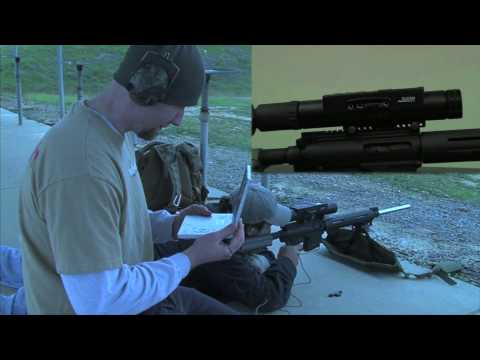
 In addition to the standard Elcan Digital Hunter, Elcan offers a version for low-light shooting. The Day/Night Digital Hunter, priced at $1399.00, can be combined with IR (infrared) “flash-lights” to provide full night-hunting capability. Low Light mode displays all the available visible light and the near infrared light (that can be “seen” by the scope’s image sensor, but not by the human eye). Utilizing the near infrared means more light energy is available to the scope for better, brighter imaging. After dark, active night vision enables covert surveillance and varmint hunting (where legal). The effective range of the active night vision depends on the power of the IR Flashlight(s).
 However, if you are shooting a 6BR at medium ranges, say 250 to 400 yards, you should seriously consider trying the 90-95 grain class of bullets, which includes the Berger 90gr Match Target BT, the Lapua 90gr Scenar, the Berger 95gr Match Target VLD, and the Sierra 95gr MatchKing.



 High-Tech Equipment from Kurzzeit
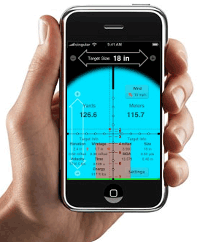 Many of our readers are now using smart-phones for ballistic calculations. Now there is a new App for the iPhone which makes mildot target ranging simple and easy.

 Part One covers basic principles, tactics, and strategies, with a focus on the 200-yard stages. Emil writes: “There are as many dimensions to ‘wind reading’ as there are stages to High Power competition. Your tactical mindset, or philosophy, must be different for the 200 and 300 yard rapid-fire stages than it would be for the 600 yard slow-fire. In the slow-fire stages you have the ability to adjust windage from shot to shot, utilizing the location of the previous shot as an indicator. Additionally, a change to the existing conditions can be identified and adjusted for prior to shooting the next shot.”
 Bryan Litz, author of


 We had a long chat with Eric Stecker,