|
|
January 12th, 2010
Bryan Litz, a skilled long-range shooter and ballistician for Berger Bullets, has created a “deployable” ballistics computer, MOBALL, based on the versatile Texas Instruments Voyage 200 graphing calculator. The MOBALL unit lets shooters input a wide variety of environmental variables. It delivers very precise ballistics solutions, and can run for months on a set of ordinary AAA batteries.

CLICK HERE for full description of MOBALL Ballistics Calculator.
When Bryan released the MOBALL unit late last year, it was set up to use English system measurements for most of its functions. That worked great for most users, but some shooters with mildot scopes wanted the ability to use Mils and meters instead of MOA and yards. Well, Bryan listened to these requests — he’s upgraded the MOBAL to provide metric range inputs and both metric and Mil drop outputs as an option.
Bryan tells us: “I’ve added the option to use meters/MILS in MOBALL. After consulting with several shooters who requested metric, it turns out that most of them didn’t want complete metric (caliber in mm, bullet weight in grams, temp in Celsius, etc) but only the range and drop in meters and MILS. So, I’ve updated the program functions accordingly. MOBALL has been upgraded to accept range in meters (as well as yards) and output drop in cm and MILS (as well as inches and MOA).”
The MOBALL Unit Retails for $290.00 and is available from AppliedBallisticsLLC.com.
December 14th, 2009
There are a variety of ballistics programs that can be used with handheld PDAs, and even Apple iPhones. But Bryan Litz, author of the new Applied Ballistics for Long Range Shooting book, has come up with something bigger and better. Employing the powerful Texas Instruments (TI) Voyage 200 graphing calculator, Bryan has created a Mobile Ballistics Solution (MOBALL) that is more sophisticated (and accurate) than typical PDA-based programs.

MOBALL includes TI graphing calculator and ballistics software. Kestrel windmeter NOT included.
Bryan tells us: “The Mobile Ballistics Computer (MOBALL) was created for one purpose: to provide shooters with the most accurate and complete ballistic firing solution possible for application in the field.” MOBALL runs on a TI graphing calculator — a sturdy, stand-alone, non-network device. That means you don’t need long-term cell phone contracts, expensive data plans, or weekly OS “updates” and patches. The TI also delivers long run-time on ordinary AAA batteries. That’s a big advantage over most laptop computers, which run out of “juice” after only 4-5 hours in the field.
According to Bryan, what sets MOBALL apart from other “deployable” ballistics calculators is that: “MOBALL provides a complete ballistic solution, with the ability to account for every major and minor variable affecting a bullets trajectory. In addition to the standard variables like atmospherics, uphill/downhill angles and wind, MOBALL also has the ability to account for more subtle ballistic effects like spin drift, Coriolis effect, and multiple winds in up to 3 zones.”
Importantly, Bryan’s MOBALL device can employ Ballistic Coefficients (BCs) referenced to the G7 standard. Compared to the older G1 BC model, the G7 BC standard better matches the characterics of the long, boat-tail bullets actually used by long-range shooters. Trajectories calculated using the G7 BC are more accurate for long-range bullets because the G7 BC doesn’t vary with velocity like the conventional G1 BC.
 
The difference between G1 and G7 BCs is explained online in the Berger Blog article A Better Ballistic Coefficient. The subject is also discussed in detail in Chapter 2 of Bryan’s Applied Ballistics book.
At $290.00, MOBALL isn’t the least expensive option for a mobile ballistics device, but that price includes the TI Voyage 200 graphing calculator, worth $180.00 by itself. Bryan adds: “As already mentioned, the feature set is extensive, and the software is much more sophisticated than most ballistics programs designed for PDAs. The solution is VERY accurate (CLICK to download MOBALL Accuracy Report). Also, the TI Voyage 200 is an impressive device itself, capable of solving advanced engineering and math problems. If you’re a high school/college student, engineer, etc, the TI Voyage 200 can be used for many school and work tasks unrelated to ballistics.”
Save $20 on MOBALL and Ballistics Book Combo
As a special Holiday Offer valid through December 31, 2009, you can save money when purchasing MOBALL and Bryan’s Applied Ballistics book together. The book and MOBALL unit are being offered as a Holiday Combo Set for $309.95. That’s a $20 savings over the $329.95 cost of purchasing both book and MOBALL unit separately.
November 27th, 2009
 One of our readers asked “What effect does altitude have on the flight of a bullet?” The simplistic answer is that, at higher altitudes, the air is thinner (lower density), so there is less drag on the bullet. This means that the amount of bullet drop is less at any given flight distance from the muzzle. Since the force of gravity is essentially constant on the earth’s surface (for practical purposes), the bullet’s downward acceleration doesn’t change, but a bullet launched at a higher altitude is able to fly slightly farther (in the thinner air) for every increment of downward movement. Effectively, the bullet behaves as if it has a higher ballistic coefficient. One of our readers asked “What effect does altitude have on the flight of a bullet?” The simplistic answer is that, at higher altitudes, the air is thinner (lower density), so there is less drag on the bullet. This means that the amount of bullet drop is less at any given flight distance from the muzzle. Since the force of gravity is essentially constant on the earth’s surface (for practical purposes), the bullet’s downward acceleration doesn’t change, but a bullet launched at a higher altitude is able to fly slightly farther (in the thinner air) for every increment of downward movement. Effectively, the bullet behaves as if it has a higher ballistic coefficient.
Forum members Milanuk explain that the key factor is not altitude, but rather air pressure. Milanuk writes:
“In basic terms, as your altitude increases, the density of the air the bullet must travel through decreases, thereby reducing the drag on the bullet. Generally, the higher the altitude, the less the bullet will drop. For example, I shoot at a couple ranges here in the Pacific Northwest. Both are at 1000′ ASL or less. I’ll need about 29-30 MOA to get from 100 yard to 1000 yards with a Berger 155gr VLD @ 2960fps. By contrast, in Raton, NM, located at 6600′ ASL, I’ll only need about 24-25 MOA to do the same. That’s a significant difference.
One thing to remember — it is the barometric pressure that really matters, not simply the nominal altitude. The barometric pressure will indicate the reduced pressure from a higher altitude, but it will also show you the pressure changes as a front moves in, etc. which can play havoc w/ your calculated come-ups. Most altimeters are simply barometers that read in feet instead of inches of mercury.”
As Milanuk states, it is NOT altitude per se, but the LOCAL barometric pressure (sometimes called “station pressure”) that is key. The two atmospheric conditions that most effect bullet flight are air temperature, and barometric pressure. Normally, humidity has a negligible effect.
One important thing to remember is that the barometric pressure reported on the radio (or internet) may be stated as a sea level equivalency. So in Denver (at 6,000 feet amsl), if the local pressure is 24″, the radio will report the barometric pressure to be 30″. If you do high altitude shooting at long range, bring along a Kestral, or remember to mentally correct the radio station’s pressure, by 1″ per 1,000 feet.”
You can do your own experimental calculations using the JBM Online Ballistics Program (free to use). Here are two printouts, one showing bullet trajectory at sea level (0′ altitude) and one at 20,000 feet. For demonstration sake, we assigned a low 0.2 BC to the bullet, with a velocity of 3000 fps.
Trajectory of Bullet fired at Sea Level
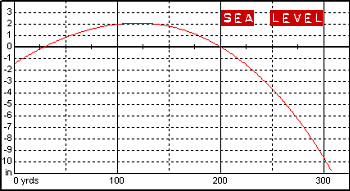
Trajectory of Bullet fired at 20,000 feet

Here’s a useful resource on External Ballistics if you want to learn more about the effects of altitude and barometric pressure on bullet flight.
October 17th, 2009
LINK: Advanced Ballistics Program for I-Phones and I-Pods
Apple’s I-Phone and I-Pod offer a superb user interface with serious computing power. Here’s a very trick software App (good enough for the U.S. military) that runs ballistic calcs and even has a bullet database.

October 5th, 2009
One of our readers, Rafal Walczowski, revealed that programmers from Poland have developed ballistics software for cell phones. The new program, KABAL, should be able to operate in over 90% of programmable mobile phones. Rafal tells us: “Our idea was to develop software which could be used on the most common devices people carry all the time — mobile phones.” Current mobile ballistics programs require a separate device (such as a Windows PDA), or are limited to a single type of phone (e.g. the KAC program for the I-Phone). The Polish developers came up with a handier, more universal application: “We made software that should work on every device with JAVA MIDP.2.0. That should work for about 90-95% of the phones on the market. And, later, we will make a KABAL version that runs with older versions of JAVA.”

Rafal reports the KABAL Ballistics program for mobile phones has worked well in field tests: “The algorithm for our calculator was field-tested for 18 months at ranges up to 1076 meters. Many different calibers, rifles, and bullets were employed during testing. We are pleased with the results, even when compared to QuickTarget and Exbal programs. Our KABAL program often proved more accurate, especially for long-range calculations, whereas QuickTarget and Exbal could be too optimistic.”
English Version Coming Soon — and Free BETA Version Online
Rafal reports: “Several weeks ago we finished the Polish version of KABAL and we are selling it for mobile phones. We are now are working on an English-language version, which is currently in beta testing.” There is a free English test version that works in a PC browser. This includes a BC database, a bullet stability calculator, plus tooltips describing each field. You can try out the free online beta version by clicking the link below. Rabal adds: “We would highly appreciate any opinions/feedback about our software”.
CLICK HERE for Beta Version of English KABAL Ballistics Software (Web use only)
July 18th, 2009
Our “master fabricator” and silhouette guru Mark LaFevers recently attended the SoCal Precision Rifle Competition, Mark’s first-ever tactical match. Competition was fierce at this year’s SCPRC. The match winner, and “top gun” among the 50+ competitors was Sgt. Dan Gilland, (USMC), a scout-sniper from a nearby Marine base. This was only Dan’s second civilian match and yes, the young Marine was shooting a .308 Win (7.62×51 to be precise). Jason Boak took second place while Gordon Campfield finished third. Jason was the top shooter among the NorCal guys, who did well, capturing 6 of the top 10 places, earning California intra-club bragging rights.
 |
 |
Mark told us that the match was a humbling yet very fun experience. In these kind of matches very few, if any, sighters are allowed, and you’re often shooting at unknown distances. Accordingly, it is imperative that you have rock-solid come-ups at all distances, before you arrive at the match. In addition, the SCPRC offered the challenges of angled shooting (requiring ballistic compensation), and lowlight shooting. Log on to the CalGuns.net Forum for a complete match report by NorCal shooter Vu Pham, with lots of photos, plus stage descriptions (match directors take note).

A wide variety of calibers were shot at the match, and Mark observed that no one chambering seemed to have the edge (though a .308 finished on top). However, most of the top shooters were running detachable magazines, and had barrels fitted with muzzle brakes. You can see the dust kicked up from the muzzle brakes in the video below. The first part of the video shows a stage where competitors had to start with standing (off-hand) shots, then transition to a stepped barricade, moving lower and lower as the timer ticked off the seconds. For the standing stages, Mark noted, you wanted a rifle that balanced well and was not too heavy. Some of these beefy tactical rifles, optimized for prone work, are tough to hold offhand.
Please enable Javascript and Flash to view this VideoPress video.

July 16th, 2009
 Bryan Litz, chief Ballistician for Berger Bullets, has just released an impressive new, hard-cover treatise on external ballistics. While Bryan’s 536-page Applied Ballistics for Long-Range Shooting will surely take its place among the “classic” reference books on precision shooting, it does much more than explain theories of bullet flight. Using advanced equipment, Litz measured the actual drag of over 175 popular bullet types in the field. Armed with this new experimentally-derived data, shooters can now calculate their loads’ true trajectories with greater precision than ever before. Bryan Litz, chief Ballistician for Berger Bullets, has just released an impressive new, hard-cover treatise on external ballistics. While Bryan’s 536-page Applied Ballistics for Long-Range Shooting will surely take its place among the “classic” reference books on precision shooting, it does much more than explain theories of bullet flight. Using advanced equipment, Litz measured the actual drag of over 175 popular bullet types in the field. Armed with this new experimentally-derived data, shooters can now calculate their loads’ true trajectories with greater precision than ever before.
If you’re serious about long-range shooting, or just have an interest in bullet design and performance, you should buy this book. It is offered for $39.95 directly from Bryan’s website, AppliedBallisticsLLC.com.
In the video above, Litz explains some of the key features of his new book. (Watch the video — Bryan explains what you’ll get for your $39.95!) Don’t be fooled by Bryan’s youthful appearance. This guy is the Einstein of external ballistics. He holds a degree in Aerospace Engineering, and he was an honest-to-goodness rocket scientist who worked with the U.S. Air Force on air-to-air missile design for six years before joning Berger Bullets. What’s more, Bryan is an extremely talented long-range shooter. Bryan was the 2008 National Palma Champion, and he holds the all-time NRA mid-range iron-sight record (450-39X).

Even if you rely on a software program to calculate your come-ups, it is important to know how bullets are affected by wind and gravity, and how bullet ballistic coefficients are determined. If you’re looking to expand your knowledge of ballistics and the nuances of bullet design, you should find Bryan’s book informative and readable.
You don’t need an MIT degree to understand this book. It was Bryan’s goal to explain the important elements of exterior ballistics in a practical way that can be understood and applied by shooters. What you learn from Applied Ballistics for Long-Range Shooting can help you make better decisions about the bullet(s) and the caliber(s) you choose to shoot, and give you more confidence when taking those long shots in the field.
June 30th, 2009
 Here’s a great job opportunity for someone who enjoys interacting with other shooters, and helping them develop accurate loads. Sierra Bullets wants to hire another Ballistic Technician to answer questions about Sierra bullets and loads from Sierra’s reloading manual. The new Ballistic Technician will also appear at competition and trade shows from time to time. You’ll also have a chance to work with a great bunch of guys — the current team of six Ballistic Techninicians who currently respond to three to five thousand inquiries per month. Here’s a great job opportunity for someone who enjoys interacting with other shooters, and helping them develop accurate loads. Sierra Bullets wants to hire another Ballistic Technician to answer questions about Sierra bullets and loads from Sierra’s reloading manual. The new Ballistic Technician will also appear at competition and trade shows from time to time. You’ll also have a chance to work with a great bunch of guys — the current team of six Ballistic Techninicians who currently respond to three to five thousand inquiries per month.
Job Description: Answer incoming phone calls and emails from customers looking for load data, ballistic software help, and miscellaneous firearms/shooting questions. Data entry to update customer’s information and profiles. Handle customer complaints including paperwork and filing. Develop load data and work on new product development as needed. Attend matches, tradeshows, and events as needed. Paid match attendance/mileage for competitive shooters. Other duties within the sales department as required.
Call 660-827-6300 with questions about this position. If you are interested in working for Sierra, please email your current resume to patknight [at] sierrabullets.com, or mail your resume to:
Sierra Bullets
Attn. Human Resource Department
1400 West Henry Street
Sedalia, MO 65301
June 24th, 2009
Lapua has used sophisticated Doppler radar to calculate the actual air drag of its bullets throughout the course of bullet flight. Drag coefficients derived from these continuous field measurements make it possible to calculate bullets’ trajectories with great precision. By using Doppler-radar derived drag coefficients, trajectories can be predicted much more accurately than when using the simplified one-number BCs provided by most other bullet-makers.
To enable shooters to calculate trajectories (with the Doppler bullet data) more effectively, Lapua now offers a FREE special edition of QuickTarget Unlimited (QTU) software tailored for Lapua bullets. QTU is a very sophisticated program that allows you to choose among 12 different drag models. QTU also allows you to compensate for rifle firing angle, rifle cant, wind speed, atmospheric pressure, temperature, and humidity.

Using this free software, you can calculate the trajectories of Lapua bullets to a great degree of certainty. With the QTU Program, as starting values, you need only bullet type and muzzle velocity (add windspeeds if known). The software will calculate bullet drop, velocity and energy as a function of distance and flight time. Complete QTU instructions are in the QTU Manual.
CLICK HERE to download QTU Software Manual. (Read the manual. QTU is complex with many variables and uses metric values by default. The manual explains how to set everything for yards and MOA, and how to input data for wind, temperature, rifle angle and other variables.)
How to Get the Software
To get the FREE QuickTarget Lapua Edition software, first go to the Lapua Ballistics Start Page. On that page, click the “Register” link. Fill in ALL the required info (user name, password, email etc.), and hit the “Create Account” button. Validation: Lapua will send a message to the email account you listed. Open that email and click the internal link to verify that you have an active, valid email account.
OK, now go back to the Ballistics Start Page. Fill in your user name and password, and click the “Login” button. A new page should open with the heading: “About QuickTarget Unlimited (QTU) Lapua Edition”. OK, now move your mouse pointer left and click on the words “Download Lapua Edition”. Now a new page will open.
Almost done. Scroll down and you’ll see a blue “Download Now” button at the bottom. Click that, then click “Agree” on the software license screen that comes next. After you click “Agree” a new page appears showing: “QuickTarget Unlimited Lapua Edition”.

Click the link for “qtulapua.zip” and a 6.1 megabyte .zip archive file will be downloaded to your computer. Open that .zip file and click the “SETUP.EXE” file to install the software.
June 14th, 2009
The Hensoldt line of optics represents the premium military/tactical series of riflescopes and spotting scopes produced by Germany’s Carl Zeiss Optronics GmbH. Hendsolt products are expensive, to be sure, but they offer many features found in no other tactical optics. Thanks to importer HDC, LLC, Zeiss Hensoldt products are now available in the American marketplace, through a network of dealers, including G.A. Precision, McMillan Firearms, SWFA, Superior Shooting Systems (David Tubb), and Tac Pro Shooting Center. You can review the specs and features of Zeiss Hensoldt scopes on the HDC website, www.hudisco.com.

HDC, LLC was selected by Carl Zeiss Optronics GmbH, a subsidiary of the Carl Zeiss group, to become the distribution partner in the USA for the Hensoldt line of Zeiss optics. This allows HDC to bring to the American market the latest and most advanced optical products from the Zeiss factories. The Hensoldt line offers unrivaled glass quality and state-of-the-art technology in both telescopic and reflex sights.

Below is a video of the remarkable 6-24x72mm SAM scope. This optic integrates superb, ultra-bright apochromatic fluorite glass with a calculator module that provides ballistic info and weather data to the shooter. SAM stands for “Sniper Auxiliary Module”. An integrated ballistics calculator can be programmed for up to four different types of ammo. Sensors in the integrated ring mount measure weather parameters. These values, as well as scope data, are then directly projected into the visual field of the eyepiece. This provides selectable displays of elevation clicks, windage clicks, angle of fire, cant angle, temperature, and air pressure.
Please enable Javascript and Flash to view this VideoPress video.
|


