A quality borescope is a pricey tool, but once you get to use one, it’s hard to imagine how you ever did without it. To learn how a borescope can help you diagnose barrel issues, you should read a Rifle Shooter magazine feature story, What the Eye Can See.
In this article, writer Terry Wieland explains how to inspect for defects in new barrels, how to recognize different kinds of fouling (in both barrels and brass), and how to spot throat erosion in its early stages. Terry uses a Gradient Lens HawkEye BoreScope. The current generation of HawkEyes can be attached to a still or video camera to record digital images of your bore. The most interesting part of the article is on the second page. There, author Wieland provides photos of various types of internal flaws that can appear in barrels. This will help you spot pitting, excessive land wear, rust damage, and damage from corrosive primers.
Wieland notes that BoreScopes aren’t just for barrels: “The borescope has other uses as well. It can be used to examine the interior of a cartridge case to look for the beginnings of a case separation or to examine the interior of a loading die that is giving you trouble. When you consider the number of tubular objects that play such an important role in rifle shooting, it is a wonder we were ever able to function without such a method of studying bores.”
This Gradient Lens video shows how to correctly borescope your barrel:
What’s more fun that a barrel of monkeys? Well a barrel of ammo of course. Here’s an item for the man who has everything, or maybe the prepper who needs enough 5.56x45mm ammo to defeat a horde of zombies, plus their undead friends and relatives. For a mere $5999.99 you can get a barrel containing 12,500 rounds of Federal 5.56x45mm 62gr “Green Tip” ammunition. No joke — this is a real item offered for sale by Grafs.com. When you’re not shooting, your ammo barrel can do double duty as a handy side-table in your living room or man-cave. Just the thing to hold a plate of snacks and your favorite beverage.
In all seriousness, this is impressive Mil-Spec FMJ ammunition right off the production line. The 62-grain green-tipped bullets feature a hardened steel penetrator core. The boxer-primed cases are fully reloadable (though the miltary primer crimps would have to be removed). The ammo is delivered in a heavy-duty steel drum, with steel clamp-on lid with rubber seal. Each container is plastic-lined and packed (from the factory) with dessicant pouches for long term storage.
NOTE: In some jurisdictions there may be restrictions on this product (based on the quantity of rounds or other factors). Check your local laws and regulations.
Krieger Barrels Inc. is a family-run business. Founder John Krieger now works with two of his sons in the business, Andrew (“Andy”) and Mark. At SHOT Show 2014 we had a chance to chat with John and Andy. John told us that he is very proud to work with his two sons. He said that Andy, who has a degree in engineering, brings an important skill set and a new level of scientific expertise to the business. On his part, Andy says that his father is a “great boss… and the best teacher you could have”. Meet this father and son barrel-making team in this short video.
John Krieger and Andrew Krieger
How does Krieger Barrels produce such a great product year in and year out? It takes a lot of highly-skilled labor and some serious machinery to produce outstanding cut-rifled barrels. To illustrate the barrel-making process, Krieger has produced a fascinating video, filmed at Krieger’s production facility in Richfield, Wisconsin. This video shows the process of single-point, cut-rifled barrel-making start to finish. If you love big, powerful machines, you’ll enjoy this video. Its really quite amazing to see all that’s involved in the production of cut-rifled barrels.
How Krieger Barrels Are Made (MUST-WATCH video — one of the best we’ve ever featured).
For anyone interested in accurate rifles, this is absolutely a “must-watch” video. Watch blanks being cryogenically treated, then drilled and lathe-turned. Next comes the big stuff — the massive rifling machines that single-point-cut the rifling in a precise, time-consuming process. Following that you can see barrels being contoured, polished, and inspected (with air gauge and bore-scope). There is even a sequence showing chambers being cut.
Here is a time-line of the important barrel-making processes shown in the video. You may want to use the “Pause” button, or repeat some segments to get a better look at particular operations. The numbers on the left represent playback minutes and seconds.
We can predict, with some certainty, how long a light bulb will last (in use), or a shingle roof, or even a nuclear reactor. But how about barrels? Is there a way to reliably estimate barrel life based on known characteristics? This article explains one effort to quantify barrel life…
How long will a barrel last before the accuracy “goes south”? There are so many variables involved (powder type, bore diameter, bullet coatings etc.) that it’s hard to predict. You might say “Well, my buddy has a .243 and he got 1500 rounds before the throat was shot out” — those kind of comparisons can be useful, but they’re not very scientific, and they won’t help much if you’ve got a gun in a new chambering (such as the 6.5×47) for which long-term test results are lacking.
Is there a more reliable way to predict barrel life — one that will work for a broad range of calibers? Well, Forum member MikeCr has developed an Excel spreadsheet that accounts for a number of variables, and gives a pretty good estimate of useful barrel life, whether you’re shooting a .223 Rem or a 338 Lapua Magnum. Mike’s program predicts barrel life using five variables: 1) Bullet Diameter; 2) Powder Charge weight; 3) Powder Heat Potential (KJ/kg); 4) Pressure (in psi); and 5) Bullet Coating (yes/no). Mike provides a table with Heat Potential ratings for most popular powder types. The user needs to know the pressure of his load. This can be estimated with QuickLOAD.
You can download the lastest version of Mike’s spreadsheet below. You’ll need Excel or an Excel viewer to open the file.
Shown below is Mike’s Spreadsheet, with variables for a 6BR shooting 105gr “naked” bullets with 30.3 grains of Hodgdon Varget powder. The formula predicts 2401 rounds of barrel life. That corresponds pretty well to what we’d expect for a 6BR — about 2500 rounds.
Mike observes: “There has been alot of discussion lately related to cartridge design and resulting barrel life. This is a really important factor to consider amongst a myriad of choices. Barrel life is controversial, and subjective. There are no clear-cut standards for comparison. But a few years ago, I put together a spreadsheet based on Bart Bobbit’s rule of thumb. It worked pretty good, only occasionally failing some tests when validated against posted barrel lives.
According to Ken Howell, I had to account for pressure. And Henry Child’s powder temperature testing provided another piece needed. So, I’ve tweaked it here and there to pass more tests. From 223rem to 300 UltraMagnum. Another element added, but turned off is shot interval. I would need way more tests to lock in on this. But everyone knows, the faster you shoot, the worse the barrel life.
Anyway, another factor hard to define is ‘accurate’ barrel life. This cannot be quantified without standards. Barrels are replaced when expectations are no longer met. I feel that a [barrel] passes peak potential in a finite period due to throat erosion. But that don’t mean it’s toast, if it still shoots well enough. It’s just as likely that many of us never see that peak potential anyway. It’s a slippery thing. Point-blank BR competitors will toss a barrel when it leaves the 1s. I could get another 4000 rounds from it, and be content with its performance, I’m sure.”
NOTE: Mike says: “This spreadsheet may show a lower barrel life than you prefer. But it pretty well spotlights cartridges to stay away from if you plan much time at the range or in dog town.”
Editor’s Comment: We want to stress that Mike’s spreadsheet is a helpful tool, but it is not a definitive “take-it-to-the-bank” indicator of barrel life. Mike cautions that predicting barrel life involves so many different factors (including how hot the barrel is run), that the task is a bit like predicting tread life on car tires. Still, the spreadsheet is very helpful. It can certainly warn us that some chamberings (such as the 6-284) are likely to be barrel burners. That can help you make a smart decision when choosing a chambering for your next rifle.
Are you tired of messing with cleaning rods, bore guides, stinky solvents, and messy JB patches? Can’t wait hours for bore-foam products to work? Well now there’s a new solution ideal for all pistol, shotgun, and rifle shooters. With the new Bore-O-Matic cleaning machine, you can clean your barrels in seconds. Remove copper, powder fouling, and even hard carbon in one ultra-fast operation. The Bore-O-Matic uses a self-deploying snake fitted with a bronze brush to instantly rout out all types of fouling. A powerful 0.5 horsepower electric motor spins the brush at 200 rpm as it snakes its way through your bore, eating away fouling, and leaving a “squeaky clean” interior finish in its wake.
The Bore-O-Matic is easy to use. Simply squirt your favorite solvent* in the barrel, fire up the motor, and let the Bore-O-Matic power its way down your barrel. In seconds you’ll have a perfectly clean bore. Since the Bore-O-Matic’s flexible drive shaft is plastic-coated, no harm can be done.
Bore-O-Matic inventor Tom Bugiardo says that the Bore-O-Matic is perfectly safe for your fine match barrels. “We’ve seen how top competitors brush their barrels like crazy, and frankly, we’re just doing the same thing, but with a motor to minimize the labor.” Additionally, Bugiardo says that the bronze brushes used on the Bore-O-Matic can’t possibly harm your bore. “We all know that bronze is softer than steel so there’s absolutely no risk”. Some potential buyers were worried about the rapidly-spinning bore brushes rounding off the edges of lands or damaging the crown. “Horse-pucky” says Bugiardo, “We’ve researched this extensively on internet gun forums, so we’re 100% confident that running a powered bronze brush at 200 rpm down your barrel can’t harm a thing. Trust us.”
Because the Bore-O-Matic spins as it runs down the bore, gyroscopic forces self-center the cleaning brush. So, no cumbersome (and expensive) bore guides are needed. “Just feed that puppy right down the barrel, and say ‘goodbye’ to barrel fouling forever”, says the inventor.
Along with the $189.99 benchtop Bore-O-Matic unit, a smaller $99.99 hand unit is available. When working in tight spaces, or when cleaning at the range, the battery-powered Bore-O-Matic “Hand-Jobber” is ideal. The Bore-O-Matic handheld unit conveniently fits in a range box and runs off long-lasting, rechargeable Lithium-Ion batteries.
With the compact Bore-O-Matic “Hand-Jobber” you can also easily dip the attached cleaning brush in a tub of JB or Iosso bore cream. Bugiardo tells customers: “Slather that JB on your brush and run ‘er right in the muzzle if you want a mirror finish in your bore. Remember, nothing says ‘pride of ownership’ better than a bore that shines like a spit-polished diamond!”
Currently the Bore-O-Matic is available only from Bugiardo’s company, TB Plumbing Supplies, in Lizella, Georgia (no website yet). Bugiardo expects the product will soon catch on with shooters nationwide and it will be carried by major retailers and online webstores.
*With its high-speed rotary brush, the Bore-O-Matic is so efficient that you don’t need expensive, specialty solvents. Bugiardo uses a simple solution of Windex, Ammonia, Drano Gel, and baking soda. “Makes my barrels shine, inside and out”, Bugiardo says.
Sometimes you’ll get a barrel that doesn’t stabilize bullets the way you’d anticipate, based on the stated (or presumed) twist rate. A barrel might have 1:10″ stamped on the side but it is, in truth, a 1:10.5″ twist or even a 1:9.5″. Cut-rifled barrels, such as Kriegers and Bartleins, normally hold very true to the specified twist rate. With buttoned barrels, due to the nature of the rifling process, there’s a greater chance of a small variation in twist rate. And yes, factory barrels can be slightly out of spec as well.
Before you purchase a bunch of bullets and set off to develop loads it’s wise to determine the true twist rate of your new barrel. Sinclair International, in its Reloading Press Blog provides a simple procedure for determining the actual twist rate of your barrel. Read on to learn how….
How Twist Rate Affects Bullet Stability
Most of you know that the twist of the rifling in the barrel is what puts spin on the bullet. As a bullet is pushed down the barrel and compressed into the rifling, the bullet follows the path or twist of the rifling. The combination of velocity and bullet spin is what stabilizes the bullet. Finding the twist rate for your barrel will help you in selecting appropriate weight bullets for your firearm. Remember, the general rule is that the faster the twist rate for a given caliber, the longer the bullet (of that caliber) you will be able to stabilize. (Generally speaking, a longer bullet will also be a heavier bullet, but the bullet geometry dictates the needed twist rather than the weight per se.)
Determining Barrel Twist Rate Empirically
Twist rate is defined as the distance in inches of barrel that the rifling takes to make one complete revolution. An example would be a 1:10″ twist rate. A 1:10″ barrel has rifling that makes one complete revolution in 10 inches of barrel length. Rifle manufacturers usually publish twist rates for their standard rifle offerings and custom barrels are always ordered by caliber, contour, and twist rate. If you are having a custom barrel chambered you can ask the gunsmith to mark the barrel with the twist rate.
Sinclair’s Simple Twist Rate Measurement Method
If are unsure of the twist rate of the barrel, you can measure it yourself in a couple of minutes. You need a good cleaning rod with a rotating handle and a jag with a fairly tight fitting patch. Utilize a rod guide if you are accessing the barrel through the breech or a muzzle guide if you are going to come in from the muzzle end. Make sure the rod rotates freely in the handle under load. Start the patch into the barrel for a few inches and then stop. Put a piece of tape at the back of the rod by the handle (like a flag) or mark the rod in some way. Measure how much of the rod is still protruding from the rod guide. You can either measure from the rod guide or muzzle guide back to the flag or to a spot on the handle. Next, continue to push the rod in until the mark or tape flag has made one complete revolution. Re-measure the amount of rod that is left sticking out of the barrel. Use the same reference marks as you did on the first measurement. Next, subtract this measurement from the first measurement. This number is the twist rate. For example, if the rod has 24 inches remaining at the start and 16 inches remain after making one revolution, you have 8 inches of travel, thus a 1:8 twist barrel.
This rifling illustration was created by Danish graphic artist Erik Dahlberg. It is published here courtesy FireArmsID.com, an excellent website for forensic firearms examiners.
If you do home gunsmithing or swap barrels frequently, you need a good barrel vise. PMA Tool is now carrying a quality 6061 Aluminum barrel vise, with spring-loaded clamps and a durable, baked-on powdercoat finish.
PMA’s Pat Reagin tells us: “These Deluxe Barrel Vises are made by our friend Bob ‘The Viper’ Pastor. Bob’s barrel vises feature hardened bolts and nuts along with fully-captured return springs. The return springs prevent the top of the vise from flopping around, making inserting and removing barrels from the vise much quicker and easier.” This feature, along with the non-slip powdercoat finish, protects your barrels from scratches and, importantly, protects the crown of the muzzle. Pat says: “You will not find a higher quality barrel vise with these features anywhere.” Price for the Pastor barrel vise, machined from 6061 Aluminum, is $60.95. CLICK HERE to order.
Product tip by EdLongrange. We welcome reader submissions.
How much does it cost you to send a round downrange? Ask most shooters this question and they’ll start adding up the cost of components: bullets, powder, and primers. Then they’ll figure in the cost of brass, divided by the number of times the cases are reloaded.
For a 6BR shooting match bullets, match-grade primers, and 30 grains of powder, in brass reloaded ten times, this basic calculation gives us a cost per shot of $0.51 (fifty-one cents):
NOTE: If you shoot a larger caliber that burns more powder, and uses more expensive bullets and/or brass, your total cost per round will be higher than $0.51.
$1.00 Per Shot True Cost? Yikes!
OK, we’ve seen that it costs about $0.51 per round to shoot a 6BR. Right?
Wrong! — What if we told you that your ACTUAL cost per round might be closer to double that number? How can that be? Well… you haven’t accounted for the cost of your barrel. Every round you fire down that tube expends some of the barrel’s finite life. If, like some short-range PPC shooters, you replace barrels every 700 or 800 rounds, you need to add $0.60 to $0.70 per round for “barrel cost.” That can effectively double your cost per round, taking it well past the dollar per shot mark.
Calculating Barrel Cost Per Shot
In the table below, we calculate your barrel cost per shot, based on various expected barrel lifespans.
As noted above, a PPC barrel is typically replaced at 700-800 rounds. A 6.5-284 barrel can last 1200+ rounds, but it might need replacement after 1000 rounds or less. A 6BR barrel should give 2000-2600 rounds of accurate life, and a .308 Win barrel could remain competitive for 4,000 rounds or more.
The table below shows your barrel cost per shot, based on various “useful lives.” We assume that a custom barrel costs $540.00 total to replace. This includes $300.00 for the barrel itself, $200.00 for chambering/fitting (conservative number), and $40.00 in 2-way shipping costs. These are typical costs shooters will encounter when ordering a rebarreling job.
The numbers are interesting. If you get 2000 rounds on your barrel instead of 1000, you save $0.27 per shot. However, extending barrel life from 2000 to 3000 rounds only saves you $0.09 per round. The longer you keep your barrel the more you save, but the savings per shot decreases as the round count increases.
How to Reduce Your TRUE Cost per Round
What does this tell us? First, in figuring your annual shooting budget, you need to consider the true cost per round, including barrel cost. Second, if you want to keep your true costs under control, you need to extend your barrel life. This can be accomplished in many ways. First, you may find that switching to a different powder reduces throat erosion. Second, if you’re able to slow down your shooting pace, this can reduce barrel heat, which can extend barrel life. (A varminter in the field is well-advised to switch rifles, or switch barrels, when the barrel gets very hot from extended shot strings.) Third, modifying your cleaning methods can also extend the life of your barrel. Use solvents that reduce the need for aggressive brushing, and try to minimize the use of abrasives. Also, always use a properly fitting bore guide. Many barrels have been prematurely worn out from improper cleaning techniques.
Put the same load in a variety of barrels (with the same length and chamberings) and you’ll see a wide variance in muzzle velocity. In fact, it’s not unusual to see up to 100 fps difference from one barrel to the next. We demonstrated this with a comparison test of Lapua factory ammo.
Chron Testing Lapua Factory Ammo
At our Southern California test range, we chronographed Lapua 105gr 6mmBR factory ammo in three different 8-twist barrels of similar length. The results were fascinating. Lapua specs this ammo at 2790 fps, based on Lapua’s testing with its own 26″ test barrel. We observed a speed variance of 67 fps based on tests with three aftermarket barrels.
Brand ‘S’ and Brand ‘PN’ were pre-fit barrels shot on Savage actions. Brand ‘K’ was fitted to a custom action. All test barrels were throated for the 100-108 grain bullets, though there may have been some slight variances in barrel freebore. With a COAL of 2.330″, the rounds were “jumping” to the rifling in all barrels. Among the four barrels, Brand ‘PN’ was the fastest at 2824 fps average — 67 fps faster than the slowest barrel. Roughly 10 fps can be attributed to the slightly longer length (27″ vs. 26″), but otherwise this particular barrel was simply faster than the rest. (Click Here for results of 6mmBR Barrel Length Velocity Test).
Results Are Barrel-Specific, Not Brand-Specific
These tests demonstrate that the exact same load can perform very differently in different barrels. We aren’t publishing the barrel-makers’ names, because it would be wrong to assume that ‘Brand X’ is always going to be faster than ‘Brand Y’ based on test results from a single barrel. In fact, velocities can vary up to 100 fps with two identical-spec barrels from the SAME manufacturer. That’s right, you can have two 8-twist, 26″ barrels, with the same land-groove configuration and contour, from the same manufacturer, and one can be much faster than another.
Don’t Demand More Than Your Barrel Can Deliver
We often hear guys lament, “I don’t get it… how can you guys get 2900 fps with your 6BRs and I can only get 2840?” The answer may simply be that the barrel is slower than average. If you have a slow barrel, you can try using more powder, but there is a good chance it may never run as fast as an inherently fast barrel. You shouldn’t knock yourself out (and over-stress your brass) trying to duplicate the velocities someone else may be getting. You need to work within the limits of your barrel.
Factory Ammo Provides a Benchmark If you have a .223 Rem, 6BR, .243 Win, 6.5×47 Lapua, 6.5×55, .308 Win, 30-06, or 300 WM Rifle, we recommend you buy a box of Lapua factory-loaded ammo. This stuff will shoot great (typically around half-MOA), and it can give you a baseline to determine how your barrel stacks up speedwise. When you complete a new 6BR rifle, it’s wise to get a box of the factory ammo and chronograph it. That will immediately give you a good idea whether you have a slow, average, or fast barrel. Then you can set your velocity goals accordingly. For example, if the factory 6BR ammo runs about 2780-2790 fps in your gun, it has an average barrel. If it runs 2820+ in a 26″ barrel (or 2835 fps in a 28″), you’ve got a fast tube.
Even if you don’t shoot competitively, you can benefit from having a mirage shield on your barrel. The shield helps prevent barrel heat from “cooking” the air in front of your scope, which can distort the view you see through the optic. Barrel heat creates a mirage effect that can blur the target image and actually shift your apparent aiming point up and down. Competitors know that a mirage shield helps them shoot smaller groups and better scores. Mirage shields can likewise benefit Varmint shooters on those hot summer groundhog and prairie dog expeditions.
Make a Mirage Shield from Discarded X-Ray Film
Forum member Fabian from Germany, whose Sako 6BR was featured as a Gun of the Week, has devised a clever and inexpensive mirage band option. Fabian is a radiologist by trade. He notes that many X-ray machines require a daily test film for calibration. These are normally just discarded in the trash, so you can get them for free.
Fabian explains: “I’m a radiologist, so I handle medical x-ray films every day. Modern X-ray machines use laser-based printers and they need to print a test-film every day. One x-ray film is about 43×35 cm (16.9″ x 13.7″). Made from polyester, the films are very stable and only 0.007″ inches thick. They are light-weight, semi-transparent, and very stable. Using normal scissors, you can easily cut four mirage shields from a single sheet of film. Then glue on some velcro to attach to your barrel. Try it, you will not be disappointed.”
More Do-It-Yourself Ideas
Other forum members have made mirage shields out of common, inexpensive materials such as old venetian blinds, thin plastic edging strips, and even cardboard reinforced with strapping tape. There’s no “magic material”. However many shooters have found that wider shields (extending well past the barrel sides) work better than narrow shields, particularly in hot weather.
Mirage Shields with Printed Designs
If you prefer to purchase a mirage shield, Shotmaster 10X offers a wide variety of shields starting at just $5.00 for a plain white 18″ shield. Patterned shields (including camo designs) are priced by length: $8.50 (18″), $9.50 (20″), $11.00 (24″). All Shotmaster shields come with two (2) velcro patches with self-stick adhesive.


 A quality borescope is a pricey tool, but once you get to use one, it’s hard to imagine how you ever did without it. To learn how a borescope can help you diagnose barrel issues, you should read a Rifle Shooter magazine feature story, What the Eye Can See.
 What’s more fun that a barrel of monkeys? Well a

 How long will a barrel last before the accuracy “goes south”? There are so many variables involved (powder type, bore diameter, bullet coatings etc.) that it’s hard to predict. You might say “Well, my buddy has a .243 and he got 1500 rounds before the throat was shot out” — those kind of comparisons can be useful, but they’re not very scientific, and they won’t help much if you’ve got a gun in a new chambering (such as the 6.5×47) for which long-term test results are lacking.


 Sometimes you’ll get a barrel that doesn’t stabilize bullets the way you’d anticipate, based on the stated (or presumed) twist rate. A barrel might have 1:10″ stamped on the side but it is, in truth, a 1:10.5″ twist or even a 1:9.5″. Cut-rifled barrels, such as Kriegers and Bartleins, normally hold very true to the specified twist rate. With buttoned barrels, due to the nature of the rifling process, there’s a greater chance of a small variation in twist rate. And yes, factory barrels can be slightly out of spec as well.
 If you do home gunsmithing or swap barrels frequently, you need a good barrel vise.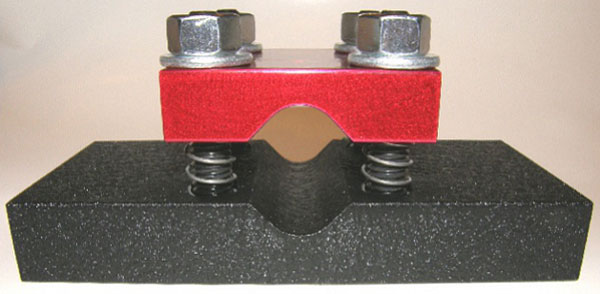
 How much does it cost you to send a round downrange? Ask most shooters this question and they’ll start adding up the cost of components: bullets, powder, and primers. Then they’ll figure in the cost of brass, divided by the number of times the cases are reloaded.
 As noted above, a PPC barrel is typically replaced at 700-800 rounds. A 6.5-284 barrel can last 1200+ rounds, but it might need replacement after 1000 rounds or less. A 6BR barrel should give 2000-2600 rounds of accurate life, and a .308 Win barrel could remain competitive for 4,000 rounds or more.


 If you have a .223 Rem, 6BR, .243 Win, 6.5×47 Lapua, 6.5×55, .308 Win, 30-06, or 300 WM Rifle, we recommend you buy a box of


