You don’t hear much about PacNor barrels in long-range competition, but FORUM member Wes J (aka P1ZombieKiller), proved that they can shoot “lights-out” in a rig assembled by a talented gunsmith. A few seasons back, Wes decided to upgrade a 6mmBR for mid-range benchrest and varmint matches. Wes tells us: “Since I restocked my 6BR … I have not had a chance to shoot it much since I have been playing the 100-200 game. I decided to take it out and do some playing at 500 yards. I have to give some serious props to my buddy (and fellow FORUM member) ‘PREACHER’ who did the chambering and barrel work for me. He can certainly make a gun shoot good. The barrel is a PacNor 1:8″ twist. My load was 105gr Berger VLDs pushed by 29.6 grains of Varget.” The five-round, 500-yard group shot by Wes J with his 6BR, measured just 1.240″, as measured by OnTarget software. Now that’s one accurate rig!
Five by Five — 5-Shot Group at 500 Yards, 1.240″, 0.237 MOA
This Editor knows something about the potential of a PacNor barrel. I have a 3-groove stainless PacNor SuperMatch on a Savage-actioned 6BR. This barrel shoots honest quarter-MOA in calm conditions, and it cleans up super-easy. The interior finish is so good, I’ve never had to brush the bore or use abrasives, and after 750 rounds it shoots as well as ever. I attribute the easy cleaning to the fact the lands in a PacNor 3-groove are wide and flat, so they are gentle on bullet jackets. I think accuracy is helped by the fact that my PacNor runs on the tight side (0.236 land dimension) with a good amount of choke. That works well with the 105gr Lapua Scenars and 103gr Spencers I like to shoot. You can read more about my rifle, nick-named the “Poor Man’s Hammer”, in this Feature Article from our archives. On one particularly calm day, in the hands of my friend (and ace trigger-puller) Joe Friedrich, the Poor Mans’ Hammer put 3 shots in under 0.200″ (measured center to center) at TWO Hundred yards. If you get a good one, PacNor three-grooves can definitely shoot.
Target Measurement with OnTarget Software
We used OnTarget software to measure the 5-shot group in the target above. This easy-to-use software is very repeatable, once you get a feel for plotting the shots. The latest On Target v2.25 Precision Calculator is FREE for a 15-day evaluation period. If you like it (and you will, trust us) there’s a modest $11.99 registration fee to activate the program. In addition to group size (in inches), OnTarget plots distance to aiming point, and the software automatically calculates the group’s vertical height, horizontal dispersion, average to center (ATC), and group size in MOA.
You can run a measurement on a scanned target or a photo of a target. You’ll need some known reference to set the scale correctly. The target above had a one-inch grid so it was easy to set the scale. Once you’ve set the scale and selected bullet diameter and target distance, you simply position the small circles over each bullet hole and the OnTarget software calculates everything automatically, displaying the data in a data box superimposed over the target image. To learn more about OnTarget Software, read AccurateShooter.com’s OnTarget Product Review. This article covers all the basics as well as some advanced “power user” tips. NOTE: Since the review was written, On Target has updated the software, and the free version now has a time limit.
Precision rifle shooters don’t have to hit a big-league fastball, or launch a top-fuel dragster in the blink of an eye. Nonetheless, reaction times are important in our sport — both for competitive shooters and hunters. Want to catch that prairie dog before he slips down his hole? You’ll need to be quick. Want to win at short-range benchrest? Then you’ll need to watch your windflags and respond quickly to a change. Miss a major wind-shift and you could ruin your whole weekend.
Here’s a fun test of reaction times from HumanBenchmark.com. The way it works is that, after clicking “Start”, you wait until the background color changes from red to green. The instant you see green, immediately click your mouse. The average (median) reaction time is 215 milliseconds.
Tips for Faster Times
Here are three tips to speed up your reaction times:
1) Respond to the color change, rather than wait to read “CLICK!”.
2) Try focusing at the corner of the colored box, rather than the center.
3) Have your index finger “poised and ready” over the left button–you can shave milliseconds by very slightly depressing the button before you actually click.
Firing line at 2019 Super Shoot. Photo courtesy Armeria Regina.
What components do world-class, short-range group benchrest shooters use? BAT actions, Krieger barrels, and Bix’n Andy triggers (and Jewells) are the components of choice. And barrel tuners are now widely used by the top shooters. As for powder, Vitavuori N133 is still the choice of virtually all top competitors. And yes the 6PPC definitely rules the roost. Every Top 20 shooter at the 2019 Super Shoot shot a 6PPC. Every one. Read on to learn more about the Top 20 Equipment used at this year’s Super Shoot.
We recently reviewed the Top 20 Equipment List for the 2019 Super Shoot at the Kelbly’s Range in Ohio. This Top 20 List reveals the gear choices for the 13.5-lb Heavy Varmint Class and the 10.5-lb Light Varmint/Sporter Class (20 entries for each division). Here are notable gear choices for Top 20 Competitors (both divisions) at the 2019 Super Shoot:
Actions: 14 of 20 HV and 16 of 20 LV/SP shooters used BAT actions. So there were 75% BATs for both classes combined. Barrels: 10 of 13 listed HV barrels and 9 of 12 listed LV/SP barrels were Kriegers. Overall, of the barrels identified in the Top 20 Equipment lists, 76% were Krieger. That’s dominance! [Note: We have been informed that entries with no barrel-maker listed may have been Bartlein barrels.] Triggers: Notably 10 of 20 HV triggers were Bix’n Andy — 50%. For the other class, 7 of 19 listed triggers were Bix ‘N Andy. All others were Jewells. Tuners: In HV Class, 12 of 20 shooters used tuners, mostly Bukys. 11 of 20 LV/SP shooters had tuners. Overall that is 57.5% tuner usage for both classes combined.
Cartridge: For both classes, every single Top 20 competitor shot the 6PPC. ‘Nuf said. Powders: 19 of 20 HV Shooters used Vihtavuori N133. Likewise 19 of 20 LV/SP shooters used VV N133, with one not reporting. That is total dominance for N133.
Bullets: There was a wide selection of bullets used in both classes. Custom bullets by “boutique” bullet makers were certainly favored by Top 20 shooters. Sta Moy 65s were popular, as were Hottenstein 68s and Bart’s bullets among others.
You can benefit from these precision mandrels, trust us…
Controlling cartridge neck tension is a critical aspect of accurate reloading. A very small change in the amount of grip on the bullet can actually have a noticeable effect on accuracy (and group size). You can tune neck tension with different size bushings used with FL-sizing or neck-sizing dies. You can also adjust neck “grip” by annealing your brass, or turning your necks for reduced neck-wall thickness.
But perhaps the most precise way to tune neck grip on the bullet is to use Precision Expander Mandrels. Many top shooters size their case necks down pretty far with a full-length sizing die then use a precision neck mandrel as a final step. This expands the neck back to the precisely-desired neck diameter. Because you are working from the “inside out”, variances in neck-wall thickness become less important. This also ensures you have a perfectly-round internal neck geometry for seating your bullet. (Yes, unfortunately some neck bushings are not perfectly round inside.)
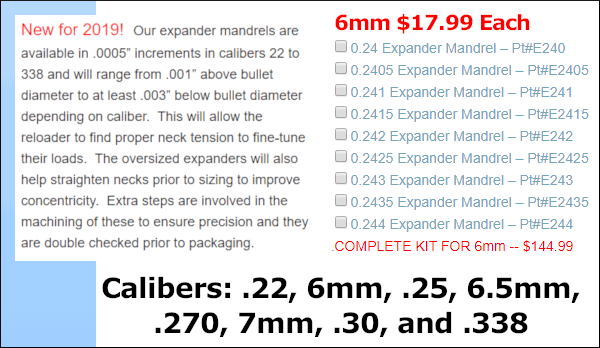
For guys who want ultra-precise control over neck tension (and “grip” on the bullet), 21st Century Shooting now offers Precision Expander Mandrels in .0005 (one-half thousandth) increments. These will be available for most popular match calibers including: .224, 6mm, .25, 6.5mm, .270, 7mm, .308, and .338 calibers. These mandrels cost $17.99 each, or you can get a complete set of nine mandrels in .0005 increments (for one caliber) for $144.99. Listed below are the nine 6mm mandrels:
John Perkins, owner of 21st Century tells us: “Finally! We have our expander mandrels up and ready to order on our website here: http://www.xxicsi.com/expander-mandrels.html.” This is a big deal. James Crofts, past National F-TR Champion, says “WooHoo — great news!”
To get best results with these precision mandrels, John recommends using the 21st Century Expander Die Body, part #904. Watch video for set-up tips:
John adds: “We are still in the midst of turning all of these so some calibers will ship when they are completed. Should have them all done by end of next week or so! Thanks for your patience while we got these set up and in process!”
In the benchrest game, both 100/200 yard disciplines and Long Range, it’s important that your rifle track smoothly and repeatably every time. You want the rifle to come straight back without twisting, rocking, or hopping on the bags. When you’re trying to drill your entire 5-Shot or 10-Shot string quickly, it’s also important that the gun returns to the same position after each shot. When the scope crosshairs return to virtually the exact point of aim, you can make successive shots with minimal aim adjustments.
For top “runners” who try to get five shots down-range in under 20 seconds, not having to make significant aiming corrections with your front rest controls can really speed up the process. Shooting quickly permits the competitor to “stay in the condition”, sending all his shots to the target before the wind direction or wind velocity changes.
TEN Shots in 20 Seconds at 1000-Yard Match
To see how rapid shooting works, watch this video of Tom Mosul, one of the USA’s best 1000-yard shooters. In a 10-shot Heavy Gun relay, Tom shoots his 17-lb Light Gun chambered for a 6mmBR Improved cartridge. He pulls the trigger for the first time at 00:20 and he fires his tenth (and last) shot at 00:40. Tom makes TEN SHOTS in 20 seconds, an average of just 2.0 seconds per shot!
TEN Shots in 31 Seconds at 1000-Yard Match
This second video, filmed from the side, shows Tom Mosel shooting a different 17-pounder. Again, note how smoothly the stock slides back and forth. Here Tom completes Ten Shots in 31 seconds, with the first shot at 00:13, and the tenth (last) at 00.44.
Adjustable Stock Rudder Through-the-Lens Video
Gunsmith Alex Wheeler sells stocks with an adjustable metal “rudder” or “keel” on the underside of the rear section of the stock. This rudder is the only part of the stock that contacts the rear bag. This aluminum rudder can adjust slightly left to right as well as adjust up/down for angle. Some guys want the keel nearly flat while others prefer the keel to be slightly lower in the rear.
This video shows how the cross-hairs stay on target once the stock rudder is adjusted properly. Alex adjusted this particular rudder by shimming the height* and moving the back of the rudder to the right.
The rudder’s horizontal adjustability allows benchrest shooters to correct for stock flaws that might adversely affect tracking. Essentially, by adjusting the rudder, you can achieve perfect alignment. Alex Wheeler explains: “If you pull your rifle back in the bags and the cross hair moves, your stock is not straight. The easiest fix is to use an adjustable rudder. They come standard on all my stocks.”
Wheeler explains: “The white box in the center of the 1000-yard target is four inches square. With a properly-adjusted rudder it’s easy to obtain less than one inch of cross-hair movement at 1000 yards.” You can see that, once Alex made the rudder adjustment, there’s hardly any detectable movement. Alex adds, “the more you play with it, the better you get it.”
*Initially Alex says he is going to shim the front. Later in the video Alex says he shimmed the rear. It can be a trial/error process. Credit Boyd Allen for finding these videos.
AccurateShooter.com offers a cool page with over 50 FREE downloadable targets. You’ll find all types or FREE targets — sight-in targets, varmint targets, rimfire targets, bullseye targets, tactical targets, load development targets and more. CLICK HERE for all our free targets, including our LOAD DEV target.
OK, if all that isn’t enough, we just found four new targets that we really like, plus our fan favorite “bughole” target.
This is a nicely-designed six-bull grid target. Use this for load development or accuracy testing. Set your scope so you can aim at the orange diamonds while your shots impact in the box above. This target has a visible background grid so it is easy to estimate your group size. You’ll find other load development targets in this Shooters’ Forum Thread.
This target was created using Open Office (Draw) by Forum member TwoBoxer for 100-yard load development and practice. He tells us: “The color, size of the center dot, crosshair lines, etc. were varied to work with my scope and magnification at 100 yards. I expect the group POI to move as elements of the load are varied. So concern about obliterating the aim point is minimal, and needs to be controlled by how you zero the rifle in any case.”
With this playing card-themed target, each shooter takes five shots and the one with the highest hand wins. You can also shoot for four-of-a-kind, against the clock, fastest four (without a mistake) wins.
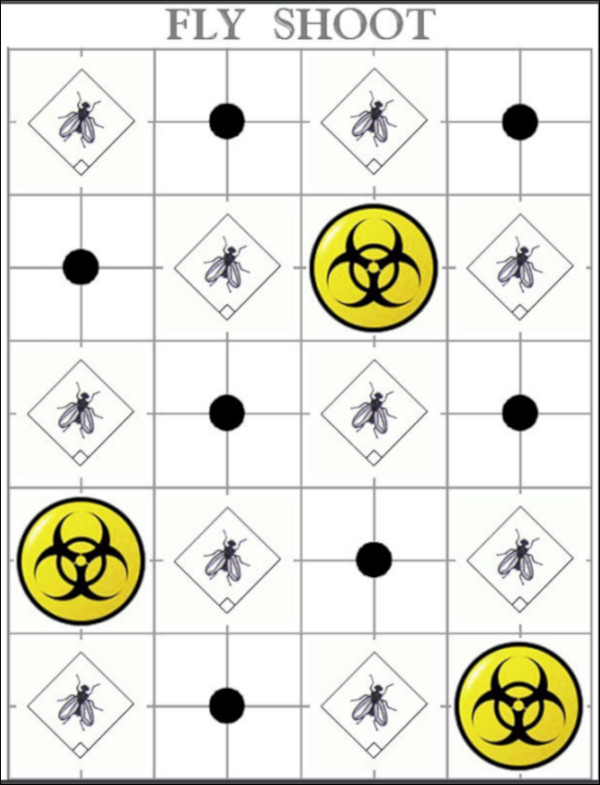
Go for true “bug-holes” with our Fly Shoot Target. You can shoot all the flies first, then go for the smaller black dots. Watch out for the bio-hazard rings!
Here’s a treat just in time for the holidays — you can see a video view of 1000-yard Benchrest competition tonight on Shooting USA television. The Wednesday, November 21, 2018 episode of Shooting USA features the 2017 IBS 1000-Yard National Championship held at the Whitehorse Shooting Center in Peeltree, West Virginia. This Shooting USA episode takes you to the Whitehorse 1K Range in September 2017. You can see the action on the firing line and the Shooting USA team also interviews many competitors. Watch this episode on the Outdoor Channel at these times: 9:00 PM Eastern and Pacific; 8:00 PM Central.
If you want to learn about the 1000-yard Benchrest game, definitely tune in to Shooting USA on September 26, 2018 (tomorrow) to watch last year’s IBS action. There were nearly 120 shooters competing (118 in Light Gun, 107 in Heavy Gun).
To learn more about on this event, read our detailed 2017 IBS 1K Nationals Match Report. At the 2017 Nationals, conditions were challenging to say the least, with rain storms, spiraling winds, and fog. In fact, rain and fog on Saturday (with cancelled relays) caused the Nationals to be extended by one day through Monday. What’s more, of the 107 shooters listed in the Two-Gun Overall results who actually shot both guns, there were dozens of DQs.
Top Guns at the 2017 IBS 1000-Yard Nationals were Edward Kenzakoski (Two-Gun Overall Champion), Mike Gaizauskas (Light Gun Overall, plus LG Score Agg), and Mike Brennan (Heavy Gun Overall, plus HG Score Agg). Group Agg winners were Richard Schatz for LG, and Charlie Lentz for Heavy. Two ladies also deserve mention. Sally Bauer shot the smallest group of the match, a 1.923″ 5-shot group in LG — that’s 0.184 MOA! Ruth Edwards drilled a 2.104″, also mighty impressive. Here’s Sally below with her very patriotic Heavy Gun…
Here’s a simple solution for lumpy front sandbags. Cut a small block the width of your fore-end and place that in the front bag between matches. You can tap it down firmly with a rubber mallet. This will keep the front bag nice and square, without bunching up in the center. That will help your rifle track straight and true. Rick Beginski uses wood (see photo), while our friend John Southwick uses a small block of metal. The metal block might work a little better, but the wood version is easier to make with simple tools. John Loh of JJ Industries offers a slick Delrin block with a built-in bubble level. Loh’s block helps ensure that the actual top surface of your front bag is level, as distinct from the front rest assembly.
At the request of Forum members, we are reproducing this helpful article by gunsmith and Hall-of-Fame benchrest shooter Thomas “Speedy” Gonzalez
How to Reduce Vertical in Your Shot Groups
One of our Shooter’s Forum members recently built a new benchrest rifle. He was concerned because his groups were stringing vertically. This is a common problem that all precision shooters will face sooner or later. In addition to ammo inconsistencies, many other factors can cause vertical stringing. Accordingly, it’s important that you analyze your gun handling and bench set-up systematically.
Hall of Fame benchrest Shooter Speedy Gonzalez has written a helpful article that explains how to eliminate mechanical and gun-handling problems that cause vertical spread in your groups. Speedy’s article addresses both the human and the hardware factors that cause vertical. CLICK HERE to read the full article. Here are a few of Speedy’s tips:
• Front Bag Tension — Vertical can happen if the front sand bag grips the fore-arm too tightly. If…the fore-arm feels like it is stuck in the bag, then the front bag’s grip is too tight. Your rifle should move in evenly and smoothly in the sand bags, not jerk or chatter when you pull the gun back by hand.
• Sandbag Fill — A front sandbag that is too hard can induce vertical. Personally, I’ve have never had a rifle that will shoot consistently with a rock-hard front sandbag. It always causes vertical or other unexplained shots.
• Stock Recoil — Free-recoil-style shooters should be sure their rifle hits their shoulder squarely on recoil, not on the edge of their shoulder or the side of their arm. If you shoulder your gun, you need to be consistent. You can get vertical if your bench technique is not the same every shot. One common problem is putting your shoulder against the stock for one shot and not the next.
• Front Rest Wobble — You will get vertical if the top section of the front rest is loose. Unfortunately, a lot of rests have movement even when you tighten them as much as you can. This can cause unexplained shots.
• Stock Flex — Some stocks are very flexible. This can cause vertical. There are ways to stiffen stocks, but sometimes replacement is the best answer.
• Rifle Angle — If the gun is not level, but rather angles down at muzzle end, the rifle will recoil up at butt-end, causing vertical. You may need to try different rear bags to get the set-up right.
• Unbalanced Rifle — If the rifle is not balanced, it does not recoil straight, and it will jump in the bags. If the rifle is built properly this will not happen. Clay Spencer calls this “recoil balancing”, and he uses dual scales (front and rear) to ensure the rifle recoils properly.
• Firing Pin — A number of firing-pin issues can cause vertical. First, a firing pin spring that is either too weak or too strong will induce vertical problems. If you think this is the problem change springs and see what happens. Second, a firing pin that is not seated correctly in the bolt (in the cocked position) will cause poor ignition. Take the bolt out of rifle and look in the firing pin hole. If you cannot see the entire end of firing pin it has come out of the hole. Lastly, a firing pin dragging in bolt or shroud can cause vertical. Listen to the sound when you dry fire. If you don’t hear the same sound each shot, something is wrong.
• Be Consistent — You can get vertical if your bench technique is not the same every shot. One common problem is putting your shoulder against the stock for one shot and not the next.
• Head Position — Learn to keep your head down and follow-through after each shot. Stay relaxed and hold your position after breaking the shot.
• Last Shot Laziness — If the 5th shot is a regular problem, you may be guilty of what I call “wishing the last shot in”. This is a very common mistake. We just aim, pull the trigger, and do not worry about the wind flags. Note that in the photo below, the 5th shot was the highest in the group–probably because of fatigue or lack of concentration.
“The blue plastic barrels that we have to shoot through are the idea of the local police — to ensure that we keep our rifles pointing at the targets!” — David Sharp
Here’s a great story from the other side of the pond — the United Kingdom. Shooting a .308 Win factory Savage rifle, a novice benchrest shooter set two new 1000-Yard UK Factory Sporter Class records with a group barely over three inches plus a 6.756″ four-group Aggregate. The Savage had been upgraded with an inexpensive aftermarket stock and Timney trigger, but was otherwise “as manufactured” — with factory barrel.
At Ingleston, competitors shoot for group size only — so there are no scoring-rings on the targets.
On October 14, 2018 David Sharp had a memorable performance at the Ingleston Range in Scotland. David Agg’d 6.756 inches for all four 5-shot groups, a new UK 1000-Yard record for the Factory Sporter Class. His smallest group measured 3.090 inches, which is also a new UK Factory Sporter record. Great Shooting David — congrats!
Sharp Sets Two New UK Factory Sporter Class 1000-Yard Records
Report by Vince Bottomley
In the UK, long-range benchrest is far more popular than short-range. The UKBRA (United Kingdom Benchrest Association) holds shoots at three venues: Diggle (100, 600 & 1000 yards), Bisley (100 yards only) and Ingleston in Dumfries, Scotland (1000 yards).
The Scottish venue is the UK’s latest 1000-yard facility. It was established just three years ago yet it is already holding well-attended monthly shoots. It is operated by the Galloway Small Arms Club and, as you may imagine, it is situated in the beautiful wild Scottish countryside.
The UKBRA operates under IBS/NBRSA rules for the Light and Heavy Gun Classes but, many of the Scottish members are also deer stalkers and came to the benches with their hunting rifles, so we also run a Factory Sporter Class. Factory Sporter rifles must be the original manufacturer’s barreled-action but a more benchrest-compatible stock may be used or ‘bag-rider’ attachments may be fitted to the butt and fore-end. The barreled-action must however be totally as it left the factory — no re-chambering or throating, though the crown may be re-cut. To discourage potentially dangerous trigger modifications, an after-market trigger may be fitted.
The Factory Sporter Class is very popular and Savage rifles, chambered for the 6mmBR, 6.5-284, and .308 Win are the favored factory-classers. These have produced some remarkable performances over the years, often out-performing custom rifles!
David Sharp is a True Sharp-Shooter
David Sharp is a relatively new benchrest shooter, though he has decades of firearms experience. David started his shooting days wild-fowling and rough shooting with a shotgun over 50 years ago. After retiring, he moved to Dumfriesshire and began shooting again — clay pigeon, wildfowling on the Solway, driven pheasant and deer stalking. As a stalker, David keeps his eye in by shooting targets on a local range using his .308 Mannlicher.
Eventually, the pains of old age began taking their toll and stomping up hills was becoming more difficult. Fortunately, David heard about the Ingleston 1000-yard range and joined the Galloway Small Arms Club in 2016. As a complete novice to benchrest shooting, David relied on the guidance and advice from his fellow Club members and eventually purchased a Savage Model 12 F-TR rifle in .308 Winchester to compete in the Factory Class.
Here’s the view looking downrange. What a beautiful place to shoot…
.308 Win Factory Savage with Choate Stock and Vortex Scope
David’s rifle has some upgrades, as permitted for Factory Sporter Class. The Savage trigger was replaced with a Timney. The Savage F-TR stock was replaced with a Choate Varmint stock fitted with a Sinclair front bag-rider. The Choate’s butt was home-modified to better ride the Edgewood bag. The rifle is fitted with a Vortex Golden Eagle 15-60 scope mounted on a 20 MOA Ken Farrell rail via Vortex rings. Dave shoots off a SEB Mini front rest. As the Mini is lighter to lug around than the SEB NEO (and less expensive), the Mini is becoming popular with UK shooters.
David reports: “My rounds are nothing special — I’m using Sierra 2155 155 grain bullets over Vihtavuori N140 powder and CCI 200 primers. I use Lapua brass (large primer) full-length sized in a Redding S bushing die to give 0.002″ neck-tension.”
Although the Ingleston Range is a beautiful place to shoot, as you can imagine conditions can vary dramatically and it is not known for mild days! However, at 9:00 am on the day of David’s record shoot, it was clear and quite still with the flags barely lifting. The temperature was already 15 deg C (59 deg F). What more could any benchrest shooter ask for?
In the photo of David above, you can just see the four 1000-yard targets in the extreme top right of the picture — up near the tree-line. Note, at Ingleston, competitors shoot for group size only. Hence there are no scoring-rings on the target. However, Vince Bottomley says score shooting may begin at some UK ranges: “This year we have purchased a set of electronic targets. The IBS target face can be inputted so we will now start to shoot for score as scores are registered instantly. Previously, it just took too long to score the targets as well as measure the groups.”


Target Measurement with OnTarget Software






 To learn more about on this event, read our detailed

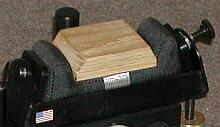 Here’s a simple solution for lumpy front sandbags. Cut a small block the width of your fore-end and place that in the front bag between matches. You can tap it down firmly with a rubber mallet. This will keep the front bag nice and square, without bunching up in the center. That will help your rifle track straight and true. Rick Beginski uses wood (see photo), while our friend John Southwick uses a small block of metal. The metal block might work a little better, but the wood version is easier to make with simple tools. John Loh of
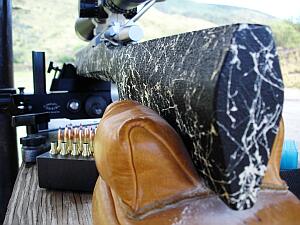 • Front Bag Tension — Vertical can happen if the front sand bag grips the fore-arm too tightly. If…the fore-arm feels like it is stuck in the bag, then the front bag’s grip is too tight. Your rifle should move in evenly and smoothly in the sand bags, not jerk or chatter when you pull the gun back by hand.


