Shooting reactive targets is fun, especially when you get to use ultra-accurate benchrest rifles. To see how the “Varmint Silhouette” game is played, tune in to Shooting USA tonight on the Outdoor Channel. Tonight’s episode features a long-range varmint benchrest silhouette match at the Ridgway Rifle Club in Pennsylvania. This is silhouette like you’ve never seen it, with targets placed from 850 to 1,000 yards, and shooters using precision rifles, high-end optics, and advanced rests. This new sport combines the knock-down fun of silhouette with the high-tech precision of benchrest shooting. At Ridgway’s first Bench Rest Silhouette match 28 shooters participated. Five years later, nearly 120 shooters attend regular monthly matches. CLICK HERE for Match Info.
Varmint Benchrest Silhouette Basics
In 2010, the Ridgway Rifle Club combined Metallic Silhouette and 1000-yard Bench Rest into one exciting new discipline. Steel targets are arrayed in banks of five at four distances. The targets are set up as follows: Crows at 850 yards, Ground Hogs at 900 yards, Bobcats at 950 yards, and Coyotes at 1000 yards. Just dinging a target is not enough — to count as a “hit”, the target must fall down.
Ridgeway allows two classes of guns, Heavy Class with a maximum weight of 17 pounds, and Standard Class with a maximum weight of 12 pounts. Both classes must otherwise conform to the Light Gun rules for the Original 1000-Yard Bench Rest Club in Williamsport, PA.
Varmint Silhouette West of the Mississipi
Clubs in other states also host Varmint Silhouette matches (or some variant thereof). One of the longest-running and most popular Varmint Silhouette matches is held the first weekend of every month at the Pala Range, in San Diego County, California. At Pala, competitors shoot at “critter” targets placed at five yardages: 200 Meters – Field Mice (“pikas”); 300 meters – Crows; 385 meters – Ground Squirrels; 500 meters – Jack Rabbits; 600 yards – Prairie Dogs
Fun Weekend for the Whole Family At Pala, there’s a deluxe Indian Casino/Spa nearby. So don’t hesitate to bring the wife. If she’s not a shooter, she can enjoy a fancy brunch or spa treatment while you’re having fun mowing down metal critters. Pala is a 30 minutes from the Pacific Ocean and beautiful beaches, so you can make this a weekend holiday for the whole family — kids love sand and surf.
Sometimes superlatives really aren’t necessary. Just look at that target. Yes that is FIVE shots (although it truly appears like one hole). And it is centered! This remarkable group, measured at 0.039″, was shot by Lou Murdica in Phoenix on January 3, 2015. Lou drilled this group with his 6 PPC railgun. Rounds were loaded with Accurate LT-32 powder and Berger 65gr BT bullets. The target will be submitted to the NBRSA as a potential new 100-yard Benchrest record in the Unlimited (Railgun) Class. The current NBRSA record small group (Unlimited) is a 0.049 shot by Hall-of-Famer Gary Ocock in 2009.
This is a file photo with a different railgun.
This wasn’t the only tiny group shot by Lou over the weekend. Murdica shot a sizzling 0.1262 five-target 100-yard Unlimited Aggregate. That 0.1262 Agg will also be submitted for consideration as a possible record. Here are the individual group sizes: 0.104, 0.183, 0.201, 0.104, 0.039. At this match Lou won both the Unlimited and Sporter class. “It was a great weekend” Lou reported.
About the Gun
What kind of rifle can put five shots in one hole? Lou was shooting an Unlimited-class railgun. This return-to-battery rig (a Kensler railgun) allows the shooter to focus on firing at the perfect time for the conditions. Lou’s Kensler railgun (see below) features a Kelbly top-loader Grizzly action, Shilen 6-groove barrel, and March 10-60X scope. The Shilen is chambered for the 6 PPC cartridge. But there’s something special about this particular 6 PPC — read on….
Click photo for larger version:
Radical New Reamer Design from PT&G
Lou used a new chamber reamer from Pacific Tool & Gauge (PT&G) with special geometry in the leade/throat section. Called a “Bore Rider” (or sometimes “bore-runner”), this new reamer design cuts a staged, variable taper in the leade/throat area that is quite different than the taper in a typical throat. It’s a little hard to explain, so we’ve included the 6 PPC Bore Rider reamer print below. (Download the PDF file for a better view.) Experts should look at the leade angle(s), freebore, and throat dimensions. You may be surprised. Dave Kiff of PT&G says this Bore Rider design has worked successfully for other cartridge types/calibers as well. Apparently this design helps the bullet center up smoothly in the bore before the bullet engages “hard” in the rifling — or so we’ve been told.
Here’s some benchrest advice that can help you reduce vertical and shoot tighter groups… without spending another penny. Next time you go to the range, experiment with the position of your rifle on the front rest, and try a couple different positions for the rear bag. You may find that the rifle handles much better after you’ve made a small change in the placement of your gun on the bags. Recoil can be tamed a bit, and tracking can improve significantly, if you optimize the front rest and rear bag positioning.
Balance Your Gun BEFORE You Spend Hours Tuning Loads
In the pursuit of ultimate accuracy, shooters may spend countless hours on brass prep, bullet selection, and load tuning. Yet the same shooters may pay little attention to how their gun is set-up on the bags. When you have acquired a new rifle, you should do some basic experimentation to find the optimal position for the forearm on the front rest, and the best position for the rear bag. Small changes can make a big difference.
Joel Kendrick, past IBS 600-yard Shooter of the Year, has observed that by adjusting forearm position on the front rest, he can tune out vertical. He has one carbon-fiber-reinforced stock that is extremely rigid. When it was placed with the front rest right under the very tip of the forearm, the gun tended to hop, creating vertical. By sliding the whole gun forward (with more forearm overhang ahead of the front sandbag), he was able to get the whole rig to settle down. That resulted in less vertical dispersion, and the gun tracked much better.
Likewise, the placement of the rear bag is very important. Many shooters, by default, will simply place the rear bag the same distance from the front rest with all their guns. In fact, different stocks and different calibers will NOT behave the same. By moving the rear bag forward and aft, you can adjust the rifle’s overall balance and this can improve the tracking significantly. One of our shooters had a Savage 6BR F-Class rifle. By default he had his rear bag set almost all the way at the end of the buttstock. When he slid the rear bag a couple inches forward the gun tracked much better. He immediately noticed that the gun returned to point of aim better (crosshairs would stay on target from shot to shot), AND the gun torqued (twisted) less. The difference was quite noticeable.
The important point to remember here is that each rig is different. One gun may perform best with the front rest right at the tip of the forearm (Position ‘D’ in photo), while another gun will work best with the rest positioned much further back. This Editor’s own 6BR sits in a laminated stock that is pretty flexy in the front. It shoots best with the front rest’s sandbag located a good 6″ back from the forearm tip (position ‘A’).
A small change in the position of the forearm on the front rest, or in the placement of the rear bag, can make a big difference in how your gun performs. You should experiment with the forearm placement, trying different positions on the front rest. Likewise, you can move the rear bag back and forth a few inches. Once you establish the optimal positions of front rest and rear bag, you should find that your gun tracks better and returns to battery more reliably. You may then discover that the gun shoots smaller groups, with less vertical dispersion. And all these benefits are possible without purchasing any expensive new gear.
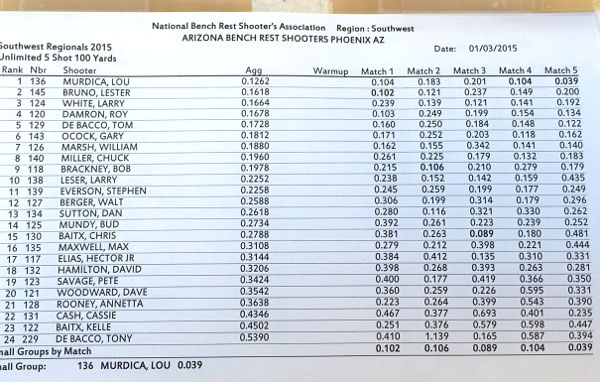
You have to love this story, supplied by our friend Lou Murdica. It seems that a petite little 10-year-old school girl finished fourth in a 100-Yard Benchrest match in Phoenix, beating some of the best in the business, including many Benchrest Hall of Famers. That’s right, shooting a remarkable 0.1612 Aggregate, little Angelina G. put a whupping on some very big names in the Benchrest game, including Lou Murdica himself. Angelina finished just .008 behind Hall of Famer Gary Ocock, beating other Benchrest superstars such as Bob Brackney, Lester Bruno, and Tom Libby. Angelina also beat legendary bullet-maker Walt Berger, but we’ll cut Walt some slack. Now in his 80s, Walt deserves praise for doing so well at the opposite end of the age spectrum.
Congratulations to Angelina on some great shooting in the Unlimited Class. Her five groups measured: 0.186, 0.172, 0.173, 0.121, 0.155. That’s impressive consistency. You go girl!
Point to ponder: If Angelina was shooting a Rail Gun, her rifle probably weighed more than she did.
Check out the big names who finished behind little Angelina.
Our friend (and ace benchrest shooter) Lou Murdica recently tested some prototype Accurate LT-30 powder from Western Powders. This is a new formulation similar to LT-32, but with a slightly faster burn rate. That makes LT-30 ideal for the 30 BR and other cartridges that presently work well with Hodgdon H4198. Lou tells us: “At a 100/200-yard group benchrest match in Phoenix this weekend, I shot the new LT-30 powder in a 30BR. I used Berger 115gr bullets in a rifle with a Shilen barrel. This powder is just like the LT-32 powder… just a little faster.”
Lou added that, in the 30 BR, this powder delivers accuracy similar to Hodgdon H4198, but 30 BR loads with match bullets can be pushed up to 200 FPS faster without apparent pressure issues. That’s significant. Lou posted some targets which do indicate that LT-30 offers excellent accuracy. Here are 5-shot groups shot with Berger 115s and LT-30 powder:
Western Powders has not yet announced an “arrival date” for LT-30, so we can’t tell you when you will see LT-30 at retail powder vendors. It appears this new propellant will go into production in the near future, though LT-30 is not yet listed on the Accurate Powders website.
Accurate’s New LT-30 Powder Is Like LT-32 but a Little Bit Faster…
LT-32 is a fine-grained extruded powder that was developed for 6mm PPC benchrest competitors. Already a proven match winner, LT-32′s excellent shot-to-shot consistency and low standard deviation (SD) make this a very good choice for competitive benchrest shooting. Due to its small grain size, LT-32 flows like a spherical powder and allows for very precise hand-loading. It also offers impressive accuracy in varmint and tactical cartridges, including the .223 Rem, and 20 Tactical. If you haven’t tried LT-32 in your PPC or varmint cartridges yet, you should give it a try. LT-32 is one of the most accurate powders on the market, when used with appropriate bullet/cartridge combos.
Stiller’s Precision Firearms is now offering its new line of rear lug, benchrest-grade rimfire actions, the 2500X (single-shot) and the 2500XS (sporter class mag-fed). These actions have already performed superbly in competition (see below). These actions represent the state-of-the-art in rimfire receivers. Top rimfire benchrest shooters are building rifles around the new Stiller actions and the results have been very promising. These actions offer true benchrest-grade manufacturing tolerances plus a superior firing pin system that should allow greater shot-to-shot consistency. Expect fewer unexplained fliers with these Stiller actions compared with older, factory-based actions (such as the Rem 40X).
Stiller 2500X Rimfire Action
The 2500X is Stiller’s new rear lug rimfire benchrest action. This features an Anschutz-style loading ramp, center recoil slot, side bolt release, and a unique shroud/firing pin system for perfect alignment (and more consistent ignition). Unlike many rimfire actions, the 2500X has a trigger hanger for easy trigger maintenance. The 2500X’s body and bolt are crafted from 416R stainless steel with a nitride finish for smooth and trouble-free operation. The outside is OD ground after nitriding for precise tolerances and a distinctive two-tone look.
Stiller 2500SX Rimfire Sporter Action
The 2500XS is a rear lug rimfire benchrest action for the Sporter Class. The “XS” model features a Sako magazine and easy-to-use loading ramp. Like the 2500X, the “XS” has an advanced shroud/firing pin system, plus a trigger hanger for easy trigger maintenance. The bolt and body are nitrided, 416R stainless OD ground for a dimensionally precise, two-tone finish. This lightweight action is specifically designed for IR50/50 sporter class benchrest. It comes with one (1) magazine.
Proof of Performance — 2500X Action Shoots 250-25X
Mike Kuklis’s new rimfire BR rifle built on a Stiller 2500X action delivered an impressive 250-25X in competition last week. Mike drilled this superb 250-25X card at the Tuckertown BR Barn on the way to a 1000-86X match win. Credit J. Miller for the photos from Benchrest Central.
Product Tip from EdLongrange. We welcome reader submissions.
Story by Jaime Hammer, IBS Social Media Manager
Paul Hammer was introduced to benchrest rifle shooting by his friend Bill Adcox at the Greenville Gun Club (in Greenville, SC) about five years ago. He has been an avid skeet shooter for most of his life, but his daughter never fell in love with that sport. The first time he took her to the rifle range with him, she was hooked. She loved the precision of it and that it’s very relaxing. If you haven’t been able to tell by now, I’m his daughter. What began slowly as a fun hobby that we could enjoy together picked up speed a year and a half ago, when we went to our first IBS match, a 100/200 yard match at Piedmont Gun Club. From then on, he spent much of his free time learning about the sport, from techniques to types of guns to how to reload his own ammunition.
Paul Hammer and Daughter Jaime Enjoy Time at the Range Together…
He frequently practices or competes in both group and score matches at 100, 200, and 600 yards at Piedmont Gun Club, Polk County Gun Club, and Greenville Gun Club. This year, he even competed for the first time in the annual Groundhog and Egg Shoot in Hickory, NC hosted by Bull’s Eye Sporting Goods. His smallest group, made while practicing at 100 yards with a 6 PPC, was 0.17 inch. His best score, made at 100 yards at the NC State Championship with a 6 PPC, was 249 with 8 Xs (he commented that he “made a perfect score with 5 Xs on the sighter target!”).
He said, “For me, benchrest rifle shooting is enjoyable because there’s so much to learn, and the people you meet along the way are nice and helpful. It’s fun and challenging.” Although he always tries and wants to shoot well, at the end of the day, he just enjoys the sport, spending time with his daughter, and meeting new people.
Part of his benchrest education has come from helping plan benchrest matches for Polk County Gun Club. Last September, in conjunction with Tony Moss, Paul began organizing monthly 100/300 yard groundhog and egg shoots. In doing so, he has learned more about shooting and what it takes to put together a successful benchrest rifle match. Paul and Tony are currently working with the board of directors to improve Polk County Gun Club’s rifle range and install target backers to get approval to hold IBS matches there.
If you would like to contact Paul to discuss the monthly Polk County Gun Club rifle matches or chat about general benchrest topics, send email to: paulhammer [at] bellsouth.net.
In these two videos from the Rekyyli Ja Riista (Recoil and Game) YouTube Channel, you can see how a modern, short-range benchrest rifle is shot. Note how the gun tracks superbly, returning right on target, shot after shot. As a result, the shooter doesn’t have to adjust the rifle position after firing (other than pushing the gun forward), so he can quickly load and fire within seconds of the previous shot. Good rests and consistent, smooth bolt actuation keep the gun from rocking.
It does take practice to perfect the right technique for shooting free recoil (or nearly free recoil — with just a pinch on the trigger guard). And, of course, you must have a very good bag/rest set-up and the stock geometry and rifle balance must be perfect. The ammo caddy also helps by placing the cartridge up high, right next to the left-aide loading port. Hats off to Forum member Boyd Allen for finding these videos. Boyd told us: “Watch carefully — Now this is how it’s done.” [Work Warning: Loud gunshot noises — Turn Down Volume before playback.]
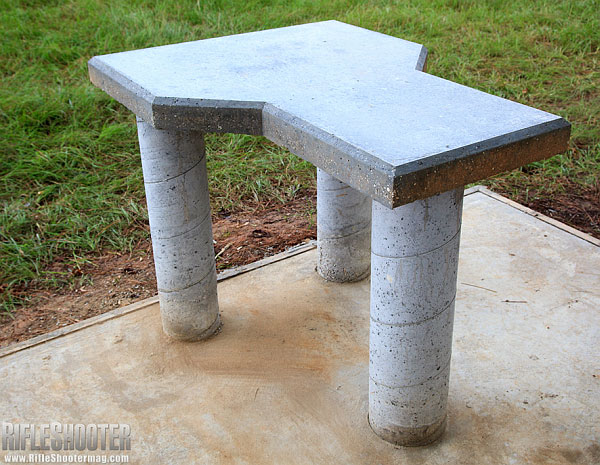
Who hasn’t dreamed of having a professional-quality permanent shooting bench on their own property? Well here’s an article that can help you make that dream come true. The latest online edition of RifleShooter Magazine shows how to build a quality concrete shooting bench step-by-step.
All aspects of the construction process are illustrated and explained. The author, Keith Wood explains: “Construction happened in three phases — first creating the slab foundation, then the support pillars (legs), and finally the table.”
Click image below to load article with slide show.
Each step in the process is illustrated with a large photo and descriptive paragraph. Starting with framing the foundation (Step 1), the article illustrates and explains the 15 Steps that produce the finished, all-concrete bench, shown below.
So, you want to put five shots through one hole at 100 yards? That may be asking a bit much, but with the right rifle, the right technique, and the right load, you might just be able to shoot “in the ones” (i.e. a group measuring 0.1 to 0.199 MOA). You could consume a lot of time and money trying to achieve this level of precision. Or you could learn from “the man”, Tony Boyer, unquestionably the most successful shooter in the history of short-range benchrest competition.
You can literally “go inside Boyer’s brain” by reading his 323-page treatise, The Book of Rifle Accuracy. First published in 2010, this is a beautiful book, full of color photos from cover to cover. Every serious benchrest shooter should read Tony’s book. He has dominated registered benchrest in a fashion that will never be duplicated. Tony Boyer has 164 U.S. Benchrest Hall of Fame points. The next closest shooter, Lester Bruno, has 48 Hall of Fame points. (Totals current 9/21/13).
The full-color book is 323 pages long, with color photos or color illustrations on nearly every page. The hard-cover edition costs $42.50, while the soft cover version is $34.50. Purchase from Amazon.com, or you can buy directly the publisher by visiting www.RifleAccuracyBook.com. The Boyer books are also available from Bruno Shooters Supply, 1-800-455-0350.


 At Pala, there’s a deluxe Indian Casino/Spa nearby. So don’t hesitate to bring the wife. If she’s not a shooter, she can enjoy a fancy brunch or spa treatment while you’re having fun mowing down metal critters. Pala is a 30 minutes from the Pacific Ocean and beautiful beaches, so you can make this a weekend holiday for the whole family — kids love sand and surf.



 You have to love this story, supplied by our friend Lou Murdica. It seems that a petite little 10-year-old school girl finished fourth in a 100-Yard Benchrest match in Phoenix, beating some of the best in the business, including many Benchrest Hall of Famers. That’s right, shooting a remarkable 0.1612 Aggregate, little Angelina G. put a whupping on some very big names in the Benchrest game, including Lou Murdica himself. Angelina finished just .008 behind Hall of Famer Gary Ocock, beating other Benchrest superstars such as Bob Brackney, Lester Bruno, and Tom Libby. Angelina also beat legendary bullet-maker Walt Berger, but we’ll cut Walt some slack. Now in his 80s, Walt deserves praise for doing so well at the opposite end of the age spectrum.

 Our friend (and ace benchrest shooter) Lou Murdica recently tested some prototype Accurate LT-30 powder from
 Accurate’s New LT-30 Powder Is Like LT-32 but a Little Bit Faster…


 In these two videos from the

 So, you want to put five shots through one hole at 100 yards? That may be asking a bit much, but with the right rifle, the right technique, and the right load, you might just be able to shoot “in the ones” (i.e. a group measuring 0.1 to 0.199 MOA). You could consume a lot of time and money trying to achieve this level of precision. Or you could learn from “the man”, Tony Boyer, unquestionably the most successful shooter in the history of short-range benchrest competition.


