|
|
September 12th, 2014
Here’s the deal of the year if you need a quality, windage-adjustable front rest. Pay just $165.00 for a competition-grade rest that normally sells for well over four hundred bucks! You heard that right. Bullets.com is offering aluminum-base front rests, with flex-shaft remote windage adjustment, for just $165.00! Choose either the popular slingshot-style rest (model BE1005) or a triangle base version (model BE1004). These front rests previously retailed for $425.00 each (with windage drive). But Bullets.com is having an “overstock” sale so you can get blow-out pricing on both these rests. At these prices ($165.00) you can afford two rests — one for yourself and one for a shooting buddy.
Slingshot-Style Front Rest Now $165.00 (BE1005)
Here is the slingshot model BE1005. Note, the optional bag is NOT included in the $165.00 sale price.


Remote Windage Adjustment System
What looks like a cable connected to a knob is actually a flexible drive shaft. This connects to the front bag carrier assembly (windage top) and moves it left and right as you rotate the knurled knob. This allows you to conveniently (and precisely) adjust windage from any shooting position.

Triangle-Base Front Rest $165.00 (BE1004)
Here is the triangle-base model BE1004. Note: Optional front sand bag is sold separately.

Premium Rests at a Blow-Out Prices
These Bald Eagle front rests can be used on the bench or on the ground for prone shooting. Designed by a benchrest shooter and refined by a member of the U.S. F-Class Open Rifle Team, this rest system has been thoroughly tested and proven to be capable of quick, precise adjustments during string shooting. There are two different models available for $165.00 — Slingshot base or Triangle base. The Slingshot model has an elongated front leg to keep the rest stable as well as keep the Windage adjustment knob within easy reach. These Bald Eagle rests feature a flex-shaft-drive Windage System that allows you to quickly and easily adjust for changing wind conditions. Front bags are sold separately. Minor modifications are required for left-hand shooters.
August 25th, 2014
If you have a digital camera or scanner, you can measure your shot groups easily with the FREE On-Target software (read our On-Target Software Review). However, not many people want to lug a laptop to the range just to measure their groups. Most folks measure their groups at the range with a small ruler, or a set of calipers. That works pretty well, but there is a much more precise method.

Neil Jones Target Measure Tool
Neil Jones makes a specialized group-measuring tool that fits a special optical viewing lens and shot-size template to your precision calipers. There are two main parts to the tool. The first part, attached to the fixed caliper jaw, is a block holding a spring-loaded plunger with a sharp point (used to anchor the tool). The second part is clamped to the sliding jaw assembly. This viewing unit has a magnifying lens plus a plexiglass plate with scribed centerline and circular reticles for various calibers (.224, 6mm, 30 cal). This device works with both conventional and digital calipers. You’ll find the Jones Target Measure Tool used by the official target measurers at many big benchrest matches. Jones claims that his tool “will speed up the measuring process and be more accurate than other methods.” The Neil Jones Target Measure Tool costs $80.00, which includes magnifier, but not calipers. It comes in two versions, one for dial calipers, the other for digital calipers. Neil Jones also sells his tool complete with dial calipers for $120.00, or with digital calipers for $150.00. It is probably cheaper to source your own calipers.
To order the Jones Tool, visit Neiljones.com, email njones@mdvl.net, or phone (814) 763-2769.
CLICK HERE for Detailed Review of Neil Jones Target Measure Tool.
August 12th, 2014

Report by Jeff Stover, IBS President
Photos by Vera Carter
 Smooth. Efficient. Well-run. Lots of small groups. Those words pretty much spell out the 45th annual IBS Group Nationals at Fairchance, PA. Match Director Bill Reahard and his crew put on a great show that consists of six days of competition from Monday through Saturday. Bill and his team spent days getting their southwestern Pennsylvania range ready for the nearly 80 shooters who attended. Fairchance is no stranger to big matches as the club has hosted previous Nationals and World Team qualifiers. Smooth. Efficient. Well-run. Lots of small groups. Those words pretty much spell out the 45th annual IBS Group Nationals at Fairchance, PA. Match Director Bill Reahard and his crew put on a great show that consists of six days of competition from Monday through Saturday. Bill and his team spent days getting their southwestern Pennsylvania range ready for the nearly 80 shooters who attended. Fairchance is no stranger to big matches as the club has hosted previous Nationals and World Team qualifiers.
IBS 2014 Group Nat’l Championship RESULTS (web-page)
IBS 2014 Group Nat’l Championship RESULTS (XLS spreadsheet)
Six Days of Competition in Four Classes
Some say that the IBS Group Nationals is a marathon. Six days of competition at both 100 and 200 yards with four classes of rifles: Light Varmint (10.5 lb.); Sporter (10.5 lb. – 6mm min caliber); Heavy Varmint (13.5 lb.) and Heavy Bench (known as ‘Unlimited’ in NBRSA-land). The first three classes are simply known as the “bag guns”. Most competitors use a 10.5-lb. rifle in 6PPC and compete in all three classes. The Heavy Bench (HB) class requires 10-shot groups as opposed to 5-shot groups for the bag guns. There is no prohibition to shooting your 10.5 lb. rifle in HB, but bag guns are simply outclassed by the rail guns, especially for 10-shot groups.
All 100-yard targets were shot the first three days followed by three days at 200 yards. It is done in this sequence to require only one change of wind flags.
Natalie from the Target Crew during the Powder-Puff match.

The week delivered pretty typical mid-Atlantic August weather: hazy sun with 80% humidity in the morning dropping to 50% as the temperature warmed. Fairchance is sometimes known to offer strong crosswinds that challenge the best of shooters. This week, however, the breezes were light to moderate and switchy. A shooter on his game with a well-tuned rifle could assemble a string of good groups. There were many ‘Teen Aggs’ (sub-.200 five target averages) shot this week.
Musical Chairs at the Group Nationals
IBS Nationals competition requires ‘full rotation’. That means that every time a shooter goes to the line for the next match target, he or she must move a requisite number of benches to the right. At the end of the day a shooter will shoot across the full width of the line. Some ranges offer unique properties that render some parts of the range harder or easier to shoot small groups. Bench rotation is important to even out those factors.
View looking down-range. This is a beautiful place to shoot.

Monday morning saw the Heavy Bench (HB) shooters hauling the big rail guns to the line. Bill Symons led the way at 100 yards with the only ‘Teen Agg’ in HB, a fine .1972. The 200-yard stage for HB would not be held until Saturday morning.
On Tuesday the bag guns came out for Light Varmint (LV) and Sporter (SP). Conditions allowed for quite a few very good groups. When the top five are under .1900 you know two things — Nationals competitors brought their “A Game” and the conditions were manageable. Sporter was not too much different as the first four were in the ‘teens. Ohio’s Jeff Gaidos led the way in LV with a .1714. In SP, Wayne Campbell from Virginia won with a .1902.
Sporter 100 “Top Guns” (L to R): Charles Miller, Steve Lee, Al Auman, Wayne Campbell, Larry Costa.

Wednesday was reserved for Heavy Varmint (HV) at 100 yards. Steve Lee worked his magic with a .1742. Reportedly, he was using some new Bart’s bullets on new Bart’s jackets. Steve shot well all week. Those new bullets certainly contributed to his success.
Wednesday afternoon saw the moving of flags for the 200-yard stage of the competition. The SP and LV 200 yard targets were Thursday’s course of fire. In LV, Hal Drake shot a .2045 Aggregate which edged Larry Costa’s .2076. At 200 yards the Aggregates are measure on MOA. Therefore, Hal’s .2045 Aggregate translates to an average 200 yard target measurement of .409”. The afternoon was reserved for SP targets. Wayne Campbell shot a .2250 to win the afternoon’s contest.

On Friday, a single Aggregate of five record targets were shot for Heavy Varmint (HV) at 200 yards. Harley Baker had his mojo working with a tiny .1674 Aggregate — not far off from the IBS record. On Friday afternoon many of the awards for the bag guns were given out. Saturday was reserved for HB 200. Since some of the bag gun shooters do not shoot a rail gun a number of competitors left Friday afternoon. The rail guns came out to contest 200 yards on the last day of the Nationals. The winner was Jack Neary who shot a .2324 Aggregate to edge Steve Lee’s .2361.
IBS 2014 Group Shooting National Championships — Top Fives

About the IBS Awards at the Group Nationals
The IBS recognizes winners as follows: Range Aggregates for each of the four classes of rifles; Grand (100 and 200) Aggregates in each of the four classes; 2-Gun (all HV and LV targets in 100 & 200); 3-gun (HV, LV, SP in 100 & 200) and 4-gun (HV, LV, SP and HB in 100 & 200). For the multi-gun competition, Florida’s Larry Costa won both the 2-Gun and 3-Gun titles. In the 4-gun, however, it was Michigander Bill Symons who took the 4-Gun title with an excellent .2332.
July 20th, 2014
Farley Manufacturing has just introduced a new gravity-fed cartridge caddy that puts your rounds right next to your rifle’s loading port. Farley’s new G-Feed Cartridge Elevator has a unique switchback-type feed path that provides high capacity in a compact unit. This unit is handy and fast to use. Farley says that, with a little practice, a skilled benchrest shooter can run five shots in less than 18 seconds. We believe that — provided a shooter has quality rests, a stock that tracks well, and good technique.

The G-Feed Elevator is held up by a 3/4″-diameter spring steel gooseneck (similar to 50s-style lamp support arm). You can easily adjust the gooseneck to the exact height and angle you want. (But Farley recommends at least 10 degrees of “tilt” to ensure proper feeding.)
Made from machined 6061 aluminum, the G-Feed Caddy ranges in price from $125.00 to $160.00 depending on cartridge size. Currently three sizes are offered: PPC, BR/PPC, and .284 Winchester. The BR/PPC model holds 22 rounds of BR cases or 23 rounds of PPC cases. The larger .284 Win model has a 25-cartridge capacity.

Product Tip from EdLongrange. We welcome reader submissions.
July 11th, 2014
Report by Dick Grosbier for IBS
June 13th to 15th saw a large contingent of IBS Score shooters gather at the Thurmont, Maryland range for the 20th Annual Bud Pryor Memorial Match and Maryland 100/200/300 Score Championships. Randy Jarvais won the Varmint for Score (VFS) Class with an impressive 749-43X performance, while Gary Long took the Hunter Class with a 733-21X Aggregate.

CLICK HERE for Complete Aggregate Match Results (XLS format)
100 Yard Match Results | 200 Yard Match Results | 300 Yard Match Results
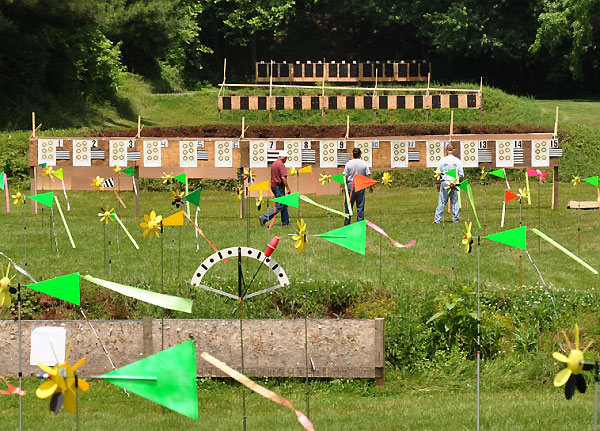
The view downrange in typical Thurmont conditions.
 About the Bud Pryor Memorial Match About the Bud Pryor Memorial Match
Bud Pryor was a fine gentleman who started shooting IBS matches in 1983. He was a machinest turned gunsmith who made friends and got many people started in shooting IBS registered matches over the next few years. Bud and Dick Grosbier ran the first IBS match at the Thurmont range in April 1983. Click Here to see vintage photos of the 1983 match.
After Bud’s untimely passing a few years later, the club decided to put on a big match and dedicate it to him. As Thurmont is one of the few ranges around with 100/200/300 yard capabilities, we decided to put on a 3-yardage Grand Aggregate match. This was not as simple as it seems, since 100/200/300 was not an IBS-recognized Aggregate. After an agenda item was approved at an IBS winter meeting, 100/200/300 records were set at Thurmont; and, over the years most records have stayed at this range. There are a total of four IBS ranges now holding 100/200/300 yard matches in 2014.
2014 Bud Pryor Day by Day
This year’s match saw generally beautiful weather. For Friday’s 100-yard stage, a 60% chance of rain was forecast and we did have a little rain in the morning but it had minimal effect on the proceedings. Range officer Curtis Nelson wisely delayed the first record match for less than five minutes while a fierce weather front blew through. Other than that, it was a nice day with temps in the mid 80s. Randy Jarvais from Maine started his conquest of the weekend early by taking the lead in the Varmint for Score (VFS) 100-yard stage by turning in a 250-22X score. It should be noted here that well-known competitor Dean Breeden turned in an identical score but Randy’s 5X performance in Match One edged Dean (3X) under Creedmoor rules. Ricky Read was third with 250-20X and Junior Shooter Kevin Donalds Jr. was fourth with 250-19X. There were also some impressive scores in Hunter Class, which is for 10-lb rifles with 2-1/4” forends and max six-power scopes. Last year’s Hunter Class winner Gary Long turned in an excellent 250-15X score followed closely by K.L. Miller with 250-14X and Dean Breeden with 250-13X. It amazes me how these guys shooting 6X scopes turn in scores that will frequently put them in the top half of the VFS class.
On Saturday, the 200-yard matches were held. It was bright and sunny and started out cool in the morning, peaking in the low 80s by mid-afternoon. The wind was extremely challenging and very tricky (I am not just saying this because I personally shot terribly). It was the Randy and Ricky show. By the end of the third match, only four shooters had not dropped points. At the end of the day, only Randy Jarvais and Ricky Read had 250 scores, with 11X and 7X respectively. So in the 100/200 Grand Agg Randy had 500-33X to Ricky’s 500-27X. Both men were well on their way to earning the greatly-coveted IBS 750 stickers. In Hunter class relatively new shooter Charlie Brock took the win with a 245-6X score followed closely by James Lederer with a 244-3X. (James is a new barrel-maker, who currently specializes in 30 caliber barrels for Hunter and VFS classes).
Randy Jarvais, Winner of the VFS Overall Aggregate.

Sunday dawned bright and beautiful and the targets are moved back another 100 yards to 300. Randy took the lead early with a 4X target on Match One while most of us were struggling to even get 50s. By Match Two Wayne France was chasing at Randy’s heels only one X behind. By the end of Match Three, Roy Hunter was also becoming a threat with a 150-4X score. Roy was shooting his LV 6 PPC with which he won last year’s match. By this point there were only four shooters clean in a field of 32. At the end of Match Four,Tony Seymore, Wayne France, and Randy J. each added 2X to their scores and moved up in the standings. Match Five turned out to be a heart-breaker for Randy. Consider this — if Randy could have shot a 50-1X he would win the 300, win the match, and set two possible new records with a 750-44X total. (Also a 500-22x score in the 200/300 Grand Aggregate would have been a potential record as well.) That could earn Randy 60 Score Shooter of the Year (SSOY) points for winning the match plus 45 points for setting records, giving Randy an unassailable lead in the SSOY race.
But that was not to be. On bull #3 of the final 300-yard target, Randy lost his only shot of the weekend. He suffered what we score shooters call a “Downtown Nine” — a shot that was clearly out of the ten ring even when viewed from the bench. No disputing that one. This moved Randy down to fourth place at 300 yards. Wayne France won the 300-yard VFS with 250-10X. In Hunter class, Orland Bunker, another “Maine-iac”, took top honors with a 240-4X.
But all was not lost for Randy when he dropped the point at 300 yards. Thanks to his consistency and the fact that both Wayne France and Tony Seymore had poor showings at 200 yards, Randy’s 749-43X Grand Agg won the match for him. Ricky Read finished second, with 749-33X. Roy Hunter (6 PPC) was third with 749-27X. In Hunter Class, Gary Long had high score for the weekend, a 733-21X. In second place was Orland Bunker at 733-17X, while Charlie Brock was third with 730-19X.
Match Winners Left to Right: Charlie Brock, Sara Harren, Orland Bunker, Wayne France, Gary Long, Randy Jarvais, Ricky Read, Roy Hunter, Tony Seymore.

Exhibiting great sportsmanship, Brad Gollner came back Sunday to work with the target crew after shoulder problems forced him to quit shooting Saturday.

I think everybody had a good time. Event feedback has been very good. I even had one shooter email me and say “My complete drubbing at the Bud Pryor Memorial last weekend notwithstanding, I wish to register for the 200/300 Nationals to be held a Thurmont on July 26 and 27.” As always it was good to see old friends fellow shooters from all over the East. – Dick Grosbier
Great BBQ and Camaraderie
After Saturday’s shooting was complete (and the flags were moved for Sunday’s 300-yard stage), it was time to gather at the clubhouse for the traditional BBQ dinner including pulled Pork sandwiches, cole slaw, potato salad, baked beans and always popular Sara Harren’s cheesy grits. After that we were treated to an amazing assortment of desserts. As usual it was a great time of fellowship and catching up with old friends some not seen since last year’s Bud Pryor Memorial. We had contestants from as far away as Maine, Wisconsin, and South Carolina.

July 10th, 2014
Weaver has a brand new, high-magnification, 46X target scope. Chances are you haven’t heard a thing about it — the new Weaver T-Series XR 46x48mm scope is so new you won’t even find it on the Weaver website. Compared to the older T-36, this new 46-power scope offers more magnification, more elevation, a larger front objective (48mm vs. 40mm), and a larger 30mm main tube (compared to 1″ for the old T-36). The new XR 46X Weaver also features side-focus parallax control. That’s a big change. You could instantly spot a classic Weaver T-36 by the adjustable front objective with its knurled ring and yardage markings. The T-Series XR 46X (as well as the new XR 24X and XR 36X) have the parallax control on the left side of the main tube (photo below).
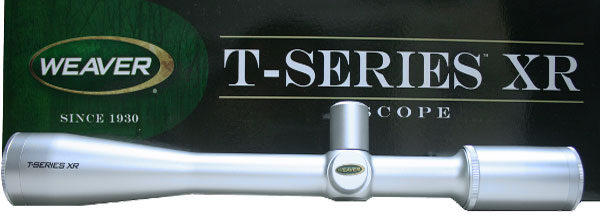
 We have looked through the new Weaver 46X scope and it is very sharp. Brightness is good — it seems comparable with a Leupold 45x45mm Competition (but that was on a bright, sunny day). Initial tests show the clicks to be tactile and positive, but we haven’t had a chance to do a full “box test” to confirm tracking. Weaver claims the new XR series scopes will focus down to 50 feet, but with the 46X we had some questions about its extreme close-focus capability. If you’re shooting beyond 50 yards, the focus should be fine. We have looked through the new Weaver 46X scope and it is very sharp. Brightness is good — it seems comparable with a Leupold 45x45mm Competition (but that was on a bright, sunny day). Initial tests show the clicks to be tactile and positive, but we haven’t had a chance to do a full “box test” to confirm tracking. Weaver claims the new XR series scopes will focus down to 50 feet, but with the 46X we had some questions about its extreme close-focus capability. If you’re shooting beyond 50 yards, the focus should be fine.
The new T-Series 46X XR is offered with two reticle choices, a fine cross-hair (FCH), or FCH with 1/16th MOA dot. Both reticles are well-suited for benchrest work. The current “street price” for the new 46X Weaver is $829.95. That’s way more than the old T-36, but it undercuts Leupold fixed-power competition scopes by hundreds of dollars. We know of only two vendors who currently carry the Weaver 46X. These are Killough Shooting Sports, and Bruno Shooters Supply.

 New 24X and 36X T-Series XR Scopes with Side-Focus and 1″ Tubes New 24X and 36X T-Series XR Scopes with Side-Focus and 1″ Tubes
The new 46-power XR scope is the star of the XR line-up. Designed to go head-to-head with Leupold’s 45X Competition scope, the 46X Weaver XR offers a modern 30mm main-tube and large (48mm) front objective. If you don’t need the bigger tube and larger objective, but still want side-focus parallax control, Weaver offers two other new XR scopes — a 36x40mm and a 24x40mm. These will both retail for under $600.
Dan Killough offers the black-finish 36-power XR for $559.95 and the black-finish 24-power XR for $549.95. Silver models are slightly more. These 1″-tube XR scopes are worth considering, but keep in mind that you can now purchase the older T-series scopes with adjustable front objectives for well under $400.00. For benchrest shooting at a fixed distance, side-focus is not necessary; adjustable front objectives work just fine. Just set and forget.
June 24th, 2014
 Texan Mike Bryant is a superb gunsmith and a very successful benchrest competitor. And though he is getting up in years, he hasn’t lost any of his talent as a trigger-puller. In fact, if recent results are any indication, Mike Bryant isn’t getting older, he’s getting better. Texan Mike Bryant is a superb gunsmith and a very successful benchrest competitor. And though he is getting up in years, he hasn’t lost any of his talent as a trigger-puller. In fact, if recent results are any indication, Mike Bryant isn’t getting older, he’s getting better.
Check out this set of targets Mike recently shot, which represent the best 100-Yard Aggregate of Mike’s shooting career. Maybe being a grandfather has improved his skill set.
Mike reports: “Here’s the set of targets I shot at the East-West HV100. Needless to say, I was tickled to death. This is the best 100-yard Agg I’ve ever shot [in benchrest competition]: 0.1744″ average.”
Click Photo for Full-Size Version

Mike is a great gunsmith, but he’s retired for the most part now: “I’ve closed up my shop and won’t be gunsmithing for the general public. I want to help my son on the ranch and shoot more benchrest.”
As far as the “shoot more benchrest” part, it looks like Grandfather Bryant is doing well indeed. Mike credits his recent success to other shooters:
 “I owe a lot of what I was able to accomplish with this Agg to Gene Bukys. Gene is currently one of the hottest-shooting benchrest competitors in the United States, and a member of the Benchrest Hall of Fame. After the Cactus Classic this year, Gene shared with us the make, twist rate, and contour of the barrels that he had been using to win everything in sight. He also told me which of his reamers that Dave Kiff had made him that he had been using and which one to order from Kiff to shoot the same chamber.” “I owe a lot of what I was able to accomplish with this Agg to Gene Bukys. Gene is currently one of the hottest-shooting benchrest competitors in the United States, and a member of the Benchrest Hall of Fame. After the Cactus Classic this year, Gene shared with us the make, twist rate, and contour of the barrels that he had been using to win everything in sight. He also told me which of his reamers that Dave Kiff had made him that he had been using and which one to order from Kiff to shoot the same chamber.”
“Gene had already matched a die to my previous chamber that [eliminated] the click at the top of the bolt stroke to insure smooth bolt operation. After the Cactus I ordered some of the same barrels that Gene was using and ordered a reamer from Kiff. I chambered two of the barrels with the reamer that Gene was using on Monday and fire-formed brass for them on Tuesday and spent a little time at home trying to get the rifles tuned up for the East-West.”
“On Saturday morning I started with one of the rifles and shot it through the LV 100. Not doing particularly well. So, switched rifles to the other one for the HV 100. It seemed to be working better and seemed to get better as the day went along. After the match, I was out pulling up my flags and Wade Hull walks up to me and holds out his hand and says ‘Congratulations, you won the Heavy 100′.”
Hall of Famers Helping Other Benchresters
Mike concludes: “If there is a story in my experience, it is really about benchresters helping other benchresters. People like Gene Bukys, Jack Neary, and Bart Sauter, all Hall of Fame members, are giving back to other benchrest shooters to help them become better. Jack Neary has been giving Vihtavuori tuning classes for many years, passing on the info that helped him get into the Hall of Fame. Bart Sauter posts on Benchrest.com, passing on key secrets of his success. And let’s not forget Tony Boyer who has helped others in many ways, including one-on-one private benchrest lessons. So, if there is a story here, it’s about these guys, not about me.”
Between benchrest matches, Mike Bryant likes to spend “quality time” with his children and grandchildren. Here is Mike on a playground slide with his grandson. Mike’s philosophy is to enjoy life and stay young at heart. We think that’s a good approach to life.

June 5th, 2014
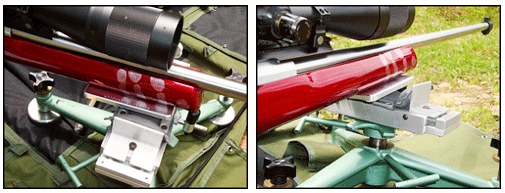
Whidden Gunworks offers a nicely-engineered “bolt-on” front plate that will enhance the bench-rested accuracy of any rifle with an accessory rail on the forearm.

 The Whidden Track Plate fits securely in the forearm accessory rail on prone, cross-the-course, and Palma rifles. These guns typically have a narrow and/or rounded fore-end so they rock and wobble when used with a front pedestal rest. The TrackPlate cures that. Once installed it provides a rock-solid, 2.9″-wide platform that mates perfectly with a benchrest-type front sandbag. This gives sling-shooters maximum stability when testing loads or zeroing their sights or scope. Plus you can now shoot F-Class competitively with a prone gun. The Whidden Track Plate fits securely in the forearm accessory rail on prone, cross-the-course, and Palma rifles. These guns typically have a narrow and/or rounded fore-end so they rock and wobble when used with a front pedestal rest. The TrackPlate cures that. Once installed it provides a rock-solid, 2.9″-wide platform that mates perfectly with a benchrest-type front sandbag. This gives sling-shooters maximum stability when testing loads or zeroing their sights or scope. Plus you can now shoot F-Class competitively with a prone gun.
The Track Plate is light-weight, has catamaran-style runners to aid tracking and prevent rocking, and can be easily stowed in a range bag. The machined aluminum Track Plate fits BOTH Anschutz-style and American-style recessed forearm rails.
The Track Plate is available from Whidden Gunworks for $40.99 or from Champion’s Choice for $40.00 (item W29P). Plate designer (and National LR Rifle Champion) John Whidden says: “The Plate is great for any rifle with a rail whether it ís smallbore, centerfire, or an air gun. Now you can try F-Class with your favorite prone rifle: the Plate has a perfect low-drag finish for riding a rest or sandbags and is competition legal in all dimensions.”
Front Bag-Rider for AR-15s from EGW
Similar to the Whidden Track Plate is a 3″-wide Delrin bag-rider from Evolution Gun Works (EGW). This was developed expressly to fit the fore-ends of AR15-type rifles with round float tubes. The EGW front bag-rider attaches to a front sling swivel stud anchor. That allows it to mount as easily as a Harris bipod — no rail needed! Just unscrew the swivel stud, put the front bag-rider in place and attach one hex-head machine screw. The front bag-rider is contoured to match the handguard profile so it fits securely with no wobble. Overall, it is a slick system. Front and rear bag-riders can be attached in a couple of minutes. The Delrin blocks slide easily in the bags and make the gun ultra-stable. The gun tracks straight back. The front bag-rider comes in two (2) variants, a $39.99 radiused version (item 32141) that attaches via swivel stud, and a $49.99 version (item 32143) that mounts via a Picatinny-style rail.
EGW AR Front Bag-Rider System
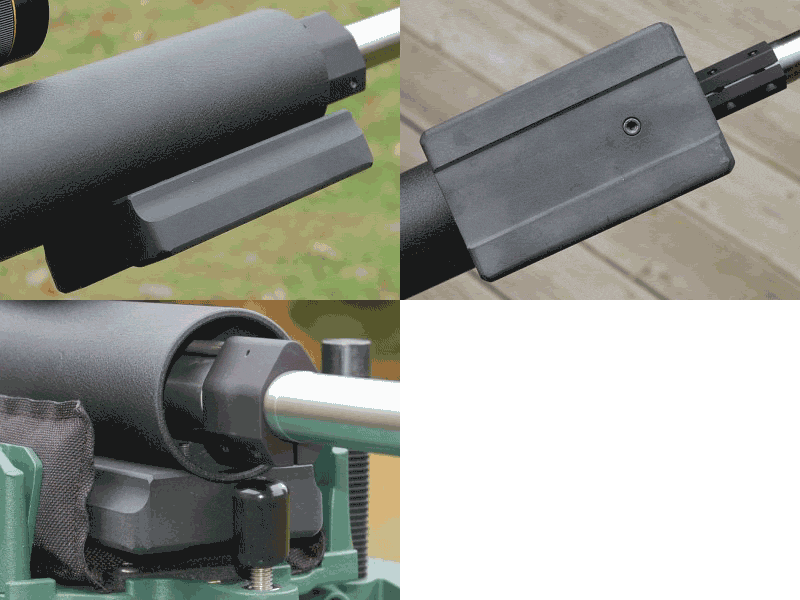
EGW Picatinny Rail-Attached Front Bag-Rider

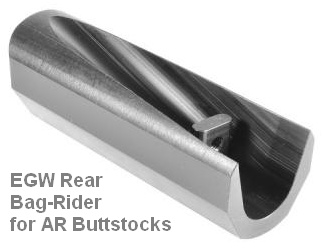
EGW Rear Bag-Rider for AR Buttstocks
EGW also offers a REAR bag-rider that attaches via the sling swivel anchor. The EGW AR Rear Bag-Rider accessory (item 32142), designed to work with A2-style buttstocks, sells separately for $39.99. This rear bag-rider provides a longer, straight “keel” that works very well in rear sandbags, giving the rifle more stability, and improving the tracking.
May 17th, 2014

Click photo for full-screen image suitable for desktop wall-paper.
Field Report by Jeff Stover, IBS President
In IBS-land you know that spring has sprung when the Memorial Shoot at Weikert, PA comes along. This year was the 28th edition which honors the memories of Nate Boop and Rich Altemus. These two gentlemen started the benchrest program at the Union County Sportsmen’s Club. This is one of the finest ranges you will find anywhere in the country. Both the range itself and its setting are world-class.
Boop Shoot Match Results Summary (.XLS File) | Boop Shoot Top 10 Equipment List (.XLS File)
This year 42 shooters hit the benches at the Weikert range. Saturday’s 100-yard targets were shot in somewhat tricky, but shootable conditions — attested by four teen Aggs. Shooters enjoyed the readable conditions on Saturday but the 200-yard stage on Sunday was another matter — with strong breezes that switched on a thin dime. Red with tails out for 10 seconds, then green with tails out for 8 seconds. Then there was a nice mix of both — with tails erect all around. Some of us love to shoot tailwinds, which were there for a few fleeting moments. But there is a lot of target real estate — over an inch — between a tailwind with a wee bit of green and a tiny smidge of red.
Though Weikert is a gorgeous range, it has one drawback. The central Pennsylvania countryside only allowed for an east-facing range. So, on a sunny day, the first three targets or so are shot with most shooters hanging blue tarps from the range roof to block the sun. This works well and does not inhibit small groups.

Curtis Nelson lines up for first shot, with blue tarp sun shade in place.
The Light Varmint 100-yard stage looked to be all Harley Baker, one of the newest inductees into the U.S. Benchrest Hall of Fame. Harley arrives at any match with impeccably prepared equipment tuned to a knife’s edge. He is tough to beat at any range. He was cruising to yet another Agg win, with Smiley Hensley pretty far behind. To finish off with a flourish, Harley nailed a very nice .190 on his last target.
Many times at the last match of an Aggregate, shooters will banter, “last chance to be a hero”. It is so trite as to not get much reaction from the line. Well, some days a hero does emerge. Smiley shot a .071″ group in Match 5 to win the LV 100 Aggregate with a .1902. Harley settled for a flat .2 and second place. Smiley may have won the battle, but not the war, as we shall see.
 
Most Shooters Use 10.5-pounders Even in Heavy Varmint Class
In the Heavy Varmint class shooters could be shouldering a 13.5-pound rifle. Most, however, stick to their 10.5-pound Sporters (a Light Varmint rifle with a 6mm bore) for an entire weekend. Many times in the loading area you’ll hear, “what are we shooting?” Yes, there a few shooters that will pull out a favored “real” Heavy Varmint, but that is pretty rare these days.
The competition in Heavy Varmint 100 was pretty fierce. Small groups were shot. Teen Aggs were possible. Al Auman shot a fine .1808 to win the Agg. Other Aggregates under 0.2 were shot by Harley Baker (.1950) and master accuracy gunsmith Sid Goodling (.1990).
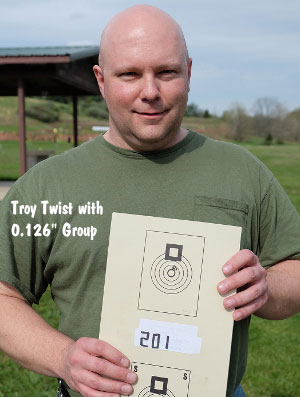
First Time’s a Charm for Troy Twist. Benchrest Novice Shoots 0.126″ Group.
Shooting a .126 group would make any Benchrest shooter happy. If you accomplish that feat the very first time you ever shot a bench rifle, and in a real match to boot, then you have Troy Twist’s story.
Troy works with Dale Boop and was always talking guns. Dale convinced Troy to show up for the 100-yard stage and Dale let Troy shoot one of Dale’s rifles. Troy performed like a champ, drilling a 0.126″ group — not too bad for a rookie! Nothing like a small group to get a new shooter interested in our game.
|
Sunday was beautiful with sunny skies and pleasant temps. The wind was another matter. The Heavy Varmint 200-yard stage was conquered by Harley Baker with a .2689 Aggregate. No Match 5 heroes emerged to take away another Agg win from Harley. The only other Aggregate under 0.3 was posted by Jeff Peinhardt. Jeff is a newer shooter that is making a name for himself in Benchrest. Finishing off the top three in the Agg was Wayne Shaw. Wayne is sometimes more associated with score shooting, but he is a top-flight group shooter as well.

The afternoon was set for Light Varmint 200 while the kaleidoscope of rapidly-changing flag colors continued. Jeff Stover led the way with a .2602 Agg. He tried to shoot whatever tail wind was available, and do it as fast as possible. Jeff got away with this sometimes dangerous tailwind strategy for four targets; on the fifth he was not burned as bad as he might have been. Closing in towards the end was Russell Rains with a .2904. Canadian Andy Laidlaw snuck into third place with a .2937 with the only remaining Aggregate under 0.3.

Andy Laidlaw from Canada loads between stages.
In the overall 2-Gun, Harley Baker was the class of the field with a .2466 for twenty targets. Stover followed with a rather distant .2791. Steady Kent Harshman finished close behind with a .2833. Interestingly, both Stover and Harshman were shooting pull-down 8208 powder (from the Vietnam War era) rather than Vihtavuori 133 or the new kid on the block, Accurate Powder LT-32.
 Two-Gun Top 3: Kent Harshman (Third), Harley Baker (Winner), Jeff Stover (Second). Two-Gun Top 3: Kent Harshman (Third), Harley Baker (Winner), Jeff Stover (Second).

Moving backers are used in 100/200/300 yard benchrest competition.

Dale and Russ Boop, shown above, are the sons of Nate Boop, in whose honor this Match has been held for 28 straight years. The Brothers Boop have been shooting Benchrest since they were little kids. Russ is in the Benchrest Hall of Fame and Dale is currently only two points out.
Father and Son Team — The Peinhardts
Jeff Peinhardt from Quarryville, PA owns PR2 Racing Technology. His company does national level motorcycle race engine development and tuning. His operation is a sophisticated engineering facility with CNC and the latest equipment. He has brought this analytical outlook and expertise to Benchrest.

Jeff is relatively new to the game, but has already excelled. His 16-year old son, Wyatt, has now moved from Junior Shooter to Rookie to Tough Competitor. Wyatt now runs with the “big dogs”. His father says the tougher the conditions, the better Wyatt does; he is a force to be reckoned with in the coming years.
May 13th, 2014
With so much attention given to the newest hardware, and most recent reloading innovations, we sometimes forget that Benchrest shooting, as a competitive sport, has been around for quite a long time. And some of those “old school” shooters managed to put together some pretty fine groups even without 21st Century gadgets and gear.
Click Photo to See Larger Version.

Here are some of the founding fathers of benchrest shooting, in a photo taken nearly six decades ago (4/3/1955). Men’s fashion has changed a bit over the years. Tony Boyer notwithstanding, you won’t find so many Stetsons at a shooting match these days. Courtesy of Sierra Bullets, here’s a “throwback” image of Benchrest shooters at the Brea, California “Round-Up” Shoot April 2 – 3, 1955. Left to right are: Frank Snow, (Founder of Sierra Manufacturing Company), John Moffit, K. E. “Smitty” Smith (NBRSA Director), Al Christie, E.F. Stewart, Jack Rice (sitting), I. F. Jack Williams, Lindsey King (behind Williams), Don “6mm” Smith, Frank Hemsted, and Art L. Elliott.
If you like this sort of “trip down memory lane”, visit Sierra Bullets’ Facebook page. Every Thursday morning, Sierra publishes a “Throwback Thursday” photograph from some decades past, together with a short featurette on the shooting-related item/person in the photo.
|


