Forum member Eric has built an innovative specialty pistol for long-range benchrest. The gun is chambered in 6.5-284 and built for IBS 1000-yard shooting. Eric originally built the gun with a 3″-wide fore-end, then decided to go with a 6″-wide offset design since the IBS no longer restricts Light Gun Forearms to three inches. Eric explained: “After building the 3″-wide stock I looked at the IBS 1000-yard benchrest rules and found out that there was not a width limit and rails were allowed for a Light Gun stock. I set out to design a 6″ version. I was thinking it should be offset also to help control torque and track straighter. I had a new 6.5mm, 1:8.5″ twist, 1.250″ HV-contour Krieger barrel. I chambered the barrel for 6.5-284 and bedded the stock.”
Eric feeds his pistol Sierra 142gr MatchKings with a load of 51.0 grains of H4831sc. Estimated muzzle velocity with this load is 2900 fps — respectable speed from the short barrel. The gun tracks remarkably well, with very little torque effect, as you can see in the video below.
After initial testing, Eric added a muzzle brake to the barrel. This tamed the recoil considerably. To learn more about Eric’s long-range 6.5-284 pistol, visit our Shooters Forum and READ this POST. To see more videos of the pistol in action (with muzzle brake), visit Eric’s PhotoBucket Album.
Gunsmiths often have to serve as gun “doctors” as well as gun builders. Gunsmith (and Hall-of-Fame shooter) Thomas “Speedy” Gonzalez was recently asked to fix a trigger problem. A customer was complaining about a trigger that was erratic and “mushy”. Speedy quickly diagnosed the problem. The Jewell trigger was clogged with gunk and sludge — left-over solvents and lubricants had gummed up the mechanisms. Here’s how the cleaning process unfolded…
Speedy: “Gee why would I want to blueprint my Jewell trigger….it has just got a little mushy lately. It may just need some adjustment. Yeah right — take a look at this”:
Speedy: “Should I go get a tetanus shot now?”
Gunsmith Mike Bryant comments: “I’ve seen a lot of Remington 700 triggers that were gummed up like [that] Jewell was. Also have seen lots of 700 triggers that had the weight-of-pull screw adjusted [by the owner] to where it had no compression on the spring. I wonder how many of the Remington accidental discharges involved triggers with one or the other of these conditions.”
Speedy: “What?! Powder in trigger as well… hmmmmmm.”
Clean up done with Iosso Lubricant/Cleaner. Speedy says this is the “Best parts cleaner I have ever found if you don’t have an ultra sonic cleaning tank. I just melted that crud off with a Q-Tip”.
Same Jewell trigger all happy now — clean as a whistle.
Trigger ready for final re-assembly, looking better than new. Thanks Speedy!
New Daily Bulletin readers may not know that our AccurateShooter.com website offers an entire set of FREE TARGETS. There are over 50 free targets, including: Sight-in targets, Load Development targets, Benchrest targets, NRA Highpower targets, Scope Testing targets, Fun Targets, Rimfire BR targets, 3D Bullseye targets, and even a special set of Rimfire Tactical targets.
Most of the targets come bundled in .zip archives, so you can easily download multiple targets with one click. The targets are saved in PDF format (Adobe Acrobat), so they are easy to print and the scale is correct no matter what your screen resolution.
In the photo above, Forum member FireMedic shows some fine shootin’ with our basic Accuracy Target. With small, red diamonds and extended black lines, this target allows very precise aiming at 100 and 200 yards. The gray dot on top provides a reference point for a 200-yard zero. FireMedic reports: “My 30″, 12 twist, 3 groove does pretty good for an old Savage chambered in .308 Win.” With an average group size of 0.208 inches we’d have to agree. Great Shootin’ FireMedic!
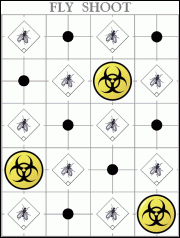
Above are two fun targets you might enjoy. The Atomic Target was originally created as a contest for our readers. The design is by Michael Forester of Auckland, New Zealand. Hit the bigger green and red neutrons, then try your luck with the smaller electrons. Or you can try to shot some “bug-holes” with our popular Fly Shoot Target. Watch out for the bio-hazard rings!
Of course, if you happen to have actual insect land on your target, you might just shoot an honest-to-goodness “bughole”. Here we see an accurate “direct hit” on a gnat’s a** by Dr. Clint D., described by GA Precision’s George Gardner as a “gnat protologist”. The shot was made at 100 yards with a very accurate GAP .260 Rem.
1000-yard Benchrest competitor James O’Hara set four (4) new IBS Records in 2013. These multi-match Light Gun Agg records were secured with O’Hara’s solid performance at the 2013 Virginia 1000-yard Benchrest State Championship. Here are the new records set by O’Hara in 2013:
During the VA state championships, O’Hara was on fire. All four groups were centered for 50s, with three groups under 3″ and the fourth a 3.715″. That’s consistency.
Target 1- Group 2.996” Score 50.2
Target 2- Group 2.433″, Score 50.1
Target 3- Group 3.715″, Score 50.4
Target 4- Group 2.188″, Score 50.1
Group Average 2.833″, Score Average 50.2
On 1000-yard benchrest targets, the 10-ring is just seven inches in diameter, while the X-Ring is a mere 3 inches in diameter. At the Virginia 1K Championships, James managed to keep all his shots within the seven-inch 10 Ring with eight of the shots inside the 3 inch X-Ring. That is amazing accuracy and consistency. David Goodridge says: “This is truly a remarkable example of superb marksmanship, rifle design, assembly, load development and equipment maintenance.” (O’Hara had previously set a 10-match Aggregate Light Gun World record of 4.5389″ in 2012).
Click image for Full-screen view
James O’Hara Talks About Record-Setting Rifles and Ultra-Accurate Long-Range Loads
James generously agreed to share his knowledge and experiences on the many facets of IBS 1000-yard benchrest preparation, reloading and shooting techniques in an intereview with Australian David Goodridge. This feature originally appeared in Australian Target Rifle Magazine. A few of O’Hara’s responses have been updated, based on a conversation with James on April 8, 2014.
Goodridge: James on behalf of the Australian LRBR community I would like to congratulate you on your achievements in 1000-yard Benchrest and thank you for [doing this] interview. To begin, could you provide an outline on your background and the reasons or factors that led you to becoming involved in 1000-yard BR at the Virginia Club.
O’Hara: I started short-range Benchrest in 1996 for a brief time and won my first 100-yard IBS match and I was hooked. Loss of eye-sight in one eye put a damper on it and I quit shooting for while, and I started shooting trap to try to switch over to left-handed. It worked and I started to pick up a gun left-handed so I went back to the rifle and built a tube gun.
I tried the local groundhog matches but the rules changed every match. I then found the Reade Range and 1000-yard matches. I restocked my gun with a long-range stock and started 1000-yard Benchrest. Finding I enjoyed the challenges associated with long range benchrest, I began 1000-yard Benchrest competition at Harry Jones Range and White Horse Range, two IBS ranges in West Virginia. I basically started after the year was under way in 2011 and I must say it was a very humbling experience. I soon learned that my previous short range [techniques] were not working.
New scales, a K&M arbor press with a force indicator, led to improvements. Then designing and obtaining reamers to my own specifications led to further substantial improvements, with the end result being that the same loads now seem to work from barrel to barrel.
James O’Hara Equipment Details
Gunsmithing: I do all the work myself, except barrel chambering/fitting is done by Dave Bruno.
Favored Caliber: I use a 6mm Dasher with a .266 neck and a .135 free bore. My load is a 103gr Spencer bullet trimmed and pointed with Hoover tools. Load is Alliant Reloder 15, 33.0+ grains weighed on a GD503 scale, with a CCI 450 primer. Right now I’m jumping the bullet about .006″. Previously, I shot them about .010” into the rifling but it was pulling the bullets or pushing them back.
Actions: For the IBS record groups I used a Bat 1.350” Bat B action in a Roy Hunter Stock. Other actions in use include a 1.530” Bat B and a Kelby F-Class Panda. Barrels: The record barrel was a Brux Heavy Varmint, 1:7.83″ twist, finished at 28″, and fitted with a Harrell’s brake. Stocks: I have two Roy hunter stocks and a PR&T and all track very well. They are balanced at two inches ahead of the receiver. All three stocks are glued with liquid Devcon and are pillared, so they are “glued and screwed”. I think this is the best system. Scopes: The PR&T-stocked rifle has a March 10-60X and the two Hunter-stocked guns have Nightforce 12-42x56mm NXS scopes. Rests: My front rest is a Sinclair Competition model that I modified with a cartridge holder that holds cartridges up by the port. I use the new super slick bag by Protektor and a rear Doctor Bag with leather ears. Scope Mounts: Rings are Burris Signature Extra High (the ones with inserts).
Case Preparation and Reloading Techniques:
My cases are three years old, with close to 100 firings. They are all from the same lot. I anneal the cases dirty to save some work and I anneal every time to have consistent neck tension. I punch the primers out and clean the pockets and run the flash hole uniformer in to make sure there is no carbon build-up. You can use the same tool as you use to prep the new cases. Flash holes are uniformed to .0625″. (Flash holes, “out of the box”, are less consistent than you may think.)
I turn necks to .0102″ with a K&M tool. Some competitors don’t turn necks, but without uniform neck tension you will have vertical. I use a K&M VLD chamfering tool and a Wilson case trimmer for new cases and when I trim fired cases. I use a nylon brush for inside the necks and clean the cases outside with 0000 steel wool using a small power station or a drill to spin them. The cases are sized on a Forster Coax press with a Harrell’s full length bushing die. Priming is done by hand using a K&M priming tool. I throw a “close” charge with Harrell’s bench rest powder measure. That charge goes in the pan of my Sartorius GD503 scale and then I trickle up to weight with an Omega powder trickler.
For bullet seating, I now use the 21st Century Hydraulic arbor press with seating force indiciation. I previously used the K&M arbor press with force indicator — it was good, but the 21st Century unit is more sophisticated, more precise, and easier to read. I have a loading block that is color-coded in the pounds of force needed to seat the bullet. I try to keep rounds in sets of 3-lb seating force settings. Each loaded round is put in the appropriate column (based on measured seating force). All loaded rounds are color-coded to avoid mixing. Leftovers from matches are used at a later date.
Click image for Full-screen view
I have now made a tool from an old bearing surface comparator. It will contact the ogive of the loaded round and it will check the seating depth while it is sitting on a granite block. Relying completely on the force and feel of the dial indicator allows seating depths to be held to .0005″ (i.e. one-half-thousandth). Compared to others means, this seems a more accurate way to check seating depth.
Bullets are spun on a Juenke machine after they are trimmed on a Hoover trimmer and pointed on the Hoover tool. For the next step, a Tubb Bearing Surface Comparator is used to sort bullets to plus/minus .0005″. I don’t discard any bullets — if I have some small lots of bullets that have a shorter or longer measurement they are used for testing. With the Spencer and BIB bullets there are not many that are not within plus/minus .001”. I quit weighing cases because of the outside variations. I only do what makes a difference [on target] and I only test and do load development at 100 yards, where I can control the conditions.
Barrel Freezing (Cryogenic treatment)
For the 2013 season, I cut barrels back to 28″ and had them “frozen” (cryo-treated) at Cryo Plus. I think that both barrels are average in the wind, but the first shot from a clean barrel is in the group. I shot around seven 100s with my other Light Gun. In Heavy Gun, I even won the group Aggregate at the Virginia State shoot. I have cryo-treated all of my barrels and I believe I have proof that it does produce benefits. I talked to George Kelbly about this before I did it. My results agreed with what George had indicated: fire cracking was less, chambering was easier and the major benefit was that the groups did not ‘walk’ as the barrels became heated.
Bench Set-up and Shooting Procedures
I use a spotting scope to help see the flags and the mirage. The mount is a Sinclair for the bench. This really helps because I can’t see the flags far out. I think the most important part of the set up is getting the gun to track, it has to come back in the box every time and shooting under the same condition every shot. I know everybody likes to run them — I do if the condition holds — but if it doesn’t you must pick them one at a time. This is where the direction and the speed of the wind come into play; you must shoot in the same condition you zero in.
When I set up to shoot, I line up the gun on my target and I move it back and forth till I can get it coming back in the ten ring and then I set my scope. I load my record rounds in my holder and I use my sighters out of the box. I now am watching and timing the conditions and I now make the decision of the one I will use and this is the only one I sight-in with. If I have some big guns beside me with brakes, I will wait till they are done or try to get in between their shots (this doesn’t always work).
Trigger control is a must and you have to be consistent. I will give up a perfect sight picture for a perfect trigger pull. I use free recoil and only my finger is on the trigger. After the rifle recoils back, I hold the fore-arm and open the bolt — you have to be careful not to upset the gun in the bags. After loading the next round, I close the bolt and push the gun forward with my right hand on the fore-arm. I am guiding [the stock] forward in between the bags. This gives me less chance to make a mistake, and maybe half of the shots need no or very little adjustment. I know it’s hard to get accustomed to, but try not to take your eye out of the scope so you are watching the mirage and not to get caught in a change. For the best part, I shoot free recoil and do all my testing at 100 yards in my backyard range. I zero dead on at 100 and come up 24 minutes for 1000 yards.
Bore Cleaning Procedures
I never try to get the gun super clean at a match, I like to see a little gray on a clean patch. I don’t want the barrel to be squeaky clean — I like to see a little haze on a patch. When it’s like that, after one fouling shot, the next shot usually goes right where it’s supposed to. When it’s squeaky clean, it may take five shots to foul in.
I used a product called WartHog 1134, and it has served me well for a long time but now that the Hazmat stopped the shipment of it, so I went to over-the-counter products and all are equally bad compared to what I had used but they do the job, it just takes longer. I never pull a patch or brush back through (across the crown), I go one way only (outward) out and then unscrew the brush or take the patch off at the muzzle. I use a 50/50 mix of Hoppies and Kroil after I clean. Just before I shoot I run a smaller patch down the bore to leave a very thing film of oil in the bore. I never want to shoot over a dry bore. If you shoot over a squeaky clean, dry bore, you’ll get copper every time.
What the Future Holds for O’Hara
My goal last season was to set the Agg records. Now I only have one more goal — that is the single target group, so I will back off shooting the Heavy Gun. I have three excellent Light Guns and a bunch of barrels to do it… so maybe! I think the greatest enjoyment is the people you shoot with, the common interest is the bond I guess but I wouldn’t change it for anything. — James O’Hara
Goodridge: James, on behalf of all Australian IBS 1000-yard BR competitors, I would like to thank you for your great patience and cooperation in preparation of this article, and for the valuable and interesting insight that you have provided into what is required to achieve success at the highest levels of 1000-yard BR competition. Not that you need it, but good luck for the 2014 shooting season.
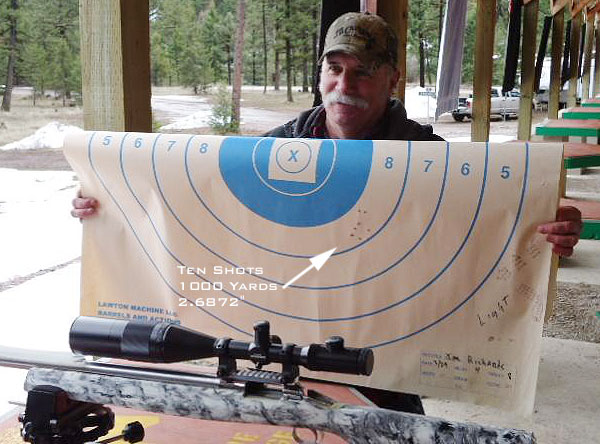
Ten shots… 1000 yards … 2.6872″. Think about that. Ten shots you could cover up with a coffee cup. That’s some amazing shooting. Is this a world record? Consider this — we believe this is the smallest 10-shot group ever shot at 1000 yards in any form of rifle competition, by anyone, anywhere, anytime. It is smaller than the existing Williamsport Light Gun and Heavy Gun 1K records. The IBS and NBRSA do not shoot 10 rounds for Light Gun, but this 2.6872″ group is smaller than the current IBS (3.044″) and NBRSA (4.322″) ten-shot HEAVY GUN records.
This amazing group was shot by Jim Richards at the Deep Creek Range outside Missoula, Montana during the 4th Light Gun Relay of a 1000-yard match. Jim was shooting the small 6mm Dasher cartridge with 105gr Berger bullets. Fellow Deep Creek Shooter Tom Mousel says this should be a new world record. The Deep Creek Range shoots under Williamsport rules, with ten shots for Light Gun. The current Williamsport Light Gun record (as listed) is 3.835″ by Cody Finch in 2006, but we’re told that Paul Martinez shot a 3.505″ at Williamsport last year. If approved at 2.6872″, Jim Richards’ new record is 23% smaller than the 3.505″ previous record. That’s remarkable — Jim Richards utterly demolished the previous mark. (As measured, Jim’s group is also smaller than the current Williamsport Heavy Gun record, 2.815″ by Matt Kline in 2010.)
The Record-setting rifle features a Borden action, Shehane ST 1000 fiberglass stock, and Nightforce Benchrest scope. The Krieger barrel was chambered by King Machine for the 6mm Dasher, with a 0.269″ neck and 0.103″ freebore. Jim Richards was running Berger 105gr Hybrid bullets.
The rifle was purchased used from Tim Claunch. We suspect Tim wishes he had not parted with it! Any gun that can put ten shots under three inches at 1000 yards is a “keeper”, that’s for sure.
Forum member Wayne B. says: “I am really happy for Jim. He has asked 1000 questions, slept in his pickup, upgraded his equipment, bought a rifle from another friend of mine and now he is a world record-holder. The men and women who shoot at Deep Creek in Missoula Montana are the best group of shooters in the world bar none! They will give you all the info you need to win and if you don’t have what you need they will loan it to ya, up to and including a rifle and ammo.”
Most F-TR rifles are essentially prone rifles adapted for use with bipod and rear bags. They feature prone or tactical-style stocks designed to allow a firm grip on the gun, with cheek, hand, and shoulder contact. This has worked very well. Unquestionably, a skilled F-TR shooter can achieve outstanding scores with such a configuration — it works. However, “there’s more than one way to skin a cat”.
At the Berger Southwest Nationals, Eric Stecker introduced a new type of rifle, and a new type of gun-handling, to the F-TR ranks. Shooting “free-recoil” style* (i.e. with virtually no contact on his rifle) Eric managed to finished second overall in F-TR (with the highest X-count), beating some past national champions in the process. Thinking “outside the box” worked for Stecker in Phoenix. The success of Eric’s benchrest-style rifle and shooting technique definitely drew the attention of other F-TR shooters.
Click photo to zoom
VOICE FILE: Eric Stecker Talks About the SWN and his Radical F-TR Rifle.
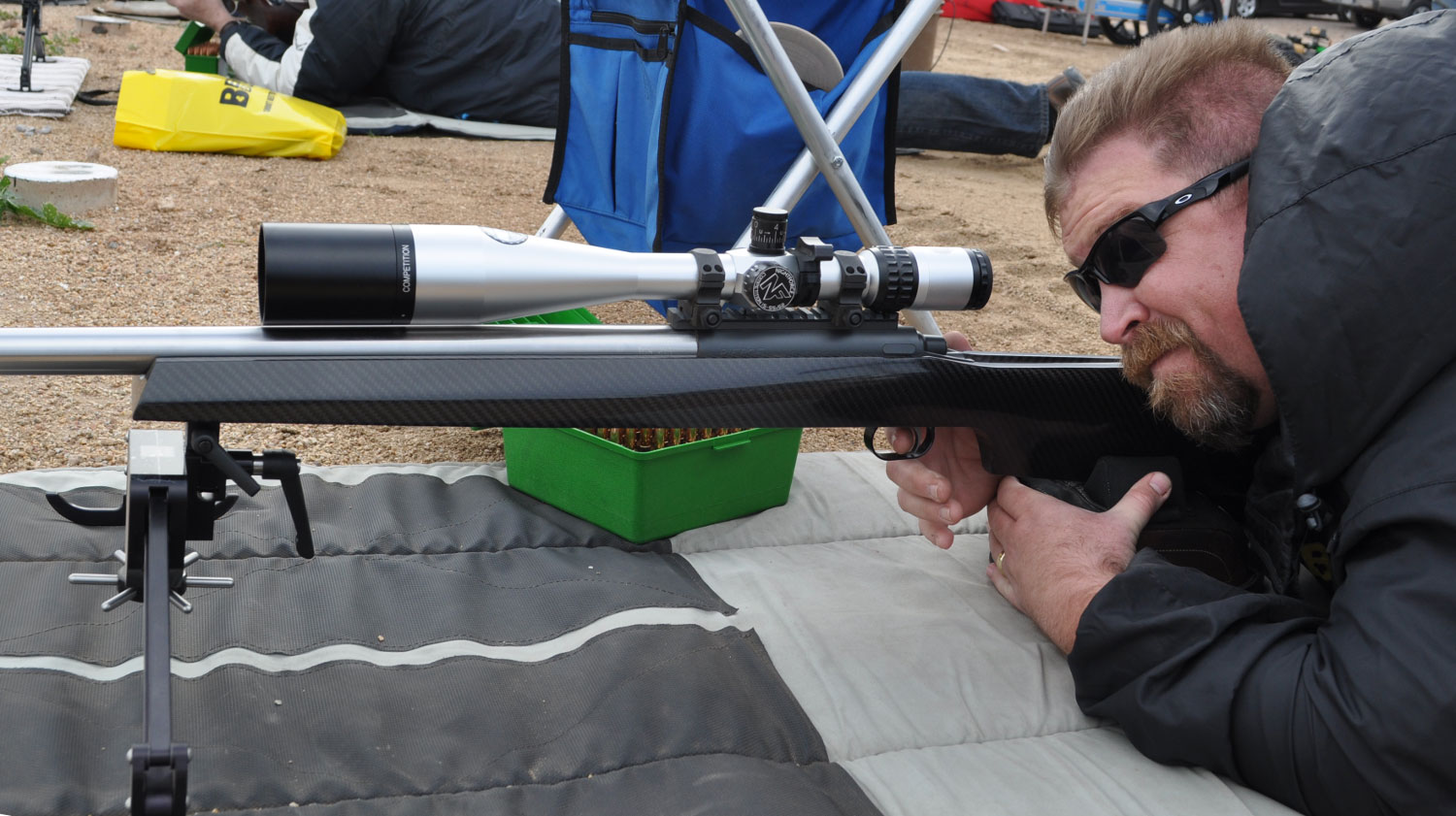
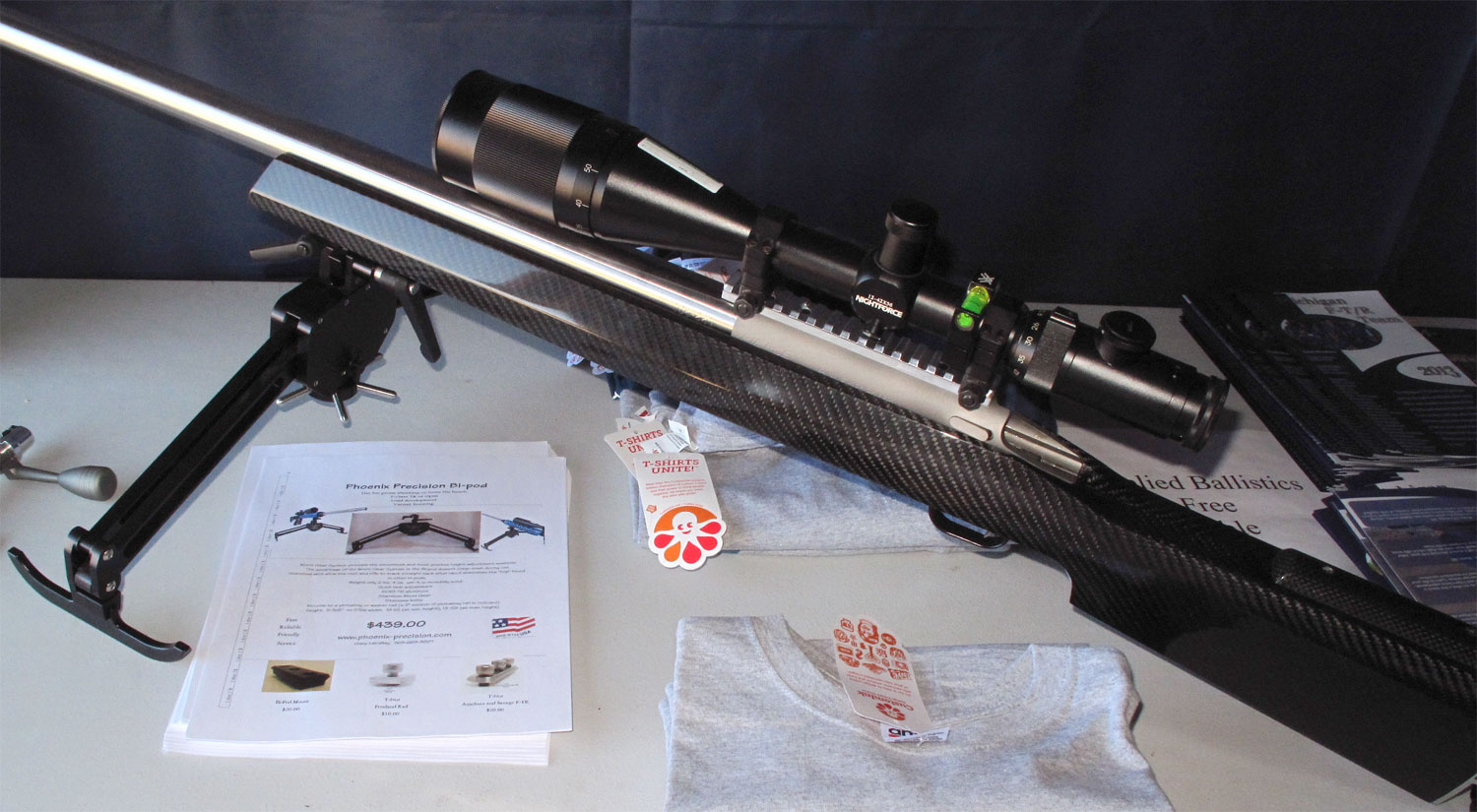
Eric’s F-TR rig was built by John Pierce using a stiff, light Scoville carbon-fiber stock. The stock is so light that Eric’s rifle came in 1.5 pounds under the F-TR maximum weight limit (8.25kg or 18.18 pounds). The gun features a Pierce action, Bartlein barrel, Jewell trigger, and a Gen 1 Nightforce 15-55X52mm Comp scope. From the get-go, Eric’s strategy was to “aim small” and shoot his rig like a bench-gun. He actually focused on shooting really small groups rather that just trying to keep shots within scoring rings and “hold waterline”. With a .308 Win that could shoot bugholes at 100 yards, this strategy paid off.
Rifle builder John Pierce explains the thinking behind this rifle: “The stock choice was mine — I had built two prototype rifles last year based on the premise that the game is Benchrest in the prone position. I still feel very strongly regarding [this concept]. I chose Bob Scoville for obvious reasons — he is an artisan and his stocks have won so much, they just flat work. We built Eric the latest configuration along these lines, and the tool worked for him. Without a doubt, Eric is a shooter, and we were all pleased to watch him perform so well.”
Eric sets up rifle before match. During live fire his hands do not contact the stock.
Eric employed a benchrest-style shooting technique with his F-TR rig — he shot pretty much free recoil, with no cheek pressure, no hand contact, and just a “whisper” of shoulder contact. Eric explains: “I shoot what’s called ‘free recoil’. Now the rifle is butted up against my shoulder very lightly, but no other part of my body touches the rifle except for my finger on the trigger.” Eric has even used this technique when shooting a 7mm cartridge in F-Open at other matches: “Someone suggested that this style wasn’t possible with the larger [7mm] cartridges, but I found it very successful so I continue to do it that way.”
VOICE FILE: Eric Stecker Talks About Shooting F-TR with Benchrest Technique.
Eric also employed an unconventional strategy — he was focused on shooting small groups (not just holding ring values): “Since I have started shooting F-Class, I treat [the target] like a benchrest target. What I mean by that is that I regard the center as my first shot, and so my objective is to create the smallest group. So, I will hold whatever… is required to end up with the bullet ending up in the center — that’s probably true of any F-Class shooter, but I guess the perspective’s a little different when you have a benchrest background.” Eric explained that “maybe I aim a little smaller than others might”, because in the benchrest game, “the slightest miss ends up costing you quite dearly”.
Click to Zoom Photo(This is not Eric Stecker’s rifle, but a “sistership” built by John Pierce.)
Eric Talks about F-TR Trends
Will other F-TR shooters build rifles suited for free-recoil-style shooting? Eric isn’t sure: “I don’t know if this type of rifle is the future of F-TR. I shoot a lot of benchrest, so putting those kinds of components into an F-TR gun made a lot of sense to me. One thing I like about F-TR is that there are a lot of different types of approaches being tried and some of them are successful. So I think it’s still pretty wide-open[.] But I think the really great part of what we found at the Southwest Nationals is that shooting [with] a benchrest-style approach certainly doesn’t hurt you. What I mean by that is … aiming small, trying to make the group as tight as possible rather than trying to hit a particular area. I actually tried to shoot tight groups — that was a focus and that worked for me — I had quite a high X-Count.” NOTE: Eric finished with 51 Xs, 14 more than F-TR Grand Agg winner Radoslaw Czupryna (37X). James Crofts had the second highest X-Count with 48 Xs.
Even Berger’s Boss did pit duty at the Berger SW Nationals.
*”Free Recoil” style shooting has its variations. Some would say “pure free recoil” would not even allow shoulder contact. Eric Stecker lightly touches the back of the stock with his shoulder.
Interest in the .222 Remington cartridge has revived following Lapua’s decision in 2009 to resume production of .222 Remington Brass. If you’re thinking of chambering a rifle in this very accurate caliber, or if you already have a .222 Rem, we’ve found a useful resource on the web for you.
Forum member Peter Simonsen has created a content-rich website, TripleDeuce.Net, with plenty of valuable info for .222 shooters. Peter tells us: “I started a little informative (non-commercial) web site about the .222 Remington, TripleDeuce.Net. You’re welcome to visit and share your thoughts and ideas.” Peter’s site includes extensive reloading advice, a list of recommended components, plus links to the major bullet-makers and powder manufacturers. His Reloading Page includes load data for a wide selection of bullets, while Peter’s photo archive shows cartridge diagrams and targets shot with Peter’s .222 Rem rifles. There is even an extensive section dedicated to the 20-222 Wildcat, an excellent varmint cartridge. The 20-222 is very efficient and very accurate.
Peter offers this advice for those getting started with the Triple Deuce cartridge:
“I religiously use the load data right off the Hodgdon web site. Recently I have gravitated toward using the old tried and true IMR4198 and H4198 powders for hunting using 40gr bullets. These two powders provide a velocity edge over the other powder choices while still maintaining safe and acceptable pressure levels. You can see this in the Hodgdon data where a max load of IMR4198 yields 3583 fps whereas H322 produces 3313 fps. So for hunting where higher velocity and terminal performance are important and accuracy is as good or close I would choose one of the two 4198 powders. This situation is similar, although not as dramatic, with 50gr bullets.
For target shooting H322 works extremely well. H4895 also provides impressive results and is a chosen powder for accuracy baseline testing by some manufacturers. I have begun experimenting with Vihtavuori N133 and Accurate 2015. Both seem very promising. But H322 and H4895 are two [dependable choices.]”
With the Berger Southwest Nationals kicking off February 4, 2014 in Phoenix, Arizona, we thought our readers might enjoy a very interesting interview with the top decision-makers at Berger Bullets, namely company founder Walt Berger, plus Eric Stecker, Berger’s Executive Vice President.
This interview covers a wide range of topics in seven (7) separate segments. We’ve embedded the first two interview sections in this article, with links for the other five below.
Sinclair Int’l has released a 7-part series of video interviews with Walt Berger (founder of Berger Bullets) and Eric Stecker (Berger’s Exec. VP and Master Bulletsmith). The series is hosted by Bill Gravatt (who was Sinclair’s President at the time the interview was filmed). You can watch Parts 1 and 2 of the interview here, and we’ve provided links to the remaining Parts 3 through 7. All seven interview segments offer interesting material. Part 6 mentions the Berger Reloading Manual (many years in the making). Part 7, over 13 minutes long, contains interesting discussions of bullet testing and the hunting performance of Berger VLDs.
NOTE: You can view this entire video series (and many other videos) on Sinclair’s YouTube Channel Page.
It’s official. Representatives of Lapua announced at SHOT Show 2014 that Nammo has purchased Vihtavuori, acquiring the “VV” line of propellants, and, most importantly, taking over Vihtavuori’s powder production facility in Vihtavuori, Finland.
This means that Vihtavuori is now officially under the Nammo umbrella as is Lapua, producer of brass, bullets, and loaded ammunition. Lapua engineer Tommi Tuuri has visited the Vihtavuori plant in person. Tommi says all operations are going well and the plant is running at normal capacity (but Nammo does plan some upgrades in the months ahead). Vihtavuori powders will continue to be imported into the United States as before and the powders will be made available through existing distribution channels.
Learn More about Nammo Purchase of Vihtavuori Powder Factory
The Vihtavuori Powder factory is located in Vihtavuori, Finland. Click marker to zoom.
The International Benchrest Shooters (IBS) has announced the IBS 2013 Shooters of the Year (SOY). Congratulations to these talented IBS shooters who took top honors in their respective disciplines:
1000-Yard SOY – Mike Wilson | 600-Yard SOY – Mike Moses / Tom Jacobs (tie)
Score SOY – Herb Llewellyn | Group SOY – Russ Raines
Many New Records Set in 2013
For IBS shooters, 2013 was a record-breaking year. Numerous records were broken at all distances from 100 yards out to 1000. Truly noteworthy was the new 600-yard, 5-shot group record set by Rodney Wagner. This has now been officially “sanctified” as a 0.336″ group. No, that’s not .336 MOA — the actual size of the group was 0.336 inches, measured center to center. Many folks would be happy with a group that size at 100 yards. Rodney did it at 600 yards! You can see Rodney with his astonishing 0.336″ (50 Score) five-shot group at right.
Also at 600 yards, Mike Hanes had a great year, posting two new Group Aggregate Records: 1.4901″ (Light Gun), and 1.7797″ (Two-Gun).
In the long-range game, James O’Hara set three new 1000-Yard Light Gun Aggregate records in 2013: Six-Match LG Group Agg, 3.072″; Six-Match LG Score Agg, 49.83; and Ten-Match LG Group Agg, 4.4374″.
In addition to the new records, two Non-Record 250-25X aggregates were logged this year in Score Matches. Kevin Donalds Jr., and Herb Llewellyn each shot a “perfect” 250-25X Agg in 2013.
IBS Annual Winter Meeting in Pennsylvania
This weekend, the IBS holds its Annual Meeting (better known as the “Winter Meeting”) in Harrisburg, PA. After Friday’s social, the business meeting convened at 9:00 a.m. on Saturday. All the officers and board members will be working together to set the goals the organization will pursue in 2014.
Report find by EdLongrange. We welcome reader submissions.



 1000-yard Benchrest competitor James O’Hara set four (4) new IBS Records in 2013. These multi-match Light Gun Agg records were secured with O’Hara’s solid performance at the 2013 Virginia 1000-yard Benchrest State Championship. Here are the new records set by O’Hara in 2013:


 Barrel Freezing (Cryogenic treatment)




 It’s official. Representatives of Lapua announced at SHOT Show 2014 that Nammo has purchased Vihtavuori, acquiring the “VV” line of propellants, and, most importantly, taking over Vihtavuori’s powder production facility in Vihtavuori, Finland.
 Many New Records Set in 2013


