|
|
January 11th, 2014
 For 2014, Kelbly’s is introducing a new series of rifles for competition, tactical disciplines and hunting. The Arcas™ Series rifles are complete packages designed with Kelbly’s recommended specifications and top-grade components. Pick your application (Benchrest, F-Open, F-TR, Hunting, Tactical) and Kelbly’s can provide a complete build with all the bells and whistles. For 2014, Kelbly’s is introducing a new series of rifles for competition, tactical disciplines and hunting. The Arcas™ Series rifles are complete packages designed with Kelbly’s recommended specifications and top-grade components. Pick your application (Benchrest, F-Open, F-TR, Hunting, Tactical) and Kelbly’s can provide a complete build with all the bells and whistles.
Shown below are the four Arcas competition rifles currently offered. In addition to these four comp guns, the Arcas series includes two tactical-style rifles and two hunting rifles (starting at $2799.00). All these Arcas series rifles will be on display at SHOT Show next week. Let us know (via comments) which Arcas models interest you the most, so we’ll be sure to feature those in our SHOT Show reports.

Every Arcas Series rifle comes with premium components and a wide choice of stock colors. In addition you can have an Arcas rifle customized. For example, the Arcas F-Open rifle shown below can be customized with an extra long barrel ($20 per inch), fluted barrel ($199.00 extra), polished metal (all parts, $249), a GRS Laminated Stock with ergonomic grip (no charge), or a PRT Lowboy stock with high gloss finish ($799 extra).

January 8th, 2014
When introduced last year, the original Nightforce 15-55x52mm Comp Scope sold for $2231.00 (or more). Now that same 2013 edition Nightforce Comp Scope can be yours for just $1850.00. This is a special promotion for AccurateShooter.com readers and Forum members. The 2013 Edition Comp Scopes are on sale because the Gen One model has been replaced by a second-generation model.
Call (570) 368-3920 to Get 15-55 NF Comp Scope for $1850.00
IMPORTANT: To get the super-low $1850.00 price you must call or email EuroOptic and mention that you saw this offer on Accurateshooter.com. Otherwise the price on EuroOptic’s website is $1950.00. To get the $1850.00 price call (570) 368-3920 or email sales [at] eurooptic.com and request the AccurateShooter.com Nightforce 2013 Competition Scope Special.

The 2014 version of the Nightforce 15-55 Comp Scope will cost at least $2352.00 (MAP) and it will not arrive at dealers for many more weeks (or months). If you buy the 2013 Edition NF Comp Scope you can save $502.00 compared to the 2014 model, and you can get your scope right now. Saving over $500.00 provides a pretty compelling reason to go with a Gen One 2013 model. NOTE: This is a LIMITED-QUANTITY Offer. When these scopes are gone they’re gone (2013 model NF 15-55x52mm Comp Scope has been discontinued).

What’s the Difference Between 2013 Comp Scope and 2014 Model?
The 2014 edition has turrets with 10 MOA per revolution instead of 5 MOA per revolution. The 2014 model also has a zero-stop feature and more reticle choices. Other than that, the previous 2013 Edition is pretty much the same as the later version. Both have 15-55X magnification, boht have 0.125 MOA click values, both have 52mm front objectives, and both have 80-90mm eye relief. The 2013 does have some advantages — it offers 60 MOA of elevation and 60 MOA of windage travel. The 2014 version only has 55 MOA of elevation and 50 MOA of windage. Also, the SILVER COLOR is only offered in the 2013 Edition. The 2014 model comes only in Black.
December 23rd, 2013

 It was big news when Nightforce introduced its 15-55x52mm Competition Scope last year. Now this impressive optic has been made even better. The turrets have been redesigned, and you now get 10 MOA per revolution (up from five MOA in 2013). With these new turrets, ZeroStop™ and Hi-Speed™ adjustments are now standard equipment. In addition, two fast, easy-to-read windage caps are included with every riflescope. Total elevation travel is 55 MOA, while total windage travel is 50 MOA. (That’s down from 60/60 in the 2013 model). It was big news when Nightforce introduced its 15-55x52mm Competition Scope last year. Now this impressive optic has been made even better. The turrets have been redesigned, and you now get 10 MOA per revolution (up from five MOA in 2013). With these new turrets, ZeroStop™ and Hi-Speed™ adjustments are now standard equipment. In addition, two fast, easy-to-read windage caps are included with every riflescope. Total elevation travel is 55 MOA, while total windage travel is 50 MOA. (That’s down from 60/60 in the 2013 model).
The 2014 version of the 15-55x52mm Competition scope still boasts the key qualities that attracted attention last year. The 15-55 Comp weighs just 27.87 ounces, making it 24% lighter than Nightforce’s 12-42x56mm Benchrest scope. The 15-55 still offers superb ED (low dispersion) glass, giving it excellent brightness and sharpness. The 15-55 Comp also retains its handy, fast-focus European-style eyepiece for 2014.
More Reticle Options for 15-55x52mm Comp Scope
When the 15-55×52 Comp scope was introduced last year, many shooters said “That scope looks fantastic, but I wish there were more reticle choices.” Well Nightforce listened to its customer base. Nightforce now offers four reticles for the Comp Scope: FCR-1, DDR-2, CTR-2, CTR-3. For long-range applications, we really like the new FCR-1, which features .016 MOA stadia lines with vertical and horizontal hash marks and numbers in one-MOA increments. Since the scope has MOA-based clicks, this makes it easy to do hold-overs or hold-offs (for wind) at long range.

Also new is the DDR-2 “double-dot” reticle. This features a .172-MOA horizontal stadia outside of .016-MOA center lines. There is a .026 MOA center dot, plus a second dot 3 MOA below center. Vertical indicators are located in 0.5, 1.0, 2.0 and 2.5 MOA increments.
 Specifications for 2014 15-55x52mm Competition Scope

October 31st, 2013

There was “Thunder Down-Under” last week at the 2013 World Benchrest Championships (WBC 2013) in Australia. The event was held at the Silverdale Range, a 1.5 hour-drive west of Sydney, NSW. This event drew roughly 80 of the world’s best 100/200 yard Benchrest group shooters who competed both individually and on national teams. Squads from Australia, Canada, Finland, Italy, New Zealand, Russia, South Africa, the United Kingdom, and the USA vied for WBC team honors. Both Australia and the United States fielded three teams, while New Zealand and South Africa each fielded two squads.

Conditions were vicious at times, with extremely high winds in a few relays. To show you how tough things were, legendary shooter Tony Boyer had a 1.560″ group during the LV 200-yard match, while Tom Libby shot a shocking 2.280″ group in the same relay. We can’t remember when we’ve ever seen groups like that posted by shooters of this skill level.
In team competition, the strong USA ‘A-Team’ finished first followed by South Africa A (second place) and Australia A (third place). Ed Adams, Tony Boyer, Gene Bukys, and Bob Scarbrough Jr. were the members of the winning USA A-Team.

In individual competition, Americans finished 1-2-3 in the Two-Gun. Texan Charles Huckeba topped the field, winning the Two-Gun Overall with a 0.2804 Grand Agg. Gene Bukys (0.2863) was second, and Bob Scarbrough Jr. (0.2881) finished third. In fourth place overall was South African Roland Thomsen (0.2919), while New Zealander Peter Haxell (0.2940) finished fifth. The top five for each of the LV and HV yardages are listed below.

Complete WBC 2013 Results have been posted on the Australian Benchrest Bulletin website. Scroll down and look for the blue “Latest Stuff” tab on the lower left. There you’ll find links for WBC 2013 events under the “Latest Results” header.
Light Varmint Grand Agg
1. Gene Bukys (USA-A) .2796
2. Todd Tyler (USA-C) .2817
3. Roland Thomsen (SA-A) .2952
4. Peter Haxell (NZ-A) .2971
5. Jan Hemmes (SA-A) .3024 |
Light Varmint 100 Yards
1. Freddie Botha (SA-B) .1936
2. Todd Tyler (USA-C) .2258
3. Wayne Campbell (USA-B) .2464
4. Peter Haxell (NZ-A) .2484
5. Gene Bukys (USA-A) .2486 |
Light Varmint 200 Yards
1. Jan Hemmes (SA-A) .2939
2. Gert Le Roes (SA-B) .2962
3. Roland Thomsen (SA-A) .2978
4. Gene Bukys (USA-A) .3106
5. Todd Tyler (USA-C) .3375 |
Heavy Varmint Grand Agg
1. Ivan Piani (ITA-A) .2389
2. Bob Scarbrough (USA-A) .2399
3. Ch. Huckeba (USA-C) .2424
4. Tony Boyer (USA-A) .2520
5. Ed Adams (USA-A) .2781 |
Heavy Varmint 100 Yards
1. Tony Boyer (USA-A) .1574
2. Ch. Huckeba (USA-C) .1722
3. C. Whittleton (AUS-B) .1872
4. Wyn. Campbell (USA-B) .1874
5. Bob Scarbrough (USA-A) .1900 |
Heavy Varmint 200 Yards
1. Ivan Piani (ITA-A) .2786
2. Ed Adams (USA-A) .2869
3. Bob Scarbrough (USA-A) .2897
4. Ch. Huckeba (USA-C) .3126
5. Jari Laulumaa (FIN-A) .3168 |

Photos by Todd Tyler, Tom Libby, and Scott Pieper, provided courtesy Aaron French.
October 21st, 2013
Report by Boyd Allen
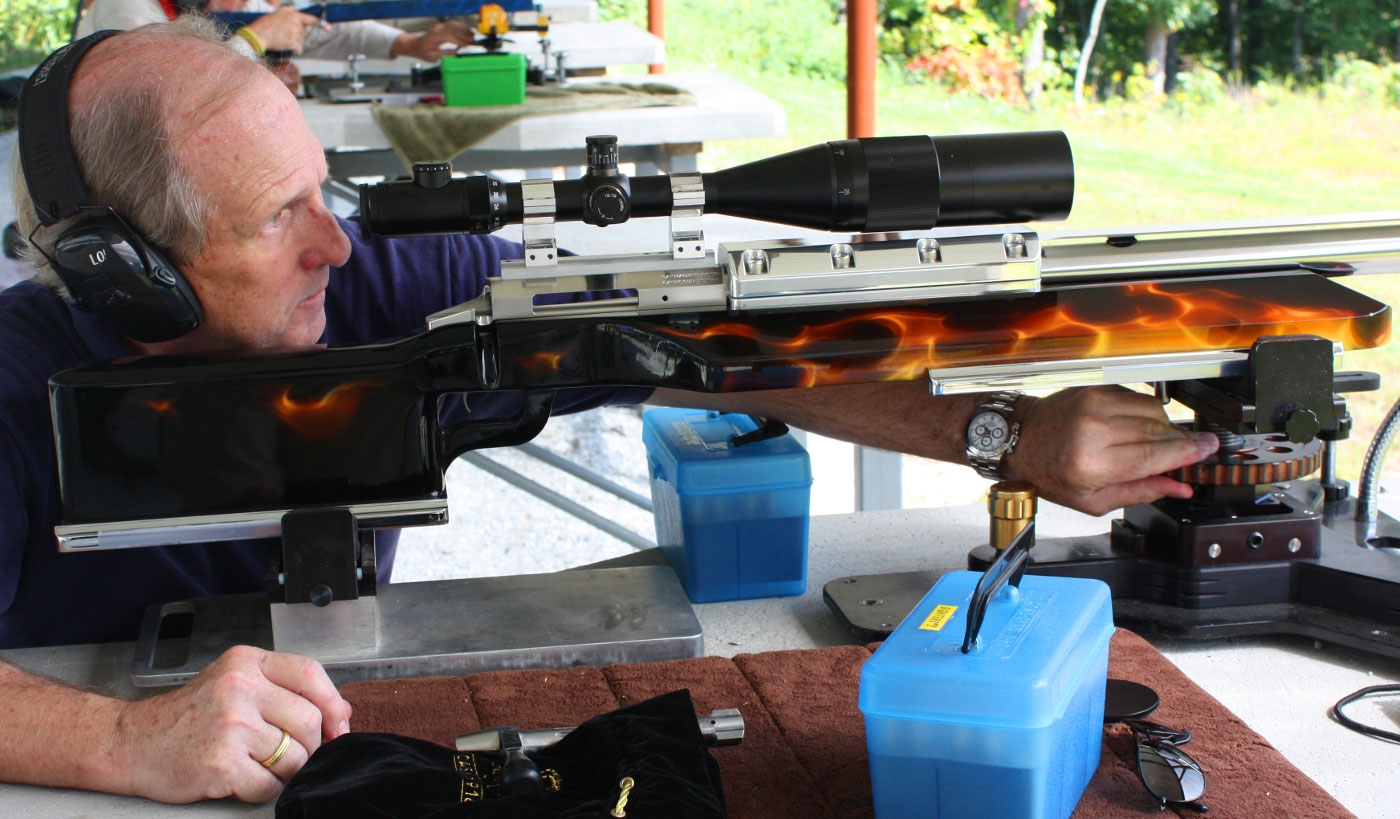
This pistol belongs to Dan Lutke, a Bay Area benchrest shooter who publishes the results for the Visalia matches to the competitors and the NBRSA. He has been an enthusiastic competitor for an number of years, at various ranges, notably Visalia and Sacramento. The action is a Remington XP-100, to which a Kelbly 2 oz. trigger has been fitted. On top is an old Japanese-made Tasco 36X scope (these were actually pretty darn good). The Hart barrel (a cast-off from Dan’s Unlimited rail gun) was shortened and re-chambered for the 6x45mm, a wildcat made by necking-up the .223 Remington parent case. The custom stock/chassis was CNC-machined by Joe Updike from 6061 Billet Aluminum to fit the XP-100 action and mount a target-style AR grip with bottom hand rest. The gun was bedded and assembled by Mel Iwatsubu. In his XP-100 pistol, Dan shoots 65gr custom boat-tails with Benchmark powder.
 
TEN Shots in 0.303″ at 100 Yards
How does Dan’s XP-100 pistol shoot? Look at that target showing TEN shots at 100 yards, with eight (8) shots in the main cluster at the top. The ten-shot group measures .303″ (0.289 MOA), as calculated with OnTarget Software. Not bad for a handgun! What do you think, can your best-shooting rifle match the 10-shot accuracy of this XP-100 pistol?


This diagram shows the most common 6x45mm wildcat, which is a necked-up version of the .223 Remington parent cartridge. NOTE: The dimensions for Dan Lutke’s benchrest version of this cartridge may be slightly different.

ACAD drawing by Peter Gnanapragasam CC by SA 3.0, via Wikimedia Commons. Title Added.
Story tip from Boyd Allen. We welcome reader submissions.
October 18th, 2013
The National Benchrest Shooters Association (NBRSA) has adopted new rules, loosening restrictions on the Sporter Class of benchrest rifles. Now a Sporter fore-arm may be any width (or angle), and the underside of the buttstock can have any angle. Previously, fore-arm width was limited to three inches, and the bottom of the buttstock had to be angled up. (NBRSA Rules will continue to require this “up-angle” geometry for all Light Varmint (LV) and Heavy Varmint (HV) rifles). In addition, the NBRSA opened the Sporter Class to any caliber “no larger than .308 Winchester”.
The idea behind these changes is to allow greater innovation in at least one class of benchrest bag guns, and to avoid “redundancy”. Currently a 10.5-lb Light Varmint can be shot as a Sporter, so long as the LV complies with caliber rules. For practical purposes, that meant Sporter Class was redundant with the Light Varmint Class, and there was no real reason for the Sporter Class to exist anymore.
The Sporter weight limit remains unchanged at 10.5 pounds (including optics). All current LV and Sporter rifles will remain 100% legal under the new rule, so no one is forced to go out and build a new rifle to shoot in Sporter class. But if you want to try a more radical stock design, now you have the opportunity to do so. Here is the text of the new rule:
NBRSA Rule Book (New Sporter Rule)
B. Definitions: 2. Equipment (d) Sporter Rifle
A Sporter Rifle is defined as any rifle having a safe manually and mechanically operated firing Mechanism and must not weigh more than 10.5 lbs, inclusive of sights. The stock can be flat, or convex, but not concave. The Forearm can be any width and have any angle. The butt stock can have any angle including a reverse angle, the barrel shall not be less that 18″ long forward of the bolt face and can be any diameter or configuration including a straight taper or a reverse taper. The Sporter Rifle can be no larger than .308 Winchester. Sporter Rifles do not have to conform to the Varmint Rifles diagram. All sand bag rules apply to the Sporter Rifle.
View NBRSA Rule Book (Includes New Sporter Definition) PDF
| Bukys Explains the Thinking Behind the Sporter Rule Change
 On Benchrest Central, leading benchrest shooter Gene Bukys discussed the new NBRSA Sporter Rule Changes: “[This] does not create a new rifle or an experimental class — it simply removes most of the restrictive rules from the existing Sporter class. Every existing LV rifle and every existing Sporter Rifle in this whole world is still legal, and competitive, under these changes. On Benchrest Central, leading benchrest shooter Gene Bukys discussed the new NBRSA Sporter Rule Changes: “[This] does not create a new rifle or an experimental class — it simply removes most of the restrictive rules from the existing Sporter class. Every existing LV rifle and every existing Sporter Rifle in this whole world is still legal, and competitive, under these changes.
My purpose in all of this is to make the Sporter class, and the LV rifle, no longer redundant classes, and to have a class where we can have some innovation in Benchrest. If there is a better stock configuration out there or a better barrel profile shouldn’t we benchrest shooters be the leading edge of this innovation? Benchrest used to be the leading edge of virtually all accuracy innovation. I’m not sure if that’s true anymore. I would like that to be… true again.
For right now, I don’t see this as making any huge radical changes to benchrest, but given time and a venue to work in (Sporter Class) there may be some really meaningful innovation that comes about. Let’s have some fun with this.” |
Gene Bukys Commissions New Convertible Sporter/LV Stock by Bob Scoville
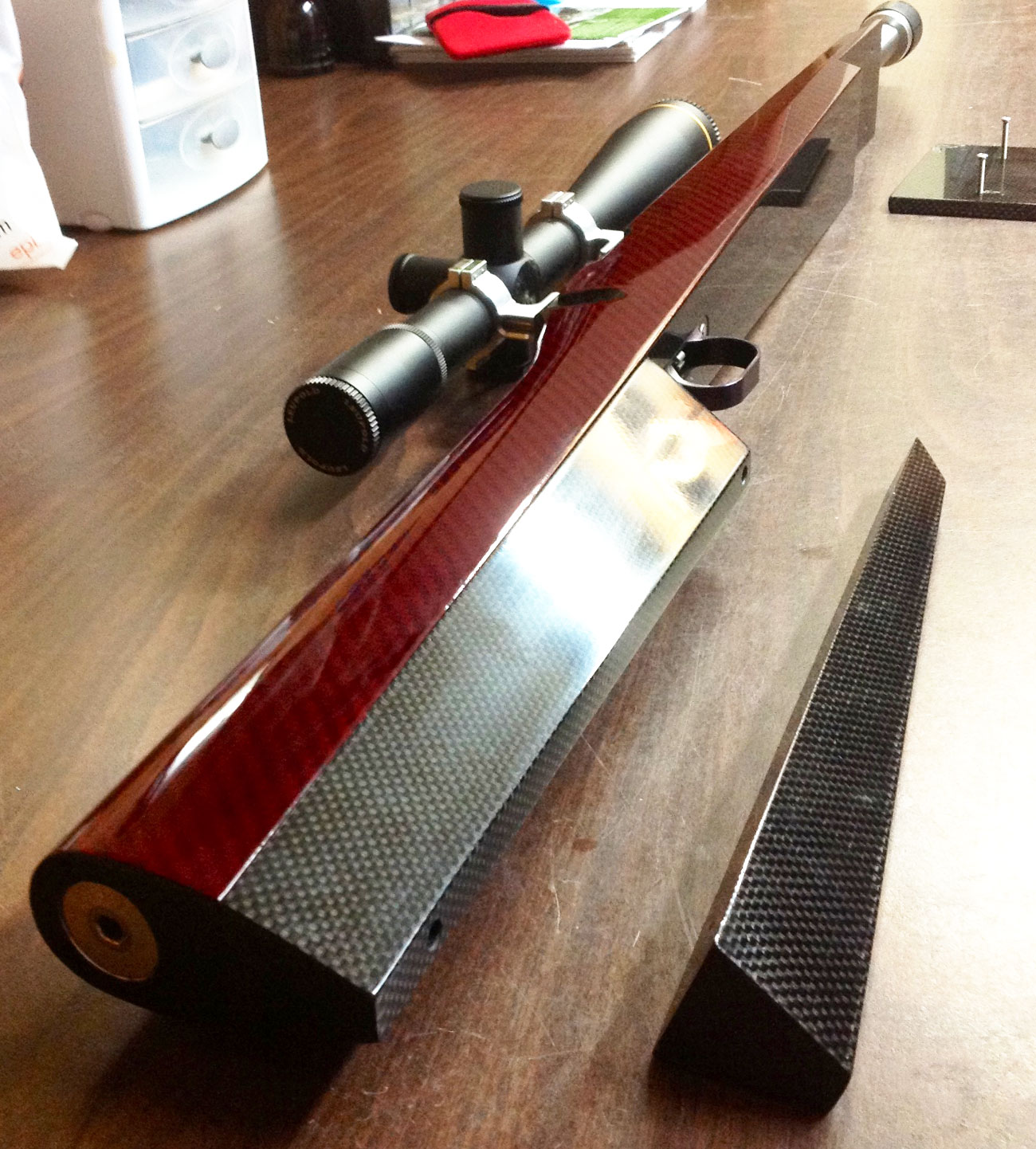
Under the new NBRSA Sporter standards, stock designers/fabricators can now experiment with a wider variety of stock shapes and geometry. Gene Bukys commissioned a new stock from Bob Scoville that shows what can be done under the new liberalized Sporter stock rules.
Gene’s latest NBRSA Sporter rifle features a stepped forearm that can fit a 5-inch wide bag rider plate. In the rear, this stock can run different size/shape “keels” (buttstock underbellies). The larger keel, shown attached in the photos, exhibits the flatter angle now allowed under the new NBRSA Sporter rule. (In fact, this keel may have a slight reverse angle, i.e. lower in the front than in the back). At any time, this Scoville stock can be switched back to a 100%-legal Light Varmint configuration by: 1) removing the 5″ front bag-rider plate; and 2) changing to the smaller, up-angled rear keel piece.
CLICK Photos to View Full-Screen Version


Photos and Links provided by Pascal Fischbach.
October 10th, 2013
Shooters who reload at the range, during the course of benchrest matches, or during load development sessions, can benefit from having a portable scale to weigh charges. Even if you throw charges, using click values, a scale allows you to double-check the accuracy of your throws. In addition, having a scale handy lets you weigh and sort components during load development.
Many reloaders prefer “old-fashioned” balance beam scales for range use. They are relatively inexpensive and simple to use. With a beam scale, unlike electronic scales, you don’t have to worry about weak batteries or finding AC power. The problem when using any scale at an outdoor range is wind. Wind can cause powder to blow out of the pan and even a light breeze can actually cause a beam scale to perform erratically.
Beat the Breezes with a Wind Box for your Scale
Forum member Boyd Allen has come up with a smart solution for reloaders who use scales outdoors — a windproof scale enclosure, aka “Wind Box”. This is something that can easily be built at home with common tools. Boyd explains: “Many guys have good set-ups for loading at the range, with clamping mounts for powder measure and press. But they lack a good enclosure for a scale. This is vitally important with beam scales because they have a lot of surface area to catch the wind. With much wind at all, the beam can oscillate to the point that is not really very usable. While a low-profile electronic scale may be less wind-sensitive, breezes DO affect weight read-outs on digital scales. And of course you always have the issue of blowing powder particles.”

Boyd Allen has used his Wind Box successfully for many seasons. He explains: “Some time ago, I got this idea, and was fortunate enough to have a friend, Ed Hellam, who liked the idea well enough to build us both one. He did a fine job, but since this was the prototype there was at least one lesson to learn. The original viewing pane was Plexiglass, and I discovered that it would hold enough static charge to throw the scale off 0.1 grains, so another friend, Bob Smith, modified my Wind Box, replacing the Plexiglass with a tempered glass faceplate. Thank you Ed and Bob….
The essence of the idea is to have a scale set up in a box with a clear cover that can be opened and closed. On one side the trickler handle/control emerges through a ‘just big enough’ hole. You raise the cover, add a sub-target-weight thrown charge to the pan, and then close the cover. With the cover secure, the set-up is protected from the wind, and you can now trickle up to your desired charge. It works very well. The scale in the photo is an old Ohaus that I picked up. It is actually more sensitive than my RCBS 10-10 and works fine. You can adapt this Wind Box design to any beam scale, or portable electronic scale. Simply adjust the dimensions to fit your particular scale and trickler.”

October 7th, 2013
 Yes old dogs can learn new tricks. Just five years ago Forum member Henry Pasquet (aka “HenryP”) got started in 1000-yard benchrest shooting. He was 66 at the time. Henry worked hard, learned fast, and pursued accuracy with a vengence. That all paid off when Henry won the 2013 IBS 1000-yard Nationals this summer, finishing as the Two-Gun Overall National Champion. Henry was kind enough to talk about his rifle, his reloading methods, and his strategy for success. In fact, Henry was eager to share “everything he knows, so that other guys can fast-track their learning process”. Henry told us: “I want to share every lesson I’ve learned, so that other guys can improve their game and enjoy the sport more.” Henry also wants to encourage other senior shooters: “If you pay attention to details (when reloading), and get a good rifle with a good barrel, age is not a handicap. With a good set-up, older guys can compete with anyone out there. This is one sport where you can be a champion in later life.” Yes old dogs can learn new tricks. Just five years ago Forum member Henry Pasquet (aka “HenryP”) got started in 1000-yard benchrest shooting. He was 66 at the time. Henry worked hard, learned fast, and pursued accuracy with a vengence. That all paid off when Henry won the 2013 IBS 1000-yard Nationals this summer, finishing as the Two-Gun Overall National Champion. Henry was kind enough to talk about his rifle, his reloading methods, and his strategy for success. In fact, Henry was eager to share “everything he knows, so that other guys can fast-track their learning process”. Henry told us: “I want to share every lesson I’ve learned, so that other guys can improve their game and enjoy the sport more.” Henry also wants to encourage other senior shooters: “If you pay attention to details (when reloading), and get a good rifle with a good barrel, age is not a handicap. With a good set-up, older guys can compete with anyone out there. This is one sport where you can be a champion in later life.”
Click on Rifle Photos to View Full-screen Versions

Q&A with Henry Pasquet, IBS 1000-Yard National Champion
Q: First, do you have any advice for older shooters getting started in their golden years?
Henry: You’re never too old. In this sport, you can excel even in your 60s, 70s and beyond. At this stage in life, we now have the time and money to get good equipment and rifles. Plus, our years of work experience help us to think, analyze, and thereby make progress. In this game, we older guys can definitely compete on a par with younger shooters.
HARDWARE
Q: Tell us about your Nationals-winning rifle and bench gear. Is there anything unique about your hardware that gave you an edge?
Henry: At the Nationals, I used my 17-lb Light Gun for both Light and Heavy Class. This rifle has a 1.55″, round BAT LP/RE action, fitted with a Bartlein barrel chambered for the .284 Shehane (an improved version of the .284 Winchester). The barrel was near-new; this was the first time I had used it this year. A great barrel and great batch of Berger 180gr VLDs all made a difference. Jay Cutright chambers my barrels. Jay’s metal-work is so precise that I can screw any barrel he’s chambered to any BAT action I own. The laminated stock was modified by Tommy Shurley from a standard 3″-wide fore-end to a 5″-wide True-Trac with an adjustable 3″-wide rear plate. It’s not pretty but it tracks like a Heavy Gun stock. Tommy made my other stocks as well.

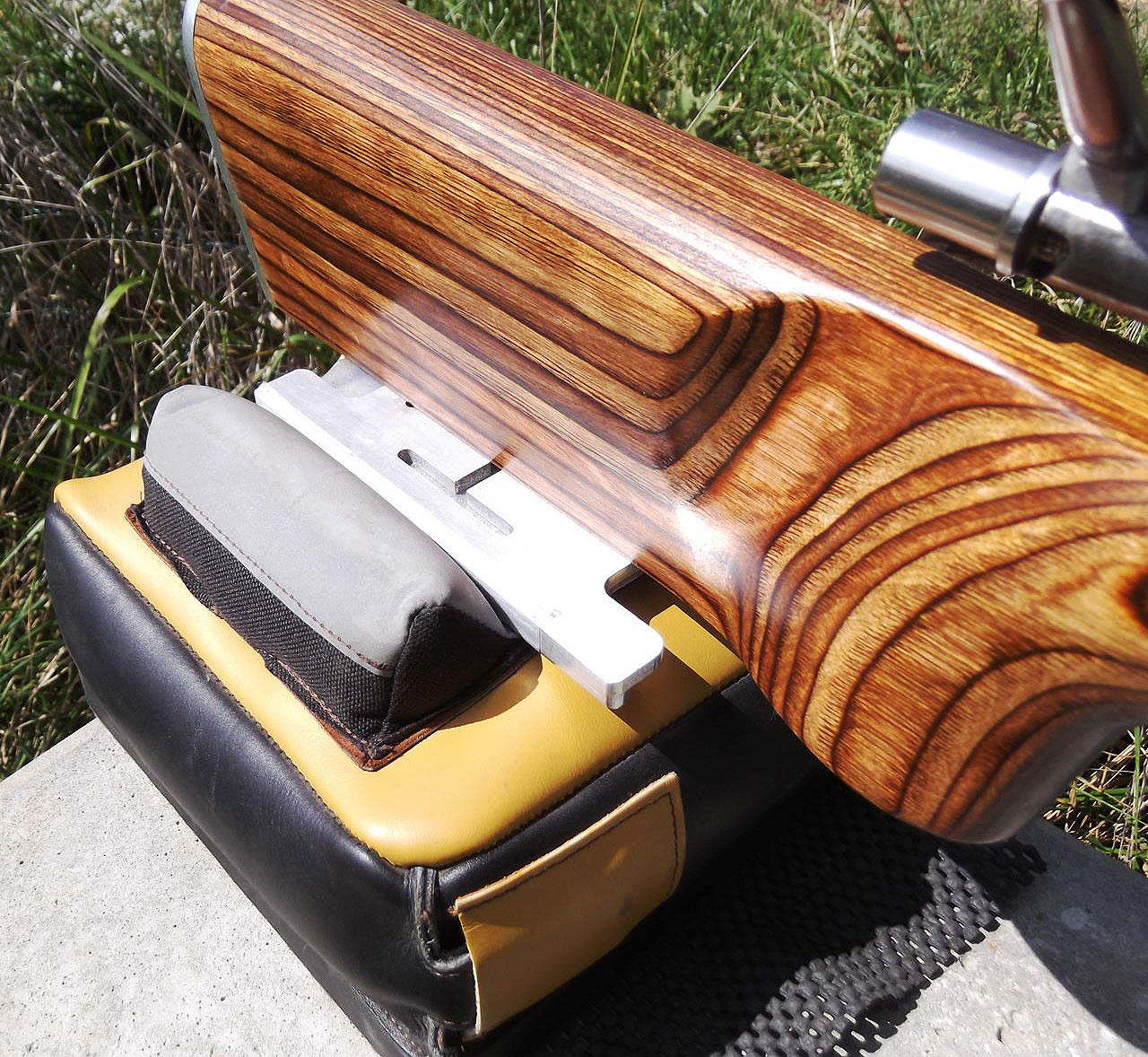
 On top is a Nightforce 12-42x52mm Benchrest scope with CH-3 reticle. I used a Fulghum (Randolph Machine) front rest with an Edgewood bag made with the low-friction 3M material. In the rear I use a special-order Protekor rear “Doctor” bag with ears spaced 3 inches apart. The rear bag also has the new 3M material on contact surfaces (photo at right). On top is a Nightforce 12-42x52mm Benchrest scope with CH-3 reticle. I used a Fulghum (Randolph Machine) front rest with an Edgewood bag made with the low-friction 3M material. In the rear I use a special-order Protekor rear “Doctor” bag with ears spaced 3 inches apart. The rear bag also has the new 3M material on contact surfaces (photo at right).
Q: During the Nationals, at the last minute you switched guns. Why did you go from a 6mm Dasher to a 7mm Shehane?
Henry: I had planned to use my Light and Heavy Dashers, but after placing the Dasher on the ready line, decided to switch to the .284 Shehane. It was still early in the morning and I felt that the heavier bullets would be easier to see against the berm. The Dasher had actually been giving tighter groups under perfect conditions, but seeing the impact is important.
Q: Tell us about the combined tuner/muzzle brake on some of your barrels. How does this improve rifle performance and how do you set the “tune”? Do you tune the barrel to the load?
Henry: I use a tuner or tuner/brake on every barrel. I started with Time Precision tuners. Art Cocchia advised getting a load with a good known accuracy node with minimum extreme spread, which controls vertical. Do not go for the hottest loads, which just reduces brass life. Then use the tuner and tune the barrel to the load. The .284 Light Gun needed a muzzle brake and tuner. I had a local gunsmith cut a thread on the muzzle brake for a tuner I got from Sid Goodling. (Eric Bostrom developed an almost identical unit at the same time. I use Eric’s tuner/brakes on all my new barrels.) Just before Nationals, I tried going up and down one marker. Down one mark cut the group in half! Think how much range time (and barrel life) that saved me. Using a tuner is easier than messing around changing loads and tweaking seating depths. Tuners definitely can work. Last year I shot a 3.348″ 10-shot group at 1000 with my .284 Win Heavy Gun fitted with a Time Precision Tuner.

Q: What are the advantages of your stock’s 5″-wide fore-end and 3″-wide rear plate? Is there a big difference in tracking and/or stability? Does the extra width make the rifle easier to shoot?
Henry: I had true Heavy Guns with 5-inch fronts and 3-inch rears. They tracked well. I felt the same result could be had with a Light Gun. I talked two stock makers into making them. I initially had the standard rear stock until Tommy Shurley and Mike Hearn came out with an adjustable rear plate. The stocks track perfectly. You can see your scope’s crosshairs stay on the target the whole time and push the rifle back for the next shot. There is no torquing (gun wobbling) when cycling the bolt. Us old guys need all the help we can get. I am getting rid of my 45-pound Heavy Guns and replacing them with Light Guns with heavy barrels.

Q: Some people say the .284 Shehane is not as accurate as the straight .284 Winchester. You’ve proved them wrong. Why do you like the .284 Shehane? More speed, less pressure?
Henry: The reason I rechambered my 7mm barrels to .284 Shehane was not velocity, pressure, or brass life. It was all about bolt lift. My straight .284 almost required me to stand up to eject brass. I damaged an extractor and had to send the bolt back to BAT. With the .284 Shehane, my bolt cycles like there is no case to eject.
Reloading Methods
Q: People want to know about your load and your loading methods. What can you reveal?
Henry: For my .284 Shehane at the Nationals, I loaded 52.5 grains of Hodgdon H4350 and Federal BR-2 primers behind Berger 180gr VLDs. I usually anneal the brass each winter. I have used the same brass for years. I use Redding bushing dies, apply Imperial sizing wax, resize, wipe off wax, clean and uniform the primers pockets using the RCBS Trim Mate Case prep center, then apply Imperial dry neck lube with a bore mop.
 To dispense powder, I use a RCBS ChargeMaster set 0.1 grain below my desired load and then weigh them on a Sartorius GD-503 magnetic force restoration scale to get identical charges. I use a K&M Arbor Press with seating force gauge when seating the bullets with a Wilson inline die. My “target” seating force on the K&M dial is 20-23 units for Dashers and 35-40 units for the .284 Shehane. I put any variables aside for sighters. I do not weigh brass, bullets, or primers. My bullets were so consistent that I did not sort by bearing surface. I did trim the Berger VLDs to the shortest bullet length with a Hoover Trimmer, and then pointed the meplats just enough to close them with a Whidden pointer. I sort my bullets to 0.005″ overall length, rejecting about five percent. To dispense powder, I use a RCBS ChargeMaster set 0.1 grain below my desired load and then weigh them on a Sartorius GD-503 magnetic force restoration scale to get identical charges. I use a K&M Arbor Press with seating force gauge when seating the bullets with a Wilson inline die. My “target” seating force on the K&M dial is 20-23 units for Dashers and 35-40 units for the .284 Shehane. I put any variables aside for sighters. I do not weigh brass, bullets, or primers. My bullets were so consistent that I did not sort by bearing surface. I did trim the Berger VLDs to the shortest bullet length with a Hoover Trimmer, and then pointed the meplats just enough to close them with a Whidden pointer. I sort my bullets to 0.005″ overall length, rejecting about five percent.
Q: What kind of precision are you looking for in your reloads? Do you trickle to the kernel? Does this really help reduce extreme spread?
Henry: I try to keep my charge weights consistent to one kernel of powder. I use the Omega powder trickler with a Sartorius GD-503 lab-grade balance to achieve that. For accurate dispensing, put very little powder into the Omega so you can drop one kernel at a time. Single digit ES (Extreme Spread) is the goal. This does make a difference at 1000 yards. If you get the same push on the same bullet with the same neck tension, good things are going to happen.
Q: You believe consistent neck tension (i.e. grip on the bullet) is really important. What methods are you using to ensure consistent bullet release?
Henry: I apply Imperial dry neck lube to the inside of my case-necks with a bore mop. The K&M arbor with seating force gauge shows the need to do this. If you put a bullet into a clean case, it will be jerky when seating the bullet. You may see 40 units (on the K&M dial) dropping to 20, then slowly increasing pressure. I explained to a friend that not lubing the neck is like overhauling an engine without lubing the cylinders. Smooth entry gives the bullets a smooth release.
Barrel Cleaning
 Q: You go 60-80 rounds between cleaning and the results speak for themselves. What is your barrel cleaning procedure? Do you think some guys clean too often or too aggressively? Q: You go 60-80 rounds between cleaning and the results speak for themselves. What is your barrel cleaning procedure? Do you think some guys clean too often or too aggressively?
Henry: I cringe when I see people wearing out their barrels with bronze brushes between relays. I clean my barrels at the end of each day when I get home. I shot my best-ever 1K Heavy Gun group (3.348″) at day’s end after 60 to 80 rounds. After trying other solvents, I have gone back to Wipe-out’s Carb-Out and Patch-Out products. I use about four patches of Carb-Out, let it sit a few minutes, then use one stroke of a nylon brush followed by Patch-Out until the barrel is clean. I use a bore mop to clean inside the chamber, then some Break Free LP on the bolt followed by bolt grease on the lugs and cocking part. I use a bore guide when anything goes down the barrel.
Shooting Skills and the Learning Process
Q: Henry, you can shoot long-distance on your own property in Missouri. How important is practice, and what do you do during a typical practice session?
Henry: I can shoot 1000 yards on my farm. I have a concrete bench using a slab from a yard furniture place on concrete blocks. Two 4 x 8 sheets of plywood hold four IBS targets. I never practice. I only test, keeping a notebook with all the info. I do most of my testing at 300 to 500 yards, shooting off my deck so I can see my shots immediately.

Q: How much of your success do you credit to really accurate rifles, versus superior shooting skills?
Henry: I do not consider myself another Carlos Hathcock or some master marksman. I am an average 1000-yard shooter, but I do work hard getting the most out of my rifles. Four other people have shot their first 1000-yard matches with my rifles, including my wife, and all of them won relays! I loaned my Dasher to another shooter two years ago and he got second at the 600-yard Nationals. Others will tell you that the rifle must be “on” to win. If your barrel or bullets are average, don’t expect to perform above average in competition.
Q: What you do enjoy most about long-range benchrest shooting? What are the attractions of this sport?
Henry: The sport offers good people and a real challenge. 1000-yard shooting keeps us all humble, but we still keep trying to see how good we can do. I am thankful for Robert Ross providing the only match location that I can shoot regularly.
Q: Henry, you have been a Forum member for many years. Have you learned important techniques from other Forum members and other shooters?
Henry: I have followed the AccurateShooter Forum since 2008. At my age I am not good at computers. I copied and analyzed many articles, especially on the .284 and the Dashers. Without AccurateShooter.com, I would probably still be shooting double-digit (10″+) groups at 1000 yards, and I sure wouldn’t have my name on a National Championship trophy.
Q: You are in your 70s now and have only been shooting competitively for a few years. How did you get so good so fast? How did you manage to beat shooters who are decades younger?
Henry: I had 20/10 vision when I was young, but am down to only 20/20. I have been interested in long range shooting for a long time including ground hog hunting. I went to some VHA jamborees also. In 2008, I went to the Williamsport Benchrest School with a friend from Pennsylvania, John Haas. We would compare notes frequently. I bought a BAT three lug from Tom Mousel in Montana. We also compared notes and made each other better. At IBS matches I studied other shooters’ equipment and techniques. I tried some, accepting some and rejecting some.
Here’s my advice:
Always be ready to learn something new. If it makes sense, try it. I would also encourage other older shooters not to quit. Stick to it. You can make enormous progress in a few seasons.

September 22nd, 2013

Report for International Benchrest Shooters (IBS)
 On August 30-31, 2013, Robert and Chrissy Ross hosted this year’s 2013 IBS 1000-Yard National Championships at their Midwest Benchrest range in Yukon, Missouri. On August 30-31, 2013, Robert and Chrissy Ross hosted this year’s 2013 IBS 1000-Yard National Championships at their Midwest Benchrest range in Yukon, Missouri.
This year’s format was run with all the Light Gun (LG) relays shot on Friday, followed by all the Heavy Gun (HG) relays on Saturday. The competition was very tight as the Two Gun Overall Champion, Henry Pasquet from Elsinore, Missouri, didn’t even realize he had won until his name was called out at the award ceremony. Henry, an active AccurateShooter Forum member, secured a well-deserved National Championship with strong performances in both classes. Henry registered a fifth place in LG Group along with tenth place in LG Score. Henry then finished first in HG Score along with eleventh in HG Group to earn the 2013 Two-Gun Overall Title.
IBS 2013 1000-Yard National Championships Results (PDF)
Matthew Kline traveled from Pennsylvania to take second place in the Two Gun competition. He garnered that honor with an eighth Place in LG Group and a fourth place in LG Score. Matthew followed up these with a ninth place in HG Group and eleventh place in HG Score.


Kansas’ Jim Bauer came in a close third in the Two Gun rankings, by finishing first in LG Score and 21st in HG Group, then adding a second place in HG Group and 16th place in HG Score. Jim’s wife Sally, last year’s IBS long-range Shooter of the Year winner, was the Top Female Shooter. Rory Jacobs, from Vapor Trail Valley Shooting Club in Spickard, MO was the Top Junior Shooter.

Hot Temperatures and Fickle Winds Challenge Shooters
The Midwest Benchrest range is literally in the Ross’ back yard and is cut right out of the middle of a Missouri forest, which gave the shooters new to the range a false sense of confidence, thinking the trees would block the winds. The shooters had to deal with temperatures in the upper 90s (and the shade trees offered little relief). With the incredible humidity present, it felt it was even hotter. Although the winds weren’t very high, they weren’t very cooperative either, as they were never consistent throughout both days. One minute it was directly behind the shooters and the next it was quartering to the right. A moment later it was to the left.

The early relay winners seemed to favor the end benches, while later in the day, they seemed to favor the middle benches. There was was nothing but bright sunshine for the two-day event. Cloud cover and cooler temps, which were earlier forecast for the shoot, finally showed up the day after the tournament. Needless to say, the “heat monkeys” were making small groups difficult at this year’s shoot. Most small groups that were shot, were followed up with larger groups, in both the LG and HG events.

All in all, everyone still had a great time competing, seeing friends and fellow shooters from other parts of the country, and enjoying the Ross’ hospitality. It wasn’t long after the shoot was over before everyone started talking about where the 2014 Nationals would be. Perhaps, Robert Ross said it best: “Ultimately, the competition yields to the resulting friendships, which are fostered as part of a common goal: Raising the bar in long range precision shooting.”
The two-day competition was run as smoothly as any monthly shoot is run. The weekend’s shoot really started off on Thursday night though. Jim and Sally Bauer, Hornady, and Midwest Benchrest, sponsored a fantastic fish fry for all the competitors and their spouses. This provided some neutral ground to meet up and catch up with both new and old friends alike before the actual shooting began. If possible we will add equipment lists and individual relay results to this story on Accurate Shooter.com.
Featured Hardware at the 1K Nationals (Click Photos to Zoom)


September 7th, 2013
All target shooters strive for perfect shot placement. Well one man has come closer to perfection than any other shooter who ever lived. You are looking at Michael Stinnett’s .0077″ NBRSA world-record group, the smallest 100-yard 5-shot group ever shot in the history of rifle competition. (We’re told the group was certified at .0077″ though labeled .008″ on this photo. A moving backer verified that this was FIVE shots.)
Call it stunning, call it humbling, call it amazing. It is, quite simply the apotheosis (“perfect example”) of accuracy. This is what we all hope to achieve. It’s staggering to see that a rifle can drill FIVE perfectly-overlapped holes — the last virtually indistinguishable from the first — at a target a football field (100 yards) away. Yes the stars aligned for Mike, but it’s great to see a benchmark like this, if only to remind us what is possible in our sport of precision shooting. (Sighters appear below record target.)

Below is a larger-than-life-size view. Using this photo we measured the group with target-calculating software, and it came out .006″ (the software only goes to three digits). We recognize that it would be much better to work from the real target rather than a photo, so we are not challenging the official measurement in the least. But this does confirm that this is a phenomenally small five-shot group.

Many folks have asked about the gun and ammo that produced the .0077″ group. The Light Varmint-class Benchrest rifle was chambered as a .30-caliber wildcat, the 30 Stewart, which is based on the 6.5 Grendel case necked up. Mike was using Hodgdon H4198 powder behind BIB 114gr, 10-ogive bullets. Notably, the record-setting ammo was pre-loaded before the match. Here is Mike’s tuner-equipped rifle. CLICK HERE for more information on the rifle and cartridge.

|
Best Group Ever Record Rifle Equipment Report
Action: Kelby Panda “Speedy Shorty” with solid bolt and PPC-diameter bolt face. Kelby was asked to build several actions which were identical with the intent to eliminate any variance in head space between the two new rifles. This helped me use a single set-up on sizing dies for both rifles and ammo is interchangeable. Both actions were sent to Thomas ‘Speedy’ Gonzalez to be blue-printed and have Jewell triggers installed.
Reamer: 30 STEWART (I just call it a 30 PPC as that is what everyone expects, but it is in fact a custom design and Ralph deserves about 99% of the credit).
Barrels: Krieger was selected for the barrels. After discussions with Randy Robinett of BIB Bullets, a 1:17″ twist was identified as the correct, safe solution. Ralph Stewart has cut all my chambers using a custom-designed reamer. [Our goal] was consistent headspace and Ralph has been able to keep my barrels within .0002 variance. The barrel tuner also comes from Ralph Stewart.
- Stock: Larson (including action bedding)
- Scope: Leupold 45X Competition in Kelby Single Screw Tall Rings
- Brass: Lapua (Base case is 6.5 Grendel)
- Bullets: Randy Robinett (BIB) 30 Cal. 114gr, 10 Ogive (secondary bullet; primary is 112gr BIB)
- Powder: H4198 – Stout Load with 2980 FPS Velocity
- Front Rest: Farley Coaxial
- Bags: Micro Fiber
- Flags: Graham Wind Flags (large)
|
|