IBS Report and photographs by Dick Grosbier
Over Labor Day weekend the Union County Sportsmans Club (Weikert, PA) hosted the 43rd annual IBS 100/200 Score Nationals. This club has a reputation for hosting fine events, and this match certainly lived up to that reputation. With 63 guns on the line, this year’s Score Nationals was well-attended. All in all this was as good a Score Nationals as I have attended in quite a while. I tip my hat to the Union County crew for running an excellent match. Weather was warm and a little muggy both days. I do not believe we ever had a drop of rain (despite a 30% chance of rain forecast). Mirage was very minimal as it was overcast both days. Winds started out very calm and slowly increased all day long both days.
Left to Right: IBS Score 2-Gun Winner Dean Breeden, Varmint For Score Grand Agg Winner Herb Llewellyn, Hunter Class Grand Agg Winner Gary Long.
On Saturday, Herb Llewellyn started out on a tear in Varmint For Score (VFS) class and stayed hot, finishing the 100-yard event with a 250-25X score. We witnessed some really fine shooting in less-than-perfect conditions. Junior Shooter Kevin Donalds Jr. (photo below) laid down a fine 250-24X to finish second. Kevin, who turns a ripe old 13 years of age in a few days, shot a remarkable 250-25X Aggregate a few months back. To the best of my memory those are the only two 250-25X scores in IBS this year. A.R. Edwards was third with 23X.
In Hunter Class Dean Breeden shot 250-17X beating more than 50% of the VFS shooters, and for those of you who do not fully understand Hunter Class, the big thing to remember is they shoot 6-power scopes. Peter Hills from Maine also shot a 250 in HTR with 9X.
Sunday the shooters lined up for the 200-yard event. Shooting his 6 PPC, Hal Drake shot a 250-14X, proving that a PPC can still win in a Score match (at least at the longer ranges). Second place (as at 100 yards) went to a Kevin Donalds, but this time it was Kevin Donalds Senior who was the runner-up, posting a 250-13X. Third place honors went to Dean Breeden also with 250-13X. In Hunter Class, veteran shooter Gary Long shot 248-5X to beat K.L. Miller under Creedmoor tie-breaker rules. Dave Thomas was third with 247-7X.
You may have noticed that nobody in the top three on Saturday was in the top three on Sunday. This led to some interesting results in the VFS Grand Aggregate. Top Man was Herb Llewellyn, with a 500-36X. Herb’s victory at the Nationals pretty much puts the last nail in the coffin of anybody trying to catch Herb in the Score Shooter Of the Year race.
Second in the Grand was Herb’s lovely wife Kim with a 500-34X. Third place went to Randy Jarvais who learned the hard way to not drop the first X! Randy tied with Kim for total score all weekend but Kim shot a 5X on the first target and Randy got a 4X. Fourth in the Grand went to 200-yard winner Hal Drake with 500-33X, and Ricky Read rounded out the Top Five with 500-32X.
Gary Long won the Hunter Grand division with 497-22X, Dean Breeden was second with 496-20X, and third was Dave Thomas with 496-14X. It was great to see Dave back shooting again. Dean Breeden put in a repeat performance as IBS Score 2-Gun winner with a 996-51X score, Larry Feusse was second with 990-46X and Dudley Pierce was third with 987-44X.
IBS 43rd Annual 100 / 200 Yard Score Nationals
Union County Sportsman’s Club — August 31st to September 1st, 2013
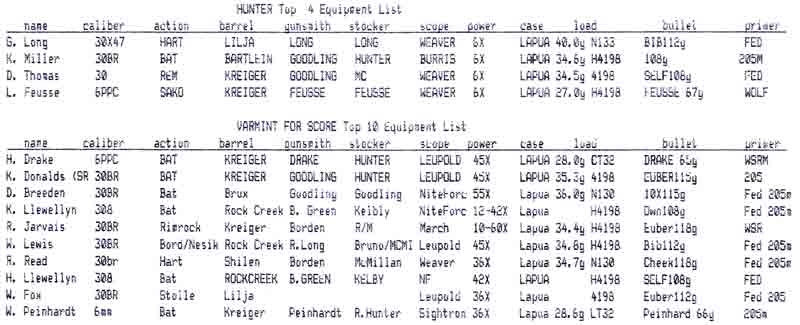
CLICK Equipment Lists Below to See LARGE Versions
Praise for the Match Crew and Kitchen Crew
I cannot say enough good things about the target crew and range officer Mark Trutt. They ran a very efficient match. I do not recall a single delay all weekend from loose- or erroneously-hung targets. We started promptly at 9:00 am and finished around 2:00 pm both days. Range officer Mark Trutt did an outstanding job when confronted with a tricky situation regarding IBS Score 2-Gun shooters. The range has 40 benches and we had a very nice turnout of 63 guns on the line but it simply was not justified to run a third relay so Mark judiciously added around 10 minutes between each relay to allow 2-gun shooters some time to reload. I don’t think the time would even have been noticed but the target crew was speedy and efficient, so we ended up with a little extra time on the line. I personally felt it made for a very nice, laid-back pace for competitors shooting only one gun. Scoring was fast and efficient for the most part.
The Kitchen crew deserves praise for the fine breakfasts and lunches. In good Weikert tradition, we were treated to “Mama Trutt’s” fresh-baked cookies each afternoon. — Dick Grosbier
There’s a new score game in town — it’s called Ultimate Benchrest (UBR). You don’t have to purchase a membership to compete, and the rules are designed to equalize calibers, so you can shoot a .223, a 6mm (.243), or a .30 caliber benchrest gun — all with an equal chance to win. There’s a special class for factory guns, so you can have fun with Savages, Coopers, Kimbers, and Remingtons. The next step up is the Modified Class — this is for factory guns that have been re-barreled or had the action moved to a flat-bottom, Benchrest-style stock. The Custom Class is for guns with custom actions, benchrest stocks, and premium barrels. Max weight is 13.5 lbs for Factory, Modified, and Custom Class rifles. Any rig over 13.5 lbs competes in the Unlimited Class. Here pretty much anything goes, including one-piece rests.
Next month, the Ultimate Benchrest Nationals will be held September 27-28 at the Buck Creek Range in Kentucky. There’s no limit on shooters and all classes can compete. This two-day event features 100-yard matches on the 27th, with 200-yard competition on the 28th. Many prizes will be awarded, including products from 21st Century Shooting, Benchmark Barrels, Berger Bullets, Cooper Firearms, Krieger Barrels, PMA Tools, Shilen Rifles, and Sinclair/Brownells. If you’re in the area, you should check it out. There’s a class for everyone, and hot food (and cold drinks) will be provided.
For more info, visit UltimateBenchrest.com or email George Coleman, georgeky [at] live.com. To register for the UBR Nationals, call jackie stogsdill at 606-382-5152 or send email to: jackie_stogsdill [at] hotmail.com .
Watch Video Highlights from the 2012 UBR Nationals
One of the most remarkable shooting records — and one that has stood for four decades — is the 0.009″ five-shot group credited to Mac McMillan. The NBRSA Light Varmint Record of .009″ for five shots (at 100 yards) was set on 9/23/1973, forty years ago. Experts have considered that record “untouchable”, “unassailable” — in other words “unbreakable.”
Well records are meant to be broken. It appears that Texan Mike Stinnett has broken the “unbreakable” .009″ NBRSA record. Mike shot a .0077″ five-shot group at 100 yards in a registered short-range benchrest match at Denton, Texas. This will be a new NBRSA record (and all-time world record) if approved. Mike was shooting a .30-caliber cartridge, listed as a 30 PPC, but there’s some talk that the cases were formed from a Lapua 6.5 Grendel case. No matter — this is a mind-blowing accomplishment, particularly considering that Stinnett was shooting a .30-caliber gun, which has considerably more recoil than a 22 PPC or 6 PPC.
Forum member Wes J. (aka “P1ZombieKiller”) reports: “My buddy Mike Stinnett was just confirmed as having beat the world record LV group at 100 yards in a registered match. His group measured .0077″ and he did it with his 30 caliber.”
Wes adds: “Mike shoots thousands of rounds a year… I have sat on the bench right next to him several times, and he has rattled off five shots down range in a matter of 2-3 seconds, and the groups have measured in the .1s. The guy can flat shoot. His wind reading abilities are mind-blowing. When he gets the right condition, he is fast. REALLY FAST.”
NOTE: We will publish photos of Mike Stinnett and his target as soon as they are available.
The 2013 World Rimfire and Air Rifle Benchrest Federation (WRABF) European and World Cup Championships will take place August 3-16 at the Plzen International Shooting Range in the Czech Republic. Top smallbore and air rifle benchresters from 19 countries will compete, along with junior squads from six nations. With over 130 registered competitors, this should be the biggest WRABF Championship event ever held.
The Championships run for 13 days in August, starting with two official practice days on August 3-4. Then Air Rifle benchrest matches will be held August 5-7. Rimfire 25m matches are slated for August 8-11, followed by 50m matches August 12-15. Awards presentations will be made on August 16th, then all the shooters head for home.
Team Italy created a handsome banner especially for the WRABG Championships:
There is a new digital magazine for Rimfire and Air Rifle Benchrest enthusiasts, The Benchrest Shooter. You can download the premier, Summer 2013 edition for free. This initial trial version of the digital magazine is free to all member states of the WRABF and ERABSF, allowing readers to preview the type of articles planned for future editions. Here is a link for a free download:
The free download links will be valid for the next two weeks — so grab this issue while you can. Future editions will be by paid subscription only. The magazine’s creators plan to produce four (4) issues of The Benchrest Shooter eZine per year, costing $3.50/ €3 per issue (based on an annual subscription price of $14/ €12). Articles in future issues will include:
Review of the Plzen World Championships
Product reviews — airline cases, rifles, components, rests, etc.
Plans for building your own front rest
Barrel tuners — how to choose one and how to use one
Country profiles and the international community
The editors of The Benchrest Shooter encourage air rifle and rimfire benchrest competitors to get involved: “The magazine in many respects is about you, your countries, the sport, development of equipment, and sharing ideas. [We] hope that people would submit articles about such ideas and products for future issues. The magazine can supply a great more detail than a forum for instance. All advertising supports WRABF and ERABSF sponsorship. The first year is a trial to see if the new eZine will be cost-effective.”
In the spring of 2004, IBS 600-yard benchrest competition was born. Piedmont Gun Club in Rutherfordton, NC was one of the three initial ranges across the country to host this new competition. Bridgeville (DE) and the Bench Rest Rifle Club of St. Louis (MO) were the other two. 600-yard benchrest was the brainchild of several IBS and club officers, Dave Tooley and Joe Goforth among them. The idea was to have a new competition at a distance far enough that short-range cartridges would not dominate, but not so far that the new mid-range discipline would duplicate 1000-yard competition. After initial “test matches” at 500 yards, in late 2003, officers at Piedmont Gun Club decided to push the targets out another 100 yards. That was the beginning of the 600-yard benchrest game.
IBS 600-Yard Match at Piedmont Gun Club (June 8, 2013) Report for IBS by Sam Hall Piedmont Gun Club is a legendary venue in the 600-yard Benchrest game because so many records have been set at this range. Throughout the 600-yard seasons at Piedmont Gun Club, June has been one of the best months for shooting small groups and high scores. Most all records have been shot there in the summer months of June, July, and August. And speaking of records, more records have been set, broken, and re-broken at Piedmont than all other IBS 600-yard ranges combined! I know of 29 separate records that have been set by just three shooters. Joel Kendrick, Terry Brady, and myself, Sam Hall. Many, many more records have been broken there also.
After a couple of rainy days, the weather cleared up for our June 8, 2013 match. It was to be one of Piedmont’s IBS 600 Yard “Shooter of the Year” points matches also. 35 seasoned veterans showed up… plus a new shooter, Jimmy Norman. There were high expectations for more records to fall. Although the weather was fair with sun and the occasional cloud, a light wind, switching from right to left, kept any records from being set this day. Many small groups were shot in the morning in the Heavy Gun session, but the switching wind picked up in the afternoon during the Light Gun competition and the groups showed it.
Thomas Parker Wins HG with a Rem-Actioned Rifle
The day started with Heavy Gun shooting first at 09:00 sharp. The wind was very light from left to right at 2-3mph with temps about 70 degrees. Thomas Parker showed us that a Remington actioned benchrest rifle can still whip the all-out custom “Race Guns” in the hands of a good shooter. Thomas won the Heavy Gun overall placing first in score (193) and second in group (1.965″) for four targets. Note: a group Agg (or aggregate) is the 4 target groups added together and averaged (divided by four). Sam Hall snuck in the small group of the day 0.986″ to help him win the HG Group Aggregate with a 1.820″. This was the only first place that Thomas did not capture. Thomas shot the standard 6mmBR cartridge, pushing Berger 105gr Hybrid bullets. His rifle featured a Remington 700 action, Brux barrel, and a custom wood benchrest stock.
Watch Heavy Gun Winner Thomas Parker Shoot at Piedmont
Mike Hanes Captures Light Gun and Sam Hall Takes the Two-Gun
After the Heavy Gun segment concluded, as always, a great lunch was served by a local church group. Lunch is held in Piedmont’s new club located just beside the 600-yard range.The club house also has bathroom facilities for men and women, a kitchen and large banquet room. Light Gun (LG) started just after the break for lunch. The winds had picked up to 5-8 mph and switching left to right now. Temps were 80-84 degrees for the rest of the day. Groups were sure not as good as they were in the morning for Heavy Gun. Mike Hanes (2012 IBS 600-yard Shooter of the Year) had small single target group of 1.423″ in LG to help him win LG Group Agg with a 2.371. Mike had second place in score with a 184 to help give him the “Overall” LG win. Mike was shooting a custom 6mm Dasher “Race Gun”. It featured a BAT dual port action, Shehane fiberglass ST-1000 stock, Jewell 2 oz. trigger, Brux barrel.
Sam Hall won the Two-Gun Overall with 8 rank points. Thomas Parker finished second in the Two-Gun with 29 rank points with Steve Jordan finishing a close third with 30 rank points. Sam said the match was great, and he invites readers to join the fun: “Come on out to Piedmont with us and give 600-yard benchrest a try. I guarantee you will be welcomed and will have a great time!”
Piedmont Gun Club — Home of the Record-Breakers
Piedmont has seven IBS 600-yard matches a year from March though September. Five matches are IBS “Shooter of the Year” matches where IBS points can be accumulated. Piedmont also has its own Shooter of the Year. All Piedmont’s 600-yard matches count toward it. They give a very nice standing trophy to the winner at the end of the year. Attendance at Piedmont for 600-yard competition is usually 30 to over 40 shooters. Most guys are regulars and have been at the 600-yard game for years. The competition is tough! I have heard many shooters say that shooting at Piedmont is like shooting at the Nationals every match. The atmosphere is very friendly though. We welcome new shooters. There is always someone there to help you when needed, whether it be a fellow shooter or range officer. On many occasions I have witnessed a fellow shooter lend his own rifle to a new shooter who wants to give it a try, someone who forgot ammo, or had equipment failures.
Not only does Piedmont Gun Club have IBS 600-yard competition, but the Club also hosts several other shooting disciplines. Piedmont has a 50-yard pistol range, trap and skeet range, 25-50-75-100 meter small bore silhouette rifle range and 50-600 yard rifle range. Piedmont hosts NRA Smallbore Rifle and 22 Cowboy Silhouette matches in March and ending in October. Piedmont also hosts three IBS 100/200 yard VFS (Varmint For Score) Benchrest matches a year including a NC State match in September 2013. They have 16 covered benches at their VFS range and 16 separate covered benches for their 600 yard range. Tommy Williams is the Club President and also is match director of the 600-yard matches to boot! Piedmont Gun Club is located in the beautiful foothills of western North Carolina.
Hardware Choices — Sam Hall Talks about 600-Yard Rigs
Over the years, 600-yard equipment has evolved. We now have a good idea of what works the best in 600-yard competition. Several varieties of long-range stocks work well so long as the geometry of the key surfaces in the fore-end and butt are parallel (or very close). Custom actions are desirable, with dual port (right bolt, left load port, right eject) or drop-port for faster shooting. The standard 6mm BR or any of its improved versions seem to be equally competitive and accurate at 600 yards. You’ll want a match-grade, stainless barrel, 26-30 inches in length, with a 1:8″ to 1:8.5″ twist rate (depending on your bullet and velocity).
Do you really need a true Heavy Gun? Both Mike Davis and I experimented with true Heavy Guns in 2007. Mine was a 61-pound, 6 Dasher built with a Shehane Aluminum Maxi-Tracker stock. Mike shot a 50-pound, 6 BRX in a massive, aluminum Bruce Baer stock. Both these “true heavies” (Mike’s and mine) had dual-port BAT actions and Brux 1:8″-twist barrels. Mike set the HG 4-target group aggregate record that year with a 1.467″ Agg and I set the HG 4-target score record with a 197. These true Heavy Guns shined when the mirage and/or wind were really bad. If they are tracking back on target well, you can rip off 5 shots in mere seconds! That said, I don’t think a “true heavy” is needed to be competitive.
Folks have certainly experimented with exotic equipment in the 600-yard game. But, for a new shooter it is good to know that fancy, ultra-expensive rifles are not necessary to win at 600 yards. You can shoot one rifle and do just as well as the man with several long-range rifles. You don’t need a separate rifle for Light Gun and Heavy Gun. Just look at what Richard Schatz has done over the years with one rifle. As the saying goes, beware of the man with one gun! To boot, matches are still being won with affordable, factory-actioned rifles. Never count out a skilled shooter with an accurate Remington- or Savage-actioned benchrest rifle — he may beat you! That was the case at our most recent match at Piedmont.
If you want to learn how to shoot accurately at very long range, one of the very best places to learn is the Williamsport 1000-Yard Benchrest School. The 6th Annual Benchrest School will be held Saturday June 8 and Sunday June 9, 2013. There are still a few slots available for this year’s session. Classes, taught by top 1K shooters, are held at the Original Pennsylvania 1000-Yard Benchrest Club Range, one of the best 1K ranges in the country. View the range on the Williamsport website, PA1000yard.com
Prospective students will be taught all aspects of long-range benchrest shooting from some of the most skilled marksmen in the country. All areas are covered: load development, precision reloading, bench skills, and target analysis. Much time is spent at the loading bench and on the firing line. And you don’t even need guns and ammo — all equipment and ammunition will be provided.
School instructors tell us: “This year’s benchrest school will be a 2-day weekend event. (There is also a ‘Meet and Greet’ gathering Friday evening). The school is a beginner class designed to teach the fundamental skills needed to be competitive at at 600 and 1000 yards. Saturday will be spent in class covering a range of topics including reloading dos and don’ts, load development and equipment handling. Sunday we will shoot an actual match to see what you’ve learned.”
Don’t hesitate if you want to grab one of the remaining slots for the 2013 school. Contact the school directors right away. For more info, visit contact Dave Gardner (Public Relations) at pa1000br@yahoo.com or 570-916-9095. To get an application, please contact Nancy Miller (Club Secretary) at nancymiller@htva.net or 607-426-1535. Cost for the class is $300.00 including lunch and dinner on Saturday.
To see what the 1K Benchrest school is like, watch the slide show/video below, produced by Sebastian Reist, an alumnus of the 2009 Williamsport 1000-yard BR school. Sebastian, a talented professional photographer, captured the highlights of his Williamsport 1K training weekend:
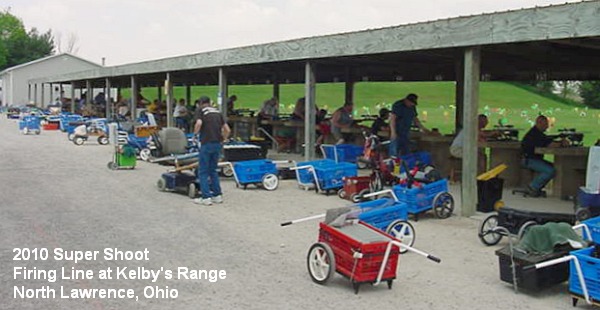
Ready for the Super Shoot? The 41st Annual Firearms Industry Super Shoot will be held on May 22-25, 2013, at Kelbly’s Rifle Range in North Lawrence, Ohio. This annual event draws some of the best 100-yard and 200-yard benchrest shooters in the world. Last year’s Super Shoot had almost 300 competitors from the USA and 14 other countries (about 15% of the competitors come from overseas).
2012 Super Shoot Highlights Video (Watch This — It’s Very Well Done!)
If you’ve never attended the Super Shoot before, and don’t know what to expect, former Sinclair International President Bill Gravatt offers some insights into this great event:
Super Shoot — What It’s All About
The excitement and anticipation leading up to a Super Shoot can be hard to explain to those who haven’t been to one. Every year, some shooters arrive at the Super Shoot a week early to dial in their rifles, learn wind conditions for the range, and enjoy the camaraderie of their fellow shooters. As the match draws closer, campers and RVs fill the area behind the range, and shooters stake out turf all over the property with their reloading and cleaning equipment setups.
Many shooters choose to load cartridges in the main barn directly behind the 60-bench firing line, while others decide to work in pop-ups, campers and other outbuildings around the facility. Benchrest shooters tend to load in small batches, and some most load cartridges between each match. Many shooters clean their rifles after each match, while others sometimes go two or three matches between cleanings, depending on the number of rounds they fire.
Another part of high-level benchrest competition that will amaze first-time attendees is the quality and amount of equipment benchrest shooters use. Just in front of the shooting benches and the targets, range flags of all kinds sprout up, from the typical “daisy wheel” flags to very sophisticated velocity indicators that show varying wind intensity. Shooters adjust their flags to align with the particular target in front of a specific bench, just slightly below the path of the bullet but still partially visible in the high-powered scopes.
The rifles represent a variety of actions, usually custom, with heavy benchrest barrels by various barrel makers. The most popular cartridge used is the 6mm PPC, but occasionally you will run into someone using a 6mm BR or a slightly modified 6mm BR, and as well as a few other cartridges. Rifle rests used are typically heavy tripods or plate rests. You see a lot of Sinclair rests, Farley rests, and a variety of others, including a few homemade rests. Bags are typically Edgewood or Protektor.
Super Shoot — Runners, Pickers and the Pursuit of Perfection
The techniques vary between shooters, and they are interesting to observe. Some shooters “run” their targets and will shoot a quick sighter and then run all 5 shots as fast as they can before conditions change. Others are “pickers” and shoot each shot carefully, going back and forth between the record target and the sighter target to verify wind conditions and bullet drift. These guys will sometimes shoot up to 10 sighters and use the full seven minutes. Both styles of shooting work and many shooters use both techniques depending on the match conditions[.]
Anyone who attends the Super Shoot will come away with a greater appreciation of precision benchrest shooting. Experienced benchresters already know there will be windy days that drive them crazy, and less experienced shooters can get completely lost when… holding off a shot in the wind. But the reward is worth it. It’s very satisfying to hold off a full inch at 100 yards because the wind changes during your string and drop your fifth shot into a sub 0.100″ group with only seconds remaining on the clock. And that’s what the Super Shoot is all about.
The Super Shoot begins with the Light Varmint Class, for guns that weigh 10.5 lbs or less, and consists of a Warm-Up match and five Registered Matches at 100 yards. Shooters are assigned to one of at least six relays and rotate through 12 benches between each of the registered matches. The rotation ensures each shooter faces various wind conditions found at different parts of the range. Competitors can fire an unlimited amount of sighter shots into the sighter target square. The shooters use these sighters to check changes in wind conditions and determine the amount of hold-off, if necessary.
Once the match starts and the “Commence Fire” command is given, shooters have seven minutes to fire five shots into the record target square. These five shots comprise their “group” score for the match. The groups are gauged using a target measuring device with a magnifier and measures the two outermost shots in the group from center point to center point. This group size is the shooter’s score for that match. The laymen’s way to calculate group size is to measure outside edge to outside edge and subtract the bullet diameter. Both procedures achieve roughly the same results. The group sizes for the five record matches comprise their 100 yard Light Varmint Aggregate. Obviously, the smallest aggregate wins.
The second day repeats the process, only competitors are shooting the Heavy Varmint Class rifles, weighing up to 13.5 lbs, at 100 yards. On the third day, the targets are moved to 200 yards and the Heavy Varmint Class is shot at that yardage. The reason for staying with the Heavy Varmint Class is that shooters who switch to heavier barrels can leave them on after shooting 100 yards. On Saturday, the final day of the match, the shooters compete with the Light Varmint guns at 200 yards.
There are winners for each yardage and gun: Light Varmint 100, Light Varmint 200, Heavy Varmint 100, and Heavy Varmint 200. There are also winners for each gun with the two yardages combined. The grand champion of the shoot is the Two-Gun Champion who has the lowest overall group aggregate for the four days of shooting.
For more information, email jim[at]kelbly.com or call (330) 683-4674. You can register onsite (at the Kelbly’s range) or CLICK HERE for 2013 Super Shoot Registration Form. NOTE: After May 10, 2013 registration fees are $130 per gun — no exceptions.
The NBRSA has wrapped up its 600-yard National Championship, with the 1000-yard National Championship taking place today and tomorrow at the Sacramento Valley Shooting Center. Richard Schatz, one of the greatest 600-yard shooters of all time, topped over 40 talented shooters to win the two-gun overall title. Richard, we’re told, also won the Light Gun Division. Forum member Terry Balding (aka “Terry”) won the Heavy Gun Class. Terry drove all the way from Wisconsin to compete in the match. We’ll publish more details as they become available. If any of our readers have more photos from the match, or a list of final results, please send them along. Here’s Richard receiving his trophy from match director Craig St. Claire:
Match Report by Mike Wallace for the IBS, with photos by Hillary Martinez and Dean Breeden. This is the first in a series of in-depth match reports published jointly by the IBS and Accurateshooter.com.
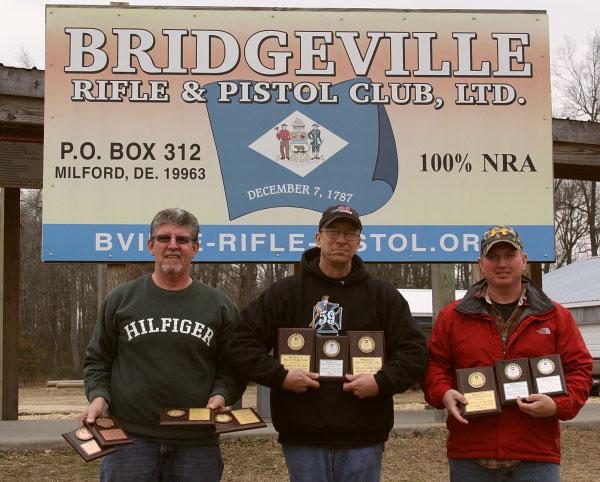
The Bridgeville Rifle and Pistol Club (Bridgeville, DE) held 600-yard IBS matches on March 16 and 17 — a separate match on each day. These two matches were the final competitions counting towards Bridgeville’s 600-yard Shooter of the Year honors. Turn-out was strong, with 21 Light Gun (LG), 17 Heavy Gun (HG), and 1 Factory Class competitors. On Day 1, weather (for Bridgeville) was good, with temperatures as high as 54° F, winds less than gale force, periods of overcast and bright sun. On the 17th the shooters braved more challenging conditions. Temps ranged from the low 30s to as high as 40 degrees, with more wind than the previous day and snow flurries in the afternoon.
Topping the podium on March 16th for the Two-Gun Aggregate were Dewey Hancock (1st), Roy Hunter (2nd), and Craig Rowe (3rd). Top performers by Class were Dewey Hancock (2.3855 HG Group), Carey Lamb (196-2X, HG Score), Craig Rowe (2.2703 LG Group), Michael Wallace (189-2X, LG Score), and Robert Jones (4.9845, Factory Group; 172-2X Factory Score).
On March 17th, Craig Rowe, Roy Hunter, and Dewey Hancock finished first, second, and third respectively in the Two-Gun Agg. Class Winners were Jerry Ware (2.7213, HG Group), Roy Hunter (189-3X, HG Score), Dewey Hancock (2.1359, LG Group), and Craig Rowe (188-1X, LG Score). Robert Jones again won for group (6.9494) and score (159-0x) in the Factory Class.
Shooters L to R Craig Rowe, Roy Hunter, Dewey Hancock.
Competition is very keen at Bridgeville. Richard Timmons, Match Director, said, “It can be challenging….it can cause you to talk to yourself!” Rookies and those interested in taking up the sport are gladly welcomed and mentored. When asked his advice for new shooters in the sport, Richard said, “Factory Class is the best place to start for beginning shooters. There are some good factory guns out there that will shoot 600 yards.”
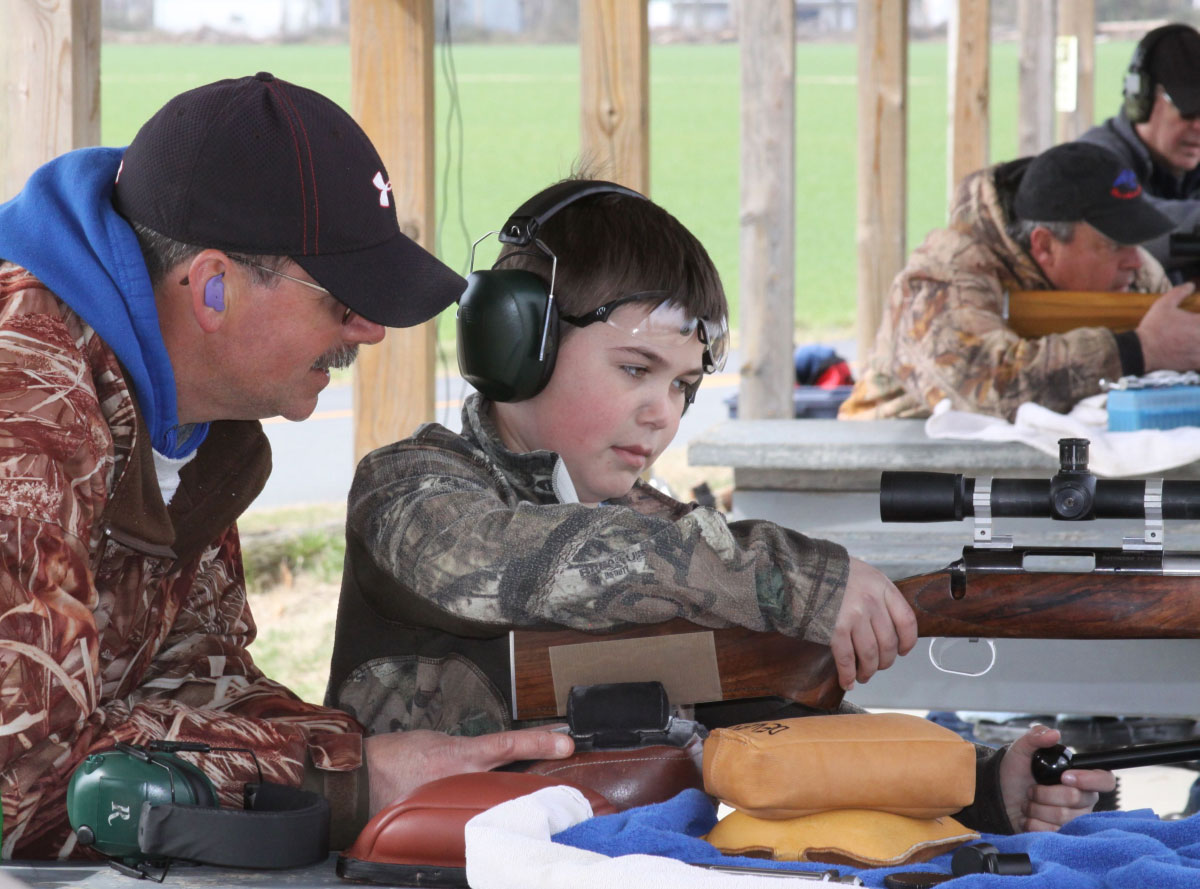
The Bridgeville matches showcased a bright, young talent. 12-year-old Kevin Donalds Jr., the youngest competitor at the two-day event, is already a shooter to be reckoned with — Kevin placed 2nd in Light Gun Group (2.5343) at the March 17th Match. Woe unto many of us later because Kevin plans on staying in the sport a long time!
Like Father, like Son… Kevin Donalds Sr. and Kevin Donalds Jr.
At this match, Bridgeville honored its 600-yard Shooters of the Year (SOY). Earning hard-fought SOY honors were the following shooters (listed 1st, 2nd and 3rd place for each Class).
Bridgeville Rifle & Pistol Club 600-Yard Shooters of the Year
Heavy Gun
1. Roy Hunter
2. Dewey Hancock
3. Bobby Mallory
Factory Class
1. Robert Jones
2. Terry Balding
3. Charles Thuet
Two-Gun
1. Dewey Hancock
2. Roy Hunter
3. Craig Rowe
Shooting at Bridgeville is Fun and Challenging Dewey Hancock is a rookie in his second year in the sport and is making a mark as you can see from match results and Shooter of the Year standings at Bridgeville R&P Club. He advises, “Good bench handling, good equipment, a good gunsmith, and good loading practice — these things will make you shoot with the good guys. You want to stay consistent in this game and that will eventually get you some wins.” When asked who his biggest competitor is, he smiled and said, “The wind!”, but then slipped in Roy Hunter’s name for 600 yards and Dean Breeden for the short range game. Dewey also stated what many of us in the sport know – “It is fun and the whole family can do it.”
Craig Rowe, in the sport for seven years shooting 600 yards and Score, said: “Bridgeville is a great place to shoot – great people – great food – and lots of great competition.” Craig cautions: “Don’t think you’re going to come here, walk in and steal the show, because there are a lot of good shooters.”
About the Bridgeville Club
The Bridgeville Rifle & Pistol Club, Ltd. was established over 50 years ago. The primary activity was NRA High Power Rifle competition at 200, 300 and 600 yards. There are 12 firing points on the High Power range. The Club recently opened its 1000-yard range, which also has firing points at 800 and 900 yards and is used for NRA Long Range Competition (Conventional, Fullbore, Palma, and F-Class) and IBS matches. The Club also has a multi-purpose range with a covered, concrete firing line with 15 benches and impact areas at 100, 200 and 300 yards. A pistol range has covered, concrete firing points and backstops at 25 and 50 yards. Another pistol range is open with five shooting lanes. This range is used for IDPA-style shooting, SASS (Cowboy Action) and Action Pistol. One 600-yard HG Score record has been set by Hal Drake at Bridgeville. For more information, visit www.Bville-rifle-pistol.org.


 IBS Report and photographs by Dick Grosbier






 One of the most remarkable shooting records — and one that has stood for four decades — is the 0.009″ five-shot group credited to Mac McMillan. The NBRSA Light Varmint Record of .009″ for five shots (at 100 yards) was set on 9/23/1973, forty years ago. Experts have considered that record “untouchable”, “unassailable” — in other words “unbreakable.”
 The 2013


 If you want to learn how to shoot accurately at very long range, one of the very best places to learn is the

 Ready for the Super Shoot? The 41st Annual Firearms Industry Super Shoot will be held on May 22-25, 2013, at


 Competition is very keen at Bridgeville. Richard Timmons, Match Director, said, “It can be challenging….it can cause you to talk to yourself!” Rookies and those interested in taking up the sport are gladly welcomed and mentored. When asked his advice for new shooters in the sport, Richard said, “Factory Class is the best place to start for beginning shooters. There are some good factory guns out there that will shoot 600 yards.”
 Dewey Hancock is a rookie in his second year in the sport and is making a mark as you can see from match results and Shooter of the Year standings at Bridgeville R&P Club. He advises, “Good bench handling, good equipment, a good gunsmith, and good loading practice — these things will make you shoot with the good guys. You want to stay consistent in this game and that will eventually get you some wins.” When asked who his biggest competitor is, he smiled and said, “The wind!”, but then slipped in Roy Hunter’s name for 600 yards and Dean Breeden for the short range game. Dewey also stated what many of us in the sport know – “It is fun and the whole family can do it.”