Legendary firearms engineer Merle “Mike” Walker passed away on March 6, at the age of 101. Walker was one of the most important gun and cartridge designers of the 20th Century, and he also was a leading proponent of benchrest shooting. Mike worked for Remington Arms Company for 37 years, as a lead designer and engineer. While at Remington, Mike created many of Remington’s most popular bolt action rifles. For many years, Mike served as Director of Research and head of the Custom Shop at Remington’s, Ilion, NY facility.
Mike led the development of many important Remington rifle designs, including the Rem m700, Rem 40X, Rem m721, and Rem m722. Walker held numerous patents, mostly for trigger designs.
“Without a doubt, the Remington Model 700 is the most popular commerical, high-power, bolt-action rifle in the world. The Model 700 is actually a product-improved Model 721 and Model 722 bolt-action rifle, the brain-child of Merle ‘Mike’ Walker and his Remington design team in the 1940s.” — Roy C. Marcot, The History of Remington Firearms
Mike was a major pioneer in modern cartridge design — he was the originator of the .222 Remington and the 6mm Remington Int’l rounds. According to Guns & Ammo: “Long-time Remington employee and benchrest competitor Mike Walker, who headed up the M722 design team, is largely credited with the development of the .222 Rem”. The .222 Rem (aka “Triple Deuce”) dominated short-range Benchrest competition until the advent of the PPC cartridges.
Walker also worked with Jim Steckl on the .30-cal wildcat that eventually evolved into the 6mm Bench Rest Remington. This cartridge demonstrated the accuracy and efficiency of the “short, fat” case design. When brass was eventually produced for the 6mmBR Rem, Mike convinced Remington to produce a run with a small primer pocket. Thanks to these pioneering efforts by Walker and Steckl, we now have the ultra-accurate 6mmBR Norma (with a small primer pocket), and the 30BR wildcat.
Mike was one of the “founding fathers” of the International Benchest Shooters (IBS), and he was in the early IBS leadership group. He was a talented (and dedicated) benchrest shooter. Remarkably, Mike shot in the 2010 IBS Nationals at age 99. Mike also played an key role in the creation of Precision Shooting Magazine. Still engaged in his passion for gun-building and firearm design, he worked in his shop even at the age of 101. He passed in a hospital on March 6, 2013 after hip replacement surgery.
IBS President Jeff Stover tells us: “The term ‘living legend’ is used in many sports and endeavors. Rarely, though, is that term used as accurately as when referring to Mr. Merle ‘Mike’ Walker. He developed the Rem 700, he helped invent the button rifling process and many other firearms innovations. Probably the last time he shot in competition was at the 2010 IBS Group Nationals at Weikert, Pennsylvania. He got around quite well — even at 99 years of age! He shot an older rifle in a beat-up stock, but he was there on the line with the rest of us. During one match Mike was having some problems and it was close to cease fire time. Our range officer could see that everyone else had finished. Mike kept shooting, trying to get five on paper. The range was quiet except for the reports from Mike’s rifle. When it was clear that all five were on paper, ‘cease fire’ was finally called. There were no questions as to what happened — all of us on the line realized it was a tribute to probably the only real Living Legend that any of us would meet, let alone shoot with….”
Mike Walker will be missed. As James Mock has written: “We in the shooting community are truly diminished. Mike was an icon of the innovative spirit of America.” Mike Walker was a true pioneer who has left an enormous legacy to all those engaged in the “pursuit of accuracy”.
Rest in Peace, Mike Walker. Thank you for your contributions to our sport.
In the benchrest game, a rock-solid front rest with precise, easy-use controls, is essential. The Farley and Sebastian rests provide a joystick that allows the shooter to adjust both horizontal and vertical position with a single move. However, many top shooters prefer more traditional rests. When you’re centered up horizontally and just want to make a very tiny vertical adjustment, a rest with a separate vertical control is hard to beat. Likewise, separate windage controls ensure that you can move left to right without altering your vertical point of aim one tad.
Among the premium non-joystick rests we’ve tried, the John Loh (JJ Industries) rest and the Randolph Machine (Fulghum) rest stand out for quality of workmanship and the smooth, precise functioning of the windage and elevation controls.
In this article we review the Fulgham Front Rest, produced by Ken Fulghum of Randolph Machine in North Carolina. It offers a unique, belt-driven elevation control. This rest has been very successful in IR 50-50, ARA Outdoor, and RBA Indoor rimfire disciplines. (Ken Fulgham himself is a highly successful rimfire benchrest shooter.) But, when fitted with a conventional front sandbag top, the rest also works great with centerfire rifles.
NOTE: The test unit shown in the photos is fitted with a Fudd Rest Top. Randolph Machine no longer sells Fudd tops. Instead Randolph produces a similiar adjustable front top with thin sand bag sections. This cost $150.00.
Fulghum Rest is Beefy and Stable
The Fulghum Front Rest is rock-solid and very stable on the bench. A large knob on the left controls the windage. The entire center section of the rest slides left and right on precision-machined cross-shafts riding in bronze, oil-impregnated bushings. The movement is super-smooth, with no grabbing or jumping. As we’ve seen with the John Loh rest, horizontal tracking is superb, and you can easily make very fine sideways adjustments with ZERO vertical shift.
Belt-Drive for Vertical Adjustment
What’s really special about the Fulghum Rest is the vertical adjustment system. This uses a synthetic toothed belt that connects a large knob in the center of the rest to the ram which supports the rest top. The belt drive runs over sprockets that provide plenty of mechanical advantage. This allows you to effortlessly raise/lower even very heavy rifles. The up/down movement is very smooth. However, there is a little slack in the belt and you can feel the belt’s teeth engage the sprockets one by one. Once you get used to the feel of the belt and how it engages the sprockets, however, you can make very precise adjustments.
Importantly, after you’ve adjusted the vertical, there is enough drag in the system that it holds vertical perfectly. There’s no “post-adjustment” vertical slippage at all. You can take your hand off the vertical knob and shoot with confidence that your aiming point won’t shift.
Overall, this is an excellent unit. Since you have to adjust windage and elevation separately, it’s not as fast as a joystick rest, but it has its advantages. There’s none of the vertical notchiness we’ve seen in some joystick units. Unless you are 100% certain you want a joystick-type rest, you should definitely “test-drive” a Fulghum Rest and see how it suits you.
Rest Retails for $750.00 without Top The Fulghum Front Rest currently retails for $750.00 with no top. Randolph Machine offers two different tops for the unit: the $120.00 Randolph MK1 Top (User supplies owl-ear bag), or the $150.00 Adjustable MKII Top (see photo at right; similar to Fudd Top). Fulghum also offers a one-piece rest (front and rear support) for $750.00.
All Randolph Machine Rests are made one at a time, by hand, so you should call for availability. Normal delivery time is “about a month” once you place your order. Here’s the contact info:
Ken Fulghum
Randolph Machine, Inc. www.randolphmachine.com
P.O. Box 147, 1206 Uwharrie St.
Asheboro, NC 27204
Phone: (336) 625-0411
Fax: (336) 625-0410
Thanks to a dedicated ‘Down-Under’ benchrester, Australian shooters have an excellent web resource for their sport. Sydney’s Robert Carnell has created a content-rich website for Australian shooters, www.benchrestbulletin.net. Carnell’s Benchrest Bulletin provides match schedules and results, range info, recent news, record listings, shooting tips, and links to important Australian and Pacific Rim shooting organizations. You’ll also find gear reviews and a Shooter’s Forum.
Carnell, a past Australian Sporter Class champion, is an accomplished benchrest shooter with decades of experience. In 1993 he won a Silver Medal at the World Championships, and he has placed highly in events he’s attended in the United States. But Carnell is far more than an ace trigger puller. Robert is a skilled and creative “home gunsmith” who has crafted his own custom action and built his own railguns from scratch. You can learn about these and other Carnellian creations in the “Personal Projects” section of Robert’s website.
Home-Built Rail Gun — Aussie Innovation
Below are photos of one of Rob Carnell’s most amazing builds. This liquid-cooled, tension-barrel rail gun is a great example of self-reliant Aussie engineering. The barrel runs inside a coolent-filled, large-diameter sleeve, much like an old water-cooled machine gun. This is the fourth rail gun that Rob built, and the second fitted with a tensioned barrel.
Robert explains: “My railgun design has a 1.75″ barrel under tension inside an aluminium tube filled with radiator coolant. There is nearly a gallon of coolant, and the barrel stays cool no matter how many shots I seem to fire, or how quickly they are shot. The brass nut on the front rides on a nylon bearing and can be tightened to get the best accuracy. I am a believer in the ‘tuner’ idea and this seems to work for me. The main tube is thick-walled aluminium 600mm (24″) long. There is a flange at both ends. The flange at the back fits onto the barrel before the action is screwed on. The front flange is a press-fit into the tube, then there is a brass nut that fits over the barrel and screws against a nylon washer on the front flange. The Railgun’s base is aluminium and has the standard adjustments — windage, elevation and a sighter cam. In addition, there is a 1/10 thou dial indicator for windage. This allows me to zero the indicator and shoot my group. If I need to add a bit of windage for a condition, I can quickly get back to the original position if my condition comes back.”
Home-Built Action Uses Remington Bolt
Rob’s rail gun uses his own home-made stainless action, which features Panda-spec threads and a modified Remington 700 aftermarket bolt. Not bad for a do-it-yourself project we’d say! CLICK HERE to read how Rob designed and built the action.
Does your rear sand-bag get lumpy or lose its shape during transport? Are your bag ears starting to sag or get mis-aligned? Well the clever Italians have a solution for you.
Varide Cicognani, an Italian webstore specializing in competition shooting accessories, offers a cleverly-designed bag transport/storage caddy for rear sand-bags. Cicognani’s Portacuscino Model TFC-P is designed to keep your rear bag “in shape” during transport and storage. The TFC-P features aluminum top and bottom brackets, connected with threaded rods. A wedge under the top bracket fits between the bag ears. The top bracket has a convenient carry handle. The whole unit (not including bag) weighs just 13.4 ounces (680 grams). The price is € 49, or $65.99 at current exchange rates. For more information, visit www.VarideCicongnani.it.
Product Tip by Boyd Allen. We welcome reader submissions.
At SHOT Show we got a “first look” at the new Kahles K-1050, a 10-50x56mm scope with unique, centerline parallax control. This is a very interesting new high-magnification competition scope. Kahles’s patented centerline parallax control allows the marksman to adjust windage, elevation, AND parallax all with ONE HAND. If you’re in prone position, for example, you simply reach forward with your right hand to dial windage, then slide your hand to the central turret to dial elevation and, finally, set the parallax by adjusting a separate concentric ring.
Watch Video to See Kahles K-1050 Features and Centerline Parallax Control
NOTE: The big-diameter metal ring is OPTIONAL. You can remove the big metal ring and still adjust parallax (from centerline) using a smaller, built-in control ring on the top turret.
Designed for benchrest and field target use, this scope has a 30mm main tube, 55 MOA elevation, and 1/8-MOA clicks. There are three (3) total turret revolutions. The turret “Rev Count” is displayed with a clever red-and-white striped “barber pole” button in the center of the top turret. One red stripe indicates REV 1, red + white indicates REV 2, and red + white + red indicates REV 3. It’s simple, but it works.
The new K-1050 also features a nice European-style +/- diopter control on the eyepiece. If you have less that perfect vision, this allows you to get a sharp target image even without eyeglasses.
We liked the scope. The glass was bright and sharp, and the clicks were positive and precise. Competition shooters have shown great interest in the new K-1050, and Kahles plans to bring the new scope to the USA by mid-summer 2013. Price is expected to be around $2800.00 USD.
Barrel tuners have been used successfully in rimfire benchrest for many years (see photo below). While there are competing theories as to how and why barrel tuners work on rimfire rifles, there is no question that the accuracy of some rimfire barrels can be improved with the addition of a tuner. By changing the position of weights at the end of the barrel, we’ve seen shooters shrink their average group size as well as adjust the “sweet spot” for different lots of rimfire ammo. On the other hand, tuners can be the source of great frustration; some installations may yield little or no benefit. A shooter may have to experiment with a variety of different tuner designs (and weights) to find the optimal configuration.
Centerfire Tuners–Still a Work in Progress
In centerfire benchrest competition, the vast majority of competitors do not use tuners, though a few short-range shooters such as Gene Bukys and Jackie Schmidt have enjoyed considerable success. Gene has won major championships with tuned rifles. In 2011 Gene won both the Super Shoot and World Benchrest Championship (WBC), and Gene recently set a new NBRSA Sporter Class Grand Agg Record.
Centerfire benchrest guns typically employ shorter barrels with a much fatter contour (larger diameter) than rimfire rifles. Because centerfire rounds produce much higher pressures and velocities that a 22LR, a centerfire barrel also exhibits much different vibration characteristics than a typical rimfire barrel. Nonetheless, there are pioneers working with centerfire tuners who believe that tuning may be the “next leap forward” in centerfire accuracy.
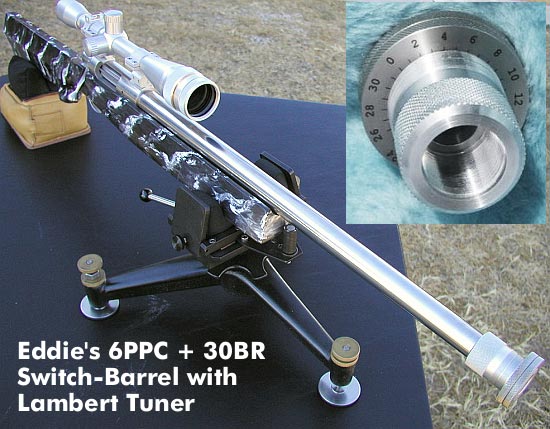
Shown below is a switch-barrel benchrest rifle built by Forum member Eddie W. of Texas. It features a dual-port Hall “M” action with a ShadeTree Engineering Tuner crafted by Butch Lambert. The gun is designed to take both a 6PPC barrel for group shooting and a 30BR barrel for score shooting. The gun was barreled by Wayne Shaw, and Eddie did the stock work himself. Eddie reports: “It is a very accurate rifle.”
Will we see more tuners on centerfire rifles? Only time will tell. Some folks believe that, since one can easily adjust the loads shot by centerfire guns (by tinkering with the powder charge and seating depth), tuners have limited utility. On the other hand, tuner advocates such as Gene Beggs believe tuners can help keep your group sizes small even as conditions (temperature, humidity) change. Gene believes that, with an appropriate tuner, you can spend less time fiddling with the load specs (changing your powder charge) and instead “dial in” your sweet spot using the tuner.
The tool-makers at 21st Century Shooting have come up with a very slick new Precision Hand-Priming Tool. This extremely well-made, benchrest-grade unit raises the bar among single-primer seating tools. Feel is great, changing shell-holders is simple, and nothing else on the market offers better control over primer seating depth. The tool’s precision-adjusting head provides clicks in .0025″ increments for precise seating depth. The tool’s body, internals, and shell-holders are stainless, while the handle is anodized aluminum. Price is $118.00 for the tool itself. Shell-holders (sizes from 17 Remington up to .338 Lapua Magnum) cost $7.99 each.
21st Century Priming Tool Review By Boyd Allen
I have been priming cases, with various hand-priming tools, for about three decades, and in the process have pretty much tried them all, from least to most expensive. When I found out that this new 21st Century tool was adjustable for seating depth, I wondered about that. After all, what do I, who believes in seating by feel, need with adjustable seating depth? Well…..I was wrong. Let me explain.
Why Adjustment for Primer Seating Depth Is Important
Most hand-seating tools do not have an adjustment for how far up the priming punch comes up into the shell holder. As a result, when priming a case with a deep pocket, especially if there has been some wear of the tool’s linkage, the finger/thumb lever may contact the tool’s body before the primer is fully seated. Having a primer seated too high can cause a myriad of problems. Prior to this, the only seater that I had used that had an adjustable linkage was the Sinclair tool, and adjusting its linkage requires disassembly — regular disassembly if you want to keep it perfect. That’s not convenient. The Sinclair is good tool, but a pain in the neck to adjust.
Precision Control Over Seating Depth — With Click Adjustment
The 21st Century Priming Tool offers quick and easy depth adjustment (unlike its rival from Sinclair). The 21st Century unit can be adjusted in precise increments (.0025”) more quickly than you can read this sentence. The knurled head of the tool is threaded onto the body, which has a very sturdy ball and spring detent indexing system that is easy to adjust and precise. Clicks are secure and positive. With this feature, you can set the tool so that the handle is in any position (distance from the tool body) that you find convenient, when the primer is fully seated. Additionally, since leverage increases as the handle approaches the tool body, different stopping points afford differing mechanical advantages (more or less effort required) and sensitivity. By doing a little experimenting, I have found a point of adjustment that give me better feel for when the primer hits the bottom of the pocket, without overshooting the mark, while keeping the force requirement within a range that is comfortable when priming a large number of cases.
Quick and Easy Shell-Holder Changing
Changing shell holders is easily accomplished. No extra hex-wrenches or tools are needed, and there are no tiny set screws to roll of the desk, to be lost forever in the carpet, never to be heard from again until you hear them rattling up the vacuum cleaner hose. To swap shell-holders, simply screw the head off of the body, lift off the one that you one that you are replacing, set the one that you intend to use in place (assuming that it used the same size primer) and screw the head back down to the setting that you want. Changing primer sizes is equally easy. NOTE: The tool requires 21st Century-made shell holders. These may be turned (relative to the handle) so that the loading slot opening faces whatever direction you prefer.
Fit, Finish, and Feel
The body and head of the tool, as well as the internal linkages, are all made from stainless steel. These closely-fitted parts are precisely machined, with an smooth, attractive finish. The handle is black anodized aluminum. Overall, the tool is well-shaped, and built like a stainless/aluminum brick.
Bottom Line: Great Tool That Works Exceptionally Well I can’t imagine anyone, who uses a single-primer tool of this type, not liking this tool. When it comes to hand reloading tools, I can afford to have pretty much whatever I want (within reason). After testing and using this tool, I pulled my Sinclair tool from its case, and replaced it with this one. That should say it all. After using this tool, I will have to give serious consideration to other 21st Century reloading products the next time I need a new tool. One thing is for sure — we have an important new player in the design and manufacture of top end of reloading equipment. 21st Century’s Precision Priming Tool “raises the bar” among single-primer seating tools.
Tool Size Considerations
I wrote the review and then took the pictures, which, upon reflection, make the tool look smaller than it is, because of the size of my hands. I thought about putting a ruler in the pictures, but rejected that as visual clutter, so I will simply tell you that from tip of thumb to that of my little finger, my right hand measures a little over 10 inches, and the palm is 4 inches wide. The size of the tool is just right.
Nightforce Benchrest Model vs. NXS by Jason Baney, AccurateShooter.com Asst. Editor
Anyone who has considered purchasing a Nightforce scope inevitably asks: “Which one best suits my application — NXS or Benchrest model?” Shooters also ask: “Why is there such a price difference between the NXS and Benchrest (BR) models?” This article compares the features of the two models (NXS and BR), and provides some guidelines for choosing the right Nightforce scope for your needs.
The NXS line is priced a bit higher, costing about 40% more than the comparable Benchrest model. NXS scopes are also a bit more robust, and feature a side parallax adjustment (side-focus), whereas the BR scopes have an adjustable front objective for correcting parallax. Another main difference is click value, as the BR scopes have 1/8 MOA clicks while the NXS scopes currently feature 1/4 MOA clicks. The “zero-stop” feature is something to consider as well, as it is only available on the NXS models and allows the shooter to quickly spin the elevation turret back down to a close range zero, usually 100 yards, without counting clicks.
Click Value: 1/4 MOA vs. 1/8 MOA
The tighter 1/8 MOA click value is generally more desirable for long range shooting as eighth-minute clicks allow the shooter to adjust Point of Impact more precisely than quarter-minute clicks. The 1/4 MOA clicks are worth about 2.6″ at 1000 yards, while a 1/8 MOA click will move your POI only 1.3″ at 1000. It is easy to see why the 1/8 MOA click value may be preferable when trying to dial in on a 3-5 inch X-Ring or 10-Ring. This is one reason why so many F-Classers favor eighth-minute clicks. The F-Class X-ring is just 5″ in diameter.
If you wanted 1/8 MOA clicks, it used to be that you had to choose the Nightforce BR model. That has changed. Nightforce now offers 8-32X and 12-42X NXS models with 1/8 MOA clicks. The 1/8 MOA-click NXS lineup is ideal for those who prefer side-parallax control AND more precise click values. Another consideration regarding click value is the availability of milrad clicks. “Mil” clicks are desirable when the scope has a mildot or MLR reticle, or similar reticle based on a milradian scale. Mil clicks are only available on NXS scopes at this time.
Ruggedness — NXS has the Edge Durability is not usually an issue with target shooters as the scope will mainly be used in benign environment on a fixed-distance range. So, as long as a scope tracks and performs reliably, most target shooters won’t fret about durability. For those that may use their rifles in a tactical or field situation, or when hunting, the added robustness of the NXS scope may prove quite important. Now the BR scopes are no slouch as far as durability compared to similar scopes, but, in my experience, they cannot take quite the abuse that the NXS scopes can.
Side-Focus Parallax vs. Front Adjustable Objective
As far as the side parallax adjust vs. adjustable objective, this usually boils down to personal preference. The side-focus parallax adjustment NXS model fits one additional focus lens in the scope body — a lens not required in the front-adjusting Benchrest model. According to Nightforce, this one extra lens in the NXS can reduce potential light transmission by 1.0 to 1.5 percent in the NXS compared to the BR model. However, most human eyes will not notice the difference, and overall resolution should be virtually the same. The side-focus NXS models will be much more convenient from a prone position than will the BR scopes as it is not necessary to reach out of position to correct parallax. The BR scopes tend to be more convenient in fixed distance environments like benchrest or F-class, where there tends to be multiple shots at a similar distance, or there is plenty of time to adjust parallax. Compared to the NXS models, the BR scopes use more movement to produce the same amount of parallax adjustment — so you can say the BR offers “finer” adjustment. By contrast, the NXS side-focus delivers a coarser yet quicker adjustment requiring less movement to “dial-in” minimal parallax.
Zero-Stop Feature on NXS Only Another point of consideration is the availability of a “zero-stop.” This is particularly useful in the same situations that the NXS scopes make the most sense. Namely, tactical or field situations where there may be stress combined with longer shots where dialing the turrets is required. The zero stop allows the shooter to set a stop point, usually a 100-yard zero. Then no matter where the turret is positioned in its span of travel, the zero can be quickly re-established by spinning the turret down until it stops at the pre-set zero.
At present, the Zero-stop is available on all Nightforce variable NXS models except the 12-42×56. So you CAN get the zero-stop on the 8-32 NXS, but not the 12-42 NXS.
CONCLUSION
With the new 1/8 MOA NXS models now available, the decision on which Nightforce scope to buy, will come down to focus/parallax adjustment, field hardiness, and price. Though it may still be a hard decision in certain situations, hopefully this discussion has made the decision a bit easier. All in all, Nightforce scopes are a great value and they offer enough choices to satisfy nearly all shooting situations. Nightforce Scopes can be purchased through EuroOptic.com and other Nightforce dealers.
Up in Wisconsin, a gentleman named Joe Maisto crafts some exceptionally nice competition cartridge boxes. Each box is hand-machined (no molds, no CNC), with the holes precisely fitted to the cartridge you shoot. Joe has been building his boxes since 1996, first from wood, and now from more durable (and easier-to-clean) polymers. Joe started with a hinge-top 25-round box (with magnetic latch) for short-range benchresters. He still makes that box, but now he also offers 40-round boxes, high-top boxes (for bigger, taller cartridges), open top cartridge blocks, and combo blocks with holes for cases and a built-in tray. Our buddies in the short-range benchrest game say the Maisto boxes are perfect for carrying rounds from the loading bench to the firing line. GO TO Joseph Maisto website.
25-Round Cartridge Boxes
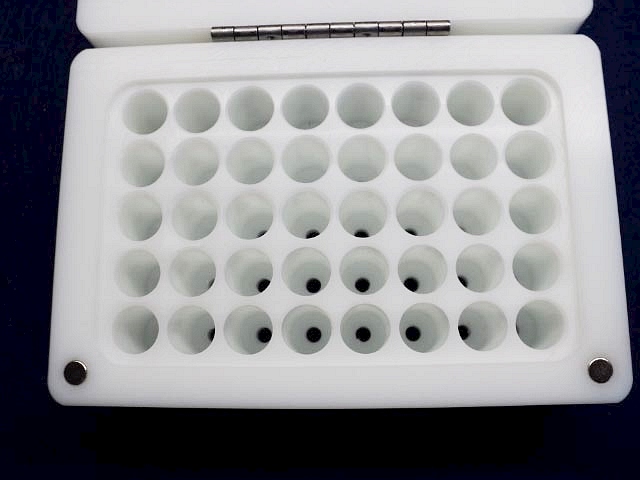
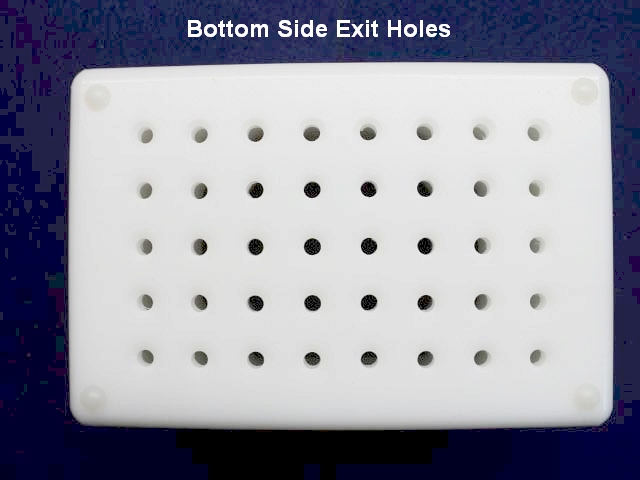
These units were designed in 1996. The originals were machined of Walnut, Cherry, or Birch. They were lovely, laborious, and expensive. To make the price more affordable, the wood units have since been retired in favor of high density polyethylene (HDPE). The front holes are separated for “record rounds”. Holes are bored with a minimum of clearance, and up to the shoulder. Additionally, each cartridge slot has a smaller hole in the bottom to allow debris to exist. These $60.00 boxes feature a quality stainless steel hinge with small but strong magnets that provide secure closure. While these were originally crafted for PPC cases, Joe offers various hole diameters for different-sized small cartridges.
40-Round Cartridge Boxes
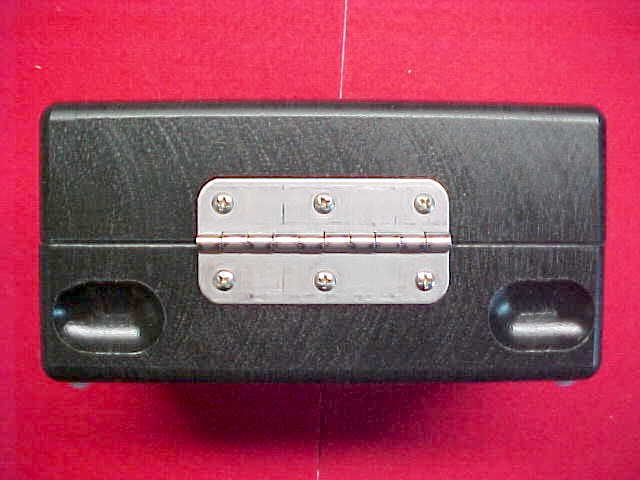
For those who want more capacity (for longer strings of fire), Joe offers 40-round cartridge boxes. These allow shooters to change loads on the line, or simply have more rounds in a single box. With finger grooves front and back, the 40-rd boxes work for both left and right handers. Just like the 25-rd boxes, the 40s have a stainless hinge and magnetic closure. Price is $130.00.
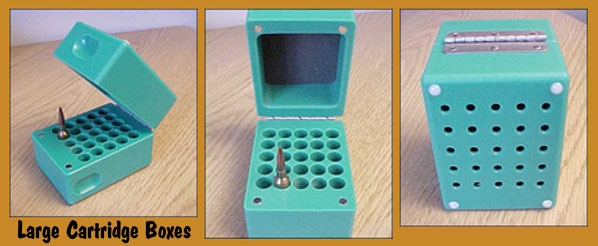
Large Cartridge Box
Joe’s Large Cartridge Boxes are taller to accommodate the bigger cartridges used for long-range shooting. These feature magnetic latching and and bottom exit holes, just like the Joe’s original PPC boxes. Joe notes that, for some cartridges, the Large Boxes “have 20 holes instead of 25 because of the larger cartridge head size”. When ordering the Large Boxes, you need to specify cartridge dimensions and cartridge overall loaded length (COAL). Price is $65.00 per box.
Cartridge Blocks
These cartridge “blocks” are made from the same material as Joe’s cartridge boxes. Each has finger grooves and exit holes. Joe says: “The size of the block is perfect for manipulating primed cases under a powder measure where space is a factor.” The 20-round block costs $19.00. Joe also offers a version with a recess on one side for empties. These have either 10 or 14 holes and cost $28.00.
Joseph A. Maisto www.benchrest.com/maisto
3647 Debby Lane
Franksville, Wl 53126
PH: (262) 886-1610
Email: jmaisto [at] wi.rr.com
Benchrest shooter Gene Bukys has smashed the existing Sporter Class 100+200 yard Grand Aggregate record, lowering the NBRSA record from 0.1886 to 0.1777. That’s a big deal in the short-range benchrest game. This record was shot in October, 2012 at the Arizona Nationals.
On Benchrest Central, NBRSA SW Regional Director Tom Libby reported:
“Yes it’s said that ‘Every Thing is Bigger in Texas’. Well in this case ‘Smaller is Better’ and Gene has done it with his new World Record for five 5-shot groups at both 100 and 200 yards in the Sporter Class Grand Aggregate.
The Old Record: .1886
The New Record: .1777
[That includes five targets at EACH distance, ten targets total.]
Great Job Eugene G. Bukys!
It is my understanding that Gene has bought a new special cowboy hat to start putting his awards on it but don’t get to close to him as the brim will hit you in the head.”
Bukys and Barrel Tuners
Commenting on Buky’s record-setting performance, Boyd Allen writes: “Gene has a fine record as a shooter, and his rifles have tuners (at least the bag guns do, I’m not sure about the rail.) In contrast to other users of tuners, I’m told that Gene tunes his to the middle of a node, locks it down, and does not move it again, preferring to tune with normal means. I think that the effectiveness of this approach is pretty evident — the proof is now in the record books! Gene would tell you that he has never seen a barrel’s accuracy increased by the addition of a tuner, but that, with a tuner, accuracy nodes are wider. I would add that, while Gene’s tuner is an important component, we must acknowledge Gene’s outstanding shooting skills — this man can win with or without a tuner.”


 The Fulghum Front Rest currently retails for $750.00 with no top. Randolph Machine offers two different tops for the unit: the $120.00 Randolph MK1 Top (User supplies owl-ear bag), or the $150.00 Adjustable MKII Top (see photo at right; similar to Fudd Top). Fulghum also offers a one-piece rest (front and rear support) for $750.00.


 Does your rear sand-bag get lumpy or lose its shape during transport? Are your bag ears starting to sag or get mis-aligned? Well the clever Italians have a solution for you.


 Designed for benchrest and field target use, this scope has a 30mm main tube, 55 MOA elevation, and 1/8-MOA clicks. There are three (3) total turret revolutions. The turret “Rev Count” is displayed with a clever red-and-white striped “barber pole” button in the center of the top turret. One red stripe indicates REV 1, red + white indicates REV 2, and red + white + red indicates REV 3. It’s simple, but it works.

 Centerfire Tuners–Still a Work in Progress

 The tool-makers at

 I can’t imagine anyone, who uses a single-primer tool of this type, not liking this tool. When it comes to hand reloading tools, I can afford to have pretty much whatever I want (within reason). After testing and using this tool, I pulled my Sinclair tool from its case, and replaced it with this one. That should say it all. After using this tool, I will have to give serious consideration to other 21st Century reloading products the next time I need a new tool. One thing is for sure — we have an important new player in the design and manufacture of top end of reloading equipment. 21st Century’s Precision Priming Tool “raises the bar” among single-primer seating tools.

 Durability is not usually an issue with target shooters as the scope will mainly be used in benign environment on a fixed-distance range. So, as long as a scope tracks and performs reliably, most target shooters won’t fret about durability. For those that may use their rifles in a tactical or field situation, or when hunting, the added robustness of the NXS scope may prove quite important. Now the BR scopes are no slouch as far as durability compared to similar scopes, but, in my experience, they cannot take quite the abuse that the NXS scopes can.
 Another point of consideration is the availability of a “zero-stop.” This is particularly useful in the same situations that the NXS scopes make the most sense. Namely, tactical or field situations where there may be stress combined with longer shots where dialing the turrets is required. The zero stop allows the shooter to set a stop point, usually a 100-yard zero. Then no matter where the turret is positioned in its span of travel, the zero can be quickly re-established by spinning the turret down until it stops at the pre-set zero.





 Benchrest shooter Gene Bukys has smashed the existing Sporter Class 100+200 yard Grand Aggregate record, lowering the


