Midsouth Shooters Supply is now taking advance orders for the new Accurate LT-32 Powder, with initial deliveries expected in January 2013. Price for a 1-lb container is $25.12, while an 8-lb jug runs $190.50. Produced by Western Powders, LT-32 is an extruded powder with extremely small kernels (roughly .0275″). This powder is designed to perform like the legendary “T-322″ powders which worked brilliantly in short-range benchrest cartridges, especially the 6mm PPC. Early testers report that Accurate LT-32 meters superbly and is easy to tune. Western claims LT-32 exhibits very low standard deviation. (Photos below by Speedy Gonzalez).
Speedy Says Accurate LT-32 is Very Promising
Benchrest Hall-of-Famer and noted gunsmith Thomas ‘Speedy’ Gonzalez tested the prototype LT-32 powder from Western Powder earlier this year. Speedy stated: “It pains me to say it, but the new LT-32 out-shot my best lots of [the original] IMR 8208 (T-322)”.
Speedy reports: “I must say that I was quite surprised by the results of my initial testing of the new Western Powder LT-32. Shooting this morning over my Oehler 35P triple screen chronograph yielded some very unexpected results. My best lot of ‘T’ powder continues to exhibit its age as it continues to lose velocity (as it ages). While the new Western LT-32 demonstrated this morning velocities equal to what my old ‘T’ powder used to shoot like 30 years ago.
This new powder goes through the measure like a ball powder. (Note: I have always felt that one of the reasons ‘T’ powder shot so well was due to the fact it measured so well as compared to other powders. This is a definite advantage for us that rely on consistent volume instead of weight.) I will have to shoot it over a season to see if it is as temperature and humidity insensitive as ‘T’, but it looks very promising from what I saw today.
It has yet to be seen if the new LT-32 proves to not be affected by temperature and humidity like the old T-322. But from these short tests it very much mimics my T-322 of old. My ‘T’ powder was always a blessing to me in the fact that when I went to a match I did not have the same problems everyone else was having [i.e. having] to tune up and down over the course of a weekend or week. I got to shoot and concentrate on the conditions instead of making it a tuning competition. It was always kind of funny watching everybody going up and down on their powders trying to accommodate the changes in weather as the days went on. Hopefully this will allow all to become better shooters by being able to concentrate on shooting and not re-turning every time one comes back from the bench.”
Statement from Western Powders
The Accurate LT-32 is an exact copy of the original T-32 manufactured in the same plant and on the same machinery as the original. Lou Murdica has been extensively testing it and he tells us it is the easiest powder to tune that he has seen in 40 years.
According to Lou, the chamber that everybody was using in the 80s will work with this powder. The bullets do not need to be seated way out in order to get more powder in the case. In testing the powder in our Bond Universal receiver against the original “T” powder, SDs were about 30% lower with the new powder versus the “T” powder. Lou and Don Nielson donated 16 lbs. of the original T-32 lot of powder for our quality control and that is what the new powder is shot against.
All of our powders are allowed to deviate +3% to -5% in pressure from the quality control lot except LT-32 which we cut the deviation percentages in half in order to have the best lot to lot consistency in the industry for this powder[.] We developed this powder specifically for the 6mm PPC and it is QC’d in the 6mm PPC.
Keith Anderson
Western Powders Ballistic Lab
NOTE: Accurate LT-32 should also be available from PowderValleyInc.com in mid-to-late January 2013. Listed Prices are: $24.10 for 1 pound and $182.00 for 8 pounds.
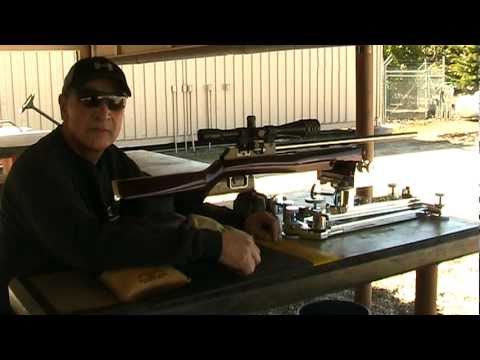
Our friend and product tester Joe Friedrich is the proud owner of a spectacular front rest from James Pappas. This rest is used for both air rifle and rimfire benchrest matches. The fancy Pappas front rest is a shortened, front-support-only version of the Pappas one-piece rest, which is popular with rimfire benchresters. Pappas engineered this rest to comply with air rifle benchrest rules which do not allow use of integrated (one-piece) front and rear rests. The end result was a 30.8-lb masterpiece of machining.
The workmanship on this Pappas front rest is astounding. Accurately described as a “work of art” by Joe Friedrich, this rest, crafted of aircraft-grade aluminum, sets new standards for “Benchrest BLING”. It looks like it should be on display in an art museum. Nearly all components of this rest, including the adjustment controls, have been polished to a mirror finish.
Convenient Rear Windage and Elevation Controls
The Pappas front rest features separate fine-tuning controls for windage and elevation, plus a central gross-elevation control. Normally, once the rest is centered-up on the target, you can make all needed elevation and windage adjustments with the rear (fine-adjustment) controls. In the video below, Joe explains how the controls work as he practices with his modified Theoben Rapid MFR air rifle. Joe hopes to use this new Pappas rest in the upcoming Air Rifle Benchrest Worlds to be held in South Carolina this summer. (Note: In the last minute of the video, the back-lighting was so intensely bright that we lost detail in the foreground. We apologize for that flaw, but you can still hear the audio.)
Price for this Masterpiece? Don’t Ask…
If you are interested in getting a similar rest, visit PappasRimfireProducts.com, or call James Pappas directly at (817) 735-9883. Be forewarned — James said “If you need to ask about the price, you probably can’t afford it.” This is truly the “Rolls-Royce” of front rests, and it will be priced accordingly.
After concluding its 2012 Board Meeting, the NBRSA has issued some announcements for its membership. The Fee structure has changed, and Match Directors are requested to submit info on upcoming 2013 Matches. In addition, the NBRSA noted that Long Range Rule Books are now on sale for $5.00. Call (307) 655-7415 to order these Rule Books.
NBRSA Fee Schedule for 2013
Dues and match fees will change beginning January 1, 2013. The new fee structure is designed “to be equitable to everyone”, with adjustments reflecting shipping costs. Normal match fees change to $3 per shooter per day. Annual Fees will be:
USA Domestic Annual Members & Clubs: $60
CANADIAN Annual Members: $60 + $25 shipping — Total US $85
INTERNATIONAL Annual Members: $60 + $60 shipping — Total US $120
2013 Match Schedules and Forms
The NBRSA requests that match directors send in their 2013 match schedules to Regional Directors as soon as possible. This will allow the NBRSA to post schedules online and in Precision Rifleman magazine. Match Directors who require Forms should click the links below.
You’ve heard of Heavy Metal, maybe even Heavy Water, but what about Heavy Sand? Every serious shooter should know about Heavy Sand for benchrest sandbags. Heavy Sand can weigh up to twice as much as ordinary silica sand (sold as “Play Sand”). By filling your rear bag with Heavy Sand rather than silica sand, you can nearly double the bag’s mass, and that can translate to better bag performance. A heavier bag resists movement and stays aligned better during recoil. If your bag moves during recoil, or becomes misaligned from shot to shot, that can alter your point of impact and open up your groups. Adding weight to your rear bag is a simple, cost-effective way to shoot more consistently, with greater overall accuracy.
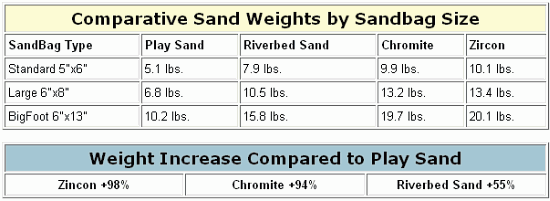
Jason tested and compared four kinds of sandbag fillers: Zircon, Chromite, Riverbed Sand, and ordinary Play Sand. Zircon is the heaviest type of sand readily available to shooters, followed by Chromite. Zircon is 98% heavier than Play Sand, while the black Chromite sand is 94% heavier than Play Sand. Riverbed Sand, commonly sold in pet stores as “Reptile Sand”, is less dense, measuring about 55% heavier than Play Sand.
Increase Bag Weight Up to 10 pounds
Compared to silica sand, how much extra weight can Heavy Sand (Zircon, Chromite, Riverbed) add to your sandbag? Up to 10 pounds, depending on the size of your rear bag. Check the chart below for the specifics. By filling a standard bunny ear bag with Zircon (vs. silica sand), you can increase bag weight by about 5 pounds. A super-sized BigFoot bag can gain 10 pounds in overall weight when filled with Zircon as opposed to silica sand.
To learn more about Heavy Sand (and where you can buy it), read Jason’s comprehensive Sand Comparison Article. It includes photos of the different sand types and links to Heavy Sand vendors, such as R.W. Hart (Zircon) and Sinclair International (Chromite).
Available for under $180.00 including front bag, the Caldwell Fire Control front rest is a remarkable value. It makes the co-axial, joystick design more affordable than ever. We used the Fire Control front rest when testing our Ultimate Varminter 20 Practical AR. Once we removed some sand from the tri-lobe front bag, the rest worked quite well.
Get a Fire Control Rest for Just $179.40
Amazon.com currently sells the Fire Control rest (item 956104) for $179.40. That’s a really spectacular deal for guys on a tight budget, looking to try out a joystick-style front rest. With the conversion described in this article, you can put together a system that works pretty darn well, and is more than adequate for many applications, including prairie-dog hunting (from a bench).
While most Fire Control owners are happy with the product, many have wanted to replace the tri-lobe front bag with a more conventional front bag from Protektor or Edgewood. This isn’t as easy as it looks because the width of the Fire Control top is too narrow for most standard 3″-wide front bags. On a “special order” basis, Protektor has crafted some narrower leather front bags that fit pretty well, but some shooters have decided to “upgrade” the entire front assembly.
Forum member Doug M. (aka DrJeckyl), has come up with an elegant solution that allows a Sinclair Int’l Benchrest Rest Top to be fitted to the Fire Control Rest. Doug notes: “The Caldwell Fire Control is a nice rest for the money, but it comes up short in the rest top department. The Sinclair RT-3 [or its replacement, the Gen II B/R top] fits perfect with minor modifications.” Shown below are the main components:
To adapt the Sinclair RT-3 or Gen II B/R top, Doug merely had to drill a couple holes in the RT-3 baseplate, and adapt a spacer to get the height correct: “The Caldwell factory top has a raised mounting portion so a 1/8″ piece of stock will be needed as a spacer to the flat-bottom RT-3. The spacer needs to be cut to the same length as the movable portion on the rest. And you should plan the mounting accordingly so the left thumbscrew clears the vertical height column at full left position (there is a cutaway in the rest under the thumbscrew that allows for easy access to the screw).” We have labeled the photo with dimensions, but Doug cautions you should measure your own original plate to insure the drill locations are correct for your unit.
Below you’ll see the completed installation, with the RT-3 installed on the Fire Control rest. Doug says it works very well. For more information on this Fire Control rest top conversion, with Doug’s measurments for the hole-spacing and his specs on the fasteners, go to the original thread in our Shooter’s Forum. NOTE: Sinclair no longer sells the RT-3 top, but Sinclair’s $69.95 Gen II B/R top can be converted just as easily. LINK to Fire Control Rest Top Conversion Forum Thread.
Want to invest in a gun-making milestone, with authentic “PPC Provenance”? Here is a rare opportunity to acquire a set of guns that forged new frontiers for rifle accuracy. Dave Kiff, founder of Pacific Tool & Gauge, is selling a consecutive built and numbered set of four (4) benchrest rifles which belonged to Ferris Pindell, one of the fathers of the PPC cartridge. These four game-changing guns were custom-crafted by Pindell with help from his friend and fellow PPC inventor Lou ‘Doc’ Palmisano.
Dave Kiff tells us: “These are the four rifles that June Pindell had sold me a while back. I have #1, #2, #3 and #4 of Ferris Pindell’s original custom-made Benchrest rifles. These are consecutive builds. I am selling all four at cost! Several collectors (and one museum) have offered a generous amount of money for only one or two of them, but I would hate to split them up. I would much rather sell all four of them complete for $6,900.00 and keep them all together. There are two PPCs and two BRs from what his wife told me. June told me these are the rifles that Ferris and ‘Doc’ Palmisano built when they created the PPC cartridge. This would be a great addition to any collection or a great start for anyone interested in shooting competition, as the rifles look very usable.”
For more information, call Yvette of PT&G at (541) 826-5808, or send email to yvette [at] pacifictoolandgauge.com .
Sale tip by Boyd Allen. We welcome reader submissions.
From the late ’70s through 1983, a huge, concrete-walled warehouse in Houston was used for benchrest testing. Virgil King and Bob Fisher set up a bullet-catching backstop at the end of a 30-yard-wide, 325-yard-long fire lane that remained unobstructed even when the warehouse was in use. This allowed accuracy tests in virtually perfect “no wind” conditions. Over a six-year period, about 30 shooters were invited to test their rifles. The results were amazing, with numerous “zero groups” being shot in the facility. Many of the lessons learned in the legendary Houston Warehouse still help benchresters achieve better accuracy today.
Dave Scott explains why the Warehouse was so unique:
“Over a period of six years, the levels of accuracy achieved in the Houston Warehouse went beyond what many precision shooters thought possible for lightweight rifles shot from sandbags and aimed shot-to-shot by human eye. For the first time, a handful of gifted, serious experimenters — armed with the very best performing rifles (with notable exceptions) — could boldly venture into the final frontiers of rifle accuracy, a journey made possible by eliminating the baffling uncertainties of conditions arising from wind and mirage. Under these steel skies, a shooter could, without question, confirm the absolute limits of accuracy of his rifle, or isolate the source of a problem. In the flawlessly stable containment of the Houston Warehouse … a very few exceptional rifles would display the real stuff, drilling repeated groups measuring well below the unbelievably tiny .100″ barrier. The bulk of rifles, however, embarrassed their owners.”
Scott’s article also reveals some interesting technical points: “One thing that IS important is that the bullet be precisely seated against the lands. T.J. Jackson reported this fact in the May 1987 issue of Precision Shooting. In a letter to the Editor, T.J. wrote, ‘…in all our testing in that Houston warehouse… and the dozens and dozens of groups that Virgil King shot in there ‘in the zeroes’… he NEVER fired a single official screamer group when he was ‘jumping’ bullets. All his best groups were always seated into the lands, or at the very least… touching the lands. Virgil said his practice was to seat the bullets so the engraving was half as long as the width of the lands. He noticed an interesting phenomenon with rifles that could really shoot: if the bullets were seated a little short and the powder charge was a bit on the light side, the groups formed vertically. As he seated the bullets farther out and increased the powder charge, the groups finally became horizontal. If he went still farther, the groups formed big globs. He said the trick is to find the midway point between vertical and horizontal. That point should be a small hole.”
You should definitely read the complete article, as it provides many more fascinating insights, including shooting technique, barrel cleaning, neck-turning, and case prep.
We all know that young people are the future of our sport. Well here’s a tale of a talented young shooter who is already “running with the Big Dogs” at the ripe old age of 10 years. Rory Jacobs, son of Forum member Tom Jacobs, recently competed at the IBS 600-yard Nationals in St. Louis. Rory won the Junior Nationals title and placed 14th in the Two-Gun Overall, finishing ahead of dozens of highly skilled adult shooters with decades of experience. Among all shooters (of any age) at the Nationals, Rory had the sixth-best Heavy Gun score and placed seventh overall in Heavy Gun. This kid has talent, that’s for sure. Of course, it helps to have a father who runs a shooting range. The Jacobs family owns and operates the Vapor Trail Valley Shooting Range, www.vaportrailvalleyllc.com, near Trenton, Missouri.
That handsome rifle was smithed by Jay Cutright, and stocked by Tom Meredith (the stock is one of Tom’s). The rifle features a BAT action and Benchmark barrel chambered in 6mm Dasher (.270″ neck) . At the Nationals, Rory shot Berger bullets pushed by Alliant Reloder 15 powder and CCI 450 primers. The front rest is from Randolph Machine.
Rory Began Shooting at Age Three
Rory started shooting and hunting at a very young age. He got his first .22LR rimfire rifle when he was three years old, and he started going on hunting trips with his father at the same young age. Within a few years he was a skilled hunter, harvesting a turkey and a couple of deer at age 6. When he was very young, his father took him prairie dog shooting several times. That’s when Rory got “hooked” on long-range shooting. He got involved in competitive shooting at age 9 at some rimfire “fun matches”. He moved up to the big leagues a year later, entering his first IBS match this spring (2012). Amazingly, at his first-ever IBS 600-yard match, Rory won Light Gun class overall and he posted the best LG group aggregate. Not bad for a 10-year-old! And how many folks, young or old, can boast that they won their first-ever benchrest match? This kid’s a natural. Not surprisingly, he is currently leading the IBS in the race for Junior 600-yard Shooter of the Year.
A well-rounded young man, Rory has a variety of interests. Along with shooting, Rory enjoys woodworking and he plays in a summer baseball league. He’s a modest, church-going youngster, whose character impressed all those who met him in St. Louis at the Nationals. When asked what he liked most about the National Championship experience, Rory replied: “I liked spending time with my dad, and I really liked helping other people.” Rory added: “The ride home in Gene Ford’s motorhome was cool.” The video shows Rory shooting at 600 yards.
Last month, Sally Bauer set a pending new International Benchrest Shooters (IBS) Score Heavy Gun (HG) record for 1000-yard competition. Her score was 100-5X with a 3.495″ tie-breaker group. Sally shot the group on August 19, 2012 at the Gopher Rifle and Revolver Club in Harris, MN. If this record is approved, Sally will be the first female shooter to hold an IBS 1000-yard benchrest record. Sally’s handsome 67-lb Heavy Gun, “Stars & Stripes”, is painted with an American flag theme.
Sally Sets a Record
At the end of the Heavy Gun match #10 Sally was directed by Range Officer Gordy Mitchell to leave all of her equipment and rifle setting on her bench. Sally was perplexed by Gordy Mitchell’s direction but he assured her “It is a good thing”. Rumors swirled and Dave Holland was summoned to the pits.
Dave and Gordy brought the target back to the scoring shed and had club officials and some respected competitors measure and sign the target. All agreed Sally had just shot an IBS record score. Sally’s rifle and equipment were measured and photographed and the target sent off to the IBS for final measurement and verification.
Gun Specifications
Sally’s 67-lb Heavy Gun was originally purchased from Bill Shehane, and it uses Bill’s Maxi-Tracker stock. The gun was originally chambered for the 6-6.5×47 Lapua Improved. But the gun didn’t shoot like the Bauers wanted, so it was rechambered to 6mm Dasher by Gordy Gritters. The action is a 2″-diameter, round, chrome moly, 3-lug, 7 ½” BAT. The barrel is a 28″, 1:8″-twist Krieger, with 1.45″-diameter straight tube. The barreled action is secured in the stock with a 9″-long barrel block. The gun uses a 12X42 Nightforce BR scope and a Jewel BR trigger. Gordy Gritters smithed the rifle. Jim Sauer states: “We have known Gordy for years now and trust every phase of our gun projects — all of them are mechanical works of art. When we get our guns from Gordy we know we can put our focus on brass prep and load development and don’t have to worry about the guns being right. That really helps save time.”
Reloading Procedure for Sally’s “Stars & Stripes” Maxiby Jim Sauer
With every new rifle we start with new brass. The first step is to run them through a full length sizing die, then over an appropriate expander mandrel. Since we use a .270 neck on our 6 Dasher chambers, neck turning amounts to a 80% cleanup of the new Lapua brass necks. We do the normal primer pocket and flash-hole uniforming.
We fire-form two times to make sure we get nice sharp shoulder corners before competition. We then separate them according to weight using 1/10th of a grain differences for each box. Much of our loading process is geared around time savings. We look for easy-to-use, consistently good products and don’t vary from them unless we have a problem or results aren’t to our standards. We have chosen to shoot Clay Spencer’s 103gr 6mm bullets. We weight-sort and bearing-surface sort them and that’s it. I gave up trimming and tipping simply because it didn’t improve how Clay built them. We also use only one primer, the CCI 450.
We use one of four different powders. Our “go-to” powder is RL15, next we try Varget, then IMR 8208, and if that doesn’t work we try H4895. We have found that these bullets usually shoot best at 2970 fps. This is not an absolute, just what normally works best. We always try higher and lower velocities looking for that special load. Once we find the powder and quantity that works the best we play with the seating depth. Usually this is a fine-tune method and most of the time 15 thousandths into the rifling works the best. But don’t be afraid to jump the bullets as much as 0.100″. When we use this procedure we usually find a combination that will shoot nice, round ¾” groups at 400 yards.
Our reloading regimen starts with ultra-sonic cleaning our brass, then tumbling until shiny. We anneal the brass every time. We proceed to full-length resizing, repriming, and lubing the inside of the necks with graphite. We then charge with our selected powder and seat the bullets. We measure for concentricity, [shooting] the best ones for the record and the others for sighters. The load that Sally shot the record with is 33.0 grains of IMR 8208 XBR, CCI 450 primers, Spencer 103gr bullets, Lapua brass, bullet seated 15 thousandths into rifling, Velocity 2980 fps.
About Sally Bauer – This is the third year of competitive shooting for Sally. She listened to proper and basic instruction and learned at her pace. She developed her own style and discipline. Not wanting to be dependent on others Sally learned to set up her rests and carries Stars & Stripes to the bench by herself.
Sally and I would like to thank the kind people we have met in this crazy frustrating game of shooting. For the most part fellow competitors have been helpful and giving of the time, experience and knowledge. Every range owner and operator we have come across has treated us like family and friend. I can think of no other sport where the participants give so freely. We would also like to thank Dave Holland, Gordy Mitchell and all the others at GRRC for the professional way they handled the target and situation. — Jim and Sally Bauer
As an interesting historical note, Gordy Mitchell observed that there was an all-star line-up at the match when Sally set her record: “After checking our bench roster I noticed we had three national champions (2009-Ed Nazy, 2010-Jim Bauer, 2011-Todd Soeby) and current top five Shooter of the Year points leaders (Al Forbes, Sally Bauer, Jim Bauer, Shannon Lowman, and Larry Bryant) all at one match.”
Open Grove Range in Southern California recently hosted an air rifle benchrest match. The Open Grove (SoCal) Regional was conducted in conjunction with the World Postal Championship and U.S. Air Rifle Benchrest nationwide standings, under World Rimfire and Air Rifle Benchrest Federation (WRABF) rules. All shooters competed for individual placements and SoCal Regional standings for this one event. In addition, three SoCal team members, Linzie Boise, Jim Herrick, and John Carter, would have their combined three-person match scores entered into World Postal Match team competition standings. It sounds more complicated than it really was. For most of the shooters this match was all about having fun with good friends. The cost was low, the fun factor was high, and, at the end of the day, everyone left with a big smile. CLICK HERE to View Match Photo Gallery (170 hi-rez pictures).
WATCH Match Video with Shooter Interviews
There were two competition classes: Light Varmint (LV) and Heavy Varmint (HV). Light Varmint class is for rifles weighing no more than 10.5 pounds, with a power limit of 12 foot-lbs-energy (FPE) max power. The Heavy Varmint class allows 15 pounds max weight, with a max power limit of 20 FPE. Any scope magnification is allowed. Unlike ARA rimfire benchrest, you can’t use a one-piece rest; a two-piece set-up (with front rest and rear bag) is required. For more information on Air Rifle Benchrest rules and classifications visit www.wrabf.com and usairriflebenchrest.com.
Hardware and Course of Fire
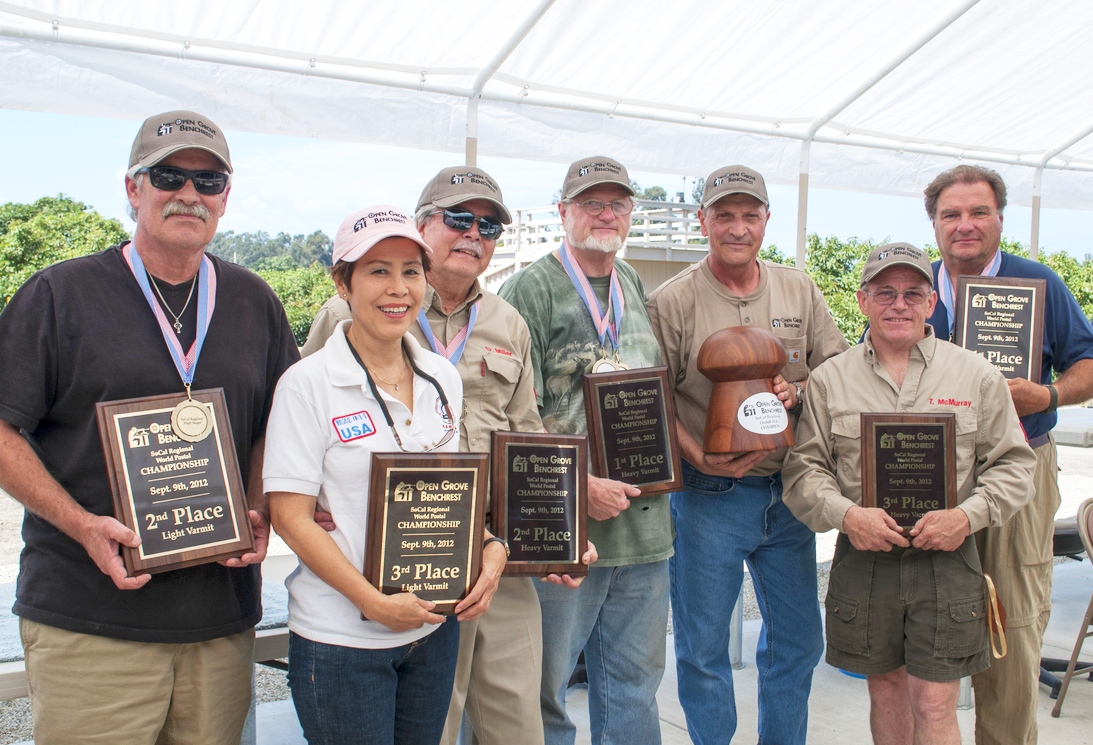
The rifles used at SoCal Regional are pre-charged using compressed air tanks. The rifles were chambered for either .177 or .22 caliber pellets. While some of the rifles were dedicated benchrest rigs, many were converted/adapted Field Target Rifles. The large side-focus-parallax wheels you see on some of the rifles are used for ranging in Field Target competition. The targets were set at 25 meters. Each target has 25 record bulls. The time limit was 30 minutes per target. Winners were determined based on the Overall Aggregate from the combined scores of three, 25-bull targets. Trophies were awarded to top shooters in HV and LV classes, and the Overall winner.
Comments from Match Director
After seven years as a rimfire benchrest shooter, I found a new passion with these air rifles. The cost involved will vary depending on where one wants to start. The sport right now is developing quickly with barrel manufacturers, custom action builders, and stock makers all getting involved. For Open Grove Benchrest, this event was a huge success in attracting different levels of competitors from first-time shooters to Benchrest regulars. We hope this will be a turning point for attracting new shooters to the sport. We tried to make this a fun family event. People really did seem to enjoy themselves. After the last relay, all the shooters were treated to a lunch. Then we gave out door prizes and awarded trophies to the winners.


According to Lou, the chamber that everybody was using in the 80s will work with this powder. The bullets do not need to be seated way out in order to get more powder in the case. In testing the powder in our Bond Universal receiver against the original “T” powder, SDs were about 30% lower with the new powder versus the “T” powder. Lou and Don Nielson donated 16 lbs. of the original T-32 lot of powder for our quality control and that is what the new powder is shot against.


 After concluding its 2012 Board Meeting, the NBRSA has issued some announcements for its membership. The Fee structure has changed, and Match Directors are requested to submit info on upcoming 2013 Matches. In addition, the NBRSA noted that Long Range Rule Books are now on sale for $5.00. Call (307) 655-7415 to order these Rule Books.


 Want to invest in a gun-making milestone, with authentic “PPC Provenance”? Here is a rare opportunity to acquire a set of guns that forged new frontiers for rifle accuracy. Dave Kiff, founder of


 Dave Scott explains why the Warehouse was so unique:


 Sally Sets a Record



 Comments from Match Director


