The 2012 IBS 1000-Yard National Championship was held August 31-Sept. 1 in Peeltree, WV at the White Horse Firearms and Outdoor Education Center. The match went well, with over 80 entries in both Light Gun and Heavy Gun classes. Light Gun and Heavy Gun relays were shot both days. Conditions were generally good, though it did get windy on Saturday.
Pennsylvania gunsmith Mark King topped the highly competitive field, placing first in the Two-Gun Grand Overall. Mark shot his trusty 6mm Dashers well in both Light Gun and Heavy Gun divisions to finish with 34 ranking points (lower is better). Mark’s LG had a Broughton barrel, while his HG had a Bartlein barrel. In second place Overall was runner-up Jeff Green with 49 ranking points. Tom Murtiff had a great run with his Light Gun, winning the LG Division after placing first in LG Score and fourth in LG Group. James O’Hara was second in Light Gun, followed by Mark King in third. In Heavy Gun division, the top two positions were separated by a single rank point. Jeffrey Moltern took the HG title after finishing first in HG group and sixth in HG score. Just one rank point behind Moltern in the HG class was Bud Williams, who finished fifth in HG Group and third in HG Score.
Our friend Pascal Fischbach from France offered us a sneak peak at the final production version of a new benchrest rig from Argentina. Pascal reports: “I’ll be in Buenos Aires soon and will meet Carlito Gonzales, maker of the CG M1 Thunderbolt benchrest rifle that performed so well at 2010 Supershoot and WBC10 last August in the hands of Dr. Cris Rando.” Pascal has ordered one of these rifles for the 2013 benchrest season. If you want more information about the CG M1 action or complete rifle, contact Pascal through his Facebook Page.
Pascal tell us: “The CG M1 action is a short, tight but smooth 3-Lug, Right Bolt, Left Port, Right Eject model. The receiver features a special 66mm-long tenon with threads in the center area and two bearing-centering areas on each side of the threads. Any gunsmith will be able to chamber additional barrels with the data and tools provided. This action offers strength and rigidity to enhance both accuracy and longevity. Carlito’s trigger is excellent — I recommend keeping it. The complete rifle will feature special quality rings that mate to the top of the receiver. Barrels can be chambered with your custom reamer or with CG’s conventional 6PPC reamer or even a PPC-AI chamber design (PT&G) that Carlitos realy likes. Price for the complete rifle will be very competitive.”
One reason this rifle performs so well is the innovative stock design. The fore-arm is very low profile in the front. At the back of the stock, an exaggerated Vee profile aids tracking and reduces vibration. Pascal says the stock tracks very straight for the first couple of inches during recoil, and the marked Vee in the rear makes it ride on the sides of the bag ears, not the bottom stitching. This helps quell vibration and improve damping. The carbon construction makes the stock “stout and stiff”.
The fluted 3-Lug Bolt is extremely well-machined.
The tang on the 2012 version has been shortened for weight reasons. There’s still plenty of bedding area on the main body.
Super-Sized Action Offered for Long-Range Rifles
For long-range shooters, Carlito Gonzales has also crafted a larger 600/1000m version of the CG M1 designed for bigger cartridges used in long-range competition. We don’t have any specifics on price or delivery date, but the action looks nice. The extended front section should provide excellent support for long, heavy barrels.
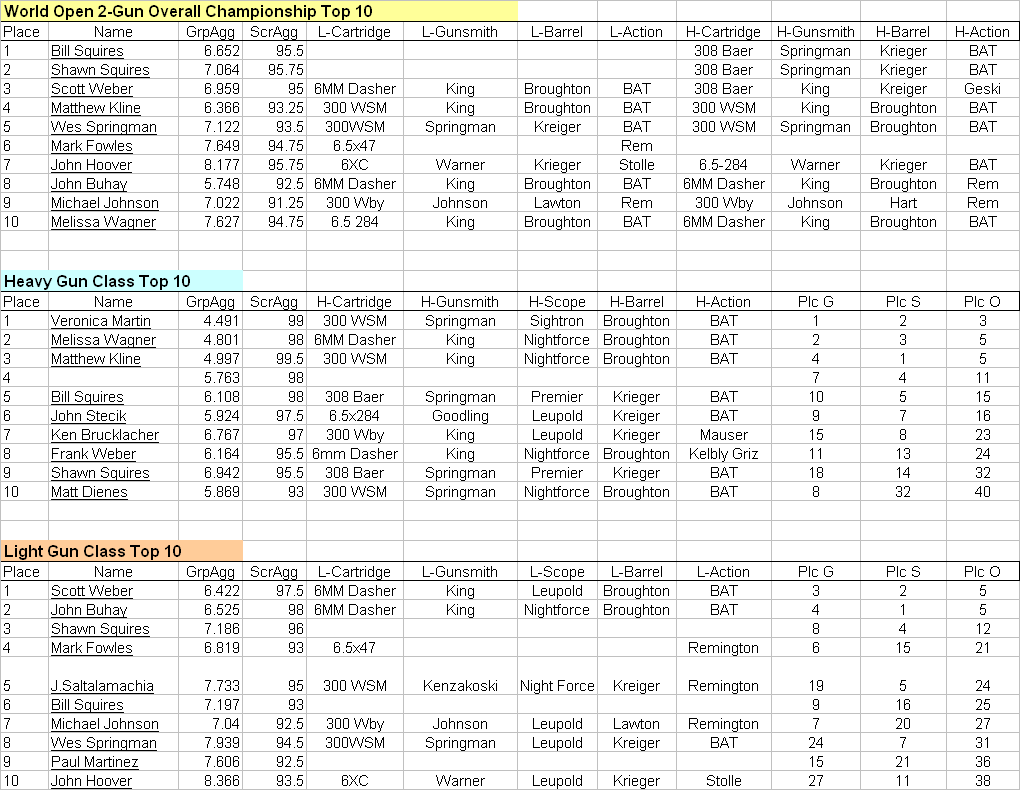
Held July 14-15 at the Original Pennsylvania 1000-Yard Benchrest Club, the 2012 Williamsport Word Open attracted a large field, with over 130 competitors. Brothers Bill Squires and Shawn Squires finished first and second respectively in the Two-Gun Overall Championship, making this year’s World Open a family affair. Both men campaigned a .300 WSM Heavy Gun and 6mm Dasher Light Gun. These rigs were smithed by the brothers themselves. The Squires boys really dominated this year. Bill ended up with 40 rank points, while Shawn had 44. Next best was Scott Weber, who had 71 rank points to finish third Overall. Shooting a 6mm Dasher, Weber also captured the Light Gun (LG) event, edging out LG runner-up John Buhay by a tenth of an inch in Aggregate Group size. (Buhay shot a Dasher in both LG and HG classes, finishing 8th Overall.)
It was “Ladies First” (and second) in the Heavy Gun (HG) class. Two talented ladies, Veronica Martin and Melissa Wagner, out-shot all the male competitors. Shooting a 300 WSM, Veronica took the HG title with an impressive 4.491″ Group Agg and 99 Score Agg. Melissa piloted her 6mm Dasher to second place in HG, with a 4.901″ Group Agg and 98 Score Agg. Finishing third in Heavy Gun was 300 WSM shooter Matt Kline, who racked up a “best in match” 99.5 Score Agg, along with a 4.997″ Group Aggregate.
As usual, the Williamsport Club put on a great event. This year there was a $40,000+ prize table — probably the best ever for a 1000-yard benchrest match. Two-Gun Overall runner-up Shawn Squires stated: “Yes it was a great weekend, even with the monsoon that occured during Day 2 of Light Gun. I would like to thank the Sponsors and Board, pit pullers and all who attended the 2012 World Open. The team at Williamsport always puts on a great event. Congratulations to Bill Squires (Two-Gun Overall), Veronica Martin (Heavy Gun Overall) and Scott Weber (Light Gun Overall). I guess if I had to lose Two-Gun Overall it might as well have been to my brother! Looking forward to the 2013 World Open.”
Shown above are the Top Ten Standings (and equipment lists) for the Two-Gun Overall, Heavy Gun Class, and Light Gun Class. For easier reading, click the “View Larger Image” link. Complete World Open Results for all 135 competitors are found on the Williamsport Club website at www.pa1000yard.com. The results are stored in an interactive database so you can search by class, event, or relay.
Report from Jason Baney, Asst. Editor
The Original Pennsylvania 1000 Yard Benchrest Club will host its annual 1000-Yard World Open July 14 and 15, 2012. It will be held at the club’s range about 15 miles north of Williamsport, PA and will draw shooters from all over the country. It is likely the largest gathering of 1000-yard benchrest shooters anywhere. This year, the combined prize value exceeds $40,000! Frank Grappone, Williamsport Club President, says: “Come shoot against the best!! Our prize table is legendary and we pay down many places in the final standings. Applications and info can be found at our website at www.pa1000yard.com. Hope to see you all there.” At this time, match fees are: $100.00 Per Class, $175.00 for both classes. (Saturday Night dinner is included in the Entry Fees.)
This event is meant to bring together shooters from each 1000-Yard (IBS and NBRSA) organization, and the current rules reflect this. The World Open includes two classes, Light Gun and Heavy Gun. At Williamsport, 10-shot groups are fired by BOTH classes, not just Heavy Guns. Light Guns (LG) must be 17.00 lbs or under and the Heavy Gun (HG) class has no major restrictions (see rules on the Williamsport website for further detail). One 10-shot group will be fired each day in each class. Scoring will be accomplished by an aggregate list of the groups and scores fired.
This Williamsport 1K match video shows 10 shots in 26 seconds — done with a 90-lb Heavy Gun.
The Schedule of Events will be:
Saturday Morning – Light Gun Match One
Saturday Afternoon – Heavy Gun Match One
Sunday Morning – Heavy Gun Match Two
Sunday Afternoon – Light Gun Match Two
Prizes will be given out to the Two-Gun Overall Champion, LG Champion, and HG Champion among others including the top dozen or more in the top of each LG and HG group and score categories. The $40,000+ prize table at this year’s World Open is quite large, probably the biggest ever for a 1K benchrest match. Prizes will be chosen by the shooter in the order of their ranking, not handed out. In addition to the regular prizes, The Original Pennsylvania 1000-Yard Club will give $1000.00 CASH to the competitor who shoots the smallest group for the weekend AND breaks the current Light Class or Heavy Class Ten Shot Benchrest World Record during this event. (One winner only per class).
This match should be one of the largest yet, and hopefully shooters are not discouraged by the high gas prices. Camping and campers can be parked for free, but will have to provide their own power. Concessions will be available as will an evening meal. The more shooters we can gather, the better the competition. We hope to see you there.
WEB Link: www.pa1000yard.com | Range Location: N41° 26.7511′, W076° 52.4212′
Benchrest shooter Bill Gammon offers a nice product that helps prevent solvents and oils from marring the finish of a fine wood stock, or a painted fiberglass stock. The STOKBOOT also prevents solvents from softening the bedding, while guarding against nicks and scratches. Gammon’s STOKBOOT fits over the rifle stock during cleaning of the barrel. The quilt on the outside soaks up the solvent before it reaches the stock and holds it until it evaporates. A twin layer of vinyl on the inside stops any solvents from getting through, but Gammon cautions that you should not leave the STOKBOOT on overnight, because solvents could soak through. The basic colors are Red, Wine, Black, Blue, and Green. Typical retail price is about $17.00.
Gammon explains how he came up with the STOKBOOT: “My wife Barbara and I started this business in 1992 as a means to support a very expensive sport, namely Bench Rest. My wife had been in the sewing business for many years. Her experience included sewing, layout, cutting, and management, so it was only logical that the next step was opening our own business. I had complained about having to use a rag over my stock to prevent solvents that I was using from ruining the paint job on the stock, and also seeping into the bedding area and softening up the bedding. So between her expertise in the sewing world and my practical knowledge, we came up with our first STOKBOOT.”
Gammon sells wholesale only. His STOKBOOTs are available through popular retail vendors including: Accuracy Arms, Borden Rifles, Bruno Shooters Supply, Russ Haydon’s Shooters’ Supply, Sinclair International. European dealers are: Reloading Solutions (UK), and Heinz Henke (Germany).
James Mock spotted some impressive new benchrest stocks at the recent Super Shoot. James told us: “Your readers may be interested in pictures of some striking stocks I saw at the Super Shoot. The purple one on the left belongs to Greg King. It is an HV with BAT action that has been coated and features a maple/carbon fiber laminated stock by Terry Leonard. Terry stained it purple (under the epoxy) at the request of Greg. The tuner was made by Sid Goodling.”
Terry Leonard can be reached at (423) 323-9327. Terry told us that a stock like this (tinted or natural wood colors) would typically run $1250.00 to $1300.00.
James Mock also spotted a handsome Walnut composite stock made by Roy Hunter. James writes: “The rifle on the right belongs to Sid Goodling (that’s Sid holding it), and it also features a BAT action. The rifle is a Light Varmint with a composite stock made from Balsa, English Walnut, and Carbon Fiber. The creator of this beautiful stock is Roy Hunter. Sid told me that a custom stock like this from Roy would cost about $1150.00. This is in line with other wooden composite stocks.” NOTE: The barrel on Sid’s gun is 21.5″. It may appear short because Roy Hunter builds his stocks “about 2″ longer than standard” according to Goodling. For more information on this rifle, contact Sid Goodling at www.GoodlingRifles.com.
Stock-Maker Roy Hunter Learned to Work Wood as a Master Furniture Craftsman
Although Terry Leonard is well-known to the BR community, Roy Hunter is a newcomer to the stock-making trade. But make no mistake — Roy is a highly-skilled craftsman who knows how to create both functional and beautiful stocks. This man knows his wood — Roy is an experienced furniture-maker who specializes in classic furniture of the 1700s and 1800s. Roy Hunter can be reached by phone at: (410) 259-7944.
Report by Murray Hicks
On March 10, 2012, history was made down under when 78 shooters attended the inaugural BRT 500m Fly Shoot National Championships held in Canberra, Australia. 500m fly shooting has grown immensely in popularity down under since the first Fly Shoot was held in Canberra, 22 years ago. The Fly Shoot is a highlight of the Aussie shooting calendar, attracting the largest field of competitors among any benchrest-style match in Australia. The day of the match was a cracker (that means good in the Aussie lingo) with blue skies and light winds.
CLICK “PLAY” to hear Murray Hicks talk about the sport of Fly-Shooting in Australia. Murray explains Fly Shoot rules, including the famous Rule 10: “Any competitor found not enjoying themselves, will be disqualified”.
[haiku url=”http://accurateshooter.net/Video/flyshoot.mp3″ title=”Fly Shoots by Murray Hicks”]
The 500m (560-yard) Fly Target is shot for score on a target with 10 scoring rings, plus a central fly image (instead of an “X”). A shot that hits any part of the fly counts as 10.1. Bonus points are also awarded for group size, with one point for a group under 10″ up to a maximum of 10 points for a group under 1″. Thus, 60.5 is the max possible score for one five-shot target (10.1 x 5 plus ten bonus points).
The Fly Shoot has two equipment classes: Light Gun (under 17 lbs.) and Heavy Gun. This is one of the few matches in Australia where Light and Heavy guns shoot head to head for overall placings. The wide variety of chamberings/calibers used by competitors is remarkable. Unlike the 600-yard BR game in the USA, which is dominated by small 6mm cartridges, at Australia’s Fly Shoots, you will see everything from small varmint calibers all the way up to big-bore Magnums. Many shooters favor the big 30s because it’s easier to see .30-caliber bullet holes through the mirage. This year’s Canberra event was won by Stuart Elliott shooting a 300 Win Mag. It was fitting that Stuart won the Inaugural BRT 500m Fly National Championships. Stuart, who runs BRT Shooters’ Supply, was one of the three Fly Shoot “founding fathers” who dreamed up the Fly Shoot discipline 22 years ago.
Spotters Add to the Fun
The use of a spotter during the match is permitted and even encouraged. This adds greatly to the fun of the shoot. Having a good mate on a spotting scope alongside you spotting your shots and helping to call the wind changes can really help when conditions get rough (as they often do).
The past year has seen the 500m Fly Shoot officially recognised by the Sporting Shooters Association of Australia (SSAA) and added to the official rule book. As a result the March shoot in Canberra this year became the Inaugural Fly Shoot National Championships. BRT Shooters’ Supply came on board as the event’s major sponsor, offering BRT’s full support and organizing an excellent prize pool. Thus the “BRT 500m National Fly Shoot Championships” was born.
The BRT 500m Fly Shoot Nationals were shot in reasonably good conditions, with major rains and floods in the week leading up to the shoot things were looking a bit dodgy. Luckily the day before the shoot the weather started to clear and over 40 tons of gravel had to be bought in to repair the access road to the 500m target line which had been washed away. The main organiser David Groves and his willing team of helpers took this all in their stride and did a tremendous effort to keep things running smoothly.
The inaugural shoot had an international flavor with shooter Sebastian Lambang, maker of the Seb rest, making the trek from Indonesia to compete. Lambang bought along his new switch-barrel rifle. With wide front “wings” attached and his .284 barrel, Seb finished 14th overall and 7th in Light Gun.
Top Competitors at 500m BRT Fly Shoot Championships
Name – Score – Class + Placing
1. Stuart Elliott: 261.03 — HG 1
2. Murray Hicks: 260.05 — HG 2
3. Anthony Hall: 257.03 — LG 1
4. Jason Trotter: 249.02 — HG 3
5. Annie Elliott: 247.03 — HG 4
6. Michael Farr: 242.04 — HG 5
7. Les Fraser: 242.01 — HG 6
8. Les Fraser: 241.01 — LG 2
9. Tyson Trotter: 238.01 — LG 3
10. Roy Gow: 237.02 — LG 4
11. Mick Easton: 235.02 — LG 5
12. Dave Groves: 228.02 — HG 7
13. Michael Bell: 228.01 — LG 6
Other Important Results
Small Group Paul Read: HG 1.382″
Best target Jason Trotter: HG 58.01
Best Junior Roy Gow: LG 237.02
Note on Rankings: The ranking list (the “Dirty Dozen”) includes 13 rankings of 12 shooters. Les Fraser shot both classes, finishing 7th overall with his HG and 8th overall with his LG. A second entry is included in the “Dirty Dozen” list for Les to allow recognition of his second highest score in Light Gun Class. However, each shooter normally only gets one overall ranking in the “Dirty Dozen” top 12.
All photos are copyright Murray Hicks, used with permission.
If you want to learn how to shoot accurately at very long-range, one of the very best places to learn is the Williamsport 1000-Yard Benchrest School. The Fifth Annual Benchrest School will be held April 27, 28 and 29 this year. There are still a few slots available for this year’s sessions. Classes, taught by top 1K shooters, are held at the Original Pennsylvania 1000-Yard Benchrest Club Range, one of the best 1K ranges in the country.
Prospective students will be taught all aspects of long range benchrest shooting from some of the most skilled marksmen in the country. All areas are covered from load development, precision reloading, bench skills, and target analysis. Much time is spent at the loading bench and on the firing line.
If you’re interested, you need to contact the school directors right away. While these Benchrest schools typically sell out, as of 3/24/2012, there were still a few student slots available for the late-April class session. If you want to grab one of the remaining slots for the 3-day school, don’t hesitate. For more information or to sign up for the 2011 1000-Yard Benchrest Class this April, contact School Director Frank Grappone, or visit the Williamsport website, PA1000yard.com.
To see what the 1K Benchrest school is like, watch the slide show/video below, produced by Sebastian Reist, an alumnus of the 2009 Williamsport 1000-yard BR school. Sebastian, a talented professional photographer, captured the highlights of his Williamsport 1K training weekend:
Nightforce Optics, Inc. (Nightforce), has completely redesigned and updated its website. Visit www.NightforceOptics.com to check out the new look and new features. The new site includes easier navigation, extensive product information, and a number of helpful tutorial features. NightforceOptics.com also includes photo galleries, product specs, and a global dealer locator.
New Site Offers Video Tutorials, Plus Interactive Reticle Calculator
The redesigned site includes detailed information on the products, reticles and technology. For example, the online Velocity™ Reticle Calculator allows the shooter to interactively explore the application and performance of the unique Nightforce Velocity™ 1000 and Velocity™ 600 reticles, relative to their own rifle’s ballistic profile. Visitors will find several tutorial videos, such as the one explaining the Nightforce ZeroStop™ system on the elevation turret. This allows the shooter to instantly return to his chosen zero point, no matter how many adjustments in elevation have been made. The site also conveys a wide range of general riflescope knowledge and information to help shooters hone their long-range skills.
“Delivering as much information to our customers as possible, within a visually appealing and useful environment, was our goal for the new website,” said Terry L. Eby, marketing project manager for Nightforce. “We will continue to add new information to the site that will help Nightforce customers[.]”
Berger Bullets has released a new 6mm (.243 caliber) bullet for short-range (100-300 yards) benchrest applications. The new bullet (shown below right), is called the “6mm BR Column”. This name does not mean the bullet is designed just for the 6mm BR cartridge. Rather it is designed for all 6mm short-range benchrest (BR) rifles, most of which are 6 PPCs (for group shooting at least). The “Column” in the name comes from the fact that Berger has optimized the height of the lead core column inside the bullet. Testing revealed that bullets which had very uniform core column heights shot more accurately and were also easier to tune. Does the new “Column” bullet work? Well, noted benchrest shooter Lou Murdica has already used them to win a Two Gun Agg in Florida against “big name” competition. Thankfully, you won’t have to wait long to try these bullets out — Berger says the new 6mm BR ‘Column’ projectiles will be available in mid-March, 2012. Call Berger at (714) 447-5422 to order.
Bullet Characteristics — Accurate and Easy to Tune
Berger’s Ballistician and lead bullet designer Bryan Litz says this new ‘Column’ bullet should be less sensitive to seating depth: “We worked very hard to produce a bullet that has a wider ‘tuning window’ for peak accuracy. This means there may be several seating depths where it shoots well. We also expect that it can shoot well at different speed nodes, but this will be dependent on your barrel.” The estimated G1 BC for these bullets is 0.277. The meplat is 0.062″, typical of benchrest bullets in this weight class. There is a small pressure ring in the bullet. Recommended twist rate is 1:13.5″ but the bullet should stabilize in a 1:14″ twist-rate barrel.
Berger’s Eric Stecker tells us: “There have been benchrest bullets in the past which were well-known for achieving consistently small groups over a wide tune range in many rifles and loads. One example of this was the Euber bullet. The seemingly ‘magical’ performance of these bullets has been attributed to special dies, stars aligning, owl feathers, or some other unknown influence. However, Bryan Litz has found that there are specific mass balance and aerodynamic properties which allow a bullet to mitigate dispersion and shoot precisely over a wide range of imperfect launch dynamics.”
Dispersion Mitigation in Bullet Design — Bryan Litz Explains The science of dispersion-mitigating bullets is understood, but until now, no one has ever deliberately designed a bullet that has these specific attributes. There have been other bullets which have accidentally achieved the partial effect and the resulting bullets became very well known. Three key things are required to develop an effective dispersion-mitigating bullet:
1. The knowledge required to design a dispersion mitigating bullet.
2. A bullet-maker with the ability to fabricate the design precisely.
3. The means by which to test the bullets extensively to determine optimal configuration.
Berger’s 6mm ‘Column’ bullet is specifically designed to mitigate the component of dispersion related to alignment. Variables related to bullet/bore axis alignment include tight necks, turning necks, bullet jump, chamber concentricity, powder charge, and so on. These are all variables which will be less critical for the new Berger 6mm ‘Column’ bullet.
To be realistic, these new bullets only mitigate dispersion effects related to axis alignment, NOT aiming error, wind deflection, or poor shooting.
Four Years of Prototype Testing Yields Superior Bullet Design
Using his knowledge of design factors that mitigate (reduce) dispersion, Berger’s bullet designer Bryan Litz went to work creating a bullet design that had a wide, forgiving tune range. This means that the bullet shoots well with a wide variety of loads and seating depths. Bryan came up with three different shapes. Then for each of these three bullet profiles, Berger tested three different core column heights to identify the truly optimal design. Over the next four years, Lou Murdica shot thousands of test rounds in the data capture phase of the project. When testing concluded, one bullet proved to be head and shoulders above the others in its ability to shoot well at the widest variety of loads and seating depths.
The prototype bullet design that shot best in Berger’s tests has entered production as the new Berger 6mm BR ‘Column’. You’ll notice that there is no listed weight. Berger doesn’t list weight because Berger learned that the bullet’s mass is not as important as the overall balance of the bullet, which is achieved with a specific internal lead column height. Due to slight variations in copper and lead material batches, one lot may weigh 64.8 gr while another lot might weigh 65.1 grains or 64.6 grains. Berger says: “So long as the column of lead is the correct height to achieve the desired balance” the bullets should perform, no matter what the average weight of a given lot of ‘Column’ bullets may be. That said, when loading for a match, you’ll want to load all your ammo with bullets from the same lot.
Berger is now accepting orders for the new 6mm BR ‘Column’ bullets. The first lots should be available around March 16, 2012. Call Berger at (714) 447-5422 for pricing info or to place an order.


 The 2012 IBS 1000-Yard National Championship was held August 31-Sept. 1 in Peeltree, WV at the White Horse Firearms and Outdoor Education Center. The match went well, with over 80 entries in both Light Gun and Heavy Gun classes. Light Gun and Heavy Gun relays were shot both days. Conditions were generally good, though it did get windy on Saturday.




 The 500m (560-yard) Fly Target is shot for score on a target with 10 scoring rings, plus a central fly image (instead of an “X”). A shot that hits any part of the fly counts as 10.1. Bonus points are also awarded for group size, with one point for a group under 10″ up to a maximum of 10 points for a group under 1″. Thus, 60.5 is the max possible score for one five-shot target (10.1 x 5 plus ten bonus points).



 If you want to learn how to shoot accurately at very long-range, one of the very best places to learn is the

 Nightforce Optics, Inc. (Nightforce), has completely redesigned and updated its website. Visit

 The science of dispersion-mitigating bullets is understood, but until now, no one has ever deliberately designed a bullet that has these specific attributes. There have been other bullets which have accidentally achieved the partial effect and the resulting bullets became very well known. Three key things are required to develop an effective dispersion-mitigating bullet:
 Four Years of Prototype Testing


