There are hundreds of cartridge types capable of winning in F-Open. For F-TR you can shoot either the .223 Rem or .308 Win, but you have many load options. This article will focus on proven choices, currently used by the top F-Class shooters in the world. Our discussion will analyze cartridge selection based on the four different F-Class sub-disciplines: Open Mid-Range, Open Long-Range, F-TR Mid-Range, and F-TR Long Range.
Click image to view full-screen photo.
Mid-Range F-Open Cartridges
For starters, a .300 WSM is certainly capable of winning mid-range matches but it is not ideal. So what is ideal, and why? F-Class Mid-Range matches usually are usually shot at 300, 500, or 600 yards — or all three. At those distances the 6mm and 6.5mm cartridges rule. In moderate conditions, the 6mm Dasher is unbeatable. Its low recoil along with its super grouping ability and good ballistics make it my number one choice for Mid-Range.
Best bullets for the 6mm Dasher are: Vapor Trail 103gr, Berger 105 Hybrid, 108 BT, and 105 VLD (hunting). Best powders are: Varget, H4895, and Reloder 15.
Choices for Mid-Range in Tougher Conditions:
We all know that conditions are not always “moderate” that’s why something a little bit bigger will save you a “Nine” or two. The 6.5X47 Lapua was designed for 300-meter competition, but as soon as it was released, it was adopted by F-Class, benchrest, and tactical shooters. It offers great ballistics with very low recoil and big “accuracy window”. Lapua makes great brass for it (no surprise there) and Berger makes great bullets: 130gr VLD, 140gr VLD, 140gr Hybrids. Best powders in most barrels are Varget and H4350, I don’t use double-based powders such as Reloder 17 and the Vihtavuori N500 series because of their unpredictable performance day to day (greater temp sensitivity).
The 6.5X47 Lapua necked down to 6mm is also a great option for mid range matches. I was able to easily get 3200 fps with 105 hybrids and H4350.
Choice for Long-Range F-Open Competition
In Long-Range F-Open Class (out to 1000 yards), the big, high-BC bullets rule. If I had to pick one cartridge for F-Class (both mid- and long-range) I would pick the .284 Winchester or one of its variants. The .284 Win is currently dominating in F-Open competition. It offers great barrel life, it is super-easy to tune and its recoil is very manageable. The best bullets for it by far (in my opinion), are the Berger 180 Hybrids. But Sierra’s new 183gr MK bullet (with factory-uniformed meplats) seems to perform very well as does the Berger 180 VLD. Best powders for the .284 Win are H4350 and H4831SC.
Long-Range Only F-Open Cartridge
As much as I like the .284 Win, for long-range competitions I like the .300 WSM even more. If you look at a .300 WSM and a 6mm Dasher side by side, they appear almost identical in geometry — the .300 WSM looks like an “super-sized” Dasher. Both cartridges are currently the “darlings” of long-range benchrest due to their extraordinary grouping ability and huge “node’’ windows. Big accuracy windows allow loads to perform well in different conditions and geographical locations. That’s obviously very important if you travel to compete. The .300 WSM loaded with Berger 215gr or 230gr Hybrids is very tough to beat at long range, and it is currently my number one choice.
The 7mm RSAUM is another outstanding long-range round. It resembles a 6BR on steroids and it is almost as easy to tune. Best bullets for it are Berger 180gr Hybrids, 195gr EOLs, and Sierra’s 183gr MatchKing. Best powders for the 7mm RSAUM are: H4350, H4831SC, and VV N160.
Top Caliber/Bullet Combos for F-TR
In F-TR competition, the choice is clear — a .308 Win throated for Berger 185gr BTLRs and 200gr Hybrids will win in mid-range AND long-range comps. Many championships have been won, and many records set with those two bullets in the .308 Win. To quote Danny Biggs (a two times FTR National Champion) “The 185 BTLR is the best bullet for .308 Win ever made”.
The Berger 215gr Hybrids have been used to win many competitions including recently the 2015 F-Class Nationals. Bryan Litz won both the Mid-Range and Long-Range 2015 Championships using 215s. Bryan’s rifle is shown below:
I recommend chambers throated for the 185/200 grain projectiles over the 215/230 grain bullets. The reason is that if you have your barrel throated out for the 215s or the 230s, you could have a “slow” barrel and max out on pressure before the desired velocity is reached. Optimum freebore for the 230s is too long for the 185/200s, so you would be limited to using only 215/230gr bullets in that barrel.Furthermore, the recoil increase with heavier bullets is substantial, causing the rifle to be more difficult to shoot.
.223 Rem — Not A Competitive Option
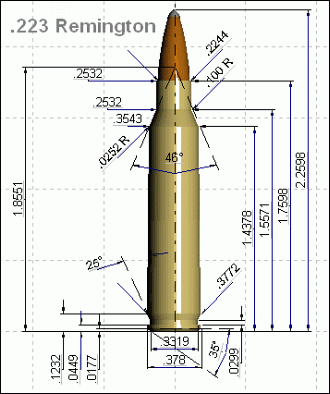
I would stay away from the .223 Remington. On paper the 90gr VLD will shoot inside most .308 Win loads even at a 1000 yards. But in reality, on average, the .223 Rem, regardless of what powder/bullet combo is used, cannot compete with the .308 Win. [Editor: The equipment lists at major F-TR matches will confirm Kovan’s conclusion here.]
Conclusion (and Other Options)
This article covers only the (currently) most popular cartridge/bullet combos for F-Class (F-Open and F-TR). As I said in the beginning, many cartridge types are capable of winning but are not listed due to their low popularity, case design, or lack of quality components. All of the above information is based on my personal experience and it is meant to help new shooters choose the right cartridges for F-Class matches. Thanks for reading and good luck — Emil Kovan
Emil Kovan Competition History:
– 2014 F-Class Open National Champion
– 2015 F-Class Open National Championship, Silver Medal
– F-Class Open National Championship Teams, 2015, 2014, 2013, Shooting Team Member
– Over 15 wins in Regional and State Championships in Palma, F-TR, F-Open
Applied Ballistics team dominates the King of 2 Miles match: Mitchell Fitzpatrick (1st Place), Bryan Litz (2nd Place), and Paul Phillips (4th Place).
The King of 2 Miles event has come to an end, the scores have been tallied, and Team Applied Ballistics finished first, second, and fourth. That’s dominance. The “Top Gun” was young Mitchell Fitzpatrick, who blitzed the field with his impressive .375 Lethal Precision Arms LLC rifle shooting prototype solid 400gr Berger bullets. Mitchell built this rifle himself using a McMillan A5 Super Mag stock. Remarkably, Mitchell nailed first- and second-shot hits at the 2477-yard target, a full 1.4 miles away. That’s amazing shooting. The photo below illustrates the vast distance from firing line to target.
Mitchell gave credit to his team-mates: “We had the best ballistic solutions possible thanks to the work done at Applied Ballistics LLC by the one and only Bryan Litz. Bryan is also a world-class wind coach and world champion shooter. Paul Phillips, also a world-class wind coach, world champion shooter, and just an all-around class act. Paul was invaluable to making the wind calls we needed to win this match. One of the most important parts of any rifle system is the projectile… Berger’s new prototype .375-cal 400gr projectile we have been developing gave us a monumental ballistic advantage. [It was] without a doubt, a key to our success.”
Berger Ballistician Bryan Litz took second place shooting a .338 Edge (the only .338 rifle in the Finals). Durvin Wick finished third, while Paul Phillips, shooting Bryan’s rifle, placed fourth overall.
Report by Bryan Litz, Team Applied Ballistics
The 2016 King of 2 Miles event is in the books. Today the Top 10 teams engaged targets at 2011 yards, 2477 yards, and 3375 yards. All three Applied Ballistics teams had hits at 2011 yards, and two out of three of us scored first-round hits at 2477 yards! Note that no competitor (from any team) hit the two-mile (3375-yard) target, but that gives us a goal to shoot for next year. Many factors contributed to the success of the Applied Ballistics shooters in this event:
1. Teamwork. We shoot together on the U.S. Rifle Team. The standardized communication protocols between coaches and shooters was a big advantage in this timed event. We had excellent team-work, and are already discussing ways to improve and adapt our approach to ELR events.
2. Science. Applied Ballistics specializes in the science of accuracy. First round hits in this event are scored highly and you can get more first round hits if you know your ballistics. The top two shooters in this event both had first round hits at 2477 yards today which was key, and is not possible without highly accurate ballistic solutions.
3. Ballistic Performance. The performance of Mitchell Fitzpatrick’s .375 Lethal Precision Arms LLC rifle with the prototype 400 grain Berger Bullets solid is unmatched (G7 BC of 0.56 at over 3000 fps). This performance helped Mitch win the match by a sizable margin. The other two Applied Ballistics teams were shooting Bryan Litz’s .338 Edge with the Berger Bullets 300 grain Hybrid. Despite being a smaller caliber (compared to the .375s, .416s, and .50-calibers), the .338 Cal 300 grain Berger Hybrid proved to be a great performer.
There were quite a few big .50 Cals on the line, but a .375 topped the field. Sheri Judd photo.
Thanks to Eduardo Abril De Fontcuberta, Founder of the KO2M Event
We would like to thank all those who worked hard to make this event happen especially Eduardo Abril De Fontcuberta (shown below with Mitchell Fitzpatrick and Paul Phillips). Eduardo has worked hard to organize a great event that pushes the limits of ELR shooting in a fun and competitive way. We’re very grateful for the chance to participate and look forward to competing in the King of 2 Miles event next year. Also, thanks to Kelly McMillan for his support of our team. Kelly has been an awesome sponsor of our efforts here, as well as the U.S. Rifle Team, and the shooting community in general.
Berger Ballistician Bryan Litz has been preparing for the King of Two Miles match next week. He’s been out testing a VERY high-BC bullet — Berger’s new prototype .375 caliber 400-grainer. In the photo above, you can see Applied Ballistics intern Mitch Fitzpatrick (flanked by twin LabRadar chronos) shooting at a target set at 2400 yards. Next week, at the King of Two Miles event, the challenge will be even greater — Bryan and his team will be shooting out to roughly 3600 yards.
Bryan reports: “We’ve been preparing for the King of Two Miles match next week. Last Friday we shot 2400 yards at Thunder Valley Precision in Ohio, measuring time of flight and refining the custom drag model for our bullet. We are logging flight times over three seconds and the bullet is still supersonic at 2400 yards! Tomorrow we’re shooting 1800 yards as a final verification before we load up and begin traveling out west.”
OPTICS for Extreme Long Range Bryan is running Nightforce ATACR scopes on his .375 rifles. These ATACRs offer 120 MOA (or 35 Mils) of elevation. That’s impressive, but you still need more “up” for these extreme distances.
Bryan notes: “No scope has enough elevation to dial direct to two miles even with these large-caliber, high-performance rifles. You need some kind of external adjustment, or use a steep rail (e.g. +80 MOA). This works but can sacrifice your ability to zero under 1000 yards.”
This video shows a hit at 2400 yards with the .375-caliber bullet. The target is 8’x8′ square. The targets Bryan will shoot at next week’s King of Two Miles competition will be up to 1200 yards further than this. (Two miles is 3520 yards).
If you’re interested in this kind of Extreme Long Range shooting, consider attending the Applied Ballistics Seminar. The next seminar will be held July 18-19 in Michigan. Bryan says: “We’ll be sharing our experiences and lessons learned in the Two Mile shooting match among many other things we’re working on.” CLICK HERE for Seminar INFO and Registration.
At the request of our readers, we provide select “Deals of the Week”. Every Monday morning we offer our Bargain selections. Here are some of the best deals on firearms, hardware, reloading components, and shooting accessories. Be aware that sale prices are subject to change, and once clearance inventory is sold, it’s gone for good. You snooze you lose.
The Ruger Precision Rifle has been one of the hottest-selling long guns in America since its releases. It has pretty much been sold out for months. And Ruger just bumped the price on the new Gen2 edition up to $1599.00 MSRP. The Superstore got hold of some of some Gen 1 production RPRs in .243 Winchester. These rifles are IN STOCK and on sale for $1049.50. That’s a great price. The venerable .243 Win cartridge is a good choice for this rifle — Gavin Gear of UltimateReloder.com has an RPR chambered in .243 Win that has proven very accurate.
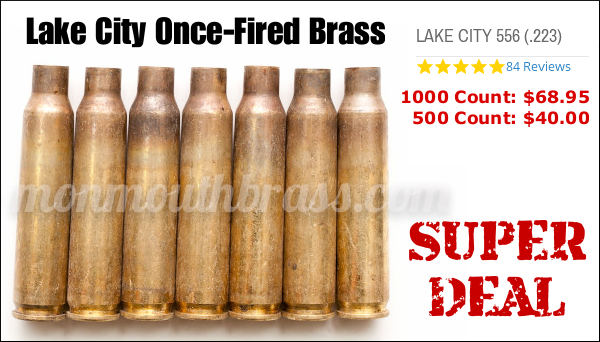
2. Monmouth Reloading — 1000 Lake City 5.56 Cases, $68.95
1000 pieces of Lake City brass for under seventy bucks? Yep, that’s a deal and a half. Monmouth Reloading is selling genuine, once-fired Lake City 5.56x45mm brass, thick-walled and sourced direct from the U.S. Military. Monmouth reports: “Our current stock of Lake City 5.56 looks to be all newer year Lake City head stamp but may contain a small percentage of other NATO headstamps. Lake City is a popular, reliable brass, normally capable of many reloads.” Monmouth includes 1% overage to account for any damaged brass. NOTE: Brass has crimped primers, so the pockets will need to be reamed or swaged prior to reloading.
3. Midsouth Shooters Supply — All Berger Bullets Now 10% Off
Need super-high-quality match, hunting, or varmint bullets? Then visit Midsouth Shooters Supply. Now through June 13, 2016, Midsouth has placed its entire stock of Berger Bullets on sale. You can save 10% off Midsouth’s already competitive prices, even on Berger’s most popular projectiles, such as the 6mm 105gr Match Hybrid, 6.5mm 130g Matcrh AR Hybrid, and the ultra-high BC 7mm 180gr Match Hybrid.
4. CDNN Sports — HK 416 .22LR Rimfire Rifle, $379.99
If you are looking for an AR-type .22 LR rifle for cross-training and rimfire tactical matches, the HK 416 is a fine choice. Made by Walther under license, these HK 416 D145RS rimfire rifles are accurate and reliable. This is a good deal at $379.99! The HK 416 normally sells for $550.00 to $600.00. One purchaser writes: “Great .22. I have had this gun a couple of months and have put about 500 rounds of 5 different brands of ammo through it. Not one FTE. I have shot other brands that can’t get through one 30-round mag without a failure.” CLICK HERE for Product Details.
5. Natchez — Hornady 22-Cal Varmint Bullets, $9.99 Per 100
Headed out for a varmint safari soon? Need inexpensive bullets for your .223 Rem or 22-250? Then check out this deal on Hornady 55-grainers from Natchez. Get 100 Soft Point .224-Caliber FB bullets for just $9.99. At that price, it doesn’t hurt so much when you shoot 1000+ rounds over a weekend. With good expansion, these bullets work great on prarie dogs and other small critters. Note: These sale bullets ship in a bag, not the box as shown.
6. Amazon.com — Howard Leight Electronic Earmuffs $40.97
Every shooter should own a pair of Electronic muffs, even if you prefer shooting with earplugs and/or standard muffs. Electronic muffs are great when you are doing spotting duties or are working near the firing line. They allow you to hear ordinary conversations while still providing vital hearing protection. Right now Amazon.com has the Howard Leight Impact Sport Electronic Muffs on sale for just $40.97. This is good deal — these NRR 22 muffs are currently Amazon’s #1 seller in the category. NOTE: For regular, sustained shooting we recommend muffs and/or earplugs with a higher NRR rating.
7. Natchez — RCBS ChargeMaster Dispenser, $279.99
Here’s a very good deal on the popular RCBS ChargeMaster combo scale/powder dispenser. This unit sells elsewhere for up to $389.00. You may want to act quickly as sale pricing changes frequently. This item is also available on Amazon.com for $296.99 with free shipping for Prime members.
8. Harbor Freight – 8-Drawer Wood Tool Chest
This Wood Tool Chest makes a great addition to your reloading room. The eight (8) drawers can hold the many small tools and accessories used for hand-loading, such as bushings, shims, uniforming tools, mandrels, neck-turners and more. A deeper top compartment (under the lid) holds wrenches and other larger tools. The price is just $79.99. A lockable sliding wood panel fits in place to cover the drawers when not in use. This locking panel also secures the drawers during transport.
9. Bullets.com — Handgun Safe $49.95
This pistol safe keeps your handguns secure while still permitting instant “push-button” access. The three-button lock can be personalized with 3- to 8-digit codes, and there is a key override. This safe will hold two (2) full-sized pistols and can also store passports, cash, or other valuables. The spring-loaded door gives you near-instant response. The all-steel case also includes mounting holes for fixing the safe to floor or shelf.
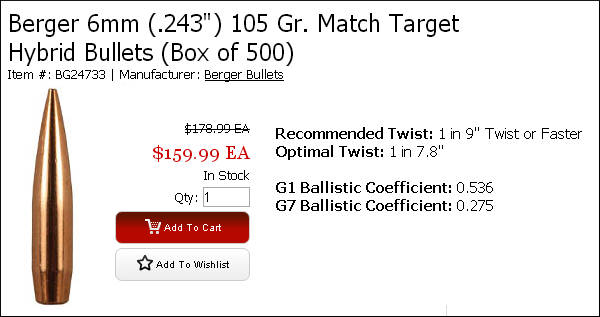
Need top-quality 6mm match bullets for your 6mmBR, 6mm Dasher, 6XC, 6mm Creedmoor, 6-6.5×47, or .243 Win? Then get out your checkbook, because this is a very good deal on hard-to-find Berger 6mm 105gr Hybrid Match Bullets.
Right now Precision Reloading offers big, 500-count boxes of 105gr 6mm Hybrids for just $159.99. That works out to just $31.99 per 100, a lot less than you’d pay normally. These .243-diameter premium bullets hold many records and have won many important shooting competitions. You may want to act quickly — supplies are limited. When Precision Reloading runs out of sale inventory, prices will go up. To order, visit PrecisionReloading.com
The Berger Southwest Nationals event is less than two weeks away… so get your bags packed and ammo loaded boys and girls. The SW Nationals run February 9-14, 2016, kicking off on Tuesday the 9th with a shooting clinic.
Photo by Phil Kelley at Ben Avery Range.
This prestigious rifle competition, hosted at the Ben Avery Shooting Facility, outside Phoenix, Arizona, draws top F-Class and sling shooters from around the country. The Berger SW Nationals event is the premier long-range match of the year in the Western United States. Over 360 shooters have already registered for the SWN. NOTE: there are a few spots left. To register, go to the Berger SWN Entry Page.
To help you prepare for the Berger SW Nationals, here are some competition tips from Bryan Litz. Bryan knows the Ben Avery range well. He won the Mid-Range and Long-Range F-TR National Championships there last year. And twice he has won the sling division at the Southwest Nationals. Here are wise words from Bryan:
Competition TIP ONE. Improving your scores in long range competition is a constant process of self-assessment. After each match, carefully analyze how you lost points and make a plan to improve. Beginning shooters will lose a lot of points to fundamental things like sight alignment and trigger control. Veteran shooters will lose far fewer points to a smaller list of mistakes. At every step along the way, always ask yourself why you’re losing points and address the issues. Sometimes the weak links that you need to work on aren’t your favorite thing to do, and success will take work in these areas as well.
Competition TIP TWO. Select your wind shooting strategy carefully. For beginners and veterans, most points are typically lost to wind. Successful shooters put a lot of thought into their approach to wind shooting. Sometimes it’s best to shoot fast and minimize the changes you’ll have to navigate. Other times it’s best to wait out a condition which may take several minutes. Develop a comfortable rest position so you have an easier time waiting when you should be waiting.
Competition TIP THREE. Actively avoid major train wrecks. Sounds obvious but it happens a lot. Select equipment that is reliable, get comfortable with it and have back-ups for important things. Don’t load on the verge of max pressure, don’t go to an important match with a barrel that’s near shot out, physically check tightness of all important screws prior to shooting each string. Observe what train wrecks you and others experience, and put measures in place to avoid them.
Competition TIP FOUR. If your long range ballistic predictions aren’t tracking, always come back and verify your 100-yard zero. Sometimes a simple zero shift can be misconstrued as errors in long range ballistics predictions.
SHOT Show 2016 kicks off in two weeks in Las Vegas. While at SHOT Show next month, we plan to get the “inside scoop” on new bullet designs from Berger, Hornady, Lapua, Nosler and Sierra.
A while back, at SHOT Show 2012 we chatted with Berger Ballistician Bryan Litz about Berger’s popular line of Hybrid bullets. Berger now offers a wide range of Hybrids in multiple calibers and weights. In fact, for .30-Caliber shooters, Berger now offers seven different Hybrid match bullets, with weights from 155 grains up to 230 grains. Two .338-caliber OTM Tactical Hybrids were introduced in 2012 (a 250-grainer and a 300-grainer).
Bryan tells us: “The hybrid design is Berger’s solution to the age old problem of precision vs. ease of use. This design is making life easier for handloaders as well as providing opportunities for commercial ammo loaders who need to offer a high performance round that also shoots precisely in many rifles with various chamber/throat configurations.”
For those not familiar with Hybrid bullets, the Hybrid design blends two common bullet nose shapes on the front section of the bullet (from the tip to the start of the bearing surface). Most of the curved section of the bullet has a Secant (VLD-style) ogive for low drag. This then blends in a Tangent-style ogive curve further back, where the bullet first contacts the rifling. The Tangent section makes seating depth less critical to accuracy, so the Hybrid bullet can shoot well through a range of seating depths, even though it has a very high Ballistic Coefficient (BC).
In the video we asked Bryan for recommended seating depths for 7mm and .30-Caliber Hybrid bullets. Bryan advises that, as a starting point, Hybrid bullets be seated .015″ (fifteen thousandths) off the lands in most barrels. Watch the video for more tips how to optimize your loads with Hybrid bullets.
Berger has released two important informational updates for its line-up of bullets. First, the Ballistics Coefficients (BCs) have been updated for the vast majority of bullets Berger sells. In addition, G7 model BCs are being provided for most of the bullets. You will want to use the updated BC data, which is based on actual testing of recent production lots of bullets.
Second, Berger is now providing a dual twist-rate recommendation for most bullets. Berger is now lists a “minimum” barrel twist rate as well as an “optimal” twist rate. To get maximum long-range performance from your bullets, use a barrel with the “optimal” rate of twist.
CLICK HERE for the latest Berger Quick Reference Sheets with updated BCs and new Optimal Twist Rates. Eric Stecker, Berger President says: “We have tested every lot of bullets produced in the last several years to bring you these updated numbers for all of our bullets.”
Ballistic Coeffificent (BC) Updates with G7 Data
Berger notes: “We have updated all of our Ballistic Coefficients to be even more accurate.
Prior to 2008, all of Berger Bullets’ BCs were calculated using a computer prediction. Early in 2009, we began measuring BCs with live-fire testing. As a result, Berger’s BCs were updated and G7 BCs were also made available. This represented a dramatic improvement in the accuracy of performance data at that time. Since 2009, the BCs assessed for Berger Bullets have not been updated. As part of our ongoing effort to provide shooters with the best information possible, Berger has been testing every lot of bullets produced for the last several years. The result is updated and highly accurate running averages of BCs for recent production lots.
Here are some of the Updated BC Values for popular Berger Target (Match) Bullets:
G7 Form Factor Addition
Berger also added the G7 form factor to the Ballistics Quick Reference Sheet. The analysis of form factors can be very useful when considering a bullet’s long range performance potential. Going by BC alone can be deceptive since BC includes the weight and caliber of the bullet. Form factor indicates how much drag the bullet has, which is a very important consideration for all bullets of all calibers.
NEW Dual Twist-Rate Recommendations
Recommended twist rates for bullets are commonly listed as a single value, such as 1:12” (one rotation in 12″ of barrel travel). This may be overly simplistic. There is a big gray area of marginal stability in which bullets can fly with good accuracy, but with a reduced (i.e. sub-optimal) Ballistic Coefficient. Recognizing this reality, Berger is now listing two twist rates for each bullet it makes. The first is the minimum twist needed for good accuracy, which Berger has always recommended. The second is the new optimal twist rate, which is the twist that will stabilize the bullet to a level which achieves its full performance (BC) potential. CLICK HERE For more information.
This article first appeared in 2014. We are reprising it at the request of many readers who are fans of the .30-06 cartridge.
The “Old Warhorse” .30-06 Springfield cartridge is not dead. That’s the conclusion of Forum member Rick M., who has compared the 1000-yard performance of his .30-06 rifle with that of a rig chambered for the more modern, mid-sized 6.4×47 Lapua cartridge. In 12-16 mph full-value winds, the “inefficient and antiquated” .30-06 ruled. Rick reports:
“I was shooting my .30-06 this past Sunday afternoon from 1000 yards. The wind was hitting 12-16 mph with a steady 9 O’clock (full value) wind direction. My shooting buddy Jeff was shooting his 6.5×47 Lapua with 123gr Scenar bullets pushed by Varget. Jeff needed 13 MOA left windage to keep his 6.5x47L rounds inside the Palma 10 Ring. By contrast I only needed 11.5 MOA left windage with my .30-06. I was shooting my ’06 using the 185gr Berger VLD target bullet with H4350. I managed the same POI yet the .30-caliber bullet only needed 11.5 MOA windage. That’s significant. From this experience I’ve concluded that the Old Warhorse ain’t quite dead yet!”
Rick likes his “outdated” .30-06 rifle. He says it can deliver surprisingly good performance at long range:
“To many of the younger generation, the Old Warhorse .30-06 is ‘outdated’ but I can guarantee that the .30-06 Springfield is a VERY ACCURATE cartridge for 1000-yard shooting (and even out further if need be). With some of the advanced powders that we have today, the .30-06 will surprise many shooters with what it’s capable of doing in a good rifle with the right rate of twist. My rifle has a 1:10″ twist rate and I had it short-throated so that, as the throat erodes with time, I could just seat the bullets out further and keep right on shooting. My recent load is Berger 185gr Target VLDs pushed by IMR 4350. This is a very accurate load that moves this bullet along at 2825 fps.”
Tech Tip by Doc Beech, Applied Ballistics Support Team
I am going to hit on some key points when it comes to bullet pointing. How much pointing and trimming needed is going to depend on the bullet itself. Specifically how bad the bullets are to begin with. Starting out with better-quality projectiles such as Bergers is going to mean two things. First that you don’t need to do as much correction to the meplat, but also that the improvement is going to be less. NOTE: We recommend you DO NOT POINT hunting bullets. Pointing can affect terminal performance in a bad way.
NOTE the change in the bullet tip shape and hollowpoint size after pointing:
Don’t Over-Point Your Bullets
What is important here is that you never want to over-point. It is far better to be safe, and under-point, rather than over-point and crush the tips even the slightest bit. To quote Bryan Litz exactly: “Best practice is to leave a tiny air gap in the tip so you’re sure not to compress the metal together which will result in crushing. Most of the gain in pointing is taking the bullet tip down to this point. Going a little further doesn’t show on target”. So in essence you are only bringing the tip down a small amount… and you want to make sure you leave an air gap at the tip.
Also keep in mind, bullet pointing is one of those procedures with variable returns. If you only shoot at 100-200 yards, bullet pointing will likely not benefit you. To see the benefits, which can run from 2 to 10% (possibly more with poorly designed bullets), you need be shooting at long range. Bryan says: “Typically, with pointing, you’ll see 3-4% increase in BC on average. If the nose is long and pointy (VLD shape) with a large meplat, that’s where pointing has the biggest effect; up to 8% or 10%. If the meplat is tight on a short tangent nose, the increase can be as small as 1 or 2%.” For example, If you point a Berger .308-caliber 185gr Juggernaut expect to only get a 2% increase in BC.
Should You Trim after Pointing?
Sometimes you can see tiny imperfections after pointing, but to say you “need” to trim after pointing is to say that the small imperfections make a difference. Bryan Litz advises: “If your goal is to make bullets that fly uniformly at the highest levels, it may not be necessary to trim them.” In fact Bryan states: “I’ve never trimmed a bullet tip, before or after pointing”. So in the end it is up to you to decide.
Pointing is Easy with the Right Tools
The process of pointing in itself is very simple. It takes about as much effort to point bullets as it does to seat bullets. We are simply making the air gap on the tip of the bullet ever-so smaller. Don’t rush the job — go slow. Use smooth and steady pressure on the press when pointing bullets. You don’t want to trap air in the die and damage the bullet tip. You can use most any press, with a caliber-specific sleeve and correct die insert. The Whidden pointing die has a micrometer top so making adjustments is very easy.
Bryan Litz actually helped design the Whidden Bullet Pointing Die System, so you can order the Pointing Die and Inserts directly from Applied Ballistics. Just make sure that you pick up the correct caliber sleeve(s) and appropriate insert(s). As sold by Applied Ballistics, the Whidden Bullet Pointing Die System comes with the die, one tipping insert, and one caliber-specific sleeve. To see which insert(s) you need for your bullet type(s), click this link:


 .223 Rem — Not A Competitive Option
Emil Kovan Competition History:


 Berger Ballistician Bryan Litz has been preparing for the
  Bryan is running