“Forever”. That’s a serious concept. In a world where many products are guaranteed for just 30 days (or not at all), the Brownells “forever” 100% satisfaction guarantee is pretty darn impressive. In this video, Pete Brownell, company CEO, explains how the Brownells guarantee works. If any product Brownells sells ever proves unsatisfactory, at any time, Brownells will replace it or refund your money. That applies to both Brownells-branded products as well as third-party manufactured items sold by Brownells. Think about that the next time you buy a trigger or scope rail or other firearm accessory.
“One thing about Brownells that sets it apart from any other organization inside or outside the firearms industry is our return policy. Here’s how it is… it’s guaranteed forever. What this means is, if you buy [a product] from Brownells… whatever it is, it’s guaranteed forever. Not just lifetime, but forever.” — Pete Brownell, CEO
100% Satisfaction Guarantee on Everything We Sell
If you aren’t completely, 100% satisfied with any purchase you receive from Brownells, for any reason, at any time, return it for a full refund or exchange. No hassle, no problem. And, we won’t bog you down in endless paperwork. [This statement appears on Brownells.com].
Black Rifle Gone Bad…
Take a close look at this AR-15 bolt. Notice something missing — namely all the lugs? A healthy AR-15 bolt has seven (7) bearing lugs (plus an extractor hump). For all seven lugs to have sheared “clean off”, something serious must have happened to this bolt assembly. The folks at Brownells published this “lost luggage” image on Facebook to spur discussion. So, you AR experts out there — what do you think caused the problem here? Was it over-pressure, metal defect, headspace problem, gas system malfunction (or some combination of issues)? Post your theories in the comment section below…
You can never be too safe when hand-loading your own ammunition. This helpful Brownells video outlines the Seven Fundamental Reloading Safety Tips. This is important information for novice hand-loaders and a good refresher for those with reloading experience!
Summary of the Seven Safety Tips:
1. Store your reloading supplies in a safe and dry location, away from children and away from any possible source of ignition. This includes keeping your powder and primers separate.
2. Get and use respected reloading manuals, especially for new cartridges. Start low and work up slowly while watching for warning signs of pressure and/or case fatigue.
3. Locate your reloading activity where you will not be distracted. If you get interrupted, stop. (Distractions will eventually lead to mistakes.)
4. Do NOT mix powders. Keep your powders clearly marked and dated. You can use masking tape to write the date on the container.
5. If you load the same cartridge type for different firearms, make sure your ammo headspaces properly in each gun.
6. Check cases frequently. Look for split necks, case head separation or other signs of fatigue and excessive pressure.
7. If reloading military brass, be aware that case capacity is usually reduced, and initial loads should be at least 10-15% lower than published data.
Here are some other tips that will help your avoid making costly mistakes (such as using the wrong powder, or undercharging a case):
Powder Type — Always double-check the label on your powder containers. After placing powder in the powder measure, put a piece of tape on the measure with the powder type written on it. Some guys write the powder type on a card and place that right in the hopper.
Scale Drift — Electronic balances can drift. If you are using a digital powder scale, calibrate the scale with a test weight every 50 rounds or so.
Case Fill — If you throw more than one charge at a time, look INSIDE every case before seating a bullet. Squib charges can be dangerous if you don’t notice them before firing the next round.
Progressive Presses — When using a progressive press, consider using an RCBS Lock-Out Die. This will detect a low charge and stop the machine. These dies will work with RCBS, Hornady, and Dillon progressives.
Got fifty bucks? Well that’ll buy you an AR Lower this week. Quite simply, this is the best AR deal we’ve seen this year, and one of the best values on a firearm receiver we can remember. Right now, while supplies last, Brownells.com is offering Bushmaster-brand AR-15 stripped lower receivers for just $49.99. You read that right — you can get a major manufacturer AR lower for under fifty bucks. That’s a savings of $120.00 off the normal price. Get them while you can.
NOTE: Stripped lowers are considered the firearm, so this must be delivered to an FFL-holder. It is fairly easy to complete the lower with readily available parts and the trigger group of your choice.
Bushmaster Stripped Lower Receiver Product Description
Receiver is a rigid 7075 T6 aluminum forging with extra metal in the right places for added strength without unnecessary bulk. Features a beefy, M16A2-pattern reinforced area around the front pivot pin, a strengthening ridge over the receiver extension threads, and a ridge around the mag release button to guard against accidental magazine drop by preventing unintentional button activation. Bead blasted after machining to ensure a uniform, non-reflective surface before application of lusterless black military hardcoat A8625, Type III, Class 2 anodized finish that adds surface strength and resists abrasion. A final, nickel acetate seal coat provides extra protection against corrosion. Stripped lower is the perfect companion for Bushmaster Lower Receiver Parts Kit, available separately
Our take on Bore-Store Gun sleeves is simple: They work great, so buy them and use them — for ALL your valuable firearms.
These thick, synthetic-fleece sacks cushion your guns, preventing nicks and scratches. The breathable fabric wicks away moisture, and the fibers are coating with corrosion inhibitors. I personally use Bore-Stores for in-safe storage with all my guns, and I have never had one of my guns rust inside a Bore-Store, even when I lived a stone’s throw from the ocean.
Bore-Stores are offered in a wide range of sizes, so you can find something to fit everything from a Snub-nosed revolver to a 32″-barrelled 50 BMG. Rifle-size Bore Stores can be purchased for $12.00 – $21.00 from Brownells. For long F-Class or tactical rifles, we recommend the 10″x52″ Scoped Shotgun Bag, Brownells item 132-000-003. You can also order direct from the Bore-Store manufacturer, Big Spring Enterprises, www.BoreStores.com. Big Spring will also craft custom sizes on request.
Consider Military-Style, Triple-Layer Bags for Long-Term Storage
While we prefer Bore-Stores for regularly-used guns, if you have heirloom firearms that will be kept in storage for very long periods without seeing any use, you may want to grease them up and place them in the thin, but rugged three-layer storage bags sold by Brownells. The bags are made from a three-layer laminate of polyester, aluminum, and polyethylene film, with a shiny silver exterior. Though the laminate is thin, the Brownells storage bags are puncture-resistant, and have a 0% moisture transmission rating so moisture can’t get inside. These bags are also resistant to petroleum-based chemicals and they won’t break down even in contact with soil or moisture.
Here’s one VITAL bit of advice for using these bags. Be absolutely sure, before you seal up the bags, that your guns are DRY and that all metal surfaces have been coated with an effective anti-corrosive, such as BoeShield T9 or Eezox. Brownells’ storage bags are inexpensive. A three-pak of 12″x 60″ rifle sacks (item 083-055-003WB) costs just $22.99 — under eight bucks a gun. That’s cheap insurance for rifles and shotguns that may cost thousands of dollars.
Get Your Guns Out of Foam-lined Cases — They Are Rust Magnets
Just about the worst thing you can do in the winter (short of leaving your rifle outside in the rain) is to store firearms in tight, foam-padded cases. The foam in these cases actually collects and retains moisture from the air, acting as the perfect breeding ground for rust.
Remember, those plastic-shelled cases with foam interiors are for transport, not for long-term storage. Don’t repeat the mistake of a wealthy gun collector I know. He stored four valuable Colt Single Action Army (SAA) revolvers in individual foam-padded cases, and locked these away in his gun safe. A year later, every one of his precious SAAs had rusted, some badly.
If you’re looking for loaded ammunition at affordable prices, WikiArms.com can help you find a good deal. WikiArms constantly searches the listings of ammo vendors across the web. Then WikiArms ranks the offerings by cost per round, low to high. This way you can instantly compare prices from multiple vendors including Ammoland, Brownells, Cabelas, Lucky Gunner, MidwayUSA, Natchez, Sinclair Int’l, Slickguns, Sportsmans Guide, and Wideners. Search bots refresh pricing constantly so listed prices are normally current within five minutes. WikiArms even displays the amount of product currently in stock for each vendor.
Using WikiArms is easy. Just click your choice of caliber (such as 9mm, .22LR, or .308 Win) on the navigation bar, or hit the Good Deals link to see a variety of cartridge types all at one time. WikiArms is fast, and it is FREE to use. Check it out.
When does a gunsmith become a “firearms manufacturer”? That’s an important legal question that professional gunsmiths need to consider. Normally, a gunsmith (with an FFL) can receive firearms, chamber/fit barrels, do bedding jobs, and install stocks without requiring a firearms manufacturer’s license. However, other gunsmithing tasks may spill over into “manufacturing activities”. Sometimes the distinctions are not so obvious. Consider these three examples provided by the Bureau of Alcohol, Tobacco, Firearms and Explosives (ATF):
Surplus Rifle Sales Version 1: A gunsmith purchases surplus firearms, cleans the firearms, then offers them for sale to the public.
ATF Verdict: The company does NOT need to be licensed as a manufacturer.
But consider this…
Surplus Rifle Sales Verson 2: A gunsmith buys surplus military rifles or pistols and removes the stocks, adds new stocks or pistol grips, cleans the firearms, then sends the firearms to a separate contractor for bluing. These firearms are then sold to the public.
ATF Verdict: This would be considered manufacturing of firearms and the gunsmith should be licensed as a manufacturer.
And “Sporterizing” an old military rifle can be considered “manufacturing” as well:
Surplus Rifle Sales Version 3: A gunsmith buys surplus military rifles, bends the bolts to accept a scope, and then drills the receivers for a scope base. The gunsmith offers these firearms for sale.
ATF Verdict: This would be considered the manufacturing of firearms and the gunsmith should be licensed as a manufacturer.
These three examples provided by the ATF suggest that gunsmiths need to study the law, and be mindful that the more a firearm is altered and modified (with the objective of resale), the greater the possibility that a manufacturer’s license would be required.
ATF Guidelines for Gunsmiths
On its Manufacturers FAQ Page, the ATF has provided some guidelines to help gunsmiths and FFL-holders determine when a manufacturing license is required:
“Generally, a person engaged in gunsmithing requires only a dealer’s license (type 01). However, there are circumstances in which a gunsmith might require a manufacturing license. Generally, a person should obtain a license as a manufacturer of firearms if the person is:
1. Performing operations which create firearms or alter firearms (in the case of alterations, the work is not being performed at the request of customers, rather the person who is altering the firearms is purchasing them, making the changes, and then reselling them), 2. is performing the operations as a regular course of business or trade, and 3. is performing the operations for the purpose of sale or distribution of the firearms.”
ATF Examples Showing When Manufacturer License Is or Is Not Required
Below are examples of gunsmithing operations with guidance as to whether or not such operations would be considered manufacturing under the Gun Control Act (GCA). A key factor is whether the “operations performed on the firearms were… for the purpose of sale or distribution”. (NOTE: These examples do not address the question of whether the operations are considered manufacturing for purposes of determining excise tax.) View ATF Manufacturer FAQ Page for more details.
Example 1: Completing Rifle on Customer-Supplied Action.
A company receives firearm frames from individual customers, attaches stocks and barrels, and returns the firearms to the customers for the customers’ personal use.
ATF Verdict: Manufacturer License NOT Required.
The operations performed on the firearms were not for the purpose of sale or distribution. The company should be licensed as a dealer or gunsmith, not as a manufacturer of firearms.
Example 2: Barrel-Making. A company produces barrels for firearms and sells the barrels to another company that assembles and sells complete firearms.
ATF Verdict: Manufacturer License NOT Required.
Because barrels are not firearms, the company that manufactures the barrels is not a manufacturer of firearms. [However], the company that assembles and sells the firearms should be licensed as a manufacturer of firearms.
Example 3: Single Gun Project. A company acquires one receiver, assembles one firearm, and sells the firearm.
ATF Verdict: Manufacturer License NOT Required.
The company is not manufacturing firearms as a regular course of trade or business and is not engaged in the business of manufacturing firearms. This company does not need to be licensed as a manufacturer.
Example 4: Production of actions or frames for direct sale. A company produces a quantity of firearm frames or receivers for sale to customers who will assemble firearms.
ATF Verdict: Manufacturer License IS Required.
The company is engaged in the business of manufacturing firearms and should be licensed as a manufacturer of firearms.
Example 5: Production of actions as parts suppliers. A company produces frames or receivers for another company that assembles and sells the firearms.
ATF Verdict: Manufacturer License IS Required
BOTH companies are engaged in the business of manufacturing firearms and each should be licensed as a manufacturer of firearms.
Example 6: Modification of Pistols. A gunsmith buys government model pistols and installs “drop-in” precision trigger parts or other “drop-in parts” for the purpose of resale.
ATF Verdict: Manufacturer License IS Required.
This would be considered the manufacturing of firearms, as the gunsmith is purchasing the firearms, modifying the firearms and selling them. The gunsmith should be licensed as a manufacturer.
Commentary by Robert Whitley
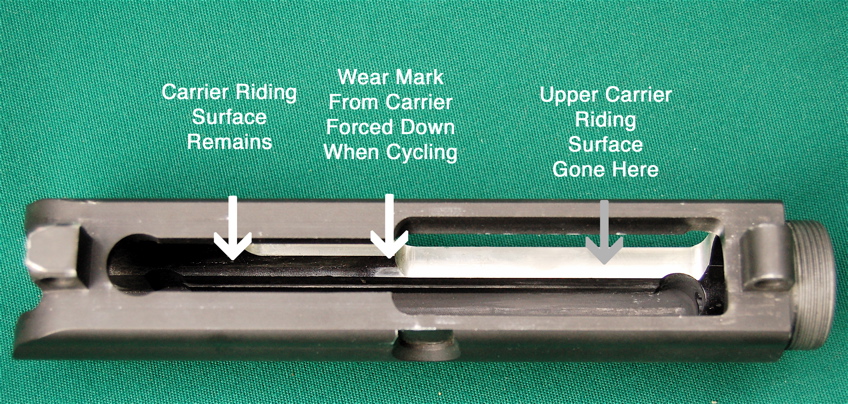
In recent years several major firearms component suppliers have promoted the idea of the “do-it-yourself” AR-15 build up. In one sense this is a good thing because it promotes peoples’ education and understanding of firearms, but the down side of this is some folks are assembling and modifying AR-15s without an understanding of the rifle and without the necessary skills and tools to do things properly. The net result of this “do-it-yourself” work can be an AR-15 that is non-functional, problematic or dangerous. Here are two examples of common issues with “do-it-yourself” modifications.
Opening Up the Ejection Port
One common modification for AR-15’s is the opening up of the ejection port. This is typically done to permit more room for ejection or loading of the rifle, and it is also typically done in conjunction with a side charging handle modification.
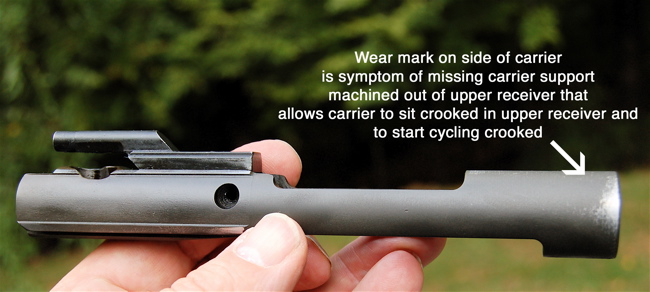
A common issue I have seen with this modification is that the person opening up the port removes the upper right hand carrier support and riding surface. The net result of this is that the carrier sits loose in the upper receiver when the bolt is in lock-up and this can have very detrimental effects on the function and accuracy of the AR-15. Below are more pictures of one that I saw recently.
Wrong Buffer Installed
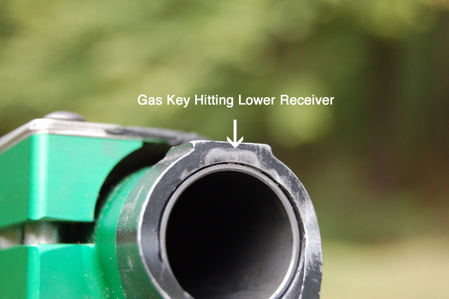
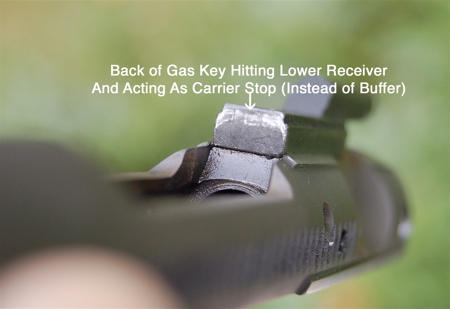
Another common mistake is the use of an improper buffer with the rifle (i.e. like using a carbine buffer in a standard rifle length buffer tube). There are many after market buffers being sold out there, but if the wrong buffer is used with the rifle, it can allow the bolt carrier to cycle too far back so that the rear of the carrier gas key becomes the stop for the carrier (i.e. when it smashes into the upper part of the lower receiver – OUCH!).
We have even seen situations where the gas key is snapped right off the carrier from this, and it completely disables the rifle and can also cause extensive damage to the firearm as well. Unfortunately we have seen this situation far too often and it is clear that a person needs to fully understand how the buffer assembly works if “do-it-yourself” work is going to be done to the buffer assembly, since everything done to the buffer assembly has an effect on the rifle, its function and accuracy.
While I applaud the person who is self-reliant and has a “can do” attitude, the other side of this is when it comes to a firearm, “do-it-yourself” work should only be done when and if one fully understands the rifle and how it functions and how the work will affect the rifle.
Robert Whitley
AR-X Enterprises, LLC
199 North Broad Street
Doylestown, PA 18901
(215) 348-8789 www.6mmAR.com
Report based on story by Kyle Jillson for NRA Blog
Summer is the time of year to get outside and have fun with family and friends. A great way to enjoy shooting with friends and family members is to attend a Brownells/NRA Day. These fun events will be held throughout the summer, at locations across the USA. These events are designed for all ages — from youngsters to senior citizens. The activities appeal to all skill levels, from first-time shooters to seasoned competitors.
Brownells/NRA Day events are fun affairs, where participants can try out a variety of different shooting disciplines. Events are always a big hit and you won’t find people as friendly and helping anywhere else. Below is a complete list of upcoming July events. If you see one nearby, go to the Brownells/NRA Day website to learn more.
In today’s economy, saving money is a good thing. And here’s a way you can save 7.5% on anything and everything that Brownells sells. To celebrate its 75th year in business, Brownells is offering a special 7.5% discount on all products. Yes, this 7.5% savings applies to everything Brownells carries, including current sale items. To get your 7.5% savings, be sure to use Discount Code FRK during checkout while shopping at Brownells.com. This is a limited time offer.
Sale tip by EdLongrange. We welcome reader submissions.


 Here’s one VITAL bit of advice for using these bags. Be absolutely sure, before you seal up the bags, that your guns are DRY and that all metal surfaces have been coated with an effective anti-corrosive, such as BoeShield T9 or Eezox. Brownells’ storage bags are inexpensive. A three-pak of 12″x 60″ rifle sacks (item 083-055-003WB) costs just $22.99 — under eight bucks a gun. That’s cheap insurance for rifles and shotguns that may cost thousands of dollars.
 Remember, those plastic-shelled cases with foam interiors are for transport, not for long-term storage. Don’t repeat the mistake of a wealthy gun collector I know. He stored four valuable Colt Single Action Army (SAA) revolvers in individual foam-padded cases, and locked these away in his gun safe. A year later, every one of his precious SAAs had rusted, some badly.
 If you’re looking for loaded ammunition at affordable prices,