If you buy one book about Long Range Shooting, this should be it. Based on sophisticated testing and research, this 356-page hardcover from Applied Ballistics offers important insights you won’t find anywhere else. Modern Advancements in Long Range Shooting – Volume II, the latest treatise from Bryan Litz, is chock full of information, much of it derived through sophisticated field testing. As Chief Ballistician for Berger Bullets (and a trained rocket scientist), author Bryan Litz is uniquely qualified. Bryan is also an ace sling shooter and a past F-TR National Champion. Moreover, Bryan’s company, Applied Ballistics, has been a leader in the Extreme Long Range (ELR) discipline.
AUDIO FILE: Bryan Litz Talks about Modern Advancements in Long Range Shooting, Volume 2. (Sound file loads when you click button).
Volume II of Modern Advancements in Long Range Shooting ($39.95) contains all-new content derived from research by Applied Ballistics. Author Bryan Litz along with contributing authors Nick Vitalbo and Cal Zant use the scientific method and careful testing to answer important questions faced by long range shooters. In particular, this volume explores the subject of bullet dispersion including group convergence. Advanced hand-loading subjects are covered such as: bullet pointing and trimming, powder measurement, flash hole deburring, neck tension, and fill ratio. Each topic is explored with extensive live fire testing, and the resulting information helps to guide hand loaders in a deliberate path to success. The current bullet library of measured G1 and G7 ballistic coefficients is included as an appendix. This library currently has data on 533 bullets in common use by long range shooters.
Bryan tells us that one purpose of this book is to dispel myths and correct commonly-held misconceptions: “Modern Advancements in Long Range Shooting aims to end the misinformation which is so prevalent in long range shooting. By applying the scientific method and taking a Myth Buster approach, the state of the art is advanced….”
Bullet Dispersion and Group Convergence
Part 1 of this Volume is focused on the details of rifle bullet dispersion. Chapter 1 builds a discussion of dispersion and precision that every shooter will benefit from in terms of understanding how it impacts their particular shooting application. How many shots should you shoot in a group? What kind of 5-shot 100 yard groups correlate to average or winning precision levels in 1000 yard F-Class shooting?
Chapter 2 presents a very detailed investigation of the mysterious concept of group convergence, which is the common idea that some guns can shoot smaller (MOA) groups at longer ranges. This concept is thoroughly tested with extensive live fire, and the results answer a very important question that has baffled shooters for many generations.
Part 2 of this Volume is focused on various aspects of advanced hand-loading. Modern Advancements (Vol. II) employs live fire testing to answer the important questions that precision hand loaders are asking. What are the best ways to achieve MVs with low ES and SD? Do flash hole deburring, neck tension, primer selection, and fill ratio and powder scales sensitivity make a difference and how much? All of these questions are explored in detail with a clear explanation of test results.
One of the important chapters of Part 2 examines bullet pointing and trimming. Applied Ballistics tested 39 different bullet types from .224 through .338 caliber. Ten samples of each bullet were tested for BC in each of the following configurations: original out of the box, pointed, trimmed, pointed and trimmed. The effect on the average BC as well as the uniformity in BC was measured and tabulated, revealing what works best.
Part 3 covers a variety of general research topics. Contributing author Nick Vitalbo, a laser technology expert, tested 22 different laser rangefinders. Nick’s material on rangefinder performance is a landmark piece of work. Nick shows how shooters can determine the performance of a rangefinder under various lighting conditions, target sizes, and reflectivities.
Chapter 9 is a thorough analysis of rimfire ammunition. Ballistic Performance of Rifle Bullets, 2nd Edition presented live fire data on 95 different types of .22 rimfire ammunition, each tested in five different barrels having various lengths and twist rates. Where that book just presented the data, Chapter 9 of this book offers detailed analysis of all the test results and shows what properties of rimfire ammunition are favorable, and how the BCs, muzzle velocities and consistency of the ammo are affected by the different barrels.
Chapter 10 is a discussion of aerodynamic drag as it relates to ballistic trajectory modeling. You will learn from the ground up: what an aerodynamic drag model is, how it’s measure and used to predict trajectories. Analysis is presented which shows how the best trajectory models compare to actual measured drop in the real world.
Finally, contributing author Cal Zant of the Precision Rifle Blog presents a study of modern carbon fiber-wrapped barrels in Chapter 11. The science and technology of these modern rifle barrels is discussed, and then everything from point of impact shift to group sizes are compared for several samples of each type of barrel including standard steel barrels.
In discussions of ballistics, you’ll see references to “tangent”, “secant”, and “hybrid” bullet shapes. We know that, for many readers, these terms can be confusing. To add to the confusion, bullet makers don’t always identify their projectiles as secant or tangent designs. This article provides a basic explanation of tangent, secant, and hybrid ogive bullet designs, to help you understand the characteristics of these three basic bullet shapes.
Tangent vs. Secant vs. Hybrid
Most match bullets produced today use a tangent ogive profile, but the modern VLD-style bullets employ a secant profile. To further complicate matters, the latest generation of “Hybrid” projectiles from Berger Bullets feature a blended secant + tangent profile to combine the best qualities of both nose shapes. The secant section provides reduced drag, while the tangent section makes the bullet easier to tune, i.e. less sensitive to bullet seating depth position.
Berger Bullets ballistician Bryan Litz explains tangent and secant bullet ogive designs in a glossary section of his Applied Ballistics website, which we reprint below. Bryan then explains how tangent and secant profiles can be combined in a “hybrid” design.
How Bullet Ogive Curves are Defined
While the term “ogive” is often used to describe the particular point on the bullet where the curve reaches full bullet diameter, in fact the “ogive” properly refers to the entire curve of the bullet from the tip to the full-diameter straight section — the shank. Understanding then, that the ogive is a curve, how is that curve described?
LITZ: The ogive of a bullet is usually characterized by the length of its radius. This radius is often given in calibers instead of inches. For example, an 8 ogive 6mm bullet has an ogive that is a segment of a circular arc with a radius of 8*.243 = 1.952”. A .30-caliber bullet with an 8 ogive will be proportionally the same as the 8 ogive 6mm bullet, but the actual radius will be 2.464” for the .30 caliber bullet.
For a given nose length, if an ogive is perfectly tangent, it will have a very specific radius. Any radius longer than that will cause the ogive to be secant. Secant ogives can range from very mild (short radius) to very aggressive (long radius). The drag of a secant ogive is minimized when its radius is twice as long as a tangent ogive radius. In other words, if a tangent ogive has an 8 caliber radius, then the longest practical secant ogive radius is 16 calibers long for a given nose length.”
Bryan Litz Explains Hybrid Design and Optimal Hybrid Seating Depths
Ogive Metrics and Rt/R Ratio
LITZ: There is a number that’s used to quantify how secant an ogive is. The metric is known as the Rt/R ratio and it’s the ratio of the tangent ogive radius to the actual ogive radius for a given bullet. In the above example, the 16 caliber ogive would have an Rt/R ratio of 0.5. The number 0.5 is therefore the lowest practical value for the Rt/R ratio, and represents the minimum drag ogive for a given length. An ogive that’s perfectly tangent will have an Rt/R ratio of 1.0. Most ogives are in between an Rt/R of 1.0 and 0.5. The dimensioned drawings at the end of my Applied Ballistics book provide the bullets ogive radius in calibers, as well as the Rt/R ratio. In short, the Rt/R ratio is simply a measure of how secant an ogive is. 1.0 is not secant at all, 0.5 is as secant as it gets.
Hybrid Bullet Design — Best of Both Worlds?
Bryan Litz has developed a number of modern “Hybrid” design bullets for Berger. The objective of Bryan’s design work has been to achieve a very low drag design that is also “not finicky”. Normal (non-hybrid) secant designs, such as the Berger 105gr VLD, deliver very impressive BC values, but the bullets can be sensitive to seating depth. Montana’s Tom Mousel has set world records with the Berger 105gr VLD in his 6mm Dasher, but he tells us “seating depth is critical to the best accuracy”. Tom says a mere .003″ seating depth change “makes a difference”. In an effort to produce more forgiving high-BC bullets, Bryan Litz developed the hybrid tangent/secant bullet shape.
One recent trend in F-TR competition is the use of low-profile, benchrest-type stocks shot with a light hand-hold and little or no face contact. For this method of F-TR shooting to work, you need the right equipment, and practice a “minimalist” shooting technique. One of the pioneers in this style of F-TR shooting is action-maker John Pierce of Pierce Engineering. Above you can see John shooting one of his F-TR rifles at the 2015 Canadian F-Class Championships. Note the straight-line stock and see how the adjustable bipod is set quite low to the ground (in fact the bipod’s arms are almost straight out).
Members of the Michigan F-TR Team, including Bryan Litz, have used similar rigs with success. Bryan said it took a while to adapt his shooting technique to this kind of rig, but there is a pay-off. Armed with a Pierce-built F-TR rifle, Bryan won his first-ever F-TR Match. Bryan explains the technique he uses when shooting this kind of rifle:
“Coming over from sling shooting, I knew there would be unique challenges to F-TR which I wanted to learn prior to (not during) a major tournament. I learned a new shooting position which doesn’t involve drawing the right knee up. For F-TR I get more straight behind the gun rather than at an angle. I found that the rifle shoots best with very light cheek, shoulder and grip pressure, approaching free recoil. This is how Eric Stecker shot his similar rifle into second place in the SW Nationals [with high X-Count by a large margin]. I learned the rifle’s sensitivity to different bipod and rear bag supports, and found the best buttplate position to allow the rifle to track and stay on target after recoil. This set-up shot best with a mostly free-recoil approach, that means ‘hovering’ over the comb, rather than resting your head on the stock. This took some ‘getting used to’ in terms of neck and back muscle tone. These are the kind of details I think it’s important to focus on when entering a new discipline.”
Bryan’s Pierce-built F-TR rig is a tack-driver: “I can certainly vouch for this set-up! In [a 2015] mid-range State Championship in Midland, MI, I shot my Pierce rifle into first place with a 598-44X (20 shots at 300, 500 and 600). Once you get used to the positioning and way of shooting these rifles, they just pour shots through the center of the target.”
Pierce F-TR Rifles with Scoville Stocks
Shown below are three complete Pierce F-TR rifles, along with a barreled action for comparison. The carbon-fiber/composite stocks are built by Bob Scoville. These Scoville stocks are very light, yet very strong and very stiff.
Want to learn more about Long Range Shooting? Check out the “Elements of Long Range Shooting” videos from the National Shooting Sport Foundation (NSSF). In this multi-part series, Bryan Litz of Applied Ballistics covers a variety of topics of interest to precision shooters. Today we feature three of these videos. There are five other videos in this series. Watch the entire 8-video “Elements of Long Range Shooting” series on the NSSF YouTube Channel.
Atmospherics and Density Altitude
Bryan Litz explains: “An important element in calculating an accurate firing solution for long-range shooting is understanding the effects of atmospherics on a projectile.” Atmospherics include air pressure, air temperature, and humidity. Bryan notes: “Temperature, pressure, and humidity all affect the air density… that the bullet is flying through. You can combine all those factors into one variable called ‘Density Altitude’.” Density Altitude is used by the ballistic solver to account for air density variables that affect bullet flight.
Bullet Ballistic Coefficients
A bullet’s ballistic coefficient (BC) basically expresses how well the bullet flies through the air. Higher BC bullets have less aerodynamic drag than lower BC projectiles. You will see BCs listed as either G1 and G7 numbers. These correspond to different bullet shape models. Generally speaking, the G7 model works better for the long, boat-tail bullets used for long-range shooting. Notably, a bullet’s drag is NOT constant in flight. The true BC can vary over the course of the trajectory as the bullet velocity degrades. In other words, “BC is dynamic”. That said, you can make very accurate drop charts using the BCs provided by major bullet-makers, as plugged into solvers. However, long-range competitors may want to record “real world” drop numbers at various distances. For example, we’ve seen trajectories be higher than predicted at 500 yards, yet lower than predicted at 1000.
Ballistics Solvers — Many Options
Bryan Litz observes: “When we talk about the elements of long range shooting, obviously a very important element is a getting a fire solution, using a ballistic solver. There are a lot of ballistic solvers out there… Applied Ballistics has smartphone Apps. Applied Ballistics has integrated the ballistic solver directly into a Kestral, and the same solver runs (manually) on the Accuracy Solutions Wiz-Wheel. The point is, if it is an Applied Ballistics device it is running the same solutions across the board.”
About Bryan Litz
Bryan began his career as a rocket scientist, quite literally. He then started Applied Ballistics, the leading company focusing on ballistics science for rifle shooting. A past F-TR Long-Range National Champion and Chief Ballistician for Berger Bullets, knows his stuff. His Applied Ballistics squad was the winning team at the 2017 King of 2 Miles event, and Applied Ballistics recently received a major U.S. defense contract to to execute Phase 1 of the Extreme Sniper Strike Operations (ESSO) project.
SIG Sauer and Applied Ballistics showed off impressive new electro-optical technology at the NRA Show in Dallas. Bryan Litz says “SIG Sauer’s Ballistics Data Exchange (BDX) is game changer. Imagine lazing a long range target, and having your exact fire solution (hold-over) automatically projected into your scope based on your ballistic profile.”
BDX takes target range info from a SIG Sauer Laser Rangefinder, calculates a ballistic solution using Applied Ballistics software, then displays the hold-over info directly in the optic (via a wireless BlueTooth connection). Just dial and shoot. Put the calculated BDX dot on the target and shoot. This ground-breaking BDX technology enables key ballistic hold-over information to be exchanged wirelessly among BDX-enabled Electro-Optics products.
You can buy this as a package with scope and LRF, starting at just $700.00 for scope and rangefinder. To our surprise, these scopes have a normal form factor. They look completely “normal”, with no clunky receiver boxes or extra turrets. BDX riflescopes aren’t bulky or heavy even though they include built-in electronics, level, and inclination detection.
“Rangefinding riflescopes of the past have had two major shortcomings: they are either big, boxy and heavy, or extremely expensive. The … BDX system packs advanced ballistics technology into a simple platform that looks just like the rangefinder and riflescope [hunters use] today. It is extremely simple to use. Range a target, put the digital ballistic holdover dot on target, pull the trigger — just connect the dot.” — Andy York, President, SIG Sauer Electro-Optics.
SIG Sauer’s Ballistics Data Exchange (BDX) is an integrated system of devices that talk seamlessly to each other, sharing data. Applied Ballistics says this system be expanded in the months ahead. “This system will be comprised of scopes, rangefinders, binoculars, and more. BDX will even be able to ‘talk’ to Kestrels and Garmins as well as SIG Sauer smart-scopes. This is only the start, over the next year you will see increasing levels of tech becoming available.”
How BDX (Ballistics Data Exchange) Functions — Software and Hardware
How does BDX work? First download the SIG BDX App for Android or iOS. Then pair the KILO BDX rangefinder and SIERRA3BDX riflescope, and set up a basic ballistic profile. Once you are in the field, range your target as you normally would, and the KILO BDX rangefinder will utilize onboard Applied Ballistics Ultralight™ to instantly send your dope to the scope via Bluetooth. Using your basic ballistic profile, the ballistic solution is calculated for your target and will instantly illuminate on the BDX-R1 Digital Ballistic Reticle with windage and elevation holds in the SIERRA3BDX riflescope. A blue LED on the riflescope power selector indicates that the BDX system is paired, and when the reticle has received new ballistic holdover and windage data from the rangefinder.
We want to congratulate Bryan Litz and his talented team at Applied Ballistics LLC. We have followed Bryan’s career as a bullet designer, ballistician, author, software product developer, and ELR pioneer. His team leads the world in advancing the science of long range shooting. And it looks like all the hard work has paid off — Applied Ballistics has secured a major contract to develop extreme long-range sniper capability for the U.S. Military.
Applied Ballistics LLC, a Michigan-based tech company, has been awarded a $1,300,000 contract by the Combating Terrorism Technical Support Office (CTTSO) to execute Phase 1 of the Extreme Sniper Strike Operations (ESSO) project.
Phase 1 of the ESSO project is focused on advancing the predictive capabilities of modern ballistic solvers by performing Doppler radar measurement and modeling of current service rounds at Extreme Long Range (ELR) as a function of gyroscopic stability, and refining the models of secondary ballistic effects such as spin rate decay and spin drift at ELR. Phase 1 will conclude with the ballistic modeling enhancements being integrated into the existing Applied Ballistics ecosystem of electronic devices which are currently deployed by numerous U.S. and allied armed forces around the world. Phase 1 is scheduled for completion in late 2018.
Phase 2 of the ESSO project is a potential follow on (2019) that focuses on the development and fielding of an advanced ELR sniper rifle system designed to drastically increase first-round hit probability at ELR on man-sized targets. The Applied Ballistics Weapons Division is currently conducting research and development on weapons platforms, as well as new cartridge and bullet options, that will maximize ELR ballistic performance from lightweight, practical, magazine-fed systems.
Bryan Litz, owner of Applied Ballistics LLC, said: “Our team of Aerospace, Mechanical, Electrical and Computer Science Engineers, and Technicians will apply our combined experience including years of testing and competing in ELR Shooting to the successful completion of the ESSO program objectives. This means extending the maximum effective range of U.S. and allied snipers, achieving decisive overmatch on the battlefield. I can’t imagine a better application of Applied Ballistics’ collective efforts.”
Applied Ballistics has developed ballistics software for mobile Apps. AB’s software has been integrated into numerous products including Kestrels, Laser Rangefinders, and “Smart” optics.
Applied Ballistics Seminar in Utah, June 2-3, 2018
Applied Ballistics will offer a Ballistics Seminar June 2 and 3, 2018 at the Snowbird Cliff Lodge, Salt Lake City, Utah. This will include two full days of instruction with lectures plus Q&A sessions. The $625 cost of the seminar includes all 5 AB books, both AB DVD sets, AB Analytics, and Swag Bag.
CLICK HERE to Register. NOTE: Through April 17th, get $100 Off with discount code ABSEM100.
About Applied Ballistics, LLC:
Applied Ballistics’ mission is to be a complete and unbiased source of external ballistics information for long range shooters. We believe in the scientific method and promote mastery through understanding of the fundamentals. The results of our work are passed on to the government and shooting communities through clear and helpful instructional materials, as well as easy-to-use ballistic software running on many products.
Bushnell has released a FREE new Ballistics App powered by the Applied Ballistics Ultralite Engine. The new Bushnell Ballistics App easily calculates ballistic solutions for any popular cartridge type once you input velocity, BC, and atmospherics. The App features trusty Applied Ballistics bullet data, and it can even pull in atmospheric data from web weather sources. This allows you to calculate hold-overs and make precise wind corrections. The App is offered in both iOS and Android OS versions.
“The new Bushnell Ballistics App is powered by the Applied Ballistics Ultralite engine, the most trusted ballistics data-cruncher in the industry,” said Bushnell Marketing Manager Matt Rice. “This App allows users to easily build and modify gun profiles and build range cards to calculate firing solutions based on their specific scope and ammunition choices. All of our Bushnell scopes and reticles have been pre-loaded [in the App].”
The Bushnell App features AB Connect, a live library of G1/G7 data, plus the Applied Ballistics Bullet Library with 740+ pre-loaded bullet profiles. The Bushnell scope library features 150+ scopes and 30 reticle options. Atmospheric data can be updated manually or directly from the internet (when connected). Angle range compensation is also calculated. Gun profile management provides up to five saved profiles with reticle-based firing solutions. A multiple target feature saves up to five targets. Range cards can be shared or printed using the Email Range Card Function.
The FREE App works on both Android and iOS operating systems, and is available on Google Play and the App Store. It is optimized for Bushnell riflescopes and reticles, but is compatible with all optics. Once downloaded, the App functions off the grid — no cell service required.
“The new Bushnell Ballistic App puts the power of long-range, first-shot accuracy into the hands of any shooter,” Rice said. “it was designed to perform in any condition and to offer our consumers true value, with features that far exceed the price — which, in this case, is free!”
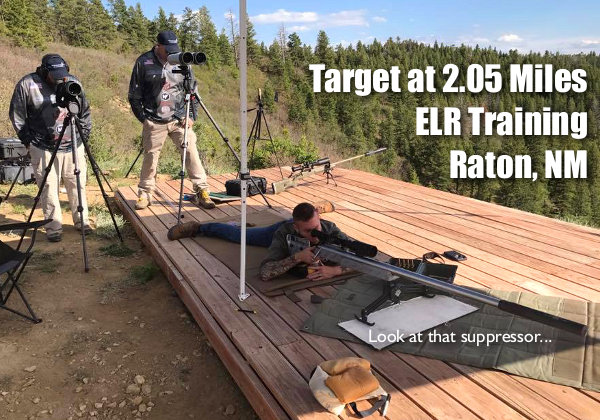
The Coriolis Effect comes into play with extreme long-range shots like this (2100 yards at Raton, NM). The rotation of the earth actually moves the target a small distance (in space) during the long duration of the bullet’s flight.
When you’re out at the range, the Earth seems very stable. But it is actually a big sphere zooming through space while spinning around its axis, one complete turn every 24 hours. The rotation of the earth can create problems for extreme long-range shooters. During extended bullet flight times, the rotation of the planet causes an apparent deflection of the bullet path over very long distances. This is the ballistics manifestation of the Coriolis Effect.
Bryan Litz of Applied Ballistics discusses explains the Coriolis Effect in his Ballistics Books and Seminars. Bryan notes that Coriolis is “a very subtle effect. People like to make more of it than it is because it seems mysterious.” In most common shooting situations inside 1K, Coriolis is not important. At 1000 yards, the Effect represents less than one click (for most cartridge types). Even well past 1000 yards, in windy conditions, the Coriolis Effect may well be “lost in the noise”. But in very calm conditions, when shooting at extreme ranges, Bryan says you can benefit from adjusting your ballistics solution for Coriolis.
Bryan explains: “The Coriolis Effect… has to do with the spin of the earth. You are basically shooting from one point to another on a rotating sphere, in an inertial reference frame. The consequence of that is that, if the flight time of the bullet gets significantly long, the bullet can have an apparent drift from its intended target. The amount [of apparent drift] is very small — it depends on your latitude and azimuth of fire on the planet.”
Coriolis is a very subtle effect. With typical bullet BCs and velocities, you must get to at least 1000 yards before Coriolis amounts to even one click. Accordingly, Bryan advises: “Coriolis Effect is NOT something to think about on moving targets, it is NOT something to think about in high, uncertain wind environments because there are variables that are dominating your uncertainty picture, and the Coriolis will distract you more than the correction is worth.”
“Where you could think about Coriolis, and have it be a major impact on your hit percentage, is if you are shooting at extended range, at relatively small targets, in low-wind conditions. Where you know your muzzle velocity and BC very well, [and there are] pristine conditions, that’s where you’re going to see Coriolis creep in. You’ll receive more refinement and accuracy in your ballistics solutions if you account for Coriolis on those types of shots. But in most practical long-range shooting situations, Coriolis is NOT important. What IS important is to understand is when you should think about it and when you shouldn’t, i.e. when applying it will matter and when it won’t.”
The Coriolis Effect — General Physics
The Coriolis Effect is the apparent deflection of moving objects when the motion is described relative to a rotating reference frame. The Coriolis force acts in a direction perpendicular to the rotation axis and to the velocity of the body in the rotating frame and is proportional to the object’s speed in the rotating frame.
A commonly encountered rotating reference frame is the Earth. The Coriolis effect is caused by the rotation of the Earth and the inertia of the mass experiencing the effect. Because the Earth completes only one rotation per day, the Coriolis force is quite small, and its effects generally become noticeable only for motions occurring over large distances and long periods of time. This force causes moving objects on the surface of the Earth to be deflected to the right (with respect to the direction of travel) in the Northern Hemisphere and to the left in the Southern Hemisphere. The horizontal deflection effect is greater near the poles and smallest at the equator, since the rate of change in the diameter of the circles of latitude when travelling north or south, increases the closer the object is to the poles. (Source: Wikipedia)
We had a great time on Day One of SHOT show. We saw some amazing products, including a remarkable upgrade to the Annealing Made Perfect system — a computer-controlled automated case feeder. We met with legendary Champions Carl Bernosky and David Tubb. David’s son-in-law Nate Stallter recently set a World Record at the first-ever ELR Challenge match, hitting 3 of 3 shots at 2011 yards with no sighters. We also attended a seminar with Bryan Litz and saw a host of new rifles and pistols which we will showcase in the next few days.
New ELR World Record Holder Nate Stallter with David Tubb
We met with Nate Stallter, the young marksman who dominated the first-ever ELR Record match held January 21, 2018 in Nevada. Shooting a Tubb LR rifle chambered for the .375 CheyTac cartridge, Nate went 3 for 3 at 2011 yards, after doing the same at one mile. Nate’s spotter was his father-in-law David Tubb, 11-time National High Power Champion. We recorded a long interview with Nate and David that provides many interesting insights into the ELR game.
AMP Induction Annealer — New Automated Power Feeding System
The micro-processor controlled AMP Annealer, already the most advanced personal annealing system on the planet, is now even better. The Annealing Made Perfect team of Alex (father) and Matt (son) Findlay showcased the new automated case-feeding option for AMP owners. This can load brass from a hopper, completely processing each case in about 10 seconds. We filmed video we’ll run in a follow-up story. There is also an important new software upgrade that allows AMP owners to precisely determine the right setting for their brass.
Kelly McMillan Shows Off ‘The Beast’
At the McMillan Stocks booth, we met with Company President Kelly McMillan. We talked about the growing popularity of Extreme Long Range (ELR) shooting. Kelly showed us the stock McMillan has developed for the ELR discipline, fittingly named ‘The Beast 2′. This is a very long stock designed to tame the recoil of big cartridges like the .375 CheyTac and .338 Lapua Magnum.
TargetVision Offers New High-Rez and 2-Mile TargetCam Systems
We talked at length with Clay Rhoden, the talented young owner of TargetVision, producers of the most highly-rated target cam systems on the market. Clay showed us his best $899 high-end systems, the UltraHD targetcam, along with the new Extreme Long Range product rated for two miles. TargetVision, which outputs WiFi signal directly to your smartphone or tablet, is the official Target Camera of the U.S. F-TR Rifle team.
Litz Talks Kestrels and ELR
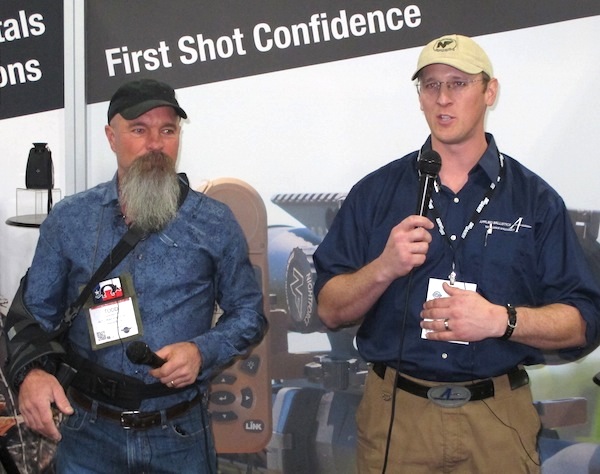
At the Kestrel booth, Bryan Litz of Applied Ballistics, along with firearms trainer Todd Hodnett, gave a short seminar on Kestrel features/capabilities, ballistics, and bullet design. We asked Bryan “Should competitive shooters tip their bullets?” He answered “It depends…”. Bryan explained that if the bullets are very uniform, with small meplats out of the box, the benefits of tipping may not be so obvious.
Wheelguns Galore at the Smith & Wesson Booth
No SHOT Show experience would be complete without a stop at the Smith & Wesson booth. There were some new Performance Center revolvers on display. The long-barreled wheelguns in the foreground below are chambered for the mighty 500 S&W Magnum cartridge.
Sierra Bullets Has New High-BC MatchKings
We visited the Sierra Bullets booth to pick up samples of the new High-BC 95gr .224 MatchKing and 150gr 6.5mm MatchKing. While there we spotted this stunning F-Class rig decked out in Sierra Green livery. This beautiful rifle was crafted by Kelbly’s. It has a Panda action and a stunning green, metal-flake paint finish.
Peterson Brass Showcases New Cartridge Brass Peterson Cartridge Company showcased a quartet of new brass products that will enter production later this year. Peterson is expanding its line of American-made cartridge brass to include 6mm Creedmoor (both large and small primer), 6XC (both large and small primer), .270 WSM, and .300 WSM. We like the availability of 6XC in with a small primer pocket option. This should be very popular with the PRS crowd. Peterson’s .270 and .300 Win Short Mag brass gives hunters and target shooters new options.
New Faster-Reacting Electronic Muffs from Howard Leight
We wanted to take home these new Howard Light electronic muffs with advanced, faster internal circuitry. Offered in a variety of colors, the new Impact Sport Bolt muffs offer a lighting-fast 0.5 millisecond reaction time, plus improved digital sound compression and wind noise reduction. These new muffs carry a 22 db total noise reduction rating (NRR).
On 1/21/18, new World Records were set under ELR Central rules for verified, consecutive three-shot string without sighters. Competitors started from cold bore, no sighters or ranging shots allowed. That’s a tough standard. In fact the first 12 shooters failed to put three shots on target at 1500 yards before Paul Phillips took his turn. Paul, Lucky number 13, placed all three of his shots on the 36″ x 36″ plate, claiming a first-ever record. Later that afternoon, John Armstrong duplicated that feat, also putting three shots on target at 1500 with no sighters.
But the best performances of all came later. Nate Stallter, shooting a .375 CheyTac, nailed his three shots at over one mile — 1768 yards. But it gets better — Nate broke his own record later in the afternoon, going 3 for 3 at 2011 yards.
David Tubb posted: “Congratulations to my son-in-law, Nate. Today he won the ELR Central World Record competition. This competition allows two separate attempts (spaced four hours apart) and consists of three cold bore shots each time. He took 3 shots and had 3 hits at 1768 yards in the morning and then beat his own record in the afternoon with 3 shots and 3 hits at 2011 yards after the wind had become trickier.”
Stallter used the new Tubb Adaptive Target Rifle (Tubb Gun) with a Dynamic Targeting Reticle and Tubb T7T two-stage trigger. He was shooting the .375 Cheytac with a 364gr Warner flatline bullet that has a patent pending Nose Ring modification in a Schneider 1:7″ twist barrel. Three of the Tubb Rifles are shown below. Note the long barrels.
As we explained, this was a tough challenge. Competitors started with a cold bore, with no sighters alowed — that makes it especially tough.
Watch this video to hear the record-setting shooters describe their equipment — chambering, action, stock, barrel, bipod, and optics. No the video is not sideways! Nearly all this video is correct, horizontal orientation. Click triangle to start correct format.
None of the competitors had shot these kind of distances at this facility, the Front Sight Firearms Training Center in Pahrump, Nevada. And the “no sighters” rule really added to the difficulty — witness the fact that the first 12 shooters failed to put three consecutive hits on a square yard of steel at 1500. Here are the three record-setting shooters:
1. Paul Phillips, 1500 yards (first record) | 2. John Armstrong, 1500 yards (tied record)
Those who understand the challenge were impressed …
Andy McNeill observed: “I’ve shot targets further too, but I didn’t go 3 for 3 with no sighters. These hit cold bore and then two consecutive follow-up shots at specific target sizes. This is what a record should be. Not I hit a target at X distance once after slinging lead at it all day.”
Jacob Scobell liked the match format: “Love that this is intentional, consecutive impacts with a fixed size target and not just a statistical probability of hitting the broad side of a barn with unlimited shots. Excellent to see a standard being set.
Now will all of these other supposed ‘world record holders’ step up and enter this competition? Sure some guy who can impact upon demand beyond 4000 yards would cake walk this right? A registered event with multiple shooters means put up or shut up.”


 Part 2 of this Volume is focused on various aspects of advanced hand-loading. Modern Advancements (Vol. II) employs live fire testing to answer the important questions that precision hand loaders are asking. What are the best ways to achieve MVs with low ES and SD? Do flash hole deburring, neck tension, primer selection, and fill ratio and powder scales sensitivity make a difference and how much? All of these questions are explored in detail with a clear explanation of test results.

 Hybrid Bullet Design — Best of Both Worlds?




 When you’re out at the range, the Earth seems very stable. But it is actually a big sphere zooming through space while spinning around its axis, one complete turn every 24 hours. The rotation of the earth can create problems for extreme long-range shooters. During extended bullet flight times, the rotation of the planet causes an apparent deflection of the bullet path over very long distances. This is the ballistics manifestation of the