One recent trend in F-TR competition is the use of low-profile, benchrest-type stocks shot with a light hand-hold and little or no face contact. For this method of F-TR shooting to work, you need the right equipment, and practice a “minimalist” shooting technique. One of the pioneers in this style of F-TR shooting is action-maker John Pierce of Pierce Engineering. Above you can see John shooting one of his F-TR rifles at the 2015 Canadian F-Class Championships. Note the straight-line stock and see how the adjustable bipod is set quite low to the ground (in fact the bipod’s arms are almost straight out).
Members of the Michigan F-TR Team, including Bryan Litz, have used similar rigs with success. Bryan said it took a while to adapt his shooting technique to this kind of rig, but there is a pay-off. Armed with a Pierce-built F-TR rifle, Bryan won his first-ever F-TR Match. Bryan explains the technique he uses when shooting this kind of rifle:
“Coming over from sling shooting, I knew there would be unique challenges to F-TR which I wanted to learn prior to (not during) a major tournament. I learned a new shooting position which doesn’t involve drawing the right knee up. For F-TR I get more straight behind the gun rather than at an angle. I found that the rifle shoots best with very light cheek, shoulder and grip pressure, approaching free recoil. This is how Eric Stecker shot his similar rifle into second place in the SW Nationals [with high X-Count by a large margin]. I learned the rifle’s sensitivity to different bipod and rear bag supports, and found the best buttplate position to allow the rifle to track and stay on target after recoil. This set-up shot best with a mostly free-recoil approach, that means ‘hovering’ over the comb, rather than resting your head on the stock. This took some ‘getting used to’ in terms of neck and back muscle tone. These are the kind of details I think it’s important to focus on when entering a new discipline.”
Bryan’s Pierce-built F-TR rig is a tack-driver: “I can certainly vouch for this set-up! In last weekend’s mid-range State Championship in Midland, MI, I shot my Pierce rifle into first place with a 598-44X (20 shots at 300, 500 and 600). Once you get used to the positioning and way of shooting these rifles, they just pour shots through the center of the target.”
Pierce F-TR Rifles with Scoville Stocks
Shown below are three complete Pierce F-TR rifles, along with a barreled action for comparison. The carbon-fiber/composite stocks are built by Bob Scoville. These Scoville stocks are very light, yet very strong and very stiff.
Bryan Litz has produced an informative new video on the subject of bullet stability. The video explains how stability is related to spin rate (or RPM), and how RPM, in turn, is determined by barrel twist rate and velocity. For long-range shooting, it is important that a barrel have a fast-enough twist rate to stabilize the bullet over its entire trajectory.
Detailed Bullet Stability Article
To complement the above video, Bryan has authored a detailed article that explains the key concepts involved in bullet stabilization. Bryan explains: “Bullet stability can be quantified by the gyroscopic stability factor, SG. A bullet that is fired with inadequate spin will have an SG less than 1.0 and will tumble right out of the barrel. If you spin the bullet fast enough to achieve an SG of 1.5 or higher, it will fly point forward with accuracy and minimal drag.”
There is a “gray zone” of marginal stability. Bryan notes: “Bullets flying with SGs between 1.0 and 1.5 are marginally stabilized and will fly with some amount of pitching and yawing. This induces extra drag, and reduces the bullets’ effective BC. Bullets in this marginal stability condition can fly with good accuracy and precision, even though the BC is reduced. For short range applications, marginal stability isn’t really an issue. However, shooters who are interested in maximizing performance at long range will need to select a twist rate that will fully stabilize the bullet, and produce an SG of 1.5 or higher.”
Berger Twist-Rate Stability Calculator
On the updated Berger Bullets website you’ll find a handy Twist-Rate Stability Calculator that predicts your gyroscopic stability factor (SG) based on mulitiple variables: velocity, bullet length, bullet weight, barrel twist rate, ambient temperature, and altitude. This very cool tool tells you if your chosen bullet will really stabilize in your barrel.
LIVE DEMO BELOW — Just enter values in the data boxes and click “Calculate SG”.
Top photo with bullet by Werner Mehl, www.kurzzeit.com, all rights reserved.
The Kestrel weather meter is an invaluable tool for shooters. While the standard model Kestrels can record wind and atmospheric conditions, the advanced Kestrel 4500 Shooter’s Weather Meter with Applied Ballistics incorporates a built-in ballistics program developed by Bryan Litz of Applied Ballistics. This is a very powerful tool, but it can be a bit complicated to program at first.
In this detailed 22-minute video, John McQuay of 8541 Tactical shows how to input firearm specs, MV, and BC into a Kestrel 4500 NV (Applied Ballistics model). This handy unit combines a Kestrel Weather meter with a full-fledged ballistics computer.
Step-by-step the video shows how to set up all the important variables. The video shows how to input Muzzle Velocity, Bullet BC (G1 or G7), Zero Distance and the other key ballistics variables. In addition, the video explains how to input gun-specific data such as bore height, barrel twist rate, and barrel rifle twist direction (right-hand vs. left-hand). (Twist direction comes into play in long range spin drift calculations).
If you own a Kestrel 4500 NV (Applied Ballistics), we think you’ll find this video helpful — particularly when it comes to setting up some of the lesser-known data items. The video also offers tips on navigating through the menus most efficiently.
You’ve heard the rumors of a new ultra-high BC 7mm bullet from Berger. Well the rumors are true. Berger is now shipping test samples of its new 195-grain 7mm Elite Hunter Bullet, part # 28550. This bullet boasts jaw-droping 0.755 G1 and 0.387 G7 Ballistic Coefficients. Those are stunningly high numbers. Compare that to 0.674 G1 and 0.345 G7 BCs for the previous BC king amoung 7mm projectiles, Berger’s own 180 gr Match Hybrid Target.
We’re certain the “orange box” 195gr Elite Hunter will soon see use by F-Open competitors. This ultra-high BC projectile could be a “game-changer” in long-range shooting when used in cartridges such as the 7mm RSAUM, 7mm WSM and even bigger 7mm magnums. Recommended barrel twist rate is 1:8.3″, with a stated “minimum” twist of 1:9″.
We ran some numbers through the JBM Ballistics program*, comparing the new 195-grainer with Berger’s popular 180gr Hybrid. The results were eye-opening. The projected drop is significantly less. Most importantly, this new 195gr bullet moves a LOT less in the wind at 1000 yards. This should translate into higher scores for F-Class shooters — that wide ‘9’ shot may stay in the ’10’ ring. In fact, based on the JBM trajectory calculation, with a 10 mph 90° crosswind, the 195gr bullet will have over SEVEN INCHES less wind drift at 1000 yards than the 180-grainer (46.0″ vs. 53.1″). That’s a big deal, a very big deal…
Drop at 800 yards: 135.5″
Windage at 800 yards: 28.0″
Drop at 800 yards: 140.9″
Windage at 800 yards: 32.2″
Drop at 1000 yards: 237.9″ Windage at 1000 yards: 46.0″
Drop at 1000 yards: 250.0″ Windage at 1000 yards: 53.1″
Drop at 1200 yards: 380.1″
Windage at 1200 yards: 69.6″
Drop at 1200 yards: 404.2″
Windage at 1200 yards: 81.2″
* Variables were set to 55.4° F, 1000′ elevation, standard Atmosphere at Altitude, 2950 fps muzzle velocity. You can use JBM Ballistics to compare at different MVs.
UPDATE from Berger
After we broke this story, Berger Bullets wanted to clarify some points. Berger explained:
“This bullet is in the testing phase and has not been officially launched. We sent this bullet out for some public testing to make sure that we had positive feedback before we moved forward with an official launch.
We want to see how it performs in multiple rifles and different chamberings.
This bullet was made for hunting purposes, we realize there are shooters who would like to take these out for target shooting, like F-Class. However, we are not certain how they will perform. If things are successful we would like to eventually launch a target version.”
The information on the label you have pictured on your article has been updated.
Twist Rates
Minimum: 1:9″
Optimum: 1:8.3″
Ballistic Coefficients
G7 BC: .387
G1 BC: .754
How to Get Berger’s 195gr Elite Hunter Bullets
These bullets are so new you won’t find them on the Berger Bullets website yet. As Berger explained above, these bullets are still in a final testing phase. Most of the early production runs have been sent out for testing purposes. If you have specific questions, you can send an email to Berger via this CONTACT PAGE. Otherwise you can phone Berger, Mon-Fri, at 714-441-7200. Please try the email option first.
Applied Ballistics has created a new series of YouTube videos about precision long range shooting. Featuring ace long-range shooter and professional ballistician Bryan Litz, these videos address various topics of interest to long-range marksmen. In this week’s video, the second in the series, Bryan Litz examines the most common causes of ballistics shooting errors at Long Range.
Watch Applied Ballistics Video about Common Mistakes in Long Range Shooting:
Bryan Litz of Applied Ballistics often hears the question: “What are the main reasons people miss their target at long range?” To answer that question, in this video, Bryan explains the most important variables in Long Range shooting. Bryan says: “Probably the number one thing is range — you have to have a [precise] range to your target because your bullet is dropping, and to hit the target you need to correct for bullet drop.” Distance may be indicated on the target bay (or berm), but for open ranges you should ascertain distance-to-target with a quality laser rangefinder. Even when the distance to target is shown with a sign or marker, you may want to confirm the distance with your rangefinder. (You may be surprised — we’ve seen marked target distances at commercial ranges off by 25+ yards!) Bryan says: “Get a good laser range to the target and you’ll be within a couple yards”.
After distance to target, the most important variable is the wind. This is the most challenging factor because the wind is constantly changing. Bryan explains: “After 300 or 400 yards, the wind [will] move your shots off the target if you don’t correct for it. The best way to account for the wind is to measure it at your location with a Kestrel. The Kestrel can give you the speed and direction of the wind at your location, which can baseline your wind call for your long-range shot.” Bryan acknowledges that there will still be variables: “The wind isn’t always blowing the same downrange as at your location… and the wind is always changing”. Bryan notes that you need to account for variances in wind between the time you gauge the wind angle and velocity and the time you actually you take your shot.
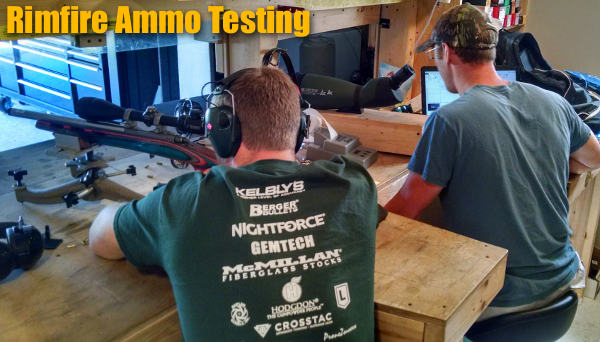
Photo shows Bryan Litz (on right) and tester Mitchell Fitzpatrick. Bryan said: “Only 2,445 rounds to go! We’re testing over 50 ammo types in five different twist barrels… science can be exhausting!”
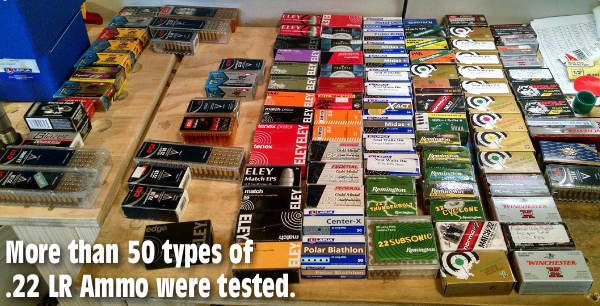
Do you know the actual BC (Ballistic Coefficient) of your rimfire ammunition? Well Applied Ballisitics will soon have answers for you. Bryan Litz and his team of testers have been working on a Herculean project. They’ve been testing over fifty types of .22 LR ammo, using five different twist-rate barrels.
Applied Ballistics has just released a fully upgraded version of its popular Tactical App for Android devices. Bryan Litz tells us: “AB Tactical has received a major overhaul (including a new Bullet Library with over 420 options). The upgrade will require that you uninstall the previous version that you have of the application and then install this new version. This is due to the complete re-write of the internal database handling.” NOTE: You need to record your gun-specific data before you install the new version. Details of the updated AB Tactical App are featured in the new 19-page USER Manual.
NOTE: This upgrade is for the Applied Ballistics Tactical Version only. There is no iPhone version of this App, and this is not the standard app that can be purchased from Google Play, or iTunes.
The new version of AB Tactical has a host of important enhancements:
Berger Twist-Rate Stability Calculator
On the updated Berger Bullets website you’ll find a handy Twist-Rate Stability Calculator that predicts your gyroscopic stability factor (SG) based on mulitiple variables: velocity, bullet length, bullet weight, barrel twist rate, ambient temperature, and altitude. This very cool tool tells you if your chosen bullet will really stabilize in your barrel.
LIVE DEMO BELOW — Just enter values in the data boxes and click “Calculate SG”.
Berger Bullets has just announced a new 6.5 mm (.264 caliber) 130gr Hybrid projectile. Optimized for magazine-length seating (and AR10-friendly), the new 130gr bullets should be ideal for tactical comps and the PRS series. We expect this new bullet to work great when loaded in modern mid-size cartridges such as the 6.5×47 Lapua and 6.5 Creedmoor. Berger’s new 6.5mm 130gr Match AR Hybrid OTM Tactical bullet (could Berger come up with a longer name?) will soon be released to the public. Berger says this new 130-grainer is the first of many new bullet designs to be introduced in the next few years. Here is a run-down on the new bullet from its designer, Bryan Litz of Applied Ballistics.
NEW 130gr Hybrid — Behind the Design
by Bryan Litz, Berger Chief Ballistician
Intelligent bullet design and selection begins with an understanding of application constraints. For bullets that will be used in unlimited rifles, there are few constraints and performance can truly be maximized. However, many shooting applications have realistic constraints such as magazine feeding of loaded rounds. In constrained applications, you need to ask the question: “What’s the best bullet that will work within the constraints of my shooting application?”
The new Berger 6.5mm 130 grain AR Hybrid OTM Tactical bullet is specifically optimized for maximum performance in magazine-length ammo.
6.5mm cartridges are the second most common cartridges used by top shooters in many of the Precision Rifle Series (PRS) matches, with 6mm being the most common. These kinds of tactical matches all have stages that require repeating rifles — either AR-10 platforms or bolt guns — so magazine feeding is a must. Recognizing that Berger did not have an option that was truly optimized for this particular application, we went to work and the latest 6.5mm Hybrid is the result.
SUMMARY
The new Berger 6.5mm 130 grain AR Hybrid OTM Tactical bullet is specifically optimized for use in loaded ammo with COAL constraints for magazine feeding. This bullet maximizes overall performance through BC as well as achievable muzzle velocity in mid-capacity 6.5mm cartridges fed from AR-length magazines.
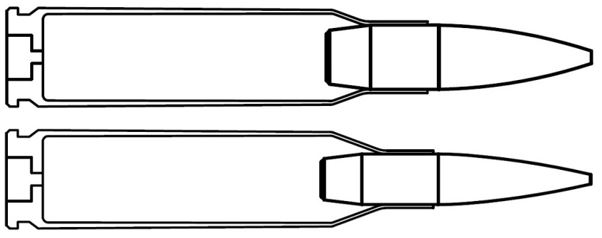
What makes this bullet optimal for magazine length ammo? To start with, the nose of the bullet is constrained in length so that when it’s loaded to mag length in 6.5mm cartridges such as the 6.5mm Creedmoor, 260 Remington and 6.5×47 Lapua, the nose of the bullet won’t be pushed below the case mouth. This can be an issue with some of the heavier 6.5mm bullets like the 140s. Furthermore, the hybrid ogive design is not sensitive to jump distance like some other designs such as the VLD.
Another consideration of length-constrained ammo is how much of the bullet is pushed down into the case. The inside of the case is for powder, and the more space you take up with bullet, the less powder you can fit in. Less powder means less total energy available, and muzzle velocity is depressed. A bullet weight of 130 grains is an optimal balance between external ballistic performance (BC) and internal case capacity considerations which translate into muzzle velocity. Further to this objective, the AR Hybrid has a minimal air gap in the front of the nose, which allows the bullet to have an even shorter OAL. When dealing with length-constrained designs, you need to pack as much bullet into as little length as possible< to optimize overall performance. Another advantage of making the bullet shorter is that stability, including transonic stability, is improved.
Although this design is length-constrained, the combination of a hybrid ogive and 7 degree Boat Tail produce a very respectable G7 form factor of 0.920 which is within 1% of the popular 6mm 105 grain Hybrid. See below for full live fire ballistic performance data.
The 6.5mm 130 grain AR Hybrid will be barely stable from a 1:9″ twist, and reaches full stability from a 1:8″ twist which is common for many 6.5mm rifles. Visit the Berger Bullets twist rate calculator to get more detailed stability information on your specific barrel twist, muzzle velocity and environment.
Cartridge Selection for Magazine Length Constraint — Advanced Analysis
The trend to smaller calibers in magazine-fed rifles is happening for a very good reason. For a .308 Winchester round, you only have 2.37 calibers of nose length available for the bullet to protrude from the case. Such a short nose will have relatively high drag for the caliber. By contrast, smaller calibers such as 6.5mm and 6mm have proportionally more length available for the nose to protrude from the case and still fit in the same COAL constraint. Proportionally longer noses mean lower drag. Proportionally longer bullets mean higher sectional density. Combine an elevated sectional density with lower drag, and you get higher BC bullets. For example, consider a 175 grain .30 caliber bullet commonly used in .308 Winchester M118LR-type ammo. These 175 grain bullets have G7 BCs in the neighborhood of .243 to .260. Neck the .308 down to 6.5mm (260 Remington) or 6mm (.243 Winchester) and now look at the BCs of the bullets available in these calibers which work within the same magazine length constraint. The 6.5mm 130 grain AR Hybrid has a G7 BC of 0.290, and the 6mm 105 grain Hybrid has a G7 BC of 0.278 — both of which are higher than the .30 cal 175 grain bullet BC. Furthermore, you get hundreds of feet per second more velocity with the necked-down cartridges as well.
All of the above translates into higher hit percentage. See the caliber comparison chart below* which is an excerpt taken from the book: Modern Advancements in Long Range Shooting which addresses this and many other topics in even more detail.
*The Weapon Employment Zone (WEZ) analysis shown above is for a 1000-yard shot on a standard IPSC silhouette in an uncertain environment having: +/- 2 mph wind, +/- 1 yard range, Muzzle Velocity SD of 10 fps, and a rifle shooting 1 MOA groups.
Following Sierra’s introduction of Tipped MatchKing (TMK) bullets, Bryan Litz of Applied Ballistics LLC has received many requests to determine the Ballistic Coefficient (BC) of these bullets through testing. Below are Litz’s findings for four out of the six bullets he has able to acquire and test so far.
As you can see from the above table, when Sierra’s G1 BC is averaged for all speed ranges (which is representative of long range shooting) the results closely match the Applied Ballistics’ measurements of the same bullets, averaged from 3000 to 1500 FPS. The G7 BC doesn’t suffer nearly the velocity sensitivity as G1 and should be used for modern long range bullets when possible. Bryan tells us: “When I get the .22 caliber 77gr, and the .308 caliber 168gr tested, I’ll update the table.”
How do these Tipped MatchKings compare to standard MatchKings? According to Bryan’s measurements, here are some comparisons:
The 69gr TMK BC is +8% compared to the 69gr SMK
The 125gr TMK BC is -5% compared to the 125gr SMK (Litz believes this SMK was ‘pointed’)
The 155gr TMK BC is identical to that of the 155gr SMK (#2156, which is also pointed)
The 175gr TMK BC is +10% compared to the 175gr SMK
Bryan provided this additional advice for users of Ballistics programs: “Sierra’s stated BCs are measured by live fire, and are typically pretty accurate if the velocity bands are properly observed (7mm being the exception). A common error is to look at the BC that Sierra gives for your MV and just use that. Doing so overestimates the performance of the bullets over long range, and will cause you to hit low compared to your trajectory predictions.”




 Proportionally longer noses mean lower drag. Proportionally longer bullets mean higher sectional density. Combine an elevated sectional density with lower drag, and you get higher BC bullets. For example, consider a 175 grain .30 caliber bullet commonly used in .308 Winchester M118LR-type ammo. These 175 grain bullets have G7 BCs in the neighborhood of .243 to .260. Neck the .308 down to 6.5mm (260 Remington) or 6mm (.243 Winchester) and now look at the BCs of the bullets available in these calibers which work within the same magazine length constraint. The 6.5mm 130 grain AR Hybrid has a G7 BC of 0.290, and the 6mm 105 grain Hybrid has a G7 BC of 0.278 — both of which are higher than the .30 cal 175 grain bullet BC. Furthermore, you get hundreds of feet per second more velocity with the necked-down cartridges as well.


