|
|
March 13th, 2015
 Today is Friday the 13th. Oddly enough, this is the second month in a row with the 13th falling on a Friday. Does that mean double bad luck? For those of you who are superstitious — maybe you should avoid climbing ladders or using power tools today. Today is Friday the 13th. Oddly enough, this is the second month in a row with the 13th falling on a Friday. Does that mean double bad luck? For those of you who are superstitious — maybe you should avoid climbing ladders or using power tools today.
When it comes to shooting, there are many things that shooters chalk up to “bad luck”. In fact, most of these instances of “bad fortune” just come from a failure to anticipate problems. When you have a major, critical problem at a shooting match, i.e. a “train wreck”, this can be the end of your weekend. In this article, Ballistics Guru Bryan Litz talks about “train wrecks” and how to avoid them, even if you are shooting on Friday the 13th. As Bryan told us: “I don’t believe in superstition — we make our own luck!”
Urban Dictionary “Train Wreck” Definition: “A total @#$&! disaster … the kind that makes you want to shake your head.”
 Train Wrecks (and How to Avoid Them) Train Wrecks (and How to Avoid Them)
by Bryan Litz of Applied Ballistics LLC.
Success in long range competition depends on many things. Those who aspire to be competitive are usually detail-oriented, and focused on all the small things that might give them an edge. Unfortunately it’s common for shooters lose sight of the big picture — missing the forest for the trees, so to speak.
Consistency is one of the universal principles of successful shooting. The tournament champion is the shooter with the highest average performance over several days, often times not winning a single match. While you can win tournaments without an isolated stellar performance, you cannot win tournaments if you have a single train wreck performance. And this is why it’s important for the detail-oriented shooter to keep an eye out for potential “big picture” problems that can derail the train of success!
Train wrecks can be defined differently by shooters of various skill levels and categories. Anything from problems causing a miss, to problems causing a 3/4-MOA shift in wind zero can manifest as a train wreck, depending on the kind of shooting you’re doing.
Below is a list of common Shooting Match Train Wrecks, and suggestions for avoiding them.
1. Cross-Firing. The fastest and most common way to destroy your score (and any hopes of winning a tournament) is to cross-fire. The cure is obviously basic awareness of your target number on each shot, but you can stack the odds in your favor if you’re smart. For sling shooters, establish your Natural Point of Aim (NPA) and monitor that it doesn’t shift during your course of fire. If you’re doing this right, you’ll always come back on your target naturally, without deliberately checking each time. You should be doing this anyway, but avoiding cross-fires is another incentive for monitoring this important fundamental. In F-Class shooting, pay attention to how the rifle recoils, and where the crosshairs settle. If the crosshairs always settle to the right, either make an adjustment to your bipod, hold, or simply make sure to move back each shot. Also consider your scope. Running super high magnification can leave the number board out of the scope’s field view. That can really increase the risk of cross-firing.
2. Equipment Failure. There are a wide variety of equipment failures you may encounter at a match, from loose sight fasteners, to broken bipods, to high-round-count barrels that that suddenly “go south” (just to mention a few possibilities). Mechanical components can and do fail. The best policy is to put some thought into what the critical failure points are, monitor wear of these parts, and have spares ready. This is where an ounce of prevention can prevent a ton of train wreck. On this note, if you like running hot loads, consider whether that extra 20 fps is worth blowing up a bullet (10 points), sticking a bolt (DNF), or worse yet, causing injury to yourself or someone nearby.

3. Scoring/Pit Malfunction. Although not related to your shooting technique, doing things to insure you get at least fair treatment from your scorer and pit puller is a good idea. Try to meet the others on your target so they can associate a face with the shooter for whom they’re pulling. If you learn your scorer is a Democrat, it’s probably best not to tell Obama jokes before you go for record. If your pit puller is elderly, it may be unwise to shoot very rapidly and risk a shot being missed (by the pit worker), or having to call for a mark. Slowing down a second or two between shots might prevent a 5-minute delay and possibly an undeserved miss.
 4. Wind Issues. Tricky winds derail many trains. A lot can be written about wind strategies, but here’s a simple tip about how to take the edge off a worse case scenario. You don’t have to start blazing away on the command of “Commence fire”. If the wind is blowing like a bastard when your time starts, just wait! You’re allotted 30 minutes to fire your string in long range slow fire. With average pit service, it might take you 10 minutes if you hustle, less in F-Class. Point being, you have about three times longer than you need. So let everyone else shoot through the storm and look for a window (or windows) of time which are not so adverse. Of course this is a risk, conditions might get worse if you wait. This is where judgment comes in. Just know you have options for managing time and keep an eye on the clock. Saving rounds in a slow fire match is a costly and embarrassing train wreck. 4. Wind Issues. Tricky winds derail many trains. A lot can be written about wind strategies, but here’s a simple tip about how to take the edge off a worse case scenario. You don’t have to start blazing away on the command of “Commence fire”. If the wind is blowing like a bastard when your time starts, just wait! You’re allotted 30 minutes to fire your string in long range slow fire. With average pit service, it might take you 10 minutes if you hustle, less in F-Class. Point being, you have about three times longer than you need. So let everyone else shoot through the storm and look for a window (or windows) of time which are not so adverse. Of course this is a risk, conditions might get worse if you wait. This is where judgment comes in. Just know you have options for managing time and keep an eye on the clock. Saving rounds in a slow fire match is a costly and embarrassing train wreck.
5. Mind Your Physical Health. While traveling for shooting matches, most shooters break their normal patterns of diet, sleep, alcohol consumption, etc. These disruptions to the norm can have detrimental effects on your body and your ability to shoot and even think clearly. If you’re used to an indoor job and eating salads in air-conditioned break rooms and you travel to a week-long rifle match which keeps you on your feet all day in 90-degree heat and high humidity, while eating greasy restaurant food, drinking beer and getting little sleep, then you might as well plan on daily train wrecks. If the match is four hours away, rather than leaving at 3:00 am and drinking five cups of coffee on the morning drive, arrive the night before and get a good night’s sleep.”
Keep focused on the important stuff. You never want to lose sight of the big picture. Keep the important, common sense things in mind as well as the minutia of meplat trimming, weighing powder to the kernel, and cleaning your barrel ’til it’s squeaky clean. Remember, all the little enhancements can’t make up for one big train wreck!

March 4th, 2015
By Bryan Litz, Applied Ballistics
 Last month, in the Daily Bulletin, we talked about twist rate and muzzle velocity. That discussion was based on a detailed study published in Modern Advancements in Long Range Shooting. Last month, in the Daily Bulletin, we talked about twist rate and muzzle velocity. That discussion was based on a detailed study published in Modern Advancements in Long Range Shooting.
More Spin, Less Drag
In this article, we look at how twist rate and stability affect the Ballistic Coefficient (BC) of a bullet. Again, this topic is covered in detail in the Modern Advancements book. Through our testing, we’ve learned that adequate spin-stabilization is important to achieving the best BC (and lowest drag). In other words, if you don’t spin your bullets fast enough (with sufficient twist rate), the BC of your bullets may be less than optimal. That means, in practical terms, that your bullets drop more quickly and deflect more in the wind (other factors being equal). Spin your bullets faster, and you can optimize your BC for best performance.
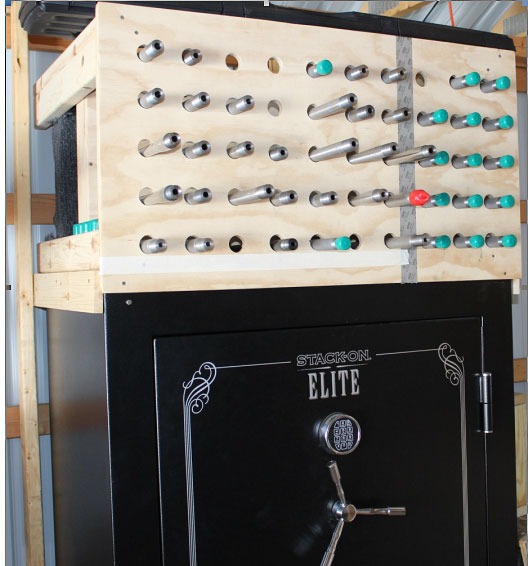
Any test that’s designed to study BC effects has to be carefully controlled in the sense that the variables are isolated. To this end, barrels were ordered from a single barrel smith, chambered and headspaced to the same rifle, with the only difference being the twist rate of the barrels. In this test, 3 pairs of barrels were used. In .224 caliber, 1:9” and 1:7” twist. In .243 caliber it was 1:10” and 1:8”, and in .30 caliber it was 1:12” and 1:10”. Other than the twist rates, each pair of barrels was identical in length, contour, and had similar round counts. Here is a barrel rack at the Applied Ballistics Lab:
Applied Ballistics used multiple barrels to study how twist rate affects BC.
“The Modern Advancements series is basically a journal of the ongoing R&D efforts of the Applied Ballistics Laboratory. The goal of the series is to share what we’re learning about ballistics so others can benefit.” –Bryan Litz
Barrel twist rate along with velocity, atmospherics, and bullet design all combine to result in a Gyroscopic Stability Factor (SG). It’s the SG that actually correlates to BC. The testing revealed that if you get SG above 1.5, the BC may improve slightly with faster twist (higher SG), but it’s very difficult to see. However, BC drops off very quickly for SGs below 1.5. This can be seen in the figure below from Modern Advancements in Long Range Shooting.
The chart shows that when the Gyroscopic Stability Factor (SG) is above 1.5, BC is mostly constant. But if SG falls below 1.5, BC drops off dramatically.
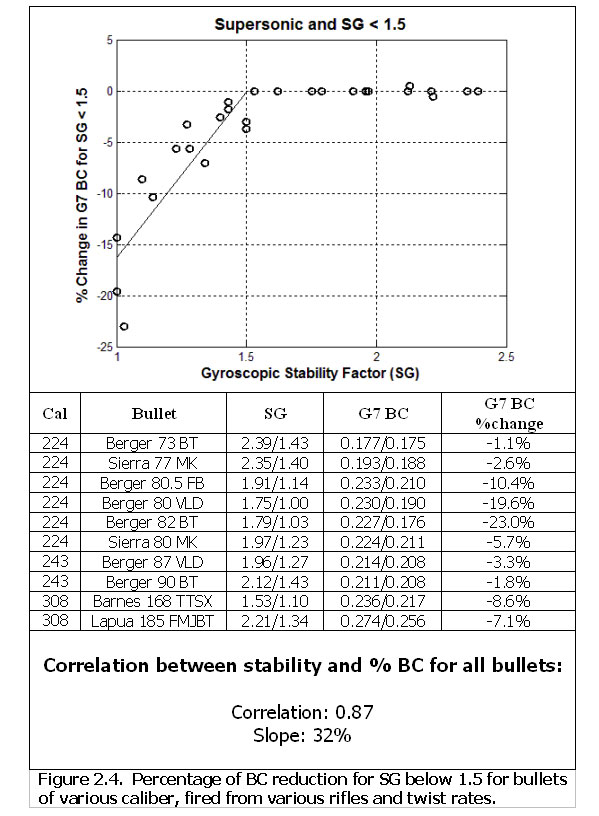
Note that the BC drops by about 3% for every 0.1 that SG falls below 1.5. The data supports a correlation coefficient of 0.87 for this relationship. That means the 3% per 0.1 unit of SG is an accurate trend, but isn’t necessarily exact for every scenario.
It’s a common assumption that if a shooter is seeing great groups and round holes, that he’s seeing the full potential BC of the bullets. These tests did not support that assumption. It’s quite common to shoot very tight groups and have round bullet holes while your BC is compromised by as much as 10% or more. This is probably the most practical and important take-away from this test.
To calculate the SG of your bullets in your rifle, visit the Berger Bullets online stability calculator. This FREE calculator will show you the SG of your bullets, as well as indicate if your BC will be compromised (and by how much) if the SG is below 1.5. With the stated twist rate of your barrel, if your selected bullet shows an SG of 1.5 (or less), the calculator will suggest alternate bullets that will fully stabilize in your rifle. This valuable online resource is based directly on live fire testing. You can use the SG Calculator for free on the web — you don’t need to download software.
Learn More About SG and BC
 This article is just a brief overview of the interrelated subjects of twist rate, Gyroscopic Stability, and BC. The coverage of twist rates in Modern Advancements in Long-Range Shooting is more detailed, with multiple live fire tests. This article is just a brief overview of the interrelated subjects of twist rate, Gyroscopic Stability, and BC. The coverage of twist rates in Modern Advancements in Long-Range Shooting is more detailed, with multiple live fire tests.
Other chapters in the book’s twist rate section include:
· Stability and Drag – Supersonic
· Stability and Drag – Transonic
· Spin Rate Decay
· Effect of Twist rate on Precision
Other sections of the book include: Modern Rifles, Scopes, and Bullets as well as Advancements in Predictive Modeling. This book is sold through the Applied Ballistics online store. Modern Advancements in Long Range Shooting is also available in eBook format in the Amazon Kindle store.
February 11th, 2015

The Berger Southwest Nationals (SWN) kicked off Tuesday, February 10th, with an instructional clinic at the Ben Avery 1000-yard Range. This combined a lecture/Q&A session with live-fire training. Ballistics “Professor” Bryan Litz reports: “The clinic was a big hit as usual, with lots of competitor participation. There was a big crowd this year, as you can see.”


The clinic started with a class on Exterior Ballistics hosted by Bryan. This focused on why ballistics is important to competitive shooters, and how to balance ballistic performance objectives against real world constraints. Topics included bullet weight options for F-TR (155 to 215 grains), barrel/chamber considerations, plus the real-world trade-offs involved with heavy bullets (yes the BC may be better but recoil becomes an issue). Many of the questions related to content from Bryan’s recent books, and discussions in AccurateShooter.com’s Ballistics sub-Forum and Daily Bulletin.
Following the ballistics class, shooters made their way to the firing line for one-on-one instruction with experienced shooters in each discipline (sling, F-TR and F-Open). During this segment of the clinic, champion shooters worked directly with novice and intermediate shooters. Bryan said: “It was great to see the ‘top guns’ sharing their knowledge.”
Last but not least, Mid Tompkins directed a wind clinic with live fire demonstrations. Bryan reports: “Mid has a way of getting your attention. Personally, I thought his 2 MOA wind call that put the very first shot in the 5 inch X-ring at 1000 yards got everyone’s attention!” After the demonstrations, clinic “students” went to the firing line to put wind-clinic lessons into practice, and to verify their zeroes.
Mid Tompkins at the SWN Shooters’ Clinic

Here are some more images from the instructional clinic held last year at the 2014 SW Nationals.


January 9th, 2015
 AccurateShooter.com has added something NEW to our Shooter’s Forum. We recently launched a new Ballistics & Bullets Board, with Bryan Litz as the “Guru in Residence”. Bryan and his team at Applied Ballistics will help answer your questions about bullet trajectories, wind drift, BC values, bullet sorting methods, meplat trimming/pointing, and other general ballistics matters. This is your chance to get your questions answered by Bryan, a expert ballistician, and an ace long-range shooter. In addition, our new Ballistics Forum area features free excerpts from Applied Ballistics’ respected publications, including Applied Ballistics for Long Range Shooting, and Bryan’s new book, Modern Advancements in Long Range Shooting. CLICK HERE for FREE Samples. AccurateShooter.com has added something NEW to our Shooter’s Forum. We recently launched a new Ballistics & Bullets Board, with Bryan Litz as the “Guru in Residence”. Bryan and his team at Applied Ballistics will help answer your questions about bullet trajectories, wind drift, BC values, bullet sorting methods, meplat trimming/pointing, and other general ballistics matters. This is your chance to get your questions answered by Bryan, a expert ballistician, and an ace long-range shooter. In addition, our new Ballistics Forum area features free excerpts from Applied Ballistics’ respected publications, including Applied Ballistics for Long Range Shooting, and Bryan’s new book, Modern Advancements in Long Range Shooting. CLICK HERE for FREE Samples.
If you have a ballistics question, or are simply curious about subjects such as bullet pointing, trajectory prediction, ballistics programs, ballistic coefficients, etc., then visit our Shooters’ Forum and join the discussion in our new Ballistics & Bullets Board.

Get $5.00 Off Applied Ballistics Books
As a special benefit for AccurateShooter.com Forum members, Applied Ballistics is offering $5.00 off Books and DVDs. If you haven’t acquired one of Bryan’s books yet, here’s a way to get with the program and save five bucks in the process. CLICK HERE for $5.00 discount info.
Get Answers from the Man Who Literally
‘Wrote the Book’ on Ballistics…
As an aerospace engineer, Bryan worked six years for the government on air-to-air missile designs. He is now owner of Applied Ballistics and Chief Ballistician for Berger Bullets. Bryan is also a champion long range shooter, so he brings a great deal of practical knowledge and experience to the table regarding the science of accuracy.

A Place to Share Knowledge and Advance the Science of Ballistics
Applied Ballistics is pleased to sponsor AccurateShooter.com’s new Ballistics & Bullets Board: “The new Ballistics Forum area provides an established place for shooters go and discuss ballistics-related issues in general. In addition to this basic objective of connecting shooters to each other, the staff of Applied Ballistics will frequent the Forum to provide expert advice on ballistics, and the use of ballistics programs. Bryan Litz will regularly visit the ballistics Forum, looking for ways to help shooters with ballistics questions. Beyond that, we’re eager to take suggestions on what kinds of tests we might consider for the AB Laboratory. We’re here to advance the science of ballistics, and we’d like to do that in ways that benefit the greatest amount of people. The ballistics forum gives us a place to explore these questions. We can answer the questions that we know, and formulate tests to explore those questions we don’t understand as well, then share the results online for everyone to see.”
How to Find the Ballistics & Bullets Board
To join in the discussions, visit our Shooters’ Forum. Scroll down until you see “Ballistics & Bullets Board, Presented by Bryan Litz and Applied Ballistics”. Just click on the orange title and you’re “in like Flynt”.

Guests can read all the topics. However, if you want to post or start a thread you’ll need to REGISTER with our Forum. There’s no charge (membership is FREE), and registration only takes a few minutes.
November 14th, 2014
Gear Review by GS Arizona
This article originally appeared in the Rifleman’s Journal website.
Many of you have doubtlessly read Bryan Litz’s articles in our Daily Bulletin and on his Applied Ballistics website about various current long-range bullets. Bryan’s work carries a great deal of weight in the world of ballistics, so his comments (and mathematical proofs) regarding the benefits of bullet pointing certainly caught my attention. Bullet pointing, like meplat trimming, is an effort to reduce the ballistic inconsistency created by the somewhat jagged tip of the jacket where the bullet forming dies bring it to a point in the manufacturing process. Of course, we could eliminate this problem altogether by shooting closed-tip, open-base bullets like the Lapua D46, but that merely shifts the jacket problem to the other end of the bullet.

In any event, hollow point bullets rule the accuracy world today, so John Whidden, multi-time National Long Range Champion at Camp Perry and a talented gunsmith and designer to boot, came up with a very handy tool to let us make those hollow points pointier. Let’s have a look at John’s tool and see how it works.

The Whidden Bullet Pointing Die System uses a Forster bullet seating die body as its basic structure and that’s a good choice given the quality machining Forster does on these. The real heart of the tool comes in two parts: the caliber sleeve and the pointing die that fits inside the sleeve. In fact, to point up different caliber bullets, you only need to change the caliber sleeve, everything else remains the same. The last item is the bullet base that slips into a standard .308 shellholder and supports the bullet as it goes into the die body.
 It took me less than five minutes to get everything set up, including changing the caliber sleeve from 6mm to .30 caliber. John’s instruction sheets are well illustrated and clearly written; you should have no problem getting up and running. It took me less than five minutes to get everything set up, including changing the caliber sleeve from 6mm to .30 caliber. John’s instruction sheets are well illustrated and clearly written; you should have no problem getting up and running.
Pointing the bullets is as easy as sizing a piece of brass. You can see in the top photo the difference between a few pointed bullets and a few un-pointed ones. The innermost pointed bullet in the picture was my first attempt and I adjusted the die a little after that, you can see that the others are closed a little more. John even includes a couple of sample bullets so that you can see one done right and one done wrong. That is a nice addition that can help you achieve the desired results.
I think Bryan’s work supports the validity of this concept and John’s tool puts it into practice in a simple-to-use manner that makes it just about impossible to do any damage to the bullet. I have shot pointed bullets in various calibers at many matches now. Pointing is not a “miracle cure”, but I believe that pointing bullet tips can produce long-range accuracy gains, through reduced vertical dispersion, for many popular types of match bullets. The Whidden Bullet Pointing Die System retails for $220.00 (with one insert). Additional die inserts are $42.00 each. Extra caliber sleeves are also $42.00. You can purchase directly from Whidden Gunworks, or from Sinclair International.

October 28th, 2014
 In discussions of ballistics, you’ll see references to “tangent” and “secant” bullet shapes. We know that, for many readers, these terms can be confusing. To add to the confusion, bullet makers don’t always identify their projectiles as secant or tangent designs. This article provides a basic explanation of tangent and secant designs, to help you understand the characteristics of both bullet shapes. In discussions of ballistics, you’ll see references to “tangent” and “secant” bullet shapes. We know that, for many readers, these terms can be confusing. To add to the confusion, bullet makers don’t always identify their projectiles as secant or tangent designs. This article provides a basic explanation of tangent and secant designs, to help you understand the characteristics of both bullet shapes.
Tangent vs. Secant vs. Hybrid
Most match bullets produced today use a tangent ogive profile, but the modern VLD-style bullets employ a secant profile. To further complicate matters, the latest generation of “Hybrid” projectiles from Berger Bullets feature a blended secant + tangent profile to combine the best qualities of both nose shapes. The secant section provides reduced drag, while the tangent section makes the bullet easier to tune, i.e. less sensitive to bullet seating depth position.
Berger Bullets ballistician Bryan Litz explains tangent and secant bullet ogive designs in a glossary section of his Applied Ballistics website, which we reprint below. Bryan then explains how tangent and secant profiles can be combined in a “hybrid” design.
How Bullet Ogive Curves are Defined
While the term “ogive” is often used to describe the particular point on the bullet where the curve reaches full bullet diameter, in fact the “ogive” properly refers to the entire curve of the bullet from the tip to the full-diameter straight section — the shank. Understanding then, that the ogive is a curve, how is that curve described?
LITZ: The ogive of a bullet is usually characterized by the length of its radius. This radius is often given in calibers instead of inches. For example, an 8 ogive 6mm bullet has an ogive that is a segment of a circular arc with a radius of 8*.243 = 1.952”. A .30-caliber bullet with an 8 ogive will be proportionally the same as the 8 ogive 6mm bullet, but the actual radius will be 2.464” for the .30 caliber bullet.
For a given nose length, if an ogive is perfectly tangent, it will have a very specific radius. Any radius longer than that will cause the ogive to be secant. Secant ogives can range from very mild (short radius) to very aggressive (long radius). The drag of a secant ogive is minimized when its radius is twice as long as a tangent ogive radius. In other words, if a tangent ogive has an 8 caliber radius, then the longest practical secant ogive radius is 16 calibers long for a given nose length.”

Ogive Metrics and Rt/R Ratio
LITZ: There is a number that’s used to quantify how secant an ogive is. The metric is known as the Rt/R ratio and it’s the ratio of the tangent ogive radius to the actual ogive radius for a given bullet. In the above example, the 16 caliber ogive would have an Rt/R ratio of 0.5. The number 0.5 is therefore the lowest practical value for the Rt/R ratio, and represents the minimum drag ogive for a given length. An ogive that’s perfectly tangent will have an Rt/R ratio of 1.0. Most ogives are in between an Rt/R of 1.0 and 0.5. The dimensioned drawings at the end of my Applied Ballistics book provide the bullets ogive radius in calibers, as well as the Rt/R ratio. In short, the Rt/R ratio is simply a measure of how secant an ogive is. 1.0 is not secant at all, 0.5 is as secant as it gets.
 Hybrid Bullet Design — Best of Both Worlds? Hybrid Bullet Design — Best of Both Worlds?
Bryan Litz has developed a number of modern “Hybrid” design bullets for Berger. The objective of Bryan’s design work has been to achieve a very low drag design that is also “not finicky”. Normal (non-hybrid) secant designs, such as the Berger 105gr VLD, deliver very impressive BC values, but the bullets can be sensitive to seating depth. Montana’s Tom Mousel has set world records with the Berger 105gr VLD in his 6mm Dasher, but he tells us “seating depth is critical to the best accuracy”. Tom says a mere .003″ seating depth change “makes a difference”. In an effort to produce more forgiving high-BC bullets, Bryan Litz developed the hybrid tangent/secant bullet shape.
Bryan Litz Explains Hybrid Design and Optimal Hybrid Seating Depths
Story sourced by Edlongrange.
October 26th, 2014
 Effects Of Cartridge Over All Length (COAL) And Cartridge Base To Ogive (CBTO) – Part 2 Effects Of Cartridge Over All Length (COAL) And Cartridge Base To Ogive (CBTO) – Part 2
by Bryan Litz for Berger Bullets.
Part One of this series focused on the importance of COAL in terms of SAAMI standards, magazine lengths, seating depths, and pressure levels. Another measure of length for loaded ammunition is highly important to precision, namely Cartridge Base to Bullet Ogive Length (CBTO).
Figure 2. Chamber throat geometry showing the bullet jump to the rifling or lands.

Look at Figure 2. Suppose the bullet was seated out of the case to the point where the base of the bullet’s nose (ogive) just contacted the beginning of the riflings (the lands) when the bolt was closed. This bullet seating configuration is referred to as touching the lands, or touching the riflings and is a very important measurement to understand for precision hand-loading. Due to the complex dynamics of internal ballistics which happen in the blink of an eye, the distance a bullet moves out of the case before it engages the riflings is highly critical to precision potential. Therefore, in order to systematically optimize the precision of his handloads, it’s critically important that the precision hand-loader understands how to alter bullet seating depth in relation to the barrel rifling. Part of the required knowledge is understanding how to accurately and repeatably measure the Cartridge Base To Ogive (CBTO) dimension. This is explained in the FULL ARTICLE.
Bryan Litz offers an extended discussion on how to measure CBTO using different tools and methods, including the Hornady OAL gauge. You can read this discussion in the full article found on the Berger Bullets website. CLICK HERE to Read Full Article.
Why Not Use CBTO as a SAAMI Standard?
If CBTO is so important to rifle accuracy, you might ask, “Why is it not listed as the SAAMI spec standard in addition to COAL?” There is one primary reason why it is not listed in the standard. This is the lack of uniformity in bullet nose shapes and measuring devices used to determine CBTO.
Figure 4. Two different bullet shapes, seated to the same CBTO length, but different COAL. Note the shiny scratches on the bullets made by the comparator tool which indicates a point on the bullet ogive near where the ogive will engage the riflings.

Benefits of Having a Uniform CBTO
There is another aspect to knowing your CBTO when checking your COAL as it pertains to performance. With good bullets, tooling, and carefully-prepared cases you can easily achieve a CBTO that varies less than +/- .001″ but your COAL can vary as much as .025″ extreme spread (or more with other brands). This is not necessarily bad and it is much better than the other way around. If you have a CBTO dimension that varies but your COAL dimension is tight (within +/- .002″) then it is most likely that your bullet is bottoming out inside the seater cone on the bullet tip. This is very bad and is to be avoided. It is normal for bullets to have precisely the same nose shape and it is also normal for these same bullets to have nose lengths that can vary as much as .025″.
|
Summary of Cartridge Base To Ogive (CBTO) Discussion
Here are four important considerations regarding bullet seating depth as it relates to CBTO:
1. CBTO is a critical measurement to understand for handloaders because it’s directly related to precision potential, and you control it by simply setting bullet seating depth.
2. Tools and methods for measuring CBTO vary. Most of the measurement techniques have pitfalls (which may give rise to inconsistent results) that you should understand before starting out.
3. A CBTO that produces the best precision in your rifle may not produce the best precision in someone else’s rifle. Even if you have the same rifle, same bullets, same model of comparator gauges, etc. It’s possible that the gauges are not actually the same, and measurements from one don’t translate to the same dimension for another.
4. Once you find the CBTO that produces the best precision in your rifle, it’s important to allow minimal variation in that dimension when producing quality handloads. This is achieved by using quality bullets, tooling, and properly preparing case mouths and necks for consistent seating.
CLICK HERE to Read Full Article with More Info |
Article sourced by EdLongrange. We welcome tips from readers.
October 12th, 2014
Effects Of Cartridge Over All Length (COAL) And Cartridge Base To Ogive (CBTO) – Part 1
by Bryan Litz for Berger Bullets.
Many shooters are not aware of the dramatic effects that bullet seating depth can have on the pressure and velocity generated by a rifle cartridge. Cartridge Overall Length (COAL) is also a variable that can be used to fine-tune accuracy. It’s also an important consideration for rifles that need to feed rounds through a magazine. In this article, we’ll explore the various effects of COAL, and what choices a shooter can make to maximize the effectiveness of their hand loads.
Sporting Arms and Ammunition Manufacturers’ Institute (SAAMI)
Most loading manuals (including the Berger Manual), present loading data according to SAAMI (Sporting Arms and Ammunition Manufacturers’ Institute) standards. SAAMI provides max pressure, COAL and many other specifications for commercial cartridges so that rifle makers, ammo makers, and hand loaders can standardize their products so they all work together. As we’ll see later in this article, these SAAMI standards are in many cases outdated and can dramatically restrict the performance potential of a cartridge.
Bullet seating depth is an important variable in the accuracy equation. In many cases, the SAAMI specified COAL is shorter than what a hand loader wants to load their rounds to for accuracy purposes. In the case where a hand loader seats the bullets longer than SAAMI specified COAL, there are some internal ballistic effects that take place which are important to understand.
Effects of Seating Depth / COAL on Pressure and Velocity
The primary effect of loading a cartridge long is that it leaves more internal volume inside the cartridge. This extra internal volume has a well known effect; for a given powder charge, there will be less pressure and less velocity produced because of the extra empty space. Another way to look at this is you have to use more powder to achieve the same pressure and velocity when the bullet is seated out long. In fact, the extra powder you can add to a cartridge with the bullet seated long will allow you to achieve greater velocity at the same pressure than a cartridge with a bullet seated short.

Figure 1. When the bullet is seated farther out of the case, there is more volume available for powder. This enables the cartridge to generate higher muzzle velocity with the same pressure.
When you think about it, it makes good sense. After all, when you seat the bullet out longer and leave more internal case volume for powder, you’re effectively making the cartridge into a bigger cartridge by increasing the size of the combustion chamber. Figure 1 illustrates the extra volume that’s available for powder when the bullet is seated out long.
Before concluding that it’s a good idea to start seating your bullets longer than SAAMI spec length, there are a few things to consider.
Geometry of a Chamber Throat
The chamber in a rifle will have a certain throat length which will dictate how long a bullet can be loaded. The throat is the forward portion of the chamber that has no rifling. The portion of the bullet’s bearing surface that projects out of the case occupies the throat (see Figure 2).
The length of the throat determines how much of the bullet can stick out of the case. When a cartridge is chambered and the bullet encounters the beginning of the rifling, known as the lands, it’s met with hard resistance. This COAL marks the maximum length that a bullet can be seated. When a bullet is seated out to contact the lands, its initial forward motion during ignition is immediately resisted by an engraving force.
Seating a bullet against the lands causes pressures to be elevated noticeably higher than if the bullet were seated just a few thousandths of an inch off the lands.
A very common practice in precision reloading is to establish the COAL for a bullet that’s seated to touch the lands. This is a reference length that the hand loader works from when searching for the optimal seating depth for precision. Many times, the best seating depth is with the bullet touching or very near the lands. However, in some rifles, the best seating depth might be 0.100″ or more off the lands. This is simply a variable the hand loader uses to tune the precision of a rifle.
CLICK HERE to Read Full Article with More Info
Article sourced by EdLongrange. We welcome tips from readers.
October 1st, 2014
Accuracy 1st Development Group, a training operation based in Texas, will soon release a new instructional video: Long Range Made Easy. This training video features Bryan Litz, author of Applied Ballistics for Long Range Shooting. Many of the shooters shown in the video use the new ABM ammo developed by Bryan’s Applied Ballistics lab for Berger Bullets. Check out the preview “trailer” for Long Range Made Easy.
Watch Trailer for “Long Range Made Easy”


Accuracy 1st Scope Levels
Accuracy 1st also sells some interesting products for precision rifle shooters. Check out this unique, curved-vial scope leveler ring. More precise and sensitive than other scope levels, the Accuracy 1st leveling device can detect 1° of cant. Displayed line increments represent 2.5° of cant.
You may wonder: “Why are these scope levels better than other similar products?” Accuracy 1st explains: “Our levels are of the highest quality and accuracy. Some scope level manufacturers� use plastic housings, air bubbles and sub-par glass in their vials. In lieu of a straight bubble vial, Accuracy 1st utilizes a custom curved vial featuring medical-grade glass and a ceramic ball. The use of the ceramic ball eliminates the inherent flaws associated with air bubble levels, which at higher temperatures and pressure will compromise the bubble size causing level inaccuracies. Typically air bubble levels require 3° to 5° [tilt] to even register movement. By contrast, the Accuracy 1st custom level will read movement at a minimum of 1° and will extend measurements out to +/- 10°.”
September 12th, 2014
|
It’s been seven years since L.P. Brezny wrote the original Gun Digest Book of Long-Range Shooting. Much has changed in the long-distance shooting game in that time. Brezny addresses those developments in this completely updated Second Edition, set to be released September 25, 2014.
Highlights of Book of Long-Range Shooting (2nd Edition)
– Best new factory rifles for long-range shooting
– New calibers and loadings
– The best big bore, heavy bullet choices for 1,000 yards and beyond
– Recommended optics, accessories, chronographs, and techniques
– Popular new shooting sports: 3-Gun Competition and “Rifle Golf” |
|
Experienced firearms writer L.P. Brezny has completely updated his popular, original book on long-range rifles and shooting techniques. Readers will find up-to-date information on recent advances in long-range rifles and cartridge choices. The updated Second Edition offers hundreds of new photos and much new information on guns, optics, and ammunition.

Brezny also offers instructional “how-to” content for shooters looking to develop their technique. He draws from first-hand experience, as well as interviews with snipers and long-range competitors. Brezny discusses current military applied combat theory — new methods that help snipers achieve hits at ultra-long range. Last but not least, Brezny explores today’s popular competitive shooting events, including 3-gun competition and long distance “rifle golf.”
NOTE: This book has a lot of useful information, but it is written more for the tactical crowd than for long-range benchrest or F-Class shooters. This book is a good starting point if you want to get started in the long-range game. However, you’ll probably find more serious information about advanced reloading right here in the AccurateShooter.com archives. If you want to understand the fine points of long-range ballistics, then get Bryan Litz’s Applied Ballisitics for Long-Range Shooting (2d. Ed), now available in eBook as well as hard-cover format.
|


