|
|
August 20th, 2014
The Canadian National Fullbore Rifle Championships (CFRC) are underway this week at the Connaught Range near Ottawa, Ontario. Following on the Canadian F-Class Championships held last week, this event is for “Target Rifles”, shot with slings. So far, a British Lady, Jane Messer, is leading the pack, but two Americans, Kent Reeve and Bryan Litz, are close behind.

Bryan Litz provides this report from Canada: “Had a great time shooting today! I won the Letson sub-Aggregate and moved up to Third Place in the overall. We (Team USA Hardin) also tied for winning the coaches two-man team match with USA Praslick at 900 meters. Here’s how the leader board stacks up: Jane Messer from the UK is still leading at 1 down, Kent Reeve moved into second at 2 down, and I’m in third with 3 down. There will be two more days of individual matches and then a lot of team matches leading up to the America Match on Sunday.”
Team USA Hardin: John Whidden (L), Coach Steve Hardin, and Bryan Litz (R).

August 8th, 2014
Berger Bullets is now in the ammo business, offering high-quality, loaded ammunition for competition, hunting, and tactical applications. Berger will sell ammo through its new company, Applied Ballistics Munitions (aka “ABM” or “ABM Ammo”). See ABM’s ammunition offerings at www.abmammo.com.
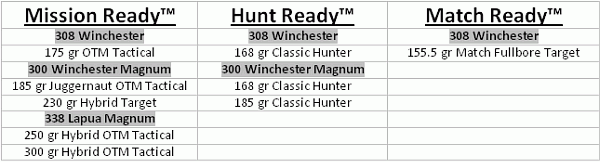
 ABM Ammo will offer precision rifle ammunition for three popular cartridge types: .308 Winchester, .300 Winchester Magnum, and .338 Lapua Magnum. There are three product lines. The “Mission Ready” line is designed for military and tactical use. In addition, ABM will offer “Hunt Ready” ammo for precision hunters and “Match Ready” ammunition for target shooters. ABM Ammo will offer precision rifle ammunition for three popular cartridge types: .308 Winchester, .300 Winchester Magnum, and .338 Lapua Magnum. There are three product lines. The “Mission Ready” line is designed for military and tactical use. In addition, ABM will offer “Hunt Ready” ammo for precision hunters and “Match Ready” ammunition for target shooters.


Each product line is loaded with the Berger bullet that best fits a given application. Each of the bullets used have been proven performers among the hand loading community for years and in some cases, decades. The chart below shows the current bullet selections for each of the three product lines:
ABM Ammo Components are Tested Lot by Lot
ABM uses high quality components and tooling to produce the most consistent ammunition possible. In a process developed by ballistics expert Bryan Litz, ABM ammo has been engineered and tested in the Applied Ballistics laboratory. ABM actually tests each individual lot of components used in the loaded cartridges to ensure quality and consistency.
Eric Stecker, President of Applied Ballistics Munitions relays, “Launching an ammunition company in today’s firearm market environment has been a challenging experience. The product will speak for itself among the shooters as to why it is so important that we pursue this effort.” To learn more about Applied Ballistics Munitions, visit www.abmammo.com.
August 6th, 2014
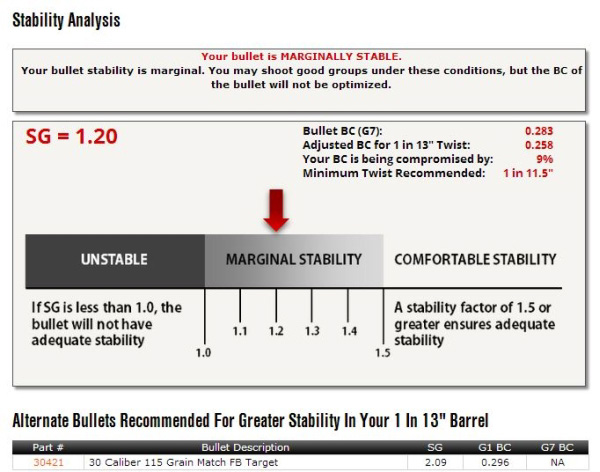
Berger Bullets has improved its online stability calculator. Tests have shown that bullets can suffer from reduced BC if the bullet rpm (spin rate) is less than optimal, even if barrel twist rate is otherwise fast enough to stabilize bullets in flight. Now, the improved, free Stability Calculator can determine if you need a faster-twist barrel to enjoy the best BC from your bullets.
CLICK HERE for FREE Berger Twist Rate Stability Calculator
By Bryan Litz, Chief Ballistician for Berger Bullets
We’re happy to announce a major upgrade to our Twist Rate Stability Calculator which is free to use on the Berger Bullets webpage. The old stability calculator was pretty basic, and would simply return a gyroscopic stability number based on your bullet, twist rate, and atmospheric conditions. This was used to determine if your barrels twist rate was fast enough to stabilize a particular bullet or not, based on the Gyroscopic Stability Factor (SG) being greater than 1.4.

Stability and BC — How Bullet RPM Affects Ballistic Coefficients
The new calculator still calculates SG, but also goes much further. In addition to calculating stability, the upgraded calculator can also tell you if your stability level is harming the effective BC of your bullets or not. Extensive testing has proven that bullets fired with stability levels between 1.2 and 1.5 can fly with excellent precision (good groups), but suffer from a depressed BC, sometimes as much as 10%. Shooting the bullets from faster twist rate barrels allows for the bullets to fly better and realize their full BC potential.
July 14th, 2014
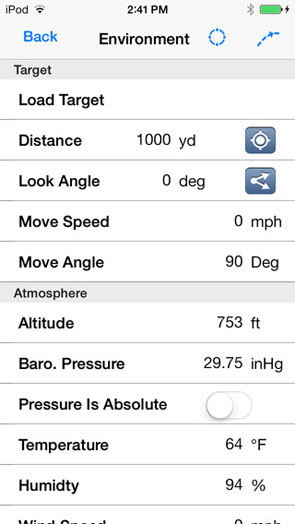
 iPhone and iPad users rejoice. The Apple iOS version of the Applied Ballistics Mobile App is now available. It has all the features of the much-loved Applied Ballistics Android App with full Apple functionality. This mobile App will run on iPhones, iPods, and iPads. iPhone and iPad users rejoice. The Apple iOS version of the Applied Ballistics Mobile App is now available. It has all the features of the much-loved Applied Ballistics Android App with full Apple functionality. This mobile App will run on iPhones, iPods, and iPads.
Price is $29.99. Click here to view details or order the App: Applied Ballistics iOS App.
CLICK HERE for Detailed Summary of App Features (Applied Ballistics Website)
The new iOS mobile App accounts for all major and minor trajectory variables that a shooter could encounter. Conveniently, the App displays single-shot solutions in HUD View or Reticle View.
Real-World Calibration — Shooters can enter their observed drops and the program will calibrate and “true” the predictions based on actual bullet impact. This is done by incorporating muzzle velocity and drop-scaling over various segments of the trajectory.
Sync to Web — A web-sync feature allows you to store your rifle and ammunition libraries online. And you can backup all the profiles online or restore them to a device.
Forum member Snuggie308, who acquired the new iOS App, gives it a thumbs up: “I bought it last night. It is a great tool. There’s a massive data base … built into it. You can’t find a better [mobile ballistics app] in my opinion.” Snuggie308 also reports that the new iOS is iPad friendly, and fills the iPad screen so it is easy to use all the features.
The Applied Ballistics iOS Mobile App runs the state-of-the-art Point Mass ballistic solver. This solver, along with the built-in library of ballistic coefficients, makes this the most accurate, precise, and complete mobile ballistics app available for iOS devices.
Ballistician (and former missile design engineer) Bryan Litz wrote this solver. The program integrates the equations of ballistic motion numerically, using a 4th-order Runge-Kutta method, the preferred method of solving dynamic equations for aircraft and missiles. The application also comes with G1 and G7 BCs for over 1,300 bullet types.
Bryan Litz tells us: “We have worked extensively on this product. With the success of the Android version of the application, released two years ago, the demand for the iOS version has been high. We are excited to now offer a full-featured iOS version that runs on iPhones, iPods, and iPads.”
Available now through iTunes, the Applied Ballistics Mobile App costs $29.99, and requires iOS 7.0 or later for proper functionality. Compatible with iPhone, iPad, and iPod touch devices, this App is optimized for the iPhone 5 series of smart phones.
June 26th, 2014
 Applied Ballistics, LLC is offering an all-new book by Bryan Litz, the first in a series. The new 339-page, hard-cover book, Modern Advancements for Long Range Shooting, Volume I, documents the ongoing R & D being done at the Applied Ballistics laboratory, the “Area 51″ of the shooting world. Applied Ballistics, LLC is offering an all-new book by Bryan Litz, the first in a series. The new 339-page, hard-cover book, Modern Advancements for Long Range Shooting, Volume I, documents the ongoing R & D being done at the Applied Ballistics laboratory, the “Area 51″ of the shooting world.
“This new series is heavily based in experimental ballistics, and takes a ‘Myth Busters’-type approach to many of the questions and problems faced by modern long range shooters,” stated Litz. Volume I of the series is scheduled for release in late July, 2014. The book will cost $39.95, but you can pre-order now for $35.95, a 10% savings.
Bryan adds: “Anyone interested in the underlying science behind shooting can benefit from this book. We address the important questions… How much does faster twist affect MV? How does stability affect BC from the muzzle and downrange? What chronographs are capable of high accuracy and precision? What characteristics should you look for in your long range rifle and optic set up? What new gadgets are being developed to enhance long range shooting?
New Book Features Extensive Live-Fire Test Results
Bryan tells us: “The book spotlights state-of-the-art technologies (and methodologies) in long range shooting. New equipment and old ideas are explored using experimental, live-fire testing. Extensive test results are reported in an easy-to-understand way. Among other things, our tests explore the effects of twist rate on muzzle velocity, BC (supersonic and transonic), precision, even spin rate decay for various rifling profiles as they are tested experimentally.
Chronographs and Optics Are Tested and Compared
Litz’s new book traces the evolution of modern rifle, bullet, and optic design. Results from chronograph comparison tests are presented, showing the strengths and weaknesses of available commercial chronographs. High-tech instrumentation such as laser rangefinders and wind measurement devices are explained in detail by contributing author Nick Vitalbo.
The New Book Puts Theory into Practice
We asked Bryan Litz how this new book differs from his previous treatises. Bryan replied: “My original Applied Ballistics for Long-Range Shooting book explains the fundamental elements of external ballistics. It’s the academic background which all future work relies on. The new book, Modern Advancements in Long Range Shooting, covers the ongoing development of equipment and ideas. We explore things like twist rate effects, modern rifle and optic design, and some of the high tech instruments which are being used to enhance the effectiveness of long range shooting.

June 24th, 2014
Bryan Litz shot his first F-TR match recently, and he came up a winner — a big winner. Competing at the Midwest Palma event, Bryan topped the F-TR field, winning by 15 points. In fact Bryan ended up finishing within 10 points of F-Open winner Alex Lipworth. In the 20-shot, 1000-yard matches, Bryan averaged an impressive 195-7X, with a stunning 196-11X score in one match. (Consider that the 1000-yard X-Ring is just five inches in diameter!) Not bad for Bryan’s first attempt at the F-TR game.
We all know Bryan has serious long-range shooting skills. But he also had a secret weapon — a wickedly accurate, wood/carbon-stocked, low-profile F-TR rifle built by John Pierce. With this Pierce rifle, Bryan had to abandon the hard-holding style he uses in sling-shooting competition. Instead he adopted a “less is more”, almost-free-recoil method — and it worked. Is this the future of F-TR? Read on and learn what Bryan has to say about F-TR shooting, “belly benchrest” style.

Sling Shooter Tries F-TR
by Bryan Litz
I’ve been coaching the Michigan F-TR team for a while and finally decided to participate in the competition. F-TR is more rifle-centric than Palma, meaning the precision demands are greater due to the smaller scoring rings. After seeing Eric Stecker’s results with his Pierce rifle at the 2014 Berger Southwest Nationals, I asked my good friend and Michigan team-mate John Pierce to “build me one like Eric’s”. This is the same basic set up as John’s own F-TR rifle as well. It’s a Pierce F-TR action with a 30″ long, 1:9″ twist Bartlein Barrel chambered for the Berger 215gr Hybrids. The barreled action is bedded into a light-weight, BR-style stock built by Bob Scoville. A Phoenix bipod underneath and a Nightforce 15-55X Competition scope complete the package.
Click Image to Zoom

Loading the .308 Winchester with Berger 215gr Hybrids
I received the rifle just one week before the Midwest Palma match. During that week prior to the match, I put over 700 rounds on the rifle. I did some load development but was mostly learning to shoot a new rifle in a new discipline. I settled on 215gr Berger Hybrids seated 0.015″ off the riflings over a stout charge of Varget in Lapua Palma (small primer) brass with CCI BR4 primers. The only brass prep was mandreling the necks of the new brass for consistent neck tension. Bullets were slightly pointed, but nothing was segregated by weight, base-to-ogive, or anything. All the ammo I shot in Lodi was loaded in brand-new Lapua brass.
Check Out Bryan’s Set-up with the Rifle (Click Photo to Zoom)

Learning the F-TR Game — Adapting to a New Shooting Style
Coming over from sling shooting, I knew there would be unique challenges to F-TR which I wanted to learn prior to (not during) a major tournament. I learned a new shooting position which doesn’t involve drawing the right knee up. For F-TR I get more straight behind the gun rather than at an angle. I found that the rifle shoots best with very light cheek, shoulder and grip pressure, approaching free recoil. This is how Eric Stecker shot his similar rifle into second place in the SW Nationals. I learned the rifle’s sensitivity to different bipod and rear bag supports, and found the best buttplate position to allow the rifle to track and stay on target after recoil. This set-up shot best with a mostly free-recoil approach, that means “hovering” over the comb, rather than resting your head on the stock. This took some “getting used to” in terms of neck and back muscle tone. These are the kind of details I think it’s important to focus on when entering a new dicipline.
“I love the way this Pierce F-TR rifle flings brass, and wins tournaments. None of my sling guns ever had an ejector. With this rig, it’s become one of my favorite things to eject the brass and just let it fly!”

I think many shooters consider themselves ‘ready for a match’ the first time the rifle shows them a couple 1/3 or 1/4 MOA 5-shot groups from a bench at 100 yards. While making the rifle shoot precisely is certainly a prerequisite for successful match shooting, it’s certainly not the whole story. So as soon as I got the load and rifle shooting 1/2 MOA from the bench, I proceeded to shoot many 10- and 20-shot strings from the ground at 300 and 1000 yards. I shot more than 500 rounds this way, studying the rifles character, and learning to shoot it. It’s amazing how much the precision (grouping) is affected by subtle variables in the set-up, especially when shooting heavy bullets. I truly believe that many F-TR rifles are hindered in their precision potential by something in the way they are set up and shot.
Advice on Shooting the Heavy Bullets in a .308 Win
I believe F-TR set-ups are way more forgiving with light- to medium-weight bullets (155 to 185 grains). By this I mean that it’s easier to shoot good groups with a variety of bipods, rear bags, etc. But as you get into the 200 – 215 grain bullet weights, the precision of the rifle (i.e. group size) becomes very sensitive to set-up and shot execution. I was able to find a good set-up which let the rifle shoot very well on a variety of surfaces (hard gravel, soft grass, sand, etc.). In Lodi, the rifle shot well all week.
Having done so much preparation and training with the rifle the week prior to the match, I felt very prepared and confident. The results were actually better than expected. There were no problems at all with equipment, and I just shot the rifle the way it liked to be shot. In the end, I won the F-TR Division. I can say there were many shooters interested in the Pierce rifle!
Impressive Performance
Bryan observes that this rifle held 1/2 MOA of vertical at 1000 yards for 17 out of 20 shots. That’s impressive accuracy. Bryan was in first place each day of the match, including the 3×1000 on Friday where he averaged over 195-7X. Remarkably, Bryan finished just 10 points behind the F-Open winner, with the next closest F-TR competitor 15 points behind Bryan. In fact, with his .308 Win, Bryan out-scored 75% of the F-Open shooters. CLICK for match results.

Bryan gave credit to his smiths and his team-mates: “I’d like to thank John Pierce for building a great F-TR rifle and thank my dad, Bill Litz, for loading the best ammo on the planet. Finally, I’d like to thank the Michigan F-TR team for helping me learn how to shoot F-TR.”
Bryan writes: “Here I am with ‘The Man’, John Pierce, and the epic F-TR rifle he built for me. This thing shoots ‘No S***’ 1/2 MOA Vertical at 1000 yards.”

June 9th, 2014
 Ballistics books have gone digital. Bryan Litz’s Applied Ballistics For Long-Range Shooting (2nd Edition), the leading treatise on the subject, is now available in digital eBook format. This new eBook version contains all the text of the print version, all the charts, all the diagrams, and all the photos. You get all this in an easy-to-read, easy-to-search format that can be viewed on a variety of devices*. You can access the book on your home computer, on your laptop, on a tablet, on a smartphone, or on a lightweight, portable Kindle e-Reader. And yes, iPad users can use the Kindle app to read the book on an iPad. Ballistics books have gone digital. Bryan Litz’s Applied Ballistics For Long-Range Shooting (2nd Edition), the leading treatise on the subject, is now available in digital eBook format. This new eBook version contains all the text of the print version, all the charts, all the diagrams, and all the photos. You get all this in an easy-to-read, easy-to-search format that can be viewed on a variety of devices*. You can access the book on your home computer, on your laptop, on a tablet, on a smartphone, or on a lightweight, portable Kindle e-Reader. And yes, iPad users can use the Kindle app to read the book on an iPad.
CLICK for FREE Sample of Applied Ballistics
for Long-Range Shooting (2d Ed.) eBook
NOTE: After clicking this link to go to Amazon.com, click on the blue book image labeled “Look Inside”. This will launch a preview window. Alternatively, Kindle users can click the “Send Sample Now” button.
|
Advantages of the eBook Edition
The eBook release of Bryan Litz’s most popular and comprehensive ballistics book is a big deal, in our opinion. There are many advantages to the digital format. First you can quickly search for any term or reference, or click from table of content entries to desired chapters. Second, you can highlight text and bookmark pages for future review. Third, you can easily change the font size to enhance reading for older eyes. Fourth, you can zoom in the charts, diagrams, and photos for a better view. Last but not least, you can easily carry the entire text in the field on the same digital device that holds your ballistics solver software.
The new eBook version of Applied Ballistics for Long-Range Shooting (2d. Ed.) is available now on Amazon.com for $39.95. |
Highlights of eBook Edition
The eBook version of Applied Ballistics for Long-Range Shooting (2d Ed.) is available now on Amazon.com. Since its release in 2011, the second edition (hardcopy) of Applied Ballistics for Long Range Shooting has sold over 10,000 copies. It’s the modern ‘go to’ book on the subject of ballistics for long range shooters. The Second Edition of the book includes two additional chapters covering extended long-range shooting and monolithic bullets.
200 Bullet Types Tested. In this eBook edition, Bryan Litz includes data from his own personal field tests with over 200 bullet types. Performance data (G1 and G7 BCs confirmed by live-fire testing) is presented along with 2-D drawings for hundreds of long range bullets.
Ballistic Program Included. eBook buyers can receive the Point Mass Ballistics Solver 2.0 for no extra charge. The software comes on a CD with the hardcopy. With the eBook, there are two ways to access the ballistics program. First, you can access the free AB online ballistics solver through embedded links in the eBook and run directly from your eReader. Alternatively, you can request the PM Solver program to be emailed to you for running on a PC.
“Our mission at Applied Ballistics is to be the complete and unbiased source of external ballistics information for long range shooters,” stated Bryan Litz, author and owner of Applied Ballistics, LLC. “We’re constantly testing new claims, products and ideas and dispensing the marketing hype which can make it difficult for shooters to master the challenging discipline of long range shooting. We developed the original hard copy of the book in order to provide shooters of all capabilities with this knowledge. The release of the eBook will not only provide readers with the same knowledge, but do so in a more accessible and mobile way.”
Sample Page from eBook

* Installation of FREE eReader software may be required for viewing on desktop computers, laptops, tablets, and smartphones. This only takes a minute or so.
May 19th, 2014

Two months ago, the Daily Bulletin featured Six Shooting Tips by Bryan Litz. That article was hugely popular with our Bulletin readers and Facebook fans. In that article, as his Competition Tip Number Three, Bryan told readers to “Actively avoid major train wrecks”. In other words, you must avoid the big disasters (such as equipment failures) that can ruin a whole match. In this follow-up article, Bryan illustrates the types of “train wrecks” that commonly befall competitors, and he explains how to avoid these “unmitigated disasters”.
Urban Dictionary “Train Wreck” Definition: “A total @#$&! disaster … the kind that makes you want to shake your head.”
 Train Wrecks (and How to Avoid Them) Train Wrecks (and How to Avoid Them)
by Bryan Litz of Applied Ballistics LLC.
Success in long range competition depends on many things. Those who aspire to be competitive are usually detail-oriented, and focused on all the small things that might give them an edge. Unfortunately it’s common for shooters lose sight of the big picture — missing the forest for the trees, so to speak.
Consistency is one of the universal principles of successful shooting. The tournament champion is the shooter with the highest average performance over several days, often times not winning a single match. While you can win tournaments without an isolated stellar performance, you cannot win tournaments if you have a single train wreck performance. And this is why it’s important for the detail-oriented shooter to keep an eye out for potential “big picture” problems that can derail the train of success!
Train wrecks can be defined differently by shooters of various skill levels and categories. Anything from problems causing a miss, to problems causing a 3/4-MOA shift in wind zero can manifest as a train wreck, depending on the kind of shooting you’re doing.
Below is a list of common Shooting Match Train Wrecks, and suggestions for avoiding them.
1. Cross-Firing. The fastest and most common way to destroy your score (and any hopes of winning a tournament) is to cross-fire. The cure is obviously basic awareness of your target number on each shot, but you can stack the odds in your favor if you’re smart. For sling shooters, establish your Natural Point of Aim (NPA) and monitor that it doesn’t shift during your course of fire. If you’re doing this right, you’ll always come back on your target naturally, without deliberately checking each time. You should be doing this anyway, but avoiding cross-fires is another incentive for monitoring this important fundamental. In F-Class shooting, pay attention to how the rifle recoils, and where the crosshairs settle. If the crosshairs always settle to the right, either make an adjustment to your bipod, hold, or simply make sure to move back each shot. Also consider your scope. Running super high magnification can leave the number board out of the scope’s field view. That can really increase the risk of cross-firing.
2. Equipment Failure. There are a wide variety of equipment failures you may encounter at a match, from loose sight fasteners, to broken bipods, to high-round-count barrels that that suddenly “go south” (just to mention a few possibilities). Mechanical components can and do fail. The best policy is to put some thought into what the critical failure points are, monitor wear of these parts, and have spares ready. This is where an ounce of prevention can prevent a ton of train wreck. On this note, if you like running hot loads, consider whether that extra 20 fps is worth blowing up a bullet (10 points), sticking a bolt (DNF), or worse yet, causing injury to yourself or someone nearby.

3. Scoring/Pit Malfunction. Although not related to your shooting technique, doing things to insure you get at least fair treatment from your scorer and pit puller is a good idea. Try to meet the others on your target so they can associate a face with the shooter for whom they’re pulling. If you learn your scorer is a Democrat, it’s probably best not to tell Obama jokes before you go for record. If your pit puller is elderly, it may be unwise to shoot very rapidly and risk a shot being missed (by the pit worker), or having to call for a mark. Slowing down a second or two between shots might prevent a 5-minute delay and possibly an undeserved miss.
 4. Wind Issues. Tricky winds derail many trains. A lot can be written about wind strategies, but here’s a simple tip about how to take the edge off a worse case scenario. You don’t have to start blazing away on the command of “Commence fire”. If the wind is blowing like a bastard when your time starts, just wait! You’re allotted 30 minutes to fire your string in long range slow fire. With average pit service, it might take you 10 minutes if you hustle, less in F-Class. Point being, you have about three times longer than you need. So let everyone else shoot through the storm and look for a window (or windows) of time which are not so adverse. Of course this is a risk, conditions might get worse if you wait. This is where judgment comes in. Just know you have options for managing time and keep an eye on the clock. Saving rounds in a slow fire match is a costly and embarrassing train wreck. 4. Wind Issues. Tricky winds derail many trains. A lot can be written about wind strategies, but here’s a simple tip about how to take the edge off a worse case scenario. You don’t have to start blazing away on the command of “Commence fire”. If the wind is blowing like a bastard when your time starts, just wait! You’re allotted 30 minutes to fire your string in long range slow fire. With average pit service, it might take you 10 minutes if you hustle, less in F-Class. Point being, you have about three times longer than you need. So let everyone else shoot through the storm and look for a window (or windows) of time which are not so adverse. Of course this is a risk, conditions might get worse if you wait. This is where judgment comes in. Just know you have options for managing time and keep an eye on the clock. Saving rounds in a slow fire match is a costly and embarrassing train wreck.
5. Mind Your Physical Health. While traveling for shooting matches, most shooters break their normal patterns of diet, sleep, alcohol consumption, etc. These disruptions to the norm can have detrimental effects on your body and your ability to shoot and even think clearly. If you’re used to an indoor job and eating salads in air-conditioned break rooms and you travel to a week-long rifle match which keeps you on your feet all day in 90-degree heat and high humidity, while eating greasy restaurant food, drinking beer and getting little sleep, then you might as well plan on daily train wrecks. If the match is four hours away, rather than leaving at 3:00 am and drinking five cups of coffee on the morning drive, arrive the night before and get a good night’s sleep.”
Keep focused on the important stuff. You never want to lose sight of the big picture. Keep the important, common sense things in mind as well as the minutia of meplat trimming, weighing powder to the kernel, and cleaning your barrel ’til it’s squeaky clean. Remember, all the little enhancements can’t make up for one big train wreck!

January 15th, 2014

Berger’s customers said “Make more bullets!”, and the company listened. Over the next few months Berger will more than double its capacity, by adding SIX new bullet-making machines, up from five at the beginning of 2013. You can do the math: 5 + 6 = 11. That means that Berger will have more than twice as many machines turning out bullets for the yellow and orange boxes. Bringing six new machines online represents a major commitment by Berger to increased production. This has been the “number one priority” for the company according to Berger ballistician Bryan Litz.
Bryan explained that Berger has already increased its output in recent months. In 2013 Berger produced 45% more bullets than in 2012. That’s a big boost. But, Bryan added, even with that 45% greater output, demand was out-stripping supply. So Berger determined the best long-term solution was to increase production capacity… and that meant acquiring new bullet-making machines. So 2014 will mark the “Rise of the Machines” at Berger, and that’s good news for fans of Berger Bullets. Within a few months you should see much greater availability of Berger bullets at gun stores and online vendors.
Bryan Litz Explains That Berger is Doubling Production Capacity This Year (SHOT Show Report)
January 13th, 2014
 More and more people are reading books on tablet computers and eReader devices such as the Kindle and Nook. Recognizing the demand for digital resource works, Applied Ballistics has just releases of its first eBook — a digital version of Accuracy and Precision for Long Range Shooting. This work (which has sold 5000 hard copy versions), is now available in electronic format for both Kindle and Nook eReaders. iPad users can use the Kindle app to access the eBook. More and more people are reading books on tablet computers and eReader devices such as the Kindle and Nook. Recognizing the demand for digital resource works, Applied Ballistics has just releases of its first eBook — a digital version of Accuracy and Precision for Long Range Shooting. This work (which has sold 5000 hard copy versions), is now available in electronic format for both Kindle and Nook eReaders. iPad users can use the Kindle app to access the eBook.
This book discusses how to evaluate multiple variables to improve your hit percentage. It explains how to correct the trajectories for drop, wind deflection, etc. through the use of Weapon Employment Zone (WEZ) analysis. WEZ is applied throughout the book, showing readers how to get more rounds on targets, more reliably. Case studies (with live fire verification for many scenarios) show what things affect your hit probability at long range.
All formats of the eBook are sold for $27.99 (hardcopy is $34.99). The Kindle book is available directly from Amazon.com, while the Nook version can be purchased from BarnesandNoble.com.
Free eReader Content on Applied Ballistics Website
If you have a Kindle, Nook, or iPad, you should visit the Ballistics website. You’ll find many free technical articles you can download as PDF files or in Kindle format or Nook format. To access these FREE articles, select the “Recreational” or “Professional” tabs on the top of the Applied Ballistics home page, then choose the “Articles” link from the pull-down menu. Bryan Litz tells us: “We recently updated our website and we’ve included a number of free articles about bullet design, long-range ballistics, and aspects of WEZ analysis. You don’t need an eReader for these — just download the PDF versions.”
|