The National Rifle Association (NRA) was founded in 1871 by Civil War veterans. Since that beginning, 150 years ago, the goals of the NRA have been to advance marksmanship training, foster sport shooting, protect the rights of gun owners, and preserve Second Amendment freedoms. The NRA now boasts over 5,000,000 members. In 2021, the NRA celebrates 150 years as the nation’s largest association of gun owners and “America’s oldest civil-rights organization”.
“The NRA has diligently protected our right to keep and bear arms longer than any other organization”, NRA President Carolyn Meadows said. “We are humbled to serve our more than 5 million members and all law-abiding gun owners. We invite you to join our organization as we celebrate this historic milestone.” To take part in NRA’s 150th Anniversary celebrations, you can sign-up online or call 1-866-672-2020 to join.
Over the past century-and-a-half, the NRA has served firearm owners through training, legislative action, and other initiatives that promote sport shooting, hunting, and personal protection. Today, the organization offers a wide range of programs for firearm owners including competitive shooting, hunter education, political action and more.
Online Resources for NRA Members
The NRA has a wide variety of online resource for its members. These include information for competitive shooters, online training for hunters, and firearms safety sites. To access ALL the many NRA online resources go to NRA.org, and then click on the RED “NRA Explore” tab upper left. A pull-down, 3-column directory will appear.
The NRA also offers some very good, informative websites, including Shooting Sports USA (SSUSA.org). Guided by Editor John Parker, SSUSA.org offers dozens of good feature stories every month. We also recommend the American Hunter website, AmericanHunter.org.
NRA Publications Feature 150 Years of NRA History
To mark its 150th Anniversary, the NRA will run historical features in four of its magazines: American Rifleman, American Hunter, America’s 1st Freedom, and Shooting Illustrated. Throughout 2021, each issue will spotlight significant events and leaders that shaped the organization and its mission. The NRA will also publish a showpiece coffee-table book, “NRA — 150 Years Strong”, in September 2021.
The NRA in the Early Years — 1871 to 1907
Shooting Sports USA (SSUSA) has a good article on the origins and history of the National Rifle Association. This timeline feature covers the first 36 years of NRA history from 1871 to 1907. The NRA was founded in 1871, and 1907 marked the first year of Matches at Camp Perry, Ohio.
SSUSA explains the NRA’s original mission: “The NRA’s program during its youthful years centered mainly on improving marksmanship among the military. Rifle tournaments at ranges in Creedmoor (NY), Sea Girt (NJ), and Camp Perry (OH) captured the country’s spirit of nationalism and resulted in key improvements in rifles and target scoring. NRA also set standards for military rifle training and even inspired the federal government to form its own segment within the War Department to focus on promoting rifle practice among soldiers as well as civilians.”
1871 — A group of New York National Guardsmen founded the National Rifle Association to promote marksmanship training. Figures such as Capt. George Wingate had called for better rifle marksmanship to support the nation’s defense.
1872 — The NRA acquires Creed’s Farm in Long Island, New York for $26,250. Renamed “Creedmoor”, this becomes the NRA’s first range. The first match was held in 1873.
1874 — The NRA hosts its first International Match, shot at the Creedmoor Range in New York.
The First-Ever Creedmoor Challenge Match in 1874
The Irish International Shooting team arrived in New York on the 16th of September and proceeded to “take in the sights”, which was understandable, before some practice at the Creedmoor range. On September 26th they presented themselves for the match with confidence and in high spirits. The crowds that day were reported to be between 5,000 and 10,000 strong, which showed the huge support already growing for the fledgling sport in America.
For this Sunday GunDay article we feature a “blast from the past” — David Tubb’s engineering tour de force, the Tubb 2000, or “T2K” for short. With the remarkable T2K, David earned multiple NRA High Power championships, and David shot the first-ever perfect score in the NRA Long-Range “any sights” championship 16 years ago.
Our write-up this week focuses mostly on “hardware” because David’s performance with the rifle speaks for itself. He has won eleven High Power National Championships at Camp Perry, and in 2004 David mounted a scope to his rifle and captured the Long-Range “any sights” Championship with a 1450/1450, the first and only perfect score ever logged at Camp Perry. He did this all with his trusty 6XC-chambered T2K, shooting the DTAC 115gr bullet in a 1:7.5″-twist Schneider P5 barrel. For more information about this remarkable competition rifle, read on.
[Editor’s NOTE: Because this is an article from our older Archives, some technical details may have changed with time. For all current specifications on TUBB rifles, including the TUBB 2000, visit DavidTubb.com. For more information on the particular T2K rifle featured in this story, CLICK HERE.]
Mag-Feed Action with Unique Bi-Camming Bolt
The action is machined from 17-4 stainless steel to true benchrest quality standards. The design features a solid top with a loading port. This increases action stability, stiffness, and strength. The loading port is easily accessible and is angled to aid the shooter in single loading rounds. The Tubb 2000 is fed via 10- or 20-round box magazines.
“I prefer using 20-round magazines with the Tubb 2000 because it provides a secure hand hold when shooting off the bipod. For across the course competition, the 10-round magazines are the best choice as they do not encumber sling-supported shooting positions. There is no difference in the functioning or reliability of either capacity magazine.”
One-finger Bolt Operation
Low effort bolt operation was a key goal in the design of the Tubb 2000 action. The exclusive bi-camming design employs two cams that engage during bolt lift to radically reduce bolt lift effort. Bolt lift is 75 degrees. The cone-faced bolt has two locking lugs which are narrower and taller than on conventional actions. This design allows the magazine to be mounted higher in the action for smoother, more positive feeding. The bolt handle is designed for superior performance in sustained fire operation. Its ergonomic shape allows operation with a single finger, if desired. The bolt is machined from 8620 carbon steel and rides back into the butt extension, under the shooter’s face so the bolt can be operated without the shooter having to change his head position. This low center of gravity also improves the rifle’s feel and performance under recoil.
The action features a full-length Picatinny rail that will accept Weaver®-style mounts. The action’s adjustable sight mounting system allows the rail to be mounted at one of three pre-set mounting angles — 0, 5, and 10 degrees — to allow the shooter to level the sights to fit his shooting style. A custom base is available to mount match iron sights. All barrels have a small section at the muzzle turned down to accept a clamping-style front sight mount or cant indicator.
The T2K’s Lock Time is ONE millisecond — over three times faster than a Model 70 Winchester.
Barrel Configuration
Tubb 2000 rifles featured hand-lapped stainless steel match barrels with the exclusive “Tubb Contour.” This unique contour maximizes accuracy and minimizes weight — it’s the perfect balance. According to David: “It’s a contour where the barrel wouldn’t shoot one bit better if it was one bit bigger.” The Tubb 2000 was conceived as a “switch barrel” gun — it’s designed to be easily re-barreled by the customer. This feature means that the same rifle can support different calibers and shooting disciplines. Finished barrels in a variety of calibers were available for “do-it-yourself” installations. The gun shown here has a Schneider barrel.
The Tubb 2000 has, over the years, been offered in a variety of chamberings including: .22-250; .243 Winchester; 6mmBR Norma (6BR); 6XC; .260 Remington; 7mm-08; and .308 Winchester. Available accessories include finished barrels, extra 10- or 20-round magazines, cleaning rod guide, adjustable bipods, custom adjustable handstop, fore-end weight rail, and cant indicator.
Trigger, Stock Adjustment and Other Features
The Tubb 2000 uses the superb Anschütz® fully-adjustable two-stage trigger (with safety); one of the finest available to the precision rifleman. This trigger can also be adjusted to provide single-stage operation. The buttstock assembly, forend, buttstock clamping block, and magazine housing, trigger guard assembly are made from 60-series aluminum, hard anodized in the customer’s choice of 6 colors: light and dark teal, purple, red, forest green, and black. (The T2K Tactical (see below) comes in matte black only.) These four parts are each available in any of the listed colors, allowing the purchaser to design his own distinct rifle.
The buttstock is FULLY adjustable for length, height, cant (angle), and offset. The cheekpiece is adjustable for height. An easily accessible knurled wheel allows the shooter to adjust the cheekpiece from the shooting position. Shooter comfort is further augmented by an ergonomic pistol grip. All adjustment features on the Tubb 2000 were designed for easy shooter access. The butt extension, clamping block, shock housing, and buttplate all have index marks to allow the shooter to record and repeat adjustment settings. The tubular fore-end can be rotated and positioned to accommodate the shooter’s preference. An integral accessory rail accepts a custom adjustable handstop or bipod. The fore-end also incorporates a built-in barrel heat wave blocking system which eliminates optical distortion in the sighting plane.”
David Tubb Explains T2K Stock Adjustments
I advocate setting stock length a little longer than most people might. I am a firm believer that it is best to “reach” slightly for the pistol grip as this ensures a strong, secure hold on the rifle. I pull the rifle firmly into my shoulder pocket when shooting offhand, and also prefer to have what I would characterize as very firm contact between rifle butt and shoulder in the sitting and prone positions as well. When using a sling in prone or sitting, stock length (and sling tension) should be great enough so that, at the least, you have to push the buttpad forward with your hand in order to place the stock into the shoulder pocket. My buttstock is shortest offhand and longest prone. If my standing setting is “0”, I’m usually out about 1-1/2 inches for sitting and about another inch for prone. I have found that many people tend to shoot with a stock that’s too long in sitting and too short everywhere else.
I have found the cast off/on adjustment feature on the buttstock to be of great help to me in attaining the natural shooting positions I desire. For prone, I offset the clamping block so the buttplate moves outward [the index mark on the clamp is to the right of center on the scale on the receiver extension tube]. I swing it a little bit inward for offhand and slightly more inward for sitting. The amounts of cast on/off (in clock-face terms) are approximately 6:30 for standing, 4:30 for prone, and 8:00 o’clock for sitting.
Stock Length Adjustment Procedure
The buttstock is adjustable in length 4+ inches. This adjustment is accomplished by moving the buttplate tube in or out after loosening the four screws on the clamping block. Ensure that the buttstock tube is fully contained in the block. The extent of rearward (lengthening) movement is determined by the front of the buttstock tube fitting flush with the front of the block.
Stock Cast and Cant Adjustment Procedure
The buttstock is adjustable for cast or offset by loosening the four screws on the clamping block and swiveling the block on the receiver extension tube. The buttplate itself is adjustable for cant up to 360 degrees and after loosening the screw directly in the center of the rubber recoil pad is adjustable for height at approximately 1-1/2 inches. The cheekpiece is adjustable vertically approximately one inch. The vertical cheekpiece adjustment is accomplished via the top knurled ring. The lower knurled ring will then secure the setting.
About David Tubb — Tubb 2000 Designer
David Tubb is arguably the winningest centerfire rifleman in history. He has won a record eleven NRA National High Power Rifle Championship titles at Camp Perry, along with six NRA Long Range HP Championships. In addition, David is an NRA Silhouette Rifle legend, having won nearly 30 open, individual National Championship titles in all four rifle categories. David has also won seven Sportsmen’s Team Challenge Championships and multiple Wimbledon Cups. His latest big win was the 2019 NRA ELR Championship in Heavy Gun Class.
For more information on the
Tubb 2000 Rifle contact:
David Tubb Accuracy
and Precision Gun Parts
800 N. 2nd Street
Canadian, TX 79014 DavidTubb.com
Phone: (806) 323-9488
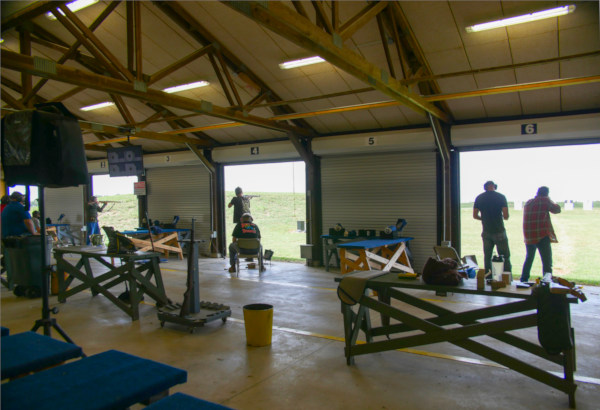
This is heartening — folks are shooting at Camp Perry again. Some normalcy has returned to the world (despite the ongoing pandemic). Though the CMP National Matches were cancelled in summer 2020, shooting returned, on a smaller scale, in the fall. The CMP hosted a Garand-Springfield-Modern and Vintage Military (GSMM) Rifle Match on Camp Perry’s Petrarca Range on September 14th.
Competitors on the line greeted each other with warm smiles and swapped stories of missed competition over the last few months – some traveling from as far as Virginia with the hopes of enjoying Camp Perry after the cancellation of the National Matches (typically an annual tradition for marksmen). Others admitted the Petrarca Match was their first time in competition since last year’s National Matches. So, for those in attendance, this event did represent a positive return to normalcy during this challenging year.
The GSMM Match was subject to strict health and safety guidelines. Participants practiced social distancing and wore masks when not firing. The CMP team also employed sanitation procedures for the facility.
The morning started off soggy as rain moved through the range area along the shores of Lake Erie, clearing off before the first relay to leave a gray backdrop. The weather quickly improved through early afternoon as the sun appeared and warmed the air, making for a pleasant return to the firing line for later relays.
Winning overall in the Garand competition was Jeffrey Cramer, 66, with a 266-3X Aggregate. Jace Diezman, 59, led the Springfield category with 266-2X, as SFC Charles Novak, 55, won the Vintage Military class, with a score of 254-1X. Joe Rondon, 53, won Modern Military with a score of 281-5X over the day.
Modern Kongsberg Electronic Targets for Rapid Scoring
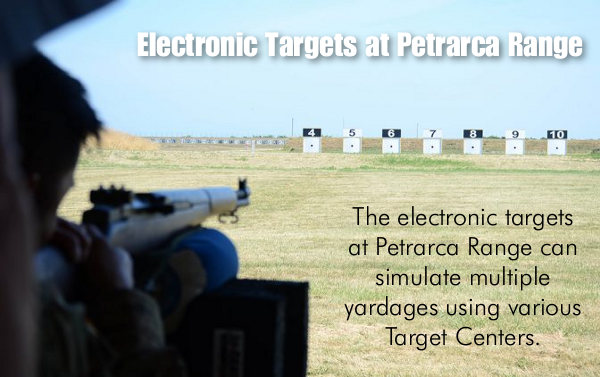
Petrarca Range is home to CMP Targets, powered by the Kongsberg Target Systems (KTS) of Norway. The lineup of electronic targets utilized on the range allows competitors to watch their shots on monitors located at each firing point eliminating the need for pit duty and dead range time.
This feature story comes from 5-time NRA National Long-Range Champion John Whidden. In this article John, who runs Whidden Gunworks, talks about the Palma rifle he has used at the Camp Perry and Camp Atterbury National Matches and other major competitions. This unique .308 Win prone rifle features a Barnard “P” action in a converted aluminum Anschutz “Precise” smallbore (rimfire) stock. The combo of Barnard action and Anschutz ergonomics is hard to beat, says John, who told us: “this is easily the best Palma rifle I’ve ever had.”
As a bonus, the Barnard “drop-in” required no modification of the Anschutz Precise stock. This means John can actually swap in his rimfire barreled action and shoot smallbore with the same stock.
Whidden’s Perfect Palma Match
Whidden secured his 2017 NRA Long Range National Championship title by shooting “clean” (not dropping a point) in the tough Palma competition. In the NRA Palma match, rifles must be .223 Rem or .308 Winchester, with metallic sights (no scopes). The match is conducted at three yardages, 15 shots at each distance of 800/900/1000 yards, with unlimited sighters at 800 and two sighters at 900 and 1000.
Whidden’s Championship-Winning Rifle
Since John captured his fifth Long Range crown with a superb performance in the Palma match, we thought we’d give readers a look at John’s very special Palma rifle. This unique .308 Win prone rifle features a Barnard “P” action in a converted aluminum Anschutz “Precise” smallbore (rimfire) stock. John told us this gun handles like no other: “After recoil, with this Anschutz stock, the sights fall right back on target — better than any other prone rifle I’ve shot”.
As a bonus, the Barnard “drop-in” required no modification of the Anschutz Precise stock. This means John can actually swap in his rimfire barreled action and shoot smallbore with the same stock.
Sling Rifle Evolved: The Ultra-Accurate Hybrid Palma Rifle
by John Whidden
The mental component of Long Range competitive shooting is always challenging but having tremendous confidence in the accuracy of your equipment is a huge benefit. There’s nothing to start your Palma match off well like knowing that you are shooting the most accurate Palma rifle you’ve ever owned.
After winning an NRA Long Range National Championship at Camp Perry, there are always plenty of questions about the equipment used by those at the top. Shooters are always looking to learn what is the best equipment at any given time so that when the time comes to spend our own hard earned dollars we can make the best choices. Even if you shoot an entirely different discipline knowing which manufacturers are making winning gear is very valuable.
Whidden .308 Winchester Palma Rifle
Action: Barnard “P” (three lugs, 60° bolt lift)
Barrel: Bartlein 32″, Light Palma contour, cryo-treated by 300 Below
Stock: Anschutz Precise aluminum smallbore stock, set up for centerfire barreled action
Trigger: Barnard Two-Stage adjustable
Whidden’s Wonder-Gun: German Stock, New Zealand Action, American Barrel
The Palma rifle I shot this year at Camp Perry is one that I have been super pleased with. I built the rifle early this year and the major components are a Barnard P action, Anschutz Precise smallbore stock, and Bartlein barrel. The caliber is .308 Win, as dictated by the Palma rules. Palma matches are fired from 800, 900, and 1000 yards utilizing iron sights only. No optical sights are allowed.
The Anchutz Precise stock is so well-designed that once I finished adjusting the details, I realized that my hold was about 1/3 smaller than with the stocks I shot previously. While in recoil the gun will track vertically and fall back down right on my own target just as it should. In the past, with my other Palma rifles, it was frankly sometimes a struggle to get them to settle back on target after a shot.
Whidden Gunworks has installed a variety of different actions in the Anschutz Precise stocks. Though the stocks are designed for the .22 LR caliber 2013 action rifles, we’ve successfully installed Barnard, Kelbly, Bat, Nesika, and Remington clone actions into them. The Barnard Model P makes a particularly simple installation because there is no modification necessary to the stock at all. A competitor can then shoot both his centerfire rifle as well as his smallbore gun in the exact same stock. The location of the trigger and bolt handle on the Barnard are positioned just right to make this work. Other actions do require at least some amount of modification to the stock, and we have found the Barnard works the best.
Barnard manufactures several models of actions as part of their lineup. All of the actions in the lineup use three lug bolts which give a shorter 60-degree bolt lift when opening and closing. All of the critical surfaces are machined after heat treating. This means that they are exceptionally true and square, more so than other actions. The Model P action is most familiar to Palma and F-Class shooters and are commonly seen on the firing line. The fact that Model P actions include an excellent two-stage trigger makes also the pricing very attractive.
Based on my previous excellent experiences, I selected Bartlein barrels for this rifle. When shooting internationally in the Palma matches we are restricted to 155 grain .308 bullets, but I made the unusual choice of a 1-10″ twist for these bullets. I’ve shot this fast twist for some years with the 155s with good success and it’s pleasing to know that Bryan Litz is finding benefits in some cartridges to shooting faster twist rates than we previously thought we needed. The chamber is the 2011 Palma and the barrel is a Light Palma contour finished at 32” length. The barrel was cryo-treated by 300 Below. The point of impact isn’t changed at all by barrel heating and the accuracy is incredible regardless of the temperature of the barrel. This can’t be said of all the barrels I’ve owned.
Get Your Own Wonder-Gun from Whidden Gunsworks
Like what you see? Whidden Gunworks can build you a rig like this, fitting a centerfire barreled action in the Anschutz Precise stock. John tells us: “Call us to find the current all-up price for a special rifle like this with Barnard or other suitable custom action, and Anschutz stock. We attempt to keep all of the parts except the stock in inventory, so lead time should be under eight (8) weeks.”
Stock Offers Great Adjustability One thing that is quickly noticed about the Anschutz Precise stock is its adjustability. The engineers did a very good job of allowing many of these adjustments to be made while in the shooting position, most notably the cheekpiece adjustments. When a shooter picks up a Precise stock for the first time they also notice how narrow the fore-end is. This really contributes to reducing the pain in the forward hand in prone when shooting with a sling. This stock is, by far, the most comfortable sling stock I’ve ever handled.
This rifle was very accurate right away and very comfortable to shoot. I’ve built some really good shooting Palma rifles but this is easily the best Palma rifle I’ve ever had. The Barnard action with its superb quality and excellent two-stage trigger has been the best choice I could have made. When you can go to the firing line knowing that you have the very best, the foundation for success has been set.
Looking downrange at the 600-yard targets. Camp Perry photo courtesy Dennis Santiago.
Shooting USA TV has an excellent episode this week, with some great features for competitive shooters and fans of historic military rifles. Shooting USA covers the President’s 100 Match at Camp Perry, one of the most prestigious shooting competitions held each summer. In addition, Shooting USA spotlights the M1 Garand rifle. A legendary firearm that helped win WWII, the .30-06 Springfield M1 Garand remains popular in vintage military matches. There is also a major Garand Match each summer at Camp Perry. You can watch Shooting USA Wednesday nights on the Outdoor Channel at 8:00 pm Eastern/Pacific, 9:00 pm Central. Or, you can view each episode the following Thursday (and thereafter) on Vimeo.com
Shooting USA is available On Demand via Vimeo.com. Watch a single episode for $0.99, or get a full-month subscription for $3.99 and watch as many shows as you like with limited commercial interruptions.
» SHOOTING USA Covers the President’s 100 Match
The historic National President’s 100 Match is a huge event. In recent years, there have been over 1000 competitors, making this one of the biggest rifle events of the year. First held in 1878, the President’s 100 match is richly steeped in history. The top 100 competitors overall are designated as the President’s 100. They receive President’s 100 medallions and certificates.
Origins of the President’s Match The National Rifle Association’s President’s Match was instituted in 1878, as the American Military Rifle Championship Match. In 1884, the name was changed to the President’s Match for the Military Rifle Championship of the United States. It was fired at Creedmoor, New York until 1891. In 1895, it was reintroduced at Sea Girt, New Jersey. Today, the match is held at Camp Perry, Ohio.
The President’s Match was patterned after the Queen’s Match for British Volunteers. That British competition was started in 1860 by Queen Victoria and the NRA of Great Britain to increase the ability of Britain’s marksmen following the Crimean War.
The tradition of making a letter from the President of the United States the first prize began in 1904 when President Theodore Roosevelt personally wrote a letter of congratulations to the winner, Private Howard Gensch of the New Jersey National Guard.
After a hiatus in the 1930s and 1940s, The President’s Match was reinstated in 1957 at the National Matches as “The President’s Hundred.” The 100 top-scoring competitors in the President’s Match were singled out for special recognition.
» Shooting USA Features the M1 Garand Vintage Military Rifle
This week’s Shooting USA episode tracks the origins and history of the Garand. An M1 Garand is a great addition to anyone’s personal firearms collection. It is a piece of living history — plus it can be used in Vintage Military rifle matches. Here are some resources for M1 Garand owners.
M1 Garand History
Jean Cantius Garand, also known as John C. Garand, was a Canadian designer of firearms who created the M1 Garand, a semi-automatic rifle that was widely used by the U.S. Army and U.S. Marine Corps during World War II and the Korean War. The U.S. government employed Garand as an engineer with the Springfield Armory from 1919 until he retired in 1953. At Springfield Armory Garand was tasked with designing a basic gas-actuated self-loading infantry rifle and carbine that would eject the spent cartridge and reload a new round. It took fifteen years to perfect the M1 prototype model to meet all the U.S. Army specifications. The resulting Semiautomatic, Caliber .30, M1 Rifle was patented by Garand in 1932, approved by the U.S. Army on January 9, 1936, and went into mass production in 1940. It replaced the bolt-action M1903 Springfield and became the standard infantry rifle known as the Garand Rifle. During the World War II, over four million M1 rifles were manufactured.
Shooting Sports USA (SSUSA) has a good article on the origins and history of the National Rifle Association. This timeline feature covers the first 36 years of NRA history from 1871 to 1907. The NRA was founded in 1871, and 1907 marked the first year of Matches at Camp Perry, Ohio.
SSUSA explains the NRA’s original mission: “The NRA’s program during its youthful years centered mainly on improving marksmanship among the military. Rifle tournaments at ranges in Creedmoor (NY), Sea Girt (NJ), and Camp Perry (OH) captured the country’s spirit of nationalism and resulted in key improvements in rifles and target scoring. NRA also set standards for military rifle training and even inspired the federal government to form its own segment within the War Department to focus on promoting rifle practice among soldiers as well as civilians.”
1871 — A group of New York National Guardsmen founded the National Rifle Association to promote marksmanship training. Figures such as Capt. George Wingate had called for better rifle marksmanship to support the nation’s defense.
1872 — The NRA acquires Creed’s Farm in Long Island, New York for $26,250. Renamed “Creedmoor”, this becomes the NRA’s first range. The first match was held in 1873.
1874 — The NRA hosts its first International Match, shot at the Creedmoor Range in New York.
The First-Ever Creedmoor Challenge Match in 1874
The Irish International Shooting team arrived in New York on the 16th of September and proceeded to “take in the sights”, which was understandable, before some practice at the Creedmoor range. On September 26th they presented themselves for the match with confidence and in high spirits. The crowds that day were reported to be between 5,000 and 10,000 strong, which showed the huge support already growing for the fledgling sport in America.
The course of fire was 15 shots to each man at 800, 900, and 1000 yards. Unfortunately, the details of each mans scores at the individual distances have been lost to time but we do know that the Americans were well ahead after the 800-yard shoot. The Irish then caught up after the 900-yard and finished the 1000-yard shoot ahead by 1 point. The Americans still had one man left to shoot and it came down to his very last shot with which he scored a 4 giving the American team the win over the Irish by 3 points.
1892 — The NRA moves its Annual Matches to the Sea Girt Range in New Jersey, which was less than 60 Miles from New York City, NY. The Sea Girt Range was maintained by the New Jersey State Rifle Association, founded in 1878.
1903 — The U.S. War Department sets up a National Board for the Promotion of Rifle Practice (NBPRP). In 1903, an amendment to the War Dept. Appropriations Bill established the NBPRP to promote both Military and Civilian marksmanship. This government advisory board became the predecessor to today’s Corporation for the Promotion of Rifle Practice and Firearms Safety that now governs the CMP.
1907 — The NRA commences National Matches at Camp Perry, Ohio.
History of Camp Perry
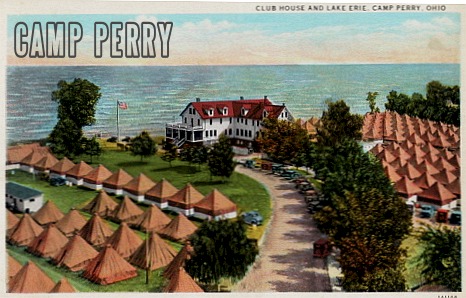
The National Matches have been held at Camp Perry since 1907. The range is located along the shores of Lake Erie in northern Ohio near Port Clinton. The site was first acquired in 1906, in response to the need for a larger facility for military training and the NRA’s shooting programs. In 1906 Gen. Ammon B. Crichfield, Adjutant General of Ohio, ordered construction of a new shooting facility on the shores of Lake Erie, 45 miles east of Toledo, Ohio. The original land for Camp Perry was purchased in 1906, and the reservation was named after Commodore Oliver Hazard Perry, the American naval commander who won the Battle of Put-in-Bay during the War of 1812.
On August 19, 1907, Cpl. L. B. Jarrett fired the first shot at the new Camp Perry Training Site. And that year, 1907, Camp Perry held its first National Pistol and Rifle Championship events. This location has hosted the annual NRA National Matches ever since. Today, over 4,000 competitors attend the National Matches each year, making it the most popular shooting competition in the western hemisphere.
Federal legislation originally launched the National Matches. The 1903 legislation also established the National Matches, commissioned the National Trophy and provided funding to support the Matches.
CMP-Affiliated Clubs May Continue Sanctioned Matches with Restrictions
While the Civilian Marksmanship Program (CMP) has cancelled its National Events at Camp Perry this summer, the CMP has stated that club-level CMP matches may proceed, provided important health practices are followed.
The Civilian Marksmanship Program recently announced that affiliated clubs may resume CMP-sanctioned rifle and pistol matches those events, provided state and local guidelines and safe range practices are being followed.
The CMP states: “The CMP has canceled all of its match events based on the large volume of participants at its marksmanship events. However, clubs who have relatively manageable numbers of attendees may use discretion in conducting activities for safety reasons. We will continue to monitor the current environment and follow practices in the best interest of our staff, customers and participants regarding future events.”
“In the best interest of everyone involved, the CMP is not opposed to affiliated clubs holding sanctioned matches, as long as they provide a safe environment for participants, range safety personnel and spectators,” said Christie Sewell, CMP Programs Chief.
The CMP Recommends Affiliated Clubs Follow Guidelines to Keep Facilities Safe:
1. Following state and local laws and adherence to health advisories
2. Limiting/spacing the number of participants who congregate for safety briefings, etc.
3. Spacing out firing points, leaving empty firing points between shooters
4. Ensuring participants wear masks, covering their nose and mouth.
5. Washing hands frequently and/or providing disinfectant wipes.
6. Cleaning common surfaces such as shooting benches and equipment.
(Editor: This cleaning should include public restrooms).
“In our sport during this time, we need to practice safety on two fronts – safe firearms handling at all times and providing a healthy place for competitors to hone their skills. That means practicing appropriate social distancing, disinfecting common surfaces and screening participants for health concerns,” added Christie Sewell. Visit the CMP website at www.TheCMP.org for more information.
The Civilian Marksmanship Program (CMP) issued a statement yesterday, April 22, 2020, announcing the complete cancellation of the 2020 National Matches at Camp Perry — all rifle and pistol matches are cancelled. Sadly, due to the Coronavirus Pandemic, and concerns about ongoing stay-at-home and social distancing orders, the CMP declared that there will be no Camp Perry National Matches in 2020:
Official CMP Statement about 2020 National Matches
After thoughtful consideration and reflection, the Board of Directors of the Civilian Marksmanship Program announces the cancellation of the 2020 National Matches at Camp Perry.
“This decision was not arrived at lightly, but was prompted by restrictions resulting from the COVID-19 pandemic. These matches date back to 1903 and have been held at Camp Perry since 1906,” said Judith Legerski, CMP Board Chairman.
“The health and safety of our competitors, participants, vendors, military support, volunteers and staff members is of the upmost importance — overriding even the historical imperative of maintaining the continuity of the Matches,” agreed Legerski, with Chief Operating Officer Mark Johnson and Programs Chief Christie Sewell.
“We were unable to come up with a manner in which we could safely produce the Matches. Housing and pit duty were amongst the many insurmountable problems faced by the CMP Board,” Legerski explained.
The CMP looks forward to the 2021 National Matches at Camp Perry as the best marksmanship celebration ever! In the meantime, please stay safe and healthy at home, as we prepare for the new normal ahead of us.
All CMP operations have been shut down since mid-March and a full resumption of business remains undetermined. Full refunds will be made to those who have already registered.
The Civilian Marksmanship Program (CMP) is closing all its facilities and halting all scheduled activities from Monday, 3/23/2020 through Monday, 4/6/2020. During this period the CMP recommended that all CMP match sponsors “cancel their matches until some degree of normalcy returns.” The CMP issued this statement today:
Greetings. Many are facing difficult times in regard to the recent Corona virus outbreak and the CMP community is among them. We are grappling with the status of many of our current and upcoming programs, and unfortunately several events will be canceled or altered as a result.
The federal government’s Centers for Disease Control and Prevention has proclaimed that all events with attendance of 50 or more should be canceled immediately. The CMP has complied with this directive and we are notifying customers and participants accordingly.
The CMP is shutting down all of its facilities and activities for the next two weeks, beginning Monday, March 23, with plans to return Monday, April 6. During that time, the CMP will monitor conditions and will report changes to that plan as required. CLICK HERE for additional closure information.
We encourage all CMP match sponsors to cancel their matches until some degree of normalcy returns. It is in the best interest of the CMP community to take positive precautions rather than deal with potentially damaging consequences otherwise.
The CMP thanks you for your understanding during these trying conditions. We look forward to greater times ahead and getting back to the business of firearms safety and marksmanship!
Competitors take note — The CMP Western Games will continue as scheduled at Ben Avery in Phoenix this week, from March 13 (today) through March 22, 2020. However, the CMP has cancelled some other events scheduled this spring due to concerns over the Coronavirus (COVID-19) (see below).
Regarding the Western Games, the CMP states: “The Western CMP Games and HP Matches at Ben Avery Shooting Facility, AZ [are] to be Conducted as Scheduled. Participants need to be mindful of sound general health practices to help prevent communication of the virus (frequent hand washing, social distance with others, etc.).”
The Western Games begin Friday, March 13 and conclude Sunday, March 22.
CMP Event Cancellations
1. CMP National JROTC Championship — Camp Perry, OH (March 19-21)
Changed to Postal Match.
This championship event will continue as a postal match with finals. Details will be emailed to teams and coaches as soon as they are finalized.
2. CMP 3-P Regional Airgun Championships — Camp Perry, OH – Sandy, UT – Anniston, AL (March 26-28 and April 2-4)
Changed to Postal Matches.
These regional events will continue as postal matches with finals. Details will be emailed to teams and coaches as soon as they are finalized.
3. CMP 3-P Air Rifle Junior Summer Camps and Clinics Program — Multiple Locations (June, July and August). CANCELLED Completely.
On the Watch List:
CMP 3P Air Rifle National Championship — Camp Perry, OH
(Sporter – June 25-27 and Precision July 11-13)
At this point the CMP is planning to conduct the CMP National 3-P Championship in June and July, but will be monitoring the situation and will announce additional cancellations if needed.


 “The NRA has diligently protected our right to keep and bear arms longer than any other organization”, NRA President Carolyn Meadows said. “We are humbled to serve our more than 5 million members and all law-abiding gun owners. We invite you to join our organization as we celebrate this historic milestone.” To take part in NRA’s 150th Anniversary celebrations, you can sign-up online or call 1-866-672-2020 to join.


 Trigger, Stock Adjustment and Other Features


 Stock Cast and Cant Adjustment Procedure






 One thing that is quickly noticed about the Anschutz Precise stock is its adjustability. The engineers did a very good job of allowing many of these adjustments to be made while in the shooting position, most notably the cheekpiece adjustments. When a shooter picks up a Precise stock for the first time they also notice how narrow the fore-end is. This really contributes to reducing the pain in the forward hand in prone when shooting with a sling. This stock is, by far, the most comfortable sling stock I’ve ever handled.


 The National Rifle Association’s President’s Match was instituted in 1878, as the American Military Rifle Championship Match. In 1884, the name was changed to the President’s Match for the Military Rifle Championship of the United States. It was fired at Creedmoor, New York until 1891. In 1895, it was reintroduced at Sea Girt, New Jersey. Today, the match is held at Camp Perry, Ohio.