Earlier this week, on July 27th, the CMP held the 2016 Vintage Sniper Rifle Match at Camp Perry. This unique event is a two-man team competition using scoped rifles of WWI and WWII Vintage. This has become of of the most popular rifle matches held at Perry, with 259 teams competing this summer. Many competitors use some version of the M1903 Springfield, but you’ll also see scoped M1 Garands, K31s, Mausers, and even a Lee-Enfield or two. (Semi-Auto shooters are scored separately). This year the Vintage Sniper Match was won by the “Yogi & BooBoo” family team of Silas Fentress and Wesley Fentress, with a 396-13X score. Close behind was runner-up duo Donald Schedler and John Watson (394-13X). Winning the semi-auto division were Brian Dobish and Clayton Maugans (373-8X).
Two-person teams will fire 10 rounds in 20-second intervals from scoped vintage military rifles set on sand bags. One team marksman shoots from the prone position at 300 and 600 yards, while the other serves as a spotter to relay shot position. Marksman and spotter switch positions on the firing lines, allowing each teammate to play both roles. Scores are then combined for an Aggregate team total.
Two M1 Garands, fitted with scopes and lace-on cheekpads.
Who can identify this rifle, with its unusual scope mount?
Our friends at Criterion Barrels have written an interesting article about the 2014 Vintage Sniper Rifle Match. It you want an “insider’s perspective” on the 2014 Match, plus Vintage Sniper gunsmithing tips, read this article. Here are some highlights:
About the Match and the Rifles
The Vintage Sniper Match was the brainchild of Hornady’s Dave Emary. The competition was inspired by his father, a World War II scout sniper, who carried a rifle similar to the 1903A4 rifle builds that can be found today on the Camp Perry firing line. Bob Schanen worked alongside Dave and the CMP staff in establishing the various competition rules prior to the first official Vintage Sniper Match in 2011. The match developers made a point to offer some level of flexibility in rifle configuration, allowing specific types of non-issue optics and rifle rebuilds. This helped make the match more inclusive.
Hornady’s Dave Emary and “Gunny” R. Lee Ermey (right):
Camp Perry — The Venue
The hallowed grounds of Camp Perry have hosted some of the nation’s finest shooters each summer for more than a century. Some of the world’s greatest marksmen have accomplished remarkable feats on the ranges of this lakeside military outpost. Located on the coast of Lake Erie, Camp Perry is positioned just outside of the scenic town of Port Clinton, Ohio. It is our firm belief that every shooter should make the pilgrimage to the Camp Perry at least once in their lifetime. If not participating in an event, visitors should at least make an attempt to meet the competitors, witness the wide selection of firearms used by participants, and pay a visit to the various vendors on base.
When the NRA and CMP issued new rules allowing the use of 4.5X optics for Service Rifles, some asked: “will scopes really make a difference?”. The answer is a resounding “Yes”, based on match results just in from Camp Perry. In the prestigious National President’s 100 Match fired July 25th, the first-, second-, and third-place finishers all had scopes. Keith Stephens won the match, SFC Evan Hess took second, and Hugh Reich finished third — an all-optics Podium. Both winner Keith Stephens and third-place Hugh Reich were running March 1-4.5x24mm scopes on their rifles. And there were many other optics users among the Top 20 competitors in the President’s 100 Finals. (The President’s 100 Match concludes with a single 10-round shoot-off at 600 yards, fired by the best 20 shooters from the prelims.)
The March 1-4.5x24mm scope was designed expressly for Service Rifle competition and tactical applications (it will focus down to 10 yards). This first-focal-plane optic features 1/4″ MOA clicks and optimal eye relief for AR-type rifles. March’s optics experts tell us: “This scope was specifically designed for the Service Rifle match shooter. Oversized tactical turrets allow for easy windage and elevation adjustments. High-quality ED (low distortion) lenses provide superior image resolution”. Current retail price for this scope is $2338.00 from Bullets.com.
That is a significant investment to be sure. But if you asked President’s 100 Match Winner Keith Stephens, he’d probably tell you his March 1-4.5x24mm scope was worth every penny…
Keith Stephens won the prestigious 2016 President’s 100 Match at Camp Perry, as well as the Alice Bull Trophy for the highest-scoring civilian.
Our friend Dennis Santiago is at Camp Perry, where today (25 July) he is shooting the National President’s 100 Rifle Match — a competition steeped in history. First fired in 1878, this match was incorporated into the National Match program in 1903. The President’s Match was modeled after the famous British Queen’s Prize Match. Originally, the Match winner received a letter of congratulations from the President of the United States.
In the President’s Rifle Match, all competitors fire 10 shots standing, 10 shots rapid prone, and 10 shots prone slow fire to determine who makes the President’s 100 list. The top 20 shooters then advance to a final where they fire a 10-shot stage at 600 yards. This 20-marksman Finals Shoot-off now concludes the President’s Rifle Match.
Origins of the President’s Match
The President’s Match originated in 1878 as the American Military Rifle Championship Match. In 1884, the name was changed to the President’s Match for the Military Rifle Championship of the United States. It was fired at Creedmoor, New York until 1891. In 1895, it was reintroduced at Sea Girt, New Jersey. Today, the match is held at Camp Perry, Ohio.
The President’s Match was patterned after an event for British Volunteers called the Queen’s Match. That British competition was started in 1860 by Queen Victoria and the NRA of Great Britain to increase the ability of Britain’s marksmen following the Crimean War.
The tradition of making a letter from the President of the United States the first prize began in 1904 when President Theodore Roosevelt personally wrote a letter of congratulations to the winner, Private Howard Gensch of the New Jersey National Guard.
After a hiatus in the 1930s and 1940s, The President’s Match was reinstated in 1957 at the National Matches as “The President’s Hundred”. The 100 top-scoring competitors in the President’s Match are singled out for special recognition.
Quadruple Distinguished Marksman
You are looking at a very special human being — the world’s only holder of FOUR Distinguished Marksmanship Badges. While competing in the 2016 National Trophy Pistol Matches at Camp Perry, Team Lapua’s Steve Reiter (Tucson, AZ) became the first Quadruple Distinguished Badge Marksman in history. This past week, 74-year-old Reiter received his most recent Distinguished Badge, the new .22 Rimfire Pistol Badge, which has only been in existence since 2015. Before that, Reiter had earned his Pistol Distinguished Badge in 1972, his International Badge in 1973, and his Rifle Distinguished Badge in 1998. Over his four-decade competitive career, Reiter has competed in free pistol, standard pistol, air pistol, and centerfire events as well as rifle.
Earning FOUR Distinguished Badges is a great achievement — something that has never been done before, much less by a Senior shooter. We offer our congratulations to Steve for achieving this first-ever, shooting milestone.
Practice and Hard Work Were Key Says Reiter
Reiter told us: “It’s a big honor, really. When you’re the first at anything, it’s a big honor. It feels great to be the first.” Steve added: “Most people don’t understand how much work it is. And it being a CMP badge … it means something.”
To be a successful marksman, Steve explained, it takes dedication and lots of practice: “You have to work pretty hard. More or less, you have to do a lot of practicing and a lot of dry-firing, and actually work at it. You can’t come out here and just shoot. You’ve got to really work at it, like anything else, to get to the top of your field.”
A former U.S. Army Reserve Team member, Reiter’s list of shooting honors over his 40-year competition career is truly remarkable:
Member of the 1980 Olympic team in Free Pistol
Five-time National Champion at Camp Perry
34 Overall National Championship Titles
44 National Records
40+ Regional Championships
Two-time President’s 100 Champion in Pistol
Two-time National Trophy Individual Match Champion in Pistol
10-time Winner of the National Match High Senior Pistol Trophy
Five-time Winner of Citizens’ Military Pistol Trophy
Canada International Service Pistol Champion
Two-time Free Pistol National Champion
Standard Pistol National Champion
Seven-time Interservice Championship Team Member
In addition to these titles, Reiter also set other numerical scoring records, including the best .22 Aggregate (899), and the best Three-Gun Aggregate Score (2671).
Team Lapua — Supporting Excellence
Lapua, or more officially Nammo Lapua Oy, is part of the large Nordic Nammo Group. Our main products are small caliber cartridges and components. The Lapua cartridge factory was established in 1923. From a modest and practical beginning, Lapua has grown into one of the most respected brands in the industry. The best shooters in the world choose Lapua cartridges and components. In 2014, Nammo acquired the Vihtavuori smokeless powder factory.
Camp Perry has entered the electronic age — Perry’s first electronic targets “go live” this week. On Thursday, July 21, the CMP hosts a Ribbon Cutting Ceremony to celebrate the installation of its new Kongsberg electronic rifle and pistol targets on Camp Perry’s Petrarca Range. During the afternoon, guests can test out the new targets with their own suitable firearms, or use “loaner” AR-15 rifles and M9 pistols provided by the CMP.
The first ten electronic rifle targets, placed at 200 yards, are now ready for action on the Petrarca Range. Reduced target centers will allow shooters to practice for longer distances as well. the smaller pistol/smallbore targets are mounted in portable carriers so they can be stationed at 25 or 50 yards. Three pistol targets are now in place (see photo at right).
This is the beginning of a process to supply many ranges at Camp Perry with state-of-the-art Kongsberg (KTS) electronic targets similar to those installed at the CMP’s Talladega Marksmanship Park. However, the CMP is NOT planning a whole-scale replacement of all of Camp Perry’s old-fashioned targets.
CMP Offers Free “Test Drives” of Kongsberg Electronic Targets
Petrarca Range will be open throughout the National Matches to allow competitors and visitors to try the KTS targets for FREE. During this time, guests are encouraged to bring their own firearms and ammo to use at the range as no rentals will be available other than the day of the Ribbon Cutting. After the National Matches are over in August, the range will be open several Mondays for Open Public Shooting, with a small fee charged to shoot on the electronic targets.
Video Demonstrates Kongsberg Target System
KTS Electronic Targets use multiple acoustic sensors to “hear” the shot and accurately triangulate its location. Shot placements (and score values) are calculated instantly and transmitted in real time to display screens at the shooting stations. These kind of targets allow matches to run faster, with no pit duties required. All scoring is handled by the KTS central “brain” which can outputs scores to linked electronic scoreboards.
Monitors Display Score and Shot Location Instantly Each Kongsberg target connects to a monitor that displays the hit locations to the shooter. Easy push-button controls allow the shooter to cycle through hits and options without having to change positions. The monitors employ non-glare glass protected by an aluminum frame that acts as a shade. This ensures good visibility for the shooter.
These state-of-the-art electronic targets are also used in the CMP’s new Talladega Marksmanship Park, where they have proven to be very popular with shooters. NOTE — the CMP is not planning a whole-scale replacement of all of Camp Perry’s old-fashioned targets. However the CMP hopes to modernize the Camp Perry facility, by installing some electronic targets on all Camp Perry ranges by summer 2018.
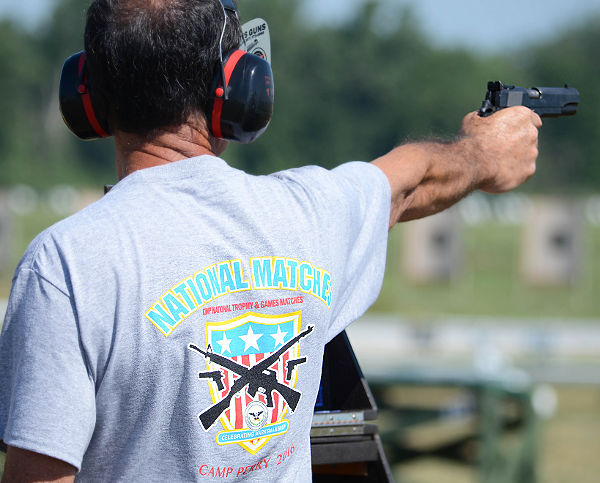
The nation’s top bullseye pistol shooters were at Camp Perry last week for the NRA National Trophy Pistol Championships. If you’ve every wondered what it takes to win a pistol match using the classic, one-handed hold, here are some tips from one of the best ever, Brian “Gunny” Zins, 12-Time NRA National Pistol Champion.
Brian has authored an excellent guide to bullseye pistol shooting. Brian’s Clinic on the Fundamentals recently appeared in The Official Journal of the New York State Rifle & Pistol Association. The CMP scanned the story so you can read it online. CLICK HERE to read full article.
Top Tips from Brian Zins:
Trigger Movement: If trigger control is ever interrupted in slow fire the shot needs to be aborted and the shot started over.
Relationship between Sight Alignment and Trigger Control: Often when the fundamentals are explained these two are explained as two different acts. Well, truth be told it’s really kind of hard to accomplish one without the other. They have a symbiotic relationship. In order to truly settle the movement in the dot or sights you need a smooth, steady trigger squeeze.
Trigger Finger Placement: Where should the trigger make contact on the finger? The trigger should be centered in the first crease of the trigger finger. Remember this is an article on Bullseye shooting. If this were an article on free pistol or air pistol it would be different.
Proper Grip: A proper grip is a grip that will NATURALLY align the gun’s sights to the eye of the shooter without having to tilt your head or move your or move your wrists around to do that. Also a proper grip, and most importantly, is a grip that allows the gun to return to the same position [with sights aligned] after each and every shot. The best and easiest way to get the proper grip, at least a good starting position… is with a holster. Put your 1911 in a holster on the side of your body[.] Allow your shooting hand to come down naturally to the gun.
After a rip-roaring Opening Ceremony, the 2016 National Matches at Camp Perry commenced with the handgun Small Arms Firing School (SAFS) on July 11th, followed by Excellence-In-Competition (EIC) pistol matches on July 12th. The SAFS was led by USAMU, Military Team, and CMP instructors. Following classroom instruction and practice on the range, SAFS participants fired a true M9 EIC Match with the goal of earning points towards the prestigious Distinguished Badge.
On July 12th, the CMP .22 Rimfire and Service Pistol EIC matches were held. These matches were hugely popular — with 480 Rimfire competitors and 400 Service Pistol shooters. This year, there was plenty of talent on the firing line. Of the top 50 Service Pistol shooters, 46 were Distinguished, including the top 18 competitors.
The USAMU’s SSG Greg Markowski won the Service Pistol EIC Match with a score of 293-11X. Fellow USAMU team members SFC Lawrence Cleveland (286-5X) and SFC James Henderson (284-9X) finished second and third respectively.
In the .22 Rimfire EIC Pistol Match a USAMU shooter again took top honors. SFC Michael Gasser shot 293-5X to become the overall winner. Close behind, with identical 292-11X scores, were Jonathan Shue and SGT Ryan Franks. It’s notable that both Shue and Franks had many more Xs than SFC Gasser, the overall winner.
Talented shooters stood shoulder to shoulder on the firing line…
The license plate says it all — perfection at Perry is a 10X.
There were 480 registered competitors in .22 Rimfire EIC match.
USAMU Shooters won both EIC pistol matches (.22 Rimfire and Service Pistol).
Many U.S. Military Service Personnel attended the EIC Matches
It took decades of competition to acquire all those patches — that’s dedication to the sport.
Establishing zero at 300 yards. Dennis says: “Wow you can really drive that crosshair into the center of the bull with ease” with the 4.5X optic.
Dennis Santiago recently received the all-new Nightforce Competition SR Fixed 4.5x24mm Service Rifle scope. He will be using this at Camp Perry soon, so he needed to get zeros (and click values) for all his yardages. Off he headed to the Burbank Rifle and Revolver Club (BRRC) for a Zero Session.
After establishing a 100-yard, base-line zero from the bench, Dennis put on his sling and jacket to work out to 200, 300, and 600 yards. When shooting at 200, Dennis said: “The target is huge in that 4.5X scope. Fun to drive. Next stop NRA Week at Camp Perry!”
Above you can see Dennis working up two elevation zeroes for 600 yards. First he fired a center hold using the crosshair inside the circle to “pie” the bull. Next, he shot with a 12 o’clock hold using the lower leg of the crosshair to bisect the target. You can see the target at 600 yards in the top right of the photo.
Zeroing Task accomplished, Dennis is ready to take this rifle to Camp Perry for the National Championships. He says: “In the end, it’s always about your handy-dandy notebook.”
New 2016 CMP/NRA Rules Allow 4.5X Optics
Dennis Santiago explains the Service Rifle rule changes that now allow scopes up to 4.5X max magnification (and max 34mm objective):
“Per the 2016 Rulebooks of the CMP and NRA, today’s Service Rifle is now defined to include an M-16/AR-15 variant with an optical sighting system not to exceed 4.5X magnification. So, this optic-equipped rifle goes head-to-head with the match-tuned M-16A2/AR-15A2 iron sight guns in the same class. The rules were updated to take into account that some military branches no longer train service members to shoot iron sights as their primary marksmanship method and have switched to reliance combat optics. The rules were debated and tried in 2015 and codified at the beginning of this year. This will be the first Nationals where the old and new generation guns compete side-by-side.
Here is my personal prediction: There will be improved scores by Expert class shooters who figure out how to work with optics jumping into Master class. At the High Master level, there may be a slight rise in numerical scores but there will be a massive jump in X-Count. EICs will remain the all-out race they’ve always been; whoever makes the fewest mistakes wins the day.”
On Monday, July 11th, the CMP and NRA host the 2016 First Shot Ceremony, the official opening of the National Trophy Pistol and Rifle Matches at Camp Perry, Ohio. The ceremony kicks off at 9:30 am and is open to the public.
The event begins with music from the 122nd Army Band. Next come aerial fly-overs by a Navy TBM Avenger, a WWII-era B-25 bomber, and the Yankee Air Museum’s Yankee Lady B-17. Vintage military vehicles (jeeps and tanks) will also be on display during the ceremony.
After the aircraft, a salute will be fired from four artillery pieces, which span 200+ years of the nation’s history. The “Guns of July” will include: War of 1812-era cannon, Civil War-era cannon, modern-era 37mm anti-aircraft gun, and last but not least, Camp Perry’s own 70mm cannon.
The distinguished First Shot Speaker will be CMP Board Member, Oscar Mahlon Love, a former Commissioner of the New Mexico State Police and Civilian Aide Senior to the Secretary of the Army. After the speech Mr. Love will fire the first official shot of the National Matches down Rodriguez Range.
Birds-Eye View of Camp Perry Ranges
We know many of our worldwide readers may never have a chance to visit Camp Perry in person, but they are still interested in this historic facility on the shore of Lake Erie, near Port Clinton, Ohio. If you’ve always wanted to see what Camp Perry looks like, here are a series of “Birds-eye” photos taken from the Beach Tower.
We know that many of our readers will be headed to Camp Perry soon to compete at the National Matches. Most Camp Perry rifle shooters will load their ammunition in advance and then pack the ammo in their car/truck for the drive to Perry. What’s the best way to hold that precious ammo? Well we like the big, lockable ammo crates from MTM. We think these are more way convenient than old mil-surplus metal cans, which are pretty narrow, limiting your options.
These stackable, lockable “Ammo Crates” hold up to 85 pounds of shooting supplies. Choose from two different versions. The Medium (4.5″-deep) Ammo Crate is good for smaller boxes of bullets, factory ammo, or shotshells, while the Large (7.25″-deep) Ammo Crate is ideal for packing the plastic 50-count and 100-count plastic ammo boxes. We like the Large-size, deeper crate for the added capacity since we typical carry our cartridges in the large 100-count MTM boxes with carry handles.
Purchasers like these big brown Ammo Crates. Read the user reviews on Amazon. One purchaser (B-Lo) states: “This thing is sweet and fully-loaded doesn’t flex and has good, tight locking lid/handles. A must have for anyone looking to store or transport larger quantities of ammo”. Another verified purchaser (Go-Navy) wrote: “5 Stars — I have purchased four of these over the last several months. Construction, dimensions, lock ability are all outstanding. When I saw them on sale today … I grabbed another four.”


 The President’s Match was patterned after an event for British Volunteers called the Queen’s Match. That British competition was started in 1860 by Queen Victoria and the NRA of Great Britain to increase the ability of Britain’s marksmen following the Crimean War.
 Quadruple Distinguished Marksman
 Team Lapua — Supporting Excellence
 The first ten electronic rifle targets, placed at 200 yards, are now ready for action on the Petrarca Range. Reduced target centers will allow shooters to practice for longer distances as well. the smaller pistol/smallbore targets are mounted in portable carriers so they can be stationed at 25 or 50 yards. Three pistol targets are now in place (see photo at right).
 Each Kongsberg target connects to a monitor that displays the hit locations to the shooter. Easy push-button controls allow the shooter to cycle through hits and options without having to change positions. The monitors employ non-glare glass protected by an aluminum frame that acts as a shade. This ensures good visibility for the shooter.

 The nation’s top bullseye pistol shooters were at Camp Perry last week for the NRA National Trophy Pistol Championships. If you’ve every wondered what it takes to win a pistol match using the classic, one-handed hold, here are some tips from one of the best ever, Brian “Gunny” Zins, 12-Time NRA National Pistol Champion.