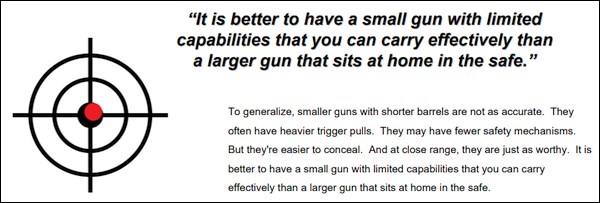
Millions of Americans now exercise their Constitutional right to “keep and bear arms”, specifically to carry a pistol for personal protection and home defense. In response to the rapid growth of the CCW (Concealed Carry Weapon) market, numerous gun-makers have introduced compact handguns specifically designed for concealed carry. These “Carry Guns” tend to be smaller, lighter, with smoother, rounded edges on slide and frame. Today, many modern carry guns are also “Optics Ready”, meaning they have slides that can accept smaller red dot sights. And some companies are now selling handguns with the optics pre-installed.
Top Ten Best Carry Pistols for the Money
Here the Honest Outlaw Channel reviews ten semi-auto pistols. The host states these are the “10 best pistols for the money,” adding that “these handguns are reliable, accurate, durable, light weight, and cost less than most alternatives.” This video was released in December 2022, so it covers the latest generation of modern carry pistols.
Five Favorite Carry Pistols — Colion Noir’s Top Handguns
Colion Noir is a very popular gun reviewer and Second Amendment advocate. In this video, which has over 1.1 million views, Colion covers the five guns he personally carries. Why five? Colion states: “When it comes to my concealed carry guns, I practice tactical polyamory. Essentially, I don’t just carry one gun. I have a rotation of guns I carry based on what I’m wearing that day, where I’m going, and what I’m doing. I put a lot of thought into my carry rotation, which changes based on my needs. Sometimes a gun that’s better at handling the job comes out, and I’ll carry it once I’m comfortable with its reliability. That said, there are five guns I consistently carry[.]”
Five Top Choices among CCW & EDC (Everyday Carry) Handguns
The host notes: “We are going over the five best CCW firearms that I reviewed this year and ranking them from 1 to 5. We are going to save the best for the last. Some of the criteria for ranking these firearms isn’t only based on performance. We are ranking based on performance, price, reliability, and comfort.”
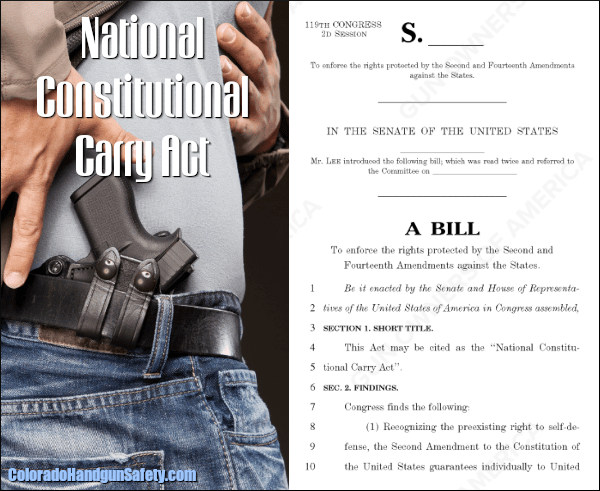
U.S. Senator Mike Lee (Utah) has introduced notable new legislation, the National Constitutional Carry Act. Senator Lee’s U.S. Senate Bill restores the right to carry firearms in ALL 50 states. This bill would ensure that law abiding American citizens are able to carry around the country without fear of antigun states arbitrarily restricting or criminalizing their chosen self-defense tool. Residents of antigun states would no longer have to endure second class Second Amendment treatment, whether through outright hardware bans or policies that indirectly discourage the exercise of Second Amendment rights.
The Gun Owners of America (GOA) endorses the National Constitutional Carry Act. Erich Pratt, GOA Senior Vice President, issued the following statement: “In a time of war, Americans cannot afford to have the right to bear arms delayed by arbitrary state permitting processes. Public safety is threatened not only by ordinary criminals, but also bad actors working for foreign adversaries, and Americans need to be armed for the security of our free state. That’s why Gun Owners of America is proud to endorse Senator Mike Lee’s National Constitutional Carry Act. Under this GOA-backed legislation, the right to carry a firearm without a government permission slip will be fully restored, and unconstitutional states regulations on firearms, ammunition, and magazine size will be preempted.”
Here is GOA’s Minuteman Moment video analysis of the proposed National Constitutional Carry Act:
Women are arming themselves — millions of females now have carry permits and female gun ownership is up 77% since 2005. What factors should women consider when choosing a handgun for self-defense? What are good choices for a lady’s defensive handgun, suitable for concealed carry? Is a self-loading pistol better than a revolver? In this article we include two videos focusing on handgun options for females. The videos cover six key factors: function, size, weight, ergonomics, reliability, and concealability.
Classic Swiss Precision — the Sig P239
The single-stack Sig P239 is an ultra-reliable, compact pistol with a grip suitable for smaller female hands. Weighing 25 oz. in 9mm, it is slightly heavier than polymer-framed handguns, but that may be a good thing. During my handgun training days, this Editor found most women shot the Sig P239 better than Glocks, with more control over recoil. This is a hammer-fired pistol with decocker but no separate safety. There are many other good handgun options for concealed carry — some smaller, thinner and lighter, but the Sig P239 provides a good benchmark for reliability and accuracy. Shown is the .40 S&W model. We prefer the 9mm Luger version. Photo Creative Commons BY-SA 3.0.
Choosing a Self-Defense Handgun — Ladies Explain the Options
Not Just a Guy Thing — Half of New Gun Buyers Are Women
According to the Wall Street Journal, over the past few years, “Close to half of all new U.S. gun buyers since the beginning of 2019 have been women.” And the percentage of female gun owners overall has increased dramatically. Here’s an interesting statistic — according to an NSSF survey, the percentage of gun owners who are female has increased dramatically. The National Shooting Sports Foundation (NSSF) has documented a 77% rise in female gun ownership since 2005.
And now nearly one-quarter of American gun owners are female. According to statistics from the NRA, around 23% of women in the U.S. own guns presently, when just 13% did in 2005.
The vast majority of first-time female gun buyers acquire a handgun for defensive purposes. However, the statistics also show that many new female gun owners are also getting involved in sport shooting and/or competitive shooting. An interesting TWAW survey shows that 76% of female gun owners are over 45 years of age, and most are married or in a serious relationship.
Here’s a helpful, time-saving tool for handgun owners. MidwayUSA’s online Holster Finder lets you quickly find the right holsters for virtually all popular makes and models of pistols and revolvers. The wide variety of carry styles, materials, and features can make finding the right holster difficult or confusing. Drawing on a database of over 125,000 gun/holster combinations, the MidwayUSA Holster Finder turns that complex task into an easy three-step process.
The selection process is simple: 1. Choose Pistol or Revolver; 2. Select Make and Model of Handgun (and barrel type/length); 3. Click to view results. Just choose your gun type, select your make, model and barrel, then view the results. All major holster types are included: Ankle, Belly Band, Belt (outside waistband), Chest, Competition, Drop Leg, Inside Waistband (IWB), Paddle, Pocket, and Shoulder. Check out the MidwayUSA Holster Finder at MidwayUSA.com/holster-finder.
If you are evaluating a firearm for self-defense use, you should consider three main factors: Reliability, Functionality (sights, trigger, ergonomics), and Effectiveness (ability to halt/neutralize threats). Regarding effectiveness, you need to consider what happens when the projectiles from your firearm reach the target. That involves penetration and terminal ballistics.
A 12ga shotgun is very effective inside 20 yards, with less risk of over-penetration* vs. a centerfire rifle.
You’ve probably heard the term “Terminal Ballistics”. But do you really know what this refers to? Fundamentally, “Terminal Ballistics” describes the behavior of a projectile as it strikes, enters, and penetrates a target. Terminal Ballistics, then, can be said to describe projectile behavior in a target including the transfer of kinetic energy. Contrast this with “External Ballistics” which, generally speaking, describes and predicts how projectiles travel in flight. One way to look at this is that External Ballistics covers bullet behavior before impact, while terminal ballistics covers bullet behavior after impact.
The study of Terminal Ballistics is important for hunters, because it can predict how pellets, bullets, and slugs can perform on game. This NRA Firearm Science video illustrates Terminal Ballistics basics, defining key terms such as Impact Crater, Temporary Cavity, and Primary Cavity.
External Ballistics, also called “exterior ballistics”, is the part of ballistics that deals with the behavior of a non-powered projectile in flight.
Terminal Ballistics, a sub-field of ballistics, is the study of the behavior and effects of a projectile when it hits its target.
*This Shooting Illustrated article discusses over-penetration risks with a variety of cartridge types. “A bullet passing through a threat and continuing with the potential to cause unintentional damage to a bystander or object is a situation commonly described as over-penetration.”
Want to see some handgun shooting fun on TV tonight? Today Shooting USA television will feature the 2024 IDPA National Championship on the Outdoor Channel.
The International Defensive Pistol Association (IDPA) sponsors practical competitions that focus on skills used with concealed handguns. More than 370 competitors gathered at the 2024 IDPA Nationals in Alabama. The event ran August 15-17, 2024 at the CMP Talladega Marksmanship Park in Talladega, Alabama.
The IDPA event airs Wednesday 11/19/25 at 9:00 PM Eastern/Pacific, 8:00 PM Central on the Outdoor Channel. If you miss the broadcast you can view the episode at any time for $0.99 on Vimeo. Or, subscribe to see all Shooting USA shows on Vimeo as often as you wish for $2.99 per month.
NOTE: The 2025 Championship was held in September at the Mission 160 Range in Whitewright, Texas. Here is a video showing highlights from the 2025 IDPA Nationals event:
What More? CLICK HERE for another 2025 IDPA Championship Video with Music.
Basics of IDPA Competition — Equipment and Scoring
Most of our readers are rifle guys, but it’s fun to shoot a pistol match now and then. You don’t need a lot of equipment, and if you shoot IDPA (Int’l Defensive Pistol Assn.) matches, you can really win with a $400 pistol and $25.00 worth of bulk 9mm ammo. That’s a bargain compared to what you’ll spend on a competitive PRS or F-Class rig and custom hand-loads.
If you want to get into the IDPA game, Shooting Sports USA has a good article that explains the basic rules and classifications. IDPA is not your grandad’s bullseye pistol match. There is movement and action. Stages are timed, and competitors engage targets from cover if available. Singled-handed shooting is sometimes required, as is shooting while moving. You can compete with pretty much any handgun suitable for self-defense — but no $4000 Raceguns with fancy optics. The fact that you can be 100% competitive without spending a ton of money is what makes IDPA so popular.
Along with SSP and ESP, there are three other main IDPA classes: Custom Defensive Pistol (CDP) for .45 ACPs (mostly 1911 types), Concealed Carry Pistol (CCP), and Revolver (REV). All classes have a minimum power factor. Scores are based on time and shot placement on the IDPA target.
IDPA Scoring System
The official IDPA Target (right) has multiple scoring zones. If you don’t hit the target’s center mass zone or head zone (both appear green in illustration), you drop one or three points. Here’s the formula: Score (in seconds) = Time + Points Down + Penalties. In IDPA, “points down” (and penalties) are added to your time. If you hit the outer edge of the target, you get 3 points down. Nearer center can be 1 point down. Center hit or head shot is 0 points down. See IDPA Scoring for Dummies.
One of our Forum members asked: “Are there any good books on pistol marksmanship? I’m looking for a book that covers techniques and concepts….” Here are six recommended titles that can make you a better pistol shooter. These books run the gamut from basic handgun training to Olympic-level bullseye shooting.
Good Guidebooks for Pistol Shooters
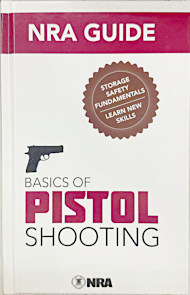
There are actually many good books which can help both novice and experienced pistol shooters improve their skills and accuracy. For new pistol shooters, we recommend the NRA Guide to the Basics of Pistol Shooting. This full-color publication is the designated student “textbook” for the NRA Basic Pistol Shooting Course.
Serious competitive pistol shooters should definitely read Pistol Shooters Treasury a compilation of articles from World and National Champions published by Gil Hebard. You could work your way through the ranks with that book alone even though it is very small. It is an excellent resource.
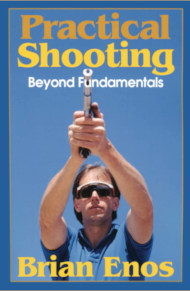
If you’re interested in bullseye shooting, you should get the USAMU’s The Advanced Pistol Marksmanship Manual. This USAMU pistol marksmanship guide has been a trusted resource since the 1960s. Action Shooters should read Practical Shooting: Beyond Fundamentals by Brian Enos, and Practical Pistol by Ben Stoeger. Brian Enos is a well-known pistol competitor with many titles. Ben Stoeger is a two-time U.S. Practical Pistol shooting champion. Last but not least, Julie Golob’s popular SHOOT book covers pistol marksmanship, along with 3-Gun competition. Julie holds multiple national pistol shooting titles.
Jessie Harrison is one of the greatest female pistol shooters on the planet. In the video below, Jessie offers smart tips on purchasing a handgun, and getting started in competition. Jessie covers caliber choice, handgun fit/ergonomics, concealability, holster options, and other key factors.
Do you often carry a concealed handgun? Then you can benefit from Beretta’s FREE 15-page e-book, Ten Essential Tips for CCW Holders. This eBook, in handy PDF format, helps gun owners select an appropriate handgun (and holster), understand legal obligations and responsibilities, and train effectively with the firearm. This short PDF eBook offers many useful tips to consider, in particular for gun owners who are contemplating the pros and cons of everyday carry for themselves.
As the Beretta CCW booklet says, “Carrying a concealed handgun requires a certain amount of confidence. You need to be confident in your knowledge of laws and regulations. You have to have confidence in your accuracy, and you need to trust that you can carry a gun effectively, securely and comfortably. If a gun is a burden for you to carry, you probably won’t.”
Surprising Facts About Actual Defensive Handgun Use
You may be surprised to learn when and how handguns are actually used for self-defense. Most defensive uses are at very short range and the incident only lasts a matter of seconds. You need to be prepared, and train to be proficient drawing and aiming your weapon. And remember, shooting is a last resort, when a safe retreat is not available.
55% of gunfights take place in 0-5 feet.
20% of gunfights take place in 5-10 feet.
20% of gunfights take place in 10-21 feet.
95% of gunfights take place in 0-21 feet. (Source: FBI)
The average man can cover 21 feet of ground in 1.5 seconds.
The average gunfight is over in 3-5 seconds.
3 to 4 shots are usually fired.
Most gunfights take place in low-light conditions.
On average, one shot in four strikes someone.
Here are two (2) sample pages from Beretta’s CCW eBook.
AccurateShooter.com is more about rifles than pistols. But we know that the majority of our regular readers own handguns, and many also have concealed carry (CCW) permits. And with the prospect of social unrest following the election, we expect more reader than ever will be “packing” a sidearm. Accordingly, we’ve found a great resource for CCW holders that can help you select a holster. On the Shooting Illustrated website you’ll find a detailed review of 30 different holster types. Each holster is illustrated, with pros and cons explained. These are all EDC holsters, meaning those designed for “Every Day Carry”.
Shooting Illustrated calls this article “HolsterPallooza” and it really does provide a ton of helpful information. Most other holster reviews on the web may feature a half-dozen holsters at the most. In this Holsterpallooza article you can see 30 holsters, with a wide variety of materials, designs, and applications. There are small molded IWB holsters for CCW, conventional on the belt holsters, leather shoulder holster rigs, and even ankle holsters. This is a great place to start if you are in the market for a holster.
Here’s sample of the many holster options reviewed, an innovative hybrid IWB holster constructed with leather over Kydex. That gives you the “best of both worlds” — the secure fit/retention of a molded Kydex shell, with an attractive leather exterior.
Shooting Illustrated explains: “As the interface between your gun and your body, the holster is a vital component of your carry rig. In many cases, the circumstances of your daily life will determine the method of carry you choose. This, in turn, will determine what type of holster you need, which may end up determining the handgun you carry. Therefore, choosing the method and type of holster may be as, or even more important than, choosing a firearm.”
MORE Reviews — Hickok 45 Reviews 15 CCW Holsters:
If you want to see even MORE holsters for “Every Day Carry” (EDC), check out this video from Hickok 45. This popular YouTube host looks at 15 different IWB holsters from a number of manufacturers. Hickok 45 examines many hybrid holsters that combine Kydex or plastic with leather for increased comfort. He has his favorites… and they might not be what you’d expect. NOTE: As this video has been watched over 900,000 times, you may also want to read the viewer comments. There are many helpful suggestions from CCW holders who carry daily.
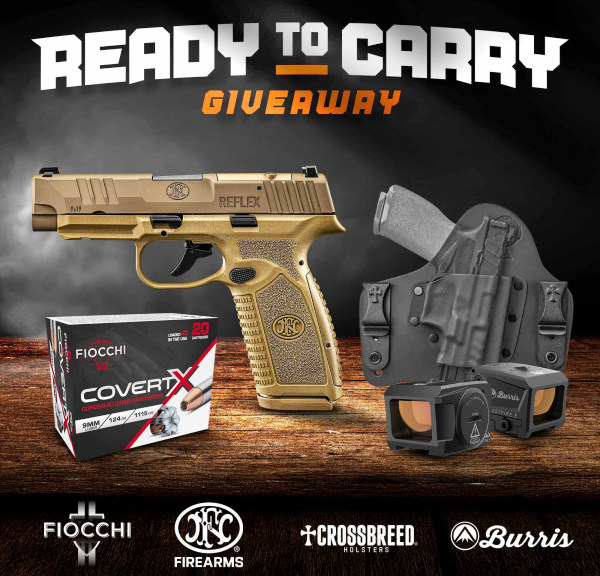
So, are you feeling lucky? Then you may want to sign up for the ShootOn.com Giveaway contest. The “Ready to Carry” Shoot ON contest prize pack includes an FN Reflex 9mm pistol, a Burris FastFire Red Dot Optic, a Crossbreed SuperTuck Holsert, and 5 boxes of Fiocchi CovertX defensive ammo. The total retail value of the “Ready to Carry” Giveaway prize package is $1,331.90.
CLICK HERE to visit the contest entry page. NOTE: No purchase is required to enter the “Ready to Carry” Giveaway. Simply go to the Shoot ON “Ready to Carry” Giveaway page and enter. You can also boost your odds of winning through the Daily Bonus Entry option. The Shoot ON “Ready to Carry” Giveaway ends April 17, 2025, so enter today!
Giveaway Items — Total Value $1331.90
Handgun: FN’s new Reflex XL MRD micro-compact 9mm is a rugged, accurate optics-ready pistol with good ergonomics and up to 18-round capacity even with a compact format. FN claims the Reflex EL series pistols off “best-in-class triggers” for optimal performance.
Holster: The Crossbreed SuperTuck is an IWB holster developed for deep concealment. This combine a Kydex pocket with a combat-cut premium leather backer for security and comfort. The SuperTuck also has powder-coated steel belt clips adjustable for height and cant (angle).
Red Dot Optic: The Burris FastFire E is an enclosed red dot optic with a large 22×17 mm sight window for the 3.5 MOA dot. The FastFire E offers 100 MOA of elevation and windage adjustment range so it works with handguns, shotguns and rifles. A tough housing protects the unit which is waterproof, shockproof and fogproof. The FastFire E offers an “always on” function.
Ammunition: The contest package includes five, 20-round boxes of Fiocchi’s new CovertX personal defense ammunition. This CovertX ammo features a new jacketed HP projectile specifically engineered for controlled expansion when fired from short-barrel handguns.




 Want to see some handgun shooting fun on TV tonight? Today Shooting USA television will feature the 2024 IDPA National Championship on the Outdoor Channel.
 Along with SSP and ESP, there are three other main IDPA classes: Custom Defensive Pistol (CDP) for .45 ACPs (mostly 1911 types), Concealed Carry Pistol (CCP), and Revolver (REV). All classes have a minimum power factor. Scores are based on time and shot placement on the IDPA target.



 Good Guidebooks for Pistol Shooters