We frequently receive inquiries about compact self-defense pistols. Many folks (some of whom already own a full-sized pistol) ask: “What’s a good compact 9mm pistol I can carry or keep in a vehicle during trips?” Of course, there is the Glock 19. And the new Sig Sauer P365 is quite good. But they are both around $500.00. You can spend about half that and still get a very good 9x19mm pistol with lifetime warranty and good ergonomics.
Here are three 9mm handgun options, all available now for well under $300.00. In fact, our third choice, the Ruger EC9, is currently just $209.99 at Brownells (with promo code). That’s just a few bucks over two hundred! It’s a buyers’ market right now…
1. Walther Creed 9mm Pistol, $269.99
The Walther Creed offers excellent ergonomics, good accuracy, and well-designed controls at a killer price — $269.99 at CDNN Sports. This gun, designed to be a value-leader, emulates Walther’s more expensive PPQ model (MSRP $649.00) at a much lower price. The Creed’s frame size and shape is the same as the PPQ, but the Creed lacks interchangeable backstraps. Slide and trigger are very similar. The Creed features a snag-free bobbed hammer. Testers have praised the new Creed, saying that, despite the bargain price, it “sacrifices little to nothing in… ergonomics, accuracy, and reliability.”
2. Smith & Wesson SD9VE 9mm, $249.99 with CODE M8Y
The two-tone Smith & Wesson SD9VE 9mm pistol features contrasting stainless-steel slide and barrel. Weighing just 22.7 oz, this DAO pistol ships with two 16-round magazines, offering plenty of fire-power. Overall length is 7.2″ with a 4″-long barrel. Both front and rear sights are drift-adjustable. This is a nice medium-sized pistol that shoots well. The Smith & Wesson SD9VE is on sale now at Brownells. Sale price is currently $259.99 with a $10 handling charge.
SAVE MORE: During check-out at Brownells.com, you can use code “M8Y” to receive $20 Off and get FREE delivery. That lowers your net cost to just $249.99 shipped to your FFL. Under $250.00 for a nice S&W Nine is a great deal.
3. Ruger EC9 9mm — $209.99 at Brownells with CODE M8Y
The striker-fired Ruger EC9 features a 3.12″ barrel and measures 6.0″ overall. This 1.07-lb EC9 is slim for easy concealment. Weighing just 1.07 lbs., this is definitely an “all-day carry” option. With Brownell’s current sale pricing and promo codes, you can get this little pistol for just $209.99 delivered (see right). You heard that right. Sale price is currently $219.99 with a $10 handling charge. However, during check-out you can use code “M8Y” to receive $20 Off and get FREE delivery. That lowers your net cost, so that your all-up price, delivered to your FFL, is just $209.99. That’s a great price for a reliable gun backed by Ruger. Here is a recent review from verified buyer: “It’s an LC9 with fixed sights that are milled into the slide. Same trigger. Same frame. Sweet shooter. Perfect for concealed carry. Can’t beat it for the price.”
The latest Crime Prevention Research Center (CPRC) study on concealed handgun permits reveals that over 16.3 million Americans now have them, and that the ranks of permit holders are becoming more diverse, with more women and minorities getting permits than ever before. The major findings of the 2017 CPRC report are summarized below. A copy of the report is available for download here.
There are now over 16.3 million gun permit holders, a record 1.83 million increase in permits since July 2016. Nationwide, 6.53% of adults have a concealed handgun permit. That’s roughly one in 15 adult citizens. Outside of California and New York, 8% of adults have a permit. The permit issuance numbers for women, Blacks, and Asians are increasing at faster rate than for men and Caucasions.
More guns, less crime — that’s the conclusion of the latest report from the Crime Prevention Research Center (CPRC). The CPRC Concealed Carry Report attributes some of the drop in crime rates to the fact that more Americans than ever before are carrying handguns for protection. In the past eight years, the number of concealed handgun permits has soared, growing from 4.6 million in 2007 to over 16.3 million this year. Overall, 6.53% of the U.S. adult population, i.e roughly one in fifteen American adults, now has a concealed carry permit.
Here are some interesting findings in the 2017 CPRC Report:
6.53% of the total adult U.S. population has a weapons carry permit.
Last year, the number of permit holders grew by a record 1.83 million. This is more than the previous record increase of 1.73 million, set just the year before.
In 11 states, more than 10% of adults have permits. Alabama has the highest rate — 20%. Indiana is second with 15.8%.
In 14 states, a permit is no longer required to carry in all or virtually all of the state. This is a major reason why legal carrying handguns is growing so much faster than the number of permits.
In 2016, women made up 36% of permit holders in the 14 states that provide data by gender. Eight states had data from 2012 to 2016 and they saw a 326% faster increase in permits among women than among men.
From 2012 to 2016, in the five states that provide data by race over that time period, the number of black people with permits increased 30% faster than the number of whites with permits. Asians appear to be the group that has experienced the largest increase in permitted concealed carry.
Regression estimates show a significant association between increased permit ownership and drops in murder and violent crime rates. Each one percentage point increase in rates of permit-holding is associated with a roughly 2.5 percent drop in the murder rate.
States with the largest increase in permits have seen the largest relative drops in murder rates.
Carry Permit Holders are Law-Abiding
Interestingly, Concealed handgun permit holders are extremely law-abiding. In Florida and Texas, permit holders are convicted of misdemeanors and felonies at one-sixth of the rate at which police officers are convicted. From 2014 data, police officers commit crimes at rate of 103 per 100,000 (national average) compared to 12.8 per 100,000 for permit holders in Florida and 22.8 per 100,000 for permit holders in Texas.
The NRA has announced a new summer event — a trade show focused on licensed “carry”, self-defense, and home protection. The new NRA Personal Protection Expo (PPExpo) will be held August 25-27, 2017 at the Wisconsin Center in Milwaukee, Wisconsin. This is a 3-day educational and interactive experience for citizens interested in personal protection, concealed carry, and defense tactics. According to the NRA: “This all-new event will equip visitors with the products, training and mindset necessary to prepare and defend themselves and their loved ones when threats arise.”
Expo guests can attend educational protection/defense workshops taught by leading experts and instructors from across the country. The Expo’s Exhibit Hall will showcase firearms, shooting accessories, concealment gear, storage products, tactical gear, and home defense solutions.
The Expo’s concealed carry (CCW) workshops will cover concealment methods, holster selection, and tactics. Personal protection seminars will cover personal defense, situational awareness, product selection, and skills building. Home defense seminars will cover home defense plans, preventative security measures, and responding to intruders. For more information about the Personal Protection Expo, visit https://www.NRAPersonalProtectionExpo.org.
Ruger has just introduced a new compact version of its Ruger American Pistol. We predict the new American Compact will become popular with CCW-holders. With a 3.55″ barrel, and 6.65″ length, Ruger’s new 9mm carry gun is similar in size to a S&W M&P9C, and slightly smaller than a Glock 19. At 28.7 ounces, the new Ruger Compact is heavier than the M&P9C (21.7 oz.), and the Glock 19 (23.6 oz.), but the Ruger is the slimmest of the three, with a slide width of just 1.05 inches.
We’re pleased to see the American Compact is offered either with or without an external frame-mounted safety, to suit the buyer’s preference. Also, the gun offers easy take-down with no trigger pull required (by contrast, you have to pull the trigger to take-down a Glock).
Ruger’s new Compact American Pistol is offered either with 10+1 capacity*, or 17+1 capacity. The 17+1 version employs magazines from the full-size Ruger American pistol, with a sleeve or “boot” to fit the shorter grip. With either type of magazine, the gun has proven 100% reliable, according to writer Rich Grassi, who tested the new pistol for The Shooting Wire.
The grip ergonomics on the Compact American Pistol could be described as “Walther-esque”. Rich Grassi says that’s a good thing — this little pistol is comfortable in the hand: “You also don’t pinch a finger when inserting a magazine – either magazine – into the American Compact. Like the service-size gun, three grip modules (back strap with palm swells) are included. The gun has the Novak Low Profile carry sights with the ‘3-dot’ pattern thereon.” Grassi said his test pistol shot low with a standard sight picture, but otherwise the accuracy was good.
NRA testers say the new Compact Ruger American Pistol is extremely reliable and very accurate.
Ruger says this pistol “combines a recoil-reducing barrel cam… with a low-mass slide, low center of gravity and a low-bore axis to provide better balance, less felt recoil, and less muzzle flip[.]” The Ruger Compact American Pistol also features a pre-tensioned striker system, which allows for a short-take-up trigger with positive reset. Like its bigger brother, the Compact American Pistol features a modular wrap-around grip system that fits a wide range of hand sizes.
*Some early reviews have stated the “standard” capacity as 12+1. However Ruger’s website and the official Spec Sheet lists 10+1.
Amidst the hue and cry (and Congressional sit-ins) calling for more gun control, few observers have actually looked at the facts. Do we, in fact, have an increasing gun crime problem in this nation? Is gun violence spiraling out of control, as the anti-gunners would have you believe?
What do the verified FACTS say (as opposed to the ‘sky is falling’ anti-gun zealots)? Well, the truth of the matter is that major gun-related crime rates have been steadily on the decline for more than a decade. Likewise, most of the major violent crime rates have been declining over the past two decades. What’s more, even accidental gun deaths have been declining despite a huge rise in gun ownership.
So the next time someone tells you that guns must be outlawed to halt a terrible increase in gun crime, you can respond, with 100% certainty, that gun-related crime is going down, not up.
And interestingly, as the supply of handguns has increased, the amount of property crimes has plummeted. Maybe the bad guys are thinking twice before breaking and entering…
Gun Facts™ debunks common myths about gun control. It is intended as a reference guide for journalists, politicians and anyone interested in learning about gun control facts… crime, and the Second Amendment. The free Gun Facts e-book provides over 100 pages of indexed information.
Credit Boyd Allen for finding this first chart. We welcome reader submissions.
Do you have a concealed carry permit, or do you plan to carry a concealed handgun in the future? Then you can benefit from Beretta’s FREE 15-page e-book, Ten Essential Tips for CCW Holders. This eBook, in handy PDF format, helps gun owners select an appropriate handgun (and holster), understand legal obligations and responsibilities, and train effectively with the firearm. This short eBook offers many useful tips to consider, in particular for gunowners who are contemplating the pros and cons of everyday carry for themselves.
As the Beretta CCW booklet says, “Carrying a concealed handgun requires a certain amount of confidence. You need to be confident in your knowledge of laws and regulations. You have to have confidence in your accuracy, and you need to trust that you can carry a gun effectively, securely and comfortably. If a gun is a burden for you to carry, you probably won’t.”
Surprising Facts About Actual Defensive Handgun Use
You may be surprised to learn when and how handguns are actually used for self-defense. Most defensive uses are at very short range and the incident only lasts a matter of seconds. You need to be prepared, and train to be proficient drawing and aiming your weapon. And remember, shooting is a last resort, when a safe retreat is not available.
55% of gunfights take place in 0-5 feet.
20% of gunfights take place in 5-10 feet.
20% of gunfights take place in 10-21 feet.
95% of gunfights take place in 0-21 feet. (Source: FBI)
The average man can cover 21 feet of ground in 1.5 seconds.
The average gunfight is over in 3-5 seconds.
3 to 4 shots are usually fired.
Most gunfights take place in low-light conditions.
On average, one shot in four strikes someone.
Here are two (2) sample pages from Beretta’s CCW eBook.
Many of our readers have concealed carry permits. When carrying a handgun concealed, holster choice is key. A good holster will carry more comfortably, “print” less, and be 100% secure while still allowing rapid access. Our systems admin Jay C. recently acquired a Walther PPS M2 as a carry gun. Jay has a CCW permit, and he sometimes chooses to carry a concealed handgun, particularly on trips.
After looking at many options, Jay chose a Kydex Clinger ATom Holster. These are very affordable, yet they have many great features. The most important design feature of the $19.99 Clinger Atom is the location of the belt clip. This is placed over the trigger guard area, not the slide. This pulls the grip in closer than if the clip was mounted over the slide as on other holsters. This smart design feature really works, improving concealment and comfort. Jay says: “the Atom works great with my little Walther — it’s very stable and comfortable.”
The $19.99 Clinger Atom also offers adjustable “ride height”. This is accomplished by moving the belt clip up or down. Holster retention (the clamping tightness) is easily adjusted with a simple hex screw.
Along with its popular Atom holster, Clinger offers two other holsters: 1) the $29.99 Stingray model (with choice of 0°, 15°, or 30° cant); and 2) the dual-clip, ultra-thin No-Print Wonder Holster priced at $59.99. The latter is a good choice for carrying a heavier pistol for long periods. All three holsters (Atom, Stingray, No Print Wonder) are shown in the video above.
Clinger offers a Zero-Risk Guarantee. Try any Clinger holster for two weeks. If you don’t like it, you can return it for a full refund. There is also a “Bumper-To-Bumper Lifetime Warranty”. If anything on your Clinger Holster ever needs repair the manufacturer will repair it or replace it for free.
Do you know someone who wants to get started in pistol shooting? Here’s a new opportunity. The NRA now offers its Basics of Pistol Shooting Course in an online format. That makes it easy to cover the “classroom” part of the course on your own time. The $60.00 online course includes 11 step-by-step lessons (to be followed by live range training). CLICK HERE to enroll in online Pistol Training Course.
Train Online, Then Register for a Range Session
For the NRA Basics of Pistol Shooting course, Phase 1 is conducted in an online environment, completed on your own time (cost is $60.00, non-refundable). After successfully completing the online exam, students can register for Phase 2, the instructor-led training session. Phase 2 is conducted at your local range with an NRA Certified Instructor. You must successfully complete Phase 1 and Phase 2 in order to receive your NRA Basics of Pistol Shooting course certificate.
Designed and developed by experts to accommodate busy schedules, the web-based course takes a blended learning approach to firearms training with both online and physical components. Students have 90 days to work through 11 online lessons before registering for Phase 2, the NRA Certified Instructor-led phase at a local range. “America has more first time gun owners than ever and the NRA remains dedicated to being the number one provider of firearm training,” said Executive Director of NRA General Operations, Kyle Weaver. “Thanks to our online courses and network of more than 125,000 NRA Certified Instructors, it has never been easier to learn basic firearm skills.” The NRA offers other online training courses at Onlinetraining.nra.org. These offerings include a Range Safety Office (RSO) course, and a Range Development and Operations course.
Jay Christopherson is AccurateShooter.com’s systems administrator — he keeps the servers up and running. Jay is also a very talented rifle shooter who holds a carry permit. Recently, Jay acquired a Walther PPS M2, a compact, defensive carry pistol. Here Jay reviews that pistol, which is now his “go-to” handgun when he chooses to carry a firearm pursuant to his CCW permit.
The Walther PPS M2, Single-stack 9mm is a Comfortable, Reliable Everyday Carry Pistol.
Looking for a new carry pistol in a single-stack, 9mm configuration, I tested out the slim (1″-wide) Walther PPS M2, with three different magazine capacities. For someone who has carried a 5″-barreled, .45 ACP model 1911 for the last few years, the switch to a single-stack 9mm was a big change — but a welcome one in terms of weight and comfort. I like my big 1911, but the PPS M2 gives me the feeling that if it’s needed, it’ll be a safe, effective, and reliable option. I still love my 1911, but when it comes to carry, the 1911 will stay in the safe while I “pack” the smaller, lighter PPS.
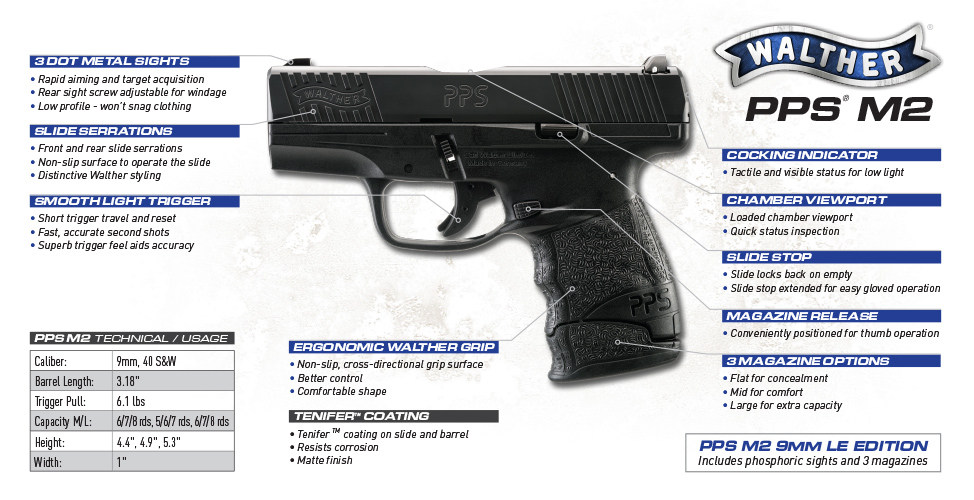
Click Image for Large View of Pistol Specifications Sheet
Like many of AccurateShooter.com’s readers, I have a permit to carry a concealed firearm and I use the privilege regularly. I’m no great shakes with a pistol, having focused most of my efforts on long-range rifle shooting, but I do spend enough time at the pistol range to ensure that I am familiar with my weapon and comfortable shooting it out to ranges where I might encounter a situation requiring its use.
Part of being responsible is selecting a carry weapon that you can be comfortable with, both using and carrying. Now, I’ll admit that I’ve focused a lot on the former, but not as much on the latter. I’m an unabashed fan of John M. Browning’s crowning (in my opinion) achievement, the Colt .45 ACP M1911. My current 1911, with a 5” barrel, is not the easiest pistol in the world to carry comfortably. While I love shooting it, carrying it is another situation altogether. I’ve tried many different configurations, but found myself carrying it less and less.
And so, I decided that I needed to enter the world of the 9mm single stack for a carry weapon. There are a lot of reasons why I chose to go that direction, but it’s a highly subjective and personal subject (some of the arguments out there are pretty heated), so I won’t bore you with mine. Suffice it to say, there’s plenty of available information for you to make an informed decision. To help with testing, Walther Arms was kind enough to provide a new Walther PPS M2, in 9mm, for evaluation.
Three Magazine Options
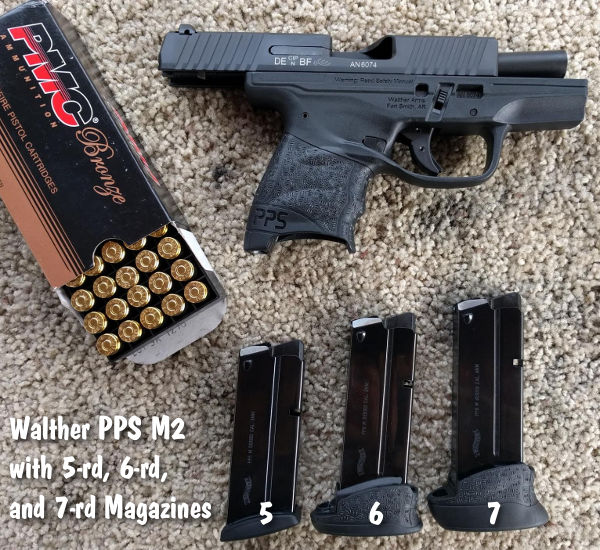
Along with the PPS M2, Walther provided three magazines — the 5-round standard mag plus 6-round and 7-round extended magazines. I tried all three magazines, both for carry/fit, and at the range to see if they would affect my ability to shoot the pistol. For reference my hands are roughly 9.25″ wide — according to the Internet, the average hand size for a male is 7.44″, so I guess I’ve got larger than average hands. The shortest magazine was a bit too short for me to grip comfortably — my pinky finger had zero engagement and my two-hand grip suffered for it. The middle magazine let my pinky engage the grip partially, but was still not ideal. The longest magazine fit perfectly. My guess is that if your hand is in the average range, the middle magazine will work for you. For women, I think the smallest grip will work nicely. My wife has an average hand span for females and thought that the smallest grip felt pretty natural for her.
The trigger is fair — the takeup is smooth, the trigger breaks relatively cleanly and predictably, but a rough spot on the Glock-style trigger safety lever wore against my finger, leaving it feeling a bit raw. It’s fairly minor and something that can easily be resolved. And even with my larger fingers, I still had no problem with trigger guard clearance. Disassembly is fairly easy, though the take-down lever takes some effort to work. [Editor — on the PPS M2 I tried at SHOT Show, the small slide-stop lever was hard to manipulate.]
After having carried my 1911 around quite a bit, I found the Walther PPS M2 to be much lighter and easier to carry (I use a Clinger holster). I rarely notice it, even when getting into and out of a car. With the PPS M2 it’s easy to carry without “printing”, at least with the appendix carry method I prefer.
General Function and Accuracy Testing
I took the pistol down to the range to test it out and get a feel for it. I bought a variety of 115 grain FMJ ammunition to test including PMC and Blazer brass-cased 9mm. I ran about 400 rounds through the little Walther. None of the ammo experienced any sort of issue and the pistol never failed to perform flawlessly. With 400 rounds through the PPS M2 cleanly, I am confident to carry the PPS M2 when I feel the need to carry.
I set up targets at 15 feet and 30 feet — remembering that I’m looking for a personal defense/carry pistol and that I don’t practice for competition! At both ranges, shooting all three magazines, I had no problems putting together groups that are more than accurate enough for “center mass”.
During a second testing session, I shot the pistol for accuracy with my forearms rested on sandbags. The results were impressive. Above is a seven-shot (7-shot) group at 10 yards (30 feet) with the CCI Blazer Brass ammo. At right is a group shot at 5 yards (15 feet), forearms rested, with the PMC ammo. The one shot that went up outside the group was probably me, the shooter. Remember this is a very small, light-weight pistol that does have some muzzle flip. I’ve seen other tests done with the Walther PPS M2, at longer ranges in the hands of skilled shooters and producing much cleaner groups.
Summary — Walther PPS M2 is a Keeper
Overall, I really like the 9mm single stack Walther PPS M2. It’s a very handy, manageable pistol. After testing the gun for AccurateShooter.com I decided to purchase the pistol and keep it. That’s the ultimate vote of confidence. This gun shoots comfortably, accurately and reliably, and most of all, the PPS M2 is comfortable to carry. When I choose to carry, should I ever need a firearm, I have every confidence in the Walther PPS M2.
This photo shows some of the handguns actually found by the TSA in carry-ons last year.
Here’s an important reminder to our readers who have concealed-weapon carry permits — don’t overlook your carry gun when traveling through airports. Many travelers with carry permits are forgetting weapons stashed in carry-on luggage. The TSA is encountering more firearms than ever, and those weapons are normally confiscated with their owners subject to penalties.
In 2014, according to TSA.gov, 2,212 firearms were discovered in carry-on bags at checkpoints across the country (that’s a 22% increase over 2013). Of those, 1,835 (83 percent) were loaded. Firearms were intercepted at a total of 224 airports.
Another problem is that Carry Permit holders may enter an airport with their guns still on their person. Here are actual examples:
A 94-year-old man attempted to enter the checkpoint at LaGuardia Airport with a loaded .38 caliber revolver clipped to his belt.
A loaded .380 caliber firearm was discovered strapped to the ankle of a passenger who walked through a metal detector at Cincinnati/Northern Kentucky International Airport.
A loaded .380 caliber firearm was discovered in the rear pocket of a San Antonio International Airport passenger during advanced imaging technology screening.
If you are traveling by air, make sure you remove all firearms from your person (or carry-on luggage), unload the firearm(s), place any weapon in a locked, hard-sided container, and declare them as checked baggage. Anything else can land you in jail.
Here are the TSA guidelines for transporting firearms as checked baggage:
Comply with regulations on carrying firearms where you are traveling from and to, as laws vary by local, state and international governments.
Declare all firearms, ammunition and parts to the airline during the check-in process. Ask about limitations or fees that may apply.
Firearms must be unloaded and locked in a hard-sided container and transported as checked baggage only. Firearm parts, including firearms frames and receivers, must also be placed in checked baggage and are prohibited in carry-on baggage.
Replica firearms may be transported in checked baggage only.
Rifle scopes are permitted in carry-on and checked bags.
All firearms, ammunition and firearm parts, including firearm frames, receivers, clips and magazines are prohibited in carry-on baggage.


 The two-tone Smith & Wesson SD9VE 9mm pistol features contrasting stainless-steel slide and barrel. Weighing just 22.7 oz, this DAO pistol ships with two 16-round magazines, offering plenty of fire-power. Overall length is 7.2″ with a 4″-long barrel. Both front and rear sights are drift-adjustable. This is a nice medium-sized pistol that shoots well. The Smith & Wesson SD9VE is on sale now at Brownells. Sale price is currently $259.99 with a $10 handling charge.
 The striker-fired Ruger EC9 features a 3.12″ barrel and measures 6.0″ overall. This 1.07-lb EC9 is slim for easy concealment. Weighing just 1.07 lbs., this is definitely an “all-day carry” option. With Brownell’s current sale pricing and promo codes, you can get this little pistol for just $209.99 delivered (see right). You heard that right. Sale price is currently $219.99 with a $10 handling charge. However, during check-out you can use code “M8Y” to receive $20 Off and get FREE delivery. That lowers your net cost, so that your all-up price, delivered to your FFL, is just $209.99. That’s a great price for a reliable gun backed by Ruger. Here is a recent review from verified buyer: “It’s an LC9 with fixed sights that are milled into the slide. Same trigger. Same frame. Sweet shooter. Perfect for concealed carry. Can’t beat it for the price.”


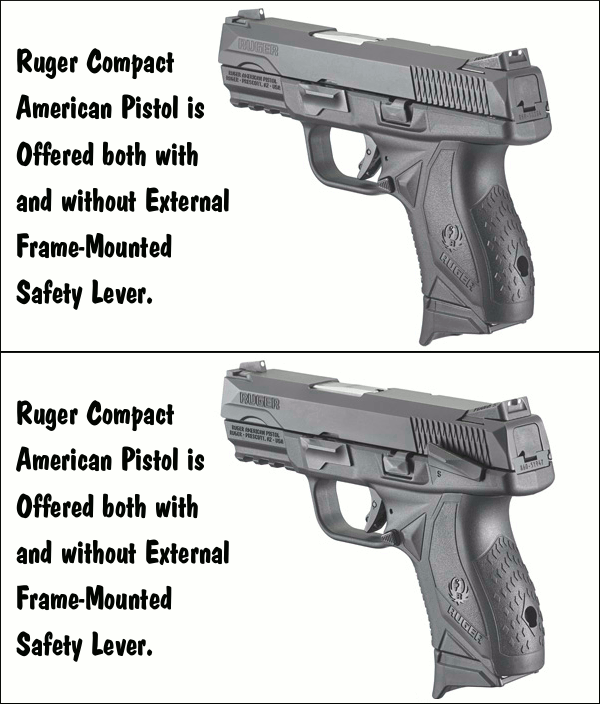
 Ruger’s new Compact American Pistol is offered either with 10+1 capacity*, or 17+1 capacity. The 17+1 version employs magazines from the full-size Ruger American pistol, with a sleeve or “boot” to fit the shorter grip. With either type of magazine, the gun has proven 100% reliable, according to writer Rich Grassi, who tested the new pistol for



 During a second testing session, I shot the pistol for accuracy with my forearms rested on sandbags. The results were impressive. Above is a seven-shot (7-shot) group at 10 yards (30 feet) with the CCI Blazer Brass ammo. At right is a group shot at 5 yards (15 feet), forearms rested, with the PMC ammo. The one shot that went up outside the group was probably me, the shooter. Remember this is a very small, light-weight pistol that does have some muzzle flip. I’ve seen other tests done with the Walther PPS M2, at longer ranges in the hands of skilled shooters and producing much cleaner groups.


