Story based on Report by Ashley Brugnone, CMP Writer
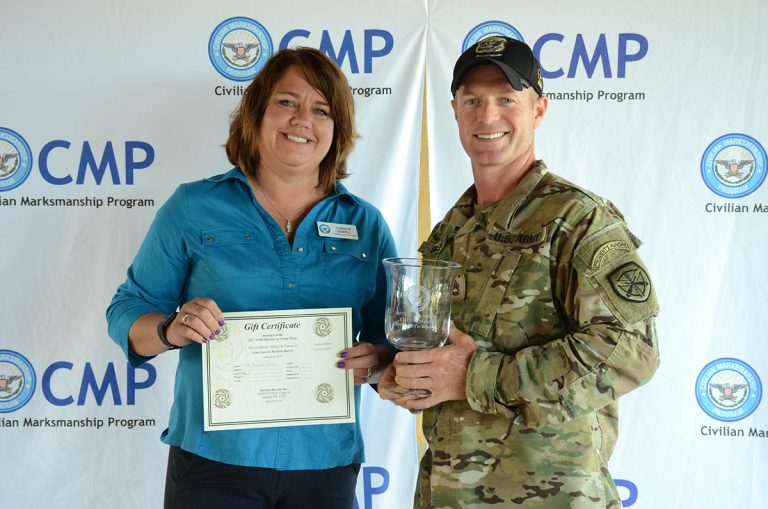
SFC Brandon Green, 32, of the U.S. Army Marksmanship Unit, fired a score of 2368-97X to earn the championship title in the 2400 Aggregate Rifle event held during the inaugural Civilian Marksmanship Program (CMP) Cup Matches. The 2400 Aggregate award goes to the top shooter in the three combined 800 Aggregates. The 2015 National High Power Champion, SFC Green is a gifted competitor who has excelled in multiple rifle disciplines. In addition to Service Rifle and High Power events, Green has competed in PRS and tactical matches.
Even before joining the USAMU Green was an ace marksman. As a junior, he earned Distinguished Air Rifle Badge #1. “I’ve been very fortunate to get support from friends, family and the ROTC programs in high school, and of course from the CMP and NRA as well, which kind of catered to someone like myself, coming in as a junior and shooting all the way up through the High Power sports,” said Green. “I’ve also been lucky enough to gain so many opportunities from being a part of the Army and the USAMU. It’s been a long learning journey, but it’s been a good one.”
The CMP Cup Matches, which kicked off the 2017 National Matches at Camp Perry, were introduced as an extra series of elite match and service rifle competitions. The schedule included a 4-Man Team Match, three consecutive days of 800 Aggregate matches, and an EIC Service Rifle Match.
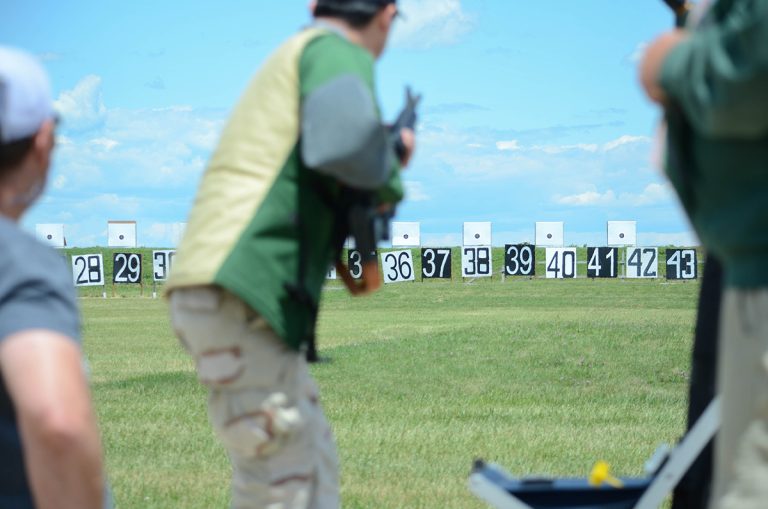
4-Man Team Match kicked off a week of events fired entirely on the CMP’s electronic High Power targets.
The CMP Cup Series week marked a new era at Camp Perry, with the first successful competitions fired on the base’s ranges using CMP’s mobile electronic targets. Over 36,000 rounds were sent downrange, with less than 50 questioned by competitors throughout the week. For many, the Cup Matches provided an initial look at the CMP’s target system.
Also making marks in the 2400 Aggregate match during CMP Cup Week was SSG Amanda Elsenboss, 28, of the Army Marksmanship Unit, who earned the High Woman Award, as well as Serena Juchnowski, 18, of Richfield, OH, who snagged the High Junior credit. Paul Terrence, 65, of Cleveland, OH, was named the High Senior of the event.
In the archives of On The Mark magazine, DCM Emeritus Gary Anderson, an Olympic Gold medal-winning shooter in his younger years, offers sage advice for competitive shooters.
In his article Ten Lessons I Wished I Had Learned as a Young Shooter, Anderson provides ten important guidelines for everyone involved in competitive shooting. Here are the Ten Lessons, but you should read the full article. Anderson provides detailed explanations of each topic with examples from his shooting career.
LESSON 1 – NATURAL ABILITY WILL NOT MAKE YOU A SHOOTING CHAMPION.
(You also need hard work, training effort and perseverance.)
LESSON 2 – ANGER IS THE ENEMY OF GOOD SHOOTING.
(The key to recovering from a bad shot is to stay cool, no matter what happens.)
LESSON 3 – BAD SHOTS CAN TEACH YOU MORE THAN GOOD SHOTS.
(Today, error analysis is one of the most powerful tools for improving scores.)
LESSON 4 – NEVER GO WITHOUT A SHOT PLAN.
(A shot plan is a detailed breakdown of each of the steps involved in firing a shot.)
LESSON 5 – PRACTICE IN BAD CONDITIONS AS WELL AS GOOD CONDITIONS.
(Most competitions are fired in windy conditions or where there are plenty of distractions.)
LESSON 6 – CHAMPIONS ARE POSITIVE, OPTIMISTIC PEOPLE.
(Negative shooters expect bad results; positive shooters expect to train hard to change bad results.)
LESSON 7 – IT’S NOT ABOUT WHETHER YOU WIN OR LOSE.
(It’s about how hard you try to win.)
LESSON 8 – YOUR DOG WON’T BITE YOU AFTER SHOOTING A BAD SCORE.
(Hopefully your coach, parents and friends won’t bite you either.)
LESSON 9 – YOUR PRESS CLIPPINGS CAN HURT YOU OR HELP YOU.
(Winning can go to our heads. We start thinking we are so good we don’t have to work hard any more.)
LESSON 10 — YOU NEVER SHOT YOUR BEST SCORE.
(Great champions are always looking for ways to improve.)
About Gary Anderson Gary Anderson served as the Director of the Civilian Marksmanship Program (CMP) from 1999-2009, and is now DCM Emeritus. As a Nebraska farmboy, Gary grew up hunting and shooting. Dreams of winning an Olympic Gold Medal in shooting led Gary to the U.S. Army. In 1959, he joined the elite U.S. Army Marksmanship Unit. Just two years later, he won his first national championship.
At the 1962 World Shooting Championships in Egypt, Anderson stunned the shooting world by winning four individual titles and setting three new world records. At the 1964 Tokyo Olympics, Gary won the 300m free-rifle Gold Medal, setting a new world record in the process. At the 1966 World Shooting Championships in Germany, Anderson won three additional world titles. At the 1968 Olympics, Gary won a second gold medal in the 300m free-rifle event.
Gary retired from active international competition after the 1969 World Championships in Spain, where he set a 50m, three-position world record. After his “retirement” from international competition, Gary competed in the National High Power Championships, winning the President’s National Trophy in 1973, 1975 and 1976. Over his competitive career, Anderson won two Olympic Gold Medals, seven World Championships, and sixteen National Championships. No American has ever won more major shooting titles.
Gary’s influence on shooting sports extends beyond the United States. Gary has attended eleven Summer Olympic Games, three as a competitor and eight as technical delegate or a jury member. Gary is the first American ever elected as Vice President of the International Shooting Sport Federation (ISSF), and still serves in that capacity. In 2012, Gary received the International Olympic Committee’s highest honor, the Olympic Order.
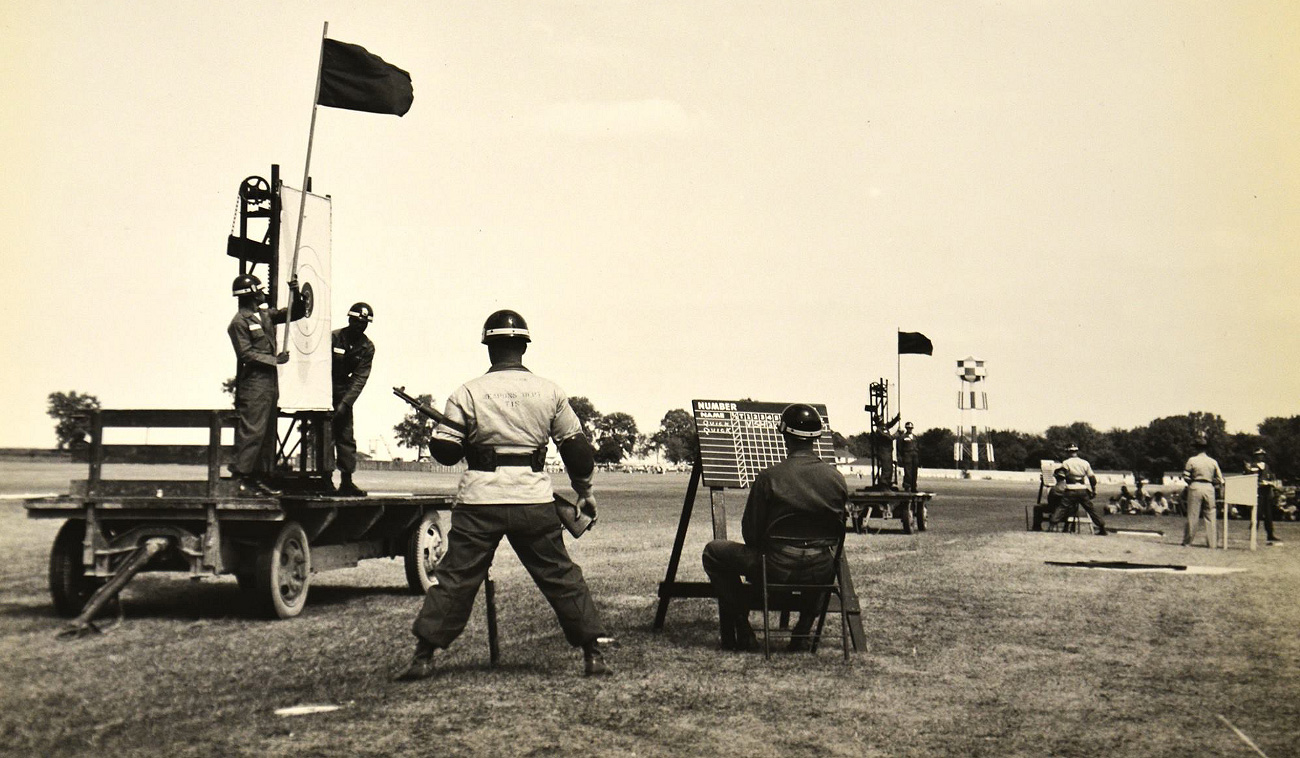
Ever wonder what “Maggie’s Drawers” means? Well, in the shooting community it means a complete miss on the target, as originally indicated by a large red flag. In this 1957 photo, the U.S. Army brought the targets to the students at the annual Small Arms Firing School. Wheeled carts with “demo” targets were positioned at the firing line, between shooting stations, so trainees could better see the procedures. Soldiers demonstrated firing a shot, scoring the target and scorecard on the Camp Perry firing line. Targets in use at the time were the “V” type. In this demonstration shot, the pit worker waves a red flag, known as “Maggie’s Drawers”, signifying a miss. This old photo comes from the Civilian Marksmanship Program (CMP) Archives.
If you click the gray tab to view the photo full-screen, you can see something extra. Look carefully at the horizon below the muzzle of the M1 Garand held by the shooter in the foreground. If you look carefully, you can see a crane being used to erect the beach tower that now watches over Lake Erie and the ranges when they are “hot”.
Origin of ‘Maggie’s Drawers’ Term Hap Rocketto, noted shooting historian, has explained the etymology of “Maggie’s Drawers”. This term “refers to the red flag waved vigorously across the face of the target to signify a complete miss of the target during practice”. The term came in use in the early 20th Century (prior to WWI) when flags were used to signal shot locations on long-range rifle targets.
Hap writes: “Since [the early 20th Century] the target has changed to the decimal bull and the marking system has been revised several times. Flags are no longer used, being replaced by value panels and chalk boards. However, one term from the flag days has held on with a tenacity that is indicative of the strong traditions of the high power community. If a shooter had the misfortune of firing a miss a red flag was waved across the front of the target. The flag is commonly known as ‘Maggie’s Drawers’ giving us the term now generally used to refer to a miss. The term ‘Maggie’s Drawers’ seems to be based on, as many things are in the military, a bawdy song. Prior to The Great War there was an old music hall song entitled The Old Red Flannel Drawers That Maggie Wore which [was creatively altered], as things tend to be by the troops, into something less delicate than might have been sung in vaudeville in the United States or in British music halls of the day.”
The CMP National Matches at Camp Perry, Ohio commence with the First Shot Ceremony on Monday, June 26, 2017. That’s just two days away! With the NRA having moved the National High Power Rifle Championships away from Camp Perry to Indiana this year, the CMP has stepped into the breach, offering more matches in the first part of the June 2017 National Match Schedule.
In the opening week of the National Matches schedule, June 26-30, 2017, the Civilian Marksmanship Program (CMP) will lead off with CMP Service Rifle and CMP Match Rifle events, called the CMP Cup Matches. The CMP Cup series includes: CMP Four-Man Team Match, CMP 800 Aggregate Matches, and CMP Excellence-in-Competition (EIC) Service Rifle Match. This will be followed by pistol events July 1-2, and July 9-13, 2017.
On July 14-25, the CMP conducts its second set of National Matches rifle events including the CMP National Trophy Rifle Matches, and CMP Rifle Games Events. Notable special events will include the President’s 100 Match (July 17), National Trophy Team Match (July 20), the CMP Garand Match and M1A Match (July 22), and the Vintage Sniper Match (July 24). The Sniper Match was the brainchild of Hornady’s Dave Emary. The competition was inspired by his father, a World War II scout sniper, who carried a rifle similar to the 1903A4 rifle builds found today on the Camp Perry firing line.
Hornady’s Dave Emary and “Gunny” R. Lee Ermey (right) at Vintage Sniper Match:
Rimfire Sporter — Fun for the Whole Family
The CMP’s final event, the hugely popular National Rimfire Sporter Match, will be held on Saturday, July 29 (see below). For more information, visit the CMP 2017 National Matches website.
Watch Highlights from the 2016 National Rimfire Sporter Match:
This year, NRA High Power events and major rifle championships will be held in Indiana, at Camp Atterbury. The American Rifleman website explains: “The High Power Rifle Championships have a new venue, exciting side matches and the opportunity to shoot at a mile. Preparations for the 2017 NRA National High Power Rifle Championships at Camp Atterbury (near Edinburgh, Indiana) are proceeding well. The Indiana National Guard is making improvements to firing lines, housing is open for reservations, and buildings have been selected for administrative needs[.] NRA and the Indiana National Guard are working hard to make this year at Camp Atterbury a memorable one.”
The championships will be conducted July 7 to 25, 2017, and they will include Across-the-Course (XTC), Mid-Range, and Long-Range matches, as well as classic trophy matches — such as the Leech Cup and the Wimbledon Cup… and, of course, Palma competition.
Match Schedules Adjusted to Allow Travel Time
The shooting schedule has been adjusted to give competitors time to travel between events held at different locations. Following the completion of the XTC matches, competitors will have a day to travel to Camp Perry, Ohio, should they wish to attend the Small Arms Firing School and shoot the Civilian Marksmanship Program National Trophy Matches. Similarly, Smallbore Prone competitors in Bristol, Indiana, will have a day of travel to arrive at Camp Atterbury to participate in the High Power Mid-Range and Long-Range Prone matches.
NRA National Championship Rifle Events in Indiana
The NRA has moved the National High Power XTC Rifle Championship, Mid-Range Championship, and Long Range Championship away from Camp Perry, Ohio, starting in 2017. Starting this summer, all these events will henceforth be held at Camp Atterbury, Indiana. That means if you want to compete in both CMP and NRA rifle matches, you would need to go two different venues, located 280 miles apart, in two different states.
By Steve Cooper, CMP North General Manager & Ashley Brugnone, CMP Writer
In disappointing fashion to all involved, the CMP [cancelled] its June 17 Excellence-In-Competition match when significant damage was done to the target system following the successful completion of standing and rapid-fire sitting stages at 200 yards by nearly 100 competitors.
Nearly 100 competitors took to the firing line on Viale Range for Saturday’s EIC Rifle Match.
The CMP EIC match was the historic debut of the latest in scoring technology on the “big” ranges at the 101-year-old Ohio National Guard training site near Port Clinton. The match fired on Viale Range was a fill-in for a previously cancelled Ohio Rifle & Pistol Association event. CMP is in its second year of operating 10 electronic target lanes at 100 yards for rifle and five lanes for pistol at Camp Perry’s Petrarca Range. CMP also operates two 80-point electronic indoor airgun ranges at Camp Perry and Anniston, AL, respectively.
During the changeover from 200 to 300 yards at the Saturday event, multiple targets were damaged when newly-trained CMP target workers accidentally strained or tore several interconnecting cables on the target line while raising and lowering target carriers. Diagnostics showed several targets were showing errors, but CMP technicians believed many targets could be salvaged and some were repaired.
The loss cut the range from 35 to 19 serviceable targets. CMP staff and competitors agreed to shrink the size of the range, re-squadding shooters into more relays on the remaining working targets. After repairs were made, firing continued with the prone rapid-fire stage at 300 yards. When firing was complete, a handful of shooters received inconsistent information on their monitors. A re-fire was conducted for that group and many of the re-fire group still reported target errors.
Members of CMP staff convene to discuss abnormalities during the 300-yard prone rapid-fire stage of the EIC Rifle Match. Moments later, the match was called off after it was determined too many targets were compromised by damaged cables in the Viale Range pits.
It became clear that the initial damage to the target communication system was worse than originally thought. Christie Sewell, CMP Programs Chief, explained to competitors that it was impractical to go any further and had no choice but to cancel the match. CMP offered refunds to all competitors or the option of crediting their entry fees to a future match. The match did not count toward the competitors’ EIC match total for 2017.
The Takeaway from this Experience – CMP is a Pioneer in the Electronic Target World
They say it’s easy to recognize pioneers — they’re the ones with arrows in their backs. It feels that way sometimes at the Civilian Marksmanship Program as we roll out the most sophisticated electronically-scored targets in the world to America’s bullseye rifle and pistol shooters. Sometimes we make mistakes and they cost us time, money and aggravation.
Cables carry power + communications from target to target the length of the line. Many places between targets can trap and catch cables. The loss of 1 cable can take out 5 adjacent targets.
But we press on. And the competitors who understand our goals press on with us. We pull the arrows out of each other’s backs, cover shot holes with thick-skin pasters, learn from our mistakes and press on with our mission. That mission includes safety instruction, youth marksmanship fundamentals, growing the sport of bullseye target shooting and providing our competitors the best opportunity to maximize participation in this sport.
What Actually Went Wrong on Saturday
Those familiar with the KTS targets at the CMP Talladega Marksmanship Park know they are hard-wired and mounted to actuators that tilt the targets up and down for use on three different target lines. Shooters fire from a common covered firing line and fire distances of 200, 300 or 600 yards during open public sessions and matches without moving. Those targets are semi-permanent and fit into frames that are bolted to iron brackets mounted on a concrete deck.
After 56 years Pat Farmer was reunited with the M1 Garand he used while serving his country.
By Ashley Brugnone, CMP Writer
Pat Farmer hadn’t felt the weight in his hands in 56 years. After five decades, the memories flooded back as his fingertips grazed the wood of the stock and gripped it tightly. It was a piece of his personal history, and the history of his country… and now, it’s a relic he’ll be able to keep for the rest of his life.
“I had never dreamed it would be in the CMP (Civilian Marksmanship Program) warehouse,” he said. “I had just hoped to possibly start a search beginning with the CMP.”
The 74-year-old from Jacksonville, NC, is a retired veteran who served 26 years in the armed forces. He was raised on a farm in Nebraska where he became familiar with guns at an early age. As a teen, he enlisted in the U.S. Marine Corps during his senior year in high school through a delay program. On August 30, 1960, he left for the Marine Corps Recruit Depot in San Diego, California, to attend boot camp — where he celebrated his 18th birthday.
Upon arrival he was issued M1 Garand #4305638. The firearm soon became a close companion as he spent countless hours with it on the “Grinder” — a Marine Corps term for a deck or parade ground used for drill and formations.
Reunited with M1 Garand after 56 Years
On May 8, 2017, Pat Farmer was reunited with M1 Garand #4305638 thanks to the CMP. Bringing it back to life, Pat began to fieldstrip the rifle. As he got to the trigger housing of the gun, he found something that he couldn’t believe – tape with his name and markings on it. It read, “Farmer 20/8L.” Pat believes it was his 500-yard “dope” – twenty clicks elevation, eight clicks left windage.
“Fifty-six years ago, we drilled and did the manual of arms with M1s as if they were matchsticks. It seems much heavier now!” Farmer added with a laugh.
Pat was eventually selected for aviation school after infantry training and shot on the rifle team while attached to a Reserve unit. He went on to shoot expert rifle at the Camp Mathews rifle range*. “It was some of the best and most rewarding years of my life,” he said.
Many years later, Pat one day went through an old locker box and found his custody receipt from Jan. 27, 1961, when he turned in his boot camp rifle before transferring to aviation school. Curiosity set in as he wondered whatever became of M1 Garand #4305638 – and the idea of finding it overcame him.
“I had purchased a few rifles from the old DCM and also CMP, so on a whim I decided to contact CMP to see if my old M1 had ever passed through their system,” he explained. Here’s the story of what happened and the years of waiting…
Story based on report by Ashley Brugnone, CMP Writer
Headed to Camp Perry this summer? Then consider doing some airgunning while you’re there. More shooting equals more fun right? Camp Perry centerfire competitors can participate in air rifle/air pistol events throughout the month of July. The air gun matches are held inside the modern air-conditioned Gary Anderson CMP Competition Center. This facility has modern electronic targets with monitors at each shooting station. Large LED view screens show scores to spectators.
The Gary Anderson Competition Center range consists of 80 firing points – each equipped with new electronic targets, installed in November 2016. The high-tech Kongsberg Target System (KTS) targets are powered by OpticScore technology, which are scored optically by internal LED lights. Monitors at each firing point instantly display scores, and button functions with an LED lighted screen allow ease of use for individuals of all ages and experience levels.
Events at the CMP air range include 30 and 60 Shot Air Pistol, 30 and 60 Shot Air Rifle, 20 Shot Standing and 20 Shot Novice Prone. For an extra challenge and maybe even a little spending money, Top Center Shot cash prizes will be awarded during the 20 Shot Standing, 30 Shot Air Pistol and 30 Shot Air Rifle competitions. Additionally, an AiR-15 Challenge and Top 20 Shoulder-to-Shoulder competition with CMP National Match AR-15 style air rifles will be held.
AiR-15 Match Rifle Based on Anschütz 8001 Creedmoor Sports offers an AR-style air rifle built around an Anschütz 8001 barreled action. This rifle was designed in conjunction with the development of the CMP’s National Match Air Rifle shooting discipline.
Air Gun Range Open to Public Between Scheduled Matches
The Air Gun Range will be open for public “fun shooting” this July, between scheduled matches. Camp Perry visitors are invited to visit the Competition Center and “give it a shot”. Loaner air rifles and air pistols will be available, along with help from trained CMP staff members.
CMP staff members are also on hand to answer questions. The facility also has a CMP store where guests may purchase shirts, mugs, and other items. CLICK HERE for more information about the National Match Air Gun events
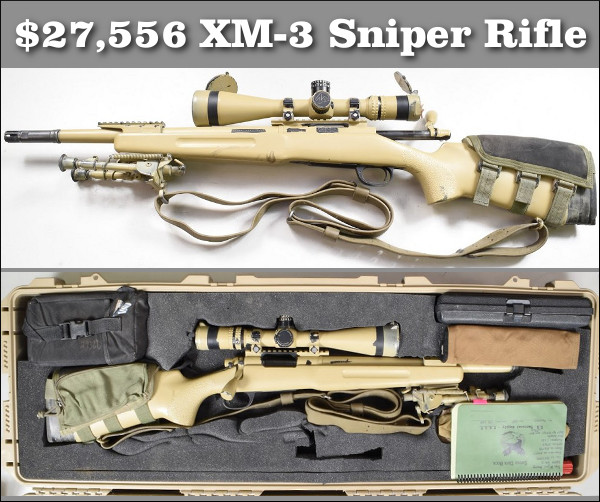
Would you pay over twenty-seven grand for a slightly-used Rem 700 bolt-action rifle and Nightforce scope? Well somebody did just that recently, paying the princely sum of $27,556.00 for a DARPA XM-3 Sniper Rifle system in a CMP Auction. In fairness the buyer did get a case, a PVS22 Night Vision Device (NVD), and some other accessories. Created for the USMC, only fifty-two (52) XM-3s were ever made, so this is a pretty rare rifle. But, honestly, is this thing really worth $27,556? What do you think?
This XM-3 system was recently sold by the CMP at auction (SEE Auction Photos). There was plenty of interest in this item, with 111 total bids for the rifle, case and accesories. Here is the CMP Auction product description:
DEFENSE ADVANCED RESEARCH PROJECT AGENCY (DARPA) XM-3 Sniper Rifle S6533990
These XM-3 sniper rifles used by the United States Marine Corps. In mid-2005, DARPA worked with Lt. Col. Norm Chandler’s Iron Brigade Armory (IBA) to field items to expeditionary units in Afghanistan. Since they already had a great working relationship, DARPA contracted IBA to build and test lightweight sniper rifles that incorporated the improvements the snipers desired in combat. The mission was to be lighter and smaller than the existing M40s, while having better accuracy, clip-on night vision that did not require re-zero, better optics, and better stock, and it had to be suppressed. The barrel had to be short enough to allow maneuverability yet long enough to deliver a 10” group at 1,000 yards. If the barrel was too heavy, maneuverability would decrease, yet if the barrel was too light it would only be able to shoot a few rounds before the groups started to shift due to barrel temperature. IBA tested a number of barrel lengths, ranging from 16 to 20 inches and in different contours. Each rifle with a different length was assigned an XM designator starting with XM1 through XM3. In each case, everything on the prototype rifles was kept the same except the barrel.
During the final phases of testing it was found that the 18” barrels had no issues keeping up with their longer 20” brethren. The final barrel length was set at 18.5”, and the contour was a modified #7. The straight taper on the barrel was only 2” vs. 4” and the overall diameter at the muzzle was .85” vs. .980”. This helped reduce a lot of the rifle’s weight while not negatively affecting accuracy or effective range. A number of the groups at 1,000 yards were < 1 MOA. The Marines of I-MEF were the first to field test the rifles at Camp Pendleton. Shortly after I-MEF took receipt of the XM-3s, the first units in II-MEF took receipt of theirs. By mid-2006 there were dozens of XM-3s in Iraq. There were 52 XM-3s made.
More info on the XM-3 Sniper Rifle can be found at SteveReichertTraining.com.
Also included: Scope SN P06798; Sniper Data Book with some firing information; PVS22 Night Vision Device SN 2936D (NVDs function); appears complete tool/cleaning kit with cleaning rod; sling; suppressor case and wrap (SUPPRESSOR IS NOT INCLUDED!); bipod; cold bore shot target; instructions; iM3200 Storm case.
The great shooting coat controversy has been quelled — at least for the next few months. The CMP will not be banning any brands of commonly-used jackets for now. On Monday, May 15th, the CMP announced that it would halt “strict enforcement” of shooting jacket rules for the remainder of 2017, until new, clear standards can be adopted. Here is the CMP’s statement:
Moratorium on Strict Enforcement of Shooting Jacket Rules
The Civilian Marksmanship Program has declared a moratorium on strict enforcement of rules on design and construction of shooting jackets for 2017 until specific procedures and measurement tools are developed to determine the maximum amount of support coats may provide to competitors.
“The CMP 2018 Rules will contain further clarifications concerning jacket design and construction specifics going forward,” said Mark Johnson, CMP’s Chief Operating Officer. “The CMP strives to institute rules that promote true marksmanship skill and those that resist the equipment race (gamesmanship) facets of our sport.”
“The CMP’s matches are being developed to enhance competitor learning and increasing their own personal marksmanship skill set, not who can buy the best gadget for means of additional support or easier access to higher point totals,” Johnson said.
In 2017, the primary emphasis of the shooting jacket rule, 6.6.1 in the CMP Highpower Rifle and Pistol Competition Rules, 21st Edition – 2017, still applies. The rule states, in part, “Shooting jackets made of flexible material may be worn in CMP Rifle events. Shooting jackets may have shoulder, sling and elbow pads providing those pads are not constructed so as to provide rigid artificial support. Jacket constructions that use back braces (…) or other non-flexible materials are prohibited.”
For 2018, it is the CMP’s intent to provide a clear and concise definition of “flexibility” as it relates to support materials used in shooting jackets and a simple measurement process capable of passing or failing jackets across the entire spectrum of highpower rifle jackets in the marketplace.”
Jacket Rules Not Abandoned Completely
We commend readers to look at the second-to-last paragraph in the CMP statement above. The CMP says Rule 6.6.1 still applies, requiring shooting jackets to be made of “flexible materials” without “rigid, artificial support”. Keep that in mind. While the CMP is halting “strict enforcement” of jacket rules, you still can’t show up with a bionic exo-skeleton.
The CMP has approved a new event for Glock pistols at the 2017 National Matches at Camp Perry. Plastic Pistols at Perry? Traditionalists may scoff, but this is certainly a way to get more (and younger) pistol competitors involved. The first-ever GLOCK Sport Shooting Foundation (GSSF) Match will be held on July 1, 2017 as part of the CMP’s 2017 National Matches. The inaugural Glock Match will be open to both adults and juniors, with two different categories: Stock and Unlimited.
The big news are the prizes — six Glock pistols will be awarded to top Class winners. The Glock Match will be shot on NRA D1 paper targets, with ten (10) rounds each at 5, 7, 10, 15 and 25 yards. NOTE: This is NOT a slow-fire match. According to the CMP press release, competitors will have just 15 seconds for each 10-round string. We hope that’s a misprint — ten shots in 15 seconds makes this a “mag-dump” contest, not a precision match, in our opinion. To compete at the match, shooters must have an active GSSF membership (you can join during match registration at check-in).
There will be two pistol classes, Stock and Unlimited. The Stock Class is for GLOCK firearms with components that are or ever have been available from GLOCK, Inc., though some modifications are permitted. NOTE: Fiber-optic and express sights are approved.
The Unlimited Class is for firearms with major modifications such as aftermarket barrels, mag funnels, recoil springs, and firing pins. Unlimited Class pistols can use “any non-post and notch sights including but not limited to, ghost ring or laser, electronic or optical sights.”
“This match was suggested by Bob Schanen, a valued, long-time GLOCK employee and Camp Perry rifle competitor for 30+ years,” said Brandie Collins, GLOCK public relations and communication manager. “The partnership with CMP in bringing this match to Camp Perry meets our common goals of promoting safe gun handling, marksmanship and introducing people to competitive shooting. Shooters of all skill levels will enjoy shooting this match.”




 In the archives of
 Gary Anderson served as the Director of the Civilian Marksmanship Program (CMP) from 1999-2009, and is now DCM Emeritus. As a Nebraska farmboy, Gary grew up hunting and shooting. Dreams of winning an Olympic Gold Medal in shooting led Gary to the U.S. Army. In 1959, he joined the elite U.S. Army Marksmanship Unit. Just two years later, he won his first national championship.
 Gary retired from active international competition after the 1969 World Championships in Spain, where he set a 50m, three-position world record. After his “retirement” from international competition, Gary competed in the National High Power Championships, winning the President’s National Trophy in 1973, 1975 and 1976. Over his competitive career, Anderson won two Olympic Gold Medals, seven World Championships, and sixteen National Championships. No American has ever won more major shooting titles.
 Hap Rocketto, noted shooting historian, has explained the etymology of “Maggie’s Drawers”. This term “refers to the red flag waved vigorously across the face of the target to signify a complete miss of the target during practice”. The term came in use in the early 20th Century (prior to WWI) when flags were used to signal shot locations on long-range rifle targets.