A.P. Lane’s Gold Medal-Winning Colt Revolver
This Colt Officer’s Model revolver, factory-fitted with a skeletonized hammer, belonged to legendary Olympic shooter A. P. Lane, who was known as the “Pistol Wizard”. Lane used this Colt Revolver to win FIVE Olympic Gold Medals — three in 1912 and two in 1920.
A.P. Lane was one of the greatest pistol shooters of his generation. He shot scores that were typically 25-50 points higher than those of his competitors. And he exhibited true Corinthian spirit. At the 1912 Olympics, Lane shared his match ammunition with another competitor who used that ammo to capture the Silver Medal (Lane won the Gold).
This revolver, factory-fitted with a skeletonized hammer, was used by American A.P. Lane in winning five Olympic Gold Medals in the 1912 and 1920 Olympic Games. It’s a .38 caliber, Officer’s Model centerfire revolver from the early 20th century. Olympian A.P. Lane’s Gun can be found in Gallery 13, Firearm Traditions for Today, at the NRA National Firearms Museum in Fairfax, Virginia. The Museum exhibit includes a panoply of Lane pieces – his revolver, his five Gold Medals, and the five Olympic certificates that went along with them.
Photo courtesy NRA MuseumClick Photo to View Larger Image
With today’s plastic-framed Glocks and Keltecs, aesthetics have been sacrificed on the altar of functionality. Not so in the early 20th century — in that period, the best firearm designers created guns that looked as good as they worked. One example is the classic Colt Woodsman. This design came from the legendary John Moses Browning and was later refined by Colt before the pistol’s introduction in 1915. The Colt Woodsman’s frame design evolved over time in three distinct series: Series One 1915–1947, Series Two 1947–1955, and Series Three 1955–1977. Shown above is a stunning Carbonia-blued and engraved Third Series model with ivory grips.
Engraved Colt Woodsman from NRA Museum In the NRA Museum’s Robert E. Petersen Gallery are many fine engraved arms. This Colt Woodsman .22 pistol is one of the Third Series guns that were made until 1977. Heavy barrels in either 4.5 or 6 inch lengths were offered in this variation. The Museum’s staff says: “We think the poised golden rattlesnake near the serial number is the [best] embellishment without putting down in any way the ivory grip panels or gold outline inlays.”
You can see this lovely Colt and countless other fine firearms at the NRA Museum in Fairfax, Virginia. The Museum is open every day from 9:30 am to 5:00 pm, and admission is free.
Here at AccurateShooter.com we tend to focus on highly-accurate (1/2-MOA or better), custom-built bolt-action rifles. But for home defense, deer hunting, or just having fun with the grand-kids, factory-built firearms serve their purpose. With that in mind, we wondered, “Just what are the most popular mass-production firearms these days?” Gunbroker.com, the biggest firearms auction site, has tallied the top-selling new and “previously-owned” firearms in various categories for all of last year. Here are Gunbroker’s “Best Selling Firearms” for 2015.
GunBroker.com’s Best-Selling New and Used Firearms of 2015
Some things we expected — the Rem 700 is the top-ranking bolt-action rifle, and the Ruger 10/22 was the leading semi-auto rifle. But notably, the Ruger Precision Rifle (Below) is now the second-best selling bolt rifle in the country. That shows how popular “tactical” style bolt guns have become. It also proves Ruger has created a winner — a fine-shooting rifle that has quickly established a following.
The second most popular bolt-action long-gun is the new Ruger Precision Rifle
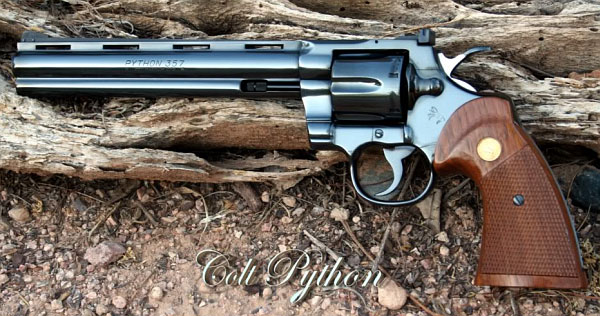
In the handgun rankings, there were some surprises. Despite being out of production, the Colt Python is the best-selling used revolver. Why is an out-of-production gun a top-seller? First, high-grade Pythons are actually increasing in value, making this “snake” a good investment. Pythons are also highly accurate, beautifully-finished revolvers with superb triggers. These qualities make the guns highly desirable to serious shooters as well as collectors.
Each day, on Facebook, the NRA National Firearms Museum showcases something special from the Museum collections. Recently the Museum displayed a trio of snakes — three very special Colt Pythons. From bottom to top, these three prized wheelguns are: Colt Python serial number 2, number 3, and number 5. And yes, that is the original box for Python #2 (at bottom). The museum says such low serial number guns were typically produced for a company executive or key members of the gun design team.
Loved for their beautiful finish, nice balance, and great trigger, Colt Pythons have proven to be excellent investments. Since the Colt Python was first introduced in 1955, Python prices have gone through the roof. A pristine, LNIB early-era Colt Python can now command $4000.00 or more. The Museum estimates the price of Pythons has risen 14,300% since 1955.
You can see hundreds of other interesting firearms on the National Firearm Museum website, www.NRAMuseums.com. Or, if you’re lucky, you can see the collections in person. The NRA now operates three Museum locations: the NRA National Firearms Museum in Fairfax, Virginia; the NRA National Sporting Arms Museum (at BassPro) in Springfield, MO; and the Frank Brownell Museum of the Southwest in Raton, NM.
Ever heard of the Canadian Rangers, an element of the Canadian Armed Forces (CAF) Reserve? Founded in 1947, the Rangers serve as the CAF’s eyes and ears in sparsely-settled northern and coastal areas of Canada. The Rangers cover the remote frontiers, performing public safety as well as security duties. For their entire history, the Canadian Rangers have always used a compact model of the Lee-Enfield No. 4. But that’s about to change…
Stirring Rapid-Fire Demonstration by Canadian Rangers
The Rangers have decided to replace their beloved (but antiquated) Lee-Enfields for something more advanced — the Tikka T3 Compact Tactical Rifle (CTR) in .308 Winchester.
Canadian Ranger Model Tikka Compact Tactical Rifle Features:
1. Barrel, Bolt, and Action made by Colt Canada under license from SAKO.
2. Larger bolt handle and enlarged trigger guard to accommodate gloved hands.
3. Protected front and rear iron sights.
4. Laminated stock in unique gray/orange or red colour with Ranger Crest.
5. Two-stage trigger with three-position safety.
The first 125 prototypes have been delivered to the Rangers for field testing. Feedback from the Rangers will be incorporated in the final production rifles. The contract calls for 6500+ production rifles to be delivered to the Rangers by end of 2018.
In addition to the rifle, the package will include a custom-molded Pelican hard transport case, plus a soft transport case (outfitted with sling and cleaning kit). Both hard case and soft case feature the Canadian Ranger Crest.
This handsome Paterson revolver, the earliest known, factory-engraved Colt, sold for remarkable $414,000 at an April 2015 RIA auction.
Gun prices climbed into the stratosphere last month during the 2015 April Premiere Firearms Auction conducted by the Rock Island Auction Company (RIA). The most expensive gun at auction was an historic Colt Paterson, the first-ever factory-engraved Colt handgun. Complete with the original fitted factory case with various accessories, this Paterson inspired a bidding war that saw the price rise to a stunning $414,000. That is an amazingly high price for a gun that was not owned by a well-known historic personage. Generally, to command a price in the multiple hundreds of thousands of dollars, a gun must have a significant historic provenance — such as having been owned by a legendary figure such as Billy the Kid or Wyatt Earp.
It seems like prices continue to rise every year at auctions of historic and collectible firearms. At RIA’s April Premier Auction, the total sale value of the auctioned guns topped $11.6 million. Remarkably, a first-year production Colt Python (serial #170) sold for $17,250! That makes this Editor regret not having acquired an early model Snake decades ago.
With today’s plastic-framed Glocks and Keltecs, aesthetics have been sacrificed on the altar of functionality. Not so in the early 20th century — in that period, the best firearm designers created guns that looked as good as they worked. One example is the classic Colt Woodsman. This design came from the legendary John Moses Browning and was later refined by Colt before the pistol’s introduction in 1915. The Colt Woodsman’s frame design evolved over time in three distinct series: Series One 1915–1947, Series Two 1947–1955, and Series Three 1955–1977. Shown below is a stunning Carbonia-blued and engraved Third Series model with ivory grips.
Click Photo to View Larger Image Photo courtesy NRA Museum
Engraved Colt Woodsman from NRA Museum
In the NRA Museum’s Robert E. Petersen Gallery are many fine engraved arms. This Colt Woodsman .22 pistol is one of the Third Series guns that were made until 1977. Heavy barrels in either 4.5 or 6 inch lengths were offered in this variation. The Museum’s staff says: “We think the poised golden rattlesnake near the serial number is the [best] embellishment without putting down in any way the ivory grip panels or gold outline inlays.”
You can see this lovely Colt and countless other fine firearms at the NRA Museum in Fairfax, Virginia. The Museum is open every day from 9:30 am to 5:00 pm, and admission is free.
Now through April 20, 2015, the Museum hosts a Theodore Roosevelt exhibit: “The Trappings of an Icon”. This includes Roosevelt memorabilia on loan from Sagamore Hill National Historic Site.
TECH TIP by Robert Whitley,AR-X Enterprises LLC
Over the years, while working with various AR-15 cartridges that require a larger bolt-face bolt (i.e. bigger than a 5.56 NATO/.223 Rem bolt-face, like those cartridges that use a 6.8 SPC bolt or the bolt face suitable for the 6.5 Grendel-based cartridges), I have found that there is an increased potential for a certain type of jam if a modification to the standard “Mil-Spec”, square-edged ejector is not made.
The original AR-15 square-edged ejector design was made for a much smaller-diameter bolt face and the smaller diameter 5.56 NATO/.223 Rem case, and it works perfectly in that application. However, as people have adapted the AR-15 platform to shoot bigger cartridges, some parts have been modified to accept the larger cartridges (i.e. bigger bolt-face bolts for the 6.8 SPC and the 6.5 Grendel, and different extractors), yet other parts have been all but ignored. One of these “ignored” parts has been the ejector. Most of the larger-bolt-face AR-15 bolts still use the standard “Mil-Spec”, square-edged 5.56 NATO/.223 Rem. ejector. That’s the problem. But there is a simple, reliable fix!
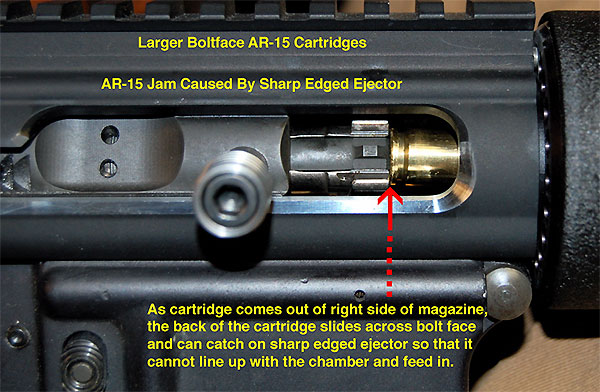
Chamfering AR Ejector for Improved Reliablity with 6mm, 6.5mm and 6.8mm Cartridges
With the larger bolt face and the larger-diameter AR cases, the old-style “Mil-Spec” ejector can cause infrequent but still annoying jams if the ejector is not modified. The jam can occur when a cartridge case feeds up and out of the right side of the magazine, and as it does so, the back of the case must slide across the bolt face and sideways over top of the ejector if it is to center up to the chamber and feed in. If the side of the case catches on the sharp-edged ejector you can get a jam. (See picture above).
Fortunately there is an easy fix for this. One way is to take the ejector out and spin it in a lathe or cordless drill and machine or grind it and round or chamfer the sharp edge. (See picture of rounded ejector next to square edged ejector).
Quick Fix Alternative — Bevel Your Ejector
Another “quick fix” is to leave the ejector in the bolt and chamfer the sharp edge with something like a Dremel tool. (See picture). This fix is easy to do and permanently resolves this potential feeding jam issue. There are no downsides to this modification if done right and I would recommend this modification for the ejectors in all larger bolt-face AR-15 bolts.
This gunsmithing tip provided by Robert Whitley of AR-X Enterprises LLC, 199 North Broad Street, Doylestown, PA 18901. Phone: (215) 348-8789. Website: 6mmAR.com.
Do you have a tactical rifle project in the works, or are you looking to upgrade the bottom metal on your existing bolt gun? Then head over to the PT&G website before the end of month. During April Pacific Tool & Gauge (PT&G) is running a Bottom Metal Blow-Out Sale. You can save 15-42% on quality Bottom metal for a variety of rifle types — Colt, Howa, Remington, Ruger, Winchester. On sale this month are both flush and extended options for detachable box magazines. In addition, you’ll find a variety of hinged, flush bottom metal sets for conventional internal magazines.
New PT&G Bottom Metal for Ruger Actions
Ruger owners take note — PT&G is now taking orders for DBM-capable Stealth bottom metal for Ruger rifles. This bottom metal in offered in both Short Action and Long Action Versions. It will fit the M77, M77 Scout (short action only), and M77 Hawkeye, and Ruger American (with aftermarket stock). The Short Action Version is now $99 (28% off) while the Long Action verision is $119.50 (20% Off).
Maggie Reese, one of the nation’s top female 3-gun shooters, recently signed as a factory-sponsored Team Colt shooter. It seems that blue and white suits Maggie just fine. Maggie just won the Ladies Open Division title at the Superstition Mountain Mystery (SMM) 3-Gun match in Mesa, Arizona. This marked the third time Reese finished as “High Lady” at this competition. Maggie told us: “The SMM 3-Gun is a competition I’ve gone to since the start of my shooting career, and it’s always a pleasure to go back.”
Photo credit: Yamil Sued
Reese used a Colt LE6920 for the rifle portion of the SMM 3-Gun. “There was a lot of accuracy involved in this particular match,” said Reese. “Having a dependable rifle made all the difference in trusting my shot placement.”
The stages also included distance targets up to 350 yards, along with some unique challenges. One stage had competitors strapped to a chair that was rotated to a 90-degree angle (See video below). “Shooting sideways was a fun experience,” said Reese. “Body placement was so important for this stage, along with being comfortable with your rifle. Up next for Reese is the 3-Gun Nation Pro Series Event in Tulsa, followed by the USPSA Multi-Gun Nationals on April 16 in Las Vegas. To follow Maggie Reese and other Team Colt members this season, visit Facebook.com/ColtFirearms.
Superstition Mountain Tilting-Chair Stage (Benny Hill style)
This video, by Brett Russo, features Jamie Franks, Taran Butler, Craig Outzen, Maggie Reese, Peter Jonasson, Chris Cheng, Jessica Hook, and others.
Here is Maggie with other shooters at SMM 3-Gun. Can you name the people in the picture?


 A.P. Lane’s Gold Medal-Winning Colt Revolver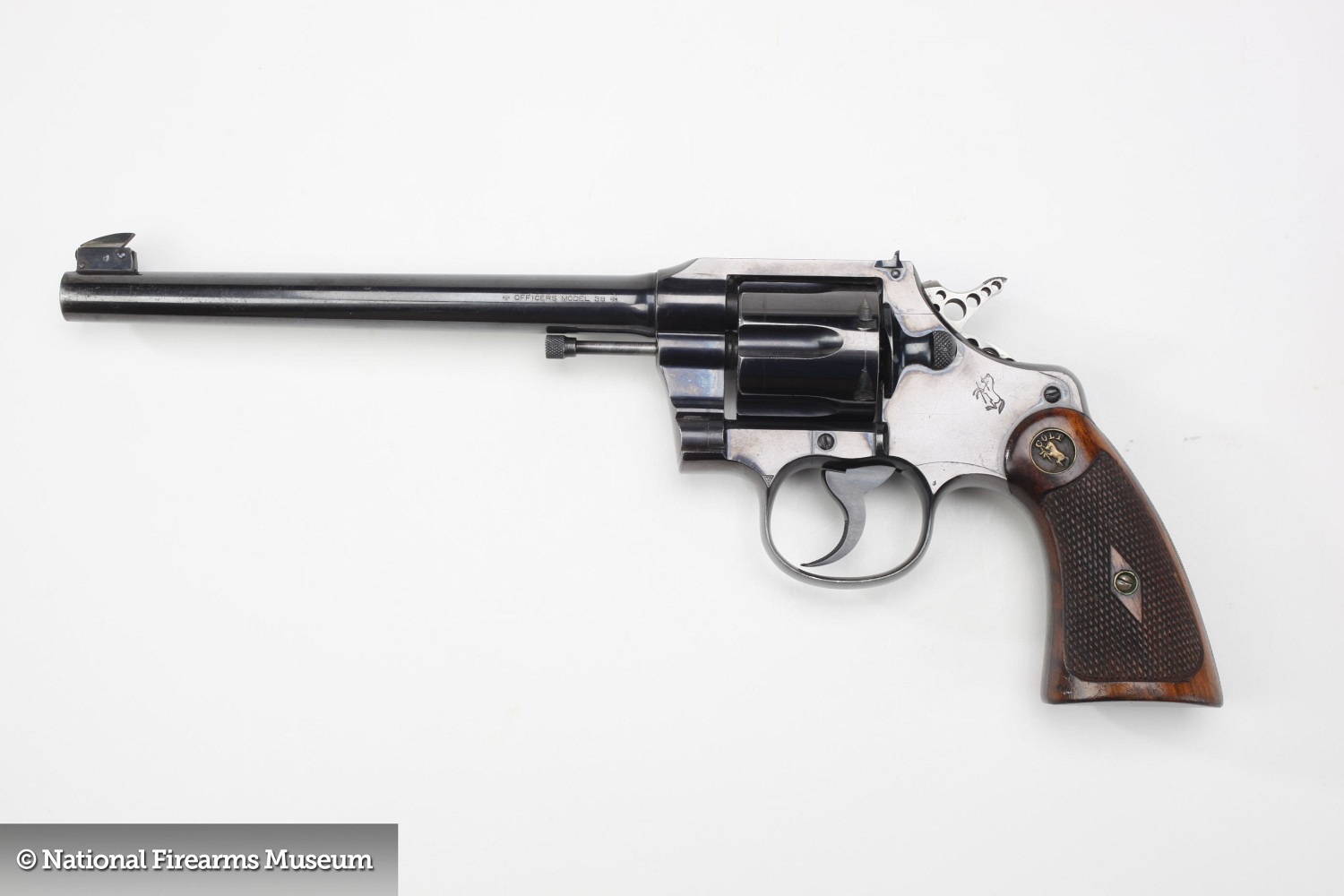


 In the NRA Museum’s Robert E. Petersen Gallery are many fine engraved arms. This Colt Woodsman .22 pistol is one of the Third Series guns that were made until 1977. Heavy barrels in either 4.5 or 6 inch lengths were offered in this variation. The Museum’s staff says: “We think the poised golden rattlesnake near the serial number is the [best] embellishment without putting down in any way the ivory grip panels or gold outline inlays.”






 The stages also included distance targets up to 350 yards, along with some unique challenges. One stage had competitors strapped to a chair that was rotated to a 90-degree angle (See video below). “Shooting sideways was a fun experience,” said Reese. “Body placement was so important for this stage, along with being comfortable with your rifle. Up next for Reese is the 3-Gun Nation Pro Series Event in Tulsa, followed by the USPSA Multi-Gun Nationals on April 16 in Las Vegas. To follow Maggie Reese and other Team Colt members this season, visit


