“Say What?” — Forum Members Talk About Hearing Loss
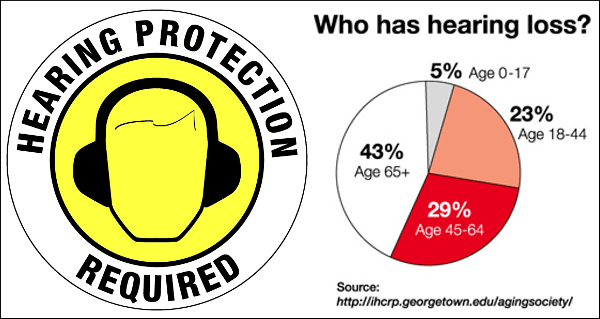
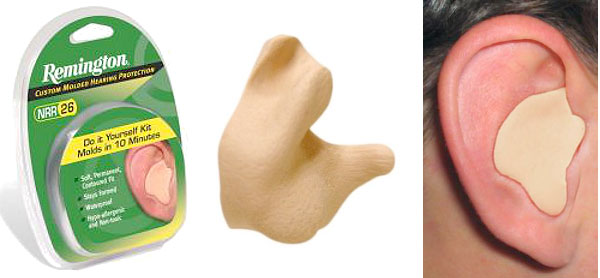
Hearing loss can be progressive and irreversible. If you are a shooter, this is serious business. You need to use effective hearing protection every time you go to the range. Even if you are away from the firing line, gunshot noises can damage your hearing. Good foam earplugs costs mere pennies but they can prevent deafness in your later years. Many folks also wear muffs over plugs. Some other shooters prefer the custom-molded ear plugs. Electronic muffs can be useful when you are away from the firing line because they allow you to converse.
Here are some comments from Forum members on the subjects of hearing loss and the need for proper ear protection. You can join the discussion in this FORUM THREAD:
“If you are young and don’t want to end up with profound hearing loss like I have… ALWAYS ALWAYS ALWAYS use hearing protection. This is from a guy who is social security/medicare eligible, has two Re-Sound aids at a not so cheap $2000.00 EACH… and now has religion! When I was young [we] never wore ear gear and laughed at the ringing after 100 rounds of 12 gauge at the skeet range. Now we live with the consequences. Be smarter than I was!” — Gary0529
“Take it from a 70-year-old that has been shooting 49 years. I now have a Re-Sound hearing aid in the left ear and a Cochlear Implant in my right. I still cannot hear. Custom molded plugs are best. Some are sold at gun shows and some are made by the folks that make hearing aids. They are cheap as compared to this $200,000 implant. DO IT NOW for everyone around guns.” — Richard King, King’s Armory
“Say WHAT? You have to type a little louder! I used to shoot without any muffs, when I was ‘young and indestructible’, and now I have about 40% loss. When I take youngsters and friends shooting, they get muffs and plugs. I’m not allowed suppressors where I live. I would use them if I could.” — Josh B.
“For what it’s worth, I wear both ear plugs and muffs that have NO sound adjustment capability. As a youngster (15) I wore no ear protection either in shooting or motorcycle riding. I kept doing that until entering military service at age 18 where we had to wear ear plugs at the range. Started wearing ear plugs after that, except when motorcycle riding. At around age 53 my hearing started going south as a result of my own stupidity as a youngster and now some 15 years later I only have about 45% of my hearing left. So beware all — there is a price to pay if you don’t protect your hearing.” — Shynloco

“Here are several points to consider:
1. The NRR (noise reduction rating) is determined by “experimenter” fit, not user fit, and trained listeners during the testing period. This results in inflated protection numbers compared to real-world protection.
2. Any disruptions in the protector/skin seal will greatly reduce the effectiveness. Think eye glass temple bars, lots of hair, ear wax, etc. A 5% leak results in a 50% reduction in effectiveness.
3. Double protection gives only 5-10 dB extra protection.
4. Bone conduction gives about 50 dB protection so hearing protectors are the weak link[.]
5. Keep the protectors in/on your ears. Over 8 hours, if you remove them for only 30 minutes (cumulative), the effective protection is cut in half.So, if you are using a really good muff with NRR of 33 and a foam plug with NRR of 27, the real-world NRR would be about 35 dB, at best. This would attenuate a gunshot by that amount. The key is time versus exposure. Limit the exposure and you limit the dose.” — DelS
“Personally, I use Etymotic Research GSB-15 electronic blast protectors. They are rated at 26-28 dB, but inserted correctly, with the correct fitting tip, approach 38 dB. And, they have a compressor amplifier that allows you to hear soft sounds normally and with very high fidelity. As the sound level goes up, the gain goes down till at an ambient sound pressure level of around 90 dB SPL, the gain is unity, or what comes in goes to the ear canal. However, once the sound level gets to 117dB SPL, the amplifier cannot go higher. So, if you are firing a large rifle with an impulse noise of around 160 dB SPL, your ear only hears 117 dB SPL of that for an effective attenuation of about 40 dB. RIGHT! about the same as the mastoid bone! Can’t get any better than that.
What gives me the right to say all these things? First, a BSEE as well as the graduate course in Audiology and a hearing aid dispensers license. And working in research and product development for the ear the last decade of my career.” — Norm Matzen
 Remington now offers a