F-Class shooting (both F-Open and F-TR) is one of the fastest-growing forms of rifle competition. Each season many new shooters hit the line and attendance at the major F-Class matches increases every year. But if you’re new to the game, you may ask “Where can I shoot an F-Class match?”. Well, Forum member Rod V. (aka Nodak7mm) has compiled a useful list of 112 ranges throughout the USA where F-Class matches are held. With venues from Alabama to Wyoming — you should find an F-Class program not too far from home. The list, in Excel spreadsheet format, provides range locations and weblinks (where available). Click the link below to download the F-Class Range List (.xls file):
Note — this list, now in its 20th Revision, is augmented regularly, but info is still being gathered. No claim is made that the list is comprehensive. But it still covers the the lion’s share of the important F-Class venues nationwide. If you know of a range that should be added to the list, please post the location on our F-Class Range List Forum thread. Rod will update the list as new range info is received. Rod writes: “Range information is wanted and welcomed. I would like your help on collecting specific info on Clubs/Ranges where known F-Class matches are held.” Here’s a partial sample from Rod’s list:
Emil Kovan is one of the top F-Class shooters in the world. He won the 2014 United States F-Open Championship, and finished second in F-Open Division at the 2016 Canadian National F-Class Championship in Ontario. He is a great shooter and a great gun-builder as well.
“What are the best components for an F-Open class rifle, and why?” That’s a question that I get asked all the time and will try to answer in this article. Two months ago, I was contacted by Duane, a gentleman I met at the 2015 F-Class Nationals. He was interested in building a rifle with the new Master Class Low Profile F-Open Stock, created by Carl Bernosky and Alex Sitman of Master Class Stocks.
I have known Alex Sitman for many years, and use his stocks exclusively, but was not very familiar with his new Low Profile F-Open stock. After a brief conversation with Alex, I placed an order, and had the stock inletted and bedded at my shop in a month. My first impression was “Wow that’s a long stock” — the forearm is significantly longer than on the original Master Class F-Class prone stock. I bolted the barreled action in, and squeezed the end of the forearm and barrel together, the stock flexed a little bit, but not as much as other designs that I have tested. I think that’s due to having “more meat” in the receiver area. The full stock depth continues farther forward that on some other “low profile” designs. That makes the stock stiffer in the vertical plane, reducing the hinging effect forward of the action. The stock was finished in gloss black per the customer’s request. Interestingly, I found that the multiple layers of paint and clearcoat stiffened the stock up quite a bit.
CLICK IMAGE below for full-screen version
Low Center of Gravity Tames Torque
Compared to the original Master Class F-Open stock, the barrel sits about an inch lower. Lower center of gravity equals less torque, and that is very important when shooting heavy bullets in fast twist barrels. Another significant improvement is that the toe of the stock is flat and parallel to the forearm. I added a 3/4″ track rail in the rear, and milled the underside of the fore-end to create two parallel “rails” in the front to help the stock track better.
One of the biggest reasons why I like Master Class stocks, is the pistol grip. I don’t shoot “free recoil” and a comfortable pistol grip is super important to me when selecting a stock. The new Master Class Low Profile stock shares the same grip as the old model. This allows the stock to accommodate either a “hard hold” style or a more free-recoil style of shooting — whatever the rifle’s owner prefers. This design versatility is one reason I recommend Master Class stocks. Shooters may experiment with either shooting style to find what suits them best.
Cartridge Choice — A 40° .284 Win Improved
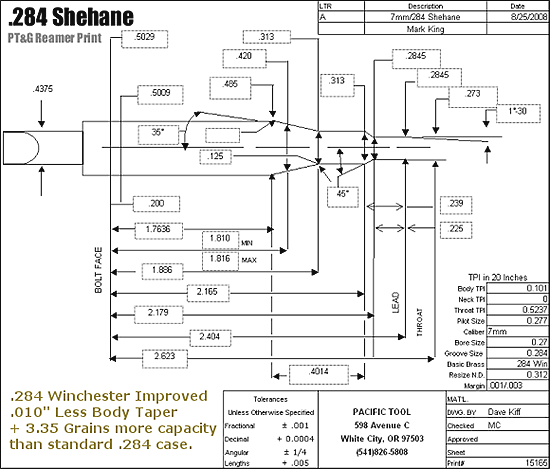
Duane decided to have the barrel chambered for my 284 KMR IMP (Improved) wildcat. What is .284 KMR IMP and why choose it over the straight .284 Winchester? Improved by definition means “made better”, I took a great cartridge, and modified it to increase capacity, reduce pressure, and increase brass life.
There are many “improved” variants of the original .284 Winchester: 7mm Walker, .284 Shehane, .284 Ackley and so on. My version, the 284 KMR IMP, shares the .010″ blown-out sidewalls of the .284 Shehane, but I have further increased the case capacity by changing the shoulder angle from 35 to 40 degrees. The 284 KMR IMP allows you to almost match magnum cartridge velocity in a standard-bolt-face action. If you want to run 180gr-class 7mm bullets over 2900 FPS, it is cheaper and more convenient to have a barrel chambered in 284 KMR IMP than to spend $650 for a magnum bolt.
Tuning Loads for the .284 Win Improved Cartridges
The 284 KMR IMP seems to have two nodes, one around 2820 fps and other at 2940 fps. My match load clocks at 2935 fps with single-digit ES. Note –I selected that load based on accuracy, NOT raw speed. A lot of novice (or hard-headed) shooters make the mistake to push their cartridges to the max, and disregard more accurate loads at lower velocity.
The sport of F-Class is rapidly growing, and the equipment used is improving constantly. I remember that only few years ago, an F-Open rifle that could shoot sub-one-inch of vertical at 300 yards was considered competitive. Now, we are pursuing sub-one-inch vertical at 600 yards! It takes a great rifle to approach that goal, but it is also up to the shooter to learn and experiment as much as possible in order to achieve success.
Dies for an Improved .284 Win Cartridge
One of the biggest challenges in campaigning a wildcat cartridge has been obtaining great dies. When searching for custom dies, it almost seems like that the odds are stacked against us. The most common problem is wait-time — custom die orders can take months to be completed. Also, most custom die makers want you to send them two or three cases, each fire-formed three times. I find that funny because if could somehow properly size the cases for three fire-forming cycles, I would not need a sizing die.
Custom-made dies should size the case just right, but sometimes the die’s internal dimensions are slightly off, and this leads to problem number two: dies sizing too much (or even worse) too little. I had a one “custom” die that would not size the bottom of the case enough. This made the extraction of fired cases very difficult. I feel that the best option (if available) for shooters interested in wildcat chambers is to have their gunsmiths make the dies. I offer that die-making service in addition to barrel chambering.
BAT Machine “M” Action
Duane decided to use a BAT M action for this rifle, and I think that he could not have made a better choice. We are blessed with many good match-quality receivers: Barnard, BAT, Borden, Kelbly, Nesika, and Stiller just to mention a few. These are all very well-made and suitable for F-Class. Among BAT Machine Co.actions, I like BAT models M, MB, and 3LL best. I prefer these because because of their size (large bedding footprint) smoothness, timing, options available, and last but not least visual appearance.
Trigger: I recommend and use Jewell triggers. Other good options are: Kelbly, CG Jackson (good 2-Stage) Anschutz (best 2-Stage for Bat and Kelbly actions), Bix’N Andy, and David Tubb.
Barrel: Duane made another good choice here. He decided to go with a Brux 1:8.5″-twist, 4-groove cut-rifled barrel. If you look at the F-Class and Long Range benchrest equipment lists, you will see that cut-rifled barrels are currently dominating. Many records have been shot with both button-rifled, and cut-rifled barrels. I have shot both, and prefer cut-rifled barrels. I am not saying that button-rifled barrels are not capable of shooting as well as cut-rifled barrels, but on average, in my experience, four out of five cut-rifled barrels (from top makers) will shoot well, vs. three out of five buttoned barrels. YMMV, but this is what I’ve observed.
Scope: Duane’s rifle was fitted with a Nightforce 15-55x52mm Competition scope with DDR-2 reticle. This optic is ultra clear, reasonably lightweight (28 oz.), super reliable, and has 1/8 MOA clicks — what you want for long range F-Class competition. In this 15-55X NF model, I like the DDR-2 reticle best, because fine cross hairs (FCH) are hard to see in heavy mirage. The DDR-2 has a heavier horizontal line, with a center dot. March scopes are also very popular and very well-made.
Thanks for reading, and keep ‘em in the middle…
Emil Kovan Competition History:
– 2014 F-Class Open National Champion
– 2016 F-Class Open Canadian Championship, Silver Medal (tied for first on score)
– 2015 F-Class Open National Championship, Silver Medal
– F-Class Open National Championship Teams, 2015, 2014, 2013, Shooting Team Member
– Over 15 wins in Regional and State Championships in Palma, F-TR, F-Open
There are hundreds of cartridge types capable of winning in F-Open. For F-TR you can shoot either the .223 Rem or .308 Win, but you have many load options. This article will focus on proven choices, currently used by the top F-Class shooters in the world. Our discussion will analyze cartridge selection based on the four different F-Class sub-disciplines: Open Mid-Range, Open Long-Range, F-TR Mid-Range, and F-TR Long Range.
Click image to view full-screen photo.
Mid-Range F-Open Cartridges
For starters, a .300 WSM is certainly capable of winning mid-range matches but it is not ideal. So what is ideal, and why? F-Class Mid-Range matches usually are usually shot at 300, 500, or 600 yards — or all three. At those distances the 6mm and 6.5mm cartridges rule. In moderate conditions, the 6mm Dasher is unbeatable. Its low recoil along with its super grouping ability and good ballistics make it my number one choice for Mid-Range.
Best bullets for the 6mm Dasher are: Vapor Trail 103gr, Berger 105 Hybrid, 108 BT, and 105 VLD (hunting). Best powders are: Varget, H4895, and Reloder 15.
Choices for Mid-Range in Tougher Conditions:
We all know that conditions are not always “moderate” that’s why something a little bit bigger will save you a “Nine” or two. The 6.5X47 Lapua was designed for 300-meter competition, but as soon as it was released, it was adopted by F-Class, benchrest, and tactical shooters. It offers great ballistics with very low recoil and big “accuracy window”. Lapua makes great brass for it (no surprise there) and Berger makes great bullets: 130gr VLD, 140gr VLD, 140gr Hybrids. Best powders in most barrels are Varget and H4350, I don’t use double-based powders such as Reloder 17 and the Vihtavuori N500 series because of their unpredictable performance day to day (greater temp sensitivity).
The 6.5X47 Lapua necked down to 6mm is also a great option for mid range matches. I was able to easily get 3200 fps with 105 hybrids and H4350.
Choice for Long-Range F-Open Competition
In Long-Range F-Open Class (out to 1000 yards), the big, high-BC bullets rule. If I had to pick one cartridge for F-Class (both mid- and long-range) I would pick the .284 Winchester or one of its variants. The .284 Win is currently dominating in F-Open competition. It offers great barrel life, it is super-easy to tune and its recoil is very manageable. The best bullets for it by far (in my opinion), are the Berger 180 Hybrids. But Sierra’s new 183gr MK bullet (with factory-uniformed meplats) seems to perform very well as does the Berger 180 VLD. Best powders for the .284 Win are H4350 and H4831SC.
Long-Range Only F-Open Cartridge
As much as I like the .284 Win, for long-range competitions I like the .300 WSM even more. If you look at a .300 WSM and a 6mm Dasher side by side, they appear almost identical in geometry — the .300 WSM looks like an “super-sized” Dasher. Both cartridges are currently the “darlings” of long-range benchrest due to their extraordinary grouping ability and huge “node’’ windows. Big accuracy windows allow loads to perform well in different conditions and geographical locations. That’s obviously very important if you travel to compete. The .300 WSM loaded with Berger 215gr or 230gr Hybrids is very tough to beat at long range, and it is currently my number one choice.
The 7mm RSAUM is another outstanding long-range round. It resembles a 6BR on steroids and it is almost as easy to tune. Best bullets for it are Berger 180gr Hybrids, 195gr EOLs, and Sierra’s 183gr MatchKing. Best powders for the 7mm RSAUM are: H4350, H4831SC, and VV N160.
Top Caliber/Bullet Combos for F-TR
In F-TR competition, the choice is clear — a .308 Win throated for Berger 185gr BTLRs and 200gr Hybrids will win in mid-range AND long-range comps. Many championships have been won, and many records set with those two bullets in the .308 Win. To quote Danny Biggs (a two times FTR National Champion) “The 185 BTLR is the best bullet for .308 Win ever made”.
The Berger 215gr Hybrids have been used to win many competitions including recently the 2015 F-Class Nationals. Bryan Litz won both the Mid-Range and Long-Range 2015 Championships using 215s. Bryan’s rifle is shown below:
I recommend chambers throated for the 185/200 grain projectiles over the 215/230 grain bullets. The reason is that if you have your barrel throated out for the 215s or the 230s, you could have a “slow” barrel and max out on pressure before the desired velocity is reached. Optimum freebore for the 230s is too long for the 185/200s, so you would be limited to using only 215/230gr bullets in that barrel.Furthermore, the recoil increase with heavier bullets is substantial, causing the rifle to be more difficult to shoot.
.223 Rem — Not A Competitive Option
I would stay away from the .223 Remington. On paper the 90gr VLD will shoot inside most .308 Win loads even at a 1000 yards. But in reality, on average, the .223 Rem, regardless of what powder/bullet combo is used, cannot compete with the .308 Win. [Editor: The equipment lists at major F-TR matches will confirm Kovan’s conclusion here.]
Conclusion (and Other Options)
This article covers only the (currently) most popular cartridge/bullet combos for F-Class (F-Open and F-TR). As I said in the beginning, many cartridge types are capable of winning but are not listed due to their low popularity, case design, or lack of quality components. All of the above information is based on my personal experience and it is meant to help new shooters choose the right cartridges for F-Class matches. Thanks for reading and good luck — Emil Kovan
Emil Kovan Competition History:
– 2014 F-Class Open National Champion
– 2015 F-Class Open National Championship, Silver Medal
– F-Class Open National Championship Teams, 2015, 2014, 2013, Shooting Team Member
– Over 15 wins in Regional and State Championships in Palma, F-TR, F-Open
With the U.S. F-Class National Championship running this week in Raton, NM, we thought we’d highlight a very important .284 Win rifle. This is the .284 Winchester rig that Charles Ballard used to win back-to-back F-Open titles in 2008 and 2009. Ballard’s huge success with the .284 Winchester cartridge helped make the .284 Win (and .284 Win Improveds) the dominant cartridge in F-Open competition worldwide. Enjoy this trip back in time to when the .284 Win was the “new kid on the block”.
Ballard Wins Back-to-Back F-Open Championships
In a very short span, Ballard and this rifle racked up an impressive string of performances. Ballard won the NRA Long-Range Regional, setting a new National Record in the process — 200-23X at 1000 yards. He also won the North Carolina F-Class Championship with the gun, and then captured the 2008 F-Open National Championship, followed by a second F-Open title in 2009. At the 2008 Nationals in Lodi, Wisconsin, Charles shot a 1337-65X with Berger 180gr bullets. At the 2009 F-Class Nationals, held at Camp Butner, NC, Ballard shot a 1328-62X to win his second straight National title.
Ballard’s “Purple Haze” rifle features superb components, including a BAT MB action, Nightforce 12-42 BR Scope, and a wickedly accurate 32″ Broughton barrel.
Charles Ballard always used eye and ear protection. For these photos, he removed safety glasses.
Building a Championship-Winning F-Classer
by Charles Ballard
This rifle project began several years ago. My purpose was to find a cartridge that would launch the high-BC, 180gr 7mm bullets at competitive velocities for F-Class competition. I also sought barrel life that would be far superior to that of a 7mm WSM or 6.5-284. I read the article on 6mmBR.com about Jerry Tierney’s .284 Winchester and the cogs began to turn. After speaking with Mr. Tierney at the 2006 US F-Class Nationals, I decided the .284 Win would be the chambering for the new gun, despite several shooters telling me I would not be able to obtain the desired velocities. Jerry said “go for it” and, as it turned out, the rifle delivered the velocity I wanted, plus extraordinary accuracy to boot. This gun has more than exceeded my expectations, winning matches and setting a new 1000-yard, single-target F-Class National Record (200-13X).
Rifle Specifications–All the Hardware
My action of choice was a beefy 1.55″-diameter, round BAT MB, Left Bolt, Right Port. I chose this action based on BAT Machine’s impeccable reputation. I also liked the fact that the MB (medium long front) action offered an extended front end. This would provide better support for a very long barrel and give more bedding surface. The action is topped with a stainless BAT tapered (+20 MOA) Picatinny scope rail. Housed in a polished, stainless BAT trigger guard is a Jewel trigger set at 5 ounces.
The barrel is a 32″ Broughton 5C. The chamber was cut with a reamer made for Lapua 6.5-284 brass necked up to 7mm. It’s throated for the 180gr Bergers. I selected a Broughton 5C because, as my gunsmith says, “They just shoot”. This is a 1:9″ twist, 1.250″ straight contour for 32″. Yes, that’s a long, heavy barrel, but I think the length gives me a velocity advantage. On other guns, a 32″ tube could cause the rifle to be front-heavy and out-of-balance. The stock by Precision Rifle & Tool has a 3″-longer fore-end which solves the problem. The purple .284 balances very well and tracks great.
Speaking of the stock, there was only one choice, a “Purple Haze” laminated F-class model from Precision Rifle & Tool. This stock features a fully-adjustable buttplate plus a removable cheek-piece with thumb-wheel adjustment. Most importantly, the stock features an extra-long, super-stiff, low profile fore-end. This design rides the bags better than any stock I have ever shot. The action area of this stock has been beefed up to house the large BAT MB action. The final component on this rifle is a 12-42×56 Nightforce BR with DD-1 reticle set in Leupold Quick Release rings.
The Ultimate F-Open Rig
To start this project, I contacted Ray Bowman of Precision Rifle & Tool, PrecisionRifleSales.com. The first order of business was to get the action ordered, knowing how long it would take to get a BAT left bolt, right port action, plus scope rail, and trigger guard. We knew we wanted a Broughton 5C, but what twist rate? Based on the success I had shooting 210s in my 300 WSM with a “slower” 1:11″ twist we opted to go with a 1:9″ twist 7mm to shoot the 180gr Bergers. A dummy round was sent to Pacific Tool and Gauge to have a reamer ground to our specs.
Not shooting free recoil, I needed a stock that would fit me like a prone stock but track like a benchrest stock. Precision Rifle & Tool’s F-Class stock fit this bill to perfection. Ray keeps Jewell triggers in stock so the only piece left to acquire was the scope. On the old F-Class targets I would have been content with a Leupold 8-25 LRT, but on the new target a scope with 1/8-MOA adjustments and high magnification is a must. I considered the Leupold competition scopes but ultimately decided on the Nightforce BR. The variable power and unobstructed DD-1 reticle of the NF were deciding factors.
NOTE: Charles Ballard always employs eye and ear protection when shooting. For these posed photos, he removed his safety glasses.
Ballard’s Tips for F-Class Competition
In this section, Charles Ballard explains the basics of shooting an F-Class match, from the initial prep period to end of match. He covers sighter strategies and techniques for record fire, and he also explains, in detail, how he dopes the wind and judges hold-offs based on mirage.
Three-Minute Prep Period
I spend the first part of my 3-minute prep period making sure my front rest and rear bag are in-line. This insures the gun returns to the same spot after recoil. After I am happy with my set-up, I take a position similar to that of a conventional prone shooter. My face rests on the stock and my shoulder is placed firmly into the buttplate. With the Right Bolt, Left Port action, I can shoot the entire match with minimal movement. The last segment of prep time is spent trying to dope the wind.
Sighter Strategies
In a match with only two sighters, I’ll make a wind call and try to hit the center with my first shot. In matches with unlimited sighters, I generally hold dead center with a no-wind zero and use the point of impact as feedback. If I feel there is a constant condition, I will click for the wind. This allows me to use the center as my primary hold. After I get the feedback I need from my sighters it’s time to go for record.
Record Fire
After record fire begins I shoot very fast, holding off for the wind. I’ll make my wind call while the target is in the pits; if my previous shot went where I thought it would I will take my next shot as soon as the target stops. I predominantly shoot and adjust my aim based on mirage. If I have switching conditions, I will remove all wind from the scope, slow down, use the flags and mirage, still holding off. I do this because I have never had success waiting on a condition to come back.
Cleaning Procedures
I do not clean until the match is over. This means I typically shoot 120 to 150 rounds on average between barrel cleanings. I quit cleaning every relay after reading Mr. Tierney’s article, but I would still clean on Saturday night after I got home. After getting in late one Saturday night, I forgot to clean my rifle. I remembered this as I was preparing to shoot the first relay Sunday morning. At the time I was shooting a 300 WSM. Well, guess what… that relay I shot a 200-19x, and the next relay I shot a 200-17x (these scores were on the old, larger F-Class target). I found that the 300 WSM’s vertical really tightened up after about 50 rounds. The same has proven true of my .284 Winchester–vertical improves once 50 rounds are through the bore.
When I do clean, it’s simple. I use Bore Tech Eliminator on three patches, then follow with a wet nylon brush. These steps are repeated until the bore is spotless. I then push one wet patch of Eliminator through the bore and leave it.
Load Development and Accuracy Testing
My philosophy on load development differs from many shooters. I don’t primarily shoot for groups. The only goal I have is to obtain the lowest ES and SD I possibly can. Holding elevation in F-Class is crucial. Uniform velocity gives me more consistent vertical point of impact.
As we commenced load development, Jerry Tierney’s .284 Win load data posted on this 6mmBR.com gave us a good starting point. We loaded 53.0 grains of Hodgdon H4831sc and shot one round, cleaned, shot three rounds, cleaned, then shot 10 rounds and cleaned. From this point we worked up in half-grain increments until pressure signs developed at 2950 fps. Then we backed the powder charge down until the bolt lift was smooth and the primers were nice and round. [Editor’s Note: Jerry Tierney is no longer with us. We mourn his passing.]
Success: 2910 FPS with Ten-Shot ES of 7 and SD of 3
At this point I began working with different primers, neck tension and seating depth. After trying Federal 210m primers, CCI BR-2 primers, light tension, heavy tension, jamming, jumping, we settled on 56.0+ grains of H4831sc with CCI BR-2 primers. We ran about .002 neck tension with the 180s seated just touching the lands. This load gave us 2910 fps velocity with an Extreme Spread (ES) of 7 fps and a Standard Deviation (SD) of 3 fps over ten (10) shots.
NOTE: If you’re skeptical of those single-digit chron readings, click on the Video Playback screen below to view Ballard test-firing a load that delivers an ES of 5 and SD of 2 for five shots. At the end he holds the Oehler Chrono up to the camera so you can view the readout yourself. Seeing is believing!
Houston–We Have a Problem
I thought we had a load dialed-in, so I was fairly confident going to the North Carolina Long-Range State Championships. Let’s just say it didn’t go as planned. I encountered vertical, vertical, and more vertical. Turns out this was my fault. I had committed a big reloading “No-No”. I had used the ball expander in the die to neck the cases up from 6.5 to 7mm. Big Mistake! The cases we had previously used for load development were first necked-up with Ray’s expander mandrel and then run through the Redding bushing dies. Lesson learned: use an expander when necking-up the brass! This step was performed on the cases for the next match and it corrected the problem, as I lost no points to elevation.
Surprise–Velocities Rise, So Load Must Be Tweaked
After the NC State Champs, the gun went into hibernation for the winter. In February of 2008, NSSC held its annual winter Palma match. On Saturday my .284 was absolutely hammering, but Sunday I started noticing a hard bolt lift. Eventually, at the end of my last string, the gun blew a few primers. Luckily, however, it was still shooting very well. On the following Monday, we went back to the test bench and chrono. To my surprise 57.0 grains of H4831 was now shooting 2975 fps! That’s way too hot. At this point the barrel had 439 rounds through it. I started calling anyone I could thing of to see if they had any idea what could be causing this problem. Nobody I spoke with had ever experienced this problem until I spoke with a very knowledgeable F-Class shooter named Andy Amber.
Andy informed me that this had happened to him with several rifles. For whatever reason, between 100 to 300 rounds, as the barrel gets broken-in, the velocity climbs significantly.. Andy told me if I loaded back to the previous velocity, in his experience, it would stay there. Andy was spot on. My load came back together with 54.5 grains of H4831sc. The Oehler consistently gave me readings of 2892 fps to 2902 fps with an SD of 4 fps using once-fired brass. New brass gave slightly slower velocity but better numbers: ES of 7 to 9 fps, and SD of 2 to 3 fps. All this data was duplicated on several occasions. This rifle now has 554 rounds through it, but only .003″ throat erosion. The bullet was moved out .003″ to maintain position relative to the lands.
I’m very exacting in my loading procedures. I think that’s why I’ve been able to build loads that consistently deliver single-digit Extreme Spreads with ultra-low SDs. Here’s my loading method.
Case Prep: I start with Lapua 6.5×284 brass necked up to .284 with an expander mandrel. Next I sort the cases into one-grain lots, for example 194.0 to 194.9 grains, then 195.0 to 195.9 grains, and so on. After the brass is sorted, I chamfer the case mouths with an RCBS VLD tool. Any residual lube from case expansion is then cleaned out of the case mouth with alcohol on a bronze brush. Finally all the cases are run through a Redding Type ‘S’ FL sizing die with .312″ neck bushing.
Loading Procedure: My CCI BR-2 primers are seated with a RCBS hand priming tool. Powder charges are dispensed and weighed with an RCBS ChargeMaster Electronic Dispenser, which is regularly calibrated with check-weights to assure accuracy. Then the 180gr bullets are seated using a Redding Competition Seating Die.
Processing Fired Cases: My fired cases are tumbled in walnut shell media, then cleaned off. Cases are full-length resized, but I bump the shoulders only .0005″ (one-half thousandth). After sizing, the case mouths are cleaned with a spinning bronze brush.
IMPORTANT TIP: After 3 firings I will uniform the primer pockets and anneal the case necks. I found this very important in holding good elevation (minimal vertical dispersion).
CALIBER CHOICE: The Case for the .284 Win
Comparison: 6.5-284, .284 Win, and 300 WSM
For shooters who are not sold on the .284 Winchester, I give you a real-world ballistics shoot-off. We comparison-tested a 6.5-284 rifle launching 142 SMKs at 2975 fps, a 300 WSM rifle firing 210 Bergers at 2850 fps, and my .284 Winchester shooting 180 Bergers at 2900 fps. We had three shooters and each rifle was fired simultaneously with no-wind zeros on three separate targets set at 1000 yards. The shooters then exchanged rifles and we repeated the test a couple times. The 6.5 and 300 stayed consistently within an inch of each other. But my .284, with its high-BC Berger 180s, shot inside both the 6.5 and 300 by at least 3″ every time. BC rules in the wind. I was sold!
Cost Comparison: .284 Win vs. 6.5-284
The cost of reloading the .284 Win is roughly $.07 more per round than that of the 6.5-284. The .284 uses a grain or two more powder than the 6.5-284, and 7mm bullets cost about $6.00 more per 100-count box. However, to truly compare the cost of shooting the two calibers you must figure in barrel life. My 6.5-284 barrel went south at 900 rounds. My .284 barrel now has 1,036 rounds, and by all indications it will shoot well to 3,000+ rounds. For cost comparisons sake, let’s use 1,200 rounds for the 6.5-284 and 3,000 rounds for the .284 Win. The average cost of a barrel, chambered and fitted, is $500.00. Using these figures, the barrel cost of a .284 Win is $.17 per round vs. $.42 per round for the 6.5-284. That’s a $.25 per round difference, equivalent to a 60% savings for the .284.
OK, if we now net the barrel cost savings (-$.25) for the .284 with the higher cost of 7mm reloading components (+$.07), I figure the .284 Win costs $.18 per round LESS to shoot than the 6.5-284. Over the span of 3,000 rounds, that’s a $540.00 savings.
Editor’s NOTE: These numbers are 10 years old. But the key fact is the extended barrel life of the .284 Win overcomes the increased bullet cost.
Gun Handling and Recoil
If there is a down-side to the .284 it would be recoil. Now don’t get me wrong, at 22 pounds with a decelerator recoil pad, the .284 is comfortable to shoot. The recoil difference between the 6.5-284 and the .284 is about the same as the difference between a 6x250AI and a 6.5-284. In the versatility section I will elaborate more on this subject.
Ease of Load Tuning
Despite the issues I explained in the load development section with low initial velocities on new barrels, I would say the .284 is fairly easy to tune. The barrel with which I shot my record was removed after that match so I don’t put too many rounds on it before the Nationals. The new barrel on this rifle was tested using the same load. As with the first barrel, the second barrel yielded 2775 fps with a “starter load” of 53.0 grains of H4831sc. With only 11 rounds through the new tube, I shot a 600-yard match on June 22, 2008. I loaded 44 rounds using 55.0 grains of H4831sc. This load ran at 2825 fps. After my first string this load started hammering. I shot a 200-7X with no elevation change on my last string.
Multi-Discipline Versatility
The .284 is my hands-down choice for shooting F-Class. I recently shot my first 600-yard benchrest match. I shot the .284 Win in heavy gun. In this match I found the first weakness in my beloved .284. On a bench you do notice the recoil. The 6mmBR pilots could run off five shots before I could shoot two. My groups were respectable: a four-group, 3.055″ Agg. But, the added recoil of the .284, even with front and rear rests aligned, took me off target. All this being said, if a man wanted just one caliber for F-Class, long-range benchrest, and hunting, I would still suggest the .284 Win.
WARNING: The loads stated in this article may be TOO HOT for many .284 Win rifles. Always START LOW and work up gradually in small increments, looking for pressure signs. With 7mm Sierra 175s, Hodgdon’s starting load is 52.0 grains of H4831sc.
The movie “The Patriot” gave us the phrase “Aim small, miss small”. While that’s a good mantra, aiming strategies for long-range competition are a bit more complicated, as this article explains…
U.S. F-Class Nationals Start Sunday, September 15th!
The U.S. Mid-Range and Long Range Nationals kick off September 15th at the NRA Whittington Center near Raton, New Mexico. Here are some tips that can help F-TR and F-Open shooters aim more precisely, and achieve higher scores. F-Class ace Monte Milanuk reviews reticle choices and strategies for holding off.
In our Shooters Forum, one newcomer wanted some advice on selecting a reticle for F-Class optics. He wondered about the advantage of Front (first) Focal Plane (FFP) vs. Second Focal Plane scopes and also wondered if one type of reticle was better for “holding off” than others.
In responding to this question, Forum regular Monte Milanuk provided an excellent summary of aiming methods used in F-Class. For anyone shooting score targets, Monte’s post is worth reading:
Aiming Methods for F-Class (and Long-Range) Shooting — by Monte Milanuk
F-Class is a known-distance event, with targets of known dimensions that have markings (rings) of known sizes. Any ‘holding off’ can be done using the target face itself. Most ‘benefits’ of Front (first) focal plain (FFP) optics are null and void here — they work great on two-way ranges where ‘minute of man’ is the defining criteria — but how many FFP scopes do you know of in the 30-40X magnification range? Very, very few, because what people who buy high-magnification scopes want is something that allows them to hold finer on the target, and see more detail of the target, not something where the reticle covers the same amount of real estate and appears ‘coarser’ in view against the target, while getting almost too fine to see at lower powers.
Whether a person clicks or holds off is largely personal preference. Some people might decline to adjust their scope as long as they can hold off somewhere on the target. Some of that may stem from the unfortunate effect of scopes being mechanical objects which sometimes don’t work entirely as advertised (i.e. one or two clicks being more or less than anticipated). Me personally, if I get outside 1-1.5 MOA from center, I usually correct accordingly. I also shoot on a range where wind corrections are often in revolutions, not clicks or minutes, between shots.
Some shooters do a modified form of ‘chase the spotter’ — i.e. Take a swag at the wind, dial it on, aim center and shoot. Spotter comes up mid-ring 10 at 4 o’clock… so for the next shot aim mid-ring 10 at 10 o’clock and shoot. This should come up a center X (in theory). Adjust process as necessary to take into account for varying wind speeds and direction.
Others use a plot sheet that is a scaled representation of the target face, complete with a grid overlaid on it that matches the increments of their optics — usually in MOA. Take your Swag at the wind, dial it on, hold center and shoot. Shot comes up a 10 o’clock ‘8’… plot the shot on the sheet, look at the grid and take your corrections from that and dial the scope accordingly. This process should put you in the center (or pretty close), assuming that you didn’t completely ignore the wind in the mean time. Once in the center, hold off and shoot and plot, and if you see a ‘group’ forming (say low right in the 10 ring) either continue to hold high and left or apply the needed corrections to bring your group into the x-ring.
Just holding is generally faster, and allows the shooter to shoot fast and (hopefully) stay ahead of the wind. Plotting is more methodical and may save your bacon if the wind completely changes on you… plotting provides a good reference for dialing back the other way while staying in the middle of the target. — YMMV, Monte
We love it when family members shoot together. It’s a great way to pass knowledge from generation to generation. Last week we featured a 10-year old boy, his father, and his grandfather who all shot a match together. Three generations! That was the young man’s first benchrest shooting match. Story HERE.
This week we are showcasing the Murdica clan. Our friend Lou Murdica was in Coastal Southern California this week. Grandpa Lou had taken two of his granddaughters to SoCal to enjoy the beach, and to shoot an F-Class match at Camp Pendleton.
Lou reports: “I took my two granddaughters (ages 12 and 14) to shoot their first-ever F-Class match! we went to Camp Pendleton yesterday and shot the 1000-yard match. This was the first time the girls had ever shot on the ground. They made me proud!”
Both girls shot very well as you can see from these targets. Angelina used a .284 Win rifle, while Bella used Lou’s 6.5×55 Improved. Both are top-level F-Open rigs. Lou said conditions were fairly challenging — with about 4 MINUTES of wind.
There were some interesting comments from Lou’s Facebook Friends:
“Lou you best quit shooting now while you can still beat them!” — Larry Bartholome (Editor: Larry B. is a past F-Class National Champion)
“Wow — just 1 point separation for the girls. Keep em in the ‘X’ girls! Good job!” — Anthony Smith
“Yea for Bella and Angelina. Such a proud grandpa!” — Kate White
All in the Family — Shooting is a Fun Hobby
Lou Murdica has also shot Benchrest Matches with his grand-children. This photo captures Grandpa Lou at Ben Avery Range in Arizona with more family members.
Camp Pendleton (California) Map
The Camp Pendleton USMC base is located on the coast between Los Angeles and San Diego. Camp Pendleton’s range is a great place to shoot if you have the opportunity some day.
F-Class shooting (both F-Open and F-TR) is one of the fastest-growing forms of rifle competition. Each season many new shooters hit the line and attendance at the big matches increases every year. But if you’re new to the game, you may ask “Where can I shoot an F-Class match?”. Well, Forum member Rod V. (aka Nodak7mm) has compiled a useful list of 112 ranges throughout the USA where F-Class matches are held. With venues from Alabama to Wyoming — you should find an F-Class program not too far from home. The list, in Excel spreadsheet format, provides range locations and weblinks (where available). Click the link below to download the F-Class Range List (.xls file):
Note — this list, now in its 20th Revision, is a treasure trove for F-Class shooters. No claim is made that the list is comprehensive. But it still covers the the lion’s share of the important F-Class venues nationwide. If you know of a range that should be added to the list, please post the location on our F-Class Range List Forum thread. Rod will update the list as new range info is received. Rod writes: “Range information is wanted and welcomed. I would like your help on collecting specific info on Clubs/Ranges where known F-Class matches are held.” Here’s a partial sample from Rod’s list:
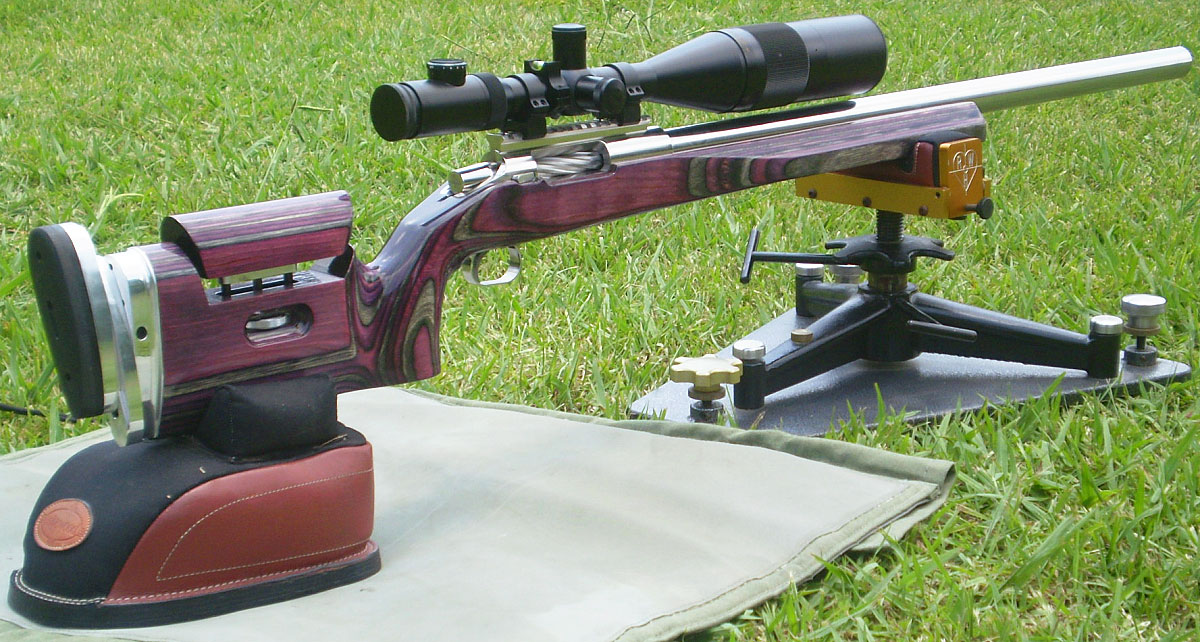
Jason Cohen’s “We the People” patriotic .284 Shehane F-Class rifle. It has already demonstrated great promise, scoring second place in its very first match, a 3×20 at 1000 yards in Wyoming.
Rifle Report by Jason Cohen
The rifle began its life as a Will McClosky Cerus stock. I approached Will at the Berger SW Nationals about a rifle I wanted to build. I wanted to do something different — PAINT it. He said he had just the stock that I could use, and sent that to Bryan Blake at Blake Machine. I chose Bryan for two reasons — first, I have shot with him a few times at National matches and he is approachable and very helpful. Second I visited his shop during the SWN in February and liked what I observed and how he approached things. Bryan never seems to be happy with the status quo. He is always trying new ideas.
I noticed that Bryan had been adding aluminum rails to the front of Cerus stocks to lower the center of gravity and improve tracking. I asked him to modify my stock and fit it with the new forearm rails, shown in the photo below. I sent him a Panda F-Class action with a +20 MOA Picatinny rail. Bryan did all the stock work and fitted the action, rails, and RAD recoil pad. Everything turned out flawless.
The barrel is a Blake Machine 1:8″-twist finished at 32 inches. It was fitted to my action by Dale Woolum of Woolum Accuracy. Dale chambers all my barrels on all my rifles. Dale also threaded the barrel for a Woolum Accuracy tuner. This has proven to be a valuable tool in my load development. On this build, I am trying a Bix’N Andy trigger for the first time.
The 284 Shehane has a proven record of accomplishments and that is why I have chosen it. I use Lapua brass (6.5-284 necked-up), CCI BR-2 primers, Hodgdon H4350 powder, and Berger 184gr bullets. All these components have been a successful combination that has worked flawlessly in my other rifle.
.284 Shehane Load Development
Load development for me starts with each new barrel. I screw on the new barrel, fire 25 rounds of whatever I have left over and then clean it. I push out to 600 yds and do a ladder test in round-robin format. I start 0.6 grains lower than my last charge that worked. I work up from that reduced charge weight in increments of 0.3 grains. The paper tells the rest of the story. Once I get something that works well at 600 yards I go back in work around that by 0.1 grains. After that I play a little with seating depth and look for a change. I will occasionally mess with the tuner and tighten things up if possible.
About the Patriotic Paint Job
So I had the idea of painting the stock because there are so many wood stocks with clear coat these days. Unless you really get some exotic woods they all seem to blend together. I have nothing against clear-coated wood, but I wanted something different, as this was my first all-wood rifle. (For short-range benchrest, I was shooting a Bob Scoville carbon stock and Terry Leonard laminate).
We started with all white on the stock and came up with the idea of an American Flag on the buttstock. I was thinking of ribbons on the front in red and blue but we could not get the layout right. Then the idea of “We the People” popped into the head. My painter said “awesome!” and he was able to airbrush the stock with a little yellow and brown to give it that vintage paper look.
The front rest is a SEB Max (see above). I chose the Max because I was shooting Group Benchrest first then made the transition to F-Class. This rest proves to be versatile in all my shooting — Short- and Long-Range Benchrest AND F-Class. The rear bag is a Edgewood EDGEbag Gator. The gun gets transported in a Pelican Hard case when I travel. Locally, I use a Champions Choice soft bag.
Jason Jumped to Open Class after Starting with F-TR
This “We the People” rifle will be one of my primary rifles for F-Open competition. I will run it through its paces shortly and see how well it does. I have high hopes of it being an great gun. I shoot primarily local and regional matches — Colorado, Wyoming, and possibly Nebraska this summer. I will travel to the F-Class Nationals in Raton as well. I used to shoot F-TR before this and made the transition to Open last season. This is my second season shooting F-Open. 2018 was my first National event and was a learning experience for me. But I was hooked after that match.
Tips for F-Class Competitors
Get some good equipment and eliminate having issues that can be caused by budget builds. It’s OK to be frugal, but sometimes cutting corners will cause you more problems and have you chasing your tail. If you’re looking for the “recipe for success”, get a good action plus a top-tier barrel and great glass.
The .284 Shehane — Accurate and Forgiving Wildcat
The 284 Shehane is amazing, very forgiving and not temperamental. I choose this because I really did not know otherwise and was steered to the Shehane by a friend. Its proven track record helped as well. Straight .284 or Shehane — you cannot go wrong. I run a 184gr Berger at about 2850 FPS and get great brass life in my other rifles. I usually start to consider tossing the brass around 15 firings. Primer pockets start to get a little looser and the brass seems to need more sizing than the newer brass with less firings.
Do you occasionally get completely unexplained flyers, or have a shot land straight down at 6 O’Clock, right below your point of aim? That could be caused by poor or inconsistent trigger technique. How you pull the trigger can and does affect your accuracy.
Many gun enthusiasts start with pistols. When they later start shooting rifles they may carry over some not-so-good practices acquired from shooting handguns with heavy 4 to 6-pound trigger pulls. You may want to “re-learn” your trigger techniques to get better rifle results.
Shooting Sports USA has a good article on trigger technique that offers many useful tips. That article also has many helpful illustrations, including the one shown above. Another illustration shows different types of trigger shoes (straight vs. curved) and explains how each makes a difference: “With a lightly curved trigger, the shooter’s finger can contact the trigger either high or low according to preference. Higher contact will increase the resistance.” READ ARTICLE HERE.
The article analyzes common errors, such as pulling the trigger with the very tip of the finger rather than the pad of the index finger: “Using the tip of the finger can lead to lateral pressure on the trigger, which throws off the shot.”
The article also explains that you should check your trigger regularly to make sure it is functioning properly and is not out of adjustment: “Just like any other moving part, the trigger can suffer from wear. In such a precise mechanism, tiny amounts of wear can cause major problems.”
The ergonomics of the Eliseo Tubegun allow a nice, straight trigger pull.
Trigger Tips
Six Suggestions for Making your Trigger Control More Consistent.
1. If your triggers are adjustable, set the pull weight appropriate to the discipline. For a hunting rifle, you don’t want an ultra-light trigger pull. For High Power, you may want a two-stage pull, while on a Benchrest rifle you may prefer a very light trigger.
2. If you have a two-stage trigger, experiment with different combinations of First Stage and Second Stage.
3. Have a friend watch you as you pull the trigger, and maybe even take a close-up video as you pull the trigger. This can reveal a variety of flaws.
4. Practice dry-firing to see if flaws in trigger technique are causing gun movement.
5. As an experiment, try pulling the trigger with your middle finger. Ergonomically, the middle finger has a more straight alignment with the tendons in your hand. This exercise can help you identify alignment issues with your index finger.
6. For stocks with adjustable Length of Pull you may want to set the LOP differently for bench shooting vs. prone or F-Class shooting.
The Bix’N Andy trigger is one of the very best you can buy. It can be fitted with a variety of trigger shoes according to shooter preference.
Here’s the super-speedy way to turn case-necks. Our friend Erik Cortina figured out how to turn his match cartridge case-necks using his milling machine. Erik told us: “While in Raton, Mid Tompkins told me that he turns his brass on milling machine. He said he could do about 500 in two hours, so I decided to try it.”
Erik fitted a Don Nielson “Pumpkin” neck-turner to the mill, and he used a modified 21st Century case holder to secure the brass. As you can see from this video, Erik was very successful with the process. The tool spins at 1500 rpm, turning Lapua 6.5-284 cases that have been necked up to 7mm.
Video Shows Erik Cortina Neck-Turning Cases with Milling Machine:
Cartridge Brass: Lapua 6.5-284 necked up to 7mm
Lubricant: Lithium grease inside and outside of neck
Neck-Turner: Nielson Pumpkin running at 1500 RPM
It’s hard to argue with Erik’s results. Here are his turned Lapua cases, which have neck-wall thickness consistent to two ten-thousandths of an inch. Think you could do better turning manually?
Some of Erik’s Facebook friends had questions about this process:
Q: Who makes the shell-holder?
Erik Cortina: I did! The shell-holder you can get from 21st Century. I Tig-welded a punch as a handle.
Q: I love the idea of working smarter not harder! Any galling issues? What are your mitigation techniques?
Erik Cortina: No issues. I use lithium grease in spray can. Makes a foam that I dip necks into.
Q: Shouldn’t either the case or the cutter be floating to allow most precise neck turning?
Erik Cortina: Up until [I tried this] I believed the same thing. I was going to build a floating case holder but decided to try rigid setup on a few cases before I built it. Results were great. Neck thickness doesn’t vary more than .0002″, which is same as when I was doing it with floating case holder on the lathe.
Q: Any problems with the Pumpkin changing the cut as it heats up?
Erik Cortina: No — there were no issues with that.
NOTE: Erik Cortina is a very skilled machinist who custom-crafted fittings used for this process. This kind of neck-turning with a milling machine may not be for the everyday hand-loader!
Nielson “Pumpkin” Neck-Turner
The circular orange cutting fixture on Erik’s Milling Machine is a Don Nielson “Pumpkin” neck-turning tool. Don designed this tool to be used by hand or with power. The Pumpkin boasts an eccentric mandrel that allows the cut to be adjusted easily in precise .0001″ increments. Benchresters like this as it allows for very precise control of cut depth and neck-wall thickness.
Jason C., commenting on Erik’s YouTube video stated: “I have a couple of those too. Nothing cuts like a Pumpkin. [Don Nielson] made the best cutter tool ever.” These are still available if you ask around. The photo shows Don with a case-holder mounted to a power assembly. A talented machinist and tool-maker, Don has also been a successful short- and long-range benchrest shooter, who has won NBRSA 600-Yard Championships. CLICK HERE to read about Don’s success with the 6.5×47 Lapua.
Nielson Neck Turner with carbide mandrel. Photo Courtesy Butch’s Reloading.


 Emil Kovan Competition History:


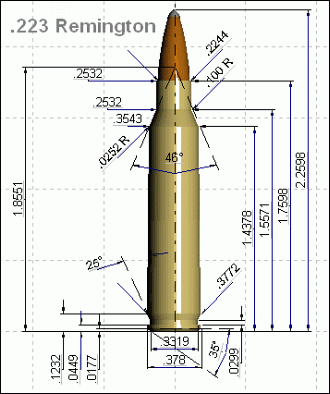 .223 Rem — Not A Competitive Option


 This rifle project began several years ago. My purpose was to find a cartridge that would launch the high-BC, 180gr 7mm bullets at competitive velocities for F-Class competition. I also sought barrel life that would be far superior to that of a 7mm WSM or 6.5-284. I read the article on


 The Ultimate F-Open Rig
 NOTE: Charles Ballard always employs eye and ear protection when shooting. For these posed photos, he removed his safety glasses.
 Three-Minute Prep Period
 Surprise–Velocities Rise, So Load Must Be Tweaked
 Andy informed me that this had happened to him with several rifles. For whatever reason, between 100 to 300 rounds, as the barrel gets broken-in, the velocity climbs significantly.. Andy told me if I loaded back to the previous velocity, in his experience, it would stay there. Andy was spot on. My load came back together with 54.5 grains of H4831sc. The Oehler consistently gave me readings of 2892 fps to 2902 fps with an SD of 4 fps using once-fired brass. New brass gave slightly slower velocity but better numbers: ES of 7 to 9 fps, and SD of 2 to 3 fps. All this data was duplicated on several occasions. This rifle now has 554 rounds through it, but only .003″ throat erosion. The bullet was moved out .003″ to maintain position relative to the lands.
 CALIBER CHOICE: The Case for the .284 Win
 Gun Handling and Recoil
 F-Class is a known-distance event, with targets of known dimensions that have markings (rings) of known sizes. Any ‘holding off’ can be done using the target face itself. Most ‘benefits’ of Front (first) focal plain (FFP) optics are null and void here — they work great on two-way ranges where ‘minute of man’ is the defining criteria — but how many FFP scopes do you know of in the 30-40X magnification range? Very, very few, because what people who buy high-magnification scopes want is something that allows them to hold finer on the target, and see more detail of the target, not something where the reticle covers the same amount of real estate and appears ‘coarser’ in view against the target, while getting almost too fine to see at lower powers.
 Others use a




 The circular orange cutting fixture on Erik’s Milling Machine is a Don Nielson “Pumpkin” neck-turning tool. Don designed this tool to be used by hand or with power. The Pumpkin boasts an eccentric mandrel that allows the cut to be adjusted easily in precise .0001″ increments. Benchresters like this as it allows for very precise control of cut depth and neck-wall thickness.


