McMillan Fiberglass Stocks is introducing a new F-Class Open Division stock. This offers a low profile fore-end and parallel geometry for improved tracking. This is similar to McMillan’s previous F-Open stock, but with important enhancements. Here is Kelly McMillan’s report:
“Our new Kestro is … made specifically for F-Class Open competition. Notice we have kept the low profile fore-end while increasing the mass and rigidity. The fore-end is not only ‘dead nuts’ in line with the butt stock, but it is also on an exactly parallel plane so when it recoils there is no rise or lateral shift in the cross hairs.
This model comes with an integral adjustable cheek-piece and can have our standard buttplate or our lightweight 3-way adjustable butt plate. My estimation is that this stock will weigh as light as 4.5 pounds fully dressed, or as much as 8 pounds depending on what you need.
We are currently working on the cheek-piece free model for those of you who don’t put your face on the stock. One more thing, this color combination we call a Tiger Stripe Maple.” Editor’s NOTE: Though “maple” is in the stock color name, this is a reinforced fiberglass stock, not wood.
Many of the world’s best F-Class shooters have traveled to Ottawa, Ontario, Canada this week to compete at the Canadian F-Class National Championships. F-Open ace Shiraz Balolia, who won back-to-back Canadian F-Open Championships in 2015 and 2014, will pursue a “three-peat” at Canada’s Connaught Ranges. There will be plenty of F-TR talent on hand as well, including Bryan Litz, reigning U.S. Mid-Range and Long-Range F-TR Champion. The first challenge for the shooters will be the weather, which can be notoriously wet and windy at Connaught. The weather forecast looks good for today and tomorrow, but thunderstorms (and rain) are predicted for Friday and Saturday.
U.S. F-TR Rifle Team Prepares for the Canadian Championships:
Shown above is the U.S. F-TR Rifle Team, which will compete in the F-TR division. In the America Match, teams from Canada, South Africa, and the United States will battle head-to-head for national honors.
Many Companies Help Sponsor U.S. F-TR Rifle Team
It takes significant resources to field a large shooting team in international competition. The U.S. F-TR Rifle team is fortunate to have many great sponsors helping the team with equipment and financial support. The team’s top-level “Gold Medal” sponsors, are, in alphabetical order: Berger Bullets, Gemtech, Kelbly’s, McMillan Fiberglass Stocks, Nightforce Optics, Pierce Engineering, and 5.11 Tactical. CLICK HERE for a list of all sponsors.
Many Forum members have been looking for a good substitute for Hodgdon H4350 powder, which remains hard-to-find in many parts of the country. One of the best alternatives is IMR 4451, part of IMR’s new Enduron line of powders. Last year, top F-Class shooter Rick Jensen did a comparison between H4350 and IMR 4451, shooting the two powder in a wide range of temperatures. His data suggests that both powders show good temp stability.
Powder Comparison Test: H4350 vs. IMR 4451
Rick Jensen, Captain of the U.S. F-Open Rifle Team, has tested some of the new IMR 4451 powder. Rick and other team members were looking for a good powder that could replace Hodgdon 4350 which is difficult to obtain currently. The makers of IMR 4451 claim that it is not sensitive to temperature and that it delivers competitive accuracy. So far, Rick’s tests, done with a .284 Winchester and 180gr Berger Hybrids, appear to confirm those claims. Rick posts:
“I did a little informal powder comparison of H4350 versus the new IMR 4451. Rifle used was a Kelbly Panda with a 30″, 1:8.75″ twist 5R Bartlein barrel [chambered in .284 Win]. All charge weights were 50.0 grains using CCI BR2 primers. I was very impressed with this new powder and I believe it to be equal to H4350 as far as temperature sensitivity.
I did not test for accuracy but I will tell you my groups were pretty much equal between the two and all were in the .2-.3 MOA range. I will defiantly be shooting more of this powder in the weeks to come, assuming the supply chain will allow. It looks very encouraging to finally have a alternative to H4350 that we might actually be able to buy.”
Chronograph Results with Temps from 23° F to 101°
Here are chronograph results of a comparison test between IMR 4451 and H4350. Rick’s rifle was cleaned and allowed to cool between each test. Five fouling shots were fired before each test. Important: Note that for both Test #1 and Test #2, the powder order is reversed in the mid-temp fields (IMR 4451 first, then H4350). For the low and high temp entries, H4350 is listed first.
Here are the IMR 4451 fired cases, displayed Left to right, coldest to the hottest (in terms of case temp when fired). All charge weights were the same: 50.0 grains.
Multi-time National High Power champion David Tubb has developed an impressive two-stage trigger for Remington 700 rifles, the Model T7T. Priced at $385.00, the T7T Trigger is a true two-stage design: first and second stages are independently adjustable for both weight and feel. Overall (combined stage) trigger pull weight can be adjusted from just under 1 pound to slightly over 3.5 pounds.
The new T7T is a quality product. We’ve used the T7T and it proved crisp, repeatable, and reliable. If you are looking for a two-stage trigger for a precision rifle, this is a good option. We like a two-stage trigger for PRS applications, and the T7T can be adjusted high enough for that role. Or, it can go all the way down to under a pound — low enough to suit most F-Class shooters.
If you are interested in the T7T, watch these two videos. The first shows how to adjust pull-weights for both stages. The second video shows how to modify your stock to provide clearance for the T7T.
This video shows how to adjust the new Tubb T7T two-stage trigger for Remington 700s:
T7T Trigger Installation Tips
While installation of the T7T may require minor modifications to your action, most gun owners with basic mechanical skills can install the T7T by themselves. Note: As installed, the T7T trigger (either Right-Hand or Left-Hand) also requires a companion T7T bolt release, which you can get from DavidTubb.com for $10.00.
This video shows how to modify your stock to fit the T7T trigger:
There are hundreds of cartridge types capable of winning in F-Open. For F-TR you can shoot either the .223 Rem or .308 Win, but you have many load options. This article will focus on proven choices, currently used by the top F-Class shooters in the world. Our discussion will analyze cartridge selection based on the four different F-Class sub-disciplines: Open Mid-Range, Open Long-Range, F-TR Mid-Range, and F-TR Long Range.
Click image to view full-screen photo.
Mid-Range F-Open Cartridges
For starters, a .300 WSM is certainly capable of winning mid-range matches but it is not ideal. So what is ideal, and why? F-Class Mid-Range matches usually are usually shot at 300, 500, or 600 yards — or all three. At those distances the 6mm and 6.5mm cartridges rule. In moderate conditions, the 6mm Dasher is unbeatable. Its low recoil along with its super grouping ability and good ballistics make it my number one choice for Mid-Range.
Best bullets for the 6mm Dasher are: Vapor Trail 103gr, Berger 105 Hybrid, 108 BT, and 105 VLD (hunting). Best powders are: Varget, H4895, and Reloder 15.
Choices for Mid-Range in Tougher Conditions:
We all know that conditions are not always “moderate” that’s why something a little bit bigger will save you a “Nine” or two. The 6.5X47 Lapua was designed for 300-meter competition, but as soon as it was released, it was adopted by F-Class, benchrest, and tactical shooters. It offers great ballistics with very low recoil and big “accuracy window”. Lapua makes great brass for it (no surprise there) and Berger makes great bullets: 130gr VLD, 140gr VLD, 140gr Hybrids. Best powders in most barrels are Varget and H4350, I don’t use double-based powders such as Reloder 17 and the Vihtavuori N500 series because of their unpredictable performance day to day (greater temp sensitivity).
The 6.5X47 Lapua necked down to 6mm is also a great option for mid range matches. I was able to easily get 3200 fps with 105 hybrids and H4350.
Choice for Long-Range F-Open Competition
In Long-Range F-Open Class (out to 1000 yards), the big, high-BC bullets rule. If I had to pick one cartridge for F-Class (both mid- and long-range) I would pick the .284 Winchester or one of its variants. The .284 Win is currently dominating in F-Open competition. It offers great barrel life, it is super-easy to tune and its recoil is very manageable. The best bullets for it by far (in my opinion), are the Berger 180 Hybrids. But Sierra’s new 183gr MK bullet (with factory-uniformed meplats) seems to perform very well as does the Berger 180 VLD. Best powders for the .284 Win are H4350 and H4831SC.
Long-Range Only F-Open Cartridge
As much as I like the .284 Win, for long-range competitions I like the .300 WSM even more. If you look at a .300 WSM and a 6mm Dasher side by side, they appear almost identical in geometry — the .300 WSM looks like an “super-sized” Dasher. Both cartridges are currently the “darlings” of long-range benchrest due to their extraordinary grouping ability and huge “node’’ windows. Big accuracy windows allow loads to perform well in different conditions and geographical locations. That’s obviously very important if you travel to compete. The .300 WSM loaded with Berger 215gr or 230gr Hybrids is very tough to beat at long range, and it is currently my number one choice.
The 7mm RSAUM is another outstanding long-range round. It resembles a 6BR on steroids and it is almost as easy to tune. Best bullets for it are Berger 180gr Hybrids, 195gr EOLs, and Sierra’s 183gr MatchKing. Best powders for the 7mm RSAUM are: H4350, H4831SC, and VV N160.
Top Caliber/Bullet Combos for F-TR
In F-TR competition, the choice is clear — a .308 Win throated for Berger 185gr BTLRs and 200gr Hybrids will win in mid-range AND long-range comps. Many championships have been won, and many records set with those two bullets in the .308 Win. To quote Danny Biggs (a two times FTR National Champion) “The 185 BTLR is the best bullet for .308 Win ever made”.
The Berger 215gr Hybrids have been used to win many competitions including recently the 2015 F-Class Nationals. Bryan Litz won both the Mid-Range and Long-Range 2015 Championships using 215s. Bryan’s rifle is shown below:
I recommend chambers throated for the 185/200 grain projectiles over the 215/230 grain bullets. The reason is that if you have your barrel throated out for the 215s or the 230s, you could have a “slow” barrel and max out on pressure before the desired velocity is reached. Optimum freebore for the 230s is too long for the 185/200s, so you would be limited to using only 215/230gr bullets in that barrel.Furthermore, the recoil increase with heavier bullets is substantial, causing the rifle to be more difficult to shoot.
.223 Rem — Not A Competitive Option
I would stay away from the .223 Remington. On paper the 90gr VLD will shoot inside most .308 Win loads even at a 1000 yards. But in reality, on average, the .223 Rem, regardless of what powder/bullet combo is used, cannot compete with the .308 Win. [Editor: The equipment lists at major F-TR matches will confirm Kovan’s conclusion here.]
Conclusion (and Other Options)
This article covers only the (currently) most popular cartridge/bullet combos for F-Class (F-Open and F-TR). As I said in the beginning, many cartridge types are capable of winning but are not listed due to their low popularity, case design, or lack of quality components. All of the above information is based on my personal experience and it is meant to help new shooters choose the right cartridges for F-Class matches. Thanks for reading and good luck — Emil Kovan
Emil Kovan Competition History:
– 2014 F-Class Open National Champion
– 2015 F-Class Open National Championship, Silver Medal
– F-Class Open National Championship Teams, 2015, 2014, 2013, Shooting Team Member
– Over 15 wins in Regional and State Championships in Palma, F-TR, F-Open
Competition Machine’s Gary Eliseo is a very smart designer as well as a talented shooter. The inventor/builder of the popular Competition Machine Tubegun chassis systems, Gary has come up with something new, which he calls the PickleForks. These are rails that fit to the sides of the tubular fore-end/handguard on his chassis systems. This allows you to use a pedestal-style front rest for F-Class competition. It also provides a much more stable platform for load testing, varmint hunting, or any kind of rest-assisted precision shooting. These new PickleForks transform a Tubegun into an ultra-stable, straight-tracking rig when used with a competition-style front rest.
Gary explains: “Now you can have the same super low-boreline, long ‘wheelbase’ and vertical sides of our innovative F1 F-Class chassis system for your tube chassis. The new PickleForks attach directly to the sides of the F-Class/Tactical fore-ends, no modifications are required. They are very rigid with no flex or twist and make the rifle track like it’s on rails.” The new Eliseo Competition Machine PickleForks are offered for a very reasonable $70.00 per pair, with Cerakote finish. (You get two metal units, one for each side of the fore-arm). For more information, visit www.GotXRing.com or call (928) 649-0742.
New Product Tip from EdLongrange. We welcome reader submissions.
Something interesting took place in St. Louis, Missouri this weekend — F-Bench competitors shot next to Sling, F-TR, and F-Open prone shooters and all had fun. We like events that bring shooters together from multiple disciplines, and we like matches that allow F-Class folks to shoot from the Bench for a change. (We’d love to see a 300-yard match that allows short-range PPC and 30BR shooters to compete side-by-side with F-Class shooters — the more the merrier.)
The 2016 Sierra Cup Match took place at the Bench Rest Rifle Club (BRRC) of St. Louis on Saturday, May 14, 2016. Some 57 shooters braved some chilly weather to compete at 600 yards. Competitor Jim K. (aka 500Stroker in our Forum) said this was “another great match” despite challenging conditions: “It was freezin’ cold, with major switching winds, but I loved every minute. Congrats to all the winners — they earned every point at this match.”
2016 Sierra Cup Winners
by Division
F-Open — Tony Francik
F-TR — Drew Rutherford
F-Bench — Neil Greenwell
Sling — Jeff Lindblom
New, Experimental Sierra Projectiles Perform Great
Two Sierra staffers competed this year, shooting prototype Sierra bullets in the final stages of testing. Congrats to Sierra’s Tommy Todd who took Second Place in F-TR class, and to Sierra’s Mark Walker who finished third in F-Open. That bodes well for the new, experimental Sierra bullets. Based on Tommy’s and Mark’s results, the new Sierra bullets appear to be very accurate indeed.
Forum member Drew R. (aka SkiUtah2) drove all the way from North Dakota to attend the Sierra Cup:
“This was my first time at BRRC and it was as anticipated — a great place to shoot. I met many gracious and talented shooters. I love getting to try new ranges and meeting people from the AccurateShooter Forum. It’s fair to say that even the guy from North Dakota was chilled when we started on Saturday. The warm welcome helped take the edge off.
Organizing a match of this caliber takes a lot of work even with an army of people behind the scenes, and without a core group herding the cats it doesn’t run well as this one did. Thanks Brett, Joe, and everyone who made this match run so smoothly. Coordinating with sling, bench, F-TR and F-Open shooters’ needs must have been remarkably challenging and you made it look effortless.
It was a fun time. I can highly recommend this range and this match to everyone wanting an enjoyable and memorable experience. Conditions on Saturday were definitely not a trigger-pulling contest, and (for me) that adds to the fun. The amenities are top tier. Many of the ranges I shoot at do not even have running water, much less showers onsite.
Thanks to Sierra for the sponsorship and very generous prize table. And thanks for the award waiving my entry fee as the ‘Long Distance Shooter’ for my trek. That was classy and completely unexpected.” — Drew R.
The NRA has released new, updated versions of Competition Rules, with changes that have been adopted for 2016. There are quite a few minor changes affecting rifle competitors in High Power, Service Rifle, Prone AR Platform Rifle, F-Class, and Smallbore Disciplines. There are also new rules for matches with Electronic Targets.
You can download the updated rules, discipline by discipline, on the NRA Rulebook Page: http://rulebooks.nra.org. Bound copies of NRA Rule Books may be ordered online from the NRA Store: http://materials.nrahq.org.
Are you trying to decide what components to use for your next F-Class build, or are you looking to upgrade your current rig? Wonder what the “big dogs” in the sport have selected as their hardware? Here’s what United States F-Open team members are using. The most popular chambering is the .284 Winchester, followed by the 7mm Walker (a 40° .284 Winchester Improved). Kelbly and BAT actions are the most popular, and nearly all team members are using cut-rifled barrels. A wide variety of stocks are used, with PR&T holding a slight edge over second-place McMillan.
Most shooters know Carl Bernosky as a 10-time National High Power Rifle champion. But you may not realize that Carl is also a very talented stock-maker and rifle-builder. Carl crafts a wide variety of wood and wood laminate stocks for competition as well as hunting. He also crafts many stocks for Alex Sitman of Master Class Stocks.
Master Class Low-Profile F-Open Stock
Here is a new Master Class Low-Profile F-Open Stock crafted by Carl Bernosky. It is made from a Cherry/Maple wood laminate. This design features a railed fore-end along with a flat, parallel toe for improved tracking and stability on the bags. The front section of the fore-arm has a low profile. This allows the barrel bore axis to ride lower. That helps reduce hop and helps the gun recoil straight back. For more information on this low-profile F-Open stock design, visit Carl Bernosky’s Facebook Page and MasterClassStocks.com.
Note that the stock maintains full depth under the action and quite a few inches forward of the action. This smart design feature is very important. We have seen other low-profile stock designs that can flex or “hinge” forward of the action because there’s not enough wood material there. In fact, the only part of the stock that needs a cut-down profile is the front 10″ or so, where the stock actually rides the front bag.
This particular stock features a “pop-off” magnetic cheekpiece, as well as a buttplate that adjusts for Length of Pull (LOP) via spacers. The action is by Pierce Engineering. This and other Master Class Stock designs can be customized with other features on request.


 “I did a little informal powder comparison of H4350 versus the new IMR 4451. Rifle used was a Kelbly Panda with a 30″, 1:8.75″ twist 5R Bartlein barrel [chambered in .284 Win]. All charge weights were 50.0 grains using CCI BR2 primers. I was very impressed with this new powder and I believe it to be equal to H4350 as far as temperature sensitivity.


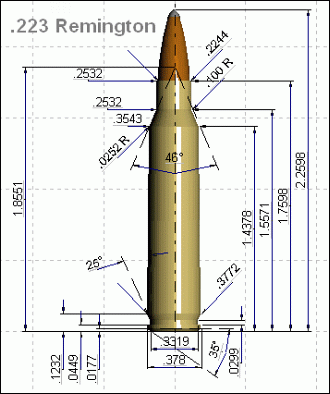 .223 Rem — Not A Competitive Option
 Emil Kovan Competition History:


