Wishing all our friends and fellow-shooters at home in Ireland and around the Globe all the very best. Happy St. Patrick’s Day. Beannachtai na Féile Phádraig! Hope you all … enjoy the festivities wherever you may be, whether be you Irish by birth, heritage, or aspiration!
Big May Match at Midlands in Ireland
The NRA of Ireland (NRAI) invites shooters to the inaugural F-Class Emerald & Ireland Long Range Challenge, to be held at the Midlands National Shooting Centre of Ireland (MNSCI), May 30 through June 1, 2014. The Long Range Challenge will be shot at 1100 and 1200 yards on May 30, followed by the Emerald match on May 31 – June 1. The Emerald will be shot at 800, 900, and 1000 yards, complete with a shoot-off for the top 10 competitors.
Guns of EIRE
Here are the custom guns crafted for the FCWC 2013 F-TR Team Ireland. Compliments to Francie McFadden of NGSS and Edi Graeff of PSE Composites for the work. (Photo courtesy of the UK Varminting website.)
Sebastian (“Seb”) Lambang is a really smart guy, a gifted machinist/fabricator, and a very innovative designer. If Seb worked in the auto industry, we’d probably all be driving flying cars by now.
Seb has just invented another really good product — a heavy, sand-filled mat for bipod use. We’ve christened this the ‘Pod-Pad™, and we think a lot of folks will want one. While the ‘Pod-Pad was designed for use with the SEB Joystick Bipod (“Joy-Pod”), it will work with other modern bipods (such as the Remple, the Sinclair, and the EVO). Inside the green fabric cover is sand plus a thin layer of neoprene. This allows the bipod feet to slide easily during recoil, and it also provides damping (and energy absorption) to reduce hop and torque.
Seb reports: “This is still a prototype mat, but I believe it works great. The carrying handle is the black belt in the middle of the mat, so it is easy to haul. There is a layer of 1/4″ thick neoprene under the slick microfiber on the top. This way the feet will slide smoothly and won’t sink, helping the rifle to maintain elevation. This heavy mat should be legal under the rules. It is not a rigid board, it can be folded.”
Watch Joystick Bipod (Joy-Pod) Used with NEW Sand-filled ‘Pod-Pad:
Seb tells us: “In this video, I am shooting my friend’s tactical rifle with the new Joy-pod, just to check how the bipod and mat work under recoil. The bipod and mat combo should work much better with a true F-TR gun. The new-generation Joy-pod has better internals and it’s more rigid. We should have the next shipment of Joy-pods ready around mid-April 2014″. Seb notes that the new Joy-pod has longer feet — more like actual skis. These can also be adjusted slightly for tilt/angle. The longer feet do seem to slide smoothly on recoil with much less hop.
The new generation Joy-pod will have a quick-detach (QD) option for mounting on a Picatinny rail. The quick-detach lever can be located on the right hand side (as shown above) or left hand side, tightening either forward or rearward as the shooter prefers.
For USA price list and more information, please contact:
Ernie Bishop
Gillette, WY
ernieemily @ yahoo.com
Phone: 307-257-7431
Here’s a handy training option for F-Class shooters. Forum member SleepyGator is an F-Class competitor, but it’s not convenient for him to shoot at long ranges close to home. Accordingly, he wanted some “reduced-distance” targets he could use at 300 yards for practice. There is an official reduced-distanced standard for 300-yard F-Class matches. This utilizes the NRA No. MR-63FC – F-Class Target Center which is pasted over the MR-63 target. It provides a 1.42″ X-Ring, 2.85″ 10-Ring, and 5.85″ Nine-Ring. (The dimensions of F-Class targets are found in the NRA High Power Rules, Sec. 22, part 4, page 70 — see sample below.)
To duplicate the 300-yard target, SleepyGator has prepared a printable version of the MR-63FC Target Center, along with a pair of training targets with two bulls and five bulls. The two-bull and five-bull targets mirror the scoring rings on the MR-63FC, but they display only the innermost three rings and two rings respectively. All three targets are Adobe Acrobat files that can be easily printed. You may need to adjust the scale (sizing) on your printer to get the dimensions exactly correct. As noted above, when printed, the 10-Ring on all three targets should measure 2.85″. This should provide some handy practice targets you can use between matches. Thanks to SleepyGator for providing these targets. You can download all three as a .Zip archive. After downloading the .Zip file, just click on the .Zip archive to extract the individual targets.
At the Berger Southwest Nationals, innovative F-Class hardware was on display. In F-TR, bipods are continuing to evolve, with new variations at every match. (We saw the Flex bipod in action and it operates very differently than anything else out there). But with F-TR bipods and F-Open front rests having evolved to such a high level, the weak link in the rifle support chain may now be at the rear.
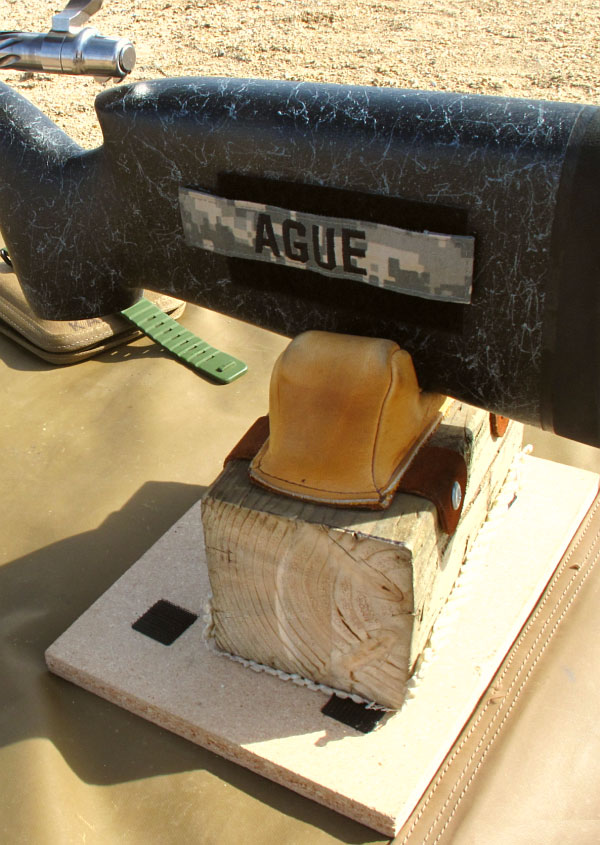
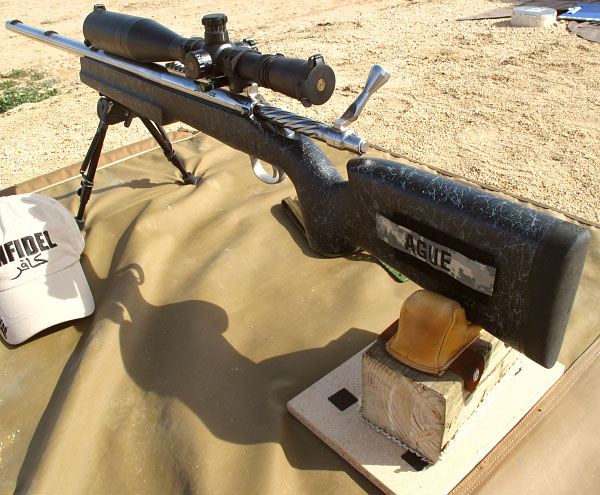
In both F-TR and F-Open, it seems that shooters are turning their attention rearward — devising new ways to stabilize (and elevate) the rear sandbags. We saw a variety of “sub-platforms” designed to give rear bags more lateral stability, and also raise the bags up off the ground. A few shooters have moved away from a conventional rear sandbag to a hybrid support that almost looks more like a front bag attached to a rigid block. Here are a couple rear bag set-ups we saw at Ben Avery in Phoenix. These should give you guys some ideas:
Check out this simple but effective Do-It-Yourself rear rest. The “base” is a large, flat piece of particle board. Above that is a sizable block of wood with carpet tacked to the base. It appears that the carpet may be affixed to small velcro squares on the flat base. The most clever feature is on top. A V-style leather front bag has been adapted to support the rear of the rifle. This solution looks both effective and affordable.
Over the past few years, interest in F-Class competition has grown dramatically. At the 2013 SHOT Show we had a chance to talk about F-TR competition with U.S. National F-TR Team members Mike Miller and Stan Pate, two of America’s top F-TR shooters. We are reprising this interview for readers who may have missed it the first time around. If you shoot F-TR (even if you’re a High Master), we think you’ll learn a few things from this interview.
In this interview, Mike and Stan agreed to share their vast store of knowledge about long-range shooting. In a wide-ranging dialog, we discussed many topics of interest to F-Class shooters: position set-up, bipod shooting techniques (and hardware), gun-handling, and bullet selection. In addition, Mike and Stan offer some great advice on wind reading and precision reloading. These general tips will benefit all competitors, no matter what their discipline.
If you shoot F-TR or you are considering getting involved in this fast-growing shooting sport, definitely watch this 14-minute video interview from start to finish. Mike and Stan are true F-TR gurus whose knowledge of the F-TR game has been gleaned from years of top-level competition. If you shoot a .308 from a bipod, we guarantee you can learn much from Mike and Stan. If you follow their advice, we bet you’ll see your scores improve in future matches.
Watch Video for Tips from U.S. National F-TR Team Members Mike Miller and Stan Pate
Need a comp scope with serious magnification, but have a limited budget? Then check out the new XTR II 8-40x50mm from Burris. Priced at $1199.00 (MSRP), this new scope offers 40X max magnification, and a lifetime, bumper-to-bumper warranty. The scope weighs 31.4 ounces, has 1/8th-MOA clicks, and 10 MOA per turret revolution. With a 34mm main tube, the scope delivers 70 MOA of elevation adjustment and 30 MOA of windage adjustment. New this year, this FFP scope should be available by the end of March 2014. Learn more in the video preview below:
Learn about Features of 8-40x50mm Burris XTR 11:
Innovative F-Class MOA Reticle with Multiple Center Dots
Burris offers this First Focal Plane (FFP) scope with an F-Class MOA Reticle, the only reticle of its kind to feature multiple illuminated center dots (on the vertical line), the Front Focal Plane reticle keeps the 1/2 MOA grid design constant (relative to target) at any magnification. A second 20 MOA offset 1/2 MOA grid allow shooters to obtain an extra 20 MOA of elevation beyond the capability of the turret adjustments and still have horizontal wind hold-off references. At each 10 MOA section you’ll find an ultra-fine crosshair with 1/8 MOA illuminated dot for maximum versatility.
It’s official. No more “vaporware”. In 2014, Leupold will sell a 7-42x56mm VX-6 scope for approximately $1800.00. This scope will be “coming out this summer”. This is a very impressive optic that will give other premium high-magnification competition scopes a run for their money. The new 7-42 features a 34mm main tube. That large diameter tube helps the scope deliver an estimated 70 minutes of elevation (final specs subject to change). There is a side parallax control, and target turrets with 1/8th-MOA click values and built-in zero stop. We were pleased to see that the scope features a “fast-focus” eyepiece with plus/minus diopter adjustment. Initially the scope will be offered with two (2) reticles, the TMOA and TMOA Plus. These feature MOA-based hash marks, with a small gap in the very center with a target dot at the aiming point.
We did get a chance to test the scope. Jason successful engaged targets at 960 yards using a .308 Win Colt modular rifle fitted with the new 7-42x56mm Leupold. Jason reports that the clicks are tactile and positive. The scope is sharp and bright all the way out to the edges of the viewing circle, even at max 42 power. We liked this optic, and can’t wait to get our hands on a final production version.
For 2014, Kelbly’s is introducing a new series of rifles for competition, tactical disciplines and hunting. The Arcas™ Series rifles are complete packages designed with Kelbly’s recommended specifications and top-grade components. Pick your application (Benchrest, F-Open, F-TR, Hunting, Tactical) and Kelbly’s can provide a complete build with all the bells and whistles.
Shown below are the four Arcas competition rifles currently offered. In addition to these four comp guns, the Arcas series includes two tactical-style rifles and two hunting rifles (starting at $2799.00). All these Arcas series rifles will be on display at SHOT Show next week. Let us know (via comments) which Arcas models interest you the most, so we’ll be sure to feature those in our SHOT Show reports.
Every Arcas Series rifle comes with premium components and a wide choice of stock colors. In addition you can have an Arcas rifle customized. For example, the Arcas F-Open rifle shown below can be customized with an extra long barrel ($20 per inch), fluted barrel ($199.00 extra), polished metal (all parts, $249), a GRS Laminated Stock with ergonomic grip (no charge), or a PRT Lowboy stock with high gloss finish ($799 extra).
Shiraz Balolia has announced that Rick Jensen will take over the reins as Captain of the U.S. F-Class Open Team. Departing Captain Balolia deserves a great deal of praise for his hard work, dedication, and leadership of the team over recent seasons. Shiraz gave generously to the squad, in terms of both time and resources. Under his tutelage, the Open Team raised its standards of training and team-work. Shiraz will be a tough act to follow.
About Rick Jensen, New Team Captain
Rick Jensen lives in Claremore, Oklahoma with his wife Crystal and his daughters Riley and Zoey. He started shooting local F-Class matches at Tulsa Red Castle Gun Club in 2005. Since then he has competed at the National and International levels. Rick’s first Nationals were in Lodi, Wisconsin in 2008. In 2010, Rick was a member of the winning North America Shooters team at the 4-man National Championship Team matches in Sacramento. Rick has shot at two World Championshipse — the 2009 F-Class World Championships at Bisley, England, and the 2013 FCWC at Raton, NM.
Rick considers one of the most memorable highlights of his career to be in the summer of 2011 when, along with Team USA, Rick won a gold medal in a combined F-Open/F-TR match against Ireland for the Creedmoor Cup. He felt that this was truly a special trip that will never be forgotten, in part due to the cup’s special ceremonies. Rick is honored to be representing the United States as the new Captain of the U.S. F-Class Open Team.
Shiraz tells us: “Yesterday marked my last day as Captain of The United States F-Class Open Rifle Team. I had indicated to the team several months back that I would not be able to continue serving as the Captain of the team due to time constraints.
I am pleased to state that the NRA has picked a very good replacement for our team. Starting today, Rick Jensen is the new F-Class Open Rifle Team Captain for the United States. Rick has been a member of the U.S. F-Open Team for over six years and knows many of the various functions associated with it. He will make a fine Captain. Please join me in congratulating Rick as the new Captain of our United States F-Open Team. Congratulations, Rick!
Personally, I will continue as a team member — doing whatever the Captain asks of me. I am actually looking forward to simply showing up and shooting or coaching at matches and various events.”
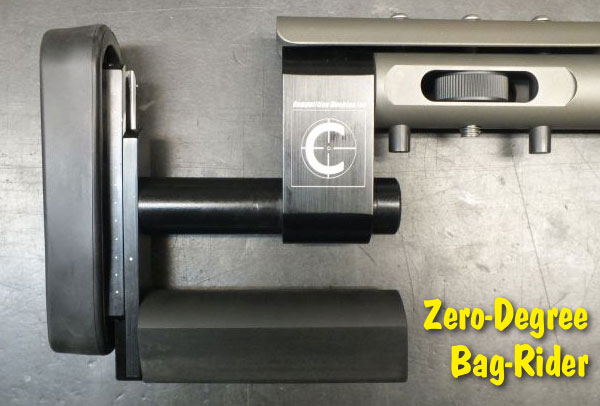
Tube-gunners take note. Gary Eliseo has just introduced a new wider, V-profile rear bag rider for his Competition Machine modular chassis systems. The new bag-rider is a wide V-shape that conforms to the shape and angle of popular rear sandbags. Gary tells us that “The new F-class rear bag rider will be available as an option in 2014. Constructed of Delrin, the new bag-rider is reversible with 0 degree and 5 degree mounting ends. The bottom of the bag-rider is sized to fit 3/4″-wide ear spacing.”
Editor’s Comment — This Kind of Bag Rider Really Works
We have tested a prototype, V-shaped bag-rider on an Eliseo 6mmBR Tubegun. The profile on our wooden prototype is very similar to Gary’s final design crafted from Delrin. We were really surprised at how much better the gun behaved with the wide, V-shaped bag rider, compared to a standard slab-sided skid. With the “V-Rider” the gun felt more “locked-in” with less side-to-side play. There also seemed to be less vertical bounce when shooting F-TR style with a bipod. But mostly the gun felt much more stable, with less tendency to roll. There was noticeably less side to side wobble, and the gun did track better.
The most important thing, is that the V-shaped bag-rider definitely made the gun easier to shoot — at least in the opinion of our three trigger-pullers. When we switched to our wide, V-shaped bag-rider, three different shooters were able to hold smaller groups with tighter horizontal. We saw fewer left/right shot impacts (away from the group center) that may have been attributable to little, last-micro-second movements of the rifle. The gun seemed to settle in the rear bag better, and after each shot, it seemed we could get back on target more quickly. The gun “locks in” to the rear bag faster and more solidly, so you spend less time fiddling with horizontal. With less wobble, the TubeGun feels less top-heavy. Understand that a V-shaped bag rider will not make your rifle more inherently accurate. However, it may help you steer the gun more consistently, and it make help the rifle track more consistently.
Product find by EdLongRange. We welcome reader submissions.


 The folks at F-Class Team Ireland wish you a Happy St. Patrick’s Day and F-TR Ireland sends greetings from the Emerald Isle….


 Over the past few years, interest in F-Class competition has grown dramatically. At the 2013 SHOT Show we had a chance to talk about F-TR competition with U.S. National F-TR Team members Mike Miller and Stan Pate, two of America’s top F-TR shooters. We are reprising this interview for readers who may have missed it the first time around. If you shoot F-TR (even if you’re a High Master), we think you’ll learn a few things from this interview.


 For 2014, Kelbly’s is introducing a new series of rifles for competition, tactical disciplines and hunting. The Arcas™ Series rifles are complete packages designed with Kelbly’s recommended specifications and top-grade components. Pick your application (Benchrest, F-Open, F-TR, Hunting, Tactical) and Kelbly’s can provide a complete build with all the bells and whistles.

 About Rick Jensen, New Team Captain
 Shiraz tells us: “Yesterday marked my last day as Captain of The United States F-Class Open Rifle Team. I had indicated to the team several months back that I would not be able to continue serving as the Captain of the team due to time constraints.