Darrell Buell, past captain of the world champion F-TR Team USA, just received an impressive new piece of kit. A custom flat sheet was created by Kent Rush for Darrell, complete with cool graphics and sponsors’ logos. As soon as we saw this on Darrell’s Facebook page, we knew this would be popular with our readers. Heck, this Editor wants one too — with “AccurateShooter.com” emblazoned on it.
Darrell loves his new shooting accessory: “Here’s the whole enchilada! Savage rifle, 2014 Nightforce Competition Scope, Berger Bullets (185 Juggernauts), Seb Lambang’s new Joy-Pod (plus “Pod-Pad” mat), a new shooting mat courtesy of Scott at Red Star Targets, and an awesome new rear-bag sheet by Kent Rush for the Edgewood bag. This new sheet allows for friction-free rear bag adjustments — Thanks Kent Rush!”
Darrell Leads North American Junior F-TR Team
Though he has stepped down from his role as Captain of F-TR Team USA, Darrell hasn’t given up his coaching duties entirely. Darrell is the coach (and adult leader) of the North American Junior F-TR Team. Darrell is lending his world-beating long-range shooting knowledge to young competitors who are making a mark for themselves already. Here is Darrell with one of his young marksmen.
The NRA, on the recommendation of the NRA High Power Committee, has appointed Ray Gross as the new United States F-TR Team Captain, to serve through the 2017 World Championship cycle. Ray brings a wealth of experience in both national and international competition. As a member of the World Championship-winning 4-person U.S. F-TR team, and the hugely successful Team Sinclair F-TR squad, Ray is a skilled coach, a top-flight shooter, and a great guy who is respected by his peers. Ray brings a unique combination of skills to the team as its new leader.
Ray Gross (center with gray hat), with fellow Team USA F-TR Shooters at Raton, NM.
Ray has asked James Crofts to serve as US F-TR Vice Captain. James comes from a military background, having served 20 years in the US Navy aboard fast attack submarines. James has also been a shooting member of the 8-man F-TR Team USA, and he is always one of the top shooters in any F-TR competition.
James told us: “It’s official, I have been named the new Vice Captain for the USA F-T/R National Team. Now the work begins but with Ray Gross as Captain I think we can handle it. Tough act to follow, Darrell Buell and Mike Miller set the bar extremely high with back to back world championship gold medals.”
We know you guys like exotic hardware, so today we pulled something very exotic from our featured rifle archives. We doubt that you have ever seen anything quite like this before. Gun-builder Richard King says: “I thought you might like to see my latest project. This is my personal gun, built the way I wanted it. I know it’s radical and some may not care for it. But it works.”
Report by Richard King (King’s Armory, Texas; ‘Kings X’ on our Forum)
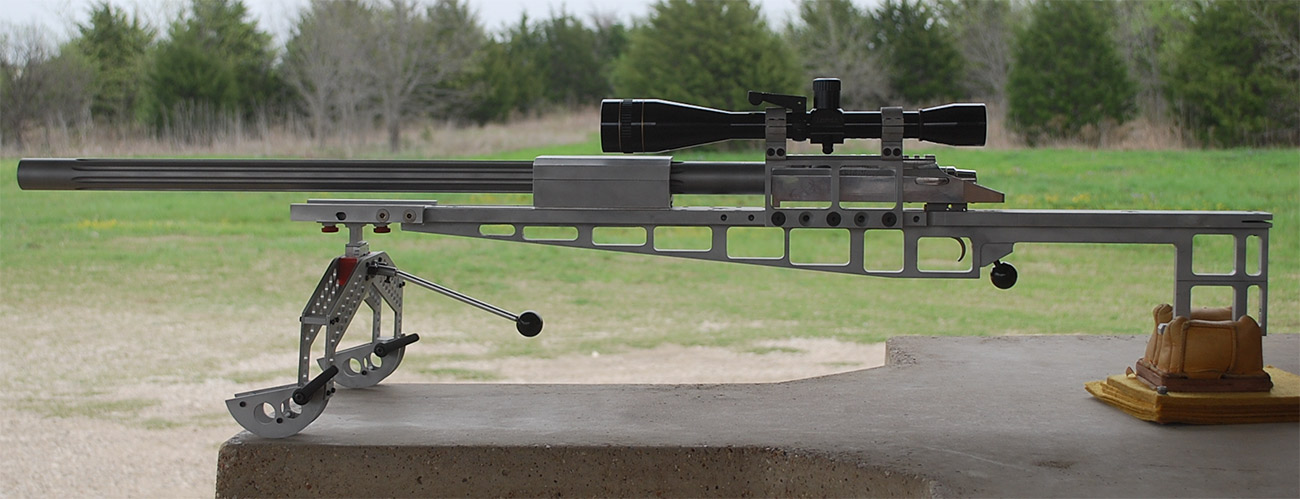
This is pretty much an all-aluminum rifle. The action is a Kelbly F-Class with a Shilen stainless steel competition trigger. The scope is a 1″-tube Leupold 36X with a Tucker Conversion set in Jewell spherical bearing rings. The .223 barrel is Pac-Nor 3-groove, 1:6.5″-twist mounted in a “V”-type barrel block. The bipod has vertical adjustment only via a dovetail slide activated by a stick handle. It works like a joy-stick, but for vertical only. I adjust for windage by moving the rear sandbag.
The 30″ barrel is 1.250″ in diameter. With the barrel block forward, the vibrations should be at a low frequency. Instead of one long rod whipping, I now have two short rods (barrel haves) being dampened. This is my fourth barrel block gun. They work, but so does a good pillar-bedded action. I just do stuff a little different.
The vertical “keel” down the bottom of the stock stops the “spring” of a flat-bar stock. There is little, if any, noticeable flex before or during recoil. The long length of the stock, the fat barrel, and the forward-mounted barrel block work together to keep the gun from rising off the ground. BUT, remember this is a .223 Rem rifle. A .308 Win version might act very differently. I may try a .308-barreled action soon, just to see what happens. But I will stick with the .223 Rem as my choice for match shooting.
The offset scope idea came from a benchrest “rail” gun. In truth, the whole concept came from a rail gun — just adapted to being shot off a bipod. Sure it isn’t directly over the bore. It is about 1.5″ over to the left. So if you want the scope to be zeroed on the center of the target, you have to adjust for the offset. At 100 yards that is 1.5 MOA. But at 300 it is only 0.5 MOA, at 600 only a ¼-MOA, and at 1000 about 1 click on my scope.
What the offset DOES do for me is eliminate any cheek pressure. My cheek never touches the stock. Since this is only a .223 Rem, I don’t put and shoulder pressure behind it. And I don’t have a pistol grip to hang on to, but I do put my thumb behind the trigger guard and “pinch” the two-ounce trigger.
The offset scope placement could interfere with loading a dual-port action from the left. That’s not a problem for me as I set my spotting scope up on the left side very close to the rifle. I have plenty of time to reload from the right side while the target is in the pits being scored.
Again — this is my rifle. It is designed for my style of shooting. It is not meant to be a universal “fit all” for the general public. However, I will say the design is adaptable. I can easily convert the system to run in F-Open Class. I would drop a big-bore barreled action into the “V” block, slide on a heavier pre-zeroed scope and rings, add plates on the sides up front to bring the width to 3”, and maybe a recoil pad. It might be interesting to offset the wings up from to counter torque of the big bullets. But I would also have to offset the rear bag rider to get the gun to recoil straight back.
How the Gun Performs
I have had “T” to the range only twice for load development. It groups like my present barrel-blocked 223 F-TR gun. But it’s much easier to shoot and it only moves about 3/4” — straight back. I tried to build am omni-directional joy-stick bipod but I could not get all the side-to-side wiggle out of it. So I have set it up so it only moves up and down (horizontal movement is locked-out). As it works now, the joystick on the bipod lets me set elevation on the target quickly (with up/down adjustment). Then, to adjust for windage, I slide my rear bag side-to-side as needed. Once set, I just tickle the trigger and smile.
Gun Handling — Shoot It Like a Bench-Gun
I basically shoot the gun with no cheek or body contact. I don’t grip it, other than maybe a pinch on the trigger guard. The scope was offset to the left to help the shooter move off the gun and avoid the possibility of head/cheek contact with the stock.
[haiku url=”http://accurateshooter.net/Video/RichKingTalks.mp3″ Title=”Richard King Talks”]
VOICE FILE: Richard King Explains How He Shoots his ‘Texas-T’ Rifle:
Most F-TR rifles are essentially prone rifles adapted for use with bipod and rear bags. They feature prone or tactical-style stocks designed to allow a firm grip on the gun, with cheek, hand, and shoulder contact. This has worked very well. Unquestionably, a skilled F-TR shooter can achieve outstanding scores with such a configuration — it works. However, “there’s more than one way to skin a cat”.
At the Berger Southwest Nationals, Eric Stecker introduced a new type of rifle, and a new type of gun-handling, to the F-TR ranks. Shooting “free-recoil” style* (i.e. with virtually no contact on his rifle) Eric managed to finished second overall in F-TR (with the highest X-count), beating some past national champions in the process. Thinking “outside the box” worked for Stecker in Phoenix. The success of Eric’s benchrest-style rifle and shooting technique definitely drew the attention of other F-TR shooters.
Click photo to zoom
VOICE FILE: Eric Stecker Talks About the SWN and his Radical F-TR Rifle.
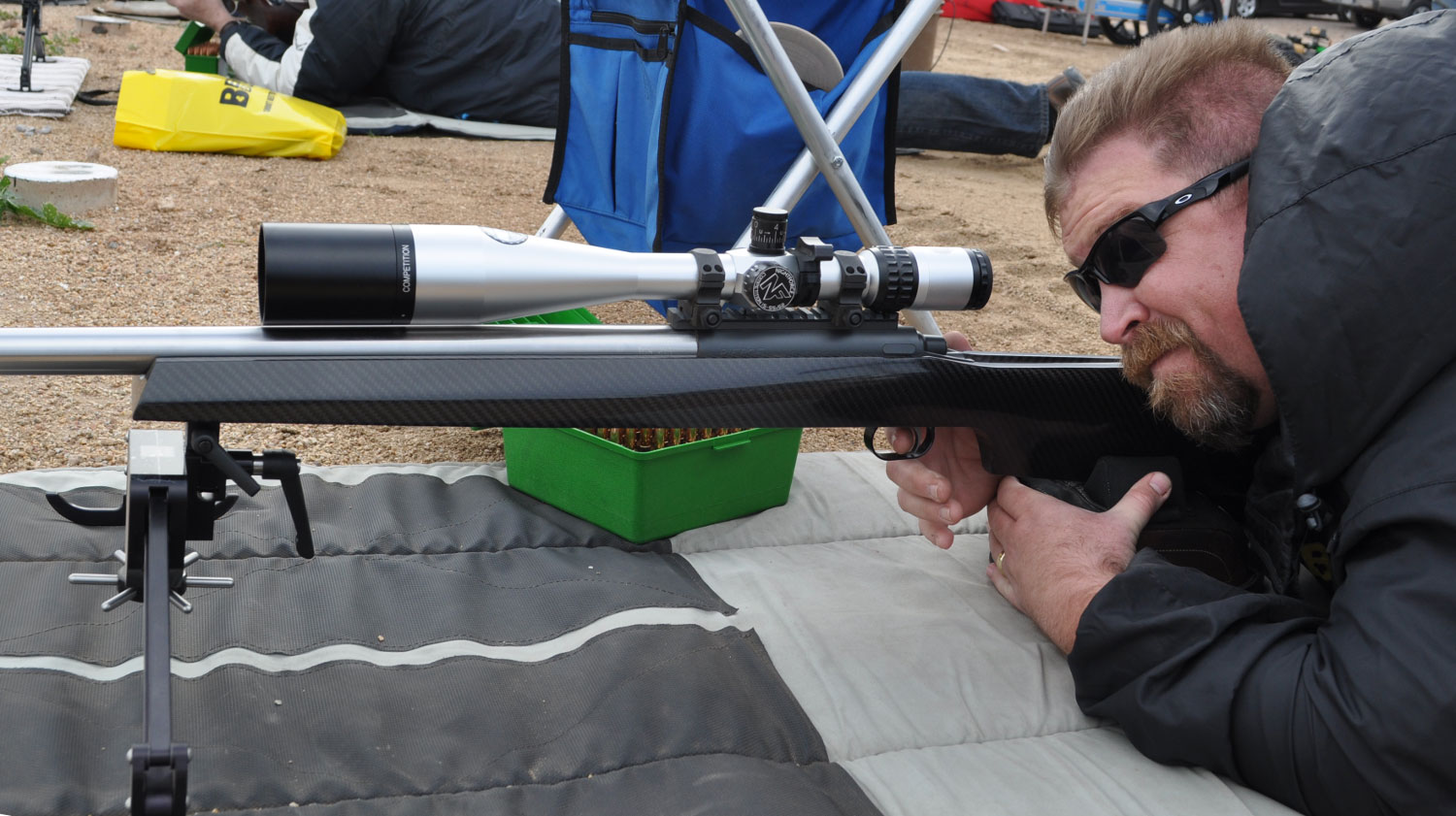
Eric’s F-TR rig was built by John Pierce using a stiff, light Scoville carbon-fiber stock. The stock is so light that Eric’s rifle came in 1.5 pounds under the F-TR maximum weight limit (8.25kg or 18.18 pounds). The gun features a Pierce action, Bartlein barrel, Jewell trigger, and a Gen 1 Nightforce 15-55X52mm Comp scope. From the get-go, Eric’s strategy was to “aim small” and shoot his rig like a bench-gun. He actually focused on shooting really small groups rather that just trying to keep shots within scoring rings and “hold waterline”. With a .308 Win that could shoot bugholes at 100 yards, this strategy paid off.
Rifle builder John Pierce explains the thinking behind this rifle: “The stock choice was mine — I had built two prototype rifles last year based on the premise that the game is Benchrest in the prone position. I still feel very strongly regarding [this concept]. I chose Bob Scoville for obvious reasons — he is an artisan and his stocks have won so much, they just flat work. We built Eric the latest configuration along these lines, and the tool worked for him. Without a doubt, Eric is a shooter, and we were all pleased to watch him perform so well.”
Eric sets up rifle before match. During live fire his hands do not contact the stock.
Eric employed a benchrest-style shooting technique with his F-TR rig — he shot pretty much free recoil, with no cheek pressure, no hand contact, and just a “whisper” of shoulder contact. Eric explains: “I shoot what’s called ‘free recoil’. Now the rifle is butted up against my shoulder very lightly, but no other part of my body touches the rifle except for my finger on the trigger.” Eric has even used this technique when shooting a 7mm cartridge in F-Open at other matches: “Someone suggested that this style wasn’t possible with the larger [7mm] cartridges, but I found it very successful so I continue to do it that way.”
VOICE FILE: Eric Stecker Talks About Shooting F-TR with Benchrest Technique.
Eric also employed an unconventional strategy — he was focused on shooting small groups (not just holding ring values): “Since I have started shooting F-Class, I treat [the target] like a benchrest target. What I mean by that is that I regard the center as my first shot, and so my objective is to create the smallest group. So, I will hold whatever… is required to end up with the bullet ending up in the center — that’s probably true of any F-Class shooter, but I guess the perspective’s a little different when you have a benchrest background.” Eric explained that “maybe I aim a little smaller than others might”, because in the benchrest game, “the slightest miss ends up costing you quite dearly”.
Click to Zoom Photo(This is not Eric Stecker’s rifle, but a “sistership” built by John Pierce.)
Eric Talks about F-TR Trends
Will other F-TR shooters build rifles suited for free-recoil-style shooting? Eric isn’t sure: “I don’t know if this type of rifle is the future of F-TR. I shoot a lot of benchrest, so putting those kinds of components into an F-TR gun made a lot of sense to me. One thing I like about F-TR is that there are a lot of different types of approaches being tried and some of them are successful. So I think it’s still pretty wide-open[.] But I think the really great part of what we found at the Southwest Nationals is that shooting [with] a benchrest-style approach certainly doesn’t hurt you. What I mean by that is … aiming small, trying to make the group as tight as possible rather than trying to hit a particular area. I actually tried to shoot tight groups — that was a focus and that worked for me — I had quite a high X-Count.” NOTE: Eric finished with 51 Xs, 14 more than F-TR Grand Agg winner Radoslaw Czupryna (37X). James Crofts had the second highest X-Count with 48 Xs.
Even Berger’s Boss did pit duty at the Berger SW Nationals.
*”Free Recoil” style shooting has its variations. Some would say “pure free recoil” would not even allow shoulder contact. Eric Stecker lightly touches the back of the stock with his shoulder.
At the Berger Southwest Nationals, innovative F-Class hardware was on display. In F-TR, bipods are continuing to evolve, with new variations at every match. (We saw the Flex bipod in action and it operates very differently than anything else out there). But with F-TR bipods and F-Open front rests having evolved to such a high level, the weak link in the rifle support chain may now be at the rear.
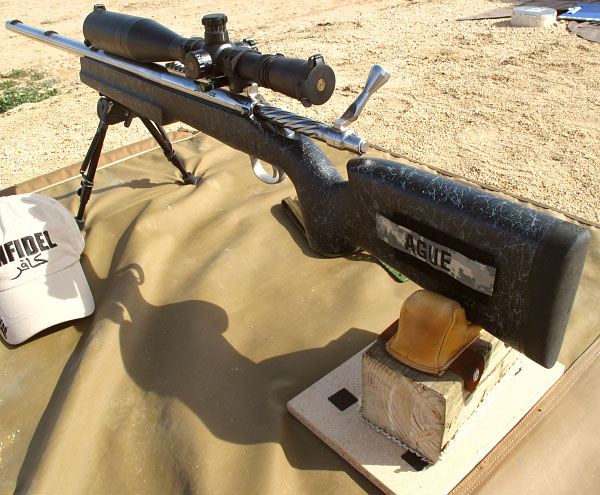
In both F-TR and F-Open, it seems that shooters are turning their attention rearward — devising new ways to stabilize (and elevate) the rear sandbags. We saw a variety of “sub-platforms” designed to give rear bags more lateral stability, and also raise the bags up off the ground. A few shooters have moved away from a conventional rear sandbag to a hybrid support that almost looks more like a front bag attached to a rigid block. Here are a couple rear bag set-ups we saw at Ben Avery in Phoenix. These should give you guys some ideas:
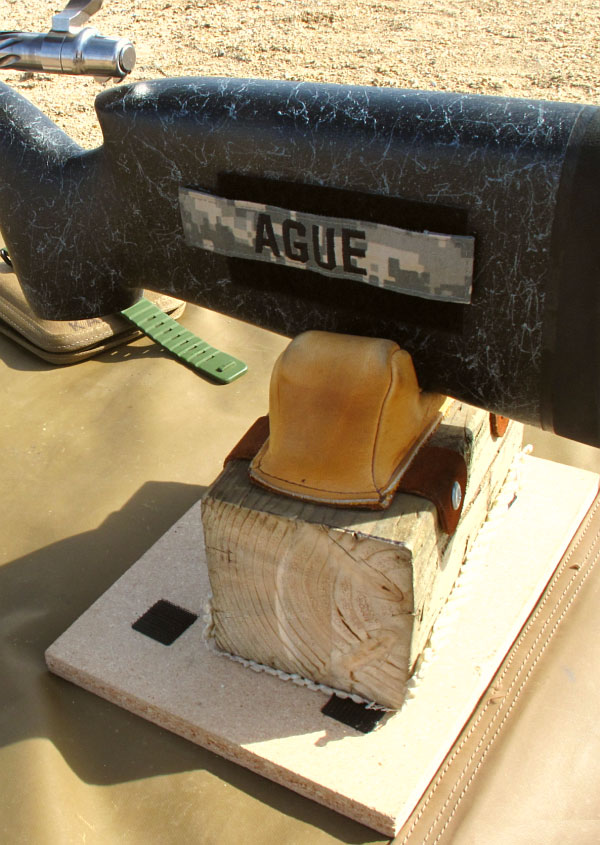
Check out this simple but effective Do-It-Yourself rear rest. The “base” is a large, flat piece of particle board. Above that is a sizable block of wood with carpet tacked to the base. It appears that the carpet may be affixed to small velcro squares on the flat base. The most clever feature is on top. A V-style leather front bag has been adapted to support the rear of the rifle. This solution looks both effective and affordable.
We know you guys like do-it-yourself (DIY) projects. And we also know that our readers like anything that helps a rifle sit more securely in the bags, and track better on recoil. Here’s a little accessory you can make yourself for pennies that will help rifles with conventional (non-benchrest) stocks ride the rear bag better.
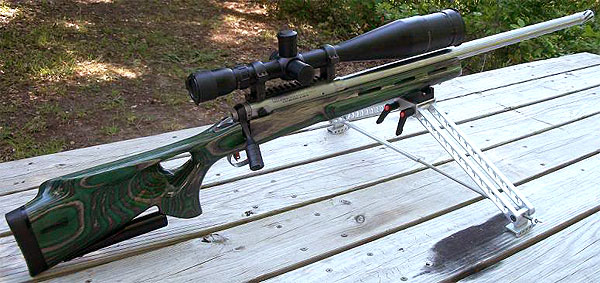
This DIY Bag-Rider is simple in design and easy to make. The invention of Forum member Bill L. (aka “Nomad47″), this is simply a short section of PVC pipe attached to the bottom of a wood stock with a couple of screws. The back half of the PVC tube is cut at an angle to match the lower profile of the stock. Nomad47 painted the PVC Bag-Rider black for sex appeal, but that’s not really necessary.
In the top photo you can see Nomad47’s bagrider attached to a Savage varminter. In the bottom photo, the PVC bag-rider tube is fitted to an F-TR style rig with a green, laminated thumbhole stock. This rifle also features a Savage action with a custom barrel and “wide-track” bipod. (Note: to be legal in F-Class competition, the muzzle brake would have to be removed.)
To learn more about this PVC Bag-Rider and other similar gadgets for the rear of your stock, read this Forum Thread.
Over the past few years, interest in F-Class competition has grown dramatically. At the 2013 SHOT Show we had a chance to talk about F-TR competition with U.S. National F-TR Team members Mike Miller and Stan Pate, two of America’s top F-TR shooters. We are reprising this interview for readers who may have missed it the first time around. If you shoot F-TR (even if you’re a High Master), we think you’ll learn a few things from this interview.
In this interview, Mike and Stan agreed to share their vast store of knowledge about long-range shooting. In a wide-ranging dialog, we discussed many topics of interest to F-Class shooters: position set-up, bipod shooting techniques (and hardware), gun-handling, and bullet selection. In addition, Mike and Stan offer some great advice on wind reading and precision reloading. These general tips will benefit all competitors, no matter what their discipline.
If you shoot F-TR or you are considering getting involved in this fast-growing shooting sport, definitely watch this 14-minute video interview from start to finish. Mike and Stan are true F-TR gurus whose knowledge of the F-TR game has been gleaned from years of top-level competition. If you shoot a .308 from a bipod, we guarantee you can learn much from Mike and Stan. If you follow their advice, we bet you’ll see your scores improve in future matches.
Watch Video for Tips from U.S. National F-TR Team Members Mike Miller and Stan Pate
For 2014, Kelbly’s is introducing a new series of rifles for competition, tactical disciplines and hunting. The Arcas™ Series rifles are complete packages designed with Kelbly’s recommended specifications and top-grade components. Pick your application (Benchrest, F-Open, F-TR, Hunting, Tactical) and Kelbly’s can provide a complete build with all the bells and whistles.
Shown below are the four Arcas competition rifles currently offered. In addition to these four comp guns, the Arcas series includes two tactical-style rifles and two hunting rifles (starting at $2799.00). All these Arcas series rifles will be on display at SHOT Show next week. Let us know (via comments) which Arcas models interest you the most, so we’ll be sure to feature those in our SHOT Show reports.
Every Arcas Series rifle comes with premium components and a wide choice of stock colors. In addition you can have an Arcas rifle customized. For example, the Arcas F-Open rifle shown below can be customized with an extra long barrel ($20 per inch), fluted barrel ($199.00 extra), polished metal (all parts, $249), a GRS Laminated Stock with ergonomic grip (no charge), or a PRT Lowboy stock with high gloss finish ($799 extra).
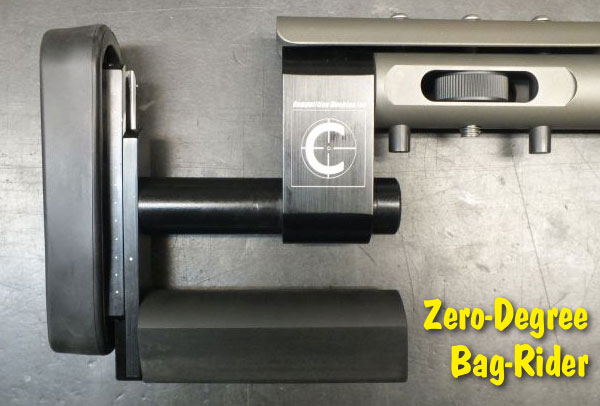
Tube-gunners take note. Gary Eliseo has just introduced a new wider, V-profile rear bag rider for his Competition Machine modular chassis systems. The new bag-rider is a wide V-shape that conforms to the shape and angle of popular rear sandbags. Gary tells us that “The new F-class rear bag rider will be available as an option in 2014. Constructed of Delrin, the new bag-rider is reversible with 0 degree and 5 degree mounting ends. The bottom of the bag-rider is sized to fit 3/4″-wide ear spacing.”
Editor’s Comment — This Kind of Bag Rider Really Works
We have tested a prototype, V-shaped bag-rider on an Eliseo 6mmBR Tubegun. The profile on our wooden prototype is very similar to Gary’s final design crafted from Delrin. We were really surprised at how much better the gun behaved with the wide, V-shaped bag rider, compared to a standard slab-sided skid. With the “V-Rider” the gun felt more “locked-in” with less side-to-side play. There also seemed to be less vertical bounce when shooting F-TR style with a bipod. But mostly the gun felt much more stable, with less tendency to roll. There was noticeably less side to side wobble, and the gun did track better.
The most important thing, is that the V-shaped bag-rider definitely made the gun easier to shoot — at least in the opinion of our three trigger-pullers. When we switched to our wide, V-shaped bag-rider, three different shooters were able to hold smaller groups with tighter horizontal. We saw fewer left/right shot impacts (away from the group center) that may have been attributable to little, last-micro-second movements of the rifle. The gun seemed to settle in the rear bag better, and after each shot, it seemed we could get back on target more quickly. The gun “locks in” to the rear bag faster and more solidly, so you spend less time fiddling with horizontal. With less wobble, the TubeGun feels less top-heavy. Understand that a V-shaped bag rider will not make your rifle more inherently accurate. However, it may help you steer the gun more consistently, and it make help the rifle track more consistently.
Product find by EdLongRange. We welcome reader submissions.
Forum member Jonathan L. (aka ‘Quest-QC’) was a member of the Canadian F-TR team at the F-Class World Championships in Raton, NM this fall. His handsome .308 Winchester rifle features some interesting hardware and a stunning African Padauk-wood stock stiffened with carbon fiber layers. We were impressed by the innovative, adjustable bag-rider assembly Jonathan fitted to the rear of his stock (scroll down for photo). With an Allen wrench, the vertical height and the slope (i.e. fore/aft angle) of the V-shaped bag-rider can be changed easily. This has many advantages. First, Jonathan can set his rifle to the most comfortable height (for his prone position) without using “lifters” under the rear bag. The system also gives him some gross elevation adjustment separate from the bipod. In addition, the angle adjustment allows the bag-rider to better match the geometry of the rear bag. Last but not least, by setting up the bag-rider with some drop (higher in front, lower in back), Jonathan can fine-tune his elevation (while aiming the gun) by simply sliding the rifle fore and aft.
Jonathan says: “This year was my second year shooting at 1000 yards and I managed to find a spot on Team Canada for the FCWC at Raton. Here is the rifle that brought me there…”
The rifle features a Kelbly Panda F-Class RB-LP action, 34″ Bartlein 1:11″-twist, Heavy Palma contour barrel. Fitted to the red-toned Padauk-wood stock is a 23.2 oz., StarShooterCF-SS light weight bipod with custom bench feet. On top is a March 8-80x56mm scope in Kelbly rings. Total weight of the rifle is 18 pounds, 1 oz., complete with the 24 oz. adjustable brass bag-rider at the back. The bag-rider block was modeled in 3D, then machined afterwards to use up the remaining weight available after all the other components. CLICK for StarShooter CF-SS Bipod Video.
African Padauk Wood is Very Stiff
Jonathan chose the red-toned African Padauk Wood because it is stiff for its weight: “The reason for choosing African Padauk is that the weight of the wood is the same as Maple but 45% more rigid.” The downside of Padauk, as Forum member Gstaylorg notes, is that it is a “very oily wood, which can make it somewhat difficult to finish with something like polyurethane. [Padauk] can generate a lot of bubbles and cause cracking problems around joints and/or seams.” Jonathan did note that he has observed a few bubbles in the auto clear coat on his stock. He plans to refinish the stock in the off-season.
Gun Is Extremely Accurate with Berger 200gr Hybrids
Jonathan says this rig was very accurate, at least until his barrel gave up the ghost. He says he has put 15 successive shots in about 1/4 MOA: “I managed to make it twice (1/4 MOA for 15) by taking my time between shots. You don’t want to overheat this barrel. I needed to provide a very strong effort (mentally) to be able to achieve such precision as the rifle is way better than me.” Jonathan shoots Berger 200gr Hybrid bullets (in the lands) with Hodgdon Varget powder, and Federal 205M primers, loaded into neck-turned Lapua .308 Win brass. He has also had good luck with Vihtavuori N150 powder in the past.
In compliance with F-Class rules, the adjustable bag-rider system would not be adjusted “on the fly” during record fire. The bag-rider’s vertical rise and fore/aft slope would be optimized before shooting, then locked in place. The bottom photo offers a good view of the V-shaped profile of the metal bag-rider. We have found that this kind of V-profile, closely matching the triangular profile of the rear ears, makes a rifle more secure in the rear bag and often allows the gun to track better.


 The offset scope idea came from a benchrest “rail” gun. In truth, the whole concept came from a rail gun — just adapted to being shot off a bipod. Sure it isn’t directly over the bore. It is about 1.5″ over to the left. So if you want the scope to be zeroed on the center of the target, you have to adjust for the offset. At 100 yards that is 1.5 MOA. But at 300 it is only 0.5 MOA, at 600 only a ¼-MOA, and at 1000 about 1 click on my scope.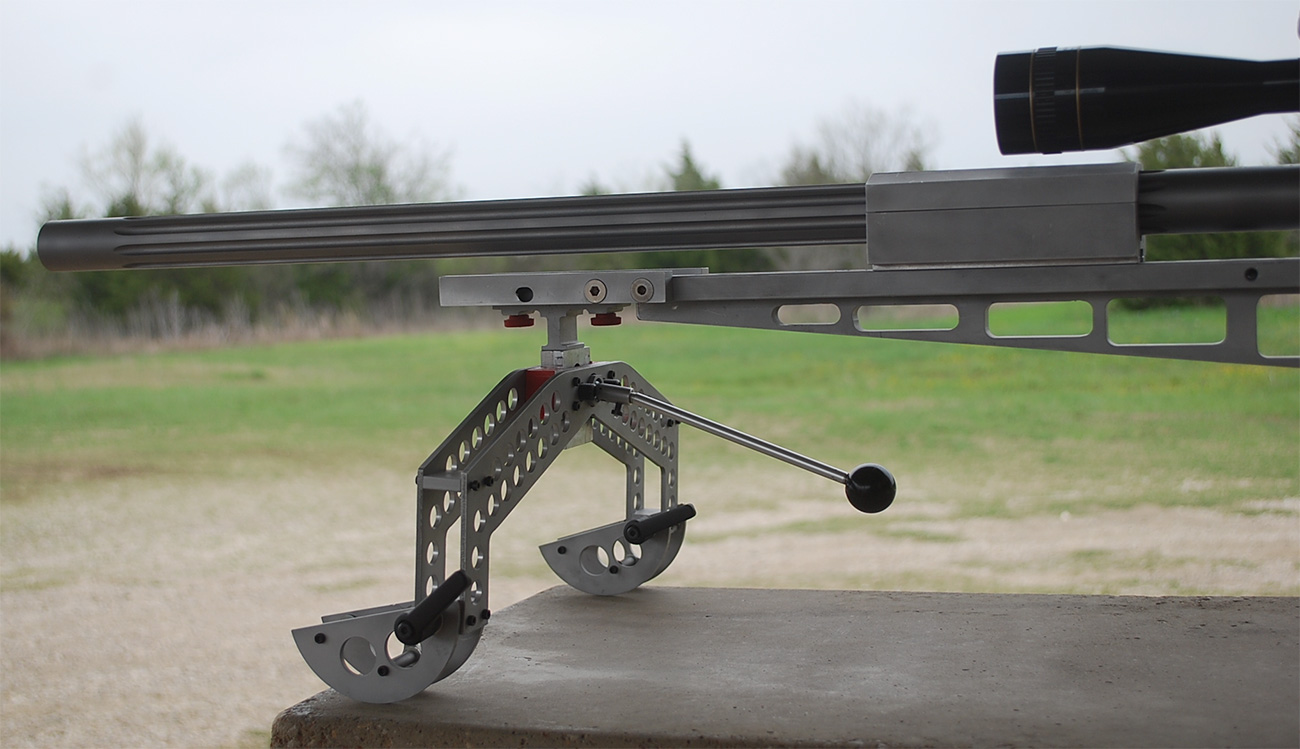






 Over the past few years, interest in F-Class competition has grown dramatically. At the 2013 SHOT Show we had a chance to talk about F-TR competition with U.S. National F-TR Team members Mike Miller and Stan Pate, two of America’s top F-TR shooters. We are reprising this interview for readers who may have missed it the first time around. If you shoot F-TR (even if you’re a High Master), we think you’ll learn a few things from this interview.
 For 2014, Kelbly’s is introducing a new series of rifles for competition, tactical disciplines and hunting. The Arcas™ Series rifles are complete packages designed with Kelbly’s recommended specifications and top-grade components. Pick your application (Benchrest, F-Open, F-TR, Hunting, Tactical) and Kelbly’s can provide a complete build with all the bells and whistles.