|
|
June 14th, 2020

A multi-time F-TR National Champion, James “Jimmy” Crofts is one of America’s top F-Class competitors. And now this F-TR ace has a stunning new rifle in his arsenal. AccurateShooter Forum member CigarCop, head honcho of KW Precision LLC, recently completed a new F-TR rig for Crofts. This handsome, state-of-the-art rifle features top-tier components: Borden action, twin Brux barrels, Cerus RifleWorks F-TR Stock, and Jewell trigger, all resting on a wide-base Phoenix Bipod.


James Crofts photo by Kent Reeve.
Have a good look at these photos below. Yes, envy is the appropriate reaction. With the smooth operation of the Borden action and the predictable accuracy of Brux barrels, we bet James’s new rig will shoot as good as it looks.

CigarCop actually chambered two barrels for James, with different fluting patterns — conventional linear flutes for one tube, and lines of staggered ovals for the other. Finished length for both barrels is 30″. Yes it looks cool, but the fluting was done mainly to save weight with the 30″-long lengths. CigarCop tells us the complete rifle, without scope and rings, weighs just under 15 pounds. Max allowed weight for an F-TR rifle, with scope, is 18.18 pounds (8.25 kg).

To learn more about this impressive F-TR rifle build by CigarCop, visit our AccurateShooter Forum and read KW Precision’s F-TR Gun-Building Thread. The stock was created on an automated CNC milling machine by Cerus Rifleworks.
 When James Crofts is not shooting his .308 Win F-TR rig,
he often trains with a .22 LR Rimfire rifle. Read on…
Rimfire Training for F-Class Competitors
2014 and 2012 U.S. National F-TR Champion James Crofts is one of America’s top F-Class shooters. A member of 2013 World Championship-winning F-TR Team USA squad, James knows a thing or two about long-range shooting. But you may be surprised to learn how James sharpens his shooting skills at relatively short distances. You see, James often practices with a .22 LR rimfire rifle at distances from 50 to 200 yards. James tells us: “Shooting my F-Class rimfire trainer saves me money and improves my shot process and wind-reading abilities.”
Remington rimfire 40X barreled action in PR&T LowBoy stock with PT&G bolt.

Rimfire Training Teaches Wind-Reading Skills by James Crofts
Training with the rimfire is extremely useful and can be done from 25 yards out to 200 yards. I am lucky and can shoot 50 yards right off my back deck. That is far enough that any miscue on rifle handling will show up on the target. I use a two dry-fire to one actual shot routine for my practices. This gives me much more positive reinforcement without any negative reinforcement.
Wind reading is extremely important with a .22 LR rifle. I use a set of smallbore flags to aid my wind calls. The smallbore flags are a must and force you to look at the flags and mirage on each and every shot.

This Rimfire rifle features a CMP-sourced Rem 40X barreled action, PR&T Low Boy stock, Jewell trigger, and Phoenix bipod. The gun was built by Ray Bowman of Precision Rifle & Tool. James Crofts told us: “The project turned out awesome — the rifle was a hammer from the beginning even with the stock barrel.”
Rimfire Training Is Cost-Effective
Rimfire ammunition is much less costly than centerfire ammo. Though .22 LR prices have risen, you can still get a 500-round brick of very good .22 LR match ammo for around $75.00. That works out to fifteen cents a round. That’s a fraction of the cost of handloading .308 Win match ammo. The top match-grade, .308-cal centerfire bullets can cost around $60 per hundred. Then you have to figure in brass, primers, and powder. Finally you have to consider your precious centerfire barrel life lost to practice.
May 23rd, 2020

The best F-Class and Sling shooters in the nation compete each year at the Berger Southwest Nationals at the Ben Avery range in Arizona. Walk down the firing line and you’ll see the absolute “best of the best” in equipment — from $3500 optics to $2000 stocks and $400 triggers. Berger SWN shooters have some of the best equipment you can buy. In this game, where just 1 or 2 points can separate first from third place (considering X-Count), it’s important to have top-flight equipment. That means a custom action, custom barrel, and high-end stock or chassis system.
Matt Schwartzkopf, a range supervisor at Ben Avery, and member of the USA F-TR Team, has collected comprehensive gear reports from the 2020 Berger SW Nationals. Matt has created charts showing competitors’ choices for Actions, Barrels, Stocks, Riflescopes and Spotting Scopes. In addition, Matt has compiled bullet choice data for all classes and Cartridge rankings for F-Open Division.
There is a discussion of the 2020 SWN Gear Selection in our Shooters’ Forum. CLICK HERE to follow that Forum thread. Many top SWN shooters, including past F-Open National Champion Larry Bartholome, have contributed to this Forum discussion about gear options.
ACTIONS Listed by Division (Sling, F-TR, F-Open)

ACTIONS by Brand (Combined Listing — All Divisions)

BARRELS by Brand (Combined Listing — All Divisions)

BULLETS by Brand (Combined Listing — All Divisions)

CARTRIDGE BRASS by Brand (Combined Listing — All Divisions)

POWDER by Brand (Combined Listing — All Divisions)

STOCKS by Brand (Combined Listing — All Divisions)

RIFLESCOPES by Brand (Combined Listing — All Divisions)

SPOTTING SCOPES Listed by Class (Sling, F-TR, F-Open)

Cartridge Selection in F-Open Division
In addition, Matt produced an interesting listing of cartridge/caliber types for the F-Open division. This is helpful because cartridge choice is unrestricted in the F-Open class. By contrast, the F-TR division is limited to .223 Remington (5.56×45) or .308 Winchester (7.62×51). You can see that the .284 Winchester (and variants) currently dominate F-Open.


March 19th, 2020

A while back, our friend Vince Bottomley in the UK wrote an excellent article for Target Shooter Magazine. Vince offers “solid-gold” advice for new F-TR and F-Open shooters. Vince reviews the cartridge options, and offers suggestions for a shooter’s first (and hopefully affordable) F-Class rifle. Vince also reviews various bipod choices for F-TR and discusses optics options (from $300 to $3000).
Here’s a short sample from the Target Shooter Magazine article:
Getting Started in F-Class by Vince Bottomley
As membership secretary of a large club, one of the questions I’m frequently asked – “What’s the best way to get started in F-Class?” My club has an F-Class shoot every couple of weeks at ranges from 300 to 1000 yards and, not surprisingly, it’s very popular.
F-TR or Open Class?
From a shaky start way back in 2004, the F-TR Class is now proving as popular as Open Class and, at GBFCA League shoots and club shoots, many shooters choose to start with a 308, shooting off a bi-pod – in other words F-TR. In Open Class, the 7mm WSM soon established itself as the “must have” cartridge – if you wanted to win but, the WSM’s appetite for barrels eventually brought another 7mm cartridge into play – the 284 Winchester. This 50-year-old stalwart was revived a decade or so ago as the 6.5-284 and indeed this cartridge found some favor with F-Class pioneers – before the potency of the WSM was discovered. If you don’t mind shelling out for a couple of barrels per year (barrel life is about 750 rounds with the WSM) go for the 7mm WSM but, if you require a decent round-count, then opt for the .284 Win and learn to read the wind a bit better!
Scopes for F-Class
If you will be shooting 1000 yards then I would recommend at least 32 power and preferably a variable – like the 8-32. The cheapest “usable” scope in this range is the Sightron. It’s a great scope for the money and at under $900 (in the USA) it’s half the price of its nearest competitor. It’s also light – at 1.5 lbs – and there are some great reticles for the F-Class shooter – like the LRMOA.

Read Full Article on Target Shooter Magazine Website.
February 20th, 2020

F-Class shooting (both F-Open and F-TR) is one of the fastest-growing forms of rifle competition. Each season many new shooters hit the line and attendance at the major F-Class matches increases every year. But if you’re new to the game, you may ask “Where can I shoot an F-Class match?”. Well, Forum member Rod V. (aka Nodak7mm) has compiled a useful list of 112 ranges throughout the USA where F-Class matches are held. With venues from Alabama to Wyoming — you should find an F-Class program not too far from home. The list, in Excel spreadsheet format, provides range locations and weblinks (where available). Click the link below to download the F-Class Range List (.xls file):
Download F-Class Range List, Revision 20 (12/24/2015) (.XLS file, right click to “save as”)

Note — this list, now in its 20th Revision, is augmented regularly, but info is still being gathered. No claim is made that the list is comprehensive. But it still covers the the lion’s share of the important F-Class venues nationwide. If you know of a range that should be added to the list, please post the location on our F-Class Range List Forum thread. Rod will update the list as new range info is received. Rod writes: “Range information is wanted and welcomed. I would like your help on collecting specific info on Clubs/Ranges where known F-Class matches are held.” Here’s a partial sample from Rod’s list:


February 10th, 2020

The 2020 Berger Southwest Nationals are complete. As expected, it was a hugely successful match that challenged the nation’s top Sling and F-Class shooters. We want to praise all the competitors and congratulate the 2020 SWN Champions in all three classes. The competition was fierce through-out the match. John Whidden won the Sling Division with a 1245-75X score, just one point ahead of runner-up Oliver Milanovic (1244-72X). Bobby Gill was third with 1240-58X.
 In the F-TR Division, Peter Johns had a dominant performance with 1242-58X, twelve points ahead of second-place Wade Fillingame (1230-50X) and third-place Ian Klemm (1230-46X). Ian also shot on the winning USA Independence F-TR Team. In the F-TR Division, Peter Johns had a dominant performance with 1242-58X, twelve points ahead of second-place Wade Fillingame (1230-50X) and third-place Ian Klemm (1230-46X). Ian also shot on the winning USA Independence F-TR Team.
Jay Christopherson Wins F-Open
We cheered the F-Open news. AccurateShooter’s own Jay Christopherson, our Systems Administrator, took the 2020 F-Open title with a brilliant 1247-83X score, 11 “Xs” ahead of runner-up Pat Scully (1247-72X). In third place was Tod Hendricks (1245-81X). Jay (photo right) was shooting a Brux-barreled straight .284 Win with Berger 180gr Hybrid bullets. Up front he uses a SEB Mini coaxial tripod rest. Jay also helped carry Team Lapua-Brux-Borden to an F-Open Team victory. Here’s a short video of Jay shooting when he finished second in F-Open division at the SWN a couple seasons back. You can view Jay’s smooth gun-handling and patience waiting for his condition:
Jay Christopherson, AccurateShooter.com’s System Admin, won the F-Open division. Jay’s Brux-barreled .284 Win was superbly accurate all week long. This video was from a past Berger SWN Event.

John Whidden of Whidden Gunworks won Sling division with a 1245-75X score. John really likes this match: “For most of us it’s the first match of the year, a chance to shake off the cobwebs.” John said conditions were “pretty nice on Friday, Saturday and Sunday — most of the changes came slow and conditions were readable from the mirage.” John, a 5-time National Long Range Champion, is always a threat to win at the SWN. John shot a .308 Win in the Palma Class, and then his .243 Win in the Any Rifle division. Both with Berger bullets and Vihtavuori powders. Here’s John at Ben Avery in 2018:


Above is Peter Johns, F-TR Class winner. Peter posted: “I just accomplished one of my goals of winning a national-level F-Class shooting match! I was only able to do with the support of my wife and family. Also I would like to thank Alonzo Custom Rifles for building a great shooting rifle, Kelly McMillan for the best rifle stock for F-TR (Kestros BR) and Vortex for the best riflecope (Golden Eagle) for F-Class.”
Top SWN Team Performances
A new team record was set at Ben Avery this year. In the F-TR Division, Team USA Independence finished with a 2563-113X score. We are told this is the highest-ever F-TR score. Congratulations to Top Scorer Ian Klemm (645-28X) and the other shooters Wade Fillingame, Fritz Braun, and Luke Ramsey. Keith Trap coached and Kent Reeve was Captain.

In F-Open Team Lapua-Brux-Borden continued its dominance, with a fine performance on the final day. The Team finished at 2584-160X, six points ahead of runner-up Team McMillan F-Open (2578-135X).


F-Open Rifle with Barrel-Cool Device on SEB Neo front rest.
Give Credit to the Match Directors and Staff
Emil Praslick III of Capstone Precision Group offered this perspective on the 2020 Berger SW Nationals: “Wrapping up the Southwest Nationals which was amazingly well run by the Desert Sharpshooters. Matthew Schwartzkopf, Michelle Gallagher, Nancy Tompkins, Melesia Cisneros, Scott Fulmer, Mid Tompkins, and everyone else behind the scenes literally work for at least six months to make the event the well-oiled machine that it is.

Moving and managing close to 400 shooters is a Herculean task, and anyone who thinks they can do better should… offer to come down to help out. I shot awful, but it was a pleasure to see the joy of the shooters as they experienced this one-of-a-kind match. Imagine cooking Thanksgiving dinner for 400 relatives with individual dietary needs on a motel hot plate, and you’ll get an idea of the scale involved. Again, thank you Matt and the gang, and we’ll see you next year!”

December 8th, 2019

Emil Kovan is one of the top F-Class shooters in the world. He won the 2014 United States F-Open Championship, and finished second in F-Open Division at the 2016 Canadian National F-Class Championship in Ontario. He is a great shooter and a great gun-builder as well.
The Anatomy of a Modern F-Class Open Rifle
Report by Emil Kovan
Kovan Match Rifles LLC, www.matchrifles.com
“What are the best components for an F-Open class rifle, and why?” That’s a question that I get asked all the time and will try to answer in this article. Two months ago, I was contacted by Duane, a gentleman I met at the 2015 F-Class Nationals. He was interested in building a rifle with the new Master Class Low Profile F-Open Stock, created by Carl Bernosky and Alex Sitman of Master Class Stocks.
I have known Alex Sitman for many years, and use his stocks exclusively, but was not very familiar with his new Low Profile F-Open stock. After a brief conversation with Alex, I placed an order, and had the stock inletted and bedded at my shop in a month. My first impression was “Wow that’s a long stock” — the forearm is significantly longer than on the original Master Class F-Class prone stock. I bolted the barreled action in, and squeezed the end of the forearm and barrel together, the stock flexed a little bit, but not as much as other designs that I have tested. I think that’s due to having “more meat” in the receiver area. The full stock depth continues farther forward that on some other “low profile” designs. That makes the stock stiffer in the vertical plane, reducing the hinging effect forward of the action. The stock was finished in gloss black per the customer’s request. Interestingly, I found that the multiple layers of paint and clearcoat stiffened the stock up quite a bit.
CLICK IMAGE below for full-screen version

Low Center of Gravity Tames Torque
Compared to the original Master Class F-Open stock, the barrel sits about an inch lower. Lower center of gravity equals less torque, and that is very important when shooting heavy bullets in fast twist barrels. Another significant improvement is that the toe of the stock is flat and parallel to the forearm. I added a 3/4″ track rail in the rear, and milled the underside of the fore-end to create two parallel “rails” in the front to help the stock track better.
One of the biggest reasons why I like Master Class stocks, is the pistol grip. I don’t shoot “free recoil” and a comfortable pistol grip is super important to me when selecting a stock. The new Master Class Low Profile stock shares the same grip as the old model. This allows the stock to accommodate either a “hard hold” style or a more free-recoil style of shooting — whatever the rifle’s owner prefers. This design versatility is one reason I recommend Master Class stocks. Shooters may experiment with either shooting style to find what suits them best.

Cartridge Choice — A 40° .284 Win Improved
Duane decided to have the barrel chambered for my 284 KMR IMP (Improved) wildcat. What is .284 KMR IMP and why choose it over the straight .284 Winchester? Improved by definition means “made better”, I took a great cartridge, and modified it to increase capacity, reduce pressure, and increase brass life.
There are many “improved” variants of the original .284 Winchester: 7mm Walker, .284 Shehane, .284 Ackley and so on. My version, the 284 KMR IMP, shares the .010″ blown-out sidewalls of the .284 Shehane, but I have further increased the case capacity by changing the shoulder angle from 35 to 40 degrees. The 284 KMR IMP allows you to almost match magnum cartridge velocity in a standard-bolt-face action. If you want to run 180gr-class 7mm bullets over 2900 FPS, it is cheaper and more convenient to have a barrel chambered in 284 KMR IMP than to spend $650 for a magnum bolt.
Tuning Loads for the .284 Win Improved Cartridges
The 284 KMR IMP seems to have two nodes, one around 2820 fps and other at 2940 fps. My match load clocks at 2935 fps with single-digit ES. Note –I selected that load based on accuracy, NOT raw speed. A lot of novice (or hard-headed) shooters make the mistake to push their cartridges to the max, and disregard more accurate loads at lower velocity.

The sport of F-Class is rapidly growing, and the equipment used is improving constantly. I remember that only few years ago, an F-Open rifle that could shoot sub-one-inch of vertical at 300 yards was considered competitive. Now, we are pursuing sub-one-inch vertical at 600 yards! It takes a great rifle to approach that goal, but it is also up to the shooter to learn and experiment as much as possible in order to achieve success.
Dies for an Improved .284 Win Cartridge
One of the biggest challenges in campaigning a wildcat cartridge has been obtaining great dies. When searching for custom dies, it almost seems like that the odds are stacked against us. The most common problem is wait-time — custom die orders can take months to be completed. Also, most custom die makers want you to send them two or three cases, each fire-formed three times. I find that funny because if could somehow properly size the cases for three fire-forming cycles, I would not need a sizing die.

Custom-made dies should size the case just right, but sometimes the die’s internal dimensions are slightly off, and this leads to problem number two: dies sizing too much (or even worse) too little. I had a one “custom” die that would not size the bottom of the case enough. This made the extraction of fired cases very difficult. I feel that the best option (if available) for shooters interested in wildcat chambers is to have their gunsmiths make the dies. I offer that die-making service in addition to barrel chambering.
BAT Machine “M” Action
Duane decided to use a BAT M action for this rifle, and I think that he could not have made a better choice. We are blessed with many good match-quality receivers: Barnard, BAT, Borden, Kelbly, Nesika, and Stiller just to mention a few. These are all very well-made and suitable for F-Class. Among BAT Machine Co.actions, I like BAT models M, MB, and 3LL best. I prefer these because because of their size (large bedding footprint) smoothness, timing, options available, and last but not least visual appearance.
Trigger: I recommend and use Jewell triggers. Other good options are: Kelbly, CG Jackson (good 2-Stage) Anschutz (best 2-Stage for Bat and Kelbly actions), Bix’N Andy, and David Tubb.
Barrel: Duane made another good choice here. He decided to go with a Brux 1:8.5″-twist, 4-groove cut-rifled barrel. If you look at the F-Class and Long Range benchrest equipment lists, you will see that cut-rifled barrels are currently dominating. Many records have been shot with both button-rifled, and cut-rifled barrels. I have shot both, and prefer cut-rifled barrels. I am not saying that button-rifled barrels are not capable of shooting as well as cut-rifled barrels, but on average, in my experience, four out of five cut-rifled barrels (from top makers) will shoot well, vs. three out of five buttoned barrels. YMMV, but this is what I’ve observed.
Brux Barrels is not the only company that produces very accurate cut-rifled barrels. We know that Krieger, Bartlein, Satern, and Hawk Hill Custom all make fine cut-rifled barrels as well.
Scope: Duane’s rifle was fitted with a Nightforce 15-55x52mm Competition scope with DDR-2 reticle. This optic is ultra clear, reasonably lightweight (28 oz.), super reliable, and has 1/8 MOA clicks — what you want for long range F-Class competition. In this 15-55X NF model, I like the DDR-2 reticle best, because fine cross hairs (FCH) are hard to see in heavy mirage. The DDR-2 has a heavier horizontal line, with a center dot. March scopes are also very popular and very well-made.

Thanks for reading, and keep ‘em in the middle…
 Emil Kovan Competition History: Emil Kovan Competition History:
– 2014 F-Class Open National Champion
– 2016 F-Class Open Canadian Championship, Silver Medal (tied for first on score)
– 2015 F-Class Open National Championship, Silver Medal
– F-Class Open National Championship Teams, 2015, 2014, 2013, Shooting Team Member
– Over 15 wins in Regional and State Championships in Palma, F-TR, F-Open
– 2013 U.S. National Team Member
– 2017 U.S. National Development Team Member
December 3rd, 2019

Cartridge Choices for F-Class Competition
By Emil Kovan
Kovan Match Rifles LLC, www.matchrifles.com
There are hundreds of cartridge types capable of winning in F-Open. For F-TR you can shoot either the .223 Rem or .308 Win, but you have many load options. This article will focus on proven choices, currently used by the top F-Class shooters in the world. Our discussion will analyze cartridge selection based on the four different F-Class sub-disciplines: Open Mid-Range, Open Long-Range, F-TR Mid-Range, and F-TR Long Range.
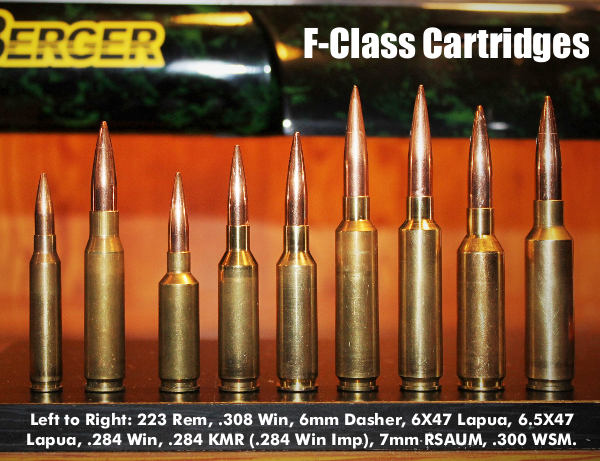
Click image to view full-screen photo.
Mid-Range F-Open Cartridges
For starters, a .300 WSM is certainly capable of winning mid-range matches but it is not ideal. So what is ideal, and why? F-Class Mid-Range matches usually are usually shot at 300, 500, or 600 yards — or all three. At those distances the 6mm and 6.5mm cartridges rule. In moderate conditions, the 6mm Dasher is unbeatable. Its low recoil along with its super grouping ability and good ballistics make it my number one choice for Mid-Range.
Best bullets for the 6mm Dasher are: Vapor Trail 103gr, Berger 105 Hybrid, 108 BT, and 105 VLD (hunting). Best powders are: Varget, H4895, and Reloder 15.
Choices for Mid-Range in Tougher Conditions:
We all know that conditions are not always “moderate” that’s why something a little bit bigger will save you a “Nine” or two. The 6.5X47 Lapua was designed for 300-meter competition, but as soon as it was released, it was adopted by F-Class, benchrest, and tactical shooters. It offers great ballistics with very low recoil and big “accuracy window”. Lapua makes great brass for it (no surprise there) and Berger makes great bullets: 130gr VLD, 140gr VLD, 140gr Hybrids. Best powders in most barrels are Varget and H4350, I don’t use double-based powders such as Reloder 17 and the Vihtavuori N500 series because of their unpredictable performance day to day (greater temp sensitivity).
The 6.5X47 Lapua necked down to 6mm is also a great option for mid range matches. I was able to easily get 3200 fps with 105 hybrids and H4350.
Choice for Long-Range F-Open Competition
In Long-Range F-Open Class (out to 1000 yards), the big, high-BC bullets rule. If I had to pick one cartridge for F-Class (both mid- and long-range) I would pick the .284 Winchester or one of its variants. The .284 Win is currently dominating in F-Open competition. It offers great barrel life, it is super-easy to tune and its recoil is very manageable. The best bullets for it by far (in my opinion), are the Berger 180 Hybrids. But Sierra’s new 183gr MK bullet (with factory-uniformed meplats) seems to perform very well as does the Berger 180 VLD. Best powders for the .284 Win are H4350 and H4831SC.

Long-Range Only F-Open Cartridge
As much as I like the .284 Win, for long-range competitions I like the .300 WSM even more. If you look at a .300 WSM and a 6mm Dasher side by side, they appear almost identical in geometry — the .300 WSM looks like an “super-sized” Dasher. Both cartridges are currently the “darlings” of long-range benchrest due to their extraordinary grouping ability and huge “node’’ windows. Big accuracy windows allow loads to perform well in different conditions and geographical locations. That’s obviously very important if you travel to compete. The .300 WSM loaded with Berger 215gr or 230gr Hybrids is very tough to beat at long range, and it is currently my number one choice.
The 7mm RSAUM is another outstanding long-range round. It resembles a 6BR on steroids and it is almost as easy to tune. Best bullets for it are Berger 180gr Hybrids, 195gr EOLs, and Sierra’s 183gr MatchKing. Best powders for the 7mm RSAUM are: H4350, H4831SC, and VV N160.
Top Caliber/Bullet Combos for F-TR
In F-TR competition, the choice is clear — a .308 Win throated for Berger 185gr BTLRs and 200gr Hybrids will win in mid-range AND long-range comps. Many championships have been won, and many records set with those two bullets in the .308 Win. To quote Danny Biggs (a two times FTR National Champion) “The 185 BTLR is the best bullet for .308 Win ever made”.
The Berger 215gr Hybrids have been used to win many competitions including recently the 2015 F-Class Nationals. Bryan Litz won both the Mid-Range and Long-Range 2015 Championships using 215s. Bryan’s rifle is shown below:

I recommend chambers throated for the 185/200 grain projectiles over the 215/230 grain bullets. The reason is that if you have your barrel throated out for the 215s or the 230s, you could have a “slow” barrel and max out on pressure before the desired velocity is reached. Optimum freebore for the 230s is too long for the 185/200s, so you would be limited to using only 215/230gr bullets in that barrel.Furthermore, the recoil increase with heavier bullets is substantial, causing the rifle to be more difficult to shoot.
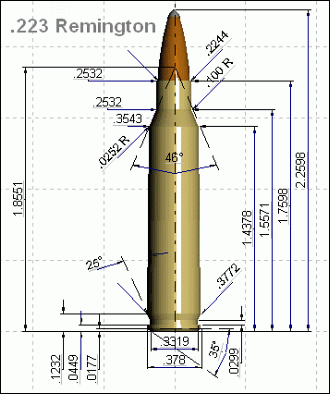 .223 Rem — Not A Competitive Option .223 Rem — Not A Competitive Option
I would stay away from the .223 Remington. On paper the 90gr VLD will shoot inside most .308 Win loads even at a 1000 yards. But in reality, on average, the .223 Rem, regardless of what powder/bullet combo is used, cannot compete with the .308 Win. [Editor: The equipment lists at major F-TR matches will confirm Kovan’s conclusion here.]
Conclusion (and Other Options)
This article covers only the (currently) most popular cartridge/bullet combos for F-Class (F-Open and F-TR). As I said in the beginning, many cartridge types are capable of winning but are not listed due to their low popularity, case design, or lack of quality components. All of the above information is based on my personal experience and it is meant to help new shooters choose the right cartridges for F-Class matches. Thanks for reading and good luck — Emil Kovan
Emil Kovan Competition History:
– 2014 F-Class Open National Champion
– 2015 F-Class Open National Championship, Silver Medal
– F-Class Open National Championship Teams, 2015, 2014, 2013, Shooting Team Member
– Over 15 wins in Regional and State Championships in Palma, F-TR, F-Open
– 2013 U.S. National Team Member
– 2017 U.S. National Development Team Member
September 30th, 2019

Michelle Gallagher is one of the nation’s top rifle shooters and team coaches. A past Long Range National Champion, Michelle is part of America’s “First Family” of Shooting, being raised by Mid Tompkins and Nancy Tompkins, both rifle champions in their own right.
Michelle, who works for Sierra Bullets, was at the 2019 F-Class National Championships in Raton, New Mexico. At the event, Michelle captured some great photos of the competitors and the New Mexico countryside at the NRA Whittington Center. This year’s Nationals were very challenging competition, with truly brutal winds on some days. Here is Michelle’s Photo Essay on the 2019 F-Class Nationals.


Father Ken Klemm and Son Ian Klemm shot together in F-TR Team Matches. Individually, Ian was second overall in the 1K F-TR Nationals, while Ken finished as High Grand Senior.


Three talented lady shooters: Michelle Gallagher (L), Nancy Tompkins, and Madison Bramley.
September 13th, 2019

The U.S. F-Class National Championships commence September 15 at the NRA Whittington Center in New Mexico. But, across the pond, the European F-Class Championships took place this past week (September 2-8) at the Bisley Range in the UK. Congrats to the big winners, Great Britain’s Dan Lomas, new European F-TR Champion, and Germany’s Ulrich Kwade, new European F-Open Champion. Team Great Britain RED, shown below, took the European F-TR Team Championship, while Team Italy won F-Open.

Team Great Britain RED won the F-TR Team Championship, with Ukraine Second, Great Britain BLUE Third.
Dan Lomas Wins F-TR Title on Home Turf at Bisley
Dan Lomas was excited about his F-TR Championship: “First place in Europe! Just finished five solid days shooting in the European Championships at Bisley. I ended up keeping my head, winning the Europeans 5 points clear! I also was given my first cap shooting for the country and, with my amazing team mates, won gold for GB by a clear 15 points. It was an amazing performance by the two coaches Jon and Ewen and captain David! Thanks, as always, to BorderBarrels/SassenEngineering for the barrel; Vicarage Ballistics for the smithing, Borden Accuracy for the amazing actions and PSE-Composites for one of the most forgiving carbon stocks!”
Germany’s Ulrich Kwade Wins F-Open Division
March Scopes Europe provided this report: “Congratulations to our good friend Ulrich Kwade of Hannover, Germany. Uli won the European F-Class Championship in F-Open class. Ulrich uses a March 10-60x56mm Highmaster scope. Uli mounted a BAT action with a Benchmark barrel chambered in 7mm/270 WSM, fitted by Stuart Anselm of GS Precision. The really amazing thing is this barrel was only delivered on the Tuesday of the competition. Uli had already made his ammo pre-prepared … that is confidence for you!”

Ulrich’s rifle has a cleverly-designed stock which he built from scratch himself. It boasts a recoil reduction system which Ulrich says removes 80% of felt recoil. Ulrich is a very talented engineer and stock-builder. We congratulate him on his win.

September 13th, 2019

The movie “The Patriot” gave us the phrase “Aim small, miss small”. While that’s a good mantra, aiming strategies for long-range competition are a bit more complicated, as this article explains…
U.S. F-Class Nationals Start Sunday, September 15th!
The U.S. Mid-Range and Long Range Nationals kick off September 15th at the NRA Whittington Center near Raton, New Mexico. Here are some tips that can help F-TR and F-Open shooters aim more precisely, and achieve higher scores. F-Class ace Monte Milanuk reviews reticle choices and strategies for holding off.
In our Shooters Forum, one newcomer wanted some advice on selecting a reticle for F-Class optics. He wondered about the advantage of Front (first) Focal Plane (FFP) vs. Second Focal Plane scopes and also wondered if one type of reticle was better for “holding off” than others.
In responding to this question, Forum regular Monte Milanuk provided an excellent summary of aiming methods used in F-Class. For anyone shooting score targets, Monte’s post is worth reading:
Aiming Methods for F-Class (and Long-Range) Shooting — by Monte Milanuk
 F-Class is a known-distance event, with targets of known dimensions that have markings (rings) of known sizes. Any ‘holding off’ can be done using the target face itself. Most ‘benefits’ of Front (first) focal plain (FFP) optics are null and void here — they work great on two-way ranges where ‘minute of man’ is the defining criteria — but how many FFP scopes do you know of in the 30-40X magnification range? Very, very few, because what people who buy high-magnification scopes want is something that allows them to hold finer on the target, and see more detail of the target, not something where the reticle covers the same amount of real estate and appears ‘coarser’ in view against the target, while getting almost too fine to see at lower powers. F-Class is a known-distance event, with targets of known dimensions that have markings (rings) of known sizes. Any ‘holding off’ can be done using the target face itself. Most ‘benefits’ of Front (first) focal plain (FFP) optics are null and void here — they work great on two-way ranges where ‘minute of man’ is the defining criteria — but how many FFP scopes do you know of in the 30-40X magnification range? Very, very few, because what people who buy high-magnification scopes want is something that allows them to hold finer on the target, and see more detail of the target, not something where the reticle covers the same amount of real estate and appears ‘coarser’ in view against the target, while getting almost too fine to see at lower powers.
Whether a person clicks or holds off is largely personal preference. Some people might decline to adjust their scope as long as they can hold off somewhere on the target. Some of that may stem from the unfortunate effect of scopes being mechanical objects which sometimes don’t work entirely as advertised (i.e. one or two clicks being more or less than anticipated). Me personally, if I get outside 1-1.5 MOA from center, I usually correct accordingly. I also shoot on a range where wind corrections are often in revolutions, not clicks or minutes, between shots.
Some shooters do a modified form of ‘chase the spotter’ — i.e. Take a swag at the wind, dial it on, aim center and shoot. Spotter comes up mid-ring 10 at 4 o’clock… so for the next shot aim mid-ring 10 at 10 o’clock and shoot. This should come up a center X (in theory). Adjust process as necessary to take into account for varying wind speeds and direction.

 Others use a plot sheet that is a scaled representation of the target face, complete with a grid overlaid on it that matches the increments of their optics — usually in MOA. Take your Swag at the wind, dial it on, hold center and shoot. Shot comes up a 10 o’clock ‘8’… plot the shot on the sheet, look at the grid and take your corrections from that and dial the scope accordingly. This process should put you in the center (or pretty close), assuming that you didn’t completely ignore the wind in the mean time. Once in the center, hold off and shoot and plot, and if you see a ‘group’ forming (say low right in the 10 ring) either continue to hold high and left or apply the needed corrections to bring your group into the x-ring. Others use a plot sheet that is a scaled representation of the target face, complete with a grid overlaid on it that matches the increments of their optics — usually in MOA. Take your Swag at the wind, dial it on, hold center and shoot. Shot comes up a 10 o’clock ‘8’… plot the shot on the sheet, look at the grid and take your corrections from that and dial the scope accordingly. This process should put you in the center (or pretty close), assuming that you didn’t completely ignore the wind in the mean time. Once in the center, hold off and shoot and plot, and if you see a ‘group’ forming (say low right in the 10 ring) either continue to hold high and left or apply the needed corrections to bring your group into the x-ring.
Just holding is generally faster, and allows the shooter to shoot fast and (hopefully) stay ahead of the wind. Plotting is more methodical and may save your bacon if the wind completely changes on you… plotting provides a good reference for dialing back the other way while staying in the middle of the target. — YMMV, Monte
|


