Looking to acquire a handgun for personal protection of home and family? There are countless options on the market. Your buying decision may be simplified by seeing what other consumers have chosen, as revealed by nationwide sales trends. You can now check firearms sales figures using “Gun Genius”, a new data-crunching service of Gunbroker.com. On GunGenius.com you can select any type of firearm (handgun, rifle, shotgun) and see the top sellers for that category.
Here are the five (5) top-selling NEW semi-auto handguns for October 2017:
And here are the five (5) top-selling USED semi-auto handguns for October 2017:
Gun Genius — How It Works
With GunGenius.com you can look for top sellers by category: semi-auto pistols, revolvers, semi-auto rifles, bolt-action rifles, lever-action rifles, single-shot rifles, semi-auto shotguns, pump shotguns, and more. Select between new guns and used guns for all categories. You can also filter for guns trending up or trending down in recent sales records. Drill down to see detailed product specifications and current prices.
It’s a buyer’s market these days for polymer-framed handguns. There was a time you’d have to pay close to $600 for a Glock 17. Now you can choose from a variety of excellent 9mm pistols all under $400.00, and some under $300.00. While the Glock has legendary reliability, some of these Top Five Budget-Priced Pistols have better ergonomics, better controls, and better sights. Here are our Top Five 9mm Pistols under $350.00. We selected these based on a variety of factors, including quality, reliability, shootability, and value. Speaking of value, four of these five are under $300!
Should you pay more for a pistol? That’s debatable. We’ve owned Glocks, Sigs, Steyrs, and HKs some of which cost over $800.00 new. We love our metal-framed Sigs, but among polymer-frame guns, we think any of these five will give the more expensive guns a run for their money. The Walther Creed, for example, is basically a “no-frills” version of the Walther PPQ which has a $649.00 MSRP.
Here are our Top Five, Value-Priced (Under $350) Full-Size 9mm Pistols, listed in order of price, low to high:
1. Walther Creed, $269.99 (CDNN Sports)
The Walther Creed offers excellent ergonomics, good accuracy, and well-designed controls at a killer price — $269.99 at CDNN Sports. This gun, designed to be a value-leader, emulates Walther’s more expensive PPQ model (MSRP $649.00) at a much lower price. The Creed’s frame size and shape is the same as the PPQ, but the Creed lacks interchangeable backstraps. Slide and trigger are very similar. The Creed features a snag-free bobbed hammer. Testers have praised the new Creed, some calling it the “best value on the market”. Here is a recent video review. The tester gave the Creed high marks, saying that it “sacrifices little to nothing in… ergonomics, accuracy, and reliability.”
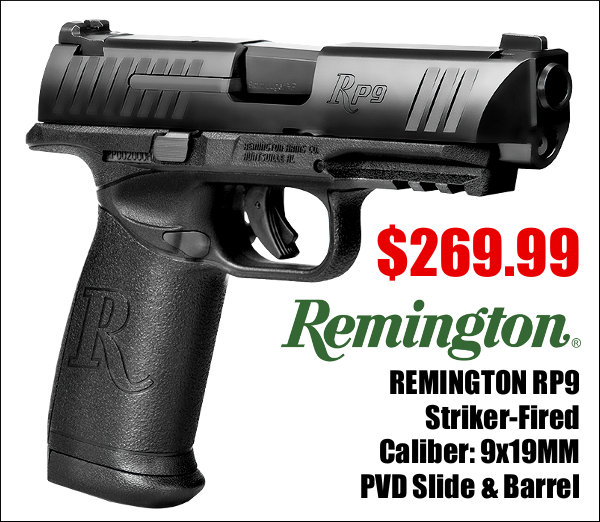
2. Remington RP9, $269.99 (CDNN Sports)
Here’s a great deal on a modern, full-size 9mm pistol. The striker-fired Remington RP9 is similar to Smith & Wesson’s popular M&P9, but we prefer the Remington’s grip, and the RP9 is considerably less expensive. The RP9 comes with three (3) grip inserts and two (2) 18-round magazines. CDNN’s sale price is $269.99. That’s a heck of a bargain for a nicely-designed, American-made pistol. We’ve shot this Remington RP9 pistol and definitely prefer its ergonomics/controls over those of the 9mm Glock 17.
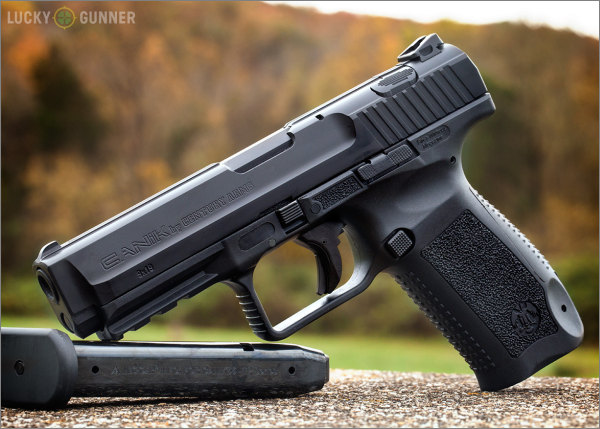
The Canik TP9 SA has been on the market for a couple years now and has really started to find favor, even among Glock fans. This striker-fired pistol has a decent trigger, and for many shooter the frame is more comfortable than the Glock. The Canik ships with polymer holster, interchangeable backstraps, and is backed by a lifetime warranty through Century Arms. If you are not familiar with this pistol, watch a few YouTube reviews. This gun has earned good marks from most testers, many of whom say it’s a better gun than the Glock, for hundreds less. For example in a head-to-head comparison test with the Glock 17, Reload Hawaii declared: “Fit and finish is fine, reliability is great, accuracy is great [plus] you get more stuff with it — I give the edge to the Canik”. Here’s a pretty throrough review including a torture test. The reviewer gave the Canik “two thumbs up”.
4. Kahr CT9 SS, $299.99 (CDNN)
This pistol is an excellent carry gun. Some might call it a “mid-sized” pistol, as it is only 6.5″ overall. The gun is thin and the controls are well recessed so this Kahr is great for discrete carry — it “prints” less than most of the other guns featured here. The striker-fired Kahr has a nice trigger pull. Take-up is pretty long, but the engagement is smooth without the hitches/spikes you feel on a Glock trigger pull. Many shooters find they can shoot the Kahr more accurately that a similar-sized Glock due to the smoother trigger. Shown above is the Kahr CT9 Night Sight version with stainless steel slide. We like the contrasting slide, but this gun is also available with a black Cerakote slide. The Kahr CT9 is on sale now at CDNN Sports for just $299.99.
5. S&W M&P 9mm, $399.99/$324.99 after Rebate (DeGuns.Net)
Just to be honest, the price of this gun is $399.99 but a current S&W rebate can drop the net cost to $324.99. That’s a great deal on a very reliable, accurate full-size 9x19mm pistol — the Smith & Wesson M&P 9mm 2.0. The M&P is a quality gun with good ergonomics. It has been selected by many LEO organizations as their duty pistol. Right now this 9mm pistol is on sale for $399.99. To sweeten the deal, this handgun qualifies for a Smith & Wesson Rebate — either $75.00 or $180 worth of ammo, mags, and mag-loader. Act soon — the Smith & Wesson Rebate offer expires September 30, 2017.
Here’s something we’d like to see gun manufacturers do more often — provide firearms for shooting matches. That can attract new shooters and grow the sport. Providing guns to competitors also helps “level the playing field”, at least when it comes to a “factory class” competition.
In order to encourage participation and promote competitive shooting, GLOCK will bring extra pistols for the inaugural GSSF Camp Perry National Challenge Match. These Glock-supplied handguns can be used by those who don’t own a Glock but who want to compete at Perry. Participants may sign up to fire in multiple relays. Entry fee is $20 for adults and $15 for Juniors.
The guns are free to use, but those who borrow pistols will still need to purchase their own 9×19 mm ammo to fire in the GSSF National Challenge match. Ammo is offered for $15/box from the CMP Store at Camp Perry.
The GSSF Camp Perry National Challenge is not an old-fashioned bullseye pistol match. Notably this match is shot two-handed, similar to an IDPA match. The relays are also “on the clock” — targets are set at distances of 5, 7, 10, 15 and 25 yards — with 10 rounds each in a time limit of 15 seconds. There will be two pistol classes, Stock and Unlimited. The Stock Class is for GLOCK firearms with only those components available from the manufacture (though some modifications are permitted). The Unlimited Class is for Glock firearms with major modifications such as aftermarket barrels, mag funnels, recoil springs, and firing pins. Standard, Fiber optic and express sights are approved in Stock Class, while Unlimited Class allows “any non-post and notch sights including but not limited to, ghost ring or laser, electronic or optical sights”.
In order to promote gun safety, Glock has launched a program to promote the four basic rules of gun handling. Called Follow the Four, Glock’s social media campaign asks shooters nationwide to “take the pledge”, agreeing to follow the Four Rules of gun safety. This year’s #FollowTheFour movement coincides with June National Safety Month and will run from June 1, 2017 through June 30, 2017.
This video with R. Lee ‘Gunny’ Ermey Explains the Safety Campaign
Glock asks those who make the safety pledge to spread the word via Facebook, Twitter, and Instagram with hashtag #FollowTheFour. Those who take the pledge and promote the message via social media will be entered to win a Glock pistol. Visit Glock.com/safetyplege page to take the pledge and learn more about the Glock give-away.
Spread the Word, But Maintain Your Privacy
You don’t have to post an actual photo of yourself to enter the contest. In fact we recommend that you do NOT post a recognizable image of yourself. We advise gun owners to maintain their privacy whenever possible. This is doubly important in states with oppressive firearms regulations such as California. Here are social media posts that do not reveal the poster’s identity.
The CMP has approved a new event for Glock pistols at the 2017 National Matches at Camp Perry. Plastic Pistols at Perry? Traditionalists may scoff, but this is certainly a way to get more (and younger) pistol competitors involved. The first-ever GLOCK Sport Shooting Foundation (GSSF) Match will be held on July 1, 2017 as part of the CMP’s 2017 National Matches. The inaugural Glock Match will be open to both adults and juniors, with two different categories: Stock and Unlimited.
The big news are the prizes — six Glock pistols will be awarded to top Class winners. The Glock Match will be shot on NRA D1 paper targets, with ten (10) rounds each at 5, 7, 10, 15 and 25 yards. NOTE: This is NOT a slow-fire match. According to the CMP press release, competitors will have just 15 seconds for each 10-round string. We hope that’s a misprint — ten shots in 15 seconds makes this a “mag-dump” contest, not a precision match, in our opinion. To compete at the match, shooters must have an active GSSF membership (you can join during match registration at check-in).
There will be two pistol classes, Stock and Unlimited. The Stock Class is for GLOCK firearms with components that are or ever have been available from GLOCK, Inc., though some modifications are permitted. NOTE: Fiber-optic and express sights are approved.
The Unlimited Class is for firearms with major modifications such as aftermarket barrels, mag funnels, recoil springs, and firing pins. Unlimited Class pistols can use “any non-post and notch sights including but not limited to, ghost ring or laser, electronic or optical sights.”
“This match was suggested by Bob Schanen, a valued, long-time GLOCK employee and Camp Perry rifle competitor for 30+ years,” said Brandie Collins, GLOCK public relations and communication manager. “The partnership with CMP in bringing this match to Camp Perry meets our common goals of promoting safe gun handling, marksmanship and introducing people to competitive shooting. Shooters of all skill levels will enjoy shooting this match.”
FBI Photo shows a Glock Model 22, .40 S&W caliber. This will be replaced by new, striker-fired 9mm Luger pistols in both compact and full-size formats.
The Federal Government loves to spend your tax dollars, and the FBI wants its share of the action. The Federal Bureau of Investigation recently issued a Request for Proposal (RFP) for the next generation of 9mm FBI pistols. At stake is $85,000,000 in Federal dollars for handguns, parts, and accessories. CLICK HERE to Download FBI RFP.
The FBI is actually seeking two 9x19mm pistols, one “Compact” and the other “Full-Size”. The pistols must be striker-fired, and capable of a “20,000 round endurance firing cycle”. Trigger pull weight shall be “no less than 4.5 pounds nor exceed 6 pounds”, with NO mag disconnect/safety. There will also be no manual external safety, no grip safety, and no de-cocking lever. Here are the RFP basic descriptions of the pistols:
Class I Compact Pistol: One (1) Class I Pistol with a barrel length of no less than 3.75” and no greater than 4.25”, minimum magazine capacity of 14 rounds, night sights, six (6) magazines, FBI approved gun lock. Firing pin/Striker fired only.
Class II Full Size Pistol: One (1) Class II Pistol with a barrel length of no less than 4.26” and no greater than 5.20”, minimum magazine capacity of 16 rounds, night sights, six (6) magazines, FBI approved gun lock. Firing pin/Striker fired only.
Why Change from .40 SW back to 9x19mm?
Last time we checked the FBI had more than enough firepower. The FBI’s stated need for $85 million dollars worth of 9mm pistols* certainly raises questions, while re-igniting the “great caliber debate”. In May 1997, the FBI officially adopted the Glock .40 S&W pistol for general agent use. Now it is going back to the 9mm Luger (aka 9x19mm), which it had used in Sig P226/228 pistols from 1988 to 1997.
Why make the change? Some people think advancements in propellants and 9mm bullets allow the smaller cartridge to rival the .40 SW for penetration and stopping power. Possibly the FBI learned that many of its agents couldn’t shoot the snappy, harder-recoiling .40 SW very well. So this change to a more user-friendly round may be all about compensating for lawmen who can’t shoot straight.
A report originating at the FBI Training Academy in Quantico, VA may explain why the FBI wants to dump the .40 SW in favor of the 9mm. Here are highlights from the Report’s Executive Summary:
LEOs miss between 70 – 80 percent of the shots fired during a shooting incident.
9mm Luger now offers select projectiles which are, under identical testing conditions, outperforming most of the premium line .40 S&W and .45 Auto projectiles tested by the FBI.
9mm Luger offers higher magazine capacities, less recoil, lower cost (both in ammunition and wear on the weapons) and higher functional reliability rates (in FBI weapons).
The majority of FBI shooters are both FASTER in shot strings fired and more ACCURATE with shooting a 9mm Luger vs shooting a .40 S&W (in similar sized weapons).
There is little to no noticeable difference in the wound tracks between premium line law Auto enforcement projectiles from 9mm Luger through the .45 Auto.
Source: FBI Training Division, FBI Academy (Quantico, VA) Report quoted in LooseRounds.com.
* In addition to the Compact and Full-Size duty pistols, the FBI plans to acquire training pistols and spare parts: “Class I Inert Training Pistol (a.k.a. Red Handle); Class I Man Marker Training Pistol (a.k.a. SIMUNITION); Class I & Class II Pistol Replacement Parts”. The $85,000,000 contract price would include these additional items.
Believe it or not, legendary German gun-maker Walther Arms has never produced a .45 ACP pistol. Until now that is. You see Walther just announced that it will (finally) build a handgun, the .45 ACP PPQ, chambered for the classic .45 ACP cartridge. John Moses Browning would approve.
The striker-fired, polymer-framed .45 ACP PPQ boasts a smooth, 5.6-lb trigger with a 0.4″ normal travel and a 0.1″ reset. The 4.25-inch barrel features polygonal rifling (like HK barrels). Both slide and barrel have a hard Tenifer finish (like Glocks). The new .45 ACP PPQ includes ambidextrous controls, slide serrations, and front Picatinny rail for mounting accessories. The pistol holds 12 rounds and is equipped with three internal safeties. Overall length is 7.4 inches, and width is 1.3 inches.
Walther Arms’ VP of Sales and Marketing, Cyndi Flannigan, states: “This new caliber and product offering is a benchmark for Walther and the PPQ. We have built it to the same exacting German standards that deliver the ultimate home defense and personal protection firearm.” The new M2 .45 ACP PPQ pistol is expected to ship to dealers in early October, 2015.
Meet the new PL-14 9x19mm pistol, also called the “Pistolet Lebedev” (Пистолет Лебедева), after its designer. This new pistol comes from Russian arms-maker Kalashnikov Concern. Notably, it is designed for both sport and war. Two versions will be produced — one for military use, and another for competition. The match version will have a lighter pull-weight trigger. “The versatility of our new pistol allows [use] not only as a military weapon for the military forces and police, but also as a pistol for different shooting competitions,” said Kalashnikov CEO Alexey Krivoruchko.
This new pistol was developed with input from both IPSC shooters and Russian Special Forces (Spetsnaz) soldiers. A lot of smart thinking went into this ergonomic design. We were pleased to see the ultra-low bore axis and a grip that does NOT copy the worst features of the Glock design. Fully loaded, the PL-14 weighs 1 kg (2.2 lbs). The PL-14 prototype frame is aluminum. We’re informed that the production military version will have a polymer frame.
Hoping to impress consumers (and possibly secure a major military contract or two), Beretta has introduced the APX, a new striker-fired 9mm handgun. The APX borrows elements from the Glock, HK VP9, and S&W M&P pistols. The grip looks very ergonomic, with an extended rear overhang on the top (like the M&P) and contoured grooves on the front (like the VP9). The most distinctive feature of the new Beretta would be the prominent machined ridges on the slide designed to aid in racking the pistol.
The APX is built with a chassis system. This means that the internal sub-frame is the serialized part. The new APX features a reversible, ambidextrous magazine release. The magazines themselves have a prominent plate on the bottom for easier insertion/extraction. To better fit various hand sizes, three different backstrap inserts can be fitted to the grip.
Beretta hopes many of the world’s armies will adopt this new pistol, which was released at IDEX (International Defense Exhibition & Conference) in late February. According to Gear Scout:
“The pistol is designed specifically for the military market, and Beretta says it’s destined to become the company’s entry into the Army’s Modular Handgun System. But, the Army has yet to release the final requirements for that program to industry. The US Army contract might be the gold rush of pistol contracts, but it’s not the only tender happening at the moment. No doubt, getting the APX out at IDEX was a way to show worldwide (and cash-flush Middle East) defense ministers the major features of the pistol while the company finishes up development on the US military/LE and eventual commercial configurations that will hit the US market soon.”
While at SHOT Show, I visited nearly all the major pistol manufacturers, and tried out their latest polymer-framed, striker-fired pistols. To my dismay, these pistols (from a half-dozen different makers), all had one thing in common — really unpleasant triggers. The triggers were mushy, “sproingy” (my term), with a heavy (and sometimes rough) “stagey” pull that was not consistent through the pull cycle. Trying one gun after another, my reaction was always: “Yep, another awful trigger”. Most of the striker-fired guns also had a sloppy slide to frame fit, so they clanked around as they cycled. I’m sure they would function reliably, but I felt I was sampling staple guns, not fine firearms.
In Search of A Better Trigger
Disheartened, I left the main exhibit hall and descended to level one. There, like a beacon, I saw the STI logo, and ranks of metal-framed, hammer-fired pistols. I picked one up. I worked the slide — it operated oh-so-smoothly, like it was on ball bearings. The grip safety functioned perfectly when I wrapped my hand on the grip — no conscious pressure was required and I didn’t feel an uncomfortable bump in the web of my hand. The safety just did its job effortlessly.
I asked an STI rep if I could dry-fire the pistol. “Go right ahead” he said. The first thing I noticed was that the take-up was smooth — butter smooth. There was no grittiness, and the take-up pull was constant. When you got to the break point, resistance increased, and at just about 3 pounds of pressure, the hammer fell with a precise release. No staginess (rising/falling pull weight), no “sproingy” feel (like a cheap coil spring compressing and then snapping), just even pressure and “click” the hammer falls. This was trigger heaven, compared to striker-fired trigger hell.
As I was at the STI booth, a young fellow came up next to me. I noticed, from his name badge, that he was from Austria, home of the Glock. He said “You know I have had Glocks for years. Then one day I said ‘Why am I doing this to myself, why am I putting up with this?’. The triggers are scheiße — I can’t stand them, and the grip shape is wrong. So I sold my Glocks and bought one of these [an STI] and now I am very happy.” He held up an STI and said “Now this is how a pistol should be made!” I smiled and said, “Isn’t it ironic that it has been more than 100 years since John Moses Browning invented the 1911, and his design still works so well?”
Here are two of the STI Pistols on display at SHOT Show. They are both built to very high quality standards, and they both have smooth-running slides and crisp, near-perfect triggers.
STI Target Master
The Target Master is built on STI’s 1911 Government-length frame with 30 lpi checkering on the front strap. The safety controls are STI ambidextrous thumb safeties and STI high rise, knuckle-relief beavertail grip safety. The 6″ slide features a lowered and flared ejection port, tri-level adjustable sights, and STI front and rear cocking serrations. The barrel is a 6.0″, fully-supported and ramped bull barrel. The Target Master comes standard with a STI two-piece steel guide rod, Commander-style hammer and patented STI Int’l trigger system. The STI Target Master ships with one 1911 Magazine.
STI International Edge
Integrating patented 2011 technology with classic 1911 design, the STI International Edge is a high capacity pistol that carries John Browning’s design into the 21st Century. Since its introduction in late 1997, the STI Edge has become the standard for USPSA/IPSC Limited Division competition. Built on the STI Modular Steel 2011® frame with polymer grip, the Edge delivers the traditional features of a 1911 with the benefit of high capacity magazines. The Edge frame preserves the 17° grip angle (like the original 1911). The design allows for double stack magazines without over-sizing the circumference of the grip.
Along with its distinctive full-length dust-cover frame, the STI Edge features traditional front and rear cocking serrations. The Edge comes standard with a stainless, high-rise, knuckle-relief grip safety, stainless ambi-thumb safeties, and a stainless, fully-supported and ramped bull barrel. The Edge ships with one 126mm magazine.




 FBI Photo shows a Glock Model 22, .40 S&W caliber. This will be replaced by new, striker-fired 9mm Luger pistols in both compact and full-size formats.


 In Search of A Better Trigger


