|
|
August 14th, 2012
Breaking News from Camp Perry – Based on preliminary score tabulations, David Luckman of Great Britain is the 2012 NRA National Long Range Champion. Luckman finished with a 1246-74X.
 As reported on NRABlog.com, Luckman topped a very competitive field, with a strong final day showing: “After a practically perfect performance in today’s Palma Individual Trophy Match (449-31X), it appears that David Luckman of the Great Britain Rifle Team will be crowned tonight as the NRA’s 2012 Long Range High Power Rifle Champion. A veteran of the International Long Range Rifle world, Luckman’s list of accolades includes the 2010 World Individual Long Range Rifle title as well as seventeen consecutive UK Grand Aggregate crosses.” As reported on NRABlog.com, Luckman topped a very competitive field, with a strong final day showing: “After a practically perfect performance in today’s Palma Individual Trophy Match (449-31X), it appears that David Luckman of the Great Britain Rifle Team will be crowned tonight as the NRA’s 2012 Long Range High Power Rifle Champion. A veteran of the International Long Range Rifle world, Luckman’s list of accolades includes the 2010 World Individual Long Range Rifle title as well as seventeen consecutive UK Grand Aggregate crosses.”
David started shooting with Sedgemoor Target Shooting Club. He became an Atheling in 1994 and has since toured with the GB team to Canada, the USA, South Africa, Zimbabwe, Australia, New Zealand and Malaysia. A truly great marksman, in 2010 Luckman shot 4 international matches in four consecutive days (National, Kolapore, Mackinnon and Australia) without dropping a single point.
David works for Clerical Medical in Bristol as an Actuary. In his spare time he is an avid sports player and qualified tennis coach. He competes in triathlons and half marathons as well as enjoying mountain biking, surfing, swimming and other sports.
August 3rd, 2012
 25-year-old Peter Wilson of Great Britain earned the gold medal in front of the home country shooting a 188 out of 200. He is now Britain’s first shooting medalist since Richard Faulds won gold in the same event in Sydney 12 years ago. Sweden’s Hakan Dahlby finished second while Russian Vasily Mosin won bronze after a shoot-off with Kuwaiti Fehaid Aldeehani. 25-year-old Peter Wilson of Great Britain earned the gold medal in front of the home country shooting a 188 out of 200. He is now Britain’s first shooting medalist since Richard Faulds won gold in the same event in Sydney 12 years ago. Sweden’s Hakan Dahlby finished second while Russian Vasily Mosin won bronze after a shoot-off with Kuwaiti Fehaid Aldeehani.
CLICK HERE for more photos of Peter Wilson
Though not well-known in North America, Wilson is a world-record-holder who was one of the favorites heading into the event. In Tucson (AZ) earlier this year, at the ISSF World Cup, Wilson set a new world record, hitting 198 out of 200. Peter, a farmer’s son from Dorset, was the youngest Olympic Double Trap finalist by 13 years and only started shooting at school following a sporting accident which prevented him from playing cricket and squash. He left school a National Shooting Champion and was ranked world No.1 earlier this year before the Double Trap Olympic final.
Practice Makes Perfect
In an interview with The Telegraph, Wilson revealed: “I shoot at 80,000 targets a year. That’s what you do, get the movements ingrained, so when you’re faced with two targets to go in an Olympic final, you’re completely comfortable about what you have to do.”
During his rise to the top, Wilson got a little help from the 2004 Olympic Double Trap Gold Medalist, Ahmad Mohammad Hasher Al Maktoum, a member of the Dubai royal family. After Wilson’s support funding from UK Sport was cut in 2008, the Dubai Royal stepped in to help, providing free coaching help for the young Brit. As the result of budget-cutting by UK Sport, Wilson lost his training stipend. Somehow he had to come up with £10,000 a year to cover his shooting expenses. He tried to work in a pub as a barman, but found that the night shifts conflicted with his shooting practice. His parents instead funded him for a year while he tried to secure further funding. He has also raised funds, along with the rest of the British shooting team, by running fundraising events.
Watch Peter Wilson Video Interview from London
April 1st, 2012
 Because of draconian restrictions on handguns in the United Kingdom, Olympic smallbore pistol shooters from the UK have been forced to conduct their training in neighboring countries, such as Belgium and France. Obviously, the need to travel overseas to practice their sport has been a major handicap for UK shooters who will compete with Team GB* at the upcoming London Olympics. Said one smallbore pistol shooter: “Our goal is to win a medal for mother England, the 2012 host nation. But it is hard to compete on a world-class level when we can’t even train at home. Going overseas every time we need to practice wastes precious time and money. Other Olympic shooters don’t face these kind of obstacles.” Because of draconian restrictions on handguns in the United Kingdom, Olympic smallbore pistol shooters from the UK have been forced to conduct their training in neighboring countries, such as Belgium and France. Obviously, the need to travel overseas to practice their sport has been a major handicap for UK shooters who will compete with Team GB* at the upcoming London Olympics. Said one smallbore pistol shooter: “Our goal is to win a medal for mother England, the 2012 host nation. But it is hard to compete on a world-class level when we can’t even train at home. Going overseas every time we need to practice wastes precious time and money. Other Olympic shooters don’t face these kind of obstacles.”
 With the 2012 London Olympics soon approaching, UK Olympic officials have been looking at ways that Team GB pistol shooters can avoid the need to travel abroad just to practice shooting. Now, through a special act of Parliament, it appears that UK Olympic pistol shooters may finally be able to hone their marksmanship skills at home. A new law will allow qualified Olympic-level pistol shooters on Team Great Britain to import a new, non-lethal training device recently introduced in the United States. With the aid of the American-made Trigger Trainer, UK Olympic shooters can now practice their trigger-pulling skills without risking a trip to prison. The Trigger-Trainer is a plastic device with a pistol grip, and spring-loaded “trigger”. However, it is incapable of firing a projectile because it lacks a barrel, magazine, firing pin, and sights. With the 2012 London Olympics soon approaching, UK Olympic officials have been looking at ways that Team GB pistol shooters can avoid the need to travel abroad just to practice shooting. Now, through a special act of Parliament, it appears that UK Olympic pistol shooters may finally be able to hone their marksmanship skills at home. A new law will allow qualified Olympic-level pistol shooters on Team Great Britain to import a new, non-lethal training device recently introduced in the United States. With the aid of the American-made Trigger Trainer, UK Olympic shooters can now practice their trigger-pulling skills without risking a trip to prison. The Trigger-Trainer is a plastic device with a pistol grip, and spring-loaded “trigger”. However, it is incapable of firing a projectile because it lacks a barrel, magazine, firing pin, and sights.

Some of Team GB’s shooters have expressed doubts about the usefulness of the rather primitive Trigger Trainer. (As it lacks front and rear sights, the Trigger Trainer is difficult to align precisely on the target). But top British Olympic decision-makers believe that the shooters’ complaints are unjustified. British Olympic Association official Nigel Wensleydale observed: “Complaints? That’s just idle whinging if you ask me… nothing’s perfect you know. Perhaps the Trigger Trainers do leave something to be desired as they come out of the box. But our Olympic shooters are clever lads. I think, with a little imagination and some sticky tape, these Trigger Trainers will be tip-top. Goodness, you could simply tape a drinking straw on top and sight through that. I mean how much precision do these chaps really need — the target’s only 10m away for goodness sake.”

*Great Britain is the name under which the United Kingdom of Great Britain and Northern Ireland competes at the Olympic Games. Great Britain was one of 14 teams to compete in the first Games, the 1896 Summer Olympics, and has competed at every Games. Great Britain is the only team to have won at least one gold medal at every Summer Games.
October 22nd, 2011
 It’s Sunday, October 22nd in Australia, on the other side of the International Dateline. That means that the World Long Range Rifle Championships (WLRC) has concluded. The last major event was the Palma Cup Match, the most prestigious event in full-bore competition. The 2011 Palma Match has been completed with Team Great Britain the clear winner with a total Aggregate of 7027-651V. That’s 35 points ahead of South Africa which took second with a score of 6992-651V. (Interestingly had exactly the same V-count, for Center hits). Team USA captured the Bronze Medal, finishing third with a total of 6980-655. It’s Sunday, October 22nd in Australia, on the other side of the International Dateline. That means that the World Long Range Rifle Championships (WLRC) has concluded. The last major event was the Palma Cup Match, the most prestigious event in full-bore competition. The 2011 Palma Match has been completed with Team Great Britain the clear winner with a total Aggregate of 7027-651V. That’s 35 points ahead of South Africa which took second with a score of 6992-651V. (Interestingly had exactly the same V-count, for Center hits). Team USA captured the Bronze Medal, finishing third with a total of 6980-655.

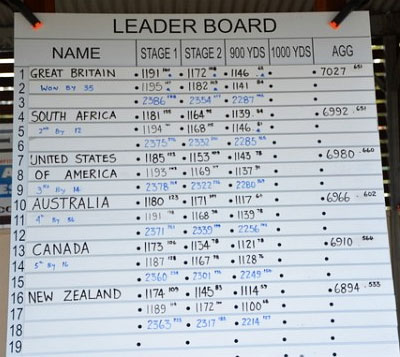 Yanks Finish Third Yanks Finish Third
Our friend Kelly Bachand, one of the Team USA Palma shooters, reports: “I’m a very proud member of the 2011 bronze medal winning USA Palma Team! There was very, very stiff competition and the conditions on the range tested our coaches and shooters thoroughly. After two long days of shooting we found ourselves bested by Great Britain and South Africa. While we did not win gold, this was still a tremendous accomplishment for our team, and I was very proud to shoot alongside the best rifle shooters in our country and from around the world.”
Link for Match Results
Preliminary results for the Palma Team Match and all the 2011 World Championships events are available online. For results for both individual and team events, visit the WLRC Results Page.
May 23rd, 2011
At a recent Great Britain F-Class Association Match at the Blair Atholl Glen Tilt range, AccurateShooter Forum member Laurie Holland shot a 96-9V for twenty shots, tying the British F-TR single match record. Laurie accomplished that feat with a Savage-actioned .223 Remington. Laurie proved that the little .223 Rem can be competitive, even at 1000 yards. The Blair Atholl range, 1,000′ ASL in the southern Scottish Highlands, has been described by a top international rifle coach as ‘the world’s second most difficult range for wind’ (behind Trentham in New Zealand). Many British F-Class shooters were therefore surprised when Laurie Holland took his Savage-based .223 Rem F/TR rifle to the range earlier this month to compete in the season’s second GB F-Class Association league round. The event consisted of five, 1000-yard matches over a weekend (three 15-round stages on the Saturday, and two 20-round matches on Sunday). Forty-eight registered GB FCA shooters turned up, split 50/50 between F-Open and F-TR categories.
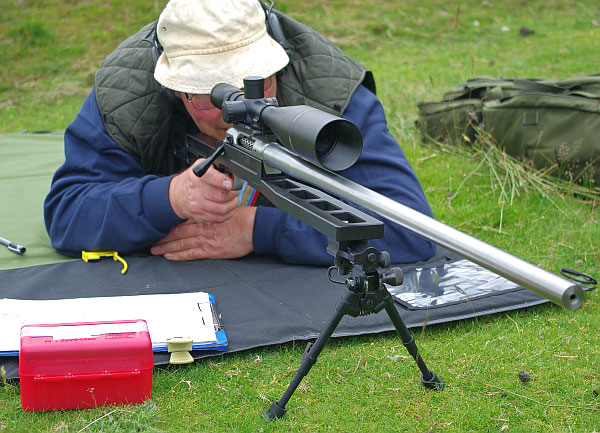
Though heavy rains were expected, Saturday was dry. However, the predominately 5 o’clock wind grew progressively stronger throughout the day, swinging through 20 or 30° with irregular gusts and lulls. With the range situated on a steep and uneven valley-side, wind changes affect elevation markedly in addition to the usual lateral movements. A gust can send the bullet high and left, while a lull moves POI low and right.

After Matches 1 and 2 Laurie was at the bottom end of the top 10 shooters in the class, but he surged to the lead in the day’s final match that saw the most difficult wind conditions. Laurie’s 66-2V score topped second place Adam Bagnall (reigning GB F-TR league champion) by seven points, and was also better than many F-Open scores. Laurie and his .223 were now tied (on points) with F-TR world champion Russell Simmonds for the overnight lead. Both had 183 points but Laurie was leading by five V-Bulls to one. As chance would have it, Russell and Laurie had been squadded to shoot together on the second detail of Sunday morning’s 20-round Match 4. NOTE: Brits employ a different system for F-Class targets. Target Rings have a 1 through 5 value, with a “V” (rather than “X”) for a dead-center hit. The maximum score possible on a twenty-round match would be 100-20V.

Laurie used the Savage successfully in the 2010 F Class European Championship meeting seen here shooting for GB in the second placed GB F/TR ‘Blue’ Team.
What followed was a classic two-man duel. Laurie explains: “While the F-Open boys on the first detail were still shooting, we had a short but violent rainstorm that really spoiled their day, this finishing just as they took their last shots. As the rain cleared, the wind apparently died too, the flags hanging limp, so we didn’t delay getting set up to take maximum advantage of the conditions. Russell and I both found the Bull / V-Bull on shot 1. Russell drilled five consecutive Vs, while I had two Bulls and three Vs. I began to think I might just hold Russell on points, but he’d hammer me on V-count. We started to find something was moving the bullets about, but there was no way of reading this on the sodden flags or even by the sway of the tops of some tall silver birch trees near the firing point, these usually proving very sensitive. It was a case of watching the plot develop, use intuition, and watch where Russell’s shot went before I took mine. (Remember, we have two competitors to each target taking shots alternately — no string shooting in the UK.)

Kongsberg electronic scoring monitor. This system gives near instant shot marking and lets spectators watch competitors’ performance in real time.
Crowd Watches Two-Man Duel — Laurie Ties Record in Match 4
With the Kongsberg electronic scoring machines, a flashing circle on the target shows the most recent shot, with its numerical Ring Value on the right side of the screen. All of our Fours came up as 4.9s, just leaking out! I was very reluctant to touch the scope knobs knowing just how easily a quarter-MOA ‘click’ can overdo the correction in these conditions and increasingly aimed low and left as the match progressed. As we reached the end we guessed our scores must be close, and amazingly I was getting more Vs now than Russell and his .308. However, neither of us knew we were tied on shot 19, both having dropped four points, and scored eight Vs, so the last shot would be crucial. Russell told me afterwards he sensed the wind had maybe picked up marginally, briefly considered aiming off a little further left, but decided to stick with his previous aim that had given him a ‘V’ – crack, 4.9 at 3 o’clock! My shot 19 had been a Four in exactly the same spot and I eased the Sightron’s reticle dot over to the bottom left corner of the Bull ring – crack, V.0 at six o’ clock for 96.9v total. Just to our right, Adam Bagnall had also shot 96, but with eight Vs, so I won the match and equaled John Cross’s GB F/TR record 20-round 1,000-yard score shot last summer. This increased my overall lead to 1 point. As the shooting concluded, we heard a rising murmur behind and turned to discover we had a substantial audience, mostly of ‘Open’ competitors, who’d been following our progress — electronic scoring not only gives an instant result, but makes shooting a spectator sport!
I’d like to say the fairy tale had a happy ending, but I blew my lead in the final four shots of the final match and ended up fourth in F-TR class, Russell taking the top spot. So, the .223 Rem will have to wait a little longer to get its first GB F-TR league round win.”
Despite faltering in the last match, Laurie still earned two stage medals and posted the highest F-TR V-count (15) in what had been a low scoring weekend. Laurie’s impressive performance with a .223 Rem now has many people reconsidering the Mouse Gun cartridge’s utility in British long-range F-TR competition.
December 4th, 2010
These photos show actual product restriction notices at stores in the UK. The bright red toy ray-gun can only be sold to adults. The sign reads: “This product is restricted…. To protect our younger customers, you have to be over 18 to buy imitation firearms.”

Steak Knives — For Adults Only
If that wasn’t bad enough, check out this sign next to a set of flatware for the dinner table: “Sale of Knives & Bladed Articles — The sale of these products is governed by the Offensive Weapons Act 1996 (as Amended by the Violent Reduction Act 2006). It is a criminal offence to sell these products to any person under the age of 18 years.”

What’s next, restricting those under 18 to soft foods they can eat with a spoon? How did things ever become this absurd? What would Winston Churchill say about the rampant “Nannyism” in today’s UK?
One of the greatest delusions in the world is the hope that the evils in this world are to be cured by legislation. — Thomas Reed
|
Editor’s Comment — Yes this is Real
We were skeptical about the knife ban, until we located the House of Commons Legislation Report. As originally passed in 1988, the knife-purchase age limit was 16 years, but, according to the report: “Section 43 [of the Violent Crime Reduction Act 2006] amends section 141A(1) of the Criminal Justice Act 1988 under which it is currently an offence to sell a knife or an article with a blade or point to a person under the age of 16 years. Section 43 increases that age to 18″.
Apparently not all Britain’s politicians are spineless idiots. During the debate on the 2006 Amendment (raising the age limit on knife sales), M.P. Mark Oaten stated:
“It is difficult to see how the proposed age limit for knives can work. The bill will land us in the ridiculous situation where a 16- and a 17-year-old can get married and set up home on their own, but can’t buy a kitchen knife”.
August 10th, 2010
Report by Laurie Holland
Blair Atholl’s Glen Tilt range in the Scottish Highlands has a worldwide reputation for being difficult thanks to constantly-varying winds influenced by the venue’s steep, irregularly-contoured terrain. Nevertheless, three new GB F-Class Association League 1,000-yard competition records were set at Glen Tilt over the weekend of August 7th and 8th. The new records were shot in Round 5 of the F-Class Association’s championship program. The event comprised five matches, three on Saturday with 20 score shots and two on Sunday with 15 for a maximum possible score of 450-90V. (UK and British Commonwealth targets score five for the Bull). Targets were the usual international F-Class design, a modified Palma type with a half-MOA white aiming mark that also scores as the ‘V’ (‘X’ in American terminology), one-MOA bull and score rings spaced a half-MOA apart.
Looking downrange at magnificent but fiendishly difficult Blair Atholl range in Perthshire, Scotland.
 
New 1K Records in F-Open and F-TR
In Match 1, John Carmichael of HPS-Target Rifles Ltd. used one of his own creations to shoot a 100-6V. A new record, this was the first-ever 1,000-yard, 20-shot match F-Open ‘possible’. John Cross almost immediately followed with a new F-TR record score of 96-3V, just edging Spanish F-Class competitor Ramon Fito. In the photo below, John Carmichael plots another Bull or V while shooting a record 1,000-yard score, with his RPA / HPS-TR System Gemini 7mmWSM rifle.

Sunday morning initially saw unusually light winds which no doubt helped Osprey Rifles proprietor Stuart Anselm set a new 15-shot, 1,000-yard F-TR record score of 75-4V in Match 4, using a rifle he had built himself on a Savage 12 Target action (photo below).

British F-Class competitive standards continue to rise in both classes, perhaps more markedly in F-TR which is seeing very sharp competition in 2010 as well as increased numbers of entrants. The overall winners were Peter Hunt (439-17V) in F-Open, and Stuart Anselm (424-12V) in F-TR. Blair Atholl also saw the first use of a .223 Rem caliber F-TR rifle in a 1,000-yard GB national league event with Laurie Holland taking seventh with 412-11V using 90gr Berger VLDs.
|


