Larry Scott, who runs GreatScottShooters.com, has a friend, Ray Mabry, who is a very talented wood-worker and carver. Ray does master-grade decorative work and checkering on gunstocks, and he also carves realistic nature subjects from wood. Larry says: “If you need stock checkering/carving or any wildlife creation, check out a friend of mine, Ray Mabry. His finished products are superb.”
Ray Mabry recently joined the AccurateShooter Forum, and you can see many fine examples of his work in this FORUM Thread. Ray tells us: “I do this work as a hobby. I do checkering and relief-carving on rifles. I also carve out of solid tupelo and bass blocks of wood. Along with rifle stock work, I carve wildlife subjects — I’ve carved eagles, owls, quail, ducks, and even prairie dogs. If you have a project in mind, call me at 270-885-6066 or send email to: rayzr [at] twc.com.”
Looking for a high-quality fiberglass stock at a bargain price? Then check out the Kelbly over-run stocks at PMA Tool. You’ll find a wide variety of stocks on sale at extremely attractive prices (from $200 to $350.00). There are 3″-wide benchrest and F-Class stocks, Hunter Class benchrest stocks, and a variety of general-purpose hunting and varmint stocks. Most of the benchrest stocks are priced at $300.00 to $350.00 — that’s hundreds less than you’d ordinarily pay for a first-tier fiberglass stock from McMillan or other big name manufacturer.
And price isn’t the only attraction. With these Kelbly over-run stocks, there is no waiting. PMA Tool can ship you out a stock in a matter of days. By contrast, you might wait months to get a newly-made stock from another maker. PMA Tool has acquired dozens of Kelbly stocks so there is a large selection. If you go to the PMA website, you can select from three categories of stocks. Then choose a stock that has the appropriate inlet for your action. Some of the over-run stocks are inletted for Pandas, others for BATs, and some for other round actions.
The National Benchrest Shooters Association (NBRSA) has adopted new rules, loosening restrictions on the Sporter Class of benchrest rifles. Now a Sporter fore-arm may be any width (or angle), and the underside of the buttstock can have any angle. Previously, fore-arm width was limited to three inches, and the bottom of the buttstock had to be angled up. (NBRSA Rules will continue to require this “up-angle” geometry for all Light Varmint (LV) and Heavy Varmint (HV) rifles). In addition, the NBRSA opened the Sporter Class to any caliber “no larger than .308 Winchester”.
The idea behind these changes is to allow greater innovation in at least one class of benchrest bag guns, and to avoid “redundancy”. Currently a 10.5-lb Light Varmint can be shot as a Sporter, so long as the LV complies with caliber rules. For practical purposes, that meant Sporter Class was redundant with the Light Varmint Class, and there was no real reason for the Sporter Class to exist anymore.
The Sporter weight limit remains unchanged at 10.5 pounds (including optics). All current LV and Sporter rifles will remain 100% legal under the new rule, so no one is forced to go out and build a new rifle to shoot in Sporter class. But if you want to try a more radical stock design, now you have the opportunity to do so. Here is the text of the new rule:
NBRSA Rule Book (New Sporter Rule)
B. Definitions: 2. Equipment (d) Sporter Rifle
A Sporter Rifle is defined as any rifle having a safe manually and mechanically operated firing Mechanism and must not weigh more than 10.5 lbs, inclusive of sights. The stock can be flat, or convex, but not concave. The Forearm can be any width and have any angle. The butt stock can have any angle including a reverse angle, the barrel shall not be less that 18″ long forward of the bolt face and can be any diameter or configuration including a straight taper or a reverse taper. The Sporter Rifle can be no larger than .308 Winchester. Sporter Rifles do not have to conform to the Varmint Rifles diagram. All sand bag rules apply to the Sporter Rifle.
Bukys Explains the Thinking Behind the Sporter Rule Change
On Benchrest Central, leading benchrest shooter Gene Bukys discussed the new NBRSA Sporter Rule Changes: “[This] does not create a new rifle or an experimental class — it simply removes most of the restrictive rules from the existing Sporter class. Every existing LV rifle and every existing Sporter Rifle in this whole world is still legal, and competitive, under these changes.
My purpose in all of this is to make the Sporter class, and the LV rifle, no longer redundant classes, and to have a class where we can have some innovation in Benchrest. If there is a better stock configuration out there or a better barrel profile shouldn’t we benchrest shooters be the leading edge of this innovation? Benchrest used to be the leading edge of virtually all accuracy innovation. I’m not sure if that’s true anymore. I would like that to be… true again.
For right now, I don’t see this as making any huge radical changes to benchrest, but given time and a venue to work in (Sporter Class) there may be some really meaningful innovation that comes about. Let’s have some fun with this.”
Gene Bukys Commissions New Convertible Sporter/LV Stock by Bob Scoville
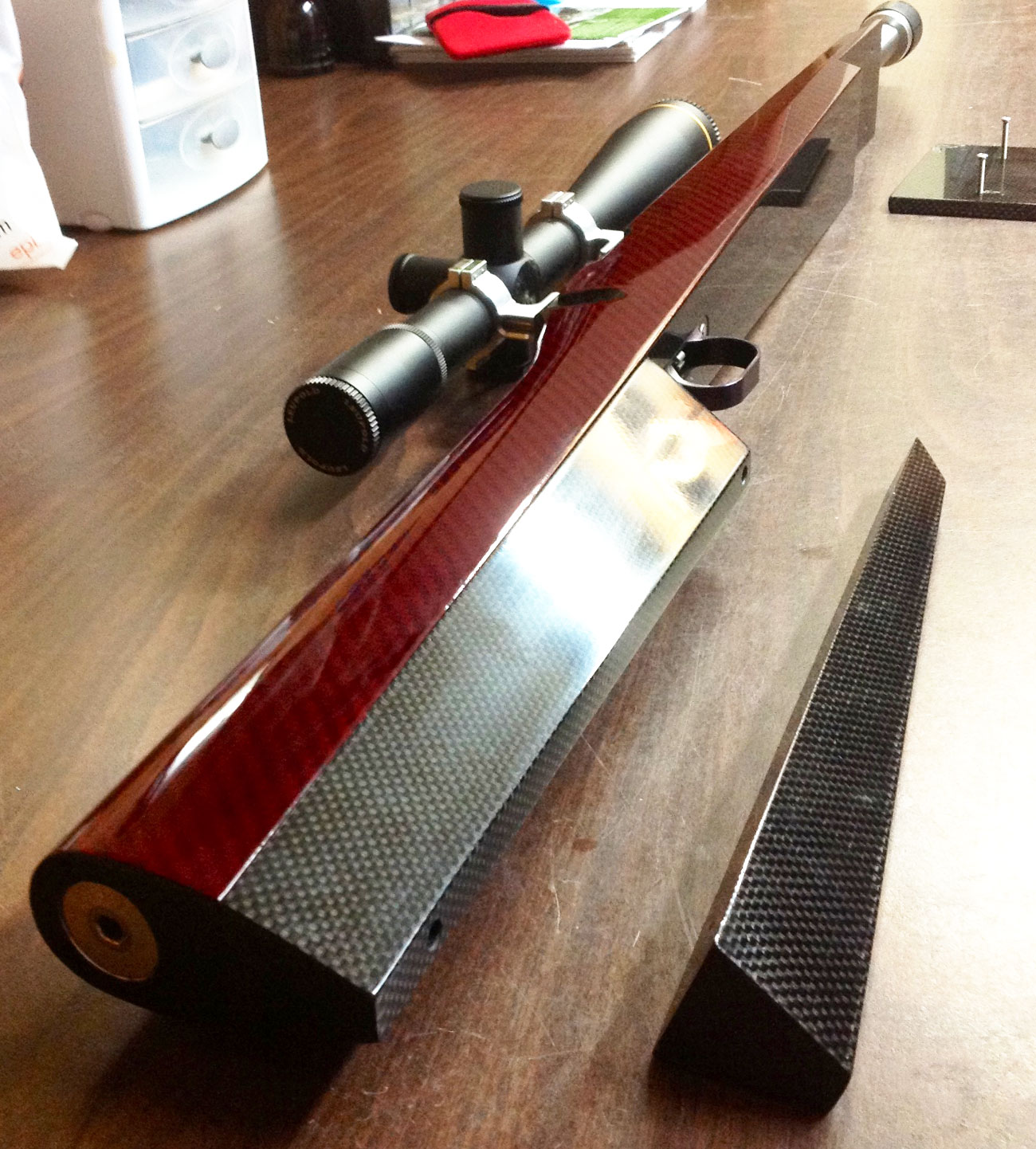
Under the new NBRSA Sporter standards, stock designers/fabricators can now experiment with a wider variety of stock shapes and geometry. Gene Bukys commissioned a new stock from Bob Scoville that shows what can be done under the new liberalized Sporter stock rules.
Gene’s latest NBRSA Sporter rifle features a stepped forearm that can fit a 5-inch wide bag rider plate. In the rear, this stock can run different size/shape “keels” (buttstock underbellies). The larger keel, shown attached in the photos, exhibits the flatter angle now allowed under the new NBRSA Sporter rule. (In fact, this keel may have a slight reverse angle, i.e. lower in the front than in the back). At any time, this Scoville stock can be switched back to a 100%-legal Light Varmint configuration by: 1) removing the 5″ front bag-rider plate; and 2) changing to the smaller, up-angled rear keel piece.
Some folks think of laminated stocks as modestly-priced, “low-tech” alternatives for varmint and hunting rifles. In fact, for shooting disciplines that do not demand ultra-light weight, good laminated stocks give up nothing in performance to the most sophisticated composite stocks. And with laminates, it is relatively easy to fine-tune fit and ergonomics to suit the individual shooter. Available in a wide choice of colors, laminated stocks can also be very handsome.
Need a rugged, durable stock for your Ruger 10/22? EABCO (E. Arthur Brown Company) has you covered. EABCO is offering a limited quantity of Fajen Composite 10/22 Stocks for just $49.00. EABCO tells us: “We bought out the last 24 of these, so get them while you can.” These are new-in-box, non-warping composite target stocks finished in black, with checkering on the grip and fore-end. Sling swivel studs, and rubber buttpad are installed. The stocks, sized for adults, are drop-in fits for your Ruger 10/22. There is enough clearance in the barrel channel to handle .920″-diameter heavy contour target barrels. If you are interested, call EABCO at 800-950-9088. The super-low $49.00 price is available via phone orders only.
Product tip from EdLongrange. We welcome reader submissions
If you have a match, hunting, or tactical rifle that needs a little more “stiction” in the grip or fore-arm areas, particularly in wet or humid conditions, consider adding a non-slip coating to the stock. This is easily done with inexpensive materials. R+D Precision has a simple do-it-yourself procedure for adding texture to your stock. Be forewarned — this is basically a permanent addition to your stock, so you might want to practice first. Also the application of the bedding compound will change the color of the stock, so you may want to re-finish the stock.
Marking the Area to Texture with Steel-Bed or Similar Material
Tape off the area you want to put the texture. Spread a very thin coat of the Steel-Bed on the stock, just enough to cover the area. This can be done using Marine-Tex or Steel-Bed. Other products could be used but Steel-Bed is proven, and it’s what R+D prefers for the job.
Best Method for Applying Texture
Here is the secret to adding texture: Using the tongue depressor that is in the kit or something similar, BOUNCE the flat part of the stick on the still-wet bedding to get the textured effect. Once the bedding has dried for about an hour, and still kind of tacky, remove the tape, pulling at a sharp angle to leave a nice sharp edge. If the bedding has a sharp raised area where the tape was, wet your finger and rub along the edge and it will knock off the edge but still give that nice sharp transition.
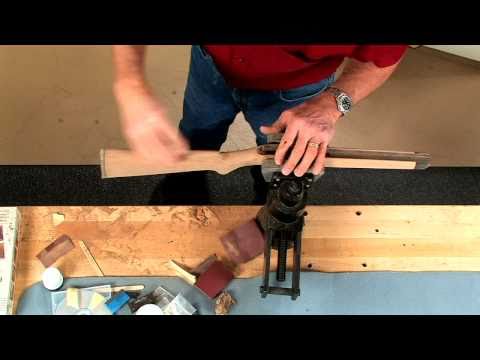
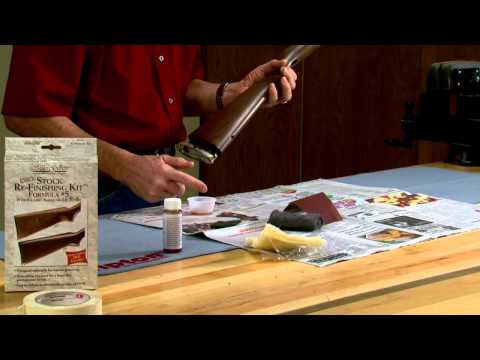
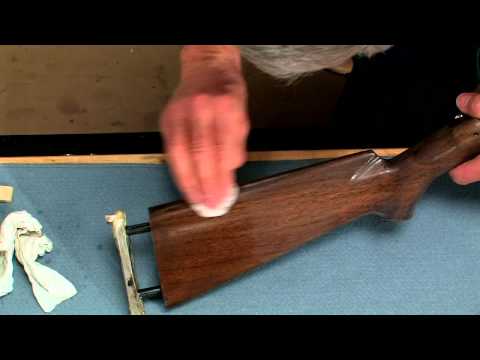
In a series of YouTube videos, Larry Potterfield of MidwayUSA shows how to prepare, finish, and polish a wood gunstock. The first video covers sanding, sealing, and filling. The second video shows how to apply a multi-coat finish by hand, with light sanding between coats. In the third video, Larry applies a final polish to his project stock. The principles illustrated in these videos can be applied to most types of stocks. However, keep in mind that Larry is working with a hardwood stock.
By contrast, with a typical Rutland laminated stock, the finishing process is somewhat different and (usually) more time consuming. You’ll probably have to do more aggressive sanding, and the sealing process can be more time-consuming because laminates typically have very porous surfaces that soak up a lot of sealant. You may have to do multiple sealant passes with aggressive sanding in-between. Alternatively, you can use multiple coats of high-solids clear coat to fill the pores.
How to Prepare a Riflestock for Finishing
How to Apply a Multi-Coat Finish
How to Polish the Finish on a Riflestock
Clear-Coating Your Stock
While you can put an oil-type finish on a Rutland laminate, we think these often look best finished with an automotive clear coat. Rub-on finishes can cause small changes in stock coloration. If you want to preserve the colors in your laminated stock, a quality, spray-on clear-coat is probably the best way to go. CLICK HERE for expert tips on how to prep and clear-coat a laminated stock.
John Whidden, multi-time NRA Long-Range Champion, runs a stock-building enterprise, Whidden Composite Works. This is a sister operation to Whidden Gunworks, which crafts V-Blocks and other specialized gun components and reloading tools. John Whidden’s stock-making business, the Composite Works, is producing a series of high-quality, V-Block-equipped stocks using state-of-the-art composite construction. The first two stock designs, the models 105 and 140, are general-purpose stocks that will work for everything from Elk hunting to tactical comps. Both models are currently available in multiple color choices: Desert Sand, Forest Green, Flecked Black, Silver, and Custom Mix. Other colors may be offered in the future.
The Whidden Composites model 105 has a familiar hunting rifle profile. The model 140 is designed as a hunting stock incorporating tactical features for shooters who prefer a more vertical strong-hand grip. Both include the Whidden V-Block (in configurations for right-handed short and long actions based on the Rem 700 bolt pattern), three installed sling studs, and a Pachmayr® Decelerator pad.
Model 105 Offers Hunters a Familiar Design with Enhanced Rigidity and V-Block
The Whidden 105, priced at $360.00, is shaped along the lines of a classic North American hunting rifle. But under the skin it is a greatly enhanced platform. Solid-core construction gives a solid feel that is often absent on lesser synthetic/plastic stocks. The V-Block system is integrated, the composites used increase stiffness, and the material is impervious to weather. The V-Block system allows the owner to easily use multiple barreled actions in the same stock.
Model 140 Provides Improved Ergonomics for Prone and Tactical Shooters
The Whidden 140 offers the ergonomic advantages of a vertical grip and raised comb for eye-scope-target (EST) alignment. For many shooters, the vertical grip feels more natural in prone position, and allows a very solid “hard hold” for a heavier-recoiling caliber. The semi-beavertail fore-end will rest solidly on sandbags, while the radiused edges still allow for comfortable grip and carrying. Whidden model 140 stocks are available for $400 in Desert Sand, Forest Green, and Flecked Black.
Model 175 Whidden Stock Design
In addition to the models 105 and 140, John produces a model 175 stock featuring an (optional) adjustable cheekpiece and other enhancements favored by tactical, prone, and F-Class competitors. The basic model 175 stock includes the V-Block, three sling studs, and a Pachmayr® Decelerator pad. Options include Foreend Rail, Adjustable Cheek Piece, and Butt Spacers. Model 175 stocks start at $549.00 plus shipping. For more information on the Whidden models 105, 140, and 175, visit Whidden Composite Works or call (229) 686-1860.
Benchrest shooter Bill Gammon offers a nice product that helps prevent solvents and oils from marring the finish of a fine wood stock, or a painted fiberglass stock. The STOKBOOT also prevents solvents from softening the bedding, while guarding against nicks and scratches. Gammon’s STOKBOOT fits over the rifle stock during cleaning of the barrel. The quilt on the outside soaks up the solvent before it reaches the stock and holds it until it evaporates. A twin layer of vinyl on the inside stops any solvents from getting through, but Gammon cautions that you should not leave the STOKBOOT on overnight, because solvents could soak through. The basic colors are Red, Wine, Black, Blue, and Green. Typical retail price is about $17.00.
Gammon explains how he came up with the STOKBOOT: “My wife Barbara and I started this business in 1992 as a means to support a very expensive sport, namely Bench Rest. My wife had been in the sewing business for many years. Her experience included sewing, layout, cutting, and management, so it was only logical that the next step was opening our own business. I had complained about having to use a rag over my stock to prevent solvents that I was using from ruining the paint job on the stock, and also seeping into the bedding area and softening up the bedding. So between her expertise in the sewing world and my practical knowledge, we came up with our first STOKBOOT.”
Gammon sells wholesale only. His STOKBOOTs are available through popular retail vendors including: Accuracy Arms, Borden Rifles, Bruno Shooters Supply, Russ Haydon’s Shooters’ Supply, Sinclair International. European dealers are: Reloading Solutions (UK), and Heinz Henke (Germany).
Texas stock-maker Wayne Young has created an innovative modular stock. The fore-end side-plates bolt on to an aluminum sub-chassis so you can alter the width, or run an offset on either side of center. You can transform the stock from 3″ wide to 5″ wide in a couple minutes. Or, if you want to experiment with offset (i.e. having more fore-end width on one side of the barrel than the other side), you can simply remove a few bolts, and stack up the sideplates on one side.
The ability to quickly (and inexpensively) transform a stock from 3″ wide to 5″ wide is a definite plus for shooters who want to use the same rig in both F-Class and benchrest. You can run your rifle at max-legal 3″ width for F-Class, then bolt on additional fore-end “wings” to run at 5″ for bench competition. The 5″-wide stocks are now legal for 600-yard and 1000-yard benchrest, at both IBS and NBRSA registered matches. Those folks who have tried out 5″-wide stocks on Light Guns have been impressed with the results. The extra width stabilizes the rifle on the bags, reducing perceived twist (torquing) and hop. There is less “Rocking and Rolling”. With the gun torquing less, the tracking during recoil normally shows an improvement as well. (But we should say that, even with the standard 3″ width, these stocks track great.)
Video Demonstrates Superior Tracking
How does a Wayne Young stock track? Straight and true — with virtually no hop. You can see for yourself. In the video below, Wayne shoots a test rifle chambered in .284 Winchester, a popular F-Class cartridge. The load is a 175gr Berger XLD bullet pushed at 3010 fps by Reloder 17 powder. That’s a stout, fast load — the recoil force easily meets or exceeds a typical F-Open match load. To better demonstrate the gun’s handling characteristics, Wayne deliberately shoots the gun free-recoil style — without gripping hard or shouldering the stock*. As you can see, the gun recoils straight back. The forearm and buttstock also slide perfectly in the bags, without “grabbing”. (Note: In the video, the rifle’s front bag-rider section is aluminum without polymer “wings”. This particular gun was built with a wider aluminum channel to fit a large-diameter, straight-contour barrel).
Stock Specifications and Design Features
Finished stocks weigh approximately 7 pounds, 4 ounces. If needed, stocks can be lightened to just under 7 pounds. Overall length is 36″. Length of pull is adjustable from 13 to 13.75 inches with standard two-way adjustable butt pad. The main chassis is machined from billet 6061-T6 (Tee Six) aluminum, while the fore-end chassis section is 6063-T5 (Tee Five). The black side sections, fore-end plates, and buttstock lowers are CNC-machined from high-grade HDPE, a rugged, chemically-resistant polymer.
The chassis for round actions features a “V-Block” seating area. There is a flat configuration for Panda and Stiller flat-bottom actions. With either the round- or flat-bottom configuration, actions can be mounted directly on the 1.25″-square aluminum chassis, using supplied action bolts. (Skim bedding is optional.) No inletting, pillar-installation, or stock finishing (painting) is required. Just bolt your barreled action into the chassis and head to the range.
Wayne’s stocks come with two-way adjustable butt-plate, adjustable cheekpiece, trigger guard, and all fasteners. If you consider all that standard equipment and the fact that Wayne’s gunstocks require no inletting and no finishing, these stocks are attractively priced. Wayne’s F-Open/Benchrest Stock, with 3″ fore-end, costs $499.00 plus $25.00 S/H. There is also a $499.00 F-TR version with a fore-end set up for bipod attachment. (Wayne produces an integral, adjustable and removable F-TR bipod for $75.00.) Add $100.00 extra if you want the aluminum components hard-anodized. With long actions or Savage actions, there is an extra charge to configure the central chassis to fit. For more information visit WaynesGunstocks.com or call (210) 288-3063 from 8:00 am to 4:30 pm Monday through Friday.
* If Wayne was shooting a .284 Win in an F-Class match, he would grip the gun and put some shoulder into it. But for demonstration purposes in the video, Wayne free-recoiled the rig so you can see how well it tracks with no holding or steering by the shooter.


 On
On 




 Veteran’s Team Rifle #2 by Doan Trevor (posted by GermanS1)



 John Whidden, multi-time NRA Long-Range Champion, runs a stock-building enterprise,

 Model 175 Whidden Stock Design


