|
|
October 17th, 2015
 FBI Photo shows a Glock Model 22, .40 S&W caliber. This will be replaced by new, striker-fired 9mm Luger pistols in both compact and full-size formats. FBI Photo shows a Glock Model 22, .40 S&W caliber. This will be replaced by new, striker-fired 9mm Luger pistols in both compact and full-size formats.
The Federal Government loves to spend your tax dollars, and the FBI wants its share of the action. The Federal Bureau of Investigation recently issued a Request for Proposal (RFP) for the next generation of 9mm FBI pistols. At stake is $85,000,000 in Federal dollars for handguns, parts, and accessories. CLICK HERE to Download FBI RFP.
The FBI is actually seeking two 9x19mm pistols, one “Compact” and the other “Full-Size”. The pistols must be striker-fired, and capable of a “20,000 round endurance firing cycle”. Trigger pull weight shall be “no less than 4.5 pounds nor exceed 6 pounds”, with NO mag disconnect/safety. There will also be no manual external safety, no grip safety, and no de-cocking lever. Here are the RFP basic descriptions of the pistols:
Class I Compact Pistol: One (1) Class I Pistol with a barrel length of no less than 3.75” and no greater than 4.25”, minimum magazine capacity of 14 rounds, night sights, six (6) magazines, FBI approved gun lock. Firing pin/Striker fired only.
Class II Full Size Pistol: One (1) Class II Pistol with a barrel length of no less than 4.26” and no greater than 5.20”, minimum magazine capacity of 16 rounds, night sights, six (6) magazines, FBI approved gun lock. Firing pin/Striker fired only.
Why Change from .40 SW back to 9x19mm?
Last time we checked the FBI had more than enough firepower. The FBI’s stated need for $85 million dollars worth of 9mm pistols* certainly raises questions, while re-igniting the “great caliber debate”. In May 1997, the FBI officially adopted the Glock .40 S&W pistol for general agent use. Now it is going back to the 9mm Luger (aka 9x19mm), which it had used in Sig P226/228 pistols from 1988 to 1997.
Why make the change? Some people think advancements in propellants and 9mm bullets allow the smaller cartridge to rival the .40 SW for penetration and stopping power. Possibly the FBI learned that many of its agents couldn’t shoot the snappy, harder-recoiling .40 SW very well. So this change to a more user-friendly round may be all about compensating for lawmen who can’t shoot straight.
A report originating at the FBI Training Academy in Quantico, VA may explain why the FBI wants to dump the .40 SW in favor of the 9mm. Here are highlights from the Report’s Executive Summary:
- LEOs miss between 70 – 80 percent of the shots fired during a shooting incident.
- 9mm Luger now offers select projectiles which are, under identical testing conditions, outperforming most of the premium line .40 S&W and .45 Auto projectiles tested by the FBI.
- 9mm Luger offers higher magazine capacities, less recoil, lower cost (both in ammunition and wear on the weapons) and higher functional reliability rates (in FBI weapons).
- The majority of FBI shooters are both FASTER in shot strings fired and more ACCURATE with shooting a 9mm Luger vs shooting a .40 S&W (in similar sized weapons).
- There is little to no noticeable difference in the wound tracks between premium line law Auto enforcement projectiles from 9mm Luger through the .45 Auto.
Source: FBI Training Division, FBI Academy (Quantico, VA) Report quoted in LooseRounds.com.
* In addition to the Compact and Full-Size duty pistols, the FBI plans to acquire training pistols and spare parts: “Class I Inert Training Pistol (a.k.a. Red Handle); Class I Man Marker Training Pistol (a.k.a. SIMUNITION); Class I & Class II Pistol Replacement Parts”. The $85,000,000 contract price would include these additional items.
October 2nd, 2015

BIG news in the shooting sports industry — Ruger has entered the ammo business. Ruger now offers high-tech handgun ammunition, using licensed polymer-composite, lead-free bullet technology. According to the Shooting Wire: “Ruger’s new lead-free ammunition will be produced under a licensing agreement with Savannah, Georgia-based PolyCase Ammunition.”
|
Ruger’s new ARX line of lead-free ammo features injection-molded bullets that are much lighter than conventional projectiles, caliber by caliber: 56 grains for .380 ACP, 74 grains for 9x19mm, 107 grains for .40 SW, and 114 grains for .45 ACP. The lighter bullets fly faster, but ARX ammo still offers reduced perceived recoil.
|
ARX Ammo for SALE
.380 ACP
9mm Luger
.40 SW
.45 ACP |
Ruger ARX Ammo with Injection-Molded Matrix Bullets
The fluted projectiles are injection-molded from a copper/polymer matrix. This offers many advantages. First, being completing lead-free, these bullets can be used at indoor facilities that prohibit lead-based ammo. Second, because the composite bullets weigh 30% less than comparable lead-based projectiles, shooters experience noticeably less recoil (even though velocities are higher). Third, the composite matrix bullet has low-ricochet properties. When these bullets strike metal, they are designed to disintegrate (into a powder), rather than ricochet. This makes them well-suited for indoor use, or use with metal plates.
Shooting Wire Editor Jim Shepherd reports that ARX ammo delivers on its low-recoil promise: “Having spent time testing the PolyCase ammunition (largely in Ruger firearms), I know the reduction in felt recoil isn’t just hype. While firing PolyCase ARX ammunition in calibers ranging from .380 in small concealed carry pistols (including a Ruger’s LCP) up to .458 SOCOM in modern sporting rifles, the lessened felt recoil was noticeable.”

PolyCase Molded Bullet Design Technology
For over a century most bullets have been mass-produced with a process called cold-forming. Lead and copper were shaped with brute force in punches and dies to create projectiles. While this is still a viable and effective way to produce bullets, other manufacturing methods are now available. By applying injection-molding technology, Polycase has developed a new type of bullet that has many advantages, as least for handgun applications. Bullets weigh approximately 70% as much as lead bullets with similar profiles. Lighter weight means higher velocities and less recoil. In addition, PolyCase bullets are lead-free, and low-ricochet — two qualities important for indoor and close-range training. The injection-molding process also reduces weight variations (compared to cast lead bullets), and ensures excellent concentricity. Molding also allows unique shapes that are impossible to produce with conventional bullet-making methods (see photo).
April 9th, 2015

Remington has introduced the brand new RM380, an ultra-small DAO .380 ACP carry pistol. This alloy-framed gun weighs just 12.2 ounces (unloaded), and is very compact, measuring 5.25 inches long. Capacity with flush-base magazine is 6+1, and Remington plans to offer a 7-round magazine with a pinky extension. Because it is hammer-fired, the RM380 has second-strike capability. There is no manual safety.
The RM380 is different that many small .380 ACP pistols in using a locking breech rather than a straight blow-back action. Remington claims this reduces perceived recoil. At a media preview hosted at the Arizona Gunsite Academy, pre-production models were tested. Those examples proved reliable, running extended strings (100+ rounds) without failure. However, testers commented on the long, very heavy, 7.9-pound trigger pull.

| Remington RM 380 Specifications |
Caliber: .380 ACP
Capacity: 6+1 rounds
Weight Unloaded: 12.2 Ounces
Sights: Fixed, F/R |
Length: 5.25 inches
Width: 0.94 inches
Height: 3.86 inches
Trigger Pull Weight: 7.9 lbs. |

March 21st, 2015
Got a 1911-style centerfire pistol? Would you like to cross-train with an ergonomically-identical rimfire version that lets you shoot less-expensive .22 LR ammo and not worry about recovering your brass? Well check out Kimber’s Rimfire 1911s. We think John Moses Browning would smile at this adaptation of his classic 1911 design.

 Guaranteed Accuracy Guaranteed Accuracy
Kimber’s line-up of rimfire pistols includes matte black and silver-tone Rimfire Target models ($871 MSRP), plus a deluxe, two-tone Rimfire Super model ($1220 MSRP) with Rosewood grips, front strap checkering, and KimPro II finish. Shown above, the Rimfire Super model is guaranteed to put five shots in 1.5″ or less at 25 yards. Both standard and deluxe models feature aluminum frame and slide, steel barrel, and adjustable match-type sights.
What’s That Pistol?
While viewing Panteo’s Training with a 22 DVD, we noticed a sweet-looking, silver-tone m1911-style rimfire pistol in the hands of host Michael Bane. At first, we thought this might be a new stainless version of Sig Sauer’s popular 1911-22. But, in actuality, Bane was shooting a Kimber Rimfire Target pistol. Michael’s aluminum-framed Kimber performed great in rapid-fire drills. See one in action below.
Watch Slow-Motion Video of Kimber Rimfire Target (Black Version)

March 8th, 2015
Hoping to impress consumers (and possibly secure a major military contract or two), Beretta has introduced the APX, a new striker-fired 9mm handgun. The APX borrows elements from the Glock, HK VP9, and S&W M&P pistols. The grip looks very ergonomic, with an extended rear overhang on the top (like the M&P) and contoured grooves on the front (like the VP9). The most distinctive feature of the new Beretta would be the prominent machined ridges on the slide designed to aid in racking the pistol.

The APX is built with a chassis system. This means that the internal sub-frame is the serialized part. The new APX features a reversible, ambidextrous magazine release. The magazines themselves have a prominent plate on the bottom for easier insertion/extraction. To better fit various hand sizes, three different backstrap inserts can be fitted to the grip.

Beretta hopes many of the world’s armies will adopt this new pistol, which was released at IDEX (International Defense Exhibition & Conference) in late February. According to Gear Scout:
“The pistol is designed specifically for the military market, and Beretta says it’s destined to become the company’s entry into the Army’s Modular Handgun System. But, the Army has yet to release the final requirements for that program to industry. The US Army contract might be the gold rush of pistol contracts, but it’s not the only tender happening at the moment. No doubt, getting the APX out at IDEX was a way to show worldwide (and cash-flush Middle East) defense ministers the major features of the pistol while the company finishes up development on the US military/LE and eventual commercial configurations that will hit the US market soon.”
January 13th, 2015
SHOT Show kicks off in exactly one week. What were some of the more unusual items unveiled at last year’s show? Well how about a convincingly authentic 1911-style pistol made entirely of wood. That’s right, every component — frame, barrel, slide, hammer, grips, trigger, even the functional beavertail grip safety — are made from wood. The gun shouldn’t be used with live, full-power ammunition of course, but otherwise it operates just like a real 1911. It will feed dummy rounds, the slide racks, and the trigger causes the hammer to fall — just like on a real 1911 made from metal. Somehow, we think John Moses Browning, father of the 1911, would have been proud….

This unique all-wood pistol is a “tour de force” of craftsmanship. NRA Blog Editor Lars Dalseide was so impressed with the “all organic” wood 1911, that he named it as his favorite story subject for 2014:
#1 – A Fully Functional 1911 Pistol Made from Wood
When walking the SHOT Show floor last January I spotted what I thought was an incredible carving. But it was more than a carving – it was a fully functional 1911 pistol made out of wood.
From the Wood Caliber workshop in Davidson, Michigan, this beauty acts and feels just like a regular 1911. For the pure beauty of it, the 1911 wooden pistol is my top story for 2014.

December 11th, 2014
There are many different systems for storing handguns in a gun safe: coated wire racks (with U-shaped baskets), wood racks, plastic racks, rotary racks, door-mount brackets, door-mount holsters, and vertical shelving units. The rotary racks take up a lot of vertical space (and have a fairly large footprint), while the wire racks use up considerable horizontal space for their capacity.
If you’re looking for the most space-efficient, in-safe handgun storage system, consider the clever Handgun Hangers from Gun Storage Solutions. These vinyl-coated, wire hangers organize handguns below the shelf, freeing up storage space above the shelf. You simply slide each hanger on the shelf and then slip your pistol’s barrel over the lower rod. Handgun Hangers are intended for guns with an overall length of 10 inches or shorter. They will fit shelves that are at least 11 inches deep and 5/8-1 inch in thickness. Handgun Hangers will hold handguns .22 caliber and up, though the fit is a bit snug on .22s. A four-pack of Handgun Hangers costs $15.14.
WARNING — Always Make Sure Handgun is UNLOADED when using Handgun Hangers!!
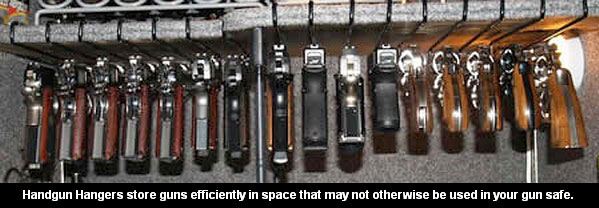
 Gun Storage Solutions also offers an Over-Under Hanger that holds two handguns — one above the shelf, and one below. A two-pack of Over-Under Hangers (capable of holding four handguns) costs $16.96. This may be a good solution for you. This editor personally prefers the standard model, so I can use the upper surface of the shelve to hold odd-shaped items such as cameras, binoculars, and miscellaneous valuables. Gun Storage Solutions also offers an Over-Under Hanger that holds two handguns — one above the shelf, and one below. A two-pack of Over-Under Hangers (capable of holding four handguns) costs $16.96. This may be a good solution for you. This editor personally prefers the standard model, so I can use the upper surface of the shelve to hold odd-shaped items such as cameras, binoculars, and miscellaneous valuables.
Magnetic Gun Caddy for Safe Doors or Walls
 Many gun owners like to mount handguns on the inside door panel of their gun safes. If this doesn’t interfere with your long gun storage, this can be a smart solution. Most of the door-mount units require special holsters or a series of peg-board style hangers. That may not work if the exposed inside of your door is bare metal. Here’s a smart solution from Benchmaster. The new two-pistol Magnetic WeaponRAC has four magnetic strips that allow the $24.99 two-gun caddy to mount directly to a metal door surface or the inner side-walls of your safe. If your safe door and walls are carpet-lined, there is also a two-pistol WeaponRAC Caddy with Velcro Mounts. A single-pistol caddy is also offered in both magnetic and Velcro versions. Many gun owners like to mount handguns on the inside door panel of their gun safes. If this doesn’t interfere with your long gun storage, this can be a smart solution. Most of the door-mount units require special holsters or a series of peg-board style hangers. That may not work if the exposed inside of your door is bare metal. Here’s a smart solution from Benchmaster. The new two-pistol Magnetic WeaponRAC has four magnetic strips that allow the $24.99 two-gun caddy to mount directly to a metal door surface or the inner side-walls of your safe. If your safe door and walls are carpet-lined, there is also a two-pistol WeaponRAC Caddy with Velcro Mounts. A single-pistol caddy is also offered in both magnetic and Velcro versions.
Editor’s Comment: If you only have 3 or 4 handguns, you may want to avoid racks altogether. Our preferred solution for 3-4 handguns is to place each gun in a synthetic fabric BoreStores sack and then line them up on the end of the top shelf in the safe. The silicone-treated BoreStores sacks wick away moisture and provide vital cushioning for the gun. This works fine for a small collection. If you have lots of wheelguns and pistols, however, look into the Handgun Hangers — they really are a space-saving solution.
October 19th, 2014
 Imagine this — your “home security” handgun is stored safely and securely near your bedside. But with the simple swipe of a keyfob, card, or wristband, you have instant access to the gun. Sound like science fiction? Well, this is real. Hornady’s new RAPID Safe uses RFID (Radio Frequency Identification) technology to allow instantaneous access to a firearm using either a special card, an RFID bracelet, or a special keyfob. In addition, the safe can be opened using a programmed keypad or a traditional key lock. Imagine this — your “home security” handgun is stored safely and securely near your bedside. But with the simple swipe of a keyfob, card, or wristband, you have instant access to the gun. Sound like science fiction? Well, this is real. Hornady’s new RAPID Safe uses RFID (Radio Frequency Identification) technology to allow instantaneous access to a firearm using either a special card, an RFID bracelet, or a special keyfob. In addition, the safe can be opened using a programmed keypad or a traditional key lock.
Brownells.com already has this new product in stock. Watch the video to see how the RAPID Safe works. The system runs with 110 volt AC power or internal battery pack. This short video shows various opening modes:
Open your safe in the blink of an eye. Simply place the included RFID bracelet, card, or key fob over the reader, and the RAPiD™ safe springs open to present your handgun.

August 26th, 2014
As the majority of states now allow concealed carry (under “shall issue” or similar doctrines), there are more Americans armed with carry guns than ever before. And now there’s a new resource that lets CCW holders keep track of the value of their totable weapons.

|
A Guide Book of Carry Gun Values covers all types of carry handguns from derringers up to full-frame semi-autos and large relovers. This full-color book offers accurate pricing estimates along with handgun specifications, production history, and market information.
This resource features the Red Book Code™, a universal system of identifying and organizing firearms on the secondary market. Additionally, since wear is a huge factor in determining a firearm’s value, the book offers a firearm condition grading scale, rating guns at NIB (New in Box), Mint, Excellent, VG+ (Very Good Plus), Good, Fair, and Poor. |
July 16th, 2014
Commentary by John Buol
The critics say that the M9 pistol (the U.S. military’s version of Beretta’s m92) must go. We’re told that the 9x19mm (aka 9mm NATO) is a poor pistol cartridge. Our Soldiers and Marines are being hampered by an inferior handgun and cartridge — or so the argument goes.
We are told that the military needs a new pistol, to be called the Modular Handgun System (MHS). According to Fox News: “The MHS would replace the Army’s inventory of more than 200,000 outdated M9 pistols and several thousand M11 9mm pistols with one that has greater accuracy, lethality, reliability, and durability.” The MHS will be a “total system replacement — new gun, new ammo, new holster, everything,” reports Daryl Easlick, Army project officer at Fort Benning, Georgia.
Easlick says that the Army, and other services, demand a pistol with a more powerful cartridge that does more damage to the bad guys: “We have to do better than our current 9mm.”

Does the military really need a new pistol, with a different chambering? Maybe not…
Here’s the real problem. Most Marines, Soldiers, police, and gun owners tend to be novice marksmen, especially with handguns. Very few people have trained to shoot a handgun well enough to offer a competent opinion on the matter. To underscore this point, let’s look at some ranges for evidence of typical skill levels.
Army Pistol Qualification Target

As you can see, there is no real trend in hits and the entire barn door (full sized silhouette) has shots sprayed all over it. And these are the shots that actually hit, all of them receiving full value. On this particular Army course, shooters are given 40 rounds to engage 30 targets and are considered qualified if 16 of the 30 targets are hit, somewhere. Soldiers can miss nearly half the time, even with ten extra rounds, and still pass. The “fast” stages of the course allow two seconds per shot and the bulk of the course is slower. Note the base of the target is blocked by the mound protecting the target lifter and that mound is a beaten zone of many very low, errant shots.
The Marines in the peanut gallery are likely chuckling, so let’s look at examples of their ranges.
Marine Pistol Target Bay

Yet Another Marine Pistol Target Bay, Showing Effects of Missed Shots.

The metal carrier behind the block wall holds a silhouette the same size as the Army target and that waist-high wall has taken a healthy beating from bad shots jerked and flinched several feet off target. Of course, the wall only shows shots pulled off target that went low. The rest ended up in the berm somewhere else. As seen closer up, the chewed-up top line of blocks is not made of concrete. That’s to avoid back-splatter towards the shooters from the excessive number of low shots.
REALITY CHECK: These are the results on actual qualification ranges with large targets, generous time limits, fixed courses of fire, and no real pressure. Imagine how much worse the shooting is when the stress and variables of combat are thrown in. Given the users wielding it, is the M9 truly ineffective? Even if it is, are shooters like this capable of a valid opinion on the matter?
Most Marines, Soldiers, police, CCW, and gun owners won’t invest the effort needed to train to a high level of skill and very few public sector organizations will expend the resources needed to make them do so. I’m not casting aspersions, just trying to address reality. If the Department of Defense (DoD) decides on a new pistol, or any other weapon, the results will be similar because the end user isn’t magically more skillful with a shiny new issue item.
About the Author
John M. Buol Jr. began his shooting career in practical competition, earning Master classifications from USPSA and IDPA. After slotting on the Army Reserve Marksmanship Program, he switched to NATO and NRA/CMP events, earning Distinguished Rifleman and Pistol Shot badges and a series of All Army Small Arms Championship wins along the way. He is a published author (Beyond “Expert”: Tripling Military Shooting Skills) and maintains the Firearm User Network Blog at http://FirearmUserNetwork.com
|


