The First Shot, the CMP’s online magazine, features a well-written article on Prone Shooting Technique by SPC Matthew Sigrist of the U.S. Army Marksmanship Unit (USAMU). The article covers all the major points of gun hold and body position: hand position, elbow position, stock weld, buttstock placement, and sling position/tension.
Keep it Steady — The Elements of a Good Prone Position
Part 1 — Building the Position By SPC Matthew Sigrist
Imagine the following scenario: You are at the last stage of fire in the National Trophy Individual Match, firing at the 600 yard line in the prone position and every point matters. What should you reflect on as you prepare to shoot this final string? As your eyes cloud from sweat, you realize that all you have to rely on is your experience and knowledge of the fundamentals.
During the National Trophy Individual Match, you will fire 60 percent of your shots from the prone position. This article will address the fundamentals of a good prone position and help you learn the techniques required to be successful in both the slow and rapid-fire stages of National Match competition.
This article will be divided into two parts. In part one, we will discuss the elements of a good prone position. In part two, we will cover the techniques you will in the rapid-fire and slow-fire stages.
The Fundamentals
The fundamentals are the building blocks of a position. Much like the framework of a house, a correct application of the fundamentals ensures a solid and stable structure. Since each person’s position will depend on their particular body build and shape, there is no “perfect position” that applies to everyone. Experience, practice and knowledge of the correct fundamentals will dictate the best position for you.
There are six key elements of any position. The purpose for these six points is to achieve a solid platform that allows for consistent sight alignment using the least amount of muscle tension.
1. Placement of the Firing Hand (the hand that pulls the trigger)
The firing hand needs to be placed high on the pistol grip. This high hand position will give you better control of the rifle. Combined with a firm grip there will be a reduced amount of hand movement when pulling the trigger. Wrap your thumb over the three fingers on the pistol grip (excluding the trigger finger). This will help isolate the movement of the trigger finger.
2. Placement of the Non-firing Hand (the hand supporting the rifle).
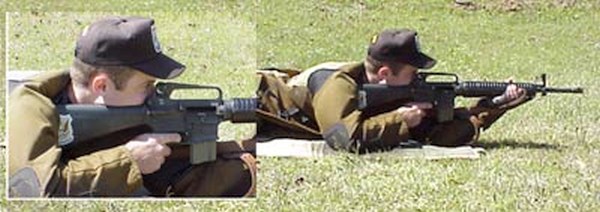
The non-firing hand should grip the handguard or stock in the flat portion of the hand between the thumb and forefinger. The fingers should curl naturally around the stock, but they should not grip it tightly. The position of the hand on the stock will depend on the physical size of the shooter. Generally speaking, taller shooters with longer arms will grip the rifle further out, near the sling swivel, while shorter shooters will need to pull their hand rearward. This is sometimes referred to as “short-stocking” the rifle.
3. Stock Weld
Stock weld is the contact that the face makes with the stock. It is important because it directly effects your sight alignment. Consistent head placement will help you achieve consistent sight alignment. The human head weighs an average of 8 to 10 pounds. The full weight of the head must rest on the stock. In doing this you achieve two things, a relaxed neck and reduced recoil because of the pressure of the head.
4. Placement of the Rifle (the contact that is made in the firing shoulder)
The rifle butt placement needs to be consistent. If this changes between shots, it effects your sight alignment and the effect of recoil. In the prone position the rifle will sit lower in the shoulder compared to other shooting positions. This allows for a more forward head and a lower position as a whole.
5. Position of the Sling
The sling should be high on the arm, above the bicep. This way the sling will have less leverage on the arm so it doesn’t cut off the circulation.
Demonstration of the placement of the firing elbow (left) and non-firing elbows (right).
6. Placement of both the firing, and non-firing elbows
A guideline for non-firing elbow placement is that there should be 1 ½’’ to 2’’ gap between your non-firing arm and the rifle’s magazine. (NOTE: this references the AR-15 service rifle) Your arm should be almost straight up and down; this will transfer the weight directly down the arm and not to the side (see picture above). Think of the firing arm as only a kind of kickstand, it doesn’t support weight it only holds the firing hand in position.
Variations of the Prone Position
There are two main variations of the prone position; open/spread legged, and bent-legged. The two types will be discussed below.
Open/Spread Leg Position
Demonstration of the Open/Spread Leg Position.
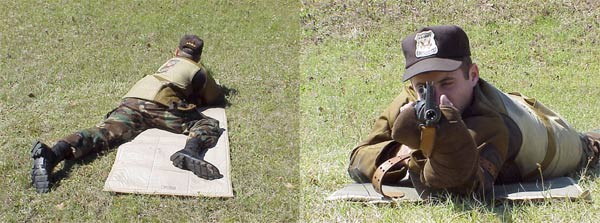
The first position is the open/spread legged position. This is when the shooter spreads their legs shoulder width or more apart. This allows for a more forward pressure on the sling and elbows. This position requires a tighter sling and solid elbow placement. The rifle should sit tight in the shoulder. With this position, your body will be farther behind the rifle compared to the bent leg position, allowing for minimum disturbance from recoil.
Bent Leg Position
Demonstration of the Bent Leg Position.
The bent leg position is when the shooter bends the firing side leg up towards the firing hand making the knee at a rough 90 degree angle to the body. The non-firing leg will remain straight and inline with the body. This will take pressure off the lungs and heart minimizing the pulse from the chest as well as easing the pressure on the lungs which will allow for easy breathing and control.
Summary
You now know the fundamentals of a good prone position, as well as the two types most commonly used. Extensive dry-firing will reveal which is the best position for you. If possible, have a friend take pictures of you in position. This will enable you to better diagnose and correct your errors. Remember, a position must be both fundamentally sound and comfortable. Practice frequently to learn your new position and to develop the conditioning required to endure long days on the range.
This week we focus on five classic metal-framed 9mm pistols. These five world-class handguns all shoot the 9mm Luger (9x19mm) cartridge. Most have been used by military and police forces as well as used by civilians for sport-shooting and defense. This Editor has shot all five pistol types and owned three. I can recommend all of them. Metal-framed pistols typically have a lower center of gravity and weigh more than Glocks and other polymer-framed handguns. Consequently, they tend to have less muzzle flip, and less perceived recoil than polymer-framed handguns.
SIG Sauer P226
The SIG Sauer P226 is a high-quality, ultra reliable single-action/double action handgun with a proud Swiss/German heritage. It has a very ergonomic grip that fits most hands very well. Standard P226s do NOT have a manual safety, but the P226 has a decocking lever drops the hammer safely. This Editor has trained new shooters with a Sig P226 and Glock 17. For 80% of my trainees the Sig P226 pointed better due to the superior grip design. This meant that the sight picture was better, and the trainees achieved better results with the P226 vs. the Glock 17. The P226 is also a very reliable firearm. I have over 6000 rounds through my P226 with not one single jam. That’s impressive. The first video, reviewing the SIG P226, has over 1.4 million YouTube views, indicating it is very popular with pistoleros.
HK P7 Series (PSP, P7m8, P7m13)
This Editor has shot a P7m8 extensively. It is superbly accurate. With a very low bore axis, it has much less muzzle flip than most 9mm pistols. And with a fixed barrel, the slide moves straight back during cycling. The HK P7 blowback-operated semi-automatic pistol was designed and manufactured by German gun-maker Heckler & Koch (H&K) from 1978 to 2008. It is thin, superbly accurate, with a precise trigger that shames the Glock. The P7m8 features a unique gas-delayed blowback system, which uses gas from the cartridge to retard the rearward motion of the slide. This works via a barrel port and a piston inside a cylinder under the barrel. The signature feature of the P7 series is the “squeeze cocker” on the front of the grip. Squeezing the cocking lever cocks the firing pin. When the front of the grip is released, the weapon is fully de-cocked, making it safe with a round in the chamber.
Browning Hi-Power
The Browning Hi-Power is a single-action, semi-automatic handgun with a legendary heritage. This handsome all-metal pistol was based on a design by American John Moses Browning, and completed by Dieudonné Saive at Fabrique Nationale (FN) of Herstal, Belgium. J.M. Browning died in 1926, several years before the design was finalized. FN Herstal initially named the design the “High Power”, which alludes to the 13-round magazine capacity, almost twice that of other designs such as the Luger or Colt M1911. The name was later shorted to “Hi-Power”. The Browning Hi-Power has served military forces and police in many countries throughout the world. It is a very well-balanced pistol, with a nice, crisp trigger. After 82 years of continuous production, FN Herstal announced that the Hi-Power would be discontinued in 2018. However, in 2022 FN resumed Hi-Power production, so this classic lives on.
CZ 75
The CZ 75 is the flagship pistol of CZ-USA and has been a staple among 9x19mm fans for over 45 years. Originally introduced in 1975, hence the name, the CZ 75 remains viable as a defensive pistol. CZ claims the CZ 75 is “used by more governments, militaries, police, and security agencies than any other pistol in the world”. The CZ 75 is very reliable and works well for both defense and IDPA competitions. The ergonomics are good, controls are intuitive, and the trigger is very nice. Over the years, CZ has made numerous variations of the CZ 75 pistol, but the original is still an excellent handgun.
Beretta 92FS and Military M9
For Americans, the Beretta 92 series of pistols is best known as the official sidearm of the American military for 30+ years. The United States military replaced the .45 ACP M1911A1 pistol in 1985 with the Beretta 92FS, designated as the “M9″. The M9 and the civilian models 92/92FS have a distinctive, recognizable feature — the cut-away slide which exposes most of the 9mm barrel. The metal frame also has an attractive grip design. The 92FS pistols we’ve shot were accurate and reliability was good. There have been various modifications and upgrades over the years. However the M9 was replaced in 2017 by the new polymer-framed SIG Sauer P320, adopted as the military’s M17/M18 modular pistols.
This Hickok 45 video review of the Beretta 92FS has over 3.1 million views:
The National President’s 100 Match is a famous competition held at Camp Perry every summer. This year’s President’s 100 Match takes place today, July 28, 2025. SEE 2025 Camp Perry NM Calendar.
This is a huge event. in recent years, there have been over 1000 ranked competitors from throughout the nation, making this one of the biggest rifle events of the year. Credit our friend Dennis Santiago for this report. Dennis has competed in the President’s 100 in recent years.
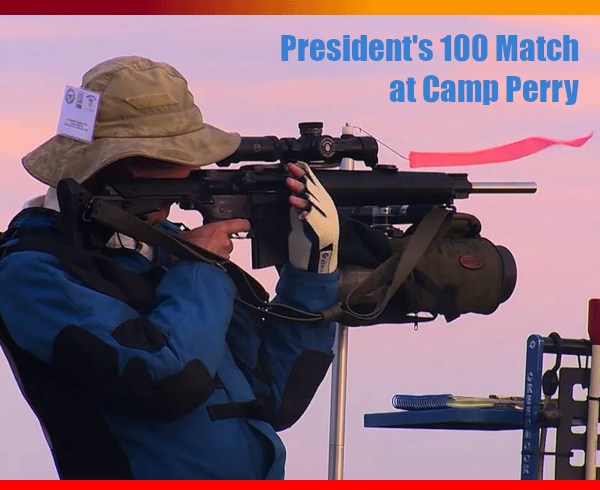
Image from Shooting USA TV which has broadcast highlights from President’s 100 match.
The President’s 100 Rifle Match is richly steeped in history. This unique match was first held in 1878. Above is the view from the line at 600 yards. The top 100 competitors overall in the President’s Rifle Match are designated as the President’s 100. They receive President’s 100 medallions and certificates.
Looking downrange at the 600-yard targets. Camp Perry photos courtesy Dennis Santiago.
President’s 100 Shoot Off — The Top 20 shooters compete in the Shoot-Off.
President’s 100 Course of Fire
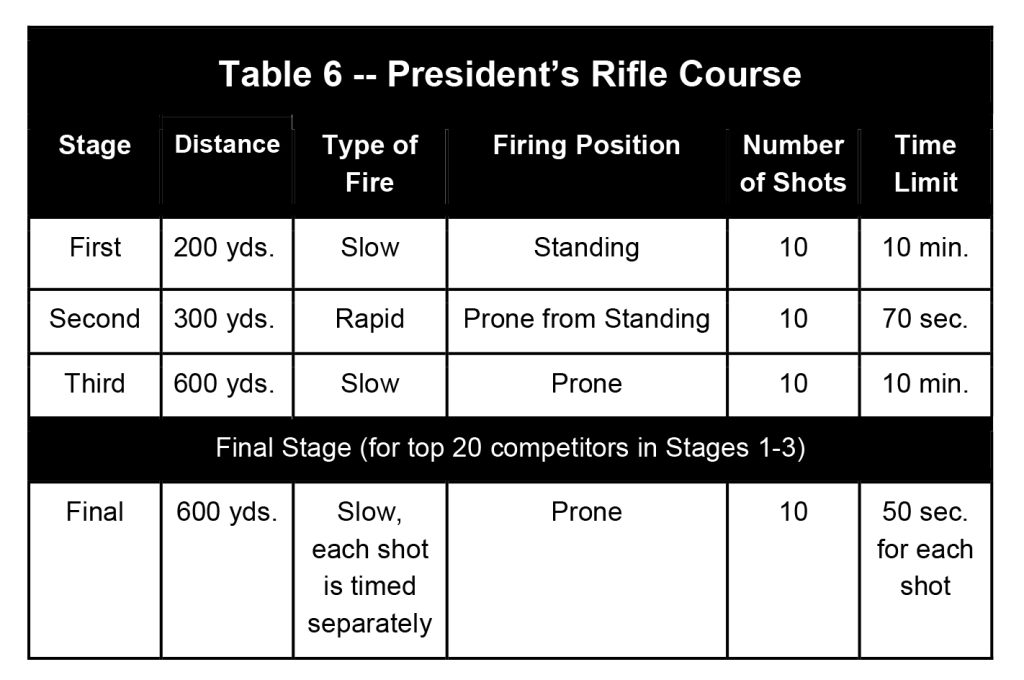
There is a three-yardage, four-stage Course of Fire for the President’s Rifle Match Course of Fire. Firing is done on the SR target at 200 and 300 yards and the MR target at 600 yards. Scores in stages 1-3 determine the President’s 100 and the final rankings of competitors in 21st place and below. Scores in stages 1-4 determine the match winner and the final rankings in places 1-20. If there is a tie for first place (equal total and X-count), the tied shooters will continue to fire one-shot-at-a-time until the tie is broken. No sighters are permitted in National Trophy Rifle Matches.
Origins of the President’s Match The National Rifle Association’s President’s Match was instituted in 1878, as the American Military Rifle Championship Match. In 1884, the name was changed to the President’s Match for the Military Rifle Championship of the United States. It was fired at Creedmoor, New York until 1891. In 1895, it was reintroduced at Sea Girt, New Jersey. Today, the match is held at Camp Perry, Ohio.
The President’s Match was patterned after the Queen’s Match for British Volunteers. That British competition was started in 1860 by Queen Victoria and the NRA of Great Britain to increase the ability of Britain’s marksmen following the Crimean War.
The tradition of making a letter from the President of the United States the first prize began in 1904 when President Theodore Roosevelt personally wrote a letter of congratulations to the winner, Private Howard Gensch of the New Jersey National Guard.
After a hiatus in the 1930s and 1940s, The President’s Match was reinstated in 1957 at the National Matches as “The President’s Hundred.” The 100 top-scoring competitors in the President’s Match were singled out for special recognition.
E-Targets at 2025 National Matches — Rimfire and Centerfire
After years of testing, the Civilian Marksmanship Program (CMP) will make full use of eTargets at the 2025 National Rifle Matches at Camp Perry, which run July 20 through August 9, 2025. The advanced Kongsberg eTargets will be used at all Highpower rifle matches, National Trophy Rifle competitions, and Rifle Games events. In addition the eTargets will be used for the Rimfire Sporter Match on July 20 and the National Mid/Long Range Matches in August. The use of eTargets eliminates the need for pit duty, drastically cutting down the duration of each match. CLICK HERE to learn more about Camp Perry eTargets.
These matches are conducted by the CMP and Ohio National Guard. Since their inception, the National Matches have become a huge, national shooting sports event with over 4,500 annual participants.
Guest Article By Michelle Gallagher, Berger Bullets
Let’s face it. In the world of firearms, there is something for everyone. Do you like to compete? Are you a hunter? Are you more of a shotgun shooter or rifle shooter? Do you enjoy running around between stages of a timed course, or does the thought of shooting one-hole groups appeal to you more? Even though many of us shoot several different firearms and disciplines, chances are very good that we all have a favorite. Are we spreading ourselves too thin by shooting different disciplines, or is it actually beneficial? I have found that participating in multiple disciplines can actually improve your performance. Every style of shooting is different; therefore, they each develop different skills that benefit each other.
How can cross-training in other disciplines help you? For example, I am most familiar with long-range prone shooting, so let’s start there. To be a successful long-range shooter, you must have a stable position, accurate ammunition, and good wind-reading skills. You can improve all of these areas through time and effort, but there are other ways to improve more efficiently. Spend some time practicing smallbore. Smallbore rifles and targets are much less forgiving when it comes to position and shot execution. Long-range targets are very large, so you can get away with accepting less than perfect shots. Shooting smallbore will make you focus more on shooting perfectly center shots every time. Another way to do this with your High Power rifle is to shoot on reduced targets at long ranges. This will also force you to accept nothing less than perfect. Shoot at an F-Class target with your iron sights. At 1000 yards, the X-Ring on a long range target is 10 inches; it is 5 inches on an F-Class target. Because of this, you will have to focus harder on sight alignment to hit a center shot. When you go back to the conventional target, you will be amazed at how large the ten ring looks.
Also, most prone rifles can be fitted with a bipod. Put a bipod and scope on your rifle, and shoot F-TR. Shooting with a scope and bipod eliminates position and eyesight factors, and will allow you to concentrate on learning how to more accurately read the wind. The smaller target will force you to be more aggressive on your wind calls. It will also help encourage you to use better loading techniques. Nothing is more frustrating than making a correct wind call on that tiny target, only to lose the point out the top or bottom due to inferior ammunition. If you put in the effort to shoot good scores on the F-Class target, you will be amazed how much easier the long-range target looks when you return to your sling and iron sights. By the same token, F-Class shooters sometimes prefer to shoot fast and chase the spotter. Shooting prone can help teach patience in choosing a wind condition to shoot in, and waiting for that condition to return if it changes.
Benchrest shooters are arguably among the most knowledgeable about reloading. If you want to learn better techniques about loading ammunition, you might want to spend some time at benchrest matches. You might not be in contention to win, but you will certainly learn a lot about reloading and gun handling. Shooting F-Open can also teach you these skills, as it is closely related to benchrest. Benchrest shooters may learn new wind-reading techniques by shooting mid- or long-range F-Class matches.
Position shooters can also improve their skills by shooting different disciplines. High Power Across-the-Course shooters benefit from shooting smallbore and air rifle. Again, these targets are very small, which will encourage competitors to be more critical of their shot placement. Hunters may benefit from shooting silhouette matches, which will give them practice when shooting standing with a scoped rifle. Tactical matches may also be good, as tactical matches involve improvising shots from various positions and distances. [Editor: Many tactical matches also involve hiking or moving from position to position — this can motivate a shooter to maintain a good level of general fitness.]
These are just a few ways that you can benefit from branching out into other shooting disciplines. Talk to the other shooters. There is a wealth of knowledge in every discipline, and the other shooters will be more than happy to share what they have learned. Try something new. You may be surprised what you get out of it. You will certainly learn new skills and improve the ones you already have. You might develop a deeper appreciation for the discipline you started off with, or you may just discover a new passion.
This article originally appeared in the Berger Blog. The Berger Blog contains the latest info on Berger products, along with informative articles on target shooting and hunting.
Looking downrange at the 600-yard targets. All Camp Perry photos courtesy Dennis Santiago.
The National President’s 100 Match is a famous competition held at Camp Perry every summer. This year’s President’s 100 will take place on July 28, 2025, three weeks away. SEE 2025 Camp Perry NM Calendar.
This is a huge event. in recent years, there have been over 1000 ranked competitors from throughout the nation, making this one of the biggest rifle events of the year. Credit our friend Dennis Santiago for this report. Dennis has competed in the President’s 100 in recent years.
The President’s 100 Rifle Match is richly steeped in history. This unique match was first held in 1878. Above is the view from the line at 600 yards. The top 100 competitors overall in the President’s Rifle Match are designated as the President’s 100. They receive President’s 100 medallions and certificates.
President’s 100 Shoot Off — The Top 20 shooters compete in the Shoot-Off.
President’s 100 Course of Fire
There is a three-yardage, four-stage Course of Fire for the President’s Rifle Match Course of Fire. Firing is done on the SR target at 200 and 300 yards and the MR target at 600 yards. Scores in stages 1-3 determine the President’s 100 and the final rankings of competitors in 21st place and below. Scores in stages 1-4 determine the match winner and the final rankings in places 1-20. If there is a tie for first place (equal total and X-count), the tied shooters will continue to fire one-shot-at-a-time until the tie is broken. No sighters are permitted in National Trophy Rifle Matches.
Origins of the President’s Match The National Rifle Association’s President’s Match was instituted in 1878, as the American Military Rifle Championship Match. In 1884, the name was changed to the President’s Match for the Military Rifle Championship of the United States. It was fired at Creedmoor, New York until 1891. In 1895, it was reintroduced at Sea Girt, New Jersey. Today, the match is held at Camp Perry, Ohio.
The President’s Match was patterned after the Queen’s Match for British Volunteers. That British competition was started in 1860 by Queen Victoria and the NRA of Great Britain to increase the ability of Britain’s marksmen following the Crimean War.
The tradition of making a letter from the President of the United States the first prize began in 1904 when President Theodore Roosevelt personally wrote a letter of congratulations to the winner, Private Howard Gensch of the New Jersey National Guard.
After a hiatus in the 1930s and 1940s, The President’s Match was reinstated in 1957 at the National Matches as “The President’s Hundred.” The 100 top-scoring competitors in the President’s Match were singled out for special recognition.
E-Targets at 2025 National Matches — Rimfire and Centerfire
After years of testing, the Civilian Marksmanship Program (CMP) will make full use of eTargets at the 2025 National Rifle Matches at Camp Perry, which run July 20 through August 9, 2025. The advanced Kongsberg eTargets will be used at all Highpower rifle matches, National Trophy Rifle competitions, and Rifle Games events. In addition the eTargets will be used for the Rimfire Sporter Match on July 20 and the National Mid/Long Range Matches in August. The use of eTargets eliminates the need for pit duty, drastically cutting down the duration of each match. CLICK HERE to learn more about Camp Perry eTargets.
These matches are conducted by the CMP and Ohio National Guard. Since their inception, the National Matches have become a huge, national shooting sports event with over 4,500 annual participants.
The NRA has released the dates of major competition shooting events this summer and fall. Here is the schedule for NRA national championships in 2025. For each event you’ll find a link for event registration. Spanning multiple disciplines — from High Power and Smallbore Rifle to Precision Pistol and Silhouette — this year’s championships will draw elite shooters from around the country. From the NRA National High Power Rifle Championship to the F-Class Fullbore Long-Range Championship, here’s the full schedule for NRA’s national competitions in 2025.
Register now for your favorite national events. Whatever your discipline — whether you shoot High Power, Smallbore, Precision Pistol, F-Class or Silhouette — there’s a competition for you. F-Class Shooters take note — this year’s Mid-Range Nationals and Long-Range Nationals will be held in different locations:
Mid-Range F-Class at Port Malabar Rifle and Pistol Club, Palm Bay, Florida
Long-Range F-Class at Bridgeville Rifle and Pistol Club, Bridgeville, Delaware
Photo by Mel Dixon from 2024 NRA National High Power Rifle Long-Range Championships.
NRA National High Power XTC Championship June 1-7, 2025 Winnequah Gun Club Lodi, Wisconsin competitions.nra.org
NRA National High Power Mid-Range Championship June 4-8, 2025 Oklahoma City Gun Club Arcadia, Oklahoma okcgunclub.org
National Muzzle Loading Rifle Association National Spring Shoot and NRA Muzzleloading Nationals June 14-22, 2025 Walter Cline Range Friendship, Indiana nmlra.org
NRA National High Power Long-Range Championship July 2-6, 2025 Alliance Rifle Club Malvern, Ohio targetscore.com
The 2025 High Power Long-Range Nationals will be held July 2-6, 2025 at the Alliance Rifle Club in Malvern, Ohio.
NRA National Precision Pistol Championships July 6-10, 2025 Cardinal Shooting Center Marengo, Ohio redfeatheroutfitters.com
NRA National Smallbore and High Power Rifle Silhouette Championships July 20-26, 2025 NRA Whittington Center Raton, New Mexico silhouettenationals.com
NRA National Conventional Smallbore Championships July 20-29, 2025 Cardinal Shooting Center Marengo, Ohio redfeatheroutfitters.com
NRA National F-Class Championship August 2-9, 2025 Winnequah Gun Club Lodi, Wisconsin winnequahgunclub.org
NRA National Lever-Action Silhouette Championship August 6-9, 2025 Ridgway Rifle Club Ridgway, Pennsylvania competitions.nra.org
National Black Powder Cartridge Rifle Championship August 15-22, 2025 Walter Cline Range Friendship, Indiana nmlra.org
Spirit of America National Fullbore Rifle Championship September 5-12, 2025 Bald Eagles Rifle Club, NRA Whittington Center Raton, New Mexico baldeaglesrc.org
National Muzzle Loading Rifle Association National Championship Shoot September 13-22, 2025 Walter Cline Range Friendship, Indiana nmlra.org
NRA World Shooting Championship September 30 to October 4, 2025 Camp Atterbury, Indiana wsc.nra.org
NRA National F-Class Fullbore Mid-Range Championship October 8-12, 2025 Port Malabar Rifle and Pistol Club Palm Bay, Florida competitions.nra.org
NRA National F-Class Fullbore Long-Range Championship October 22-26, 2025 Bridgeville Rifle and Pistol Club Bridgeville, Delaware competitions.nra.org
Visit the NRA Competitive Shooting Division website to learn more about this year’s slate of NRA National Championships.
2025 NRA National Matches Calendar
Here is the 2025 NRA National Matches Calendar showing major championship events and dates. Different events are indicated by various colors: Red for High Power Across the Course, Yellow for High Power Mid-Range, Green for High Power Long-Range, Dark Red for Smallbore and Blue for Pistol. Click the Calendar to ZOOM for easier reading.
This story is about a great shooter, Joe Hendricks Jr., and his Eliseo RTS Tubegun, chambered in 6mm Competition Match. With this versatile rifle, Joe Hendricks Jr. won the 2019 CMP Cup Aggregate Title for Match Rifles. Joe comes from a long line of talented marksmen. His father AND his grandfather are elite competitive shooters. His dad has been a National Champion, and all three generations have shot together, shoulder to shoulder, on the Remington Rifle Team. Like grandfather, like father, like son.
Joe says: “I think it’s pretty cool that there have now been two major Across the Course Championships won by a Hendricks using a Gary Eliseo chassis, one by me this year, and one in 2014 when my father (Joe Hendricks Sr.) won the NRA National Championship.”
Photography by Meghan Hendricks.
Joe Hendricks Jr.’s Rifle — Eliseo RTS Chassis, Rem 40X Action, Krieger Barrel
Joe’s rifle is built on a Competition Machine RTS Target Model chassis. This Tubegun features a Remington 40X action with Pacific Tool & Gauge Bolt and Jewell trigger. The scope is a Leupold 6-18x40mm. The barrel is a Krieger chambered in 6mm Competition Match. Joe explains: “The 6mm Competition Match is a cartridge that my dad came up with. It is basically a .243 Winchester with a 31° shoulder.”
If you look carefully in the photo below, you’ll note the silver-toned, adjustable butt-plate. That’s an upgrade Joe added: “I did a small modification to the stock, where I put on an Anschutz buttplate instead of the standard one Gary Eliseo uses. This Anschutz hardware provides a little bit more adjustability.”
Here Joe Hendricks Jr. fires at 200 yards from the standing position.
The Standing Position — Why It’s Critical to Match Success
Joe told us: “As far as shooting strategies and training methods go, I shoot a lot of standing practice — at least 50 shots per session. I still train the other positions of course, but I believe if you start your day off with a great standing score, it really makes the rest of the day easy because then you don’t feel like you’re playing catch-up the whole time.”
Joe explains: “When I’m shooting standing, I shoot in a manner very similar to the way that Carl Bernosky does. He’s written a few articles about the standing position. He always talks about making sure the shot goes off inside his hold, and I’m the same way. I don’t try to do too much. I just let the gun do its thing and when/if it stops in the Ten Ring, I shoot the shot. If it doesn’t, I don’t.”
About the CMP Cup Two-Day Course of Fire
The CMP Cup is a two-day match comprised of two, 1000-point Aggregates, for a 2000-point Grand Agg. Each day, the competitors fire 100 shots total from the 200, 300, and 600 yard lines. The match starts with 20 shots slow fire standing at 200 yards. Next are two, 10-shot, rapid fire strings in 60 seconds from the sitting position. Next are two, 10-shot strings in 70 seconds prone at 300 yards (rapid fire prone). Each day’s course of fire concludes with two, 20-shot sequences of slow-fire prone at 600 yards.
6mm Competition Match Cartridge — Slower Powder Yields Better Barrel Life
My dad was shooting a 6XC for a while and was getting tired of going through almost two barrels a year. So, he came up with the 6mm Competition Match. Like I said, it is a .243 Winchester with a 31-degree shoulder. This delivers the same (if not better) velocity as the other popular 6mm cartridges, but we get almost double the barrel life because we increased the case capacity, so we can shoot a slower burning powder. The barrel I took to Camp Perry that won the CMP Cup had over 3700 rounds on it when I was finished. [EDITOR: Take note readers! Most 6mm barrels are toast after 2500 rounds.] Granted it definitely needed to come off at that point, but it obviously was still shooting well enough to win!
Accurate Load with Peterson Brass, Berger Bullets, and Vihtavuori N165
The two loads I shot all week were Berger 108gr BT behind Vihtavuori N165 in Peterson Cartridge Company brass for 200 and 300 yards, and then Berger 115 VLD behind N165 in Peterson brass for 600 yards. Both loads are easily going over 3000 FPS. I try to only use the best components for reloading, so that’s why I go with Berger, Vihtavuori, and Peterson. Obviously Berger and Vihtavuori quality are pretty known, but I believe Peterson is right up there with Lapua[.] I’ve visited the Petersen factory many times. I’m always blown away by the time and effort Peterson puts into everything.
Winning Marksmanship — the Mental Game
The other big thing I’ve been focusing on lately is my mental game. In order to be at the top of a sport, regardless of the sport, the athlete has to have a solid mental approach. For me, I’ve learned that my key is confidence. A good shooting buddy, who was with me the first day of the CMP Cup, suggested I was arrogant because I kept telling him I was going to win. Then I told him it was confidence not arrogance. If I was confident in my ability, I did not think there was any way I could lose. [Editor: To help build confidence and visualize success, we recommend With Winning in Mind, by Lanny Bassham, an Olympic gold-medal winning marksman.]
All in the Family — Three Generations of Hendricks Marksmen
Joe’s father, Joseph Hendricks Sr., has been a National Champion rifle shooter. Joe’s grandfather, Gary Hendricks, is also a talented marksman. In fact, all three men — grandfather, father, and son — shot together on the Remington Rifle Team. Joe says that the shooting sports have helped build strong family bonds. He and his father enjoy shooting together, and competing against one another: “I learn so much just by watching my dad… shoot. Even though I have been competing for 10 years now, I’m still incredibly new to the shooting sports compared to my dad. My father is always there to help.”
“I feel very privileged to have grown up in the family that I did, with not only my father as a competitive shooter, but my grandfather as well. I definitely would not be the person I am today, let alone the shooter, without either of them. At one point, all three of us were on the Remington Rifle Team. I’ve had the opportunity to shoot team matches with all three of us on one team, as recently as this past summer.”
“Initially when I began shooting competitively, I was putting a lot of pressure on myself. I wanted to be as good a shooter as my dad and grandfather. I was trying so hard that it was really affecting my scores negatively. Then one year, I told myself I was just going to have fun, and not worry about match scores. That year was the year I really started to win things, and shoot some good scores.”
“When my father won the NRA National Championship in 2014, I was so proud, but along with being proud, all it did was make me more motivated. Ever since I started shooting, I wanted to win a National Championship, but after he won, it just fueled my fire more. There is a bit of father/son rivalry. It’s a lot of fun if we are shooting right next to each other at the same time. We just give each other crap about shooting a bad a shot, or shooting a lower score by a point or an X.”
“My dad started shooting when he was around 10, so he has a vast amount of knowledge compared to most people, especially me. He is always there to help whenever I have a question on anything firearm or shooting related. To this day, whenever I’m done with a match, I always talk to my dad. He always has time to listen to what I have to say.”
The U.S. Army Marksmanship Unit (USAMU) has created a series of instructional videos about High Power Rifle shooting, Service Rifle shooting, 3-Gun matches, and pistol competition. We’ve linked five of these informative USAMU videos today along with a special profile video on Amanda Elsenboss, who, as a USAMU shooter, has won both the Long Range and High Power National Championships in recent years.
In addition, as a major BONUS, we link twenty (20) informative articles authored by expert USAMU shooters and coaches. Those excellent, detailed articles covering a wide range of topics including rifle positions, wind reading, fitness training, trigger control, nutrition, training plans, and much more.
Amanda Elsenboss — National HP and Long Range Champion
The gifted SSG Amanda Elsenboss won the 2023 NRA High Power Championship, the 2021 NRA High Power National Championship, and the 2019 NRA Long-Range Championship. In 2022 Amanda also won the National President’s Rifle Match, the first woman ever to do so. Those accomplishments place Amanda among America’s legendary shooters. Amanda started shooting at age 8 with her father, then began competitive marksmanship at age 13. In 2009, she joined the U.S. Army as part of the USAMU rifle team. She has left full-time service, but is now a member of the Pennsylvania National Guard.
Sight Alignment and Trigger Control
In this USAMU Shooter’s Corner instructional video, SFC Kenneth Rose explains key elements of using sights on a service rifle. Rose also explain how to make the trigger pull at the optimum moment when the sights are perfectly aligned and steady.
How to Set Up Sling and Rifle for Prone Shooting
In this video, the USAMU’s SGT Jonathan Wannemacher explains how to set up a service rifle sling for prone rifle shooting. Wannemacher has earned a number of coveted awards including the the Distinguished Rifleman Badge and President’s Hundred Tab.
Rifle Grip, Stance, and Body Position for 3-Gun Action Matches
SFC Daniel Horner, now with SIG Sauer, is arguably the best 3-Gun action shooter on the planet. Horner has won multiple major 3-Gun Championships, shooting rifle, shotgun, and pistol in timed action matches. Horner’s speed, accuracy, and mobility is without peer. In this video, Horner shows techniques for AR-type rifle shooting in 3-Gun competition.
Amazing Trick Shot with Air Rifle
In this Trick Shot Tuesday video SPC Ivan Roe shoots a pill (at two different angles) off the top of a balloon. Very impressive shooting! Ivan hails from Manhattan, Montana and has been a notable member of the USAMU International Rifle Team.
How to Use Data Books During Matches
Data books can be very valuable tools during marksmanship training. In this video, USAMU shooter SGT Lane Ichord explains Data Book basics and how to log information during practice and matches.
BONUS: 20 Marksmanship Articles from USAMU Experts
USAMU shooters and coaches have written an excellent series of articles on highpower and service rifle shooting. Many of these originally appeared in The First Shot, the CMP’s on-line magazine. Here are twenty notable USAMU expert articles:
Today Shooting USA TV features the annual President’s Rifle Match at Camp Perry, Ohio. Also known as the “President’s 100″, this major Service Rifle match attracts nearly one thousand competitors to the historic ranges of Camp Perry each summer. This is a challenging, multi-stage competition that tests marksmanship and equipment alike. NOTE: This week’s episode also features the iconic M1 Garand rifle in the show’s History’s Guns segment.
Shooting USA SHOW TIMES: This Shooting USA Episode airs Wednesday, March 5, 2025 at 9:00 PM Eastern and Pacific; 8:00 PM Central. If you miss the regular broadcast, you can stream the show online at any time on Vimeo for $0.99 per episode.
Looking downrange at the 600-yard targets. Camp Perry photos courtesy Dennis Santiago.
The historic National President’s 100 Match is a huge event. In recent years, there have been over 1000 ranked competitors from throughout the nation, making this one of the biggest rifle events of the year. The top 100 competitors overall in the President’s Rifle Match are designated as the President’s 100. They receive President’s 100 medallions and certificates.
The President’s 100 Rifle Match is richly steeped in history. This unique match was first held in 1878. Here’s the view from the line at 600 yards:
President’s 100 Match Shoot Off! — The Top 20 shooters face off while everyone watches.
President’s 100 Course of Fire
There is a three-yardage, four-stage Course of Fire for the President’s Rifle Match Course of Fire. Firing is done on the SR target at 200 and 300 yards and the MR target at 600 yards. Scores in stages 1-3 determine the President’s 100 and the final rankings of competitors in 21st place and below. Scores in stages 1-4 determine the match winner and the final rankings in places 1-20. If there is a tie for first place (equal total and X-count), the tied shooters will continue to fire one-shot-at-a-time until the tie is broken. No sighters are permitted in National Trophy Rifle Matches.
Origins of the President’s Match The National Rifle Association’s President’s Match was instituted in 1878, as the American Military Rifle Championship Match. In 1884, the name was changed to the President’s Match for the Military Rifle Championship of the United States. It was fired at Creedmoor, New York until 1891. In 1895, it was reintroduced at Sea Girt, New Jersey. Today, the match is held at Camp Perry, Ohio.
The President’s Match was patterned after the Queen’s Match for British Volunteers. That British competition was started in 1860 by Queen Victoria and the NRA of Great Britain to increase the ability of Britain’s marksmen following the Crimean War.
The tradition of making a letter from the President of the United States the first prize began in 1904 when President Theodore Roosevelt personally wrote a letter of congratulations to the winner, Private Howard Gensch of the New Jersey National Guard.
After a hiatus in the 1930s and 1940s, The President’s Match was reinstated in 1957 at the National Matches as “The President’s Hundred.” The 100 top-scoring competitors in the President’s Match were singled out for special recognition.
In 1903, President Theodore Roosevelt’s vision of skilled marksmen among American citizens came to life as the National Matches; civilians on the firing line with the service weapon of the day, preparing for training in case of a time of war. T.R.’s vision is now a tradition, attracting thousands of people for five weeks of shooting competitions each year at Camp Perry in Ohio.
The National Matches have been held at Camp Perry since 1907. The range is located along the shores of Lake Erie in northern Ohio near Port Clinton. The site was first acquired in 1906, in response to the need for a larger facility for military training and the NRA’s shooting programs. In 1906 Gen. Ammon B. Crichfield, Adjutant General of Ohio, ordered construction of a new shooting facility on the shores of Lake Erie, 45 miles east of Toledo, Ohio. The original land for Camp Perry was purchased in 1906, and the reservation was named after Commodore Oliver Hazard Perry, the American naval commander who won the Battle of Put-in-Bay during the War of 1812. On August 19, 1907, Cpl. L. B. Jarrett fired the first shot at the new Camp Perry Training Site. And that year, 1907, Camp Perry held its first National Pistol and Rifle Championship events.
Some folks say you haven’t really mastered marksmanship unless you can hit a target when standing tall ‘on your own hind legs’. Of all the shooting positions, standing can be the most challenging because you have no horizontally-solid resting point for your forward arm/elbow. Here 10-time National High Power Champion Carl Bernosky explains how to make the standing shot.
Carl Bernosky is one of the greatest marksmen in history. A multi-time National High Power Champion, Carl has won ten (10) National High Power Championships in his storied shooting career, most recently in 2012. In this article, Carl provides step-by-step strategies to help High Power shooters improve their standing scores. When Carl talks about standing techniques, shooters should listen. Among his peers, Carl is regard as one of the very best standing shooters in the history of High Power shooting. Carl rarely puts pen to paper, but he was kind enough to share his techniques with AccurateShooter.com’s readers.
If you are position shooter, or aspire to be one some day, read this article word for word, and then read it again. We guarantee you’ll learn some techniques (and strategies) that can improve your shooting and boost your scores. This stuff is gold folks, read and learn…
How to Shoot Standing by Carl Bernosky
Shooting consistently good standing stages is a matter of getting rounds down range, with thoughtfully-executed goals. But first, your hold will determine the success you will have.
1. Your hold has to be 10 Ring to shoot 10s. This means that there should be a reasonable amount of time (enough to get a shot off) that your sights are within your best hold. No attention should be paid to the sights when they are not in the middle — that’s wasted energy. My best hold is within 5 seconds after I first look though my sights. I’m ready to shoot the shot at that time. If the gun doesn’t stop, I don’t shoot. I start over.
2. The shot has to be executed with the gun sitting still within your hold. If the gun is moving, it’s most likely moving out, and you’ve missed the best part of your hold.
3. Recognizing that the gun is sitting still and within your hold will initiate you firing the shot. Lots of dry fire or live fire training will help you acquire awareness of the gun sitting still. It’s not subconscious to me, but it’s close.
4. Don’t disturb the gun when you shoot the shot. That being said, I don’t believe in using ball or dummy rounds with the object of being surprised when the shot goes off. I consciously shoot every shot. Sometimes there is a mistake and I over-hold. But the more I train the less of these I get. If I get a dud round my gun will dip.* I don’t believe you can learn to ignore recoil. You must be consistent in your reaction to it.
5. Know your hold and shoot within it. The best part of my hold is about 4 inches. When I get things rolling, I recognize a still gun within my hold and execute the shot. I train to do this every shot. Close 10s are acceptable. Mid-ring 10s are not. If my hold was 8 inches I would train the same way. Shoot the shot when it is still within the hold, and accept the occasional 9. But don’t accept the shots out of the hold.
6. Practice makes perfect. The number of rounds you put down range matter. I shudder to think the amount of rounds I’ve fired standing in my life, and it still takes a month of shooting standing before Perry to be in my comfort zone. That month before Perry I shoot about 2000 rounds standing, 22 shots at a time. It peaks me at just about the right time.
This summarizes what I believe it takes to shoot good standing stages. I hope it provides some insight, understanding, and a roadmap to your own success shooting standing.
* This is very noticeable to me when shooting pistol. I can shoot bullet holes at 25 yards, but if I’ve miscounted the rounds I’ve fired out of my magazine, my pistol will dip noticeably. So do the pistols of the best pistol shooters I’ve watched and shot with. One might call this a “jerk”, I call it “controlled aggressive execution”, executed consistently.






 The National Rifle Association’s President’s Match was instituted in 1878, as the American Military Rifle Championship Match. In 1884, the name was changed to the President’s Match for the Military Rifle Championship of the United States. It was fired at Creedmoor, New York until 1891. In 1895, it was reintroduced at Sea Girt, New Jersey. Today, the match is held at Camp Perry, Ohio.


 Position shooters can also improve their skills by shooting different disciplines. High Power Across-the-Course shooters benefit from shooting smallbore and air rifle. Again, these targets are very small, which will encourage competitors to be more critical of their shot placement. Hunters may benefit from shooting silhouette matches, which will give them practice when shooting standing with a scoped rifle. Tactical matches may also be good, as tactical matches involve improvising shots from various positions and distances. [Editor: Many tactical matches also involve hiking or moving from position to position — this can motivate a shooter to maintain a good level of general fitness.]


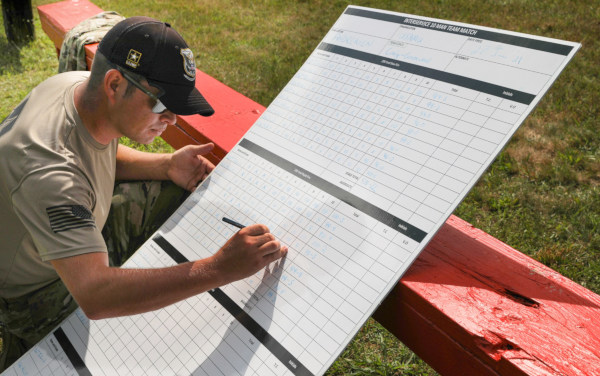


 The National Rifle Association’s President’s Match was instituted in 1878, as the American Military Rifle Championship Match. In 1884, the name was changed to the President’s Match for the Military Rifle Championship of the United States. It was fired at Creedmoor, New York until 1891. In 1895, it was reintroduced at Sea Girt, New Jersey. Today, the match is held at Camp Perry, Ohio.

 How to Shoot Standing
 5. Know your hold and shoot within it. The best part of my hold is about 4 inches. When I get things rolling, I recognize a still gun within my hold and execute the shot. I train to do this every shot. Close 10s are acceptable. Mid-ring 10s are not. If my hold was 8 inches I would train the same way. Shoot the shot when it is still within the hold, and accept the occasional 9. But don’t accept the shots out of the hold.


