Tired of carrying old-fashioned paper Score Books? Well now you can go digital — Creedmoor Sports offers a full-featured Scoring Book App that lets you plot your shot locations/scores using an Android device or Apple iPhone or iPad. The price is right — FREE! Just visit the iTunes store or Google Play Store to download the App for FREE.
Record Match and Practice Data
This FREE Data Book App, available in the Apple App Store, and the Google Play Store, provides all the same functions and capabilities of the traditional, spiral-bound print-format Creedmoor Rifle Data/Score Book, but with the convenience and ease of recording your match and practice information with your mobile device. With this App you can break your 20 shot slow-fire segments into either 10- or 20-shot targets, and also opt for sighting shots. All the specific event data can also be recorded, such as location, wind, light etc., along with wind and elevation adjustments.
COMMUNICATIONS Restrictions: In some matches you are not allowed to have electronic communication ability, so you may have to set your iPhone to “Airplane Mode”, or use this only with an iPod (which does not have two-way communication capability).
On September 19-26, the CMP 2021 New England Games will take place in Jericho, Vermont. Hosted by the Vermont State Rifle and Pistol Association and the Burlington Rifle and Pistol Club, the New England Games will be conducted at the Camp Ethan Allen Training Site, a beautiful facility.
New England Games Registration is currently open. Competitors are encouraged to register right away, though interested shooters will also be able to register for additional matches while attending the event. The CMP expects over 150 competitors this year. The New England Games have become extremely popular for the breathtaking views and serene environment. Add in the new electronic target system and you have a recipe for success.
IMPORTANT — New Magazine Restrictions. To comply with a new Vermont law, competitors may NOT bring 20-round magazines into Vermont. Competitors may use 10-round magazines during the New England Games to be compliant with the new Vermont State Law. Note, however, you may BORROW a 20-round magazine from a member of the Vermont State Rifle and Pistol Association after your arrival to Camp Ethan Allen. Contact a CMP associate during check-out process for magazine loans.
The 2021 New England Games will feature the CMP’s electronic High Power targets. The electronic target system is now well-sorted and provides accurate scoring. Shooters have monitors right at their shooting stations, providing instant scoring info — no more waiting for the targets to be marked manually. And with the elimination of pit duty allowed by the target system, matches are completed more quickly.
Here’s the view from the berm, looking back to the firing line…
Similar to the Eastern, Western, and Oklahoma CMP Travel games, the New England Games features a variety of competitive shooting matches. The CMP Highpower Rifle Matches include a 4-Man Team Match, two CMP 800 Aggregate Matches followed by an EIC Service Rifle Match. Following the CMP HP Matches will be the CMP Games Matches. The CMP Games Matches include Rifle Marksmanship 101 & M16 Match (formerly SAFS), Garand/Springfield/Vintage/Modern Military Matches, Carbine Match, Rimfire Sporter Match and Vintage Sniper Team Match. There are also several pistol matches for competitors to fire including CMP As-Issued 1911 Pistol Match, EIC Service Pistol Match, and .22 Rimfire Pistol EIC Match.
There will also be a GSM New Shooter Clinic and an M1 Maintenance Clinic during the event. CMP Sales will be at NE Games with a limited supply of rifles. They will also have ammo available for purchase.
High Praise for Venue and Match
Competitors at past CMP New England Games were mightily impressed by Camp Ethan Allen, a beautiful venue. “I was blown away by the facilities at Camp Ethan Allen,” said Steve Cooper, CMP North general manager. “The grounds were neatly manicured, our offices for registration and sales were very convenient and the classrooms were perfect for our clinics.” Photos from past events are posted on the CMP’s Zenfolio website.
Of course, it wouldn’t be a true CMP Games event without a Rimfire Sporter Match.
The CEATS Pistol Range hosted both centerfire and rimfire matches in a lovely, tree-lined setting.
Learn More about the CMP New England Games
For registration, travel, and housing information, visit the New England Games Page on the CMP website. If you have questions, Contact Vera Snyder at vsnyder@thecmp.org or call 888-267-0796, ext. 782. Competitors can also find more housing information here at Vermont.org/places-to-stay.
Dennis DeMille shows a young competitor at the CMP Western Games how to adjust his leather sling.
The NRA High Power Over-the-Course (OTC) National Championship will be held at Camp Atterbury over the next 7 days. Firing will be done in multiple positions — prone, sitting/kneeling, and standing. Proper support and adjustment of the sling is vital for successful High Power competition. In this short article, Dennis DeMille, a past Service Rifle Champion, explains how to set-up a sling on match rifles.
Setting-Up a Leather Service Rifle Sling for Competition
So you made the mistake of disassembling your leather service rifle sling, or are intimidated about how to use one? In this Creedmoor Sports InfoZone video, Dennis DeMille (past Creedmoor G.M.) explains how to set up and use a sling. The covers the basics — Dennis starts with a totally disassembled leather service rifle sling and shows you how to set it up properly.
Tip: “Many shooters shy away from using a leather sling because they have never been taught how to use one. That’s unfortunate. In my opinion a leather sling offers more support than a web sling, which is important when competiting with the heavier than normal rifles.”
Configuring the Sling for the Standing (Offhand) Position
In this second in a series of Creedmoor InfoZone videos on the setup and use of the leather service rifle sling, Dennis DeMille details how to configure and best utilize the leather service rifle sling while shooting from the standing position.
Tip: “Putting the Frogs in different hole will change the amount of added elevation a sling provides.”
Looking at Sling Types — Comparing the Features
In this video Dennis showcases a large variety of shooting slings. He explains the strong points of each type so you can choose the sling best suited to your discipline and shooting style.
The Benefits of Dry-Fire Training
Once you know how to set up your sling properly, you’ll want to practice. Dennis DeMille stresses the importance of dry-fire practice with sling and shooting coat. Dry-Fire training is essential to the sling disciplines. Dennis DeMille, a national Service Rifle Champion, told us that, for every minute he spent in actual competition, he would spend hours practicing without ammunition. While in the USMC, Dennis would practice in the barracks, working on his hold and dry-firing:
“The most important thing is to spend time off the range practicing. Most of what I learned as a High Power shooter I learned without ammunition — just spending time dry firing and doing holding exercises. Holding exercises will really identify the weak parts of your position. The primary purpose of dry firing is to get you used to shooting an empty rifle. If you can shoot a loaded rifle the same way you shoot an empty rifle then eventually you will become a High Master.”
The 600-yard target has an X-Ring 6 inches (1 MOA) across, while the 10-Ring spans 12 inches (2 MOA).
The following article is about reloading for NRA/CMP Highpower Rifle competition and is geared toward competitors shooting the AR15 Service Rifle. In Highpower Rifle competition, shooters fire in four stages: Standing slow-fire at 200 yards, Sitting rapid-fire at 200 yards, Prone rapid-fire at 300 yards, and Prone slow-fire at 600 yards. Competitors use a sling for support in all positions but standing. A typical AR15 Service Rifle sports a 20″ free-floated barrel and a 4.5-pound trigger. Service Rifle scopes are limited to maximum power of 4.5X.
Thoughts on Loading for Service Rifles, Particularly for 600 Yards
by Danny Arnold, Team CMP Article originally published in CMP Shooting News
Before we get started, I want to stress that all of the information that follows is geared toward the .223/5.56 Service Rifle. That doesn’t mean that there’s nothing here for anyone else, but the .223/5.56 Service Rifle platform is where I’ve spent the majority of my time, so here we go.
There is only one “Perfect” 600–yard load for my rifle, True or False? This example is more anecdotal than scientific, but it provides some food for thought….
Team CMP spent the early part of March competing in the Orange Blossom Regional. As soon as we got on the range, Sara Rozanski (Team CMP member) started having problems with her 600-yard ammunition. Nearly 1/3 of her cases were exiting the chamber minus the primers. I offered to swap my ammunition for hers, suspecting that my Wylde chamber would be more forgiving than her CLE chamber — a solution that seemed to solve the problem. At least neither of us was blowing primers!
Sara’s ammunition was a factory load using a well-known 80+ grain bullet with an unknown primer and powder, using brass from a respected manufacturer. My load was a different brand of 80-grain bullet, with my choice of powder and primer, all in brass made by someone else. Given the color of the primers, the only thing that our ammunition could possibly have had in common was the brand of powder… maybe. So, how did we shoot?
Sara and I shot the two-person team together and the entire 2,400 Aggregate, although on different relays. Sara’s combined 600-yard score was 780-28X (97.5%). Mine was a 783-24X (97.87%). Our scores were never more than two points apart on any of the four days. Keep in mind that we were using each other’s ammunition the entire time.
So, we had different barrels, chambers and ammunition, but similar results. That goes back to the idea that a good load will perform similarly if fired in a good barrel.
Are We Too Focused on Ballistic Coefficients (BCs)?
The revailing wisdom has always trended toward loading the highest-BC bullet we could find and pushing it as fast as possible. Back in the early ’90s when I got started with the AR15, the 80-grain Sierra was state of the art. Actually, I picked up all of my Leg points with it, although today it looks a bit dated — kinda like me.
So, the question I’ll pose is this: Would you rather shoot a high-BC bullet that groups 3/4-MOA (minute of angle) or a lower-BC bullet that groups into one-half-MOA traveling 50 feet-per-second faster? The reason that I posed this question is a situation I found myself in a decade ago. Our coach decided that he wanted us to pair-fire some 600-yard for practice. Unfortunately, I hadn’t gotten the memo and all that I had available was my normal short-line ammunition, loaded with a 77-grain bullet. The shooter I was paired with was using a higher-BC bullet than I was, but in the end, we both shot 198s.
Admittedly, using 77-grainers meant that coach had to work a little harder to keep us together on target, but it was a teaching moment for me. I knew that my upper shot 77s better than the available bullets in the 80-grain range, so I cranked out a windage table for the 77-grain bullet at 600 yards and shot those for the rest of the season. After all, the wind blows ALL bullets around. It’s just a matter of knowing what YOUR bullet is doing.
With the shortages that we’re experiencing right now, a lighter bullet may be all that you have available for the 2021 season. That doesn’t mean that you’re disadvantaged though.
Danny Arnold teaching Highpower Clinic at 2021 CMP Eastern Games
Loading High-BC Bullets
In the past decade, several bullets have appeared that weigh 80-grains or more. One thing that many of them have in common is a very sharp nose profile, whether metal or polymer. The question is: Are you using the right seating stem?
The jacket material in the bullet’s nose is very thin. If you section a bullet, you’ll find that there is a surprising amount of air space in the nose. If you’re using older seating dies, your seating stem may be contacting the bullet nose too close to the tip, where the jacket is the both thinnest and is unsupported by the lead core. This can manifest itself either as a deformation at the very tip of the bullet or as a circular dent around the bullet nose that you can see and feel with your thumbnail. I think we can all agree that denting a bullet is usually considered a bad thing.
One company goes so far as to recommend their proprietary seating stem for use with their high-BC bullets. Other companies leave it up to you to find a seating stem that will allow the bullet nose to go deeper into the seating stem, moving the contact point further down the bullet where the jacket is thicker and supported by the core material.
Seating Depth and Bullet Preferences
Some bullets don’t mind some “jump” into the lands, but some really do. Unfortunately, manufacturers don’t tell you much about that. Your chamber configuration (Wylde, CLE, or some hybrid of the two) and the bullet that you choose will determine your optimal seating depth. Long and short of it, a quality measuring tool to determine seating depth is a necessity these days. Keep in mind that if you’re doing this with a brand new barrel, the throat is likely going to change slightly in the first 200 rounds and may need to be re-measured. Actually, since all of your short range ammunition has to be loaded to magazine length, you’re probably better off developing your short range loads before starting on long range load development. That gives the throat a chance to wear in a bit on a new barrel.
Brass Prep — Why It Is Important
When match-grade AR15s first arrived on the scene, it was amazing how little it took to get them to shoot well. Other than making sure that I had brass from the same lot and running it through a set of match-grade dies, I did nothing. Of course, we were also using a post front sight. Was the occasional bad shot me, the rifle, the load or just an archaic sighting system?
Transitioning to optics has caused me to reconsider how and what I do in my reloading process: That, and having some extra time on my hands to experiment.
A little (or a lot) of time spent with a neck turning tool, a primer-pocket uniformer and a flash-hole reamer will quickly show you how consistent brass is by manufacturer and even by individual lot. That exercise also makes the prices charged for high-quality brass seem ridiculously cheap. That doesn’t mean that I advocate neck-turning or other uniforming practices, nor do I advocate spending scandalous amounts of money on long-range brass. However, our sport is about consistency. The consistency of your brass is a matter of choice, whether you choose to simply segregate cases by weight (cheap option), neck turn (labor intensive) or open your wallet a little wider for premium brass.
Weighing Charges vs. Throwing with Powder Measure
To measure or weigh? For a long time, I used a powder measure to throw all of my 600-yard loads. The powder I was using metered well, and the results downrange didn’t justify the extra time spent with a scale. That was in the day of iron sights though. Nowadays, I’m throwing my charges and trickling up to the desired weight as measured on a scale that weighs to a 100th of a grain.
To quantify the difference between individually weighing each charge versus throwing charges with a powder measure, I weighed six kernels of powder that I trickled into the pan and then dumped them into the hopper. Going through that process 10 times, I came up with an average weight of .08 grains for six kernels. Next, I threw 50 charges for weighing using my powder measure. If I felt the measure hanging up as it cut kernels, I put the charge back into the hopper without weighing it.
That’s six kernels of powder sitting in the pan — average weight .08 grains.
Those 50 smoothly-thrown charges varied .26 grains from lowest to highest, with the majority varying no more than .16 grains from highest to lowest. If the desired weight was exactly in the middle, at worst you’d be .13 grains (9-10 kernels) low or high, with the majority being off no more than .08 grains (6 kernels) above or below the desired charge weight. Is that enough to send a shot outside the 2-MOA 10-Ring? Probably not.
Has more consistent brass and weighing charges to one-hundredth (0.01) of a grain added up to higher scores? Honestly, this question is hard to answer. Looking at the results on paper at 200 yards, using a powder that meters well combined with a consistent touch on the loading lever doesn’t appear measurably different than meticulously weighing each and every powder charge. Looking back over my 600-yard plots however, I can see a trend toward a group that is closer to X-Ring height.
Since the bullseye is widest at the center, shooting groups that are the height of the X-ring gives you more room for error when the wind is blowing. That can translate into higher 600-yard scores.
How You Load Your Ammunition vs. How You Load Your Rifle
The loading/chambering cycle of the AR-15 is, in a word, violent. You have a relatively heavy bolt and carrier assembly under power of a stout buffer spring slamming forward to chamber each round of ammunition. By design, those rounds were supposed to be held securely by the magazine feed lips until the bolt stripped them off the follower. Obviously, due to their overall length, 600-yard loads can’t be chambered that way. Although the barrel extension is funnel-shaped, it’s also got a lot of “teeth” ringing the inside of it (see below).
Whether you’re using a standard magazine or a single-round loading device (SLED), dropping a round in the loading port and releasing the bolt is an act of faith in that you’re trusting the bullet to arrive in the chamber undamaged.
Ask yourself, how many times have you seen someone drop a round on the follower, press the bolt release and watch as the bolt jammed on a cockeyed round? If that happens once every 100 tries, how many times did the bolt close on a scratched, dented, or misaligned bullet? Could that be the cause of the occasional errant shot?
My technique is to drop each round on top of the SLED and then push it slightly forward with my finger, partially chambering it before releasing the bolt. Admittedly, some people may be unable to do this due to body configuration or left-handedness, but why go to all the trouble of loading “perfect” ammunition and then damage it on the way into the chamber?
Now that we’ve covered bullets, brass, and assorted errata we can move on to discussing loads for 600 Yards…
The NRA Highpower 600-yard target has a 6-inch (1 MOA) X-Ring, and a 12-inch (2 MOA) 10-Ring.
Load Development for 600 Yards
Finding a load for 600 yards is a lot like finding a load for short range. Once I decide on a bullet, powder, primer, velocity range and a measured guesstimate of seating depth, I load 10 rounds of each test load, increasing in 0.2 (2/10) grain increments. I test them from the prone position at 200 yards. Ideally, I want to see two loads that are 0.2 (2/10) of a grain apart that shoot almost identical groups. The load that I choose will fall in between the two best shooting loads that I tested. If the first load is XX.2 grains and the second is XX.4 grains, my chosen load will be XX.3 grains.
Why develop loads in 0.2-grain (tenths) increments if I have a scale that measures in 0.01-grain (hundredths) increments? Or, why not test in 0.1-grain increments?
For me, working in 0.2-grain increments gets me to the results quicker. Also, there is a difference between accuracy and consistency in this scenario. Developing loads in 0.2-grain increments gets me to an accurate load. Producing that load using a scale that accurately measures to .01-grain insures a consistent load, assuming that I do my part.
Once I’ve settled on a load, it’s time to play with seating depth, if I choose to. If I’m lucky and the groups are acceptable as-is, I won’t do anything. If I think there’s room for improvement, I’ll experiment a little. Depending on the bullet, changing the seating depth by a couple of thousandths one way or the other may change the group size. During this phase of testing, it’s a good idea to chamber a round and see if the entire round will then extract. If you leave a bullet stuck in the throat, your rounds are too long. Finding that out at a match can ruin an otherwise good day.
Danny Arnold shooting his AR15 Service Rifle, standing position at 2021 CMP Eastern Games.
Another thing to keep in mind is that your barrel is not static. Every round fired has an effect on the throat, vaporizing and scouring away metal until the distance the bullet travels before meeting the rifling measurably increases. If you have chosen a bullet that shoots best when close to the lands, you’ll need to periodically re-measure and possibly change your bullet seating depth to maintain that optimal relationship.
The Elephant in the Room — User Skill Level
There’s really not a delicate way to put this, so I won’t try. There’s little point in spending time and effort developing a load that shoots into half-MOA off the bench if you’re only capable of shooting 2 MOA using a sling right now.
That doesn’t mean that there’s no hope. On the contrary, it just means that your time and effort is better spent practicing with some good short-range ammunition on reduced targets at a 100 or 200-yard range. At that distance, wind is not a factor and your technique can be improved more quickly so you’re in a position to benefit from that ½ MOA ammunition.
About Team CMP
CMP has created a Highpower Team with top competitors. Team CMP competes at several events throughout the year and most importantly, helps to teach Highpower Clinics at CMP Competition Events. Learn from Team CMP at Camp Perry during the Advanced Highpower Clinic, scheduled this year for July 30 through August 1, 2021. Visit the Highpower Clinic Web Page for more information.
The Civilian Marksmanship Program is a federally-chartered 501(c)(3) non-profit corporation. It is dedicated to firearm safety and marksmanship training and to the promotion of marksmanship competition for citizens of the United States. For more information about the CMP and its programs, visit www.TheCMP.org.
Don’t Be “That Guy” (The Bad Apple on the Firing Line)
By SFC Norman Anderson, USAMU Service Rifle Team Member
You know the guy, he’s still talking at the coffee jug when his preparation period begins, then his magazines aren’t loaded when the command “STAND” is given, and finally, he doesn’t know the rules when he argues with the block officer as his target comes up marked “9 and No”. Although this guy might be the highlight of the “after match” activities, he is the proverbial bad apple on the firing line. With this example fresh in your mind, let’s go over how not to be “that guy”.
While the sport of High Power shooting is a hobby for most, all are passionate about performance throughout the day. In order to achieve your maximum performance each and every day, it is essential that you conduct yourself as a professional competitor. As a competitor, you have a personal responsibility to know the course of fire as well as the rules and procedures that apply to it and to be prepared to follow them. Knowing this will not only make you a better competitor, but it will enable you to resolve situations with other targets besides your own. So what does all this mean? I’ll explain…
Know the Course of Fire
Know the course of fire. It sounds easy enough, as we all shoot plenty of matches, but it’s more than that. If you think about it, how many people in the pits, for example, do not really know what is happening on the firing line? This leads to targets being pulled early during a rapid fire string or missing a shot during a slow fire string. In cases like this, the result is the same, delays in the match and upset competitors. To avoid being “that guy,” it is imperative that you stay tuned to the events as the day progresses. When you are at the range shooting a match, be at the range shooting the match.
At any firearms competition — be sure you know (and understand) the course of fire.
Know the Rules
Now, let’s discuss rules. As you have probably heard more than once, the rulebook is your best friend. Here is why. I can virtually guarantee that most competitors know some of the rules based only on the old “this is how we do it at home” adage. The funny part of that is, the same green NRA rulebook and orange CMP rulebooks are used to govern High Power matches all over the country.*
It is vital that all shooters be familiar with the rules as they are written, not with “how they are applied at home”. This creates consistency and continuity in how matches are conducted, from local club matches to state tournaments to National Championships. Knowledge is power when it comes to scoring targets under contention, what to do in the case of a malfunction, or even how to file a protest correctly. These rules are in place for a reason and it benefits everyone to both know and operate by these rules.
Maintain Composure and Humility — Exhibit Good Sportsmanship
One aspect of competing that cannot be forgotten is bearing. As I mentioned earlier, you must be prepared for both good and bad to happen. All too often we all see “that guy” (or that “that guy’s” gear) flying off of the firing line in disgust. Remember that we all must maintain our composure and humility in all conditions, not matter what happens. After all, it’s just a game. To put it into perspective, if it were easy, attendance would be a lot higher. Sportsmanship must be displayed in an effort to keep from ruining the day for all those around you. It doesn’t cost anything to smile, and smiling never killed anyone. So turn that frown upside down and keep on marching, better days will come.
Like a Boy Scout — Always Be Prepared
Lastly, I would like to cover preparedness. Being prepared goes beyond simply having your magazines loaded and a zero on your rifle. It means approaching the firing line, knowing what you are about to do, being ready for what is going to happen (good or bad), and being ready for the results. If you approach the firing line to merely shoot 10 shots standing in your next LEG match, you are not going to be pleased with the result. You must be prepared mentally and physically, not only for the next stage, but also the next shot. By being prepared physically (equipment ready), you give yourself peace of mind which is an essential part of being prepared mentally, and by being prepared mentally, you are less likely to become distracted and are more likely to maintain focus for each and every shot.
Conclusion — Informed Competitors Make for Better Matches
The culmination of these efforts results in a shooter that knows how to be ready for success on the range, but also and perhaps more importantly, a shooter who knows what it means to be a competitor. When you have a range full of competitors who know and follow the rules and proper match procedures, the match runs smoothly, everyone shoots well, and a good time is had by all. In the end, isn’t that what it’s all about?
* After this article was originally written, the CMP separated its rules into multiple Rulebooks:
The 2020-21 24th Edition CMP Highpower Competition Rules for CMP-sponsored and sanctioned matches for Highpower Rifle events in National Trophy Matches, Excellence-In-Competition (EIC) Matches, CMP Cup Matches and other CMP-sanctioned competitions.
The 2020-21 24th Edition CMP Pistol Competition Rules for CMP-sponsored and sanctioned Pistol Matches in the National Matches, National Trophy Matches, Excellence-In-Competition (EIC) Matches, and other CMP-sanctioned competitions.
The NRA has released information about the 2021 NRA National Rifle and Pistol Championships to be held July 6 – August 28, 2021. Registration for the 2021 NRA National Championships for Smallbore Rifle, High Power Rifle, F-Class, and Precision Pistol is now open. Competitors can REGISTER ONLINE for the 2021 NRA National Championships via the NRA Competitive Shooting Web Portal.
These 2021 NRA Championships will be held at Camp Atterbury, Indiana, from July 6, 2021 through August 28, 2021. Camp Atterbury has hosted the High Power Rifle Nationals since 2017. Here is the schedule:
Smallbore Rifle Championship: 6-18 July, 2021
Precision Pistol Championship: 20-25 July, 2021
F-Class Mid-Range Championship: 21-25 July, 2021
F-Class Long Range Championship: 27-30 July, 2021
Fullbore Championship: 1-7 August, 2021
High Power Mid-Range Championship: 9-13 August, 2021
High Power Long Range Championship: 14-19 August, 2021
ELR 1-Mile Championship: 20-21 August, 2021
Over-the-Course (OTC) Competition: 22-28 August, 2021
CLICK HERE to view the preliminary Match Program (PDF file). This includes aerial maps of ranges and housing locations. For the latest updates on Camp Atterbury and the 2021 NRA National Championship, subscribe to the free SSUSA Insider newsletter.
CLICK photo for Preliminary Match Program for 2021 National Championships
Lodging Options at Camp Atterbury — Summer 2021
Shooting Sports USA (SSUSA) recently released information on the NRA Championships at Camp Perry. The SSUSA article states: “As for lodging, there are several options. The most convenient are on-base, with Camp Atterbury offering hotel-style buildings with suites, along with standard rooms, and ‘open military squad bay’-style quarters available by reservation. Camp Atterbury also offers a limited number of RV spots, plus the MWR campground and cabins. Something to note: Lodging is controlled by the Camp Atterbury Lodging Office, not the NRA.
Click Photo for Large Map of Camp Atterbury, Indiana
Base Access for Summer 2021
Please note, Camp Atterbury’s main gate at Cyclone Street will be closed due to renovation. Follow the detour signs to the Schoolhouse Road Gate entrance. At base entry, each person will need to have a driver’s license or official government issued ID available for inspection. At base entry, each person will need to have a driver’s license or official government issued ID.
Health and Safety Protocols at NRA Championships
All participants at the NRA Championships should follow the Indiana National Guard Camp Atterbury COVID-19 policies. The NRA issued this statement regarding COVID-19:
“While the COVID-19 pandemic continues, competitor and staff safety is our primary concern. The NRA will follow federal, state and local regulations during this summer’s events. It is possible that due to COVID-19 the NRA and ISRPA events may become altered in order to promote better safety or remain compliant. It is possible that any or all of our events may become altered or at worse canceled due to the pandemic impact or significant changes. We do not anticipate canceling this summer’s events. We will continue to monitor the federal, state and local regulations and issue and issue further statements as needed.”
John Parker, Shooting Sports USA Editor, says this should be an exciting summer for rifle shooters: “As for High Power Rifle, the 2021 NRA Mid-Range, Long-Range, F-Class Long-Range, F-Class Mid-Range and International Fullbore Championships will also be fired at Camp Atterbury. The centerfire rifle matches will begin on July 22 and run through August 28.
Are you a High Power or F-Class marksman looking for official bullseye paper targets? Here are bulk sets of 25, 50 and 100 targets from Creedmoor Sports. All these can can be used for general practice, fun matches, or official sanctioned events. Choose the official 200-yard SR target with all scoring rings (X,10,9,8,7,6,5), priced at $49.95 for 50. For long-range practice, try the NRA Official 600-yard High Power Target ($58.95 for 25ct), or the Official “Full Face” MR-65 500-Yard F-Class Target ($31.95 for 50ct). Creedmoor also offers a variety of Repair Centers, including the 300-Yard SR-3C Target Repair Center ($34.95), or the 600-yard MR-1 Target Repair Center ($64.95). These target centers can be used on top of full targets, or by themselves for practice on smaller target frames.
Creedmoor Sports also offers match-grade spotter discs. These are used to mark shot locations. They are offered in three diameters: 1.5″, 3.0″, and 5.0″. In addition, you can purchase the spindles used with spotter discs along with orange Golf Tees also employed to mark shots. These are placed in the shot holes by pit workers.
Frankly for practice, we recommend a target cam, or ShotMarker system.
As today is Mother’s Day 2021, here’s a story about one very special mother, Polly Tubb. Now 93 years old, Polly is notable as a very talented lady shooter who reared one of the greatest marksmen in history, David Tubb.
We expect you’ve heard of David Tubb, 11-time NRA National High Power Champion, and 6-time NRA Long Range Champion. Without question, David is one of the greatest rifle shooters who ever lived. What you may not know is that David came from a family of shooters. David’s father, George Tubb, was a nationally-ranked High Power competitor. What’s more (now this may surprise you), David’s mother “Polly” was was a great shooter in her own right. When she wasn’t rearing a future Champion, Polly was hitting the X-Ring at rifle matches.
Pauline (“Polly”) S. Tubb of Canadian, Texas, earned several rifle championships during the course of her shooting career. In this photo, Polly took a moment to appear for a photo after winning the 1962 National Woman’s Bolt Rifle championship at Camp Perry. One shooter who competed against Polly observed: “I was there as a 1962 Pennsylvania State Team junior! I remember Polly. She beat some of the best Army and Marine shooters and always did it with style and good humor.”
We spoke to David Tubb this morning. He is spending the day with his mother Polly, who remains happy and vibrant at age 93. David says Polly is still enjoying life, she still plays the piano, and she remains an inspiration to him and to all her family.
Get ready to sign up folks! Registration for the 2021 NRA National Championships for Smallbore Rifle, High Power Rifle, F-Class, and Precision Pistol opens in five days. Online registration will open at 9:00 am Eastern Time on Thursday, April 8, 2021.
These 2021 NRA Championships will be held at Camp Atterbury, Indiana, from July 6, 2021 through August 28, 2021. Camp Atterbury has hosted the High Power Rifle Nationals since 2017. Here is the schedule:
Smallbore Rifle Championship: 6-18 July, 2021
Precision Pistol Championship: 20-25 July, 2021
F-Class Mid-Range Championship: 21-25 July, 2021
F-Class Long Range Championship: 27-30 July, 2021
Fullbore Championship: 1-7 August, 2021
High Power Mid-Range Championship: 9-13 August, 2021
High Power Long Range Championship: 14-19 August, 2021
ELR 1-Mile Championship: 20-21 August, 2021
Over-the-Course (OTC) Competition: 22-28 August, 2021
NOTE: Listed dates include registration/sign-up and/or practice day, and award ceremony.
See 2021 Camp Atterbury NRA National Championships calendar below. CLICK to view larger, full-screen, printable image that is easier to read. ENLARGE (+ with mouse) after loading to read small print.
CLICK CALENDAR to VIEW Full-screen PDF then click Enlarge (+)
Above is the Official Calendar for the 2021 NRA National Championships at Camp Atterbury. The 2021 NRA Nationals start with the Smallbore Championships, July 6 through Sunday, July 18. The Precision Pistol National Championships begin on Tuesday, July 20. The F-Class Mid-Range Nationals start July 22, with F-Class Long-Range commencing on July 27. Moving on to High Power Rifle, the Fullbore event runs August 1-7, while the Mid-Range Nationals begin on Tuesday, August 9, followed by the Long-Range Nationals starting on August 14, 2021. Then the NRA Extreme Long-Range (ELR) Championship begins on Friday, August 20 and concludes Saturday, August 21.
John Parker, Shooting Sports USA Editor, says this should be an exciting summer for rifle shooters: “As for High Power Rifle, the 2021 NRA Mid-Range, Long-Range, F-Class Long-Range, F-Class Mid-Range and International Fullbore Championships will also be fired at Camp Atterbury. The matches will begin on July 23 and run through August 29. Plus, the Extreme Long-Range Championship is slated to return on August 20…. This popular event that debuted in 2017 at Camp Atterbury is a can’t-miss for ELR competitors [with] targets at one mile and beyond.”
To learn more about the 2021 NRA Nationals, visit compete.nra.org. And for the latest updates, subscribe to the free Shooting Sports USA Insider newsletter.
NRA Competitive Shooting has released the Official Calendar for the 2021 NRA National Championships at Camp Atterbury. The 2021 NRA Nationals at Camp Atterbury start with registration for the Smallbore Championships on Tuesday, July 6. The Smallbore Nationals continue through Sunday, July 18. The Precision Pistol National Championships begin on Tuesday, July 20, with the F-Class Mid-Range Nationals starting July 22 (registration/practice), with F-Class Long-Range commencing on July 27. Moving on to High Power Rifle, the Fullbore event runs August 1-7, while the Mid-Range Nationals begin on Tuesday, August 9, followed by the Long-Range Nationals starting on August 14, 2021. Finally, the NRA Extreme Long-Range (ELR) Championship begins on Friday, August 20 and concludes Saturday, August 21. The last week of the month, August 22-27 is slated for OTC competition.
Smallbore Rifle Championship: 6-18 July, 2021
Precision Pistol Championship: 20-25 July, 2021
F-Class Mid-Range Championship: 21-25 July, 2021
F-Class Long Range Championship: 27-30 July, 2021
Fullbore Championship: 1-7 August, 2021
High Power Mid-Range Championship: 9-13 August, 2021
High Power Long Range Championship: 14-19 August, 2021
ELR 1-Mile Championship: 20-21 August, 2021
OTC Competition: 22-28 August, 2021
NOTE: Listed dates include registration/sign-up and/or practice day, and award ceremony.
See full 2021 Camp Atterbury NRA National Championships calendar below. CLICK to view larger, full-screen printable image that is easier to read. ENLARGE (+ with mouse) after loading to read small print.
CLICK CALENDAR to VIEW Full-screen PDF then click Enlarge (+)
To learn more about the 2021 NRA Nationals, visit compete.nra.org. And for the latest updates, subscribe to the free Shooting Sports USA Insider newsletter.


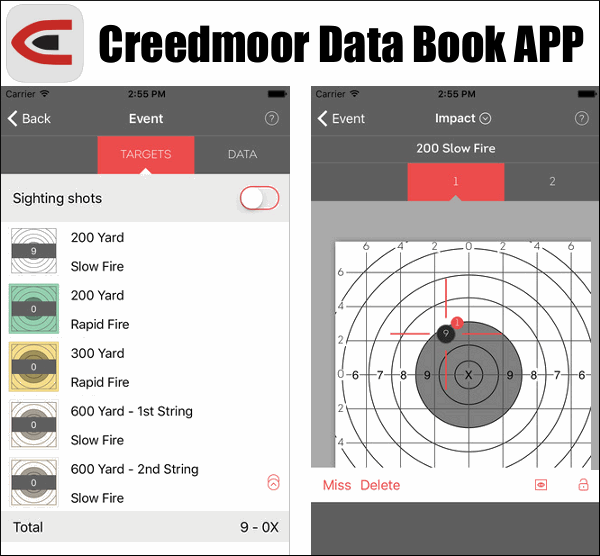
 Tired of carrying old-fashioned paper Score Books? Well now you can go digital — Creedmoor Sports offers a full-featured Scoring Book App that lets you plot your shot locations/scores using an Android device or Apple iPhone or iPad. The price is right — FREE! Just visit the iTunes store or Google Play Store to download the App for FREE.


 On September 19-26, the


 The Benefits of Dry-Fire Training


 Know the Rules


 We expect you’ve heard of David Tubb, 11-time NRA National High Power Champion, and 6-time NRA Long Range Champion. Without question, David is one of the greatest rifle shooters who ever lived. What you may not know is that David came from a family of shooters. David’s father, George Tubb, was a nationally-ranked High Power competitor. What’s more (now this may surprise you), David’s mother “Polly” was was a great shooter in her own right. When she wasn’t rearing a future Champion, Polly was hitting the X-Ring at rifle matches.


