Today, September 28, 2019, is National Hunting & Fishing Day. The annual celebration takes place on the the 4th Saturday of September every year. National, regional, state and local organizations will run thousands of “open house” hunting- and fishing-related events around the country. Events will include Fishing Derbys, Hunting Expos, Wing-shooting tournaments, and much more.
Hunting Safety Checklist
A good hunt begins with preparation. And during the hunt, safety is a key priority. To help hunters, the National Shooting Sports Foundation (NSSF) has created a Safety Checklist for hunters. This Hunting Safety Checklist, produced as part of the NSSF’s “Hunt S.A.F.E.” campaign, helps hunters follow good, safe practices in the field and at home.
National Hunting and Fishing Day (NHF Day) takes place on Saturday, September 28, 2019. The annual celebration, on the 4th Saturday of September, serves as a reminder that conservation succeeds because of leadership and funding from hunters, shooters and anglers. National, regional, state and local organizations will run thousands of “open house” hunting- and fishing-related events around the country. Events will include Fishing Derbys, Hunting Expos, Wing-shooting tournaments, and much more. Over four million Americans will participate.
Find Events in Your State
For info on NHF Day, visit www.nhfday.org. To find NHF Day events in your state, click links below:
Hunters Aid Conservation Efforts
The contributions of hunters, in the form of excise taxes paid on firearms, ammunition, and archery equipment, benefit every state. These taxes have generated approximately $5.6 billion for wildlife conservation since 1939.
Origins of National Hunting & Fishing Day
National Hunting and Fishing Day dates back to the 1960s. In 1972, by Senate Joint Resolution 117, Congress requested the President to declare the fourth Saturday of September 1972 as National Hunting and Fishing Day. On May 2 of the same year, President Richard Nixon signed proclamation 4128 designating the Fourth Saturday in September National Hunting and Fishing Day.
The number of active hunters in the USA has declined in recent years. That’s not good for wildlife management programs, which are supported, in large part, by hunting fees. Perhaps more importantly, the declin in the ranks of hunters weakens the base of support for the Second Amendment. Hunters are key to the future of firearms rights in America. We support efforts to increase the number of hunters, through mentoring and training programs.
The NRA’s American Hunter magazine has compiled a comprehensive list of hunting mentor programs, state by state. This is followed by listing of non-governmental organizations (NGOs) that provide hunter training. If you know individuals looking to get a start in hunting, check out these resources.
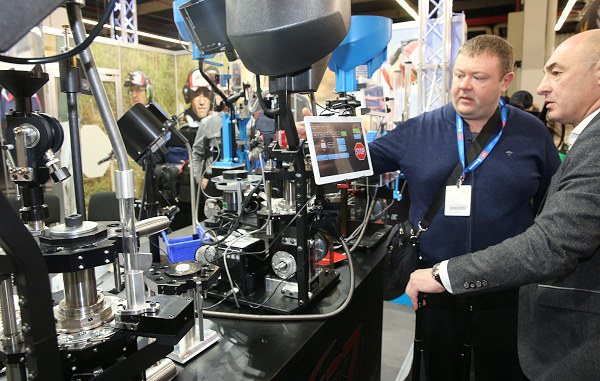
Some interesting Drive Band bullets were on display at IWA Show.
IWA Outdoor Classics Exhibition Concludes for 2019
As we publish this in the USA, the IWA Outdoor Classics trade show is drawing to a close. Today marked the last day of the 4-Day exhibition in Nuremberg, Germany. IWA is a big event, drawing over 1600 exhibitors, as well as nearly 50,000 show visitors from around the world. Here is our IWA Day 4 report, with more images from the show. Photo Credit for IWA images: NuernbergMesse / Frank Boxler and Thomas Geiger, All Rights Reserved.
Yes they like big boomers in Europe too. Here is an Austrian Steyr-Mannlicher HS .50-M1 in .50 BMG.
These state-of-the-art, computer-controlled commercial loading stations were on display at IWA.
The sound of silence. The new German-engineered Blaser R8 Ultimate Silence features an integral silencer. The over-sized barrel functions as the silencer.
Some of the best specialized competition shooting coats and pants are crafted in Europe.
Zeiss, a German company, produces some of the best rifle scopes in the world.
Spirit of the Hunt — IWA Showcases Hunting Gear and Clothing
At its heart, the IWA Outdoor Classics event remains a showcase for hunting products. The aisles included collections of antlers, hunting gear, and traditional Bavarian hunting clothing.
Parting Shot — Crack Open a Cold One with a Stag-Horn
Here’s just what you need to open a bottle of good German lager — a stag-horn bottle opener. Prost!
Hunter Safety Tips NRAFamily.org has a good article listing seven salient safety tips for hunters. Anyone preparing for a fall hunt should read this article before heading into the field. Here are two of key bits of advice:
Be Positive of Your Target before Shooting
This might sound overly simplistic, but the fact remains that, every year during whitetail season, farmers everywhere are forced to spray-paint their cattle or risk having them “harvested” by hunters who don’t bother confirming the species of the large ungulate in their sights. Why does this happen? The most likely explanation is “buck fever,” meaning that the hunter wants so badly to see a nice big buck that sometimes his eyes deceive him into thinking that there’s one there. When in doubt, don’t shoot.
Scopes Are Not Binoculars
Never use a riflescope as a substitute for binoculars. The temptation to do so is real, but when one does this, one is by definition pointing the muzzle of the gun at unknown targets.
Visit WhereToHunt.org
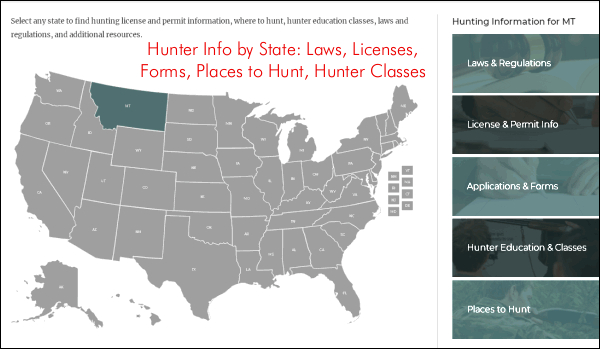
There’s a great online resource for hunters that will help you find game locations in your state and ensure you have all the proper permits and game tags. WheretoHunt.org features an interactive map of the country. For all 50 states, the NSSF has compiled information about hunting license and permits, where to hunt, hunter education classes, laws and regulations and more. For each state you’ll also find a link for required applications and license forms.
Click Map to Get State-by-State Hunting INFO
Hunting Affiliation Groups
There are many good organizations dedicated to promoting hunting and preserving our hunting habitats. These groups all offer valuable information for hunters:
National Hunting and Fishing Day (NHF Day) takes place on Saturday, September 22, 2018. The annual celebration serves as a reminder that conservation succeeds because of leadership and funding from hunters, shooters and anglers. National, regional, state and local organizations will run thousands of “open house” hunting- and fishing-related events around the country. Events will include Fishing Derbys, Hunting Expos, Wing-shooting tournaments, and much more. Over four million Americans will participate.
Find Events in Your State
For info on NHF Day, visit www.nhfday.org. To find NHF Day events in your state, click links below:
Hunters Aid Conservation Efforts
The contributions of hunters, in the form of excise taxes paid on firearms, ammunition, and archery equipment, benefit every state. These taxes have generated approximately $5.6 billion for wildlife conservation since 1939.
It’s hunting season already in many areas of the country. Improve your chances of a successful hunt by working on your position shooting skills before heading into the backcountry. Here are tips from Team USA Olympian and ISSF World Cup Winner SFC Michael McPhail.
One of the world’s best smallbore shooters, McPhail is also an avid hunter, who enjoys harvesting game with centerfire rifles. In this excellent short video from the USAMU, McPhail shows how competition shooting positions can be adapted for hunters. McPhail shows how well-established positions can provide a more stable platform for hunters in the field. That can help ensure a successful hunt. McPhail demonstrates three positions: kneeling, supported prone, and sitting in a tree-stand.
Watch SFC McPhail Demonstrate Positions for Hunters (Good Video):
McPhail first demonstrates the kneeling position. Michael notes: “I like kneeling. It’s a little bit of an under-utilized position, but it’s almost as stable as prone. It allows you get up off the ground a little bit higher to [compensate for] vegetation. For kneeling start by taking your non-dominant foot and put that towards the target, while at the same time dropping down to a knee on the dominant leg. At the same time … wrap the sling around wrist and fore-arm, lean slightly into the target and take the shot.”
McPhail shows a nice “field expedient” use of your backpack. He shows how the basic prone position can be adapted, using the pack as a front rifle support. McPhail recommends pulling your dominant (strongside) leg forward, bent at the knee. According to Michael, this takes pressure off the abdomen, helps minimizes heart beat effects, and helps with breathing.
Last but not least, McPhail shows some clever treestand tricks. McPhail recommends a position with your weakside leg pulled up and firmly braced on the front rail of the treestand. You can then rest your support arm on your leg. (That would be the left arm for a right-handed shooter). This provides a rock-solid position when shooting from a stand. The second half of the video shows how this works.
Hunting season is around the corner. We know many readers will be zeroing their hunting rigs in the next few weeks. Here is a very simple but effective way to zero any scoped rifle in a few minutes, with just four shots.
Follow this simple procedure to get a solid zero for a hunting rifle in just four shots. Of course you probably want to fire a few more rounds to confirm your zero before you head off to your hunting grounds, but this will let you get on-target with a minimum amount of time and ammo expended. (This assumes your scope is securely mounted, and the bases are not drastically out of alignment.)
QUICK-TIP: The Key to this procedure is Dialing to Shot One Point of Impact (POI). Re-aim at center of target after SHOT ONE. Then with the rifle motionless, use the turrets to put the middle of the cross-hair on the first shot location.
1. First, remove the bolt and boresight the rifle. Adjust the position of the rifle so that, looking through the bore, you can see the center of the target with your eyes. Secure the rifle in the rests to maintain its position as boresighted. Then, without moving the rifle, center the reticle. That should get you on paper. With the rifle solidly secured in front and rear rests or sandbags, aim at the center of a target placed at your zeroing distance (50 or 100 yards). Confirm there are no obstructions in the barrel! Then load and fire SHOT ONE. Then, return the gun to the exact position it was when you pulled the trigger, with the cross-hair centered on the target as before.
2. Locate, in the scope, where your first bullet landed on the target. Now, while you grip the rifle firmly so it doesn’t move, have a friend adjust the turrets on your scope. While you look through the scope, have your friend turn the windage and elevation turrets until the cross-hairs, as viewed through the scope, bisect the first bullet hole on the target. In other words, use the turrets to move the center of the reticle to the actual position of shot number one. IMPORTANT: Dial the crosshairs to the hole — don’t move the rifle.
3. After you’ve adjusted the turrets, now re-aim the rifle so the cross-hairs are, once again, positioned on the target center. Keep the rifle firmly supported by your rest or sandbag. Take the SECOND SHOT. You should find that the bullet now strikes in the center of the target.
4. Take a THIRD SHOT with the cross-hairs aligned in the center of the target to confirm your zero. Make minor modifications to the windage and elevation as necessary.
5. Finally, shoot the rifle from a field rest (shooting sticks, bipod, or rucksack) as you would use when actually hunting. Confirm, with SHOT FOUR, that your zero is unchanged. You may need to make slight adjustments. Some rifles, particularly those with flexy fore-arms, exhibit a different POI (point of impact) when fired from a bipod or ruck vs. a sandbag rest.
If you recently cleaned your rifle, you may want to fire two or three fouling shots before you start this procedure. But keep in mind that you want to duplicate the typical cold bore conditions that you’ll experience during the hunt. If you set your zero after three fouling shots, then make sure the bore is in a similar condition when you actually go out hunting.
Hunters, here’s a great FREE mobile APP for Apple and Android devices. The new ZEISS Hunting App offers many practical functions: full-featured ballistics calculator, field notes with photo archive, compass function, GPS tagging for documentation of hunting experiences, and a detailed weather forecast service. The Hunting App is offered as a FREE download, in both English and German versions.
We are impressed at how this new App integrates multiple useful features — ballistics solver, compass, GPS tagging, hunt history. The “Field Notes” function can record a wide variety of info — you can save photos, record your shots and hits, log animal sightings during the hunt, and even plot game locations on a map. Zeiss explains: “This allows users to optimally record events, the game population in the hunting territory, and their own hunting experiences.” Shots can be tagged via GPS through the shooter’s and the target’s position, and then displayed on a map. The Field Notes hunt diary shows all entries in chronological order.
KEY FEATURES: Ballistics Solver, GPS Tagging, Weather Forecast, Field Notes with Photos
Full-Featured Ballistics Solver
The integrated ballistic calculator allows hunters to easily customize the settings to suit their favorite cartridges. You can enter your own data, or choose bullet/cartridge info from a database containing over 7000 ammunition types from a variety of manufacturers. The ballistics solver can be programmed for for current weather conditions (temp/humidity), and the angle (inclination) of the shot.
Weather Functions
The weather tool offers a Five-Day Forecast, and you can choose multiple locations. In addition to the current location, users can also display the weather for their hunting areas of choice. The weather forecast includes temperature, precipitation, wind direction, wind speed, humidity, and air pressure. (Note: For precise ballistics solutions, you must input the ACTUAL conditions at your shooting location).
Hunt Log and Photos
The Field Notes function can do many things. You can log all your shots and hits, and you can plot game sightings during the hunt. Events can be augmented with photos and GPS data. With the Field Notes mapping function, you can even locate game populations in the hunting territory. A compass and automatic night mode round off the list of smart features.
Product Tip from EdLongrange. We welcome reader submissions.
Are you a safe hunter? Go through this checklist to find out. The National Shooting Sports Foundation (NSSF) has created a helpful Safety Checklist for hunters. This Hunting Safety Checklist was produced as part of the NSSF’s “Hunt S.A.F.E.” campaign which encourages hunters (and all firearm owners) to secure their firearms when not in use, and to focus on safe firearm handling and storage. The Hunting Safey Checklist helps hunters follow good, safe practices in the field and at home.
“Hunting is a time-honored tradition for many Americans, and the hunting season brings a wave of excitement and activity for all enthusiasts,” said NSSF President and CEO Steve Sanetti. “It’s also a good time of year to remind firearm owners about … safe and responsible gun handling and storage.”